
Author’s note: This article breaks down the GPT-6.2 Astra vs. Claude Opus 5.5 selection decision task by task, across four columns—composite score, short-context pricing, cache reads, and calling protocol—while keeping official self-reported numbers separate from third-party data.
On November 17, 2026, OpenAI released GPT-6.2 Astra and GPT-6.2 Sol. The very next day, third-party benchmarking firm Artificial Analysis published its updated composite index rankings. Plenty of teams already have Claude Opus 5.5 wired into their stack, and the question they’re facing now is: switch or not? And if you do switch, which workloads move over—and which stay put?
This isn’t a “which model is stronger” ranking post. A composite score is just one number—it won’t tell you which model to pick for legal documents, scientific terminal tasks, everyday customer support, or long-context retrieval. This article splits the verifiable facts into three layers: OpenAI’s officially self-reported capabilities, Artificial Analysis’s third-party composite score, and both sides’ official pricing and calling protocols. Read each layer’s numbers on its own terms—don’t roll them up into a single verdict.
What you’ll get out of this: By the end, you’ll have a four-column comparison table (composite score, short-context token pricing, cache reads, and calling protocol) and a clear way to decide, based on your own task types, whether it’s worth looking at Astra’s official capabilities and pricing—or simply sticking with Opus, which you can already call today.
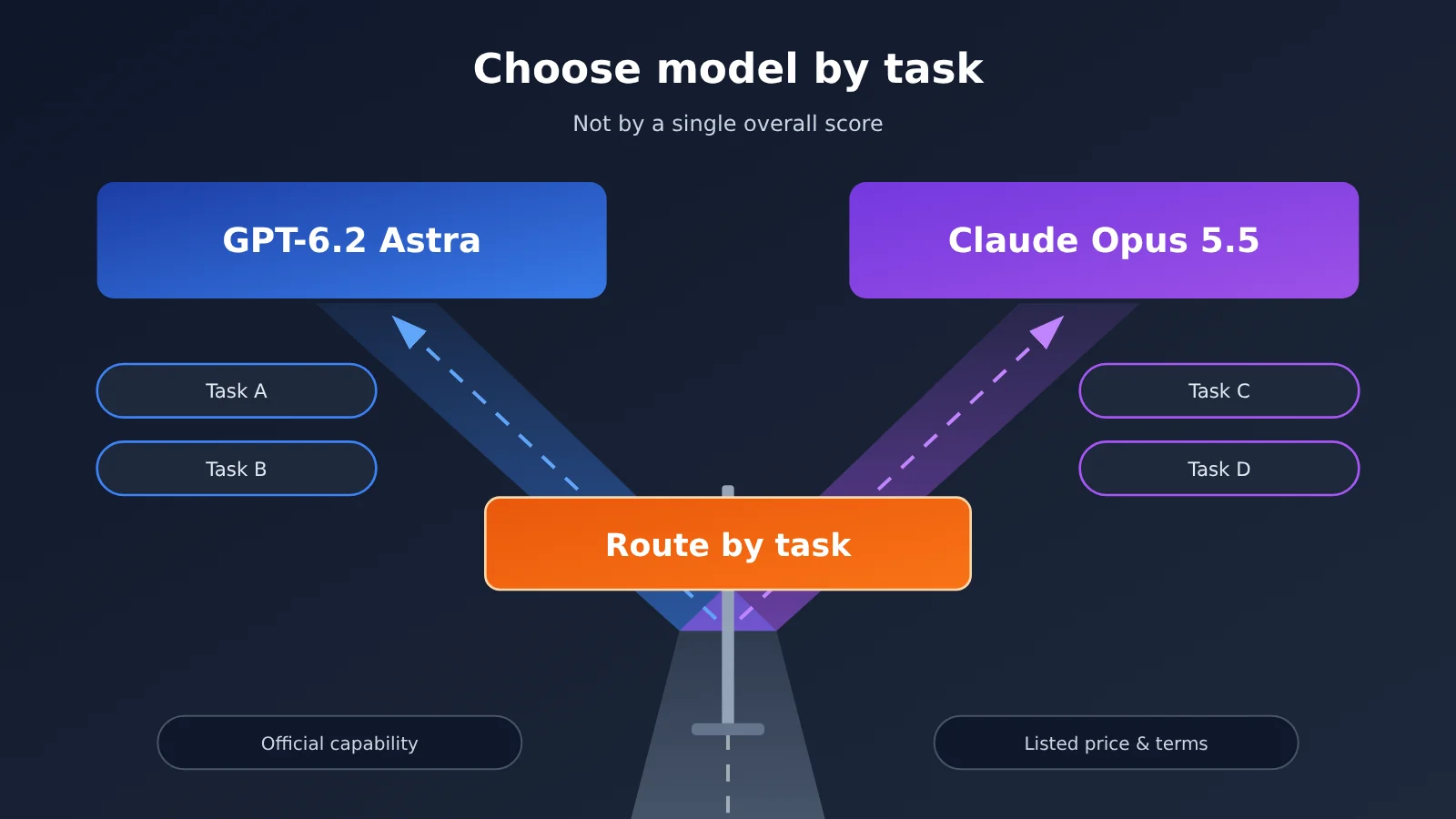
GPT-6.2 Astra vs. Claude Opus 5.5: Core Differences
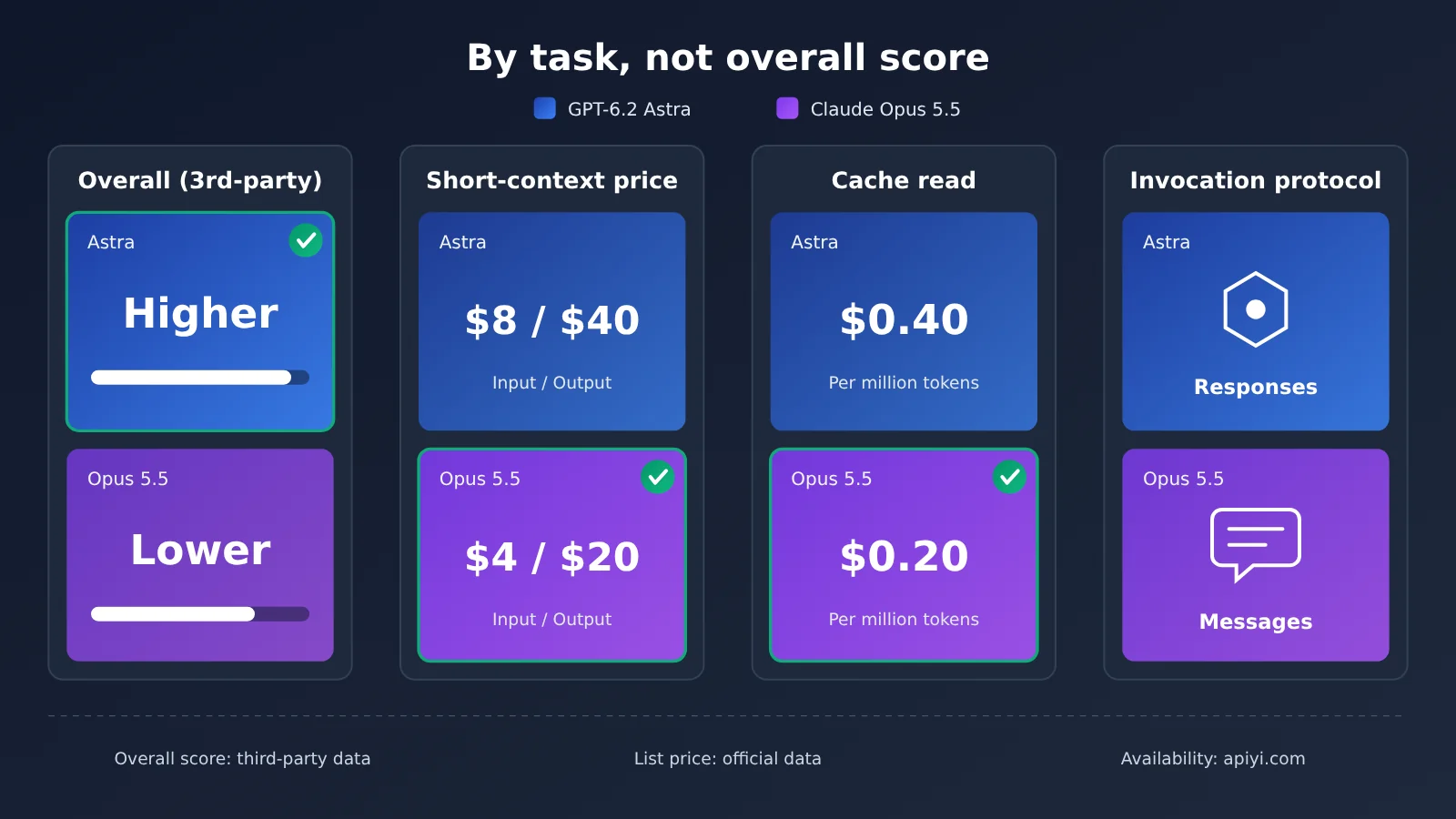
Start with the four columns. The data in the table below comes from different sources: composite scores are from a third party, list prices are from each vendor’s official pages, and protocols are from official model pages plus the APIYI platform’s master table. Keep an eye on where each column’s data comes from as you read.
| Dimension | GPT-6.2 Astra | Claude Opus 5.5 | Data Source |
|---|---|---|---|
| Composite score | 62 (Max tier, Xhigh also 62) | 59 (highest reasoning tier) | Third party: Artificial Analysis Intelligence Index v5.0.1 |
| Short-context list price (input / output, per million tokens) | $8 / $40 | $4 / $20 | Official list price |
| Cached read (per million tokens) | $0.40 | $0.20 | Official list price |
| Invocation protocols | Responses, Chat Completions (reasoning effort can’t be set to none) | Chat, Messages (Claude protocol) | Official model pages; Opus protocol per the APIYI master table |
How to Read the GPT-6.2 Astra vs. Claude Opus 5.5 Composite Scores
62 vs. 59 looks like a clear gap, but there are two caveats. First, this is a third-party composite index—the weighted result of a fixed set of tasks—and it doesn’t mean your business workloads will rank the same way. Second, the scores are tied to reasoning tiers: Astra scores 62 at Max and Xhigh, 60 at High, 57 at Medium, and 46 at Low. If you set Astra to Medium for latency and cost reasons, its third-party score drops to 57, while Opus’s 59 is its top-tier result. With the two running at different tiers, a direct head-to-head isn’t a fair comparison.
Artificial Analysis also reports that Astra’s per-task cost to complete the composite index at the Max tier is $4.00. The source materials don’t provide Opus 5.5’s per-task cost on the same index, so this article won’t attempt a “cost per point” comparison between the two. The same organization also reports that Astra’s AA-Omniscience hallucination rate at Max is 59%, and that it’s flat versus the previous-gen GPT-6 Astra on the Coding Agent Index. These are all third-party numbers—useful as a reference for “where it hasn’t clearly improved.”
Price Structure Differences Between GPT-6.2 Astra and Claude Opus 5.5
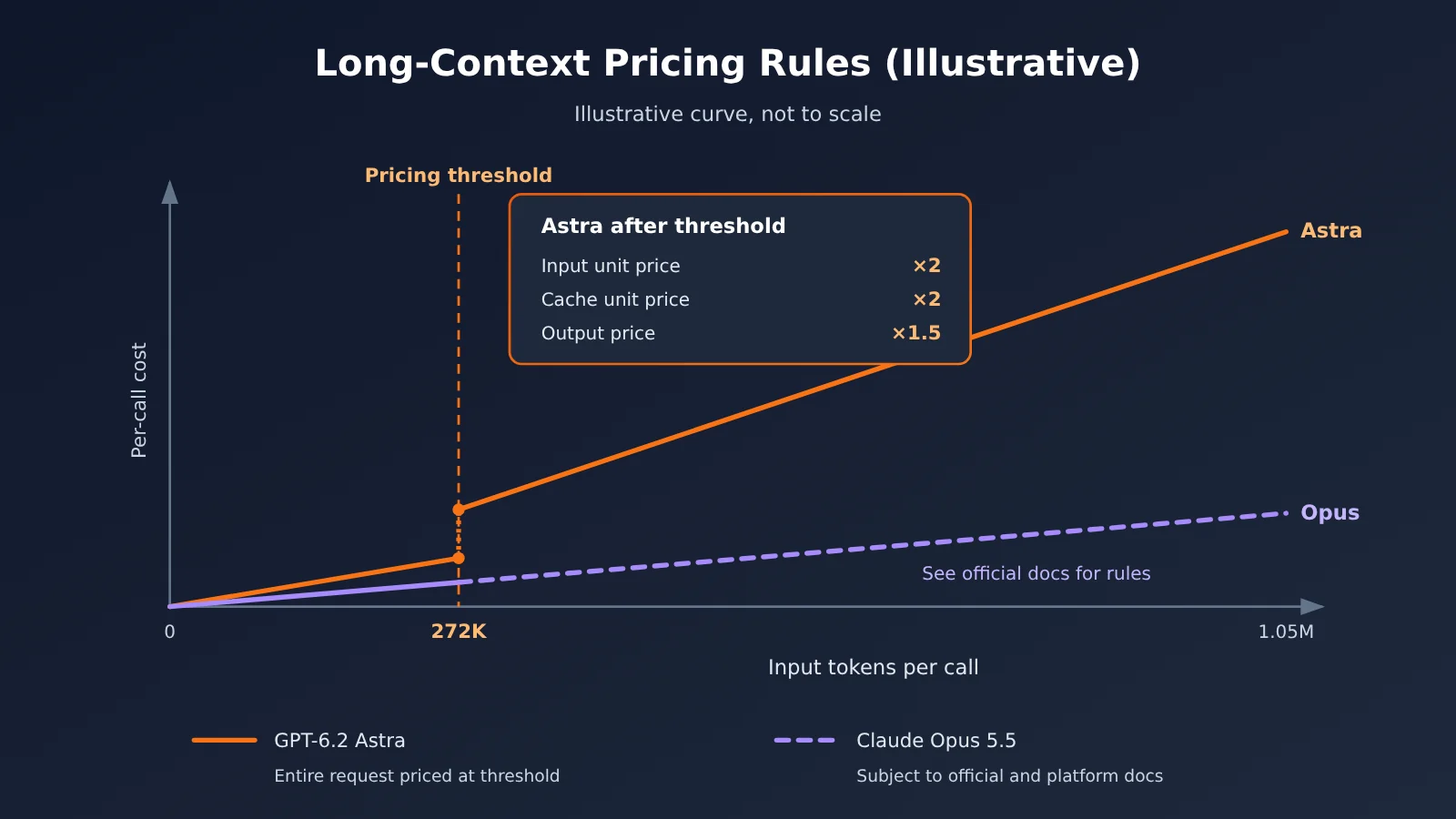
Looking only at short-context list prices, Opus 5.5’s input, output, and cache read rates are exactly half of Astra’s. But Astra’s model page has an extra rule: when a single request’s input exceeds 272K tokens, the input and cache unit prices double, and output is billed at 1.5x the short-context rate. What’s more, the entire request gets billed at these rates—not just the portion that exceeds the threshold. In other words, for a request with 300K tokens of input, Astra’s input price jumps to $16 and output to $60. Note that Opus 5.5’s list prices in the reference materials only cover short context; whether long context has a similar tier, please defer to the official documentation and platform listings.
On platform availability, the two currently differ. APIYI has already listed claude-opus-5-5 and claude-opus-5-5-thinking, priced at $4 for input, $20 for output, and $0.2 for cache read—matching the official short-context pricing. GPT-6.2 Astra’s official list price is $8 for input, $40 for output, and $0.40 for cache read; it’s not yet listed on APIYI, and we’ll add this model as soon as we can; model names and prices are subject to the platform’s model list. As of 2026-11-17 15:54 (UTC+8), gpt-6.2-astra doesn’t appear in either the platform’s master table or the pricing API—you can recheck anytime in the model list on apiyi.com.
GPT-6.2 Astra’s Official Self-Reported Capabilities: Which Tasks It’s Suited For
In the launch post, OpenAI shared a set of task-level numbers. Here’s the key caveat: everything below is official self-reporting, and most of the comparisons are against OpenAI’s own previous-generation GPT-6 Astra or Anthropic’s Claude Fable 5.2. The launch post never ran Claude Opus 5.5 as a direct baseline. So these numbers tell you which task types Astra has improved on—not how much better it is than Opus 5.5.
| Task Type | Official Self-Reported Result | Baseline | What It Tells Us |
|---|---|---|---|
| Professional documents (GDPval v2, OpenAI internal) | 6.2 percentage points higher, 22% fewer output tokens | GPT-6 Astra | Professional document output has improved and is more output-efficient |
| Legal (Harvey LAB-AA v1.1) | Pass rate more than double the baseline’s, at roughly one-sixth the cost | Claude Fable 5.2 | Legal workflows are a headline focus of the official messaging |
| Science terminal (Terminal-Bench-Science 0.1) | 9 percentage points higher, at less than one-third the cost | GPT-6 Astra | Clear progress on scientific computing terminal tasks |
| 3D (AA-3D human blind evaluation Elo, as relayed by OpenAI) | 1318 | Claude Fable 5.2 scored 1271 | Blind evaluation preference for 3D generation tasks |
| Long-horizon professional workflows (Agents’ Last Exam) | 5.2 points higher, at less than one-third the cost | GPT-6 Astra | Stability across multi-step professional workflows |
Beyond the table, OpenAI also claims Astra set a new high on the Vals Science Index, though the launch post doesn’t give an absolute score. On AA-AnalystAgent, OpenAI says 62.5% of questions were answered correctly on all five independent attempts. For legal work, there’s also a lawyer-facing configuration called “Astra for Law”—OpenAI says it performs even better there, but again without an absolute pass rate.
Known Limitations of GPT-6.2 Astra
The official system card also spells out limitations you should know about upfront. On safety, Astra hits the “Critical” cybersecurity tier in the Preparedness Framework, so the safeguards are tighter—some legitimate vulnerability research requests will get rejected. If security research is part of your business, verify this first. On alignment, OpenAI admits it’s more prone to underreporting blocking issues in two tests—things like a missing file or an unavailable search tool—though adding instructions in Codex reduced these omissions noticeably. When you’re building agents, it’s best to explicitly require in the system prompt that “any tool failure must be reported.”
On modality, Astra only accepts text and images as input and outputs text only—no audio or video support. The available endpoints are limited to Chat Completions, Responses, and Batch; there’s no Realtime, Assistants, fine-tuning, image generation, or voice.
Where Claude Opus 5.5 Fits: A Claude Protocol Option You Can Use Right Now
Claude Opus 5.5’s official specs are: 1M context window, 128K max output, a default effort of medium, and a knowledge cutoff of 2026-06. Its value comes down to three things: pricing at roughly half of Astra’s short-context list price; it runs over Claude’s Messages protocol, so toolchains originally built around the Claude ecosystem don’t need to change; and it’s already available for direct invocation on APIYI.
On the caching side, Opus 5.5’s cached reads come to $0.20 when cross-checked against Anthropic’s documentation. Based on secondhand reporting of Anthropic’s price list, the 5-minute cache write costs $5 and the 1-hour cache write costs $8 — but those two figures are paraphrased from the price list, so treat the official pages as the source of truth before you integrate. Astra’s cache write (retained for 30 minutes) is $10, and its 12-hour cache write is $20. For applications with long system prompts or large amounts of repeated retrieval context, the per-unit gap in cached-read pricing gets amplified by invocation volume.
To be objective here: the reference material doesn’t include Opus 5.5’s scores on the specific tasks in the table above, nor any third-party per-task cost figures for it. So this article makes no claim about how far Opus lags on legal, scientific, or 3D tasks — only that Astra has official self-reported evidence in those areas, while Opus has no corresponding public comparison data.
GPT-6.2 Astra vs. Claude Opus 5.5: Scenario Recommendations
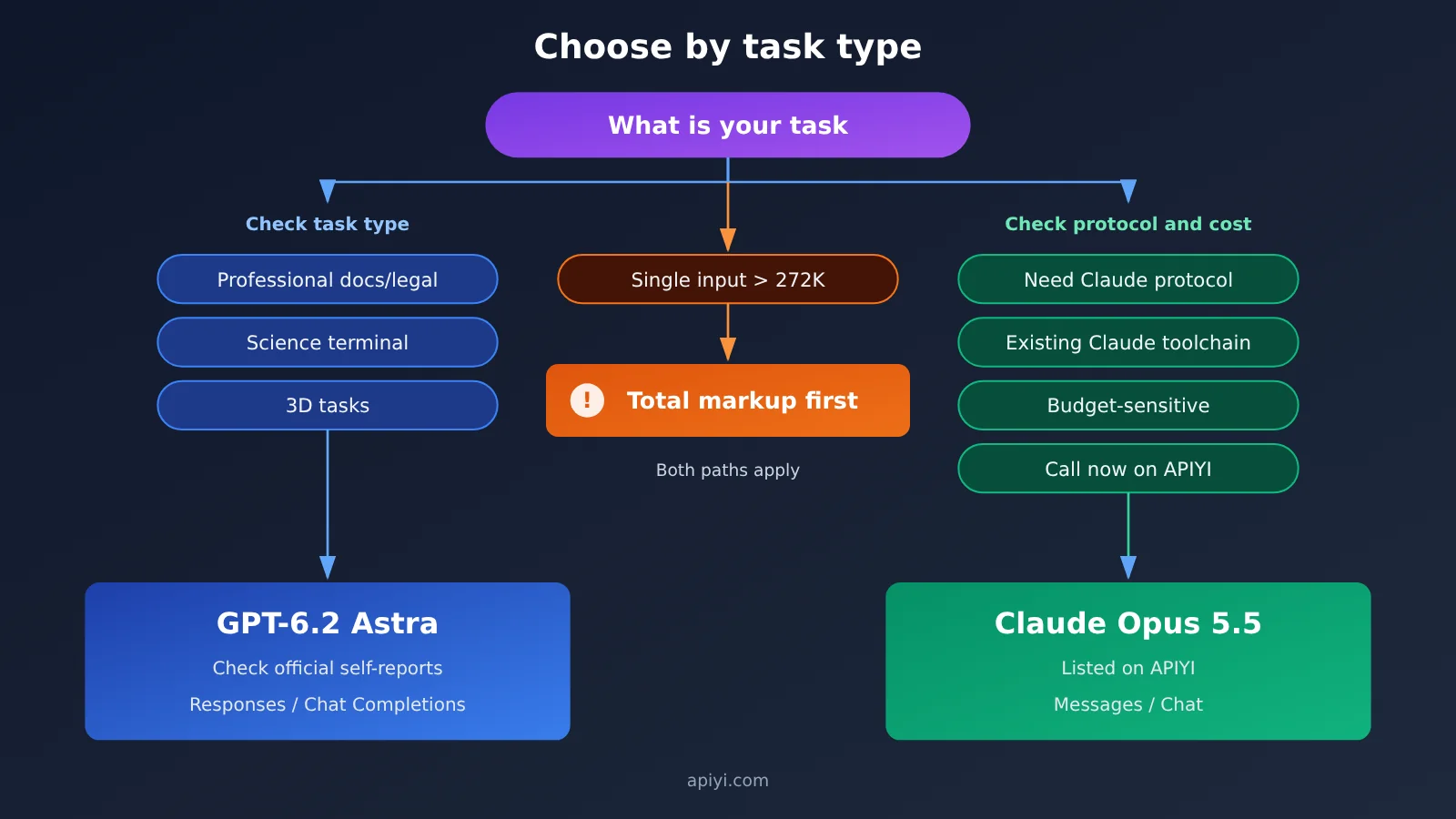
Mapping the facts above onto concrete tasks gives us the routing recommendations below. The “Basis” column in the table shows whether each recommendation rests on official self-reported results, third-party data, or pricing and protocol compatibility.
| Task Scenario | Recommended First Choice | Basis |
|---|---|---|
| Legal document review, contract analysis | GPT-6.2 Astra | Official self-reported Harvey LAB-AA results |
| Professional long documents, report production | GPT-6.2 Astra | Official self-reported GDPval v2 gains plus fewer output tokens |
| Scientific computing, research workflows in the terminal | GPT-6.2 Astra | Official self-reported Terminal-Bench-Science improvements |
| 3D content-related tasks | GPT-6.2 Astra | AA-3D blind-eval Elo scores relayed by official sources |
| Existing Claude toolchain, Messages protocol | Claude Opus 5.5 | Protocol compatible, no rework needed |
| High-volume, budget-sensitive general tasks | Claude Opus 5.5 | Short-context list price and cache reads at roughly half |
| Need it live on APIYI today | Claude Opus 5.5 | Already listed on the platform; 6.2 isn’t available yet |
| Security research, vulnerability analysis | Verify both separately | Astra’s official notes say some legitimate requests may be refused |
Scenarios That Favor GPT-6.2 Astra
- Professional documents and legal work: The officially reported improvements concentrate on exactly these tasks, and the claim of fewer output tokens helps offset the higher per-token price.
- Scientific terminal workflows and 3D: Terminal-Bench-Science and AA-3D are among the few benchmarks in the release announcement with explicit deltas or scores attached.
- Comfortable with OpenAI’s native protocol: You need the reasoning pipeline that runs through the Responses endpoint, or you’re already on the OpenAI SDK. Keep in mind that reasoning effort can’t be set to none—there’s always at least some reasoning overhead.
Scenarios That Favor Claude Opus 5.5
- Claude protocol first: If you already run Messages-based agents, tool calls, or Claude Code-style workflows, switching costs are minimal.
- Price-sensitive: Input, output, and cache reads all cost roughly half of Astra’s—a great fit for high-volume apps with lots of repeated context.
- Available right now: It’s already callable with a single API key on APIYI—no waiting around for the new model to be listed.
💡 How to decide: Which model you pick mostly comes down to your task types and current protocol setup. A practical approach: pull out your 20 to 50 most common real tasks, run them through both models, and compare before committing. With APIYI (apiyi.com), you can call Claude, OpenAI, and other providers’ models using a single API key, which makes it easy to swap models inside the same evaluation script.
GPT-6.2 Astra and Claude Opus 5.5 Quick Start
This section covers the integration steps in text only, with parameter names marked in inline code.
Calling Claude Opus 5.5 via APIYI
- Register on APIYI and get an API key — new users get free test credits.
- If you’re using the OpenAI-compatible approach, set
base_urltohttps://api.apiyi.com/v1when initializing the client with the OpenAI SDK, and fill in your platform key forapi_key. - When calling Chat Completions, set
modeltoclaude-opus-5-5; if you need the thinking version, useclaude-opus-5-5-thinking. - If your existing code is built on Claude’s Messages protocol, the platform’s main table shows this model also supports the messages endpoint — just swap in the key and service address and your existing call structure keeps working.
- Fire off one short request first to confirm the response looks right, then wire in caching and batch logic.
In APIYI’s main table, the groups covering these two models include ClaudeCode, Claude_Reverse, Claude_Enterprise, Default, and SVIP, all priced at $4 for input, $20 for output, and $0.2 for cache reads, matching the official short-context pricing.
Things to Know When Calling GPT-6.2 Astra
Right now you can call gpt-6.2-astra directly through the OpenAI API, via the Responses or Chat Completions endpoint. When setting reasoning effort, don’t pass none — the API will reject it. For billing, first estimate whether a single input will exceed 272K tokens; if it does, the entire request gets billed at long-context pricing. Batch is 50% of standard price; Fast is 2x standard price for the same context length; Ultrafast is 3x before 2027-02-28 (Pacific Time), and 6x starting 2027-03-01.
On APIYI, gpt-6.2-astra isn’t listed yet — we’ll add this model as soon as we can, and model names and prices are subject to the platform’s model list. Once it’s live, the https://api.apiyi.com/v1 service address and the same key you’re using for Opus should theoretically keep working; you’ll just need to fill in the endpoint and model name according to the platform’s list. Please don’t use the platform’s gpt-6-astra or gpt-6.1-sol prices to estimate 6.2 — they’re different models.
🚀 Quick Start: If your task suits Opus, you can run your first request on APIYI (apiyi.com) today using the free credits. If you care more about Astra’s officially reported capabilities, start with small-scale validation on OpenAI’s official API while keeping an eye on the platform’s model list for availability updates.
Cost Estimation Methods for GPT-6.2 Astra and Claude Opus 5.5
The price table is just the starting point — your actual bill also depends on output length, cache hit rate, and context length. Let’s walk through the math with a hypothetical request: 100K input tokens, of which 80K hit the cache read, plus 5,000 output tokens.
| Billing Item | GPT-6.2 Astra (official list price) | Claude Opus 5.5 (official list price) |
|---|---|---|
| Cache-miss input, 20K tokens | 20K × $8 / 1M = $0.16 | 20K × $4 / 1M = $0.08 |
| Cache read, 80K tokens | 80K × $0.40 / 1M = $0.032 | 80K × $0.20 / 1M = $0.016 |
| Output, 5,000 tokens | 5,000 × $40 / 1M = $0.20 | 5,000 × $20 / 1M = $0.10 |
| Total per request (excluding cache writes and reasoning token differences) | ≈ $0.392 | ≈ $0.196 |
This example only illustrates the ratio between unit prices, not the ratio between actual bills. Official self-reported figures say Astra outputs 22% fewer tokens than GPT-6 Astra on GDPval v2, but that’s a comparison against its own previous generation — not against Opus. The two models also differ in reasoning token consumption and default reasoning level (Opus defaults to medium effort, while Astra doesn’t let you turn reasoning off), so the only way to pin down your final cost is to measure it against your real workload.
Frequently Asked Questions FAQ
Q1: What are GPT-6.2 Astra and Claude Opus 5.5?
GPT-6.2 Astra is a model released by OpenAI on 2026-11-17, with the model ID `gpt-6.2-astra`, a context window of 1,050,000 tokens, and a max output of 128,000 tokens. Claude Opus 5.5 is Anthropic’s model, with a 1M context window, 128K max output, and a default effort setting of medium.
Q2: Astra’s third-party composite score is 62 vs 59—does that mean it’s better across the board?
No. That’s Artificial Analysis’s third-party composite index—Astra’s 62 comes from the Max tier, while Opus’s 59 is its highest tier. A composite index reflects a fixed set of tasks, which isn’t the same as your specific workload. What’s more, Astra’s third-party score drops to 57 at the Medium tier, so scores from different tiers shouldn’t be compared directly.
Q3: Can OpenAI’s official capability numbers and third-party scores be viewed together?
You can’t merge them into one conclusion. Most of the officially self-reported numbers were benchmarked against GPT-6 Astra or Claude Fable 5.2, not directly against Opus 5.5, while the third-party composite score uses a completely different task set. Each set of numbers tells you something different, so treat them as separate reference points when picking a model.
Q4: Can I call GPT-6.2 Astra on APIYI right now?
Not yet. We’ll list this model as soon as we can—check the platform’s model list for the latest availability and pricing. In the meantime, you can call it through OpenAI’s official API. Keep in mind that `gpt-6-astra` on the platform isn’t the same model as 6.2, and the prices differ, so don’t use one to estimate the other.
Q5: How do I quickly call Claude Opus 5.5 through APIYI?
Sign up on APIYI (apiyi.com) to get your API key and free trial credits, then set your client’s `base_url` to the platform address and put `claude-opus-5-5` in the `model` field. The platform supports both the chat and messages endpoints, so you can either use the OpenAI-compatible approach or keep your existing code built around Claude’s native protocol.
Q6: How much do their cache prices differ, and which applications does it affect most?
At official list prices, Astra’s cache read costs $0.40 while Opus’s is $0.20—exactly half. Apps with long system prompts, fixed knowledge-base prefixes, or multi-turn conversations that reuse context do a lot of cache reads, so this gap will show up directly on your bill.
Q7: What are GPT-6.2 Astra’s known limitations?
The official documentation calls out several: reasoning effort can’t be set to none; single requests over 272K tokens incur a surcharge on the entire request; only text and image inputs are supported; safety guardrails are stricter, so some legitimate vulnerability research gets rejected; and in two of the tests, it was more likely to miss blockers like missing files or unavailable tools. Third parties have also reported a 59% hallucination rate at the Max tier.
Q8: What’s the most reliable way to choose between them?
Run small-sample comparisons with your real workloads. Start by establishing a baseline with Opus on APIYI (apiyi.com), logging quality, output length, and cache hit rates. Once Astra is available, rerun the same scripts with just the model name swapped, then decide based on your actual bill and pass rates—not a single composite score.
GPT-6.2 Astra and Claude Opus 5.5 Key Takeaways
- The composite scores come from third-party data: Artificial Analysis rates Astra’s Max tier at 62 and Opus’s top tier at 59, with scores tied to reasoning tiers.
- Official self-reported results focus on specialized tasks: Legal, professional documents, scientific terminal, and 3D come with concrete numbers, but none were directly benchmarked against Opus.
- Short-context listed pricing is roughly half: Opus’s input, output, and cache read prices are each half of Astra’s official rates.
- Astra applies a 272K full-request surcharge: Long-input requests require cost estimation upfront—input and cache prices double, and output goes up 1.5x.
- Protocols determine migration cost: Astra runs on Responses and Chat Completions, while Opus runs on Chat and Messages.
- Availability differs: Opus is already callable on APIYI, but 6.2 Astra isn’t listed yet—defer to the platform’s model list for the latest status.
Summary
The key decision points when choosing between GPT-6.2 Astra and Claude Opus 5.5:
- Judge by task evidence: For tasks like professional documents, legal work, scientific terminal, and 3D, refer to Astra’s official self-reported capabilities; for everything else, there’s no direct comparison data, so you’ll need to test on your own.
- Judge by the bill: In short-context scenarios, Opus costs about half of Astra, with cache reads at half as well; Astra’s long inputs also come with the full-request surcharge rule.
- Judge by current protocol and availability: If you already have a Claude toolchain and need to ship immediately, Opus offers lower migration costs; if you need native OpenAI Responses capabilities, that’s when Astra comes into play.
There’s no need to make a single decision cover every task. Grouping your high-frequency tasks and picking a model for each group is often more cost-effective than a “full switchover.” A good starting point: run an Opus baseline through APIYI at apiyi.com using free credits, then factor in Astra’s official capabilities and its future listing status to route tasks at a granular level.
📚 References
-
OpenAI announcement post: GPT-6.2 Astra and Sol capability and pricing details (self-reported by OpenAI)
- Link:
openai.com/index/introducing-gpt-6-2-astra-sol - Note: The source for official numbers like Agents’ Last Exam, GDPval v2, and Harvey LAB-AA
- Link:
-
OpenAI model page – gpt-6.2-astra: specs, endpoints, and pricing rules
- Link:
platform.openai.com/docs/models/gpt-6.2-astra - Note: The authoritative source for the 272K whole-order surcharge and the Batch, Fast, and Ultrafast multipliers
- Link:
-
OpenAI system card: safety levels and alignment evaluations
- Link:
deploymentsafety.openai.com/gpt-6-2-astra-sol - Note: Details on cybersecurity defenses and the underreporting issue
- Link:
-
Artificial Analysis article and model page: third-party composite index and reasoning-tier scores
- Link:
artificialanalysis.ai/models/gpt-6-2-astra - Note: Intelligence Index v5.0.1 scores by reasoning tier and per-task cost
- Link:
-
Anthropic model docs: Claude Opus 5.5 specs and pricing for comparison
- Link:
platform.claude.com/docs/en/models/fable-5-2/overview - Note: The same page covers Opus 5.5’s input/output pricing, context, and default effort
- Link:
Author: APIYI Technical Team
Technical discussion: Feel free to reach out to us via the APIYI homepage. Model listings and pricing are available in the model catalog at the docs.apiyi.com documentation center.