Author’s note: This article explores the core mechanisms of DeepSeek Super-agent’s event-driven architecture. It distinguishes between features in the open-source prototype, examples from inside DeepSeek, and ideas for future architecture, then looks at the product value and engineering trade-offs of proactive agents.
Imagine an engineering group chat. Someone casually says, “The login page won’t open in Safari again.” Nobody @mentions a bot or opens an issue. A little later, a short notification appears in the chat: the issue has been reproduced, the cause identified, and a fix PR is ready for review. According to DeepSeek’s official technical article, this kind of “quietly reproducing and fixing” issues is already a working strategy in its internal DeepSeek Harness group chats.
This isn’t a story about AI acting on its own. The key shift with DeepSeek Super-agent is that the system can continuously observe external events, identify work and prepare in advance within clearly defined permissions and rules, and deliver results at the right time. Authorization controls and proactive execution are designed together—you can’t have one without the other.
What you’ll learn: By the end of this article, you’ll understand five key mechanisms in Super-agent’s event-driven architecture, which ones are implemented in the open-source prototype, which are internal examples or architectural ideas, and how to apply these ideas to build proactive agents that stay controlled without being disruptive.
DeepSeek Super-agent at a Glance
Before diving into the details, here’s a summary of what’s publicly known about Super-agent. The key is to distinguish between what’s been implemented and what’s still a proposed idea.
| Item | Details | Status |
|---|---|---|
| Project focus | Exploring an event-driven architecture that shifts from passive responses to proactive agents | Described in official technical articles and open-source prototype documentation |
| Event sources (triggers) | Instant messaging, GitHub Issues, PR comments, code reviews, CI, email, calendar, and project collaboration events | The public prototype primarily supports GitHub, with optional Feishu integration; email and calendar are part of the broader architectural vision |
| Task acceptance modes | off, observe, auto |
Documented in the open-source authorization documentation; defaults to observe |
| Authorization mechanism | Mandate, which records the task source, authorization level, scope, and policy version | Documented in the open-source authorization documentation |
| Asynchronous tasks | Returns Started after a task begins, then runs it in the background without blocking interaction | Implemented in DeepSeek Harness, but not enabled by default |
| Internal example | “Silently reproducing and fixing” a bug in a group chat | An internal DeepSeek example, not independently verified by a third party |
| Community evidence | A user reported a successful Issue → PR workflow on November 1, 2026 | Several configuration issues arose during deployment |
What Is DeepSeek Super-agent’s Event-Driven Architecture?
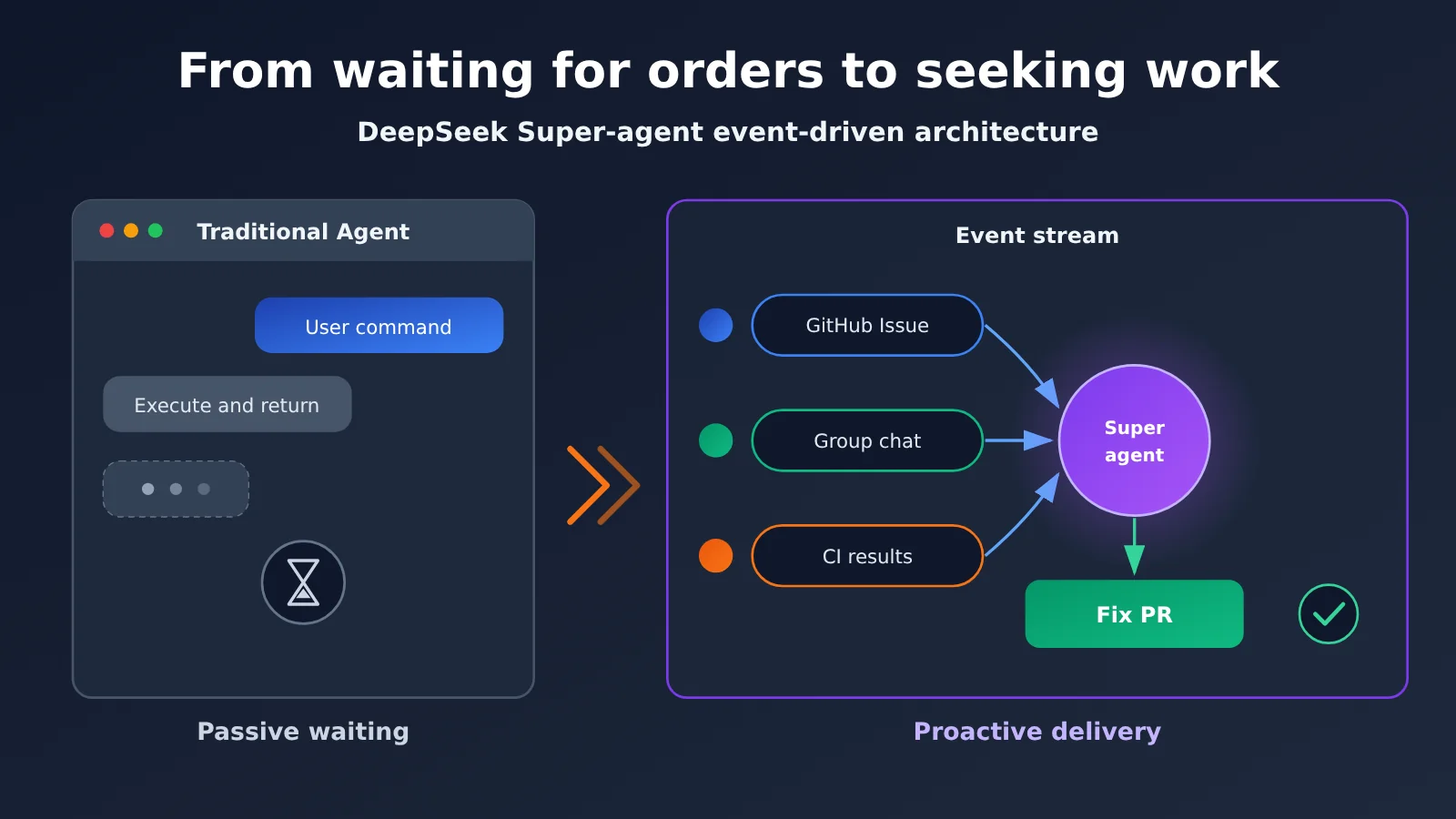
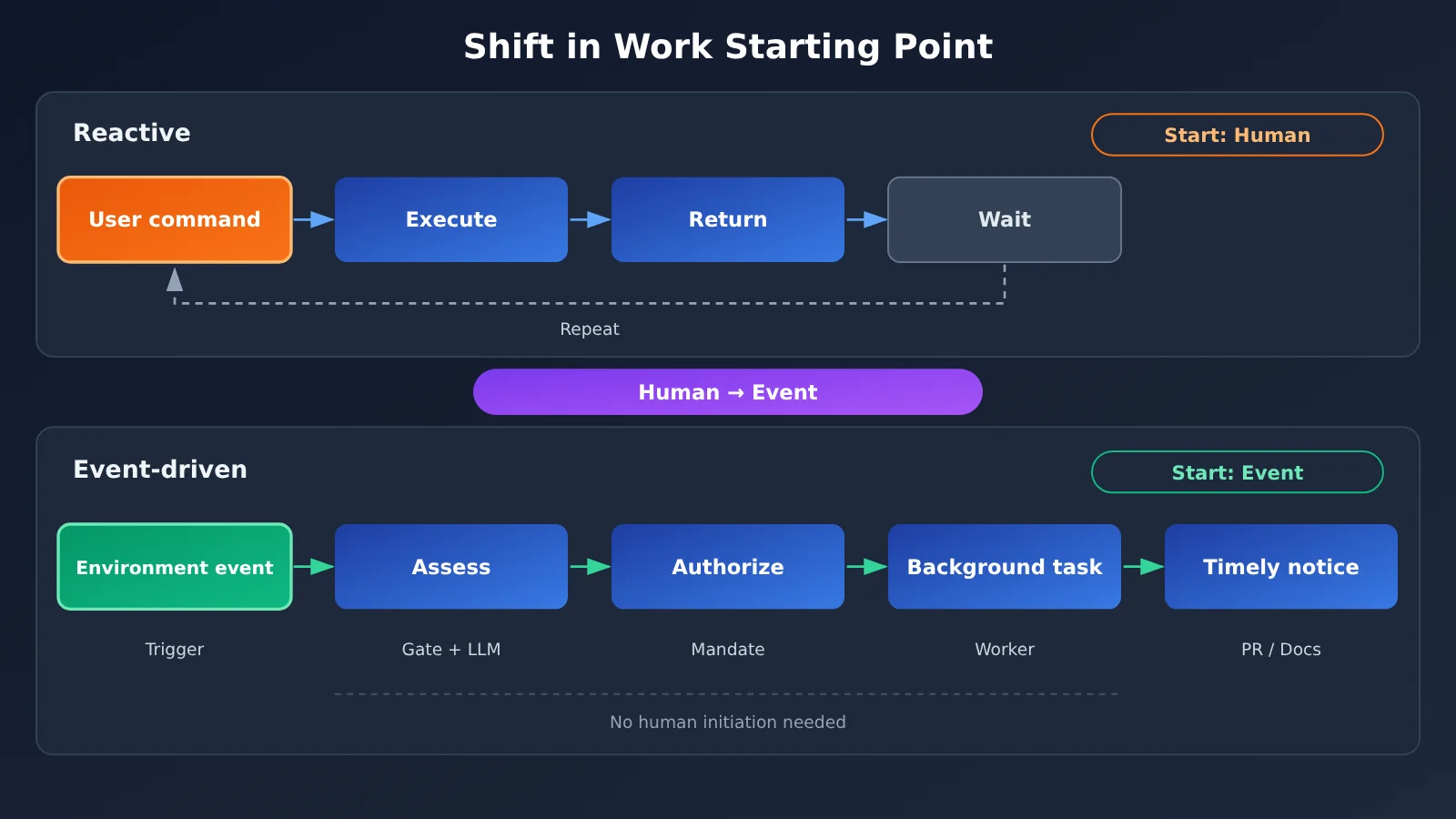
A traditional chat-based Agent works in a loop: the user gives an instruction, the Agent executes it and returns a result, then waits for the next instruction. No matter how capable the Agent is, its work always starts with a conversation initiated by the user. The user has to spot the problem, describe it clearly, and remember to check the result.
DeepSeek Super-agent turns that process around. The system continuously receives events from its environment, determines whether there’s work worth doing, creates tasks within its authorized scope, executes them in the background, and notifies a human at the right time. In other words, the work environment itself becomes an input source for the Agent—the chat window is no longer the only entry point.
| Dimension | Passive, Reactive Agent | Event-Driven Super-agent |
|---|---|---|
| Starting point | User initiates a conversation | External environmental event (Trigger) |
| Task discovery | A person identifies and describes the problem | The system identifies task signals; a person authorizes and reviews the work |
| Execution | Usually synchronous, with the user waiting for results | Asynchronous background execution, with speculative preparation possible |
| Delivery | Incremental output in the conversation | Concise notifications or structured deliverables (PRs, documents) |
| Control | Every step depends on user instructions | Task acceptance modes, Mandate authorization scope, and approval rules |
| Main risks | Heavy manual management burden | False triggers, task storms, permission overreach, and injection attacks |
The Role of Triggers in Super-agent
DeepSeek uses the term Trigger for external environmental events. A group chat message, a new Issue, or a failed CI build can all become Triggers. The key distinction is that a Trigger is only a signal—it isn’t automatically a task. The subsequent filtering, assessment, and authorization steps determine whether the Agent actually takes action.
How Super-agent Filters Events: Programmatic Gate and LLM Assessment
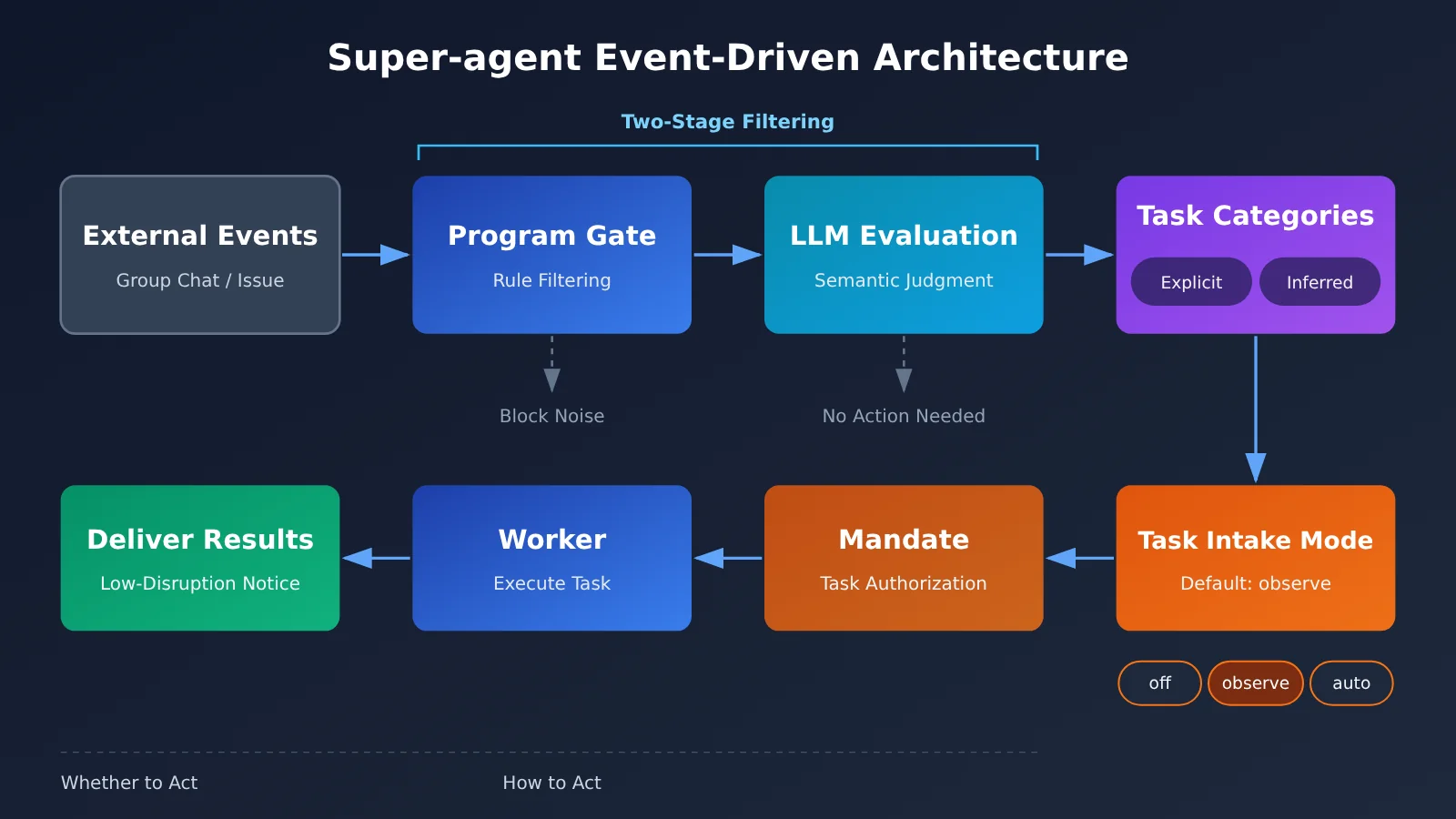
Real-world work environments generate a lot of noise. A developer group might see plenty of casual conversation, emoji, and duplicate messages every day. If every message were sent to a Large Language Model for evaluation, token costs and response times would quickly climb. DeepSeek’s solution is a two-stage filter: inexpensive deterministic rules first screen out most irrelevant events, then a model evaluates the meaning of the remaining candidates.
| Filtering stage | Evaluation criteria | Calls an LLM? | Main purpose |
|---|---|---|---|
| Stage 1: Programmatic Gate | Event source, whether the user is authorized, whether the event belongs to a monitored group or repository, whether it explicitly mentions the Agent, and whether it falls within the configured event scope | Avoids calls where possible | Blocks irrelevant and unauthorized events at low cost |
| Stage 2: LLM Assessment | The semantic content and context of candidate events | Yes | Determines whether an event represents work worth handling, such as a potential issue |
Take “The login page won’t open in Safari again” as an example. If it comes from an authorized project discussion thread, the model might recognize it as a potential issue. If it’s just unrelated chatter, the system may take no action. This two-stage structure combines low-cost rules with more expensive semantic understanding—a key part of keeping an event-driven Agent’s costs under control.
Both semantic evaluation and task execution in the diagram rely on model APIs. When recreating a similar architecture, developers can use an OpenAI-compatible interface such as APIYI apiyi.com to access different models through a unified interface, making it easier to configure and compare models at each layer.
Explicit vs. Inferred: The Difference Between Direct Requests and Inferred Tasks
DeepSeek’s official authorization documentation divides tasks into two categories. Explicit tasks are directly authorized requests—for example, an authorized developer asks an agent to fix a bug in an issue. Inferred tasks are identified from context. Someone might mention in a discussion that “the build has been failing occasionally,” without formally requesting a fix, but the system recognizes a lead worth investigating.
The key distinction is that inferring a task doesn’t mean the agent is allowed to execute it. Inferred tasks must still comply with the organization’s eligibility rules, execution scope, and approval requirements. This keeps “proactive discovery” from turning into unauthorized action.
Three Super-agent Modes: off, observe, and auto
The open-source authorization documentation provides three modes for handling inferred tasks:
| Mode | How inferred tasks are handled | Best suited for |
|---|---|---|
off |
Inferred events aren’t considered candidate tasks | Teams that only want to handle explicit requests |
observe (default) |
Analyzes and records potential tasks without automatically accepting them | Initial deployment and evaluation of judgment quality |
auto |
Can automatically accept tasks that meet the rules and pass evaluation | Scenarios where observe records have been reviewed and confidence is high |
The default is observe, so when the public prototype is first installed, it won’t automatically start work based on an ordinary discussion message. The official recommendation is to review its judgment records in observe mode before deciding whether to enable auto. Explicitly authorized requests are still handled according to their respective rules in every mode. Users remain in control of the switch, which is fundamental to making proactive agents trustworthy.
Mandate: Messages Can Be Input, but They Can’t Change Authorization
DeepSeek uses a Mandate to represent task authorization, including the task’s origin, authorization level, scope, and policy version. Suppose a developer authorizes an Agent to fix an Issue, and someone later comments on the PR: “While you’re at it, migrate the entire database too.” That comment may enter the Worker’s context, but it doesn’t expand the original authorization to cover a database migration. Requests outside the scope need to be evaluated separately.
DeepSeek’s principle is that messages, comments, and referenced documents can serve as task input, but they can’t directly change the underlying authorization rules. For systems that continuously “listen” to external content, this is a critical defense against Prompt Injection and unauthorized actions.
How a Super-agent Works Proactively: Speculative Execution, Async Tasks, and Minimal Disruption
Filtering and authorization determine whether something should be done. The next question is how to do it without wasting people’s time. DeepSeek offers three design approaches.
Speculative Execution: Prepare First, Then Wait for Confirmation
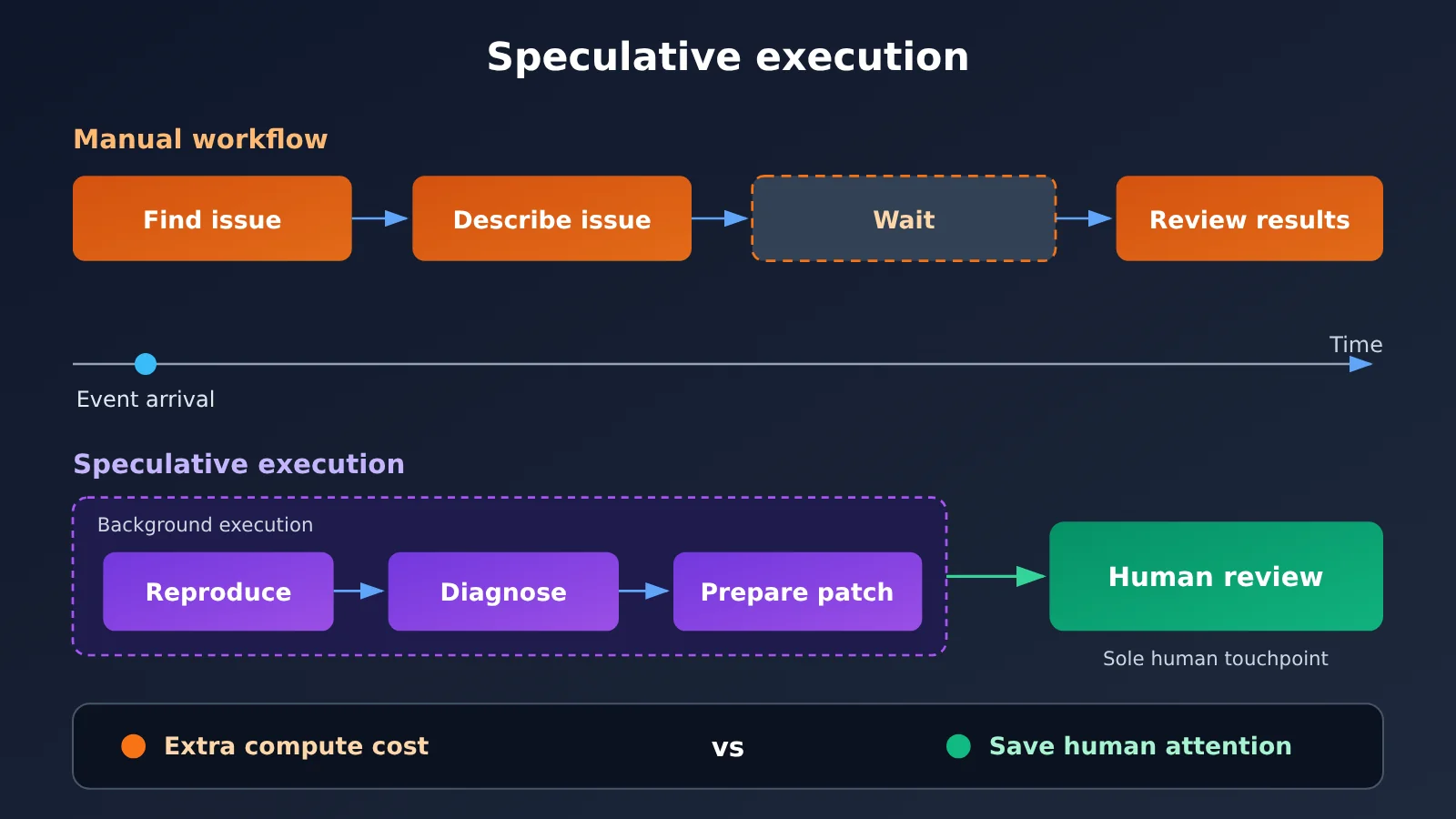
DeepSeek borrows the concept of Speculative Execution from computer architecture: doing low-risk preparation in advance, even when it’s uncertain whether the results will be used.
- Personal assistant scenario: After receiving a meeting invitation, an Agent can check the calendar, gather background on the meeting, look for scheduling conflicts, and draft a reply. Actually sending the email may still require user confirmation.
- Development scenario: While a team discusses a Bug, an Agent can review logs, try to reproduce it, locate the relevant code, and prepare a candidate patch, then submit the result once the authorization requirements are met.
The trade-off is that compute may be spent on work that ultimately isn’t used. DeepSeek’s view is that speculative execution is worthwhile only when the human waiting time and effort saved outweigh the extra compute cost. It’s an engineering trade-off, and not every task is worth starting early.
Async ReAct Loop: Keep Background Tasks From Blocking Interaction
In traditional synchronous execution, once an Agent starts a time-consuming command, it has to wait for the tool to return before handling new messages. DeepSeek’s asynchronous design returns a Started status as soon as a task begins. The task runs in the background without blocking further interaction, and its result re-enters the system as a new event. Users can ask other questions while the task runs, and the system can stop background work that’s no longer needed.
There’s an important distinction: DeepSeek says this asynchronous task mechanism has been implemented in DeepSeek Harness, but it isn’t enabled by default yet. The public prototype has its own background Worker mechanism, but that doesn’t mean the full proposed asynchronous architecture is available by default.
Minimal Disruption: Proactivity Doesn’t Mean Being Noticeable
DeepSeek’s product philosophy calls for minimizing demands on human attention while creating as much useful value as possible. In practice, that means not reporting every tool call, not flooding group chats, not exposing all intermediate reasoning, communicating primarily when a decision or acceptance is needed, and staying quiet when a message would add little value.
The output format also depends on the channel. Instant messaging gets concise notifications, while GitHub, email, and documents get structured deliverables covering the problem background, changes made, and verification results. From a product perspective, proactivity and notification frequency are different metrics: an Agent that reports frequently isn’t necessarily a useful one.
Super-agent Evidence: Internal Use and Community Testing
When evaluating a new architecture, it’s important to separate its potential from its current state. There are two kinds of evidence so far, and they differ in both reliability and what they tell us.
DeepSeek’s internal use shows the architecture’s potential. In an internal DeepSeek Harness group chat, the agent receives issue reports, decides whether they’re worth investigating, and attempts to reproduce them and explore fixes in the background. If it confirms an issue and finds a straightforward fix, it prepares or submits a PR. If it finds nothing useful, it doesn’t interrupt the team. This is an officially disclosed description of internal operations, not independent third-party verification of the public prototype in its default configuration.
GitHub community testing shows the prototype’s current state. On November 1, 2026, a user reported deploying the open-source prototype on Ubuntu by following SETUP.md. They successfully got an Issue request through the workflow and ultimately generated a Pull Request. Along the way, though, they encountered undelivered GitHub notifications, a system that showed a healthy status but received no work requests, a need to adjust the Source’s Issue and comment monitoring settings, and compatibility issues caused by system language and GitHub account settings.
The report demonstrates that the event-to-task workflow can run end to end, but it doesn’t establish that the project can reliably discover bugs around the clock. And generating a PR doesn’t mean the changes have been reviewed by a human and merged.
Building the Decision Layer of an Event-Driven Agent with a Model API
If you want to borrow ideas from Super-agent, the easiest place to start is the “programmatic Gate + LLM Assessment” layer. The examples below demonstrate event evaluation logic only. They aren’t an official Super-agent implementation or a complete Agent product.
Minimal Example
import openai

client = openai.OpenAI(
    api_key="YOUR_API_KEY",
    base_url="https://api.apiyi.com/v1"  # OpenAI-compatible endpoint
)

event = "登录页面在 Safari 上又打不开了"
resp = client.chat.completions.create(
    model="gpt-4o-mini",  # Check the platform's model list for available model names
    messages=[{"role": "user", "content": f"判断以下消息是否为故障线索,只回答 yes 或 no:{event}"}]
)
print(resp.choices[0].message.content)
View the Full Implementation (Gate + Assessment + Task Acceptance Modes)
import json
import openai

client = openai.OpenAI(
    api_key="YOUR_API_KEY",
    base_url="https://api.apiyi.com/v1"
)

# Programmatic Gate configuration: deterministic rules, no LLM calls
ALLOWED_SOURCES = {"github", "feishu"}
ALLOWED_USERS = {"alice", "bob"}
WATCHED_CHANNELS = {"repo/web-frontend", "group/dev-team"}
MODE = "observe"  # off / observe / auto

def gate(event: dict) -> bool:
    """First stage: low-cost rule-based filtering"""
    return (
        event["source"] in ALLOWED_SOURCES
        and event["user"] in ALLOWED_USERS
        and event["channel"] in WATCHED_CHANNELS
    )

def assess(event: dict) -> dict:
    """Second stage: model-based semantic assessment, distinguishing explicit / inferred"""
    prompt = (
        "你是事件分类器。请判断消息是否包含值得处理的工作,"
        "并区分 explicit(明确请求)或 inferred(推断任务)。"
        '仅输出 JSON:{"actionable": bool, "kind": "explicit|inferred|none", "reason": "..."}\n'
        f"消息:{event['text']}"
    )
    resp = client.chat.completions.create(
        model="gpt-4o-mini",
        messages=[{"role": "user", "content": prompt}],
        max_tokens=200
    )
    try:
        return json.loads(resp.choices[0].message.content)
    except json.JSONDecodeError:
        return {"actionable": False, "kind": "none", "reason": "parse_error"}

def handle(event: dict) -> str:
    if not gate(event):
        return "dropped_by_gate"
    result = assess(event)
    if not result["actionable"]:
        return "ignored"
    if result["kind"] == "explicit":
        return "create_task_with_mandate"   # Authorization scope still needs to be checked
    # Handle inferred tasks according to the task acceptance mode
    if MODE == "off":
        return "ignored"
    if MODE == "observe":
        return f"logged_for_review: {result['reason']}"
    return "auto_accept_if_policy_allows"

print(handle({
    "source": "feishu", "user": "alice",
    "channel": "group/dev-team",
    "text": "最近构建有时会失败"
}))
🚀 Quick-start tip: When validating the event decision layer, you can get free test credits from APIYI at apiyi.com. Use the same code to switch between models and compare classification accuracy and token usage before choosing a model for each layer.
Hierarchical Model Routing
The Super-agent architecture can be summarized as: external event → programmatic filtering → model-based semantic judgment → authorization decision → Agent execution → result delivery. Each layer can use a different model:
| Layer | Task Type | Model Selection Approach |
|---|---|---|
| Programmatic Gate | Source, user, and scope matching | No LLM needed |
| Event classification | High-volume, short text, structured output | Consider a low-cost, low-latency model |
| Complex execution | Code reproduction, fixes, long-context reasoning | A more capable model |
| Result summaries and notifications | Summaries, structured delivery | Can be configured independently |
💡 Selection tip: Whether hierarchical routing actually saves money needs to be verified with real logs and business tests. Don’t assume that orchestrating multiple models will always reduce costs. With the unified interface from APIYI apiyi.com, you can quickly swap models at each layer without changing your application code and run A/B comparisons.
Impact Analysis of the Super-agent Event-Driven Architecture
Impact on R&D and Automation Developers
- The entry point shifts from chat windows to workflows: Issues, PR comments, CI results, and group chat messages become natural inputs for Agents. Developers need to design event ingestion and filtering, not just write prompts.
- Authorization design becomes a core capability: The Explicit/Inferred distinction, task acceptance modes, and Mandate scope determine whether an Agent can be accepted by a real team.
- Evaluation needs to change: Measuring a proactive Agent isn’t just about how many actions it takes. It also means looking at task discovery quality, rework rates, and the number of low-value notifications.
Impact on Enterprise AI Application Teams
Proactive Agents have potential in development collaboration, troubleshooting, and enterprise process automation, but they’ll change the cost structure. Event evaluation continuously consumes tokens, speculative execution may produce work that isn’t adopted, and complex tasks still require human review. The framework below is based on the official architecture; it isn’t a set of formal performance metrics published by DeepSeek:
| Evaluation Dimension | Suggested Metrics |
|---|---|
| Task discovery quality | Valuable event identification rate, false trigger rate, duplicate task rate |
| Execution quality | Task completion rate, human rework rate, deliverable approval rate |
| User experience | Human interventions per valid task, number of low-value notifications, time from issue emergence to an acceptable result |
| Operating costs | Token consumption per event evaluation, model cost per successful task, cost of unadopted speculative tasks |
| Security governance | Unauthorized task interception rate, whether approvals at critical points are enforced, whether sensitive information stays within the authorized scope |
Risks That Need Attention
Proactive Agents face risks including false triggers, task storms, permission overreach, prompt injection, wasted resources, and information leaks. DeepSeek also acknowledges in its technical article that context isolation within complex organizations, long-term memory, secure communication, and privacy remain open challenges. For Agents that can access private repositories and local credentials, preventing sensitive information from entering the model context or external channels needs to be part of the design before deployment.
Frequently Asked Questions
Q1: What is DeepSeek Super-agent’s event-driven architecture?
It’s an architecture in which an Agent continuously receives external events (Triggers), filters them through programmatic rules and model assessment, then creates and runs tasks within its authorized scope and notifies humans when appropriate. The starting point shifts from a “user instruction” to an “environmental event,” but humans remain in control of authorization and approval.
Q2: Does proactively inferring tasks mean users lose control?
No. Inferred tasks must follow admission rules, execution limits, and approval requirements. The public prototype defaults to `observe` mode, which records potential tasks without automatically accepting them. Users can select `off` to disable task inference entirely, or enable `auto` after reviewing the records. The Mandate mechanism also ensures that messages such as comments can’t directly expand the Agent’s authorized scope.
Q3: What can the open-source prototype do today?
The public prototype primarily supports GitHub and optional Feishu integration, and provides three task acceptance modes and a Mandate authorization mechanism. Community members have reported successful Issue → PR runs, but deployments have encountered problems such as undelivered notifications and configuration compatibility issues. Event sources such as email and calendars, along with a complete asynchronous architecture enabled by default, remain part of a broader vision or internal implementation.
Q4: How can you control Token costs for a proactive Agent?
The key is two-stage filtering: first, a programmatic Gate that doesn’t call an LLM screens out most irrelevant events, passing only a small number of candidates to the model for assessment. Second, use speculative execution carefully, preparing tasks in advance only when the benefits are clear. During development, you can use APIYI apiyi.com’s usage statistics to monitor model costs per event assessment and per successful task, then adjust your filtering rules and model configuration accordingly.
Q5: How can you build a similar event assessment layer using a model API?
You can follow the example in this article: a programmatic Gate handles rule-based filtering, LLM Assessment produces a structured assessment, and inferred tasks are then processed according to the task acceptance mode. For model invocation, use an OpenAI-compatible interface. After registering with APIYI apiyi.com, get an API key and test credits, and keep the example’s base_url set to the address provided in this article to run it. Note that this only borrows the architectural approach: APIYI provides model API capabilities, not a ready-made Super-agent service.
Q6: What are Super-agent’s known limitations today?
The main limitations include a limited set of event sources in the public prototype and compatibility issues with deployment configurations. Internal “silent fix” cases haven’t been independently verified by third parties; “running in the background” doesn’t guarantee reliable operation around the clock; and generated PRs still require human review. The team also acknowledges that context isolation within organizations, long-term memory, and privacy remain unresolved.
DeepSeek Super-agent Key Takeaways
- Core shift: Agents start work based on events in their environment, not just user instructions. The chat window is no longer the only entry point.
- Two-stage filtering: A programmatic Gate filters out noise at low cost, while LLM Assessment handles semantic judgment, balancing cost and accuracy.
- Authorization first: Explicit and Inferred requests are handled separately. The default is
observe, and the Mandate prevents messages from rewriting authorization. - Proactive execution: Speculative execution and asynchronous tasks reduce the time people spend waiting, but compute costs must be weighed against actual benefits.
- Low-interruption delivery: Communicate only when a decision or review is needed. Being proactive doesn’t mean sending more notifications.
- A cautious view of the current state: Internal cases show potential, and the open-source prototype can complete an Issue → PR workflow, but it’s still far from mature.
- How to apply it: Start by building an event assessment layer with model APIs, and use APIYI apiyi.com to compare classification performance and costs across models.
Summary
DeepSeek Super-agent’s event-driven architecture doesn’t answer “Can AI make decisions on its own?” It answers “How can an Agent proactively take on work within established rules and authorization?” Its key mechanisms come down to three things:
- Perception and filtering: Triggers turn the work environment into an input, while two-stage filtering keeps noise and token costs under control.
- Authorization and control: The Explicit/Inferred distinction, three task acceptance modes, and Mandate scope ensure that being proactive doesn’t mean overstepping authorization.
- Execution and delivery: Speculative execution, asynchronous tasks, and low-interruption notifications shift the human role from “managing tasks” to “making decisions and reviewing results.”
The value of a proactive Agent isn’t measured by how many actions it takes, but by how much manual management it eliminates and how many trustworthy results it delivers. The current open-source prototype is still in its early stages, so it’s best to start in observe mode, build a record of its judgments, and establish trust gradually. If you’re designing a similar event assessment and task execution workflow, try APIYI apiyi.com to quickly test how different models perform at each layer, then make trade-offs using real business data.
📚 References
- DeepSeek Super-agent Architecture Study: An overview of event-driven architecture and proactive agent design
- Link:
blog2.eimoon.com/p/deepseek-super-agent-design/ -
Notes: Covers triggers, speculative execution, asynchronous tasks, and internal examples
-
DeepSeek Authorization Documentation: Explicit/Inferred authorization, task acceptance modes, and Mandates
- Link:
github.com/deepseek-ai/dsh-superagent-prototype/blob/main/docs/002-authorization.md -
Notes: The authoritative source for understanding the
off,observe, andautomodes -
DeepSeek Product Design Philosophy: Minimal interruptions and attention principles
- Link:
github.com/deepseek-ai/dsh-superagent-prototype/blob/main/docs/000-philosophy.md -
Notes: Explains why proactive agents shouldn’t constantly demand attention
-
DeepSeek Domain Model: Definitions of core domain concepts
- Link:
github.com/deepseek-ai/dsh-superagent-prototype/blob/main/docs/001-domain.md -
Notes: Useful for understanding the relationships between tasks, Workers, and events
-
DeepSeek Setup Guide: Installation instructions for the open-source prototype
- Link:
github.com/deepseek-ai/dsh-superagent-prototype/blob/main/SETUP.md -
Notes: Essential reading before deploying the prototype
-
GitHub Community Report: Issue → PR testing and deployment issues
- Link:
github.com/deepseek-ai/deepseek-harness/discussions/11706 - Notes: Learn about the prototype’s current real-world behavior and limitations
Author: APIYI Technical Team
Technical discussions: Contact us through the APIYI homepage. For more model integration resources, visit the docs.apiyi.com documentation center.