Author's Note: A deep comparison of Claude Opus 4.6 and Grok 4.20 Beta across 7 dimensions—including multi-agent architecture, coding capabilities, reasoning performance, and API pricing—to help developers choose the most suitable Large Language Model for their specific use cases.
In February 2026, the AI industry witnessed a head-on collision between two heavyweight models: Anthropic released Claude Opus 4.6 on February 5th, followed closely by xAI's launch of Grok 4.20 (Beta) in mid-February. Both highlight "multi-agent collaboration" as a core selling point, but their architectural approaches are worlds apart.
Core Value: After reading this article, you'll have a clear understanding of the specific differences between Claude Opus 4.6 and Grok 4.20 Beta in terms of coding, reasoning, real-time data, and API availability, enabling you to make the right choice for your specific scenario.
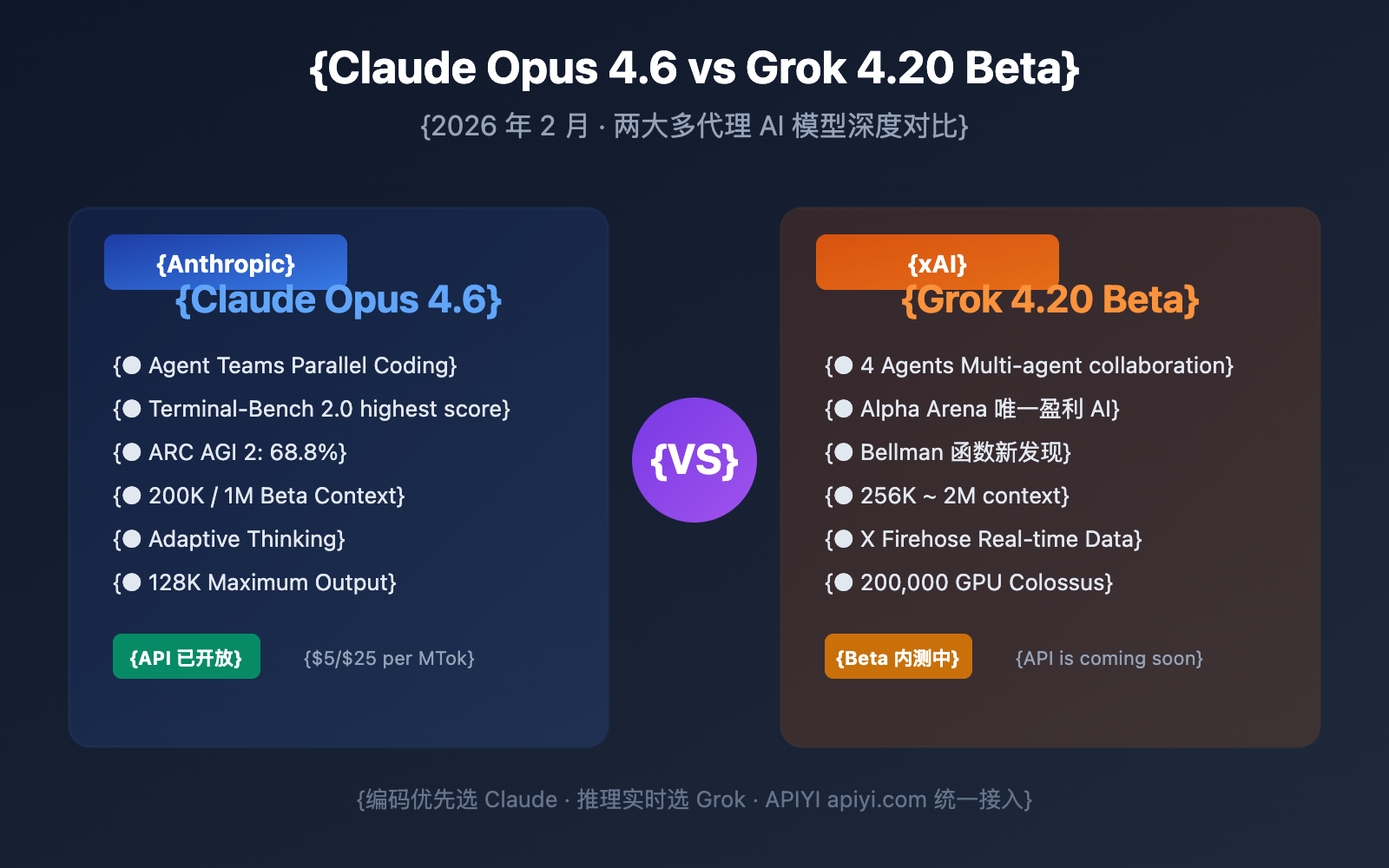
Claude Opus 4.6 vs Grok 4.20 Beta: Core Differences Overview
| Comparison Dimension | Claude Opus 4.6 | Grok 4.20 Beta |
|---|---|---|
| Developer | Anthropic | xAI (Elon Musk) |
| Release Date | Feb 5, 2026 (Official) | Mid-Feb 2026 (Beta) |
| Multi-Agent Architecture | Agent Teams (Lead + Teammates) | 4 Agents (Grok/Harper/Benjamin/Lucas) |
| Context Window | 200K Standard / 1M Beta | 256K ~ 2M tokens |
| Max Output | 128K tokens | Not disclosed |
| API Pricing | $5/$25 per MTok | Not yet disclosed (4.1 ref: $0.20/$0.50) |
| API Availability | ✅ Fully open | ❌ Not yet open |
| Exclusive Data Source | None | X Firehose real-time tweet data |
Claude Opus 4.6 vs Grok 4.20 Beta: Positioning Differences
While both models focus on "multi-agent collaboration," they target different user groups and solve fundamentally different problems:
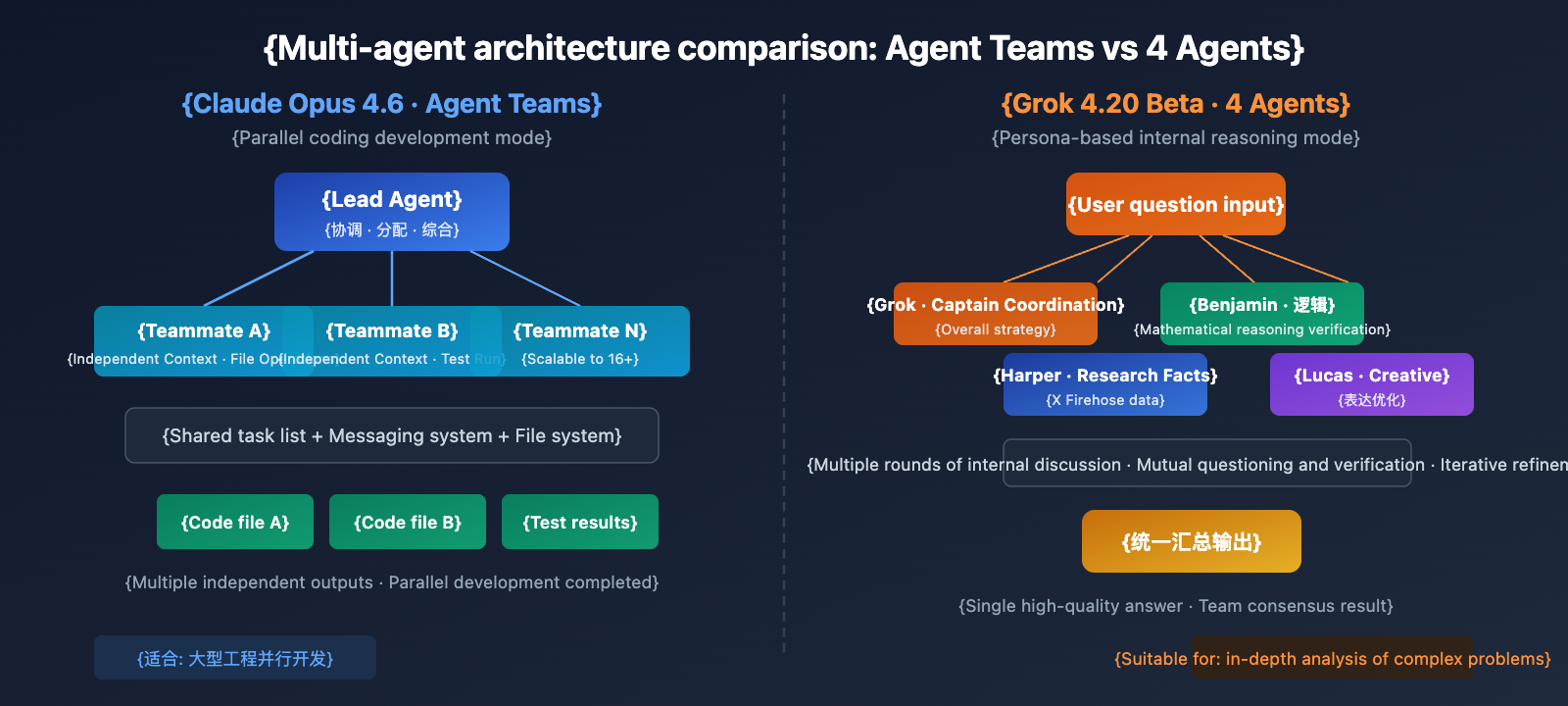
Claude Opus 4.6's Agent Teams is a productivity tool for developers. It allows multiple Claude instances to code in parallel within independent contexts, coordinated by a Lead Agent. Each Teammate can independently read/write files and run tests. This is a mature feature that's already ready for use in real-world projects.
Grok 4.20 Beta's 4 Agents system is a reasoning enhancement for general problem-solving. Four agents with distinct professional roles (Research, Logic, Creative, and Coordination) think in parallel and verify each other internally to produce more accurate answers. Currently, it's only available to SuperGrok users via the chat interface.
🎯 Selection Advice: If you're a developer needing AI to assist with coding, debugging, or handling large projects, Claude Opus 4.6 is the more mature choice right now, and you can call it directly via APIYI (apiyi.com). If you're more focused on complex reasoning, real-time information analysis, and multi-perspective thinking, Grok 4.20 Beta is definitely worth keeping an eye on.
Claude Opus 4.6 vs Grok 4.20 Beta: Multi-Agent Architecture Comparison
The multi-agent architectures of these two models represent the most significant core difference worth diving into.
Claude Opus 4.6 Agent Teams Architecture
Claude Opus 4.6's Agent Teams utilize an explicit parallel coding mode:
| Component | Functional Description | Key Features |
|---|---|---|
| Lead Agent | Main Coordinator | Assigns tasks, synthesizes results, and manages the big picture |
| Teammates | Independent Workers | Each has its own full context window |
| Task List | Shared Collaboration State | Dependency tracking and automatic unlocking |
| Message System | Inter-agent Communication | Teammates can message each other directly |
Key technical features of Agent Teams:
- Independent Context: Each Teammate has its own full context window, ensuring they don't interfere with one another.
- File-level Parallelism: Different Teammates can operate on different files simultaneously, achieving true parallel development.
- Real-time Coordination: Through the shared task list and message system, the Lead Agent can dynamically adjust the division of labor.
- Scalability: In testing, it has already supported 16 agents working in parallel to build a Rust C compiler.
Grok 4.20 Beta 4 Agents Architecture
Grok 4.20 Beta's 4 Agents system uses a role-based internal reasoning mode:
- Grok (Captain): Overall strategy formulation and final answer synthesis.
- Harper (Research Expert): Real-time searching, data verification, and access to X Firehose data.
- Benjamin (Logic Expert): Mathematical reasoning, programming verification, and precise calculations.
- Lucas (Creative Expert): Divergent thinking, expression optimization, and user experience.
The core difference of 4 Agents lies in its internal multi-turn discussion and peer review mechanism. Agents will question each other's conclusions and perform iterative corrections, a mechanism that effectively reduces hallucinations.
Claude Opus 4.6 vs Grok 4.20 Beta: Multi-Agent Architecture Core Differences
| Dimension | Claude Agent Teams | Grok 4 Agents |
|---|---|---|
| Collaboration Goal | Complete coding tasks in parallel | Analyze the same problem from multiple angles |
| Agent Roles | Functionally equivalent (all Claude instances) | Role differentiation (Research/Logic/Creative/Coordination) |
| Working Method | Independent context + shared file system | Internal parallel thinking + multi-turn discussion |
| Scalability | Scalable to 16+ agents | Fixed 4 specialized agents |
| Output Format | Independent outputs (code/files) | Unified summary output (single answer) |
| Use Cases | Parallel development for large engineering projects | Deep analysis of complex problems |
| User Visibility | Progress of each Teammate is observable | Only the final synthesized output is visible |
💡 Technical Insight: Claude Agent Teams is more like "multiple dev teams in a company working on a project in parallel," while Grok 4 Agents is more like "a panel of experts sitting around a table discussing a single complex problem." These two architectures are designed to solve entirely different sets of problems.
Claude Opus 4.6 vs Grok 4.20 Beta 基准性能对比
Claude Opus 4.6 已公布的基准测试成绩
Claude Opus 4.6 作为正式发布的模型,拥有完整的基准测试数据:
| 基准测试 | Claude Opus 4.6 | Claude Opus 4.5 | GPT-5.2 | 说明 |
|---|---|---|---|---|
| Terminal-Bench 2.0 | 65.4% | 59.8% | — | Agentic 编码评估,行业最高 |
| ARC AGI 2 | 68.8% | 37.6% | 54.2% | 人类简单但 AI 困难的推理 |
| GDPval-AA | +144 Elo | 基准线 | 对照组 | 经济价值知识工作任务 |
| OSWorld | 72.7% | 66.3% | — | 计算机使用能力 |
| Humanity's Last Exam | 行业领先 | — | — | 复杂多学科推理 |
Claude Opus 4.6 在编码领域的表现尤为突出——在 Terminal-Bench 2.0 上取得了行业最高分,被评价为"tasteful coder"(有品味的编码者),特别擅长:
- 大型代码库的导航和理解
- 代码审查和 Bug 检测
- 前端开发从设计到功能实现
- 持续性 Agentic 编码任务
Grok 4.20 Beta 已验证的实际表现
Grok 4.20 Beta 尚无完整基准测试数据(仍在 Beta 阶段),但其实际表现已在特定领域得到验证:
- Alpha Arena 交易竞赛: 所有参赛 AI 中唯一盈利(平均回报 12.11%,峰值 50%)
- 数学研究: 帮助数学家 Paata Ivanisvili 在 Bellman 函数领域取得新发现,约 5 分钟推导出 U(p,q) 的精确公式
- 工程编码: Elon Musk 公开认可"开始正确回答开放式工程问题"
- 实时数据处理: 依托 X Firehose 实现毫秒级市场情绪分析
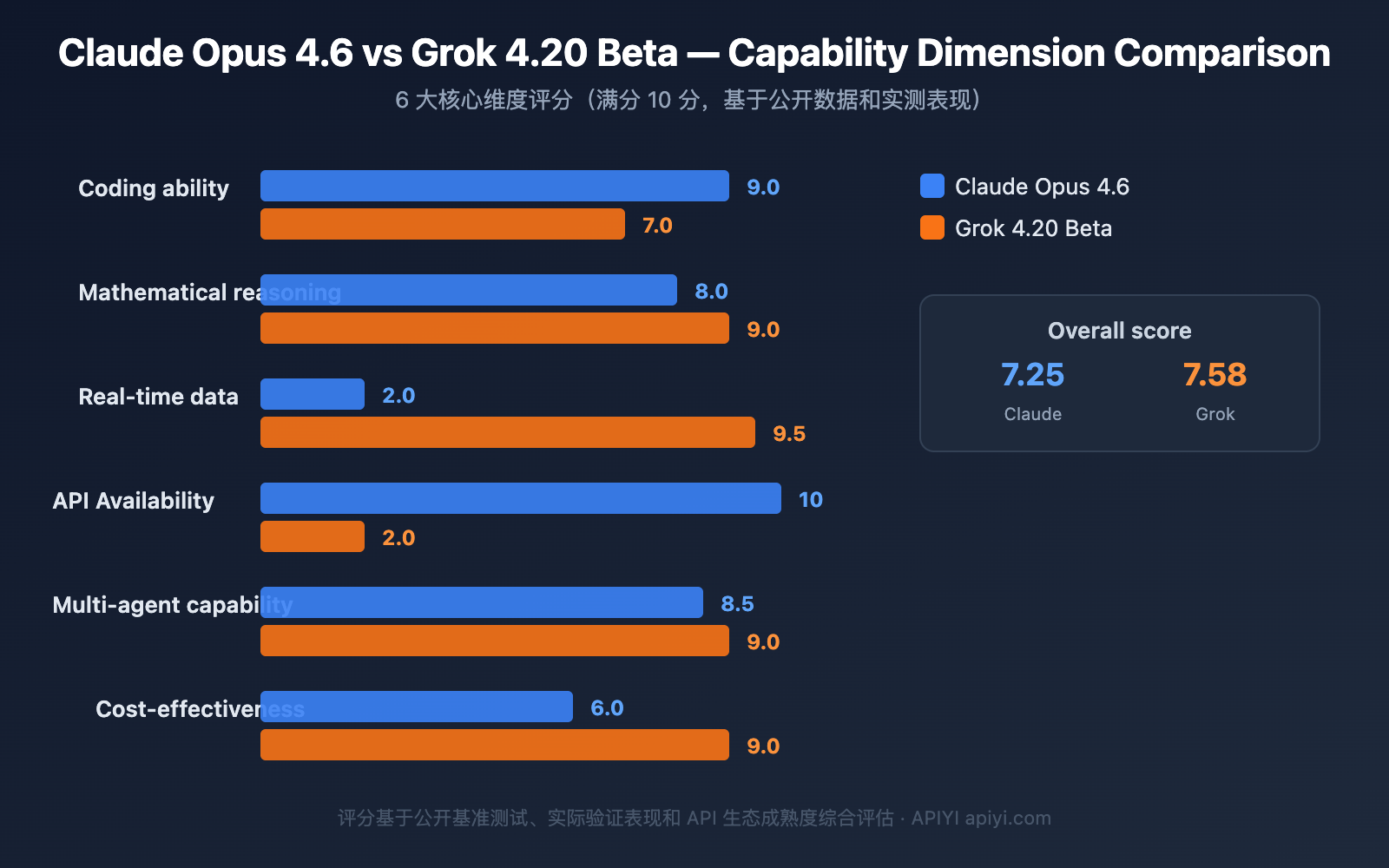
Claude Opus 4.6 vs Grok 4.20 Beta API 可用性与定价
对于开发者来说,API 可用性和成本是选择模型的关键因素。
Claude Opus 4.6 API 定价详情
| 项目 | 定价 | 说明 |
|---|---|---|
| 标准输入 | $5 / MTok | 200K 上下文内 |
| 标准输出 | $25 / MTok | 最大 128K tokens |
| 长上下文输入 | $10 / MTok | 超过 200K 时自动切换 |
| 长上下文输出 | $37.50 / MTok | 1M Beta 模式 |
| Prompt Caching | 最高节省 90% | 重复提示词缓存 |
| Batch 处理 | 节省 50% | 异步批量请求 |
| Fast 模式 | $30/$150 per MTok | 2.5 倍速度 |
Claude Opus 4.6 的 API 已经在所有主要平台上线:claude.ai、Anthropic API、Azure、AWS Bedrock 等。
Grok 4.20 Beta API 状态
Grok 4.20 Beta 的 API 尚未开放。参考 Grok 4.1 的定价:
- 输入: $0.20 / MTok
- 输出: $0.50 / MTok
如果 Grok 4.20 保持类似的定价策略,其 API 成本将显著低于 Claude Opus 4.6。但考虑到 4 Agents 架构需要运行四个并行代理,实际定价可能会有所上浮。
💰 成本建议: Claude Opus 4.6 已通过 APIYI apiyi.com 上线,开发者可以直接获取 API Key 开始调用。平台提供灵活计费和免费测试额度,支持 Prompt Caching 等降本功能。Grok 4.20 API 一旦开放,APIYI也将在第一时间接入。
Claude Opus 4.6 vs. Grok 4.20 Beta: Recommended Use Cases
When to Choose Claude Opus 4.6
- Professional Coding & Development: Agent Teams' parallel coding is currently the strongest AI-assisted development solution, making it perfect for large-scale projects.
- Frontend Engineering: Rated as a "tasteful coder," its precision in converting design drafts into functional code is industry-leading.
- Code Review & Debugging: It's more reliable when operating within massive codebases, with a significant boost in bug detection capabilities.
- Enterprise-Level Knowledge Work: Surpassed GPT-5.2 (+144 Elo) in GDPval-AA evaluations, making it ideal for finance, law, and other specialized fields.
- Immediate API Needs: The API is fully open and supports all major cloud platforms.
When to Choose Grok 4.20 Beta
- Real-Time Information Analysis: Exclusive access to X Firehose data is a massive advantage for monitoring public sentiment and market trends.
- Financial Trading Strategies: The only AI to turn a profit in the Alpha Arena competition—it's the best combo for real-time data and quantitative analysis.
- Math & Scientific Research: With proven capabilities in assisting frontier mathematical research, it's built for academic scenarios requiring rigorous reasoning.
- Deep Multi-Perspective Analysis: The internal 4-Agent discussion mechanism is great for complex decision-making and strategic planning.
- Budget-Sensitive Scenarios: Based on Grok 4.1 pricing, API costs are likely to be much lower than Claude Opus 4.6.
Claude Opus 4.6 vs. Grok 4.20 Beta Decision Matrix
| Your Needs | Recommended Choice | Reason |
|---|---|---|
| Coding & Project Management | Claude Opus 4.6 | Agent Teams + Top score on Terminal-Bench |
| Real-Time Market Analysis | Grok 4.20 Beta | Exclusive X Firehose data source |
| Math/Scientific Reasoning | Grok 4.20 Beta | Bellman function-level verification |
| Enterprise Knowledge Work | Claude Opus 4.6 | Industry-leading GDPval-AA performance |
| Need API Right Now | Claude Opus 4.6 | Fully open; available on APIYI |
| Controlling API Costs | Grok 4.20 Beta | Significantly lower projected pricing |
| Frontend Development | Claude Opus 4.6 | "Tasteful coder" reputation |
| Complex Strategic Decisions | Grok 4.20 Beta | 4-Agent multi-angle analysis |
🚀 Quick Start: Want to compare how these two actually perform? We recommend getting a Claude Opus 4.6 API Key through APIYI (apiyi.com) to test its coding and reasoning first. Once the Grok 4.20 API drops, you'll be able to switch and compare them on the same platform.
FAQ
Q1: Which is stronger: Claude Opus 4.6’s Agent Teams or Grok 4.20’s 4 Agents?
They aren't the same type of technology, so you can't really compare them head-to-head. Claude Agent Teams is a parallel coding tool that lets multiple AI instances write code for different modules simultaneously—perfect for software dev. Grok 4 Agents is a reasoning enhancement mechanism where four specialized agents analyze the same problem from different angles—ideal for complex decision-making. Your choice depends on your use case, not just "raw power."
Q2: Can I use the API for these models right now?
The Claude Opus 4.6 API is fully open. You can get an API Key via APIYI (apiyi.com) and call it directly using standard OpenAI-compatible interfaces. The Grok 4.20 Beta API isn't open yet; currently, it's only available via a SuperGrok subscription ($30/month) on the grok.com chat interface. The APIYI platform will integrate Grok 4.20 as soon as the API is released.
Q3: Is there a big difference in API costs?
Yes, the gap is quite significant. Claude Opus 4.6 standard pricing is $5/$25 per MTok (Input/Output). In contrast, Grok 4.1's reference pricing is $0.20/$0.50 per MTok, making Grok's API cost roughly 2%-4% of Claude's. However, Claude offers cost-saving features like Prompt Caching (up to 90% off) and Batch processing (50% off), which can bring real-world costs down significantly. Using a platform like APIYI (apiyi.com) also gives you more flexible billing options.
Q4: If I’m on a tight budget, which should I prioritize?
If your core need is coding and development, Claude Opus 4.6 is worth the premium. The code quality and efficiency gains from Agent Teams usually outweigh the cost difference. If your needs lean toward info analysis and reasoning, try the SuperGrok subscription ($30/month for unlimited chat) to test Grok 4.20 Beta first, then evaluate switching once the API is live. Ultimately, you'll be able to manage and call both models through APIYI (apiyi.com) on a single platform.
Summary
Key takeaways: Claude Opus 4.6 vs. Grok 4.20 Beta:
- Different paths for multi-agent architecture: Claude Agent Teams acts as a "parallel development team," while Grok 4 Agents functions as an "expert discussion group"—they're complementary rather than replacements.
- Claude for coding, Grok for reasoning: Claude Opus 4.6 leads in Terminal-Bench and ARC AGI 2, while Grok 4.20 holds exclusive advantages in mathematical research and real-time analysis.
- Clear gap in API maturity: Claude Opus 4.6 is fully available, whereas Grok 4.20 is still in Beta and its API hasn't been opened yet.
- Cost considerations: Grok API's reference price is significantly lower than Claude's, but Claude's Prompt Caching can help bridge the gap.
- Real-time data is Grok's exclusive moat: X Firehose data is irreplaceable in scenarios like financial trading and public opinion analysis.
For most developers, we recommend starting with Claude Opus 4.6 for coding and daily needs, while keeping an eye on the Grok 4.20 API rollout to supplement your workflow in specific scenarios (real-time analysis, mathematical reasoning).
We recommend using APIYI (apiyi.com) for unified API management. The platform already supports Claude Opus 4.6 and will integrate Grok 4.20 as soon as it's released, making it easy to switch between models and compare costs under a single interface.
📚 References
-
Anthropic Official – Claude Opus 4.6 Launch Announcement: Model features and benchmark details
- Link:
anthropic.com/news/claude-opus-4-6 - Description: Official launch info and technical details for Claude Opus 4.6
- Link:
-
Claude API Pricing Documentation: Complete API pricing and billing rules
- Link:
platform.claude.com/docs/en/about-claude/pricing - Description: Includes details on standard pricing, long-context premiums, Prompt Caching, etc.
- Link:
-
xAI Official Release Notes: Grok series version updates
- Link:
docs.x.ai/developers/release-notes - Description: xAI's official record of model updates and API releases
- Link:
-
xAI Model Pricing: Grok API official pricing
- Link:
docs.x.ai/developers/models - Description: Detailed pricing information for various Grok API versions
- Link:
Author: APIYI Team
Technical Discussion: Feel free to share your experience with Claude Opus 4.6 and Grok 4.20 Beta in the comments. For more model comparisons and API integration solutions, visit the APIYI (apiyi.com) technical community.