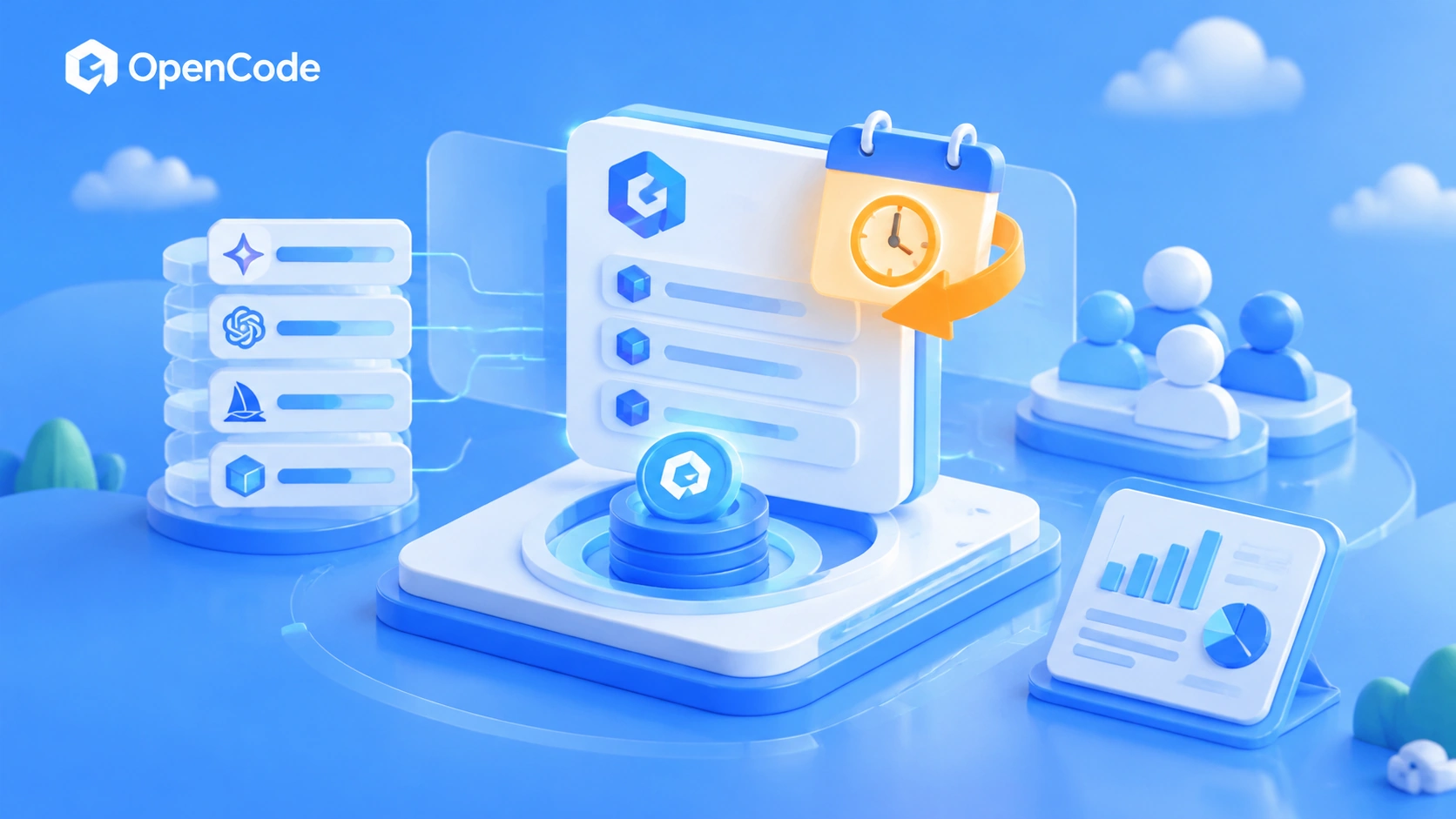
Author’s note: This article recalculates OpenCode Go’s nominal multiples using official allowances and prices, explains the five-hour window, per-model accounting, and changes to the model list, and helps you decide whether to renew or cancel based on your usage.
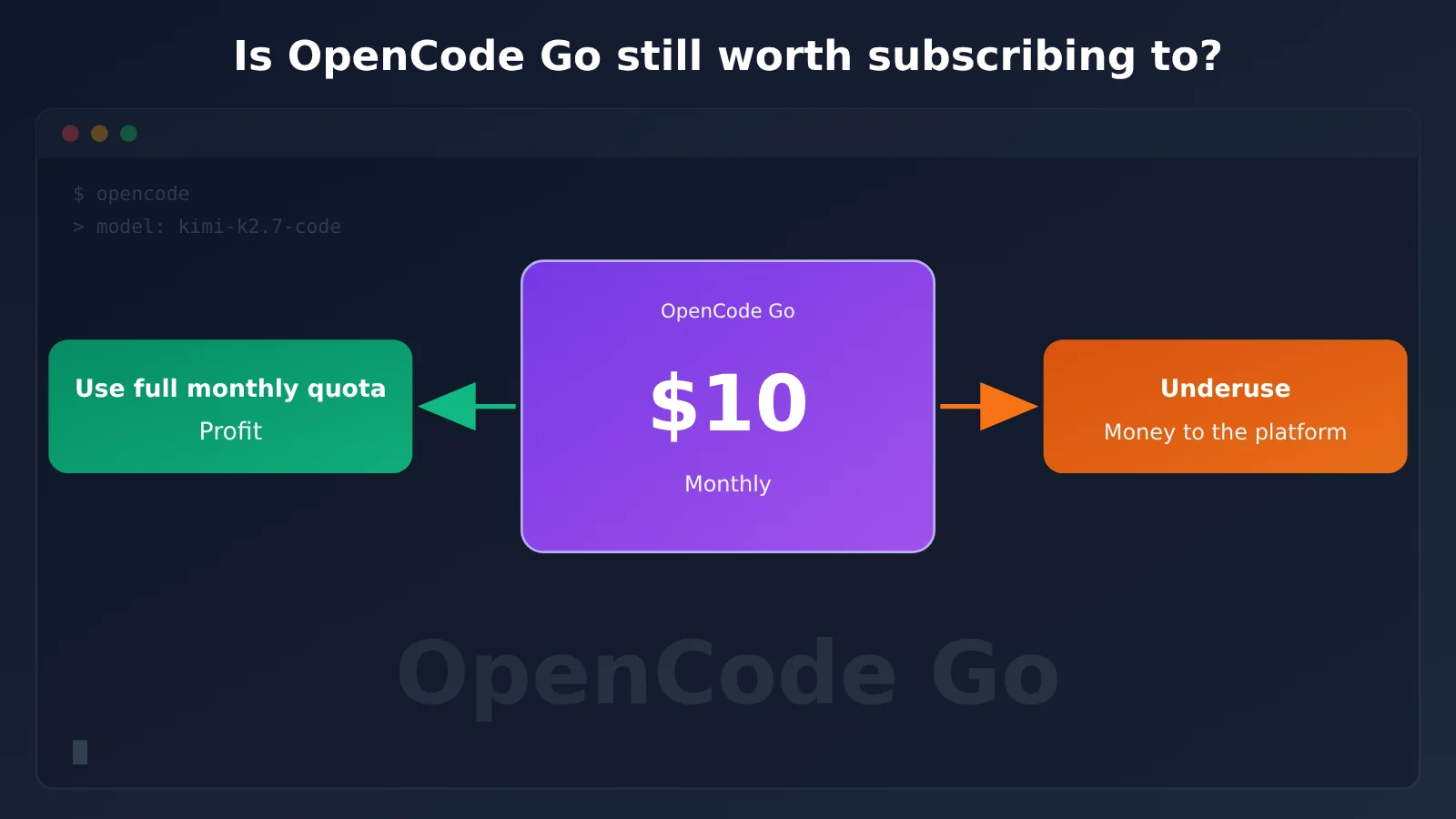
Here’s the bottom line: OpenCode Go is still worth subscribing to, but it’s a good deal for only a small group of users. If you can use up the monthly allowance for a high-multiple model—such as DeepSeek V4.1 Flash, Kimi K2.7 Code, or GLM-5.3-Flash—the $10 monthly subscription pays off. If you can’t, you’re losing out, and the platform keeps the difference.
This isn’t an “every option has its merits” kind of review. The numbers below come from three distinct sources: official OpenCode pages and documentation (retrieved October 28, 2026); third-party or user reports (marked separately and not officially confirmed); and my own calculations based on official figures (marked “recalculated,” not measured in practice). The three aren’t mixed.
The key takeaway: By the end, you can plug your own usage into the relationship “cost per request × number of requests = monthly allowance” and decide whether to renew next month.
OpenCode Go’s Core Features: What Does $10 Actually Get You?
Here’s the official breakdown: OpenCode Go costs $10 a month, and Go Plus costs $40 a month. Both plans offer the exact same models at the same per-token rates. The only difference is that Go Plus gives you a higher monthly allowance for each model. OpenCode positions the plans as offering generous allowances and reliable access for people who code with agents. You can also use the open-source OpenCode application without a subscription by connecting your own provider.
So Go isn’t selling “cheaper token rates.” It’s offering more than $10 worth of usage for $10. Whether it’s worth it depends on whether you’ll actually use that allowance. The official page lists 30 models; the table below highlights some of the most frequently discussed ones.
| Model | Go monthly allowance (Go Plus) | Estimated Go requests: 5 hours / week / month |
|---|---|---|
| DeepSeek V4.1 Flash (off-peak) | $80 ($160) | 34,670 / 86,670 / 173,330 |
| MiMo-V2.6-Flash | $60 ($120) | 30,100 / 75,200 / 150,400 |
| GLM-5.3-Flash | $60 ($180) | 6,320 / 15,790 / 31,580 |
| Qwen3.7 Plus (≤256K) | $60 ($180) | 4,300 / 10,800 / 21,600 |
| MiniMax M3 | $60 ($180) | 3,200 / 8,000 / 16,000 |
| Kimi K2.7 Code | $60 ($180) | 1,350 / 3,380 / 6,750 |
| Gemini 4 Argon (discount period) | $30 ($120) | 440 / 1,080 / 2,120 |
| GPT 6 Luna (≤272K) | $15 ($60) | 4,230 / 10,560 / 21,130 |
| Claude Haiku 5.5 (≤100K) | $15 ($60) | 3,850 / 9,620 / 19,230 |
| DeepSeek V4 Pro (off-peak) | $15 ($60) | 1,050 / 2,600 / 5,200 |
| GLM-5.3 | $15 ($120) | 220 / 540 / 1,080 |
| Grok 4.7 (≤200K) | $15 ($60) | 169 / 423 / 845 |
| Kimi K3.1 Pro | $15 ($60) | 147 / 368 / 735 |
The table is based on OpenCode’s official page, retrieved on October 28, 2026. The request counts are official estimates based on a fixed token profile. Your actual requests may be longer or shorter.
OpenCode Go Allowance Truth #1: Each Model Has Its Own Budget
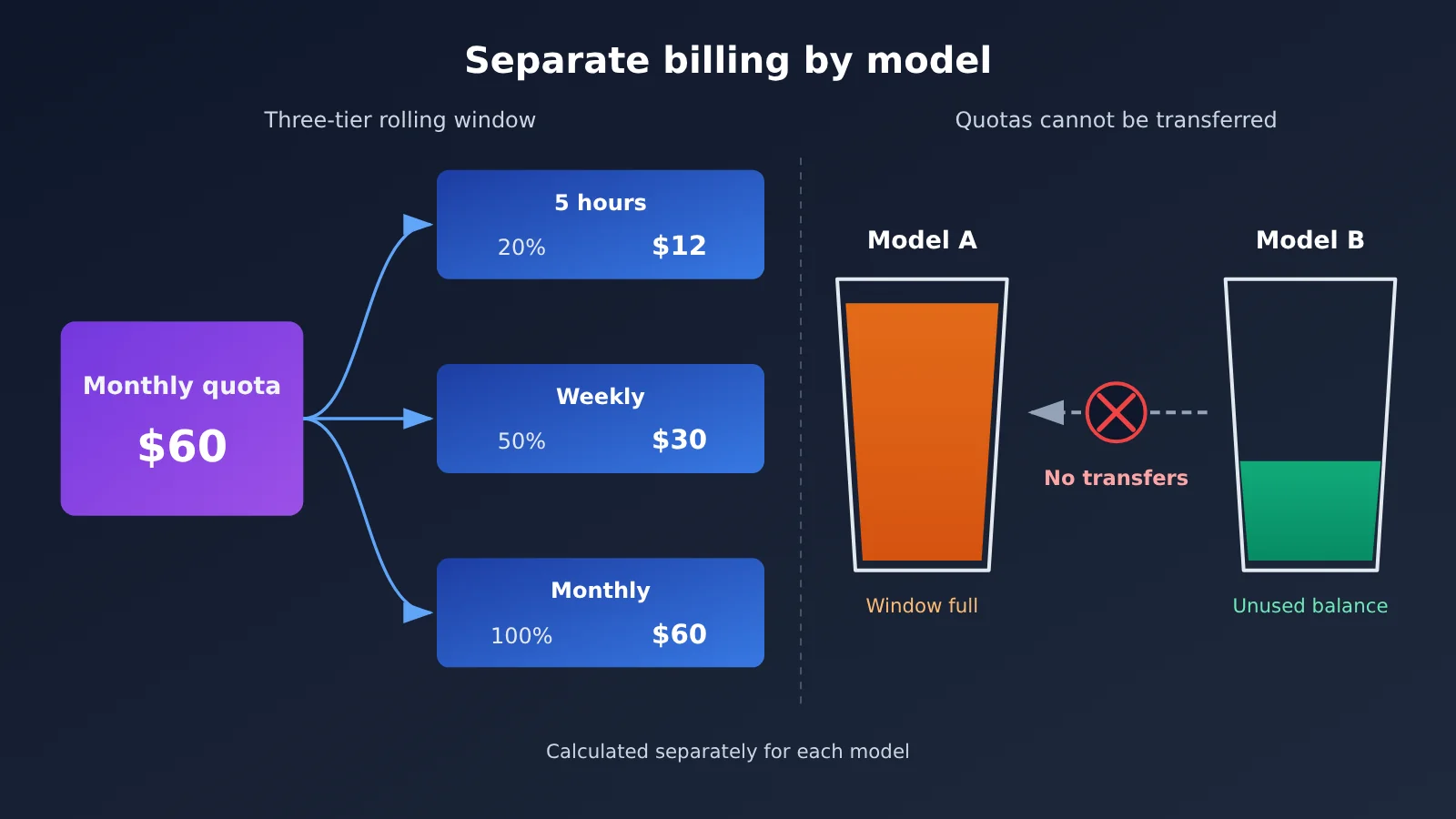
This is the easiest part to misunderstand. Each model has its own monthly dollar allowance; there’s no shared balance across the account. All three rolling windows are calculated from that model’s monthly allowance: 20% for the 5-hour window, 50% for the weekly window, and 100% for the monthly window.
Here’s what that looks like in practice: A model with a $60 monthly allowance has a $12 limit per 5-hour window and a $30 weekly limit. A model with a $15 monthly allowance gets just $3 per 5-hour window and $7.50 per week. DeepSeek V4.1 Flash has an $80 monthly allowance, with limits of $16 per 5-hour window and $40 per week. Once you’ve used up a model’s window allowance, unused allowance from other models can’t be transferred to it. Each response includes an opencode.allowance field showing how much was counted against the allowance for that request.
This has a direct impact on whether it’s worth it: If you hit the 5-hour limit on Kimi K3.1 Pro, the allowances for other models in your account won’t help. You’ll have to wait for the window to reset or switch to another model.
OpenCode Go Numbers: Recalculating Multipliers and Per-Use Costs from Official Data
First, a clarification: this section doesn’t include hands-on testing. All results are calculated from the official allowances, prices, and token profiles, so anyone can check the math.
OpenCode Go Allowance Truth #2: Nominal Multipliers Vary Widely
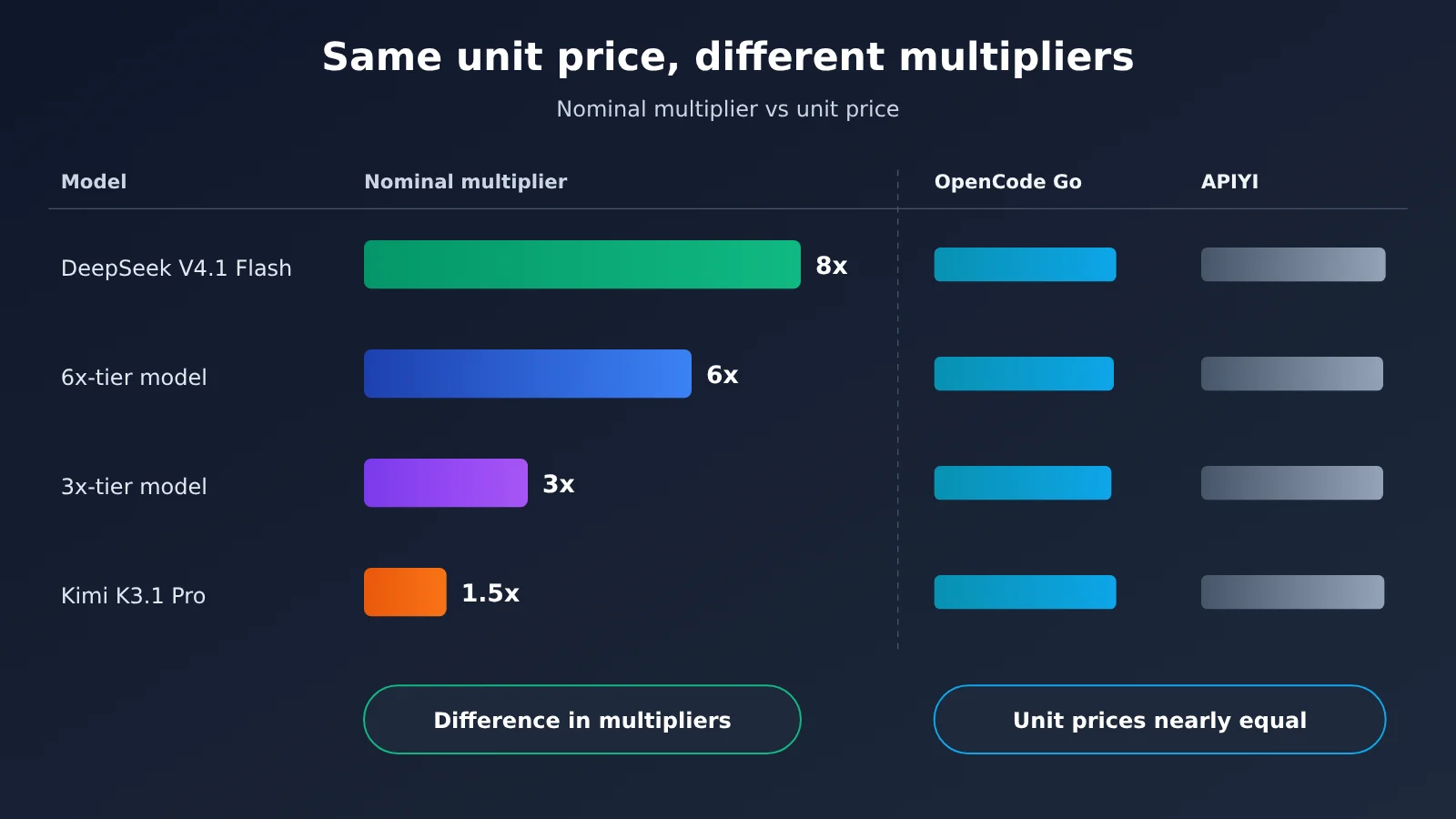
The nominal multiplier is calculated as “monthly allowance ÷ $10 monthly fee.” It’s the key calculation for judging whether the plan is worth it.
| Nominal multiplier | Models (Go tier) | Quick take |
|---|---|---|
| 8× | DeepSeek V4.1 Flash | Best value, provided you’re comfortable with DeepSeek’s regional settings |
| 6× | MiMo-V2.6-Flash, GLM-5.3-Flash, GLM-5.2, Kimi K2.7 Code, Qwen3.7 Plus, MiniMax M3, LongCat-2.0 | The main value range for Go |
| 3× | Gemini 4 Argon (Qwen3.8 Flash also has a $30 allowance) | Barely worth it during the discount period |
| 1.5× | Kimi K3.1 Pro, Kimi K3, Claude Haiku 5.5, GPT 6 Luna, GLM-5.3, Qwen3.8 Max, DeepSeek V4 Pro, Grok 4.7, Step 5 Preview | Just $5 extra, with a $3 limit every five hours |
A 1.5× multiplier means you pay $10 for a $15 allowance, capped at $3 every five hours. If you code heavily, you could easily hit that limit in a single afternoon. Pay-as-you-go, by contrast, has no time-window limit: you pay for what you use. Most of the midrange and high-end models on the list fall into this tier.
The 3× multiplier for Gemini 4 Argon is based on a 50% discount, which the official documentation says runs until 2026-11-30. Based on the official pricing, the unit price will double when the discount ends, so the same $30 allowance will cover roughly half as many requests. Its effective value will be closer to the original 1.5× tier.
Cost per Request × Number of Requests = Monthly Allowance
The provider gives a token profile for estimating request counts. Multiply it by the official pricing to calculate the cost per request:
| Model | Official token profile (input + cache reads + output) | Calculated cost per request | Monthly allowance ÷ cost per request |
|---|---|---|---|
| Claude Haiku 5.5 | 1,100 + 55,000 + 240 | About $0.00078 | $15 ≈ 19,000 requests |
| Kimi K3.1 Pro | 1,050 + 76,500 + 300 | About $0.0204 | $15 ≈ 735 requests |
| DeepSeek V4.1 Flash (off-peak) | 410 + 71,300 + 310 | About $0.00046 | $80 ≈ 170,000 requests |
All three results match the official estimates, confirming that the relationship holds. The Kimi K3.1 Pro calculation also reveals an important detail: cache reads for roughly 76,000 tokens cost about $0.0153 on their own—more than 70% of the cost per request. An agent rereads the context on every turn, so the longer the context, the faster you’ll use up your allowance.
How to estimate your own usage: Run OpenCode for a week and record the number of requests to your primary model. Multiply that by the cost per request in the table, then multiply by 4. If the result exceeds that model’s Go monthly allowance, the plan is a good deal. If it’s well below the allowance, you’re paying for capacity you don’t use.
Go vs. Pay-as-You-Go Unit Pricing
Many people assume Go is cheaper because its unit prices are lower. That’s not really the case. Here’s how the listed prices for the same models compare on OpenCode Go and APIYI:
| Model | OpenCode Go Input / Output / Cache Read | APIYI Input / Output / Cache Read |
|---|---|---|
| Claude Haiku 5.5 / claude-haiku-5-5 | $0.10 / $0.50 / $0.01 | $0.1 / $0.5 / $0.01 |
| GPT 6 Luna / gpt-6-luna | $0.10 / $0.50 / $0.01 | $0.1 / $0.5 / $0.01 |
| Kimi K3.1 Pro / kimi-k3.1-pro | $2.00 / $10.00 / $0.20 | $2 / $10 / $0.2 |
| Kimi K2.7 Code / kimi-k2.7-code | $0.95 / $4.00 / $0.19 | $0.95 / $3.99 / $0.19 |
| GLM-5.3 / glm-5.3 | $1.40 / $4.40 / $0.26 | $1.4 / $4.396 / $0.259 |
| GLM-5.3-Flash / glm-5.3-flash | $0.15 / $0.50 / $0.03 | $0.15 / $0.5 / $0.03 |
| Gemini 4 Argon / gemini-4-argon | $2.00 / $10.00 / $0.10 after discount | $2 / $10 / $0.1 |
| Grok 4.7 / grok-4.7 | $2.00 / $6.00 / $0.50 | $2 / $6 / $0.5 |
| Qwen3.7 Plus / qwen3.7-plus | $0.40 / $1.60 / $0.04 | $0.6 / $2.4 / $0.06 |
| DeepSeek V4.1 Flash (off-peak) | $0.15 / $0.60 / $0.003 | deepseek-v4-1-flash-260910: $0.15 / $0.6 / $0.003 |
| DeepSeek V4 Pro | Off-peak: $0.66 / $1.98 / $0.022 | $1.32 / $3.96 / $0.044 |
Prices are in USD per million tokens. APIYI data was updated on 2026-10-27; refer to the model list on apiyi.com for current models and prices.
The listed prices are broadly the same. The exceptions are Qwen3.7 Plus and DeepSeek V4 Pro’s off-peak rate (APIYI’s price matches Go’s peak rate), both of which are cheaper on Go. Go’s advantage is in the multiplier, not the unit price: at the same unit price, $10 buys you $15 to $80 in usage credits. Pay-as-you-go, on the other hand, has no usage-window limits and gives you access to models that aren’t on Go’s list.
OpenCode Go Pros and Cons: Haiku Is the Only Claude Model on the List
OpenCode Go’s Advantages
- High-multiplier models offer real value: DeepSeek V4.1 Flash has an 8x multiplier, and seven models are in the 6x tier, giving heavy users plenty to work with.
- Cancel anytime, with a fallback: With Extra Usage enabled, requests switch to your Console prepaid balance when you run out of quota, so your work won’t be interrupted.
- Easy setup: Run
/connectin OpenCode, select OpenCode Go, and paste in your Console key. Then use/modelsto choose a model. In configuration, models are written asopencode-go/<model-id>. - Broad client compatibility: The team has officially verified clients including Claude Code, Codex, and Hermes (≥ v0.21.6).
OpenCode Go’s limitations
- No flagship Claude models: The only Claude model on the list is Claude Haiku 5.5—there’s no Sonnet or Opus.
- Mid- to high-end models get just 1.5×: Models such as Kimi K3.1 Pro, GLM-5.3, and Grok 4.7 have just $3 available per five-hour window.
- Some clients don’t send the full session header: The official documentation specifically names DeepSeek Harness, GitHub Copilot Chat, Kimi Code, and MiMo Code as clients that don’t fully include
x-opencode-session.
The first limitation is what gives many people pause. If Claude Sonnet or Opus is your go-to model, the closest alternatives in Go are midrange models in the 1.5× tier. Rather than settling for those, you could pay for Claude directly: pay for what you use, with no five-hour window.
Connect flagship Claude models to OpenCode with APIYI
OpenCode supports custom providers. Just follow these steps:
- Set an environment variable first:
export APIYI_API_KEY=your_key. Don’t put the key directly in your configuration file. - Open
~/.config/opencode/opencode.json. - Add
apiyiunderproviderand include the following: "npm": "@ai-sdk/openai-compatible""baseURL": "https://api.apiyi.com/v1"in"options""apiKey": "{env:APIYI_API_KEY}"in"options"- Declare
claude-opus-5-5andclaude-sonnet-5-5in"models" - Set the default model at the top level of the configuration:
"model": "apiyi/claude-opus-5-5". - If you want to use Claude’s native
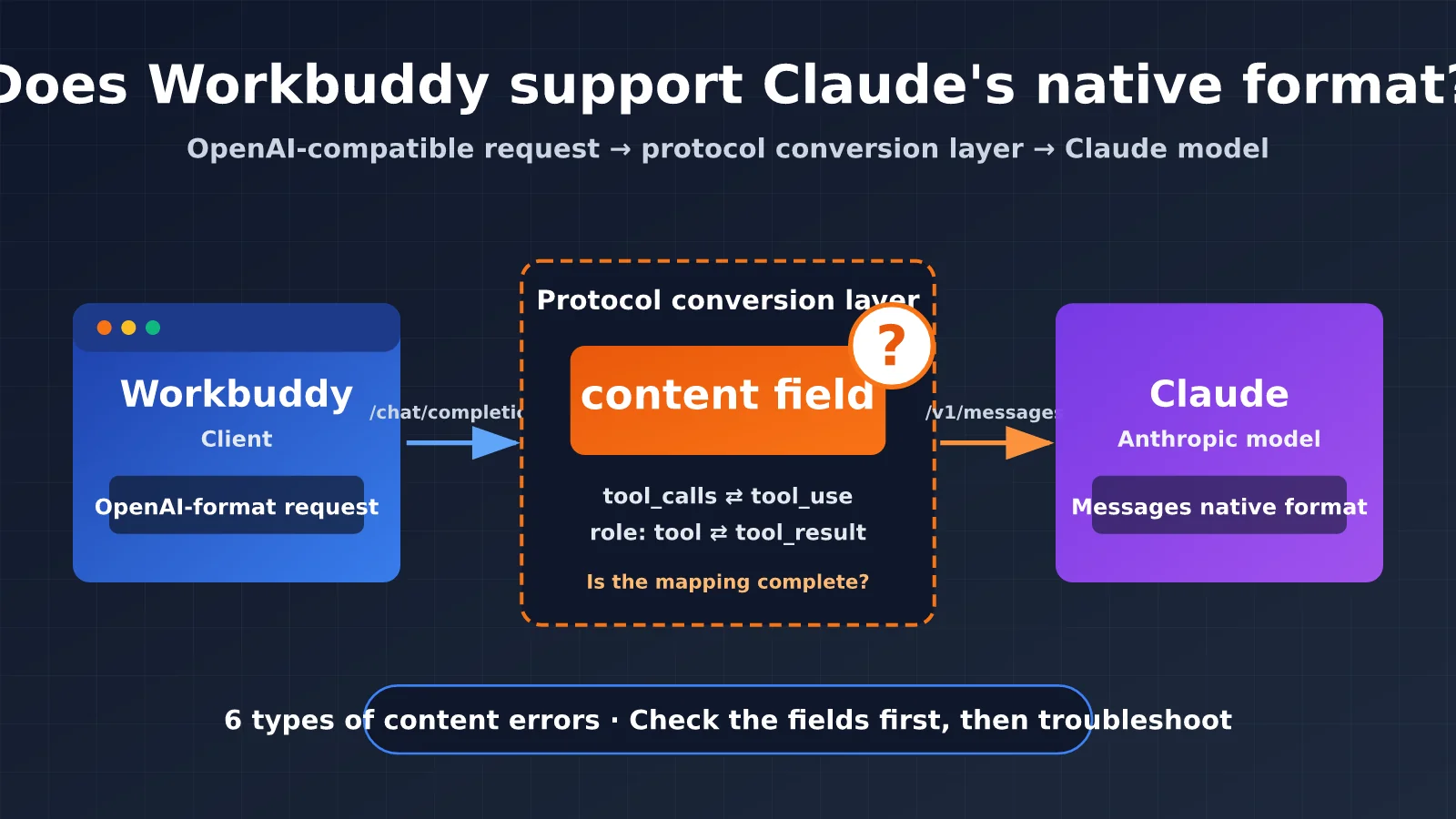
/v1/messagesendpoint, use only the root domainhttps://api.apiyi.comas the baseURL. If you include/v1, requests will go to/v1/v1/messagesand return a 404. - You can also avoid editing the file by hand: after starting OpenCode, run
/connect, selectOther, enter a provider ID (such asapiyi) and key, then add the provider and models definitions. - Or skip the configuration file altogether: enter the API key and Base URL in Magpie’s graphical interface to connect OpenCode, Claude Code, and Codex to the same gateway. OpenCode is on its list of supported agents, and you won’t need to type any commands. For the steps, see Step-by-step guide: Connect all your agents with one key using the open-source Magpie API gateway.
The examples in APIYI’s integration documentation still use older model IDs. Check the pricing table for the current IDs on the day you use them. Current pricing for the three Claude tiers is below (input / output / cache reads, in US dollars per million tokens; updated October 27, 2026):
claude-opus-5-5: $4 / $20 / $0.2claude-sonnet-5-5: $2 / $10 / $0.1claude-haiku-5-5: $0.1 / $0.5 / $0.01; input tokens above 100,000 are priced at $0.5/1M
Using the Haiku token profile from earlier with these prices, Sonnet costs about $0.0101 per call and Opus about $0.0202—roughly the same as Kimi K3.1 Pro in Go. In other words, for the same money, you can use Opus directly.
One thing to clarify: APIYI’s text models have the same list prices as the official providers. Top-ups come with a bonus of up to 20%, bringing the effective cost down by about 17%. The savings come from that bonus and the control of pay-as-you-go billing, not lower list prices.
🎯 Technical tip: If flagship Claude models are your go-to, try one or two real tasks in OpenCode using the free new-user test credit at APIYI apiyi.com. Record the cost per call, then compare it with Go’s multipliers.
4 Things to Know Before Subscribing to OpenCode Go
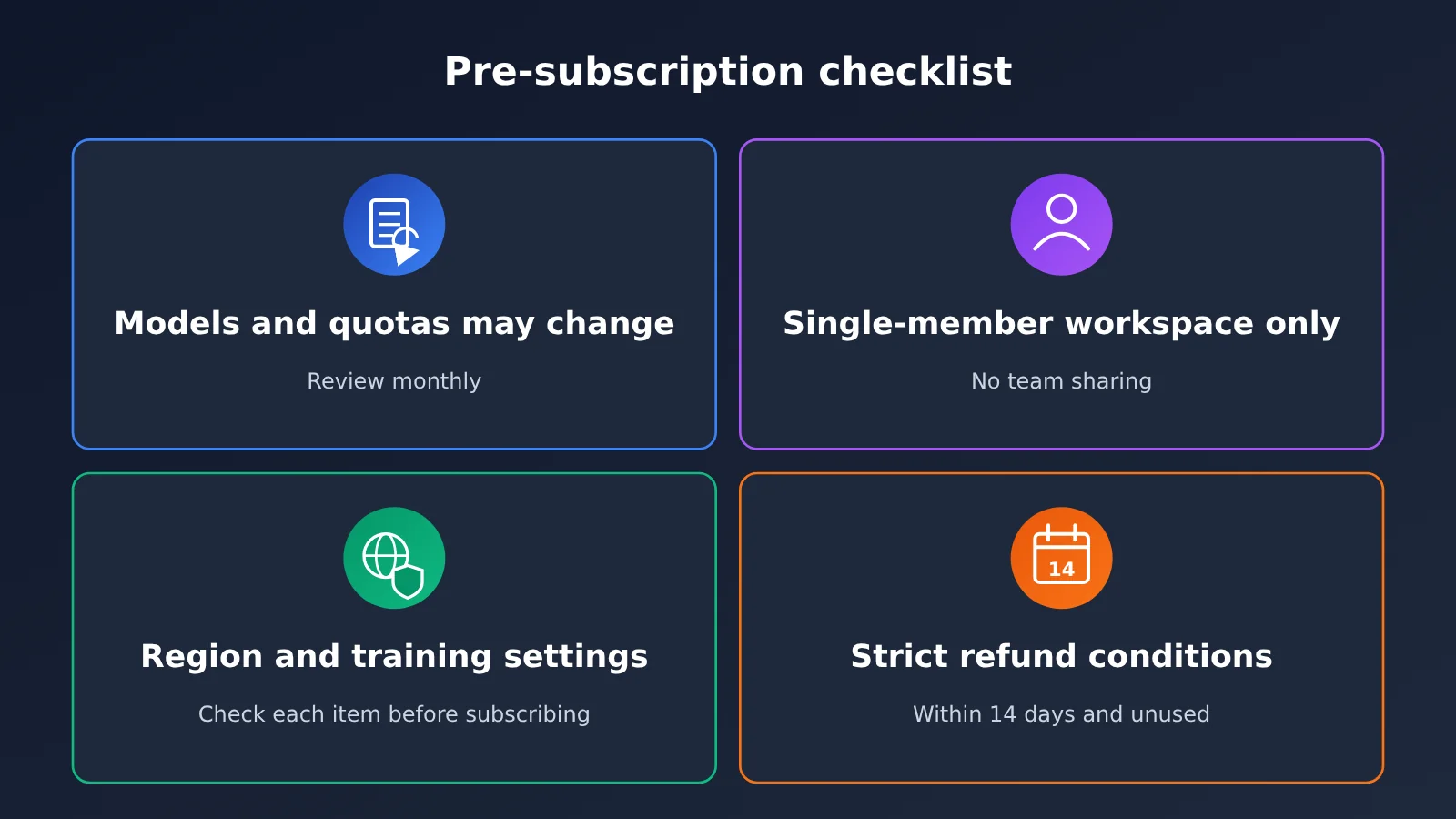
OpenCode Go usage limits, truth #3: Models and limits can change
The official documentation says the model list can change and usage limits may be adjusted based on early feedback. The following changes were recorded by the third-party analysis site threatfrontier (published August 18, 2026, and updated October 15, 2026). This is one third-party account, not an official announcement:
- In August 2026, DeepSeek V4 Flash’s monthly allowance was cut from $60 to $30, and V4 Pro’s was cut to $15.
- When checked again on October 15, 2026, V4.1 Flash’s allowance had risen to $80, while V4 Pro remained at $15.
- The $5 first-month promotion ended on August 24, 2026.
That means today’s 8x allowance isn’t guaranteed to remain 8x next month. Renewing monthly and checking the limits once a month is safer than planning around a full year upfront.
Three other things to know
- No shared team subscriptions: Go and Go Plus only work in single-member workspaces—the Personal workspace created automatically when you sign up. A workspace with a Go subscription can’t invite members.
- Data and regions: Paid endpoints that use your data for training are blocked by default, and the default allowed regions are Europe and the US. To use the two DeepSeek models, you need to change Regions to Global under Settings › Privacy. Muse Spark Contributor uses your prompts for training and isn’t ZDR. DeepSeek’s ZDR agreement is renewed monthly; the official page says the current agreement is valid through October 31, 2026. Check again before renewing.
- Refund conditions are strict: You can request a refund only if the charge was made within the past 14 days and you haven’t used any Go allowance during the current billing period. Once you’ve used it, you can’t get that month’s payment back.
OpenCode Go usage limits, truth #4: User-reported metering disputes
Two GitHub issues represent concerns raised by users in the community. Both are user reports, and their claims haven’t been confirmed by OpenCode:
- #45539 (August 27, 2026): The user reported that the five-hour window showed 102% when visible usage was around $3.09, and other Go models were locked at the same time. The issue was closed as not planned.
- #49910 (September 19, 2026): The user reported being blocked after using around $12 of their weekly allowance, while the documentation stated a weekly allowance of $30. This issue was also closed as not planned.
Under the official rules, each window is calculated based on an individual model’s monthly allowance. The $3.09 in the first issue is close to the $3 five-hour limit for a model in the $15 tier. Both issues were closed as not planned. My interpretation is that OpenCode considers this metering behavior part of the design, not a bug. That doesn’t prove there’s a problem with Go, but it does mean you should understand which model tier you’re using.
Should You Renew OpenCode Go? Three Types of Users
| User | Primary models | Recommendation | Why |
|---|---|---|---|
| Heavy agent users who primarily use cheap models with high allowance multipliers | DeepSeek V4.1 Flash, Kimi K2.7 Code, GLM-5.3-Flash, Qwen3.7 Plus | Renew | With 6× to 8× allowances, daily agent use can make full use of the quota |
| Users who primarily use Claude Sonnet / Opus | Not included in Go | Cancel | Use Claude on APIYI with pay-as-you-go billing and no time-window limits |
| Light users, users who primarily use 1.5× models, or teams that need shared access | Kimi K3.1 Pro, GLM-5.3, Grok 4.7, etc. | Cancel | The extra $5 often goes unused, while the $3-per-five-hour limit can still hold you back |
For the first group, value also depends on when you use it. DeepSeek prices double during peak hours (weekdays UTC 01:00–04:00 and 06:00–10:00). Based on the official pricing, the same allowance covers only half as many requests during peak periods.
FAQ
Q1: Is OpenCode Go’s monthly allowance shared across the whole account?
No. Each model has its own dollar allowance, and the five-hour, weekly, and monthly windows are all calculated based on that model’s own monthly allowance. Once a window’s allowance is used up, it can’t be transferred to another model.
Q2: How do I choose between OpenCode Go and Go Plus?
Both tiers have exactly the same models and prices; only the allowances differ. Start with the $10 tier. If you hit the monthly limit two months in a row, consider upgrading to Go Plus.
Q3: Could OpenCode Go’s allowances change again?
Yes. The official documentation says allowances are subject to change. According to third-party records, DeepSeek’s allowance was reduced in August and increased again in October. Check it monthly rather than planning a year ahead.
Q4: Can I use Claude Opus with OpenCode Go?
No. The only Claude model on the list is Haiku 5.5. If you need Opus or Sonnet, you can add a custom provider in OpenCode and use pay-as-you-go billing.
Q5: How do I connect OpenCode to Claude after canceling Go?
Follow the steps above to add an `apiyi` provider in `~/.config/opencode/opencode.json` and set the default model to `apiyi/claude-opus-5-5`. New users at APIYI apiyi.com get free testing credits, which you can use to estimate your cost per request.
Q6: Can I use Go and pay-as-you-go billing together?
Yes. OpenCode supports multiple providers. Use Go’s 6× to 8× models for everyday tasks, then switch to a pay-as-you-go flagship Claude model for harder problems. This combination is often more cost-effective than using either option alone.
OpenCode Go Key Takeaways
- Usage limits are tracked per model: 20% per 5 hours, 50% per week, and 100% per month. Allowances don’t carry over between windows.
- The multiplier determines the value: The 8× and 6× tiers are good deals; the 1.5× tier generally isn’t.
- Unit prices aren’t an advantage: Go’s listed prices are roughly the same as pay-as-you-go rates. Its advantage comes from the multipliers.
- The decision formula: A subscription is worthwhile only if your cost per request × monthly requests exceeds the monthly allowance.
- The list changes: Third parties track allowance adjustments, so check it again each month.
- Claude’s flagship models are missing: If you mainly use Opus or Sonnet, you can access them on a pay-as-you-go basis at apiyi.com.
Summary
Deciding whether to keep OpenCode Go is straightforward:
- Check the multiplier: If your main model is in the 6× tier or higher and you can use the full allowance each month, renew.
- Check what’s missing: If Claude’s flagship models are your main choice, Go doesn’t offer them, so cancel.
- Check your usage: If you’re a light user or mainly use models in the 1.5× tier and can’t use the full allowance, cancel.
The bottom line: If you use high-multiplier models like DeepSeek V4.1 Flash, Kimi K2.7 Code, or GLM-5.3-Flash heavily every day, keep your subscription. If you mainly use Claude Sonnet or Opus, are a light user, or are making do with 1.5× tier models, cancel next month.
If you want to keep using Claude’s flagship models in OpenCode after canceling, you can claim free credits at APIYI apiyi.com and work out your actual cost per request before deciding.
📚 References
- Official OpenCode Go page: Subscription pricing, model allowances, and per-unit pricing
- Link:
opencode.ai/go -
Note: All OpenCode Go figures in this article were retrieved on October 28, 2026.
-
Official OpenCode Go documentation: Allowance windows, regional availability, and data retention rules
- Link:
opencode.ai/docs/go -
Note: Covers window conversions, refund conditions, and the single-member workspace restriction.
-
APIYI documentation center: Pricing overview, OpenCode integration, and Base URL rules
- Link:
docs.apiyi.com(models, scenarios/programming/opencode, faq/base-url-config) -
Note: Pricing data was updated on October 27, 2026.
-
OpenCode GitHub issues #45539 and #49910: User-reported allowance metering issues
- Note: Both were closed as “not planned” and represent user reports.
Author: APIYI Technical Team
Technical discussion: Contact us through the APIYI homepage. For more resources, visit the documentation center at docs.apiyi.com.