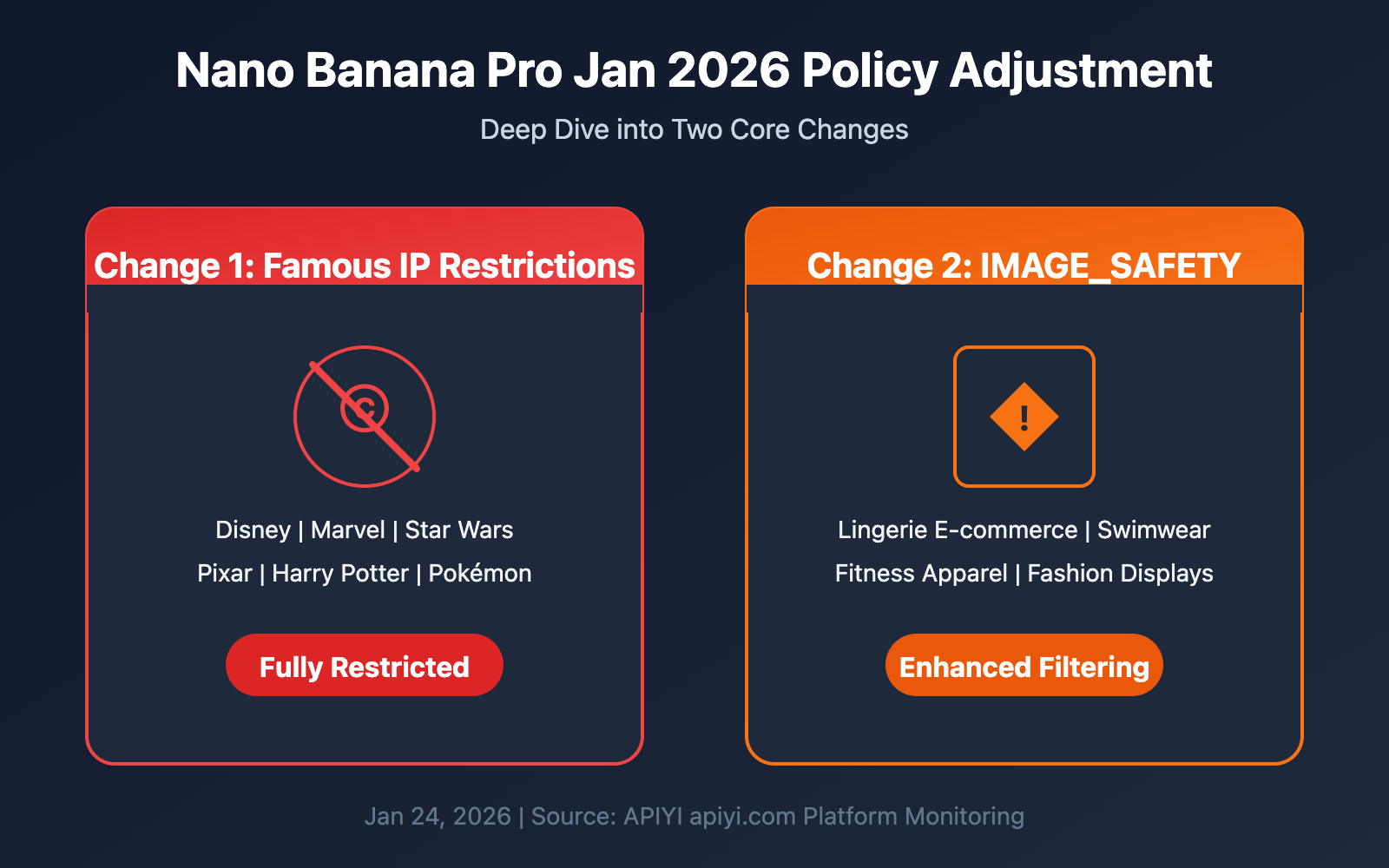
Google's AI image generation service, Nano Banana Pro, underwent a major policy adjustment in late January 2026 (around January 24th). Two significant changes—strengthened IMAGE_SAFETY content filtering and strict restrictions on famous IP character generation—have sparked widespread discussion within the developer community. This article provides a deep dive into these updates to help you understand the background and find effective workarounds.
Core Value: A 3-minute guide to the core content, underlying reasons, and practical impact of the Nano Banana Pro policy adjustment, including 5 actionable strategies.
Core Information on Nano Banana Pro Policy Adjustments
Quick Overview
| Item | Details |
|---|---|
| Adjustment Date | Around January 24, 2026 |
| Provider | Google (Nano Banana Pro / Imagen Series) |
| Core Changes | Strengthened IMAGE_SAFETY filtering + Restrictions on famous IP generation |
| Impact Scope | All developers and applications using the Nano Banana Pro API |
| Official Statement | Compliance with Google Generative AI Prohibited Use Policy |
Deep Dive: 2 Core Changes
Change 1: Famous IP Character Restrictions
The Situation:
When you try to generate images featuring well-known brand characters (like Disney, Marvel, Star Wars, etc.), the system now rejects the request. IP-related content that previously generated without issues now triggers a copyright protection mechanism.
Affected IP Scope:
| IP Category | Representative Works | Restriction Level |
|---|---|---|
| Disney Classics | Frozen, The Lion King, The Little Mermaid | Fully Restricted |
| Marvel Universe | Deadpool, Guardians of the Galaxy, Iron Man | Fully Restricted |
| Star Wars | All series characters | Fully Restricted |
| Pixar Animation | Toy Story, Finding Nemo | Fully Restricted |
| Other Famous IPs | Harry Potter, Pokémon, etc. | Partially Restricted |
Example Error Response:
{
  "finishReason": "SAFETY",
  "finishMessage": "The image was filtered because it may contain copyrighted characters or content."
}
Change 2: Strengthened IMAGE_SAFETY Content Filtering
The Situation:
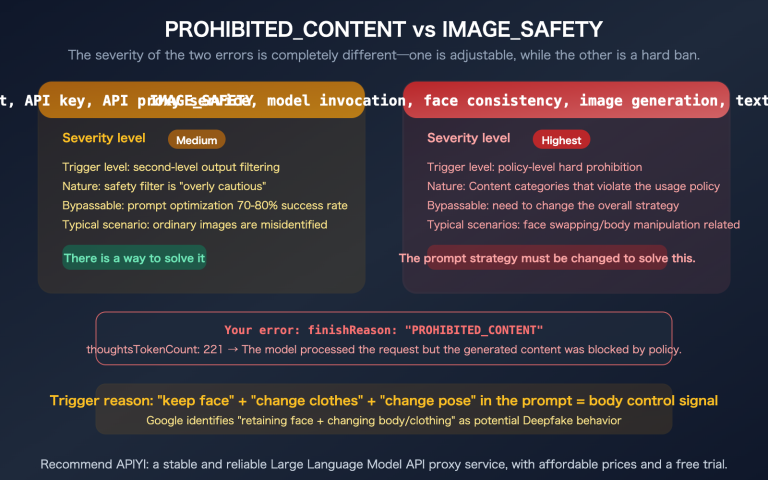
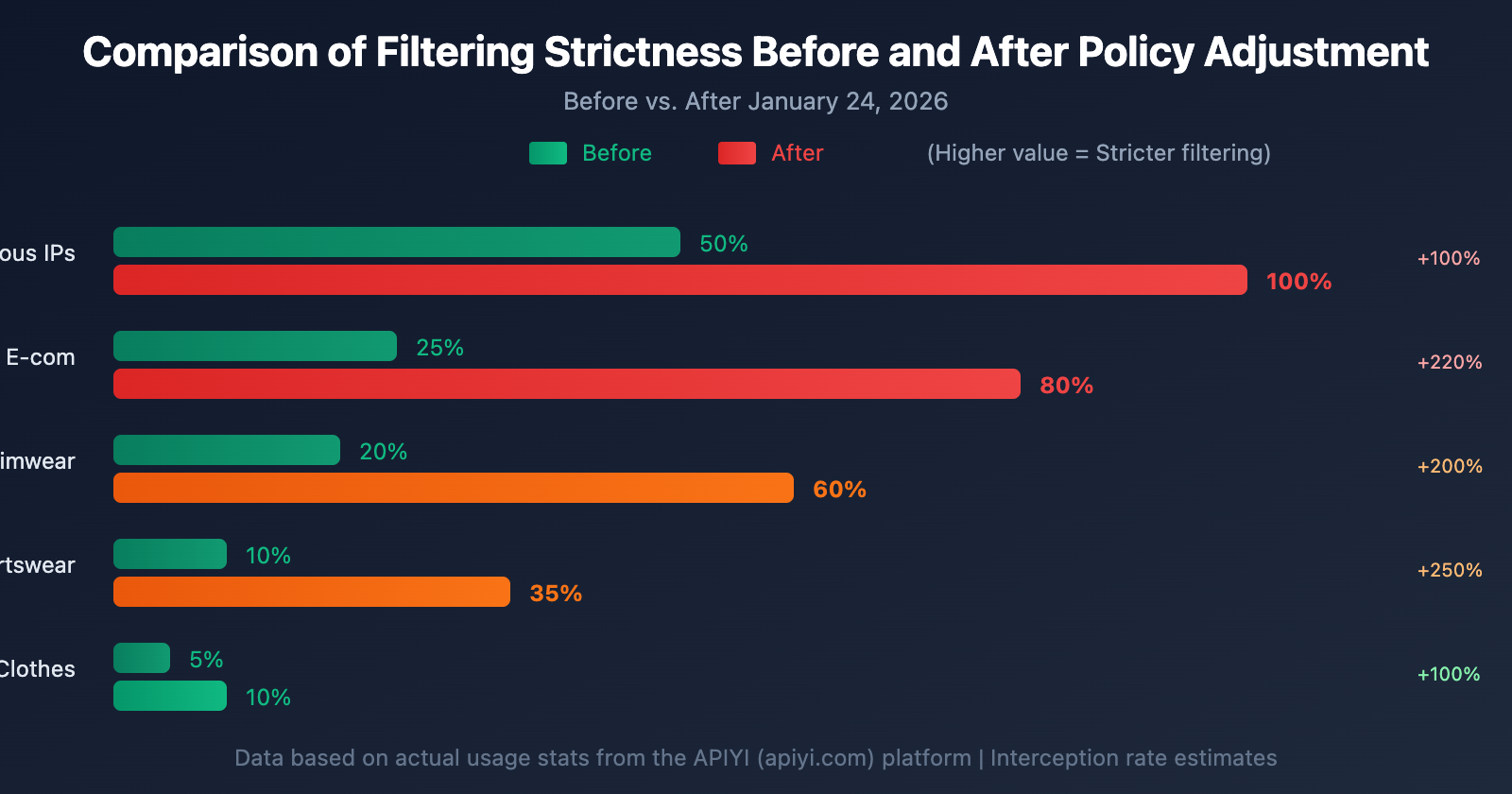
Content safety audits have become significantly stricter. Previously compliant content (such as e-commerce product photos or fashion photography) may now trigger IMAGE_SAFETY filters.
Typical Error Response:
{
  "finishReason": "IMAGE_SAFETY",
  "finishMessage": "Unable to show the generated image. The image was filtered out because it violated Google's Generative AI Prohibited Use policy. You will not be charged for blocked images. Try rephrasing the prompt. If you think this was an error, send feedback.",
  "safetyInfo": {
    "category": "HARM_CATEGORY_SEXUALLY_EXPLICIT",
    "blocked": true
  }
}
Affected Scenarios:
| Scenario | Previous Status | Current Status | Impact Level |
|---|---|---|---|
| Lingerie E-commerce Product Photos | Generated normally | Frequently blocked | High |
| Swimwear Fashion Photography | Generated normally | Partially blocked | Medium-High |
| Fitness & Sportswear | Generated normally | Occasionally blocked | Medium |
| Tight-fitting Athletic Wear | Generated normally | Occasionally blocked | Medium |
| Regular Clothing Displays | Generated normally | Mostly normal | Low |
Background Analysis of Nano Banana Pro Policy Adjustments
Driven by Disney Copyright Lawsuits
In December 2025, Disney sent a Cease and Desist Letter to Google, accusing Google's AI image generation services of "massive scale copyright infringement."
Key Points of Disney's Allegations:
| Allegation | Specific Details |
|---|---|
| Scale of Infringement | "massive scale" |
| Infringing Products | Veo, Imagen, Nano Banana, etc. |
| Method of Infringement | Generating "pristine" (high-definition) images of Disney characters |
| Involved IPs | Star Wars, Marvel, Frozen, The Lion King, etc. |
In the letter, Disney provided evidence of users generating images of its characters using simple prompts, claiming Google is "intentionally amplifying the scope of its infringement."
🎯 Background Info: Interestingly, while Disney is accusing Google of infringement, they also announced a $1 billion partnership with OpenAI, licensing their characters for use on the Sora video platform. This suggests Disney isn't against AI generation itself, but rather demands formal authorization and a share of the commercial revenue.
Increasing Industry Compliance Pressure
Beyond Disney, groups of visual artists have also filed copyright lawsuits against Google, alleging that the Imagen model was trained on their works without authorization. These legal pressures have pushed Google to proactively strengthen its content filtering.
Google's Policy Level Adjustments
In December 2024, Google updated its Generative AI Prohibited Use Policy, explicitly forbidding:
- Generating content that infringes on third-party intellectual property rights
- Using personal data or biometric features without consent
- Creating Deepfake content
- Generating non-consensual intimate imagery
This recent policy adjustment for Nano Banana Pro is the concrete implementation of these policies at the product level.
Analysis of Nano Banana Pro IMAGE_SAFETY Filtering Mechanism
How the Filter Works
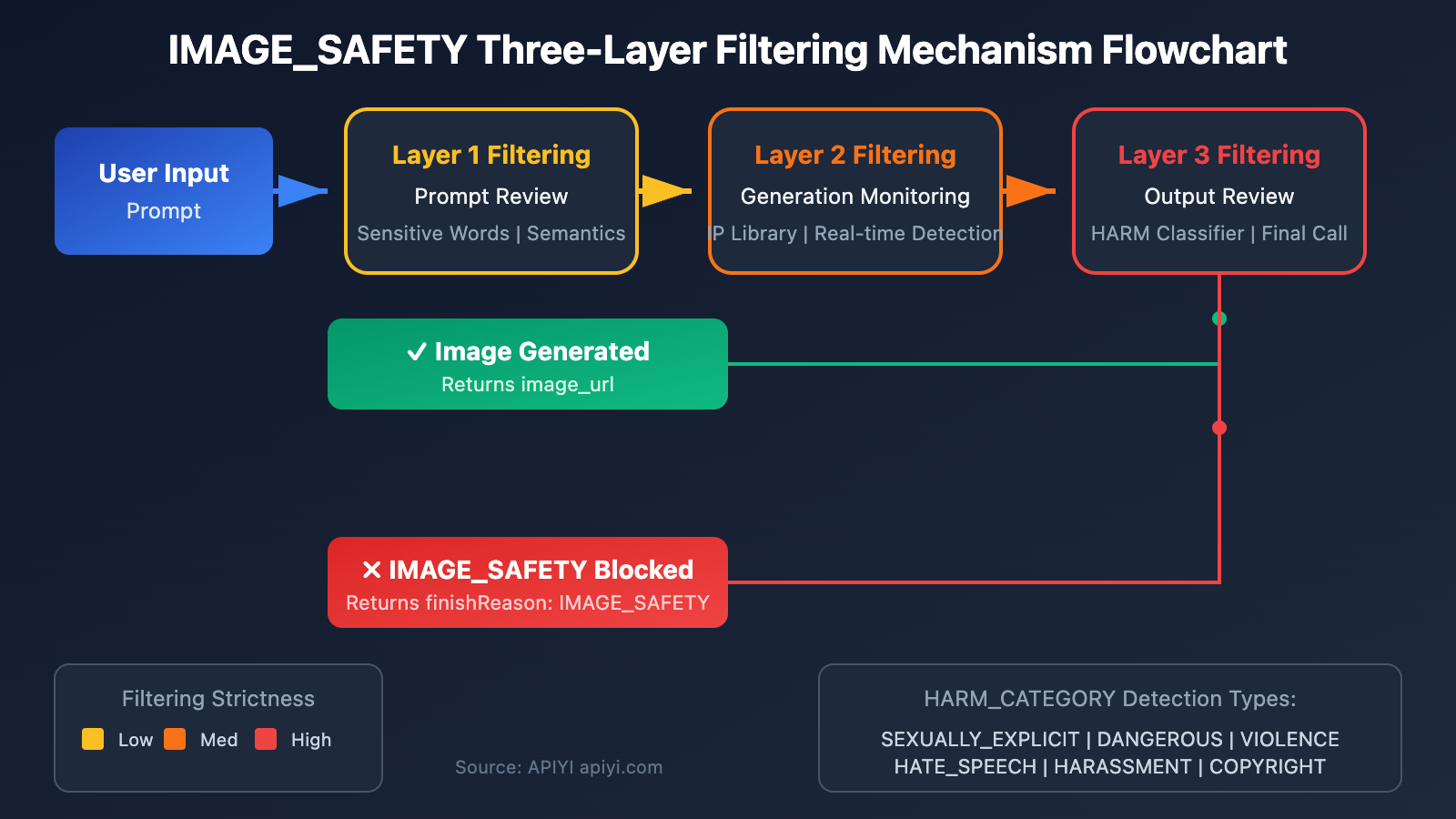
The Nano Banana Pro safety filtering system uses a multi-layered moderation mechanism:
Layer 1: Prompt Moderation
- Analyzes the text prompts entered by the user
- Detects sensitive keywords and semantic intent
- Identifies potential copyright-related descriptions
Layer 2: Generation Process Monitoring
- Real-time detection of image features during the generation process
- Comparison against a database of known IP features
- Assessment of content safety scores
Layer 3: Output Moderation
- Performs a comprehensive scan of the final image
- Applies HARM_CATEGORY classifiers
- Decides whether to release or intercept the output
Detailed Filter Categories
| Category Code | Category Name | Trigger Scenarios | Strictness |
|---|---|---|---|
HARM_CATEGORY_SEXUALLY_EXPLICIT |
Sexually Suggestive Content | Revealing clothes, intimate poses | Very Strict |
HARM_CATEGORY_DANGEROUS_CONTENT |
Dangerous Content | Weapons, violent scenes | Strict |
HARM_CATEGORY_HATE_SPEECH |
Hate Speech | Discriminatory content | Strict |
HARM_CATEGORY_HARASSMENT |
Harassment | Targeted attacks | Strict |
HARM_CATEGORY_VIOLENCE |
Violent Content | Gory, harmful scenes | Strict |
COPYRIGHT_INFRINGEMENT |
Copyright Infringement | Famous IP characters | Very Strict |
Why Is Legitimate Content Being Blocked?
There's been plenty of feedback on developer forums: why are legitimate lingerie product images for e-commerce being blocked by IMAGE_SAFETY?
Reasoning:
- Overfitted Safety Models: To ensure no violations slip through, safety models tend to adopt a "better safe than sorry" approach.
- Lack of Contextual Judgment: It's hard for the system to distinguish between "e-commerce product shots" and "inappropriate content."
- Tightened Global Strategies: Under pressure from legal lawsuits, Google has chosen to raise the overall filtering threshold.
- Black-box Decisions: Users often can't tell which specific rule was triggered.
💡 Tech Insight: By using the request log analysis features of the APIYI (apiyi.com) platform, developers can get a clearer understanding of why specific requests were blocked, which helps in optimizing prompt strategies.
Impact of Nano Banana Pro Policy Adjustments on Developers
Direct Impact
| Affected Area | Specific Manifestation | Severity |
|---|---|---|
| IP-Related Apps | Fan creation tools and fan art generation services are completely non-functional | Critical |
| E-commerce Product Images | Image generation for lingerie and swimwear categories is blocked | High |
| Fashion Photography | Some apparel display scenarios are misidentified as violations | Medium |
| Creative Design | Creations referencing styles of famous characters are restricted | Medium |
| General Purpose | Impact is relatively minor | Low |
Business-Level Impact
For the E-commerce Industry:
- AI product image generation solutions for apparel e-commerce need adjustment.
- The lingerie and swimwear categories are the most significantly affected.
- Businesses might need to revert to traditional photography or switch to alternative services.
For Content Creators:
- Derivative works and fan art generation are restricted.
- There's a need for more original designs rather than relying on IP borrowing.
- Creative freedom has seen a noticeable decline.
For AI Application Developers:
- More error-handling logic needs to be added to products.
- User experience might suffer due to frequent blocking.
- It may be necessary to introduce backup image generation services.
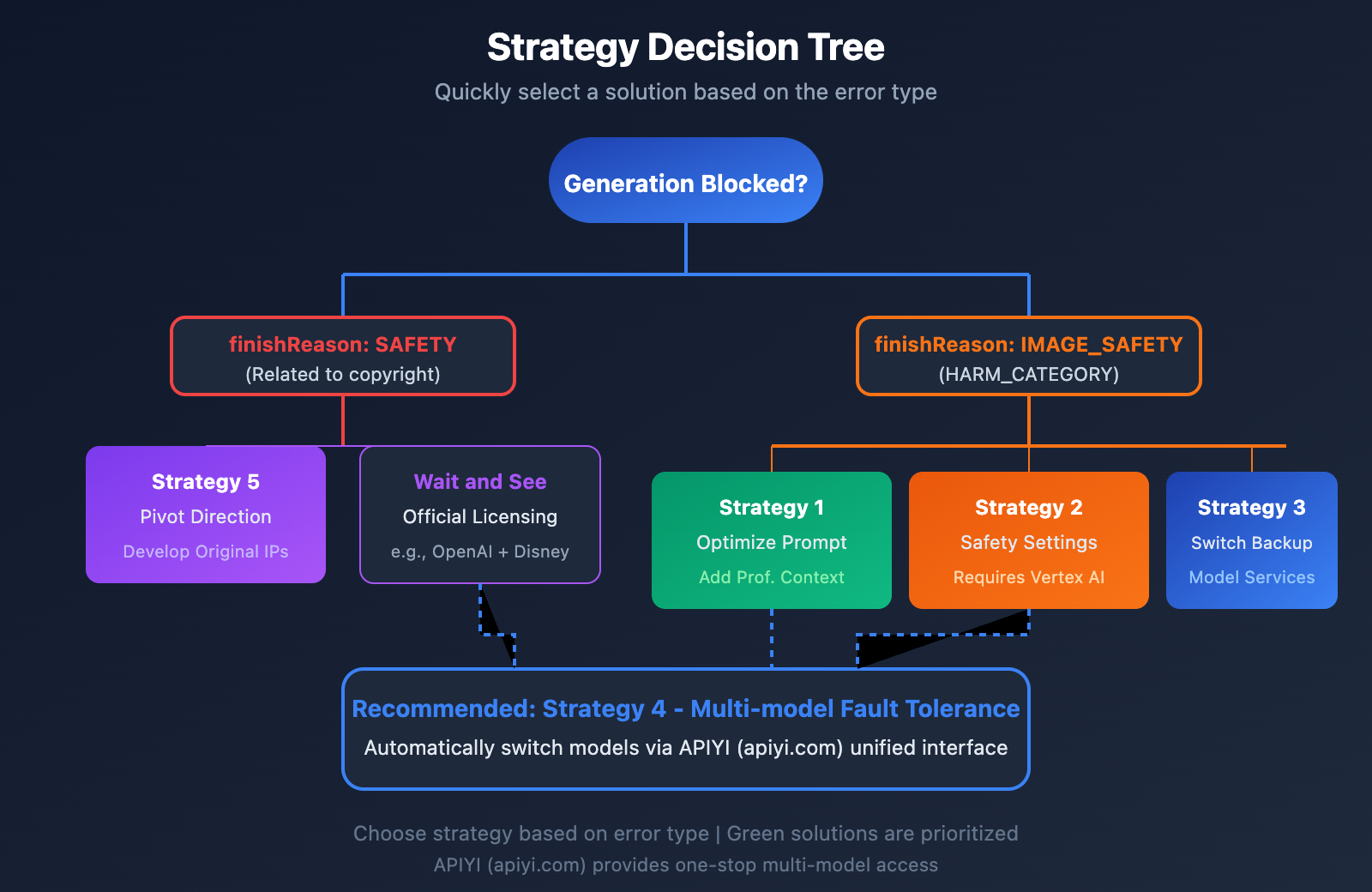
5 Strategies to Handle Nano Banana Pro Policy Adjustments
Strategy 1: Optimize Prompt Phrasing
If you're facing IMAGE_SAFETY false positives, you can try adjusting how you phrase your prompts:
# Before optimization - easy to trigger a block
prompt_before = "model wearing lace bra, fashion photography"

# After optimization - reduces the probability of misidentification
prompt_after = "fashion catalog photo, model in elegant intimate apparel, professional studio lighting, clean background"
Optimization Tips:
| Tip | Description | Example |
|---|---|---|
| Add Professional Context | Emphasize commercial or professional use | "e-commerce product photo" |
| Use Euphemisms | Avoid direct descriptions | "intimate apparel" instead of "bra" |
| Add Environmental Details | Make the content look more formal/official | "professional studio setting" |
| Clarify the Purpose | State the compliant intent | "for fashion catalog" |
Strategy 2: Adjust Safety Filter Settings
If you're using the Vertex AI version of Imagen, you can try adjusting the safety filter thresholds:
from google.cloud import aiplatform
from vertexai.preview.vision_models import ImageGenerationModel

# Adjust safety settings
safety_settings = {
    "HARM_CATEGORY_SEXUALLY_EXPLICIT": "BLOCK_ONLY_HIGH",
    "HARM_CATEGORY_DANGEROUS_CONTENT": "BLOCK_ONLY_HIGH",
}

model = ImageGenerationModel.from_pretrained("imagen-3.0")
response = model.generate_images(
    prompt="your prompt here",
    safety_filter_level="block_only_high"  # Lower filtering sensitivity
)
⚠️ Note: You can't adjust safety settings in the free version of AI Studio; you'll need the paid Vertex AI version.
Strategy 3: Use Alternative Image Generation Services
When Nano Banana Pro isn't suitable, consider other image generation services:
| Service | Strengths | Use Case | APIYI Support |
|---|---|---|---|
| DALL-E 3 | High creativity, strong compliance | Creative design, illustration | ✅ |
| Midjourney | Outstanding artistic style | Art creation, concept art | ✅ |
| Stable Diffusion | Flexible and controllable | Customized requirements | ✅ |
| Flux | Fast and cost-effective | Batch generation | ✅ |
🚀 Quick Switch: Through the APIYI (apiyi.com) platform, developers can use a unified API interface to call multiple image generation models. You can switch quickly without changing your code. When one service is blocked, you can seamlessly switch to a backup.
Strategy 4: Establish a Multi-Model Fault-Tolerance Mechanism
Implement automatic fallback logic in your application:
import openai

client = openai.OpenAI(
    api_key="YOUR_API_KEY",
    base_url="https://api.apiyi.com/v1"  # Use the APIYI unified interface
)

def generate_image_with_fallback(prompt, models=None):
    """Image generation function with fault tolerance"""
    if models is None:
        models = ["nano-banana-pro", "dall-e-3", "flux-schnell"]

    for model in models:
        try:
            response = client.images.generate(
                model=model,
                prompt=prompt,
                size="1024x1024"
            )
            return {
                "success": True,
                "model_used": model,
                "image_url": response.data[0].url
            }
        except Exception as e:
            error_msg = str(e)
            if "IMAGE_SAFETY" in error_msg or "SAFETY" in error_msg:
                print(f"{model} blocked by safety filter, trying next model...")
                continue
            else:
                print(f"{model} call failed: {error_msg}")
                continue

    return {"success": False, "error": "All models failed to generate this content"}

# Usage example
result = generate_image_with_fallback("fashion product photography, elegant dress")
View full fault-tolerance code (with retries and logging)
import openai
import time
import logging
from typing import Optional, List, Dict, Any

# Configure logging
logging.basicConfig(level=logging.INFO)
logger = logging.getLogger(__name__)

client = openai.OpenAI(
    api_key="YOUR_API_KEY",
    base_url="https://api.apiyi.com/v1"  # Use the APIYI unified interface
)

class ImageGenerationService:
    """Image generation service with fault tolerance and retries"""

    DEFAULT_MODELS = ["nano-banana-pro", "dall-e-3", "flux-schnell", "sd-xl"]

    def __init__(self, models: Optional[List[str]] = None, max_retries: int = 2):
        self.models = models or self.DEFAULT_MODELS
        self.max_retries = max_retries
        self.stats = {"success": 0, "safety_blocked": 0, "errors": 0}

    def generate(self, prompt: str, size: str = "1024x1024") -> Dict[str, Any]:
        """Generate images, automatically switching models on failure"""

        for model in self.models:
            for attempt in range(self.max_retries):
                try:
                    logger.info(f"Attempting image generation with {model} (Attempt {attempt + 1})")

                    response = client.images.generate(
                        model=model,
                        prompt=prompt,
                        size=size
                    )

                    self.stats["success"] += 1
                    logger.info(f"✅ Successfully generated image using {model}")

                    return {
                        "success": True,
                        "model_used": model,
                        "image_url": response.data[0].url,
                        "attempts": attempt + 1
                    }

                except Exception as e:
                    error_msg = str(e)

                    if "IMAGE_SAFETY" in error_msg or "SAFETY" in error_msg:
                        self.stats["safety_blocked"] += 1
                        logger.warning(f"⚠️ {model} blocked by safety filter")
                        break  # Don't retry on safety blocks, just switch models

                    elif "rate_limit" in error_msg.lower():
                        logger.warning(f"⏳ {model} rate limited, retrying after wait...")
                        time.sleep(2 ** attempt)  # Exponential backoff
                        continue

                    else:
                        self.stats["errors"] += 1
                        logger.error(f"❌ {model} call failed: {error_msg}")
                        break

        return {
            "success": False,
            "error": "All models failed to generate this content",
            "stats": self.stats
        }

    def get_stats(self) -> Dict[str, int]:
        """Get statistics"""
        return self.stats

# Usage example
service = ImageGenerationService()
result = service.generate("professional fashion photography, model in elegant evening dress")

if result["success"]:
    print(f"Success! Model used: {result['model_used']}")
    print(f"Image URL: {result['image_url']}")
else:
    print(f"Failed: {result['error']}")
Strategy 5: Adjust Business Strategies
For apps that rely heavily on well-known IPs, a fundamental pivot in business direction might be necessary:
| Original Business | Adjustment Direction | Feasibility |
|---|---|---|
| Generating Disney character images | Creating original characters, developing own IP | Mid-to-long term |
| IP derivative creation tools | Pivot to original style imitation (no specific characters) | Short-term feasible |
| Fan art generation | Wait for official authorized channels (e.g., OpenAI + Disney collab) | Wait and see |
FAQ
Q1: Why is content that used to generate fine suddenly being blocked?
Google updated its policies for Nano Banana Pro in late January 2026, primarily due to legal pressures like copyright lawsuits from Disney. The IMAGE_SAFETY filter thresholds have been significantly raised, meaning some previously compliant content might now be flagged as a false positive. We recommend testing various models on the APIYI platform to find the best alternative for your business needs.
Q2: What should I do if my e-commerce lingerie product photos are being blocked?
First, try optimizing your prompt by adding professional context like "e-commerce product photo" or "professional catalog." If it's still being intercepted, we suggest switching to other image generation services like DALL-E 3 or Flux. The APIYI (apiyi.com) platform supports a unified interface for multiple models, allowing you to switch and test them quickly.
Q3: Is it okay to generate content “in the style of” a specific character?
Describing a "similar style" is usually less likely to trigger copyright filters than directly mentioning a character's name, but it still carries risks. We recommend using more abstract descriptions, such as "colorful cartoon princess style" instead of "Elsa from Frozen style." The safest approach is to create content based entirely on original concepts.
Q4: Is this policy adjustment permanent?
It looks like copyright protection for well-known IPs is here to stay, as it's a legal compliance requirement. However, the false positive issues with IMAGE_SAFETY might improve in future versions. There's already feedback on the Google Developer Forum, and officials say they're collecting input. It's a good idea to keep an eye on the official changelogs.
Q5: How can I tell if it’s a copyright issue or a content safety issue?
Check the error message: if the finishReason is SAFETY and the message mentions "copyrighted" or "trademarked," it's a copyright issue. If the finishReason is IMAGE_SAFETY and the safetyInfo.category is something like HARM_CATEGORY_SEXUALLY_EXPLICIT, then it's a content safety issue. The strategies for handling these two are different.
Industry Impact of Nano Banana Pro Policy Adjustments
Impact on the AI Image Generation Industry
This policy adjustment reflects a major turning point in the AI image generation industry:
| Trend | Description |
|---|---|
| Copyright compliance becomes standard | Major AI services will strengthen copyright protection; this is driven by the legal landscape. |
| Content moderation continues to tighten | To avoid legal risks, service providers are trending toward higher filtering thresholds. |
| Licensed partnerships go mainstream | Collaborative models like the one between Disney and OpenAI might become the industry standard. |
| Original content is more favored | Apps that rely on borrowing IP will face significant challenges. |
Impact on the Developer Ecosystem
- A multi-model strategy is now a must: You can't rely on a single image generation service anymore.
- Fault-tolerance mechanisms need strengthening: Apps need to handle generation failures gracefully.
- Compliance awareness needs a boost: Developers need a better understanding of copyright and content safety boundaries.
💡 Development Tip: We recommend that developers use a unified interface platform like APIYI (apiyi.com) to access multiple image generation services. This reduces the risk of relying on a single provider and lets you flexibly switch to the best model for different scenarios.
Summary
The January 2026 policy adjustments for Nano Banana Pro brought two core changes: restrictions on generating famous IP and strengthened IMAGE_SAFETY filtering. This is driven by legal pressure from copyright holders like Disney and Google's proactive efforts to raise compliance standards.
Key Takeaways:
| Key Point | Content |
|---|---|
| Change 1 | Famous IP characters like those from Disney can no longer be generated. |
| Change 2 | Content safety filtering has been significantly tightened; some compliant content is being misidentified. |
| Background | Disney copyright lawsuits + industry compliance pressure. |
| Strategy | Optimize prompts, adjust safety settings, use backup services, build fault-tolerance mechanisms, and adjust business direction. |
For developers, the most pragmatic approach is to accept and actively adapt to these changes. We recommend using APIYI (apiyi.com) to quickly test various image generation models and find the best solution for your specific business scenario. The platform provides a unified API interface and supports one-click switching between different models, offering a solid safeguard against policy changes from service providers.
References:
-
Google Generative AI Prohibited Use Policy: Official usage policy document
- Link:
policies.google.com/terms/generative-ai/use-policy
- Link:
-
Vertex AI Imagen Safety Filtering Documentation: Safety settings configuration guide
- Link:
docs.cloud.google.com/vertex-ai/generative-ai/docs/image/responsible-ai-imagen
- Link:
-
Google AI Developers Forum: Nano Banana Pro IMAGE_SAFETY discussion thread
- Link:
discuss.ai.google.dev/t/nano-banana-pro-suddenly-blocking-non-nsfw-ecommerce-underwear-images-with-image-safety-error/113109
- Link:
-
Disney vs Google Reporting: Disney sends cease and desist letter to Google
- Sources: Hollywood Reporter, The Wrap (December 2025)
📝 Author: APIYI Team
📅 Release Date: 2026-01-26
🔗 Technical Support: APIYI apiyi.com – Your One-Stop AI Model API Service Platform