Author’s note: This article walks through 12 key milestones in Gemini’s history from 2023 to 2026. It shows how Google went from multimodal and long-context models to reasoning, tool use, and long-running Agent development. Gemini 4 Carbon is the latest result of that path.
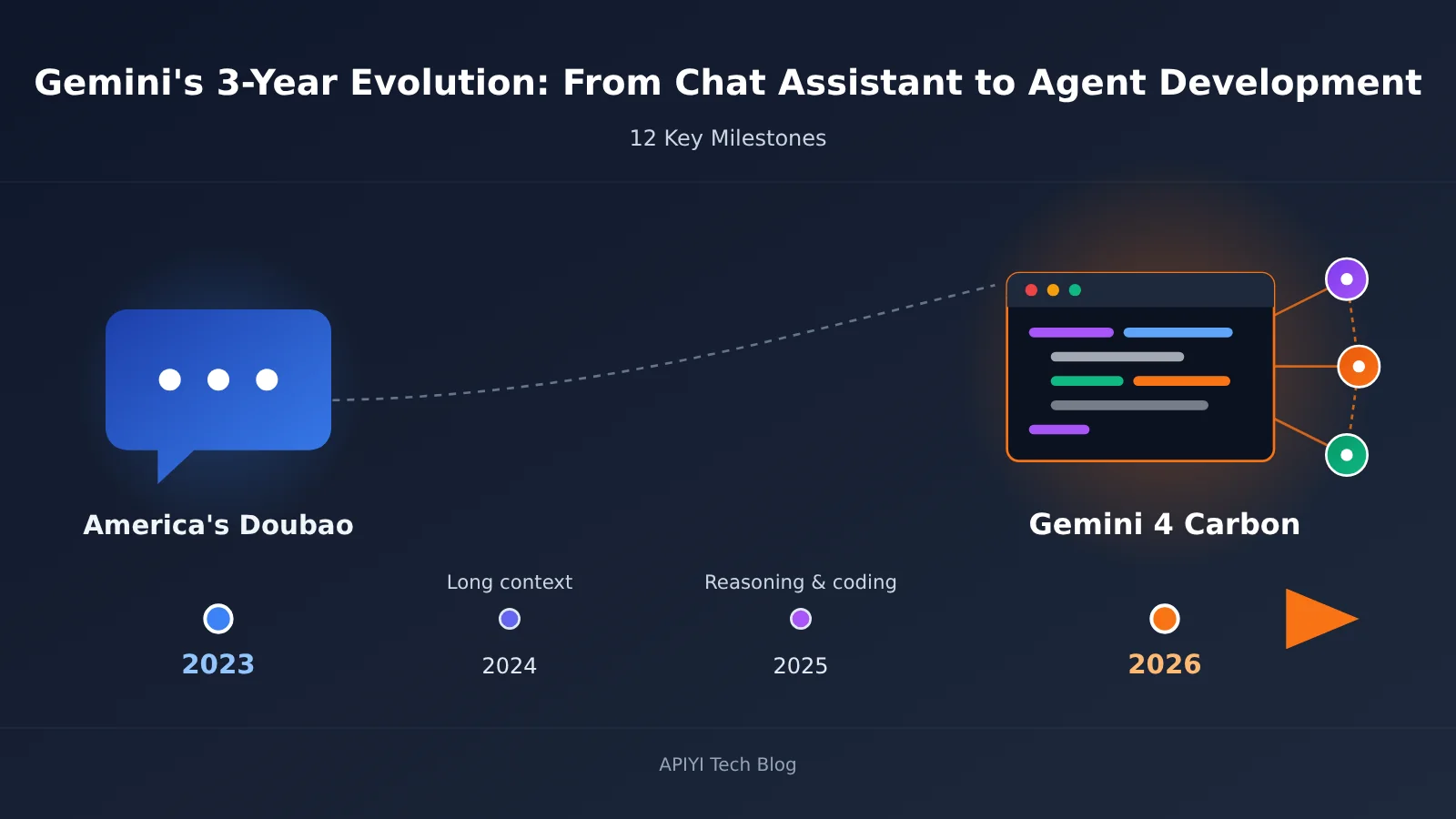
On November 10, 2026, Google expanded access to Gemini 4 Carbon for paid API developers and Google AI Ultra users. Earlier, in an evaluation published on October 28, Artificial Analysis had ranked Carbon first at the time, with a score of 59 on its Intelligence Index v5. Gemini was once jokingly called the “American Doubao” in Chinese developer circles (a jab comparing it to ByteDance’s mass-market chatbot). Now it’s in the running with the top models.
This wasn’t a sudden comeback. Carbon is the result of three years of steadily filling in gaps: multimodal capabilities, long context, reasoning, tool use, and Agent development. This article follows a “timeline + key technical changes + today’s competitive landscape” structure to explain exactly what improved in each Gemini generation. Whenever we cite an independent leaderboard, we’ll note the test category and date. We’ll also point out where competitors like Opus and Astra lead on specific tasks.
Core value: Get a clear picture of Gemini’s three years of technical evolution in one article, and decide where the Gemini 4 series fits in your development workflow.
What Gemini Has Been Through in Three Years: A Quick Look at 12 Key Milestones
Let’s start with where the nickname comes from. In the original post on the WeChat official account by Liu Xiaopai, “America’s Doubao” is a bit of a joke. Gemini has big-company backing and gets baked into phones, search, office suites, and the rest of Google’s product bundle. It’s lively at chatting, recognizing images, and serving cheap APIs. But when it comes to hardcore coding or building complex products, a lot of developers still switch back to Claude. That’s the author’s subjective summary of how people in the community see it, but it does capture the impression Gemini gave early on: lots of users, but little presence in engineering tasks.
The table below is compiled from Google’s official release announcements, and it’s the main thread for understanding this article.
| Date | Milestone | Key Changes |
|---|---|---|
| 2023-12-06 | Gemini 1.0 | Natively multimodal model family, split into Ultra, Pro, and Nano |
| 2024-02-15 | Gemini 1.5 Pro | Introduced long context, with up to 1 million tokens in early testing |
| 2024-12-11 | Gemini 2.0 | Emphasized native tool use and multimodal output, and kicked off the Agent era |
| 2025-03-25 | Gemini 2.5 Pro | A Thinking model with clearly stronger reasoning and coding |
| 2025-11-18 | Gemini 3 | Strengthened Vibe Coding and Agentic Coding, launched alongside Antigravity |
| 2026-02-19 | Gemini 3.1 Pro | Further improved core reasoning for complex tasks |
| 2026-05-19 | Gemini 3.5 Flash | Improved speed, reasoning, and long-running Agent execution |
| 2026-09-02 | Gemini 3.8 Flash | Optimized for software engineering, tool calling, and complex Agent workflows |
| 2026-09-30 | Gemini 4 Argon announced | Shifted focus to long-running workflows, engineering, and cybersecurity |
| 2026-10-13 | Argon opened to developers | Available through the paid API and Antigravity |
| 2026-10-28 | Gemini 4 Carbon announced | Built for highly complex reasoning, software engineering, and cybersecurity; opened first to a limited group of professionals |
| 2026-11-10 | Carbon access expanded | Added to the developer API and the Google AI Ultra product lineup |
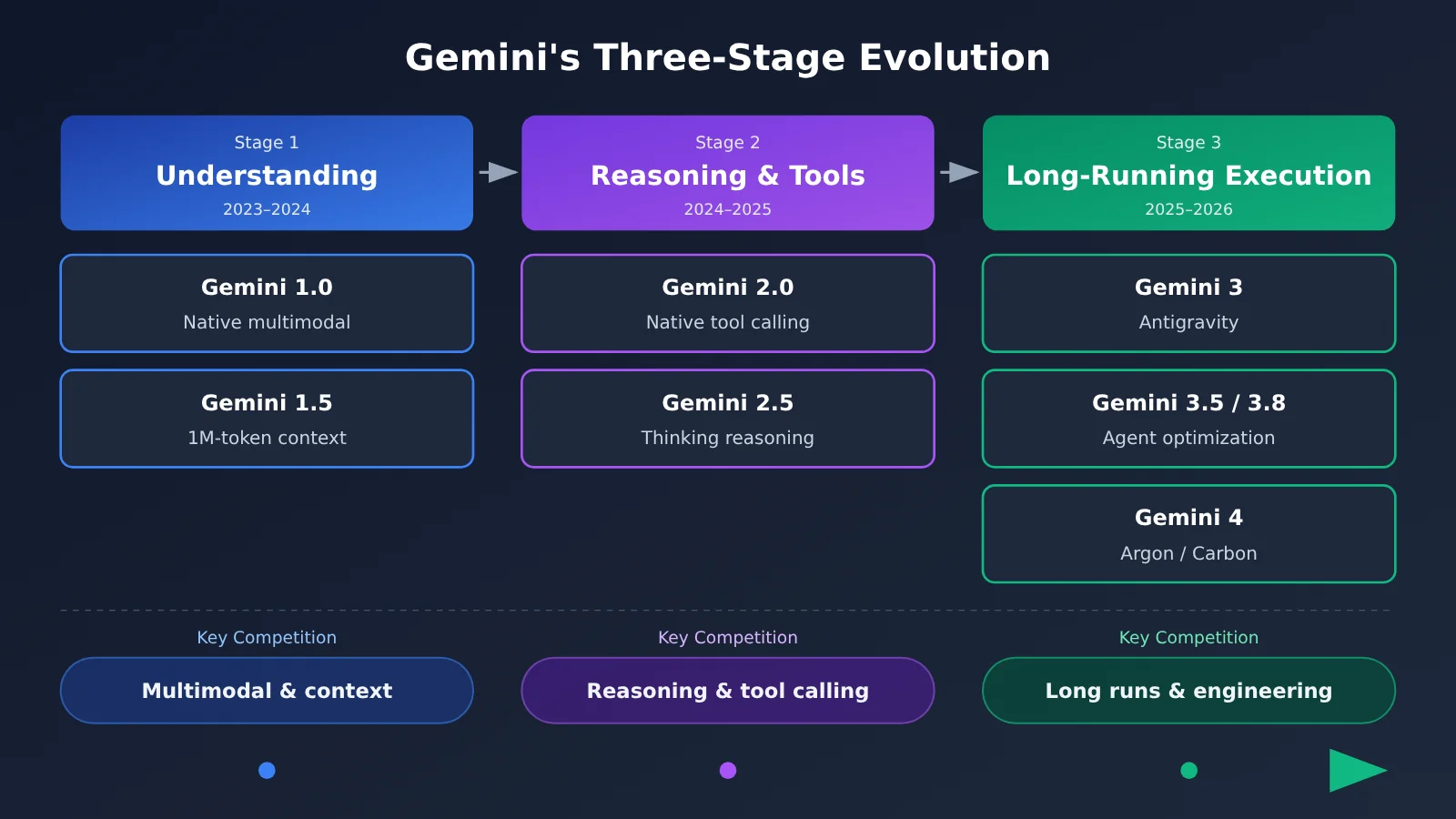
You can sum up these 12 milestones in one sentence: early Gemini’s core value was “understanding information.” Over time it added “reasoning through problems” and “calling tools,” and it finally arrived at “executing complex tasks.”
What’s Changed with Gemini, the “American Doubao”
Carbon first caught people’s attention because of its results on independent leaderboards. Artificial Analysis is a third-party evaluation organization that developers widely reference. On October 28, 2026, it published a dedicated analysis of Carbon. Here are the key numbers.
| Benchmark (Artificial Analysis) | Gemini 4 Carbon | Comparison | Notes |
|---|---|---|---|
| Intelligence Index v5 (Oct 28 report) | 59 points, #1 at the time | — | Ranked first on 4 of the 9 component metrics |
| Overall model leaderboard (later update) | Carbon High: 60 points | Opus 5.5 Max: 59 points; GPT-6 Astra Max: 57 points | The leaderboard updates in real time, so rankings may change |
| Coding Agent Index | Carbon High inside Antigravity CLI: 59 points | Opus 5.5 Max inside Claude Code: 62 points | Opus still leads in coding agent scenarios |
| AA-Briefcase knowledge work | 1609 Elo | Gemini 4 Argon: 1483 Elo | 126 points higher than Argon |
Two things to keep in mind when you read this table. First, every score here is tied to a specific model configuration, such as Carbon High or Opus 5.5 Max, so you can’t mix results across different reasoning tiers. Second, leading on the overall score doesn’t mean leading on every individual benchmark: in the Coding Agent Index, Opus 5.5 Max inside Claude Code still scores 3 points higher than Carbon High.
Also, the real-time leaderboard screenshot shared by the original WeChat article’s author shows another model, Claude Fable 5.2, ranked above Carbon. The author finds it slow on individual tasks and expensive, so they settled on a “Carbon for main development + Fable for final review” workflow. That’s one person’s own experience. It’s worth considering, but it shouldn’t be treated as a universal conclusion.
Gemini’s Early Competitive Edge: Multimodality and Long Context (2023–2024)
Gemini 1.0: Multimodal by Design
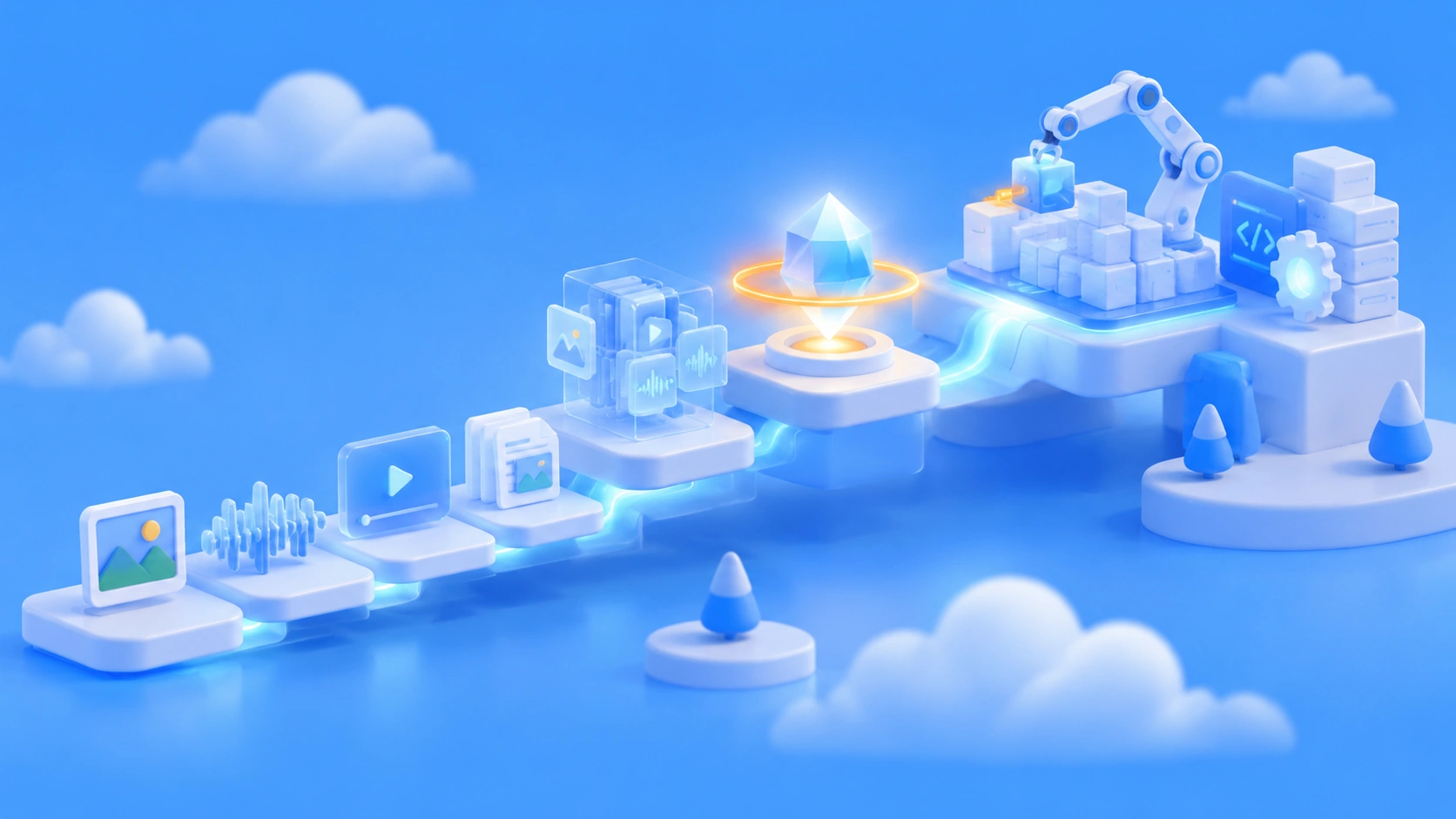
Gemini 1.0, released in December 2023, was defined by being “natively multimodal.” It was designed from the ground up to handle many types of information, including text, images, audio, video, and code, rather than starting with a text model and bolting on a vision module. If you upload a chart along with a paragraph of text, the model can understand how the two relate within a single system.
This generation tackled the question of “how many kinds of information can the model understand?” The Ultra, Pro, and Nano tiers targeted high performance, general-purpose use, and on-device scenarios respectively, which also laid the groundwork for Gemini’s later arrival on phones and other devices.
Gemini 1.5 Pro: Long Context Becomes a Battleground
In February 2024, Gemini 1.5 Pro turned long context into a major selling point, with Google showcasing a 1 million token context window. Think of the context window as the model’s workbench: the bigger the bench, the more material you can spread out at once. Google’s own examples included analyzing long videos, long audio, and large codebases. For developers, that means you can hand the model the key code of an entire project in one go and let it work out how the modules call each other, instead of feeding it piece by piece.
Gemini 2.0: A Clear Turn Toward Agents
Gemini 2.0, released in December 2024, marked a change in direction. Google began explicitly targeting the agent era, emphasizing native tool capabilities such as search, code execution, and function calling. It also showed off agent research efforts like Project Mariner around the same time.
Here’s an easy way to think about tool use. Before, a model could only answer “What’s the latest version of this library today?” from memory. With tool use, it can actively request a search, or even run a piece of code and look at the result. The model’s role starts shifting from “answerer” to “operator.”
Gemini’s Reasoning and Coding Turnaround: Thinking and Antigravity in 2025
Gemini 2.5: Thinking Lets the Model Reason Before It Answers
Gemini 2.5 Pro, released in March 2025, introduced Thinking, and its reasoning and coding abilities improved noticeably. Thinking means the model works through multiple reasoning steps before it gives an answer. Take debugging as an example. In standard mode, a model might jump straight to a fix that “looks right.” In Thinking mode, it first guesses at possible causes, rules out the hypotheses that don’t hold up, and then proposes a change. In May 2025, Google announced that 2.5 Pro had taken the lead on leaderboards like WebDev Arena at the time. It was the first time Gemini made a real mark on coding-related leaderboards.
Gemini 3 and Antigravity: From a Model to a Working Environment
On November 18, 2025, Google launched Gemini 3 and Antigravity together. Antigravity brings the editor, terminal, and browser actions into a single agent workspace. What matters here is that Google no longer wanted the model to just “write code.” It wanted the model to run the code itself, open a browser to check the result, spot problems, and fix them.
That’s what Agentic Coding means: the agent plans, writes, runs, and checks the code, while developers focus more on setting goals and reviewing results. From this point on, the model and the toolchain were designed together, and that’s a big part of how Gemini caught up.
Gemini 4 Argon vs. Carbon: Gemini Heads Toward Complex Engineering in 2026
Gemini’s release cadence picked up noticeably in 2026. 3.1 Pro strengthened core reasoning in February, 3.5 Flash balanced speed with long-running Agent execution in May, and 3.8 Flash was optimized for software engineering, tool calling, and complex Agent workflows in September. Then Gemini 4 Argon and Carbon arrived back to back.
The positioning difference between the two is the first thing developers need to get straight.
| Comparison | Gemini 4 Argon | Gemini 4 Carbon |
|---|---|---|
| Official positioning | Most everyday software engineering and knowledge work | Complex debugging, deep reasoning, long-running tasks |
| Availability | Opened to developers on 2026-10-13 | Wider availability on 2026-11-10 |
| Relationship | Base model | Built on top of Argon |
| Context | See the official docs | Model card lists up to 1M tokens (input and output combined) |
| Access | Gemini API, Antigravity, aggregator platforms such as APIYI (apiyi.com) (check the model list) | Gemini API, Google AI Ultra, aggregator platforms (check the model list) |
In short, Argon is for day-to-day work: writing features, fixing bugs, handling documents. Carbon is for tasks that need long stretches of continuous reasoning, span multiple stages, and require repeated verification, like tracking down a tricky concurrency issue in a large repo. On the AA-Briefcase knowledge-work benchmark, Carbon scores 126 Elo higher than Argon, which confirms the gap between the two on complex tasks is real.
Where Gemini 4 Carbon Actually Sits on the Web Development Leaderboard
Leading on overall intelligence doesn’t mean leading on every development task. The WebDev Arena leaderboard from November 10, 2026 is a good counterexample.
| Model | WebDev Elo | Notes |
|---|---|---|
| Claude Opus 5.5 Max | 1814 | #1 on this leaderboard |
| Gemini 4 Carbon High | 1768 | Marked Preliminary at the time |
| GPT-6 Astra Max | 1764 | Just 4 points behind Carbon |
As you can see, on web development specifically, Opus 5.5 Max leads by nearly 50 points, Carbon and Astra are essentially tied, and Carbon’s score is still preliminary. The author of the original WeChat article thinks highly of Carbon’s UI aesthetics and says it renders the page and checks its own layout. That kind of behavior is worth watching, but it’s still a personal observation, so validate it against your own projects.
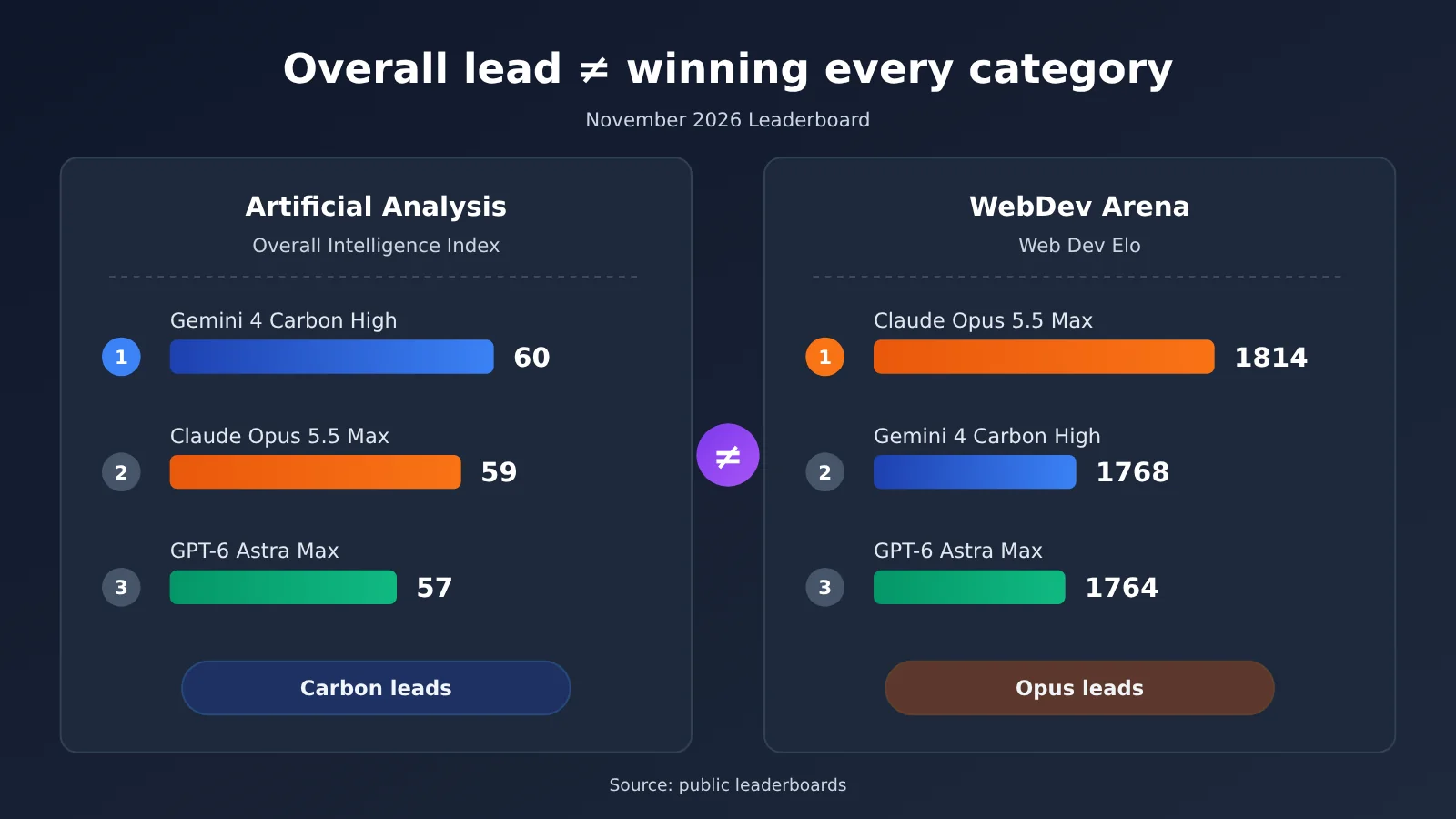
Chart note: The leaderboard data comes from the public pages of Artificial Analysis and Arena, and each leaderboard tests different categories. If you want to check the differences on your own business prompts, you can use APIYI (apiyi.com) to switch between models through the same OpenAI-compatible interface and test them directly.
Why Gemini Made a Comeback: Impact Analysis
Model Capabilities: From “Seeing a Lot” to “Getting Things Done”
Looking back over three years, Gemini has shifted its competitive focus three times. First it was about how many kinds of information a model could understand and how much it could process at once. Then it was reasoning and tool use. Now it’s about carrying out complex engineering tasks over long stretches of time. None of that earlier work went to waste. Multimodal capability lets the model read screenshots and design mockups, a long context window lets it hold an entire codebase, and Thinking plus tool calling lets it actually get its hands dirty.
Tool Ecosystem: Models and Execution Environments Designed Together
Antigravity, AI Studio, and the Gemini App, together with Google’s various developer services, cover everything from trying things out to prototyping to building a production product. This is a key difference between Google and vendors that only offer a model API: an Agent needs “hands and feet” like an editor, a terminal, and a browser, and Google can provide the complete execution environment itself.
Distribution and Pricing: Reaching Both Developers and Everyday Users
On the subscription side, on May 19, 2026, Google added a $100 Ultra tier and cut the top tier from $250 to $200. These offer roughly 5x and 20x the base quota of the $20 Pro tier, respectively. On the API side, Carbon’s public pricing is as follows.
| Period | Input (per million tokens) | Output (per million tokens) |
|---|---|---|
| Before 2026-11-30 | $2 | $10 |
| From 2026-12-01 | $4 | $20 |
A quick reminder: plan benefits and prices are subject to Google’s official pages and the dates they apply to. Absolute claims in the original WeChat article, such as “unlimited quota” and “no risk of account bans,” are not official commitments.
Impact on Developers
- Model selection shifts from “one dominant vendor” to “division of labor by task”: For general reasoning, consider Carbon first. For web development and coding Agent scenarios, compare against Opus. For everyday tasks where cost-effectiveness matters, Argon is an option.
- Cost structure needs to be re-planned: Carbon’s price doubles on December 1, and long-running Agent tasks burn through tokens quickly, so estimate your budget in advance.
- Validation needs to go back to real tasks: Leaderboards can only narrow down your candidates. In the end, you still need to test with your own codebase and prompts.
Impact on the Industry
- The three-way race is getting clearer: Google, OpenAI, and Anthropic are competing head-to-head on complex development tasks, and each keeps an edge in different specialties.
- The unit of competition is shifting from models to workflows: Going forward, the comparison won’t be just about model scores. It will also include the full toolchain, such as the IDE, CLI, and multi-Agent collaboration.
How to Try the Gemini 4 Series Through the API
If you want to test things yourself, the fastest route is to call the models directly through an OpenAI-compatible interface. The minimal example below runs as soon as you swap in your API key. Model names follow the platform’s model list:
import openai

client = openai.OpenAI(
    api_key="YOUR_API_KEY",
    base_url="https://api.apiyi.com/v1"
)

response = client.chat.completions.create(
    model="gemini-4-carbon",  # Model names follow the platform's model list
    messages=[{"role": "user", "content": "用三句话解释什么是 Agentic Coding"}]
)
print(response.choices[0].message.content)
View the full implementation: routing between Argon and Carbon by task complexity
import openai
from typing import Optional

client = openai.OpenAI(
    api_key="YOUR_API_KEY",
    base_url="https://api.apiyi.com/v1"
)

# Model names follow the platform's model list
MODEL_ROUTER = {
    "simple": "gemini-4-argon",   # Everyday development and knowledge work
    "complex": "gemini-4-carbon"  # Complex debugging, deep reasoning, long-running tasks
}

def ask_gemini(
    prompt: str,
    complexity: str = "simple",
    system_prompt: Optional[str] = None,
    max_tokens: int = 2000
) -> str:
    """Pick a Gemini 4 series model based on task complexity"""
    model = MODEL_ROUTER.get(complexity, MODEL_ROUTER["simple"])
    messages = []
    if system_prompt:
        messages.append({"role": "system", "content": system_prompt})
    messages.append({"role": "user", "content": prompt})

    try:
        resp = client.chat.completions.create(
            model=model,
            messages=messages,
            max_tokens=max_tokens
        )
        return resp.choices[0].message.content
    except Exception as e:
        return f"Error: {e}"

# Everyday tasks go to Argon, complex debugging goes to Carbon
print(ask_gemini("给这个函数补充类型注解", complexity="simple"))
print(ask_gemini(
    "分析以下并发代码可能出现死锁的原因,并给出修复方案",
    complexity="complex",
    system_prompt="你是资深后端工程师,先列假设再逐一验证"
))
Quick-start tip: Carbon’s API pricing changes on December 1, so start with a small test sample. Sign up at APIYI (apiyi.com) to get free testing credits. A single API key lets you call Gemini, Claude, OpenAI, and other models, which makes it easy to compare them side by side on the same prompt.
FAQ
Q1: Why is Gemini called the “American Doubao”?
It’s a joke that started in Chinese developer circles. The idea is that Gemini has big-company backing and shows up everywhere in Google’s product suite. It’s lively for everyday chat and image recognition, but early on it wasn’t the first pick for hardcore coding work. That impression is changing as Gemini 3, Antigravity, and the Gemini 4 series roll out.
Q2: Which is stronger, Gemini 4 Carbon or Claude Opus 5.5?
It depends on the benchmark category. On the Artificial Analysis overall leaderboard, Carbon High (60 points) edges out Opus 5.5 Max (59 points). But on the Coding Agent Index, Opus 5.5 Max leads with 62 points versus Carbon High’s 59, and Opus is also clearly ahead on WebDev Arena.
Q3: When can I use Carbon?
Carbon was announced on October 28, 2026, and was first opened to a limited group of professionals. On November 10, access expanded, and it became available through the paid developer API and the Google AI Ultra plan.
Q4: For day-to-day development, should I choose Argon or Carbon?
According to Google’s own positioning, Argon suits most routine software engineering and knowledge work, while Carbon is built for complex debugging, deep reasoning, and long-running tasks. A safe approach is to use code-based routing to separate tasks, then run the same prompts through both models on APIYI (apiyi.com) to compare quality and cost before you pick a default model.
Q5: How do I quickly call the Gemini 4 series through the API?
1. Go to APIYI (apiyi.com), sign up, and get your API key
2. Claim the free test credits for new users
3. Use the code in this article, set `base_url` to `https://api.apiyi.com/v1`, and fill in the model name from the platform’s model list
Key Takeaways: Three Years of Gemini’s Evolution
- The through-line: Gemini went from understanding information, to reasoning through problems, to carrying out complex tasks over long stretches of time
- Early groundwork: Native multimodal in 1.0 and the million-token context window in 1.5 laid the foundation for everything that followed
- The turning point: Thinking in 2.5 and Antigravity in the 3 generation moved Gemini into the main arena of coding
- Division of labor: Argon handles everyday development, while Carbon takes on complex debugging and long-horizon reasoning
- Reading the leaderboards sensibly: Carbon leads on overall score, but Opus still holds an edge on WebDev and coding-agent benchmarks
- Getting started: You can test Gemini alongside other leading models through a unified interface at APIYI (apiyi.com)
Summary
Gemini’s journey from the “American Doubao” to a top-tier coding model over the past three years comes down to three points:
- Capabilities stack up layer by layer: Multimodal, long context, Thinking, tool use, and long-running execution each build on the one before.
- Ecosystem is what turned things around: Toolchains like Antigravity gave the model a real environment to work in, and Google’s product distribution put those capabilities in front of a huge number of users.
- The competition is still multipolar: Carbon has made it into the top tier, but Opus and Astra each have their own strengths, so the best strategy for developers is to pick models by task.
Gemini used to be seen mostly as an assistant for Google’s suite of products. Today it’s a serious candidate for the primary model in complex engineering and agent development. Leaderboards are just a starting point, though, and the real answer has to come from running models on your own projects. We’d suggest using the free credits at APIYI (apiyi.com) to test the Gemini 4 series against your other candidates on the same tasks, then deciding on your team’s main lineup.
📚 References
- Google Official Blog: Gemini 1.0 Launch: Introduction to the native multimodal model family
- Link:
blog.google/innovation-and-ai/technology/ai/google-gemini-ai -
Notes: Understand Gemini’s original design goals
-
Google Official Blog: Gemini 3 and Antigravity: Agentic coding and the development environment launch
- Link:
blog.google/products-and-platforms/products/gemini/gemini-3 -
Notes: Understand Google’s shift from models to full working environments
-
Google Official Blog: Gemini 4 Carbon Availability and Pricing: Rollout scope and API pricing
- Link:
blog.google/innovation-and-ai/models-and-research/gemini-models/gemini-4-carbon-now-available -
Notes: The official positioning differences between Carbon and Argon
-
Google DeepMind: Carbon Model Card: Context and capability details
- Link:
deepmind.google/models/model-cards/gemini-4-carbon -
Notes: Check technical specs such as the 1M-token context window
-
Artificial Analysis: Carbon Evaluation Report: Independent, comprehensive benchmarking
- Link:
artificialanalysis.ai/articles/gemini-4-carbon-new-number-1 -
Notes: Source of the Intelligence Index, Coding Agent Index, and other data
-
Arena: WebDev Leaderboard: Rankings for web development tasks
- Link:
arena.ai/leaderboard/code/webdev -
Notes: Compare how different models perform on web development tasks
-
Gemini API Official Pricing: Latest billing rules
- Link:
ai.google.dev/gemini-api/docs/pricing - Notes: For pricing, always refer to the live information on the official page
Author: APIYI Technical Team
Get in touch: Contact us from the APIYI homepage. For more integration guides, visit the docs.apiyi.com documentation center.