
Author’s note: This article examines Alphabet’s disclosure in its Q3 2026 earnings report that its first-party model APIs process nearly 32 billion tokens per minute. It distinguishes between conclusions supported by the data and what remains unknown.
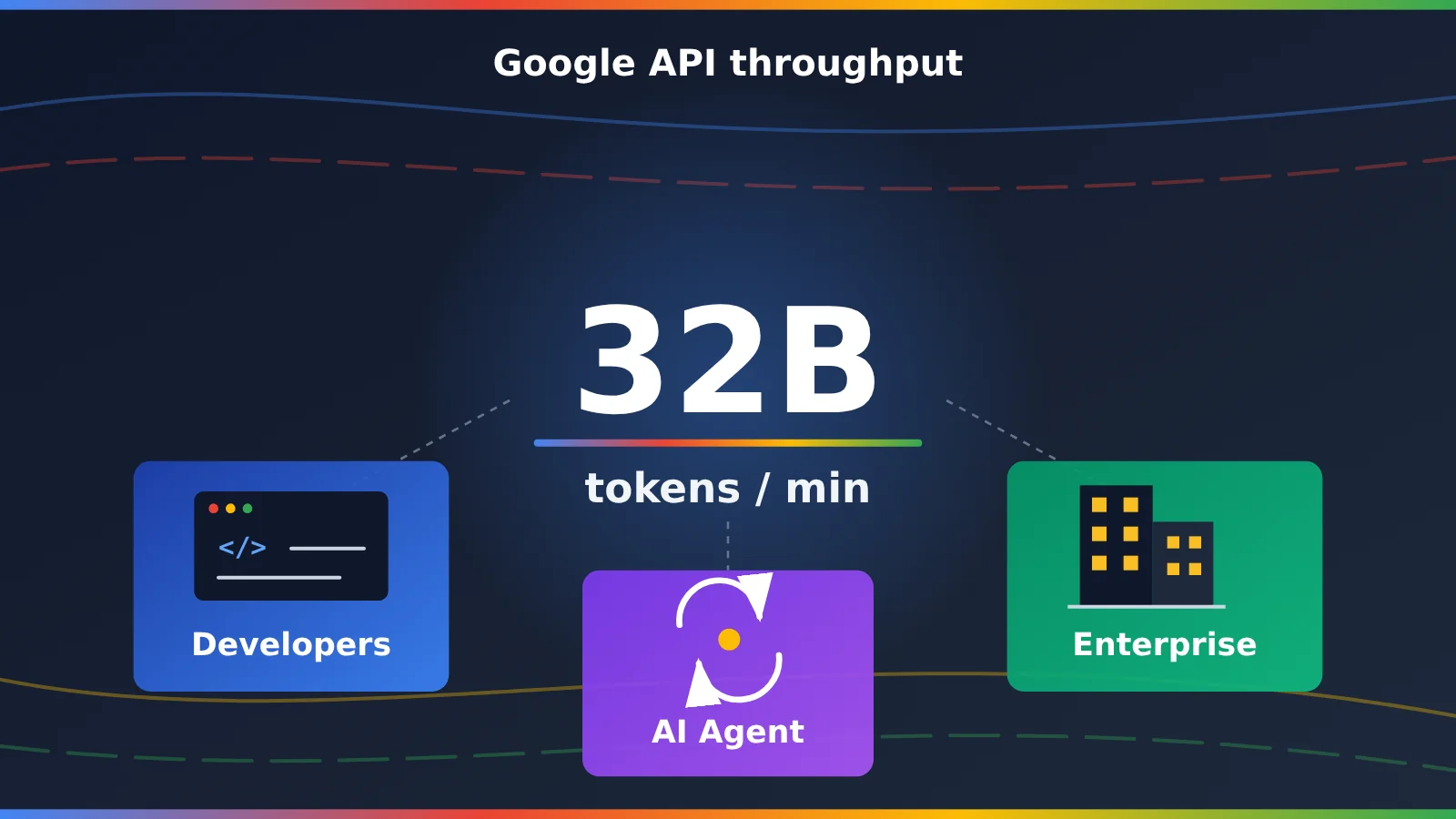
On October 28, 2026 (U.S. time), Alphabet released its third-quarter earnings report. In his remarks, CEO Sundar Pichai shared a striking figure: Google’s first-party model APIs process nearly 32 billion tokens per minute—up about 40% from the figure disclosed in the previous quarter and more than four times the level a year earlier.
This isn’t a back-of-the-envelope estimate. The figure comes directly from the CEO’s earnings remarks on Google’s official blog: “Our first-party model APIs are now processing nearly 32 billion tokens per minute”. But it’s easy to misread: it doesn’t mean 32 billion API calls, and it doesn’t measure Gemini App usage.
The takeaway: In three minutes, you’ll understand what Google’s 32-billion-token API figure measures, how it’s grown, and where developers, enterprise customers, and AI agents each use that compute.
Google API’s 32 Billion Tokens: Key Facts at a Glance
Let’s start with the reported facts. The analysis that follows is based on the information disclosed so far.
| Item | Details |
|---|---|
| Disclosure date | October 28, 2026, during Alphabet’s Q3 earnings call |
| Disclosed by | Alphabet CEO Sundar Pichai |
| Key figure | First-party model APIs process nearly 32 billion tokens per minute |
| Quarter-over-quarter change | Up approximately 40% from the figure disclosed in the previous quarter, according to Google |
| Year-over-year change | More than four times the level of a year earlier |
| Scope | Google’s first-party model APIs as a whole, not any single Gemini model |
| Not disclosed | Breakdown by model, customer, industry, or API product |
What Google’s 32 Billion Tokens Figure Does—and Doesn’t—Cover
To understand this news, it’s important to distinguish between metrics that are often conflated. The 32 billion figure refers to tokens, not API requests. A single request to analyze a long document can contain hundreds of thousands of tokens. It also describes the current processing rate reported on October 28, not the average for the entire third quarter.
The earnings report and call also mentioned developer counts, enterprise seats, and Gemini Enterprise usage. These metrics have different scopes, so they can’t be added together or used to calculate one another.
| Metric | Figure and date | Scope | Can it be added to 32 billion tokens/minute? |
|---|---|---|---|
| First-party model API throughput | Nearly 32 billion tokens/minute (2026-10-28) | Current processing rate | This is the core metric itself |
| Monthly active developers | More than 9 million/month (disclosed in Q2) | Developers using model APIs and major developer products | No; it’s a count of people, not paying customers |
| Developer tool tokens | More than 3 trillion per day (June 2026 materials) | Usage associated with developer tools | No; the scope is different |
| High-usage Gemini Enterprise customers | More than 2,600 customers using ≥100 billion tokens (over the past 12 months) | Enterprise product customer usage | No |
| Knowledge worker seats | More than 100 million sold to date | Across all Google AI services | No; these are seats, not API customers |
One more point is worth emphasizing: this figure doesn’t support a claim that the Gemini app consumes 32 billion tokens per minute. The app, Search, enterprise seats, and API tokens represent different business lines and metrics.
Google API Token Throughput Timeline
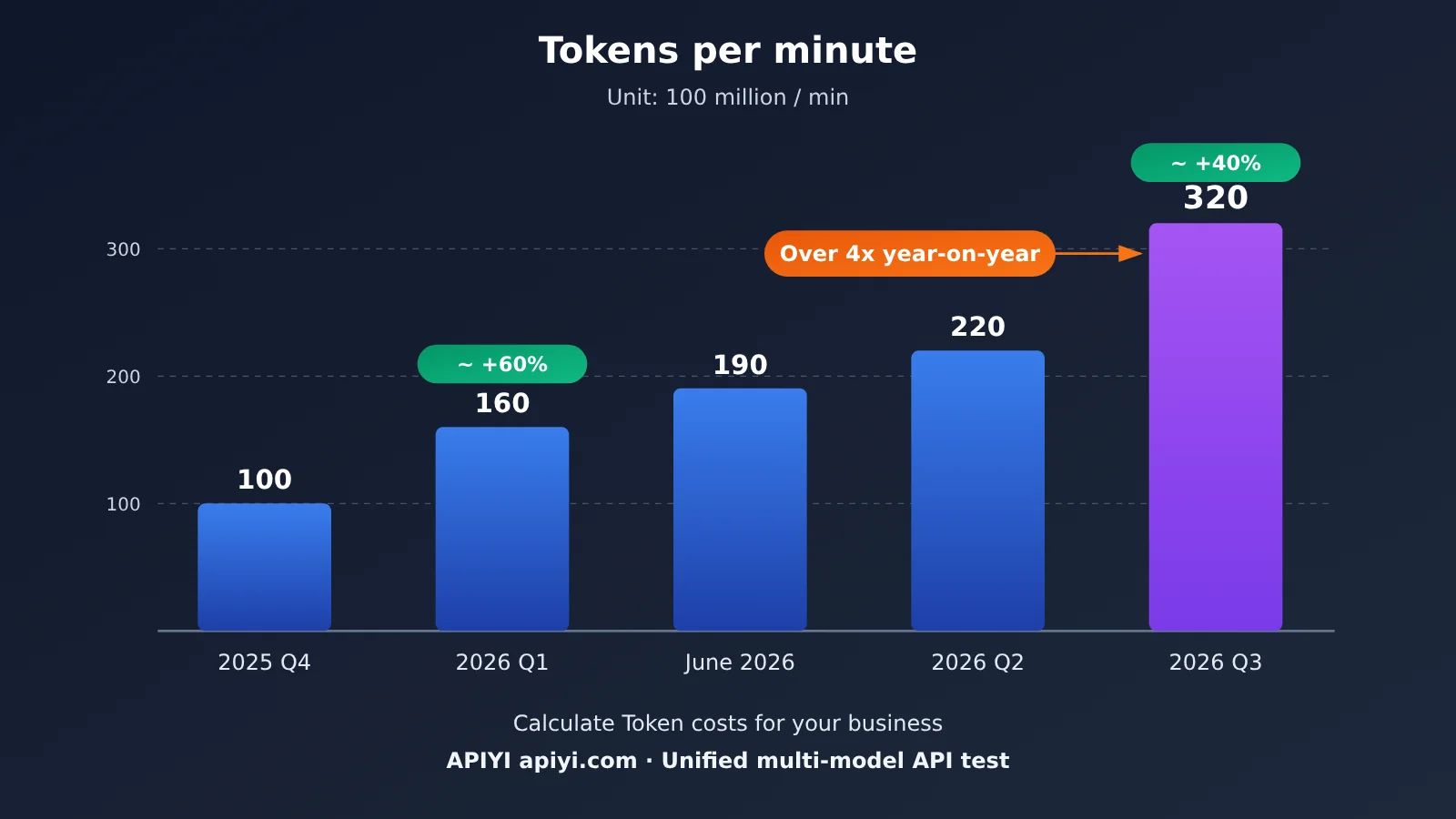
Put the recent public disclosures together, and the steepness of the curve tells a bigger story than any single number.
| Disclosure date | Occasion | Tokens per minute | Notes |
|---|---|---|---|
| Q4 2025 | Quarterly disclosure | About 10 billion | Starting point |
| 2026-04-29 | Q1 earnings report | Over 16 billion | Up about 60% from the previous quarter |
| June 2026 | Investor presentation | About 19 billion | Mid-quarter figure |
| 2026-07-22 | Q2 earnings report | About 22 billion | — |
| 2026-10-28 | Q3 earnings call | Nearly 32 billion | Google reported growth of about 40% quarter over quarter and more than 4x year over year |
If you calculate the increase directly from 22 billion to 32 billion, it’s about 45.5%. But both figures are approximate (“about” and “nearly”), so Google’s official figure of “about 40%” should be used. That doesn’t mean Google got the calculation wrong.
Putting 32 Billion Tokens per Minute in Perspective
To make the scale easier to grasp, here’s what the numbers look like at a constant rate. The daily and monthly figures are hypothetical calculations, not actual usage reported by Google.
- Per second: About 533 million tokens
- Per hour: About 1.92 trillion tokens
- Over 24 hours at a constant rate: About 46.08 trillion tokens
- Over 30 days at a constant rate: About 1,382.4 trillion tokens
Who’s Consuming Google API’s 32 Billion Tokens?
That’s the question the title raises. Based on information Google has made public, we can identify three major groups of users, but Google hasn’t disclosed the exact share attributable to any of them.
Group 1: The Google API Developer Ecosystem
Google’s Q2 earnings report shows that more than 9 million developers build applications each month using Google model APIs and its major developer products. That points to a huge potential developer community, but it doesn’t mean there are 9 million paying customers, or that every developer calls the Gemini API directly.
During the same period, the Antigravity agent development platform had more than 2.4 million weekly active users. Developers consume tokens in use cases such as:
- Coding and software development: Reading code repositories, refactoring code, generating tests, locating bugs, and repeated calls by coding agents
- AI application development: Chatbots on websites and in apps, customer service automation, internal enterprise search, and PDF and long-document analysis
- Agent workflows: Planning tasks, calling external tools, reading tool results, correcting errors, and carrying out subsequent steps
Second category: Gemini Enterprise customers
Google Cloud CEO Thomas Kurian shared enterprise usage figures on the Q3 earnings call. Over the past 12 months, more than 2,600 customers each used at least 100 billion tokens on Gemini Enterprise, with around 75 using at least 10 trillion tokens. Nearly 90% of Fortune 100 companies use Gemini Enterprise.
Another notable signal is spending growth: customers already using Gemini Enterprise in Q3 2025 increased their spending by more than 4x year over year in Q3 2026. This suggests enterprise AI is moving from small-scale trials to deployments at scale. However, Gemini Enterprise usage and the 32 billion tokens attributed to first-party model APIs are measured differently. We can’t assume those 2,600 customers accounted for most of the API figure.
Third category: Industry agents and complex business workflows
Google disclosed several industry deployments on its earnings call and in its Cloud blog. All the results below come from Google’s own disclosures and haven’t been independently verified. Google also hasn’t disclosed how many tokens each company consumed.
| Company | Industry | Deployment disclosed by Google | Results disclosed by Google |
|---|---|---|---|
| BNP Paribas | Financial services | Deployed Gemini Enterprise to more than 65,000 employees | Streamlined workflows while maintaining security and data governance |
| Tata Steel | Manufacturing | Deployed more than 300 specialized agents in nine months, covering safety, supply chains, and customer complaints | Reduced customer complaint turnaround time by around 50% |
| Ulta Beauty | Retail | AI shopping assistant | Conversion rate roughly 3x that of traditional website browsing |
| Hitachi HMAX | Industrial operations | Frontline technicians built more than 200 agent use cases, including image checks of before-and-after job photos | Productivity increased by up to around 30% in relevant use cases |
| NTT DOCOMO | Data analytics | Data analytics agent | Reduced the time to obtain some insights from two weeks to nearly instant, with an estimated 450,000 hours saved per year |
What these examples have in common is that models aren’t just being used for chat anymore. They’re embedded in real workflows involving operational safety, supply chains, shopping decisions, and data analysis. Ulta Beauty’s 3x figure refers to the shopping assistant’s conversion rate—it doesn’t mean overall sales tripled.
Multimodal: Another Driver of Google API Token Consumption
Text-based Q&A, contract review, analysis of an entire code repository, image and video understanding, and speech transcription all have very different token consumption patterns. You can’t directly convert image counts, video duration, or file sizes into tokens based on ordinary text length.
Google hasn’t disclosed how the 32 billion tokens were distributed across text, images, video, and audio. It also hasn’t said how many were input tokens, output tokens, or tokens from the model’s internal reasoning process.
Why Agents Amplify Google API Token Consumption
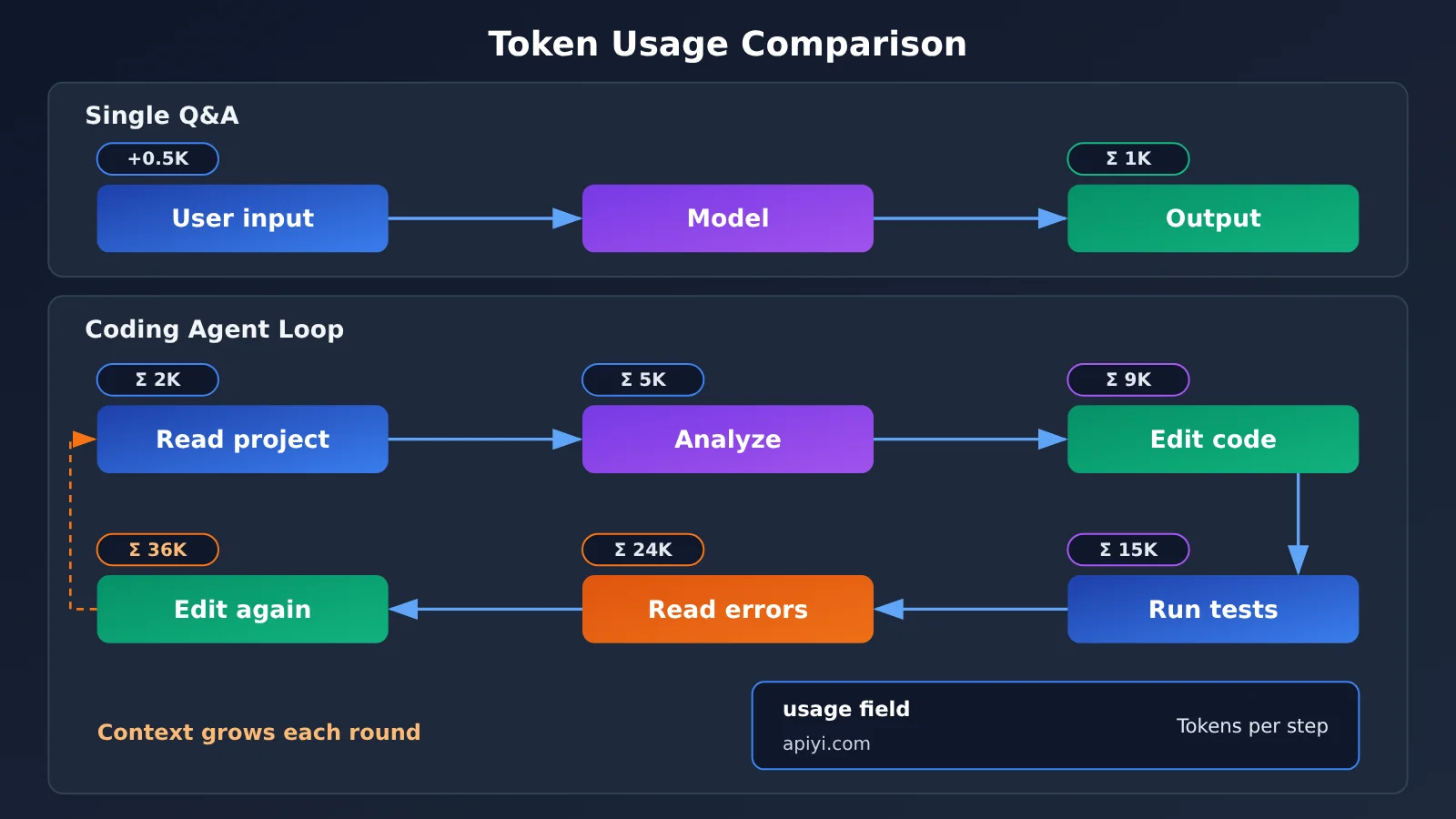
A typical chat might involve just one input and one output. To complete a task, a coding agent might read files, analyze the problem, modify code, run tests, read error messages, make further changes, and run tests again. Each step may involve a model invocation, usually with the accumulated context passed back in.
So there’s a sound mechanism behind the claim that “agents are a significant potential source of demand.” But there’s no public data to support the claim that “agents accounted for most of the 32 billion tokens.” It’s important to keep those two claims separate when writing or making decisions.
Tracking Token Accumulation in an Agent With Code
The easiest way to see this in action is to record the usage field returned by each call. The following example simulates a multi-round revision process and prints the input and output tokens for each step:
import openai

client = openai.OpenAI(
    api_key="YOUR_API_KEY",
    base_url="https://api.apiyi.com/v1"  # APIYI OpenAI 兼容接口
)

messages = [{"role": "user", "content": "写一个计算斐波那契数列的 Python 函数"}]
resp = client.chat.completions.create(model="YOUR_GEMINI_MODEL", messages=messages)
print(resp.usage.prompt_tokens, resp.usage.completion_tokens)
View the token tracking code for a multi-round agent loop
import openai

client = openai.OpenAI(
    api_key="YOUR_API_KEY",
    base_url="https://api.apiyi.com/v1"
)

MODEL = "YOUR_GEMINI_MODEL"  # 替换为平台模型列表中的 Gemini 模型名称

steps = [
    "写一个计算斐波那契数列的 Python 函数",
    "为这个函数补充单元测试",
    "测试报错:输入负数时没有处理,请修复",
    "再检查一遍边界条件并给出最终版本",
]

messages = [{"role": "system", "content": "你是一个严谨的编程助手"}]
total_in, total_out = 0, 0

for i, step in enumerate(steps, 1):
    messages.append({"role": "user", "content": step})
    resp = client.chat.completions.create(model=MODEL, messages=messages)
    reply = resp.choices[0].message.content
    messages.append({"role": "assistant", "content": reply})

    usage = resp.usage
    total_in += usage.prompt_tokens
    total_out += usage.completion_tokens
    print(f"第 {i} 步:输入 {usage.prompt_tokens},输出 {usage.completion_tokens}")

print(f"累计输入 {total_in},累计输出 {total_out}")
When you run it, you’ll see input token counts grow with each round as conversation history accumulates. That’s why token consumption in an agent workflow is much more complex than in a single Q&A exchange.
🚀 Quick-start tip: To measure token consumption across agent loops for yourself, sign up at APIYI apiyi.com for free trial credits. You can use the same API key to switch between Gemini, Claude, GPT, and other models and compare their token consumption on the same task.
What Google’s 32 Billion API Tokens Mean
Impact on Developers
- Costs are shifting from “per call” to “per workflow”: The cost of an agent task depends on the number of loop iterations and the length of the context. Developers need to budget tokens during the design phase—for example, by trimming conversation history and caching content that doesn’t change.
- Choosing the right model for each task matters more: High-performance and economical models serve different needs. A common way to control costs is to use a powerful model for complex planning and a cheaper one for batch classification.
- Multimodal billing needs its own assessment: Images, video, and audio are tokenized differently from text. Measure costs with real samples before going live.
💡 Choosing a model: Token usage and results can vary widely between models for the same task. Try running real samples through a unified interface using APIYI at apiyi.com before deciding on your production model mix.
Impact on the Industry and Google Cloud
On the earnings call, Kurian noted that enterprises building agents often need more than model invocations: they also need compute resources, services to store agent memory, and databases that provide context. As a result, model adoption could also drive growth across other cloud products.
| Financial metric (Q3 ended 2026-09-30) | Value | Notes |
|---|---|---|
| Alphabet total revenue | $127.577 billion, up 25% year over year | Company-wide |
| Google Cloud revenue | $30.709 billion, up 103% year over year | Includes enterprise AI infrastructure, AI solutions, core GCP, and TPU system sales |
| Google Cloud operating income | $11.121 billion | Quarterly operating margin of approximately 36.2% |
| Gemini API standalone revenue | Not disclosed | Cloud revenue can’t be used as a substitute |
Two points are worth emphasizing. The $30.7 billion figure is revenue for Google Cloud as a whole, not Gemini API revenue. You also can’t estimate Google’s API revenue by multiplying 32 billion tokens by public API prices: the model breakdown hasn’t been disclosed, prices vary by model, and enterprise customers may benefit from batch processing, caching, custom contracts, and discounts.
An Easy Timeline Trap
Alphabet’s Q3 financial reporting period ran from July 1 to September 30, 2026. Gemini 4 Argon officially launched on October 13, 2026, and the 32 billion tokens per minute figure was disclosed on October 28. So you can’t treat 32 billion as the average rate for Q3, let alone claim that Argon, which launched in October, was the main driver of API growth throughout the quarter. A safer conclusion is that the launch of Argon and the 32 billion token milestone together reflect Google’s model and commercial progress in October 2026.
Frequently Asked Questions
Q1: What does 32 billion tokens per minute through Google APIs mean?
It’s the overall processing rate for Google’s first-party model APIs as reported on October 28, 2026. The figure counts tokens, not requests, and doesn’t represent usage of any single Gemini model or the Gemini app.
Q2: Who’s contributing to those 32 billion tokens?
Known users include more than 9 million monthly developers, over 2,600 high-usage Gemini Enterprise customers, and Agent deployments in finance, manufacturing, retail, and industrial operations. However, Google hasn’t disclosed the breakdown by user group, industry, or model. Any claim that a particular group accounts for most of the usage isn’t supported by public data.
Q3: Is the 32 billion token figure related to Gemini 4 Argon?
Argon launched on October 13, 2026, and 32 billion was the current rate on October 28. Both were part of Google’s progress in October. But the Q3 reporting period ended on September 30, so the entire quarter’s growth can’t be attributed to Argon.
Q4: How can developers estimate their own token usage?
The most reliable approach is to test real samples and record the `usage` field returned by each call. You can get free test credits at APIYI, apiyi.com, set `base_url` to `https://api.apiyi.com/v1` in the code in this article, and test text, long-document, and multi-turn Agent scenarios separately. Then, estimate costs based on your expected volume.
Q5: Can we use 32 billion tokens to estimate Google’s API revenue?
No. The model mix, actual pricing, batch and caching discounts, and enterprise-specific contracts haven’t been made public. Google also hasn’t disclosed Gemini API revenue or profit separately.
Q6: What are the known limitations of the data in this news?
There are three main gaps: no breakdown by customer, industry, or model; no allocation across text, images, video, and audio; and no split between input, output, and internal thinking tokens. The results in the enterprise case studies also come from Google’s own disclosures and haven’t been independently verified by a third party.
Google API’s 32 Billion Tokens: Key Takeaways
- The headline number: First-party model APIs process nearly 32 billion tokens per minute, up more than 4x year over year
- Growth trajectory: Usage rose from about 10 billion to nearly 32 billion in roughly a year
- Three user groups: The developer ecosystem, Gemini Enterprise customers, and industry-specific agent deployments
- How agents drive usage: Multi-turn loops and accumulated context multiply the tokens consumed by a single task
- Keep metrics separate: Tokens, requests, seats, developer counts, and Cloud revenue aren’t interchangeable and can’t be added together
- Biggest unknown: Google hasn’t disclosed the breakdown of those 32 billion tokens by customer or use case
- Practical recommendation: Use APIYI’s unified interface at apiyi.com to measure your own application’s actual token usage over time
Summary
The key takeaways from the news that Google APIs process 32 billion tokens per minute:
- Scale is growing rapidly: More than 4x growth in a year suggests that model invocation is moving from experimentation to deployment at scale
- Sources of demand are identifiable: Developers, enterprise customers, and industry-specific agents are all real, high-usage groups
- The breakdown remains unknown: Google hasn’t published a detailed breakdown. Recognizing that is an accurate view of the data’s limits, not a gap in reporting
- Commercial value remains to be seen: What really matters over time is how much of this usage turns into sustainable, profitable enterprise applications
For developers, the most immediate takeaway is that agents and multimodal applications will make token budgets more important. Model selection and context management should be part of your architecture planning from the start. We recommend using APIYI at apiyi.com to compare the performance and consumption of multiple leading models with a single API key before choosing the approach that works for you.
📚 References
- Alphabet Q3 2026 Earnings Report (SEC): Original source for financial data
- Link:
sec.gov/Archives/edgar/data/1652044/000165204426000080/googexhibit991q32026.htm -
Details: Revenue, Google Cloud revenue, and operating profit
-
Google CEO’s Q3 2026 Earnings Remarks: Original source for the 32 billion tokens per minute figure
- Link:
blog.google/company-news/inside-google/message-ceo/alphabet-earnings-q3-2026/ -
Details: Key figures and official growth metrics
-
Alphabet Q3 2026 Earnings Call Transcript: Enterprise customer data and examples
- Link:
fool.com/earnings/call-transcripts/2026/10/29/alphabet-googl-q3-2026-earnings-call-transcript/ -
Details: Gemini Enterprise data disclosed by Thomas Kurian
-
Google CEO’s Q2 2026 Earnings Remarks: Developer and 22 billion token figures
- Link:
blog.google/company-news/inside-google/message-ceo/alphabet-earnings-q2-2026/ -
Details: 9 million monthly active developers and Antigravity weekly active user data
-
Google CEO’s Q1 2026 Earnings Remarks: 16 billion token figure
- Link:
blog.google/company-news/inside-google/message-ceo/alphabet-earnings-q1-2026/ -
Details: A milestone in the growth timeline
-
Google June 2026 Investor Presentation: 19 billion token figure and developer tool usage
- Link:
blog.google/alphabet/investor-presentation-june-2026/ -
Details: More than 3 trillion tokens per day across developer tools
-
Google Cloud: Gemini at Work 2026: Enterprise agent customer examples
- Link:
cloud.google.com/blog/products/ai-machine-learning/welcome-to-gemini-at-work-2026 - Details: Deployment examples from Hitachi and other companies
Author: APIYI Technical Team
Technical discussions: Contact us through the APIYI homepage, and visit the docs.apiyi.com documentation center for more integration resources.