Translator’s note: I break Gemini 4 Neon’s public scores into three buckets — coding, knowledge work, and science — labeling the source for every item, so you can judge which kinds of work are worth handing to it.
On 2026-11-18, Google released Gemini 4 Neon, and in his launch post Sundar Pichai summed up its positioning as “getting things done faster” on complex software engineering, knowledge work, and scientific workflows. The same day, DeepMind published the model card, and Artificial Analysis released its third-party measurement article and model page — suddenly there were several sets of public numbers.
The catch is that these numbers don’t share the same basis. The Google blog is vendor-reported; the model card’s comparison table does list Claude Opus 5.5 and GPT-6.2 Sol, but its evaluation notes state that results for non-Gemini models default to each vendor’s own reporting; only Artificial Analysis is third-party measurement. This article uses 2026-11-19 as its data verification date, keeps a source label on every item, and puts the two conflicting numbers side by side instead of averaging them.
The payoff: once you’ve read this, you’ll have a table organized by task type that tells you which items Gemini 4 Neon officially claims first place in across coding, reading documents, and science — which items the model card shows a rival ahead on — and which items the third party gives it a lead of just 1 point.
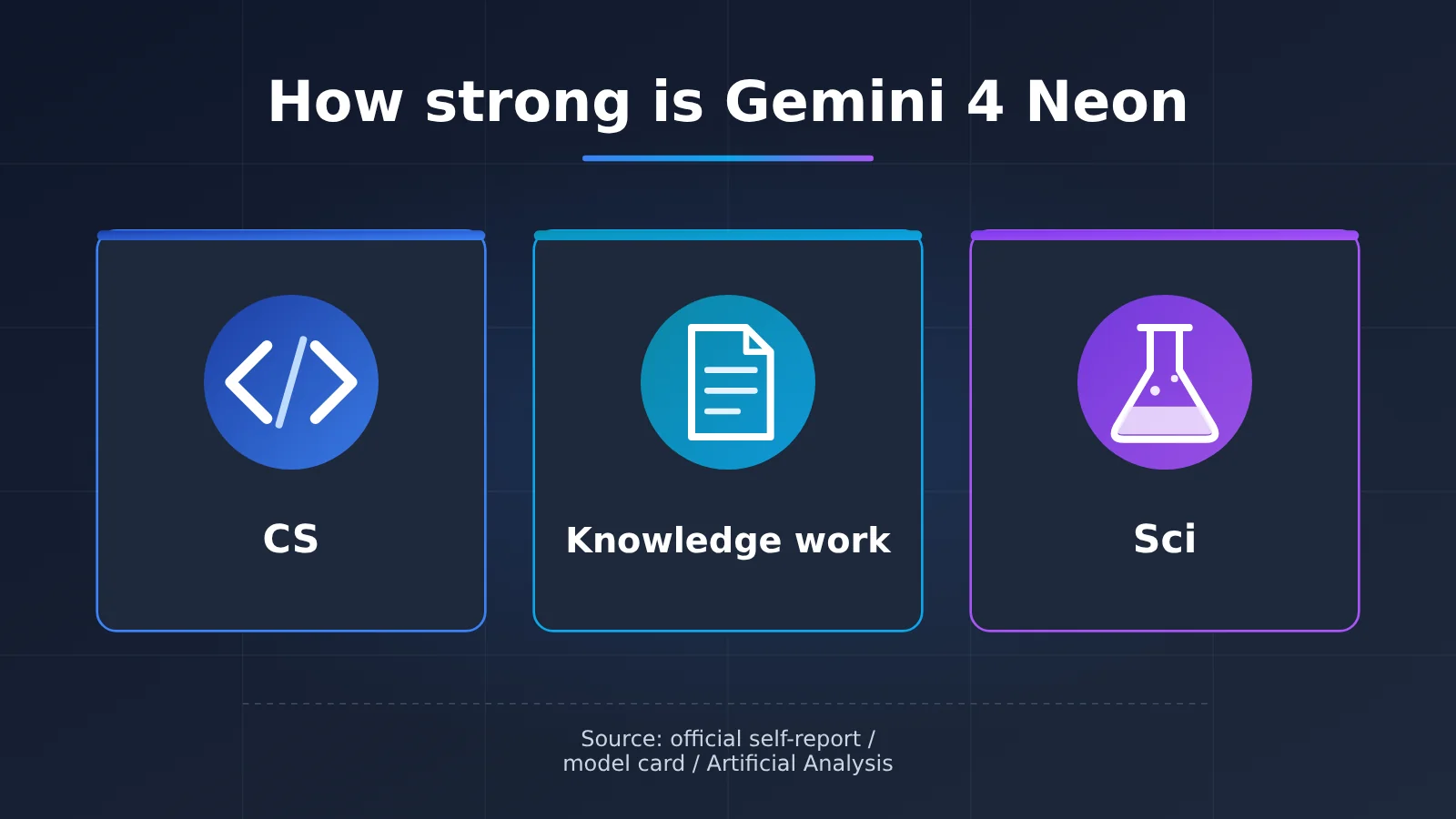
Gemini 4 Neon Key Points: Start With the Headline Number, Then Break It Into Three Parts
The overall score is the number most people look at first. An Artificial Analysis article reports that Gemini 4 Neon scores 61 on intelligence at the xhigh thinking tier, ranking 3rd overall, behind GPT-6.2 Astra (max) and Claude Fable 5.2 (max). The Google blog (Google’s own reporting) also gives 61 and 3rd place, adding that it “trails the larger, slower models.” The AA Index v5.0.1 row on the model card is 61 as well, next to Opus 5.5 at 59 and Sol at 57.
That 61 lines up across all three sources, but it’s just an entry point. The overall score blends coding, reading material, and science into a single figure, while the work you actually need to deliver usually falls into only one of those buckets. The table below sorts out what kind of evidence each source provides; the sections that follow break things down piece by piece.
| Source | What it is | What this article uses it for |
|---|---|---|
| Google blog | Google’s own reporting | Which categories Google claims first place in, plus the scores for each |
| DeepMind model card | Official summary; non-Gemini results are mostly self-reported by each vendor | Side-by-side comparison of Neon, Opus 5.5, and Sol across all three columns |
| Artificial Analysis article | Third-party measurement | Coding Agent Index, GDP.pdf, MKA, and more |
| Artificial Analysis model page | Third-party measurement, split by thinking tier | How intelligence scores differ across the four thinking tiers |
Where Gemini 4 Neon Sits in the Family
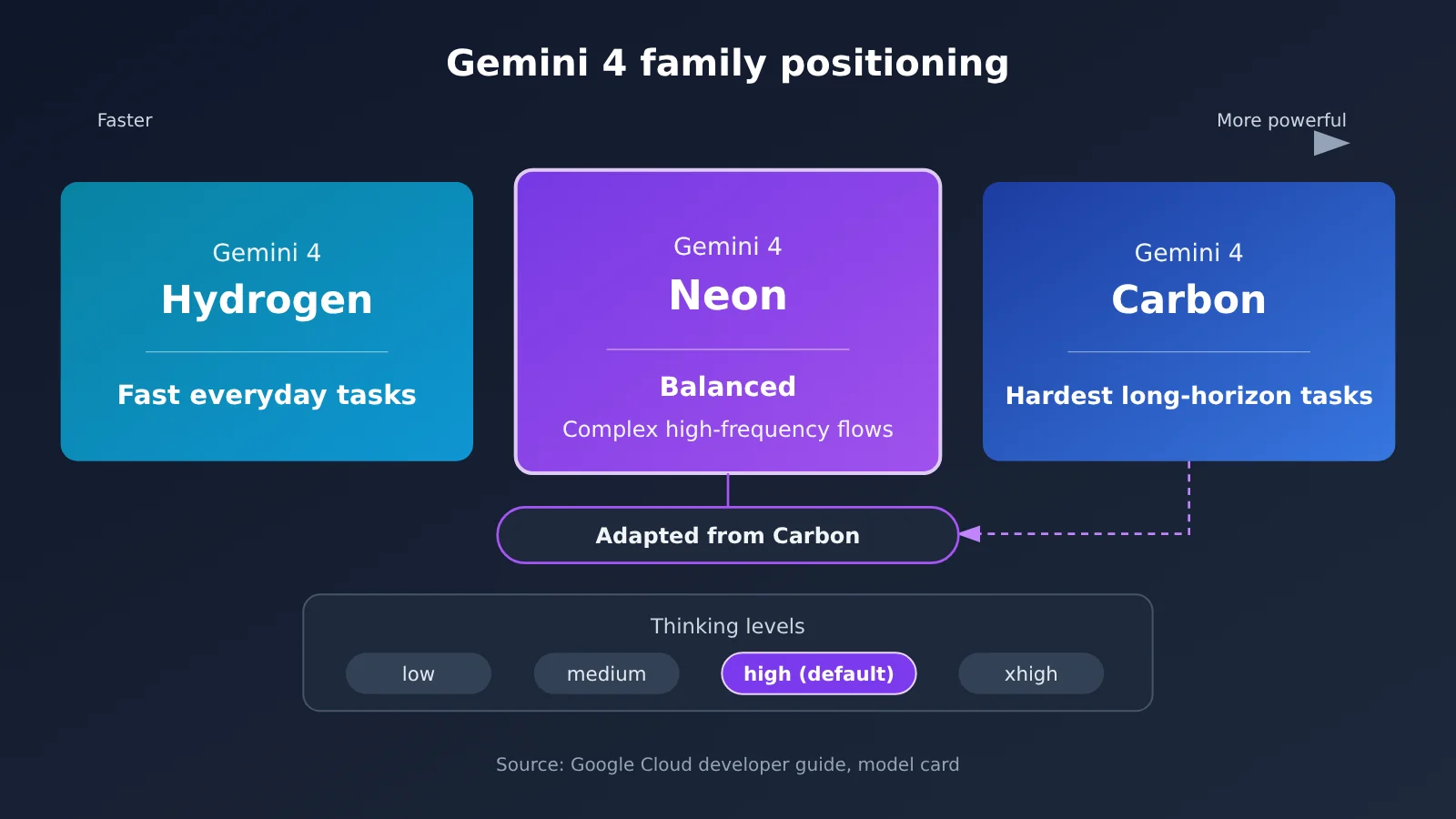
The model card states that Gemini 4 Neon is adapted from Gemini 4 Carbon, has a knowledge cutoff of March 2026, accepts text, image, audio, and video input, and offers a unified context window of up to 1 million tokens. The Google Cloud developer guide places it between Hydrogen (fast everyday loops) and Carbon (complex long-horizon work), and the official blog describes it as aimed at high-frequency complex workflows.
Understanding that positioning helps when reading the scores that follow. Neon’s comparison set differs from one source to the next: the model card has only two columns, Opus 5.5 and Sol, with no Fable 5.2, Astra, or Carbon; Artificial Analysis, meanwhile, mainly pits it against Carbon, Fable, and Opus. When comparing individual line items, this article won’t borrow numbers from other cells to fill the gaps.
Gemini 4 Neon’s Coding Ability: Leads in Two Areas, Narrowly Beaten by Opus in Two Others
Coding is where the Google blog spends the most words. Google’s own claim is that Gemini 4 Neon scores 58.6 on the Artificial Analysis Coding Agent Index, ranking first overall. The Artificial Analysis article gives the number as 59, measured under Neon xhigh on the Antigravity CLI. The 58.6 and the 59 come from two different sources, and this article keeps both.
The lead on the third-party side needs to be looked at separately. In the Artificial Analysis article, Fable xhigh and Opus 5.5 max on Claude Code both come in at 58, while Carbon high is 55. That means Neon’s lead over these two Claude models is 1 point.
The model card breaks things down further, and on two of those items Opus 5.5 is higher.
| Coding Item (Model Card) | Gemini 4 Neon | Claude Opus 5.5 | GPT-6.2 Sol |
|---|---|---|---|
| CursorBench 4.1 | 65.4% | 58.1% | N/A |
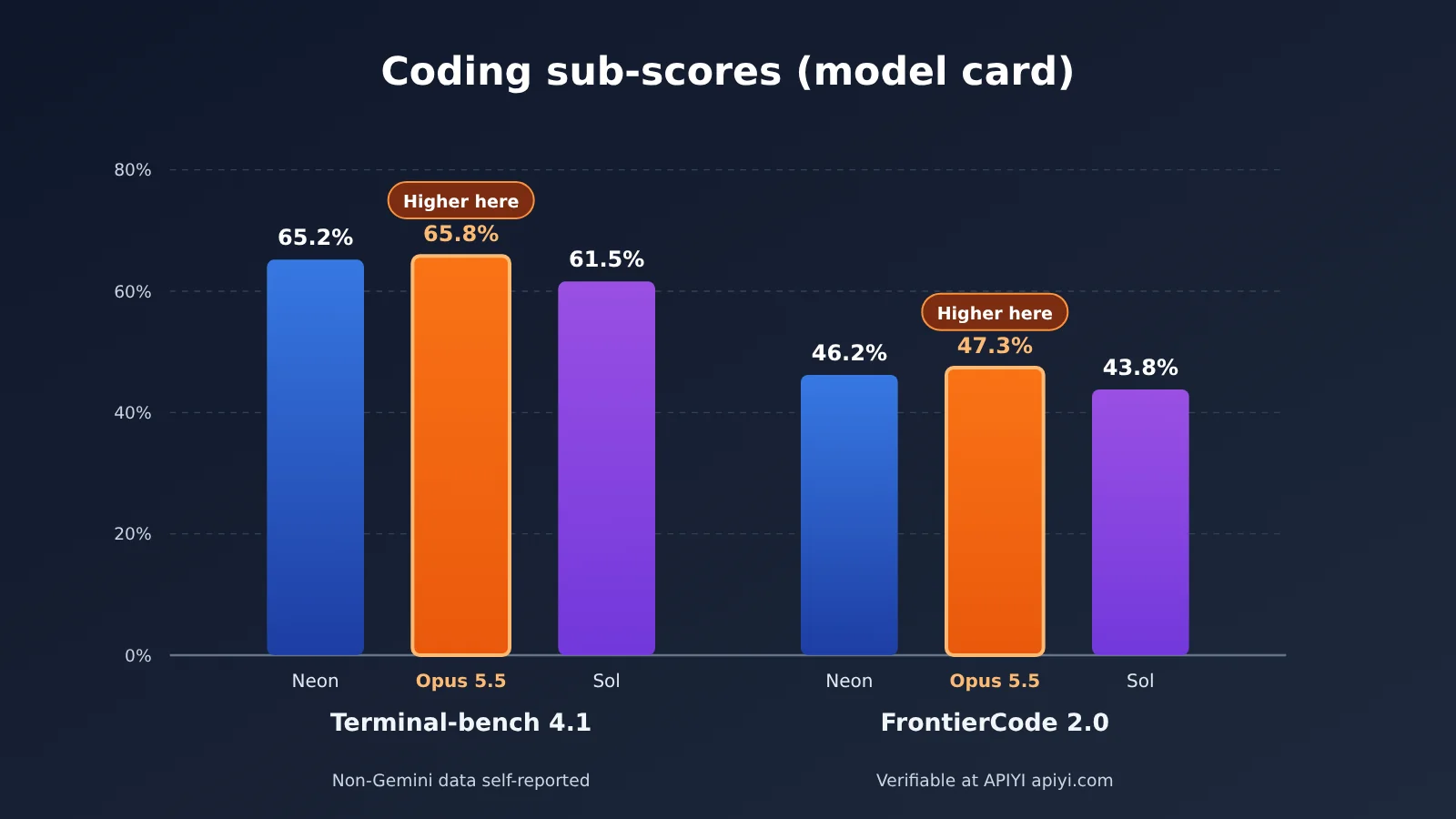
| Terminal-bench 4.1 (after cheat adjustment) | 65.2% | 65.8% | 61.5% |
| FrontierCode 2.0 | 46.2% | 47.3% | 43.8% |
| SWE-sweep vendor harness | 39.0% | 10.1% | 8.3% |
| SWE-sweep mini-SWE harness | 12.8% | 3.6% | 11.6% |
How to Read Gemini 4 Neon’s Coding Scores
On Terminal-bench 4.1, Opus 5.5 is 65.8% and Neon is 65.2%; on FrontierCode 2.0, Opus 5.5 is 47.3% and Neon is 46.2%. Both gaps are around one percentage point, but the direction is that Opus is slightly higher. In the official blog, the 46.2% for FrontierCode 2.0 is labeled as the default high setting.
The two SWE-sweep numbers are the easiest to misread. The 12.8% is the result under the mini-SWE harness, while the 39.0% is the result inside Google Antigravity (the vendor harness). The official blog describes the gap between them as an unlock brought by the harness — it reflects the effect of the toolchain, and you shouldn’t read it as the model itself being three times better. Also note that under the mini-SWE harness, Sol is 11.6%, quite close to Neon’s 12.8%.
Gemini 4 Neon on Knowledge Work: Leads on Most, but Chartography Goes to Sol
In knowledge work, the official blog makes a bunch of “No. 1” claims. It says Legal Research Bench and Tax Agent Bench are both No. 1, but the blog doesn’t give percentage scores for either. On Surge, finance, accounting, spreadsheet modeling, and complex-constraint tasks are also described as mostly No. 1—again, without per-item scores. These can only be recorded as officially self-reported rankings; this article doesn’t fill in the numbers.
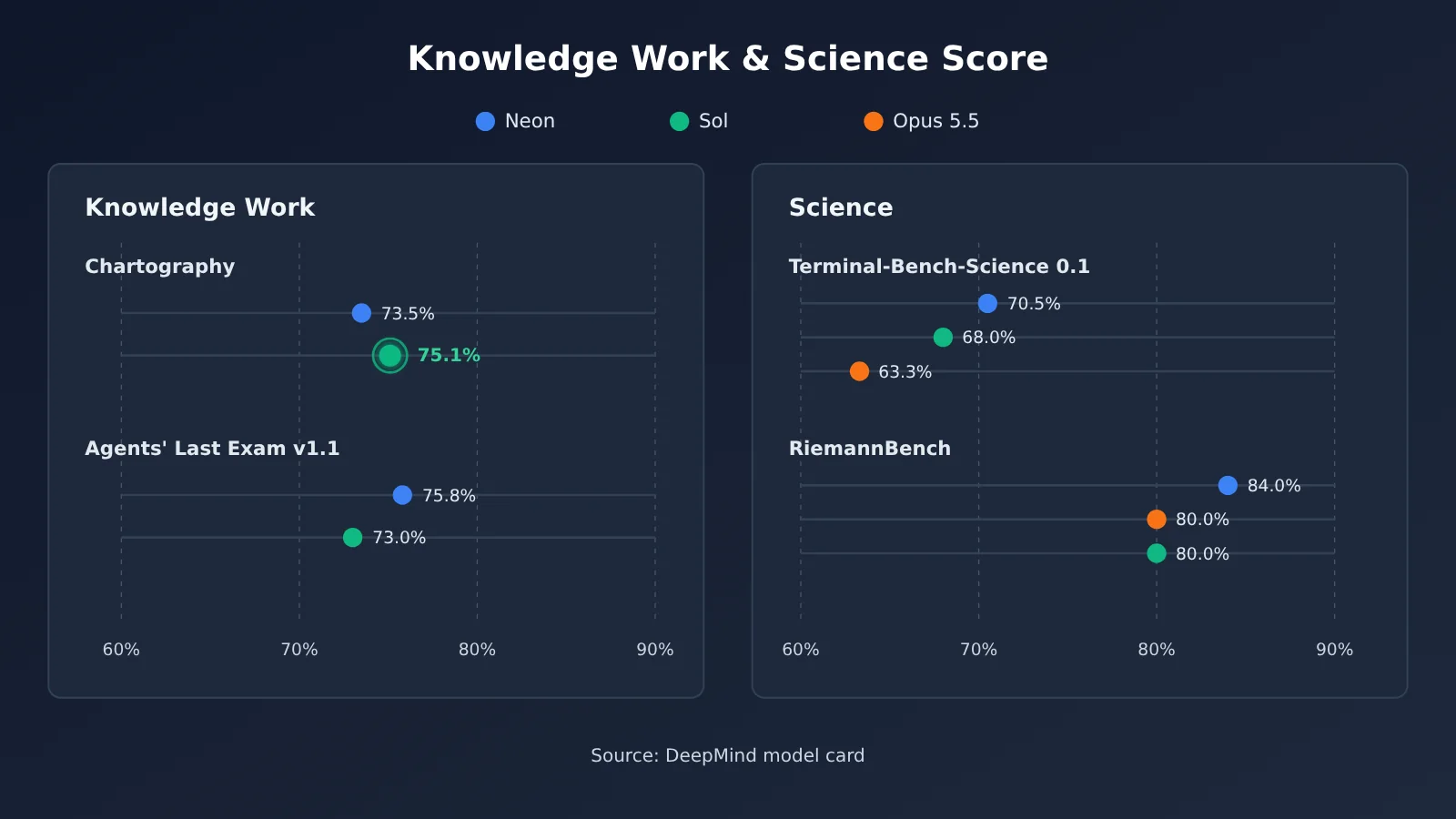
Items with scores can be checked against the model card. Zapier AutomationBench is No. 1 in the official blog at 56.3%, and Andon Labs Vending-Bench 2 is No. 1 at $16,843. Chartography is the only sub-item in this section where Sol is higher: Sol 75.1%, Neon 73.5%.
Third-party measurements provide more detail. An Artificial Analysis article shows that on GDP.pdf, Neon high is 33.4%, while Neon xhigh is instead 28.0%, and Carbon high is 28.4%—suggesting that turning up the thinking level doesn’t necessarily translate into a higher score. On AA-Briefcase, Neon xhigh scores 1700 Elo overall and 1771 Elo for presentation quality, above Claude Sonnet 5.5 max’s 1726. For MKA, the Artificial Analysis article says Neon 56%, close to Fable max’s 57% and 2 points above Carbon; the model card says 56.5%. Both numbers are kept as-is.
Gemini 4 Neon Science: Three Official “Best in Class” Claims
Science is the section where the official language is strongest of the three. The Google blog calls Terminal-Bench Science 70.5%, RiemannBench 84.0%, and HLE-Diamond 71.3% all best in class—these are official self-reported figures. The model card’s comparison table agrees: Neon is higher than Opus 5.5 and Sol on all three, but the comparison columns are again a summary of each vendor’s self-reported numbers.
| Knowledge and science item (model card) | Gemini 4 Neon | Claude Opus 5.5 | GPT-6.2 Sol |
|---|---|---|---|
| AutomationBench | 56.3% | 42.5% | 41.3% |
| Agents’ Last Exam v1.1 | 75.8% | 71.6% | 73.0% |
| Chartography | 73.5% | 66.3% | 75.1% |
| LVBench | 89.0% | 83.7% | 87.6% |
| GraphWalks (256k–1M, BFS F1) | 95.2% | 66.8% | 80.1% |
| MKA Climb WSR | 56.5% | 53.0% | 52.7% |
| RiemannBench | 84.0% | 80.0% | 80.0% |
| Terminal-Bench-Science 0.1 | 70.5% | 63.3% | 68.0% |
| HLE-Diamond | 71.3% | 67.9% | 64.0% |
GraphWalks’s 95.2% in the 256k–1M long-context range is a wide gap over Opus 5.5’s 66.8%, making it one to watch for use cases that involve reading very long materials. On Terminal-Bench-Science, Sol scores 68.0%, just 2.5 percentage points behind Neon’s 70.5%—the smallest gap among the three science items.
Gemini 4 Neon by Task: One Summary Table
Combining all three sources and sorting them into three cases — “official claims first place,” “the model card gives a competitor the edge,” and “a third party shows only a 1-point lead” — gives us the task-by-task table below. It doesn’t tell you who’s strongest across the board; it just shows you which piece of evidence each task category’s score rests on.
| Task type | Official self-reported #1 | Model card: competitor higher | Third-party: 1-point gap |
|---|---|---|---|
| Coding | Coding Agent Index 58.6, #1 overall | Terminal-bench 4.1, FrontierCode 2.0: Opus 5.5 scores higher | Coding Agent Index 59 vs. 58 for Fable xhigh and Opus 5.5 max |
| Knowledge work | Legal Research Bench, Tax Agent Bench, AutomationBench, Vending-Bench 2 | Chartography: Sol scores higher | MKA 56% vs. Fable max 57% (Neon trails by 1 point) |
| Science | Terminal-Bench Science, RiemannBench, HLE-Diamond | None | No standalone third-party science score |
| Aggregate entry point | Vals Index #2 (70.9%) | None | AA Intelligence Index 61, 1 point above Carbon high |
Gemini 4 Neon: Strengths and Weaknesses
Strengths
- Consistent lead on all three science benchmarks: Both the official report and the model card show Terminal-Bench Science, RiemannBench, and HLE-Diamond ahead of the two comparison models.
- Strong long-context reading: On the model card, GraphWalks shows a BFS F1 of 95.2% across the 256k–1M range, matching a unified 1M-token context window.
- Clear gains from the tooling chain: SWE-sweep comes in at 39.0% under the vendor harness, which suggests a meaningful boost when paired with an agent environment like Antigravity.
- Full multimodal input support: The model card lists text, image, audio, and video inputs; the Artificial Analysis model page shows Opus 5.5 accepting only text and images.
Limitations
- Not #1 on every coding benchmark: Opus 5.5 edges ahead on Terminal-bench 4.1 and FrontierCode 2.0, so it’s worth testing both models on pure terminal or frontier code tasks.
- A competitor leads on chart understanding: Sol scores higher on Chartography, so for chart-heavy reporting tasks, add Sol to your comparison.
- Higher thinking tiers don’t guarantee higher scores: In the Artificial Analysis article, GDP.pdf scores lower at xhigh than at high, so thinking tiers need to be tuned per task.
- Fairly strict parameter constraints: The developer guide states that passing
thinking_budgetorMINIMALreturnsHTTP 400, and explicit context caching isn’t supported — only implicit caching via a shared prefix of 4096 tokens or more.
We’ll keep pricing and speed to one line here: comparisons of per-task cost against Carbon come in several flavors — Google’s own claim of 32% lower, Artificial Analysis’s article at roughly 17% less — and we’ll dig into those in the dedicated pricing article; per-tier latency and output speed belong in the dedicated speed article.
Gemini 4 Neon Quick Start: Pick the Task First, Then the Thinking Tier
A good order of operations is three steps: first choose the task type from the summary table above, then choose the thinking tier, and finally check the APIYI master list to confirm the listed Gemini 4 family models cover what you need.
- Choose the task type: lean on Neon’s strengths for scientific reasoning and long-document reading; for terminal coding and chart comprehension, put Opus 5.5 or Sol on the candidate list too.
- Choose the thinking tier: the developer guide states that Neon has only four tiers —
low,medium,high, andxhigh— withhighas the default. The Artificial Analysis model page shows intelligence scores of 44, 55, 60, and 61 for the four tiers;hightoxhighis only a 1-point difference, and on GDP.pdfhighactually scores higher, so for most tasks you can just start from the default tier. - Confirm available models: for orchestration-type tasks, you can follow the approach in the developer guide — hand the main control to a strong model and route fast subtasks to
gemini-4-hydrogen; for the hardest long-horizon tasks, look atgemini-4-carbon.
On the endpoint side, for the OpenAI-compatible interface set base_url to https://api.apiyi.com/v1; for the native Gemini interface use https://api.apiyi.com with the v1beta version. Read the key from an environment variable, for example APIYI_API_KEY — don’t hardcode plaintext keys in your code. When calling, set model to gemini-4-carbon or gemini-4-hydrogen; both have endpoints for chat and gemini in the APIYI master list.
The table below lists models you can cross-reference from the APIYI master list updated 2026-11-16 (docs.apiyi.com/models.md) and the pricing API queried on 2026-11-19 (api.apiyi.com/api/pricing, 285 models total), in USD per million tokens.
| Model ID | Input | Cache read | Output | Available platforms |
|---|---|---|---|---|
gemini-4-carbon |
2 | 0.1 | 10 | APIYI master list, pricing API |
gemini-4-hydrogen |
1.5 | 0.075 | 7.5 | APIYI master list, pricing API |
claude-opus-5-5 |
4 | 0.2 | 20 | APIYI master list, pricing API |
gpt-6.2-sol |
2 (3 for input over 272000 tokens) | 0.1 | 10 (about 11.25 for the higher tier in the pricing API) | APIYI master list, pricing API |
The 2/10 for gemini-4-carbon is APIYI’s current shelf price, matching Google’s introductory price through 2026-11-30. Gemini 4 Neon is listed on the Google AI Studio pricing page at 3.00 input / 15.00 output USD per million tokens, with no free tier; it hasn’t appeared in either the APIYI master list or the pricing API yet. It’s not listed yet — we’ll get this model listed as soon as possible; model IDs and prices are subject to the platform’s model list.
🚀 Getting-started tip: before Neon is listed, you can use a single Key on APIYI apiyi.com to call
gemini-4-carbon,claude-opus-5-5, andgpt-6.2-solseparately, running each of your own coding or reporting tasks once to figure out which task types actually need Neon-level capability.
FAQ
Q1: What kind of model is Gemini 4 Neon?
It’s the mid-tier model in the Gemini 4 family that Google released on 2026-11-18. It’s adapted from Carbon, and the developer guide places it between Hydrogen and Carbon. The official blog says it targets high-frequency, complex workflows. The model ID is `gemini-4-neon`.
Q2: Gemini 4 Neon has an overall score of 61 — where does that rank?
The Artificial Analysis article shows 61 at the xhigh tier and an overall rank of #3, behind GPT-6.2 Astra (max) and Claude Fable 5.2 (max). Google’s blog and model card also list 61, so they match. But the overall score is only useful as an entry point — you need to look at task-specific subscores.
Q3: Is the Coding Agent Index 58.6 or 59?
Both are correct; they come from different sources. 58.6 is the number from Google’s blog (self-reported by Google), while 59 is the number from the Artificial Analysis article, measured on Neon xhigh in the Antigravity CLI. You shouldn’t combine or average them.
Q4: SWE-sweep shows 12.8% and 39.0% — why such a big difference?
Those are results from two different harnesses: 12.8% comes from the mini-SWE harness, and 39.0% comes from Google Antigravity. The official blog attributes the gap to the harness’s unlocking effect, so when choosing a model, focus on the agent environment you’ll actually use.
Q5: On which tasks do competitors score higher than Gemini 4 Neon?
In the model card, Claude Opus 5.5 is slightly higher on Terminal-bench 4.1 and FrontierCode 2.0, while GPT-6.2 Sol is slightly higher on Chartography. In the Artificial Analysis article, MKA is 57% for Fable max, higher than Neon’s 56%.
Q6: Can I call Gemini 4 Neon through the API now?
Google has already launched it through channels such as the Gemini API in AI Studio. APIYI apiyi.com’s overview table and pricing API don’t currently include `gemini-4-neon`, so it isn’t listed yet. We’ll get this model listed as soon as possible; model IDs and prices are subject to the platform’s model list.
Q7: What model can I use as a substitute for testing before it’s listed?
You can use the OpenAI-compatible endpoint `https://api.apiyi.com/v1` on APIYI apiyi.com to call `gemini-4-carbon` or `gemini-4-hydrogen`. With the same API key, you can also switch to `claude-opus-5-5` and `gpt-6.2-sol` for side-by-side comparison. New users get free testing credits.
Q8: What invocation limits does Gemini 4 Neon have?
The developer guide states: there are only four thinking tiers, from `low` to `xhigh`; passing `thinking_budget` or `MINIMAL` returns `HTTP 400`; explicit context caching isn’t supported; the unified limit is 1048576 tokens including input and output, and the default max output per segment is 65536.
Gemini 4 Neon Key Takeaways
- The composite score is just the starting point: The AA intelligence score of 61 and a 3rd-place ranking are consistent across three sources, but model selection still needs to be broken down by task.
- Programming: edged out on two benchmarks: In the model card, Opus 5.5 is slightly higher on Terminal-bench 4.1 and FrontierCode 2.0.
- Programming: a 1-point lead in third-party testing: Coding Agent Index 59 vs. 58 for Fable xhigh and Opus 5.5 max.
- Knowledge work: leads on most: Sol is higher on Chartography, while the long-context advantage is clearest on GraphWalks.
- Science: three items officially called best in class: It also leads in the model-card comparison, though competitor data is self-reported by each vendor.
- Reasoning levels start at high: high and xhigh differ by only 1 intelligence-score point, and high is actually higher on GDP.pdf.
- Getting started: test already-available models first: Before Neon launches, you can run tasks with Carbon and Hydrogen on APIYI (apiyi.com).
Summary
How strong Gemini 4 Neon really is becomes much clearer when you look at it in three parts:
- Programming: Officially self-reported as No. 1 on Coding Agent Index, but the third-party lead is only 1 point, and Opus 5.5 is slightly higher on two items in the model card.
- Knowledge work: Leads on most areas, including AutomationBench and long-context GraphWalks; Sol is higher on Chartography.
- Science: Three items are officially called best in class, and it consistently leads in the model-card comparison—this is the most neatly supported of the three areas.
We recommend first classifying your task into one of these categories, then checking the summary table in this article to decide whether you need Neon. Before it launches, you can use APIYI (apiyi.com) to call Gemini 4 Carbon, Hydrogen, Opus, and Sol through a unified interface for comparison. Once gemini-4-neon goes live, simply swap the model ID and re-test.
📚 References
-
Google Blog – Introducing Gemini 4 Neon: Official launch post and self-reported scores
- Link:
blog.google/innovation-and-ai/models-and-research/gemini-models/introducing-gemini-4-neon - Description: Officially self-reported rankings, coding and science scores
- Link:
-
DeepMind Model Card – Gemini 4 Neon: Three-column comparison table and model specs
- Link:
deepmind.google/models/model-cards/gemini-4-neon/ - Description: Item-by-item scores for Neon, Opus 5.5, and Sol; non-Gemini results default to each vendor’s self-reported figures
- Link:
-
Google Cloud Developer Guide – Gemini 4 Neon: Parameters and invocation constraints
- Link:
docs.cloud.google.com/gemini-enterprise-agent-platform/models/guides/gemini-4-neon - Description: Thinking tiers, token limits, caching, and error codes
- Link:
-
Artificial Analysis Article – Gemini 4 Neon intelligence gain: Third-party measurement
- Link:
artificialanalysis.ai/articles/gemini-4-neon-intelligence-gain - Description: Coding Agent Index 59, GDP.pdf, MKA, and more
- Link:
-
Artificial Analysis Model Page – Gemini 4 Neon: Index broken down by thinking tier
- Link:
artificialanalysis.ai/models/gemini-4-neon - Description: Comparison of intelligence scores across four tiers
- Link:
-
APIYI Model Master List: Listed models and pricing
- Link:
docs.apiyi.com/models.md - Description: Models and prices are subject to the platform’s model list
- Link:
Author: APIYI Technical Team
Technical Discussion: Feel free to reach out to us via the APIYI website homepage; for more materials, visit the docs.apiyi.com documentation center