Google made Gemini 4 Carbon available to paid developers and enterprises on 2026-11-10. The model ID is gemini-4-carbon. It’s a text model built on Gemini 4 Argon, and it accepts text, images, audio, and video as input. On the same day, Google said on its official blog and official accounts that it’s the most capable Gemini model to date, built for long-horizon tasks and multi-step reasoning. The Gemini API changelog also lists it as generally available (GA) as of the same day.
This isn’t a “crushes everything” launch-post recap. I’ve split the information into three layers: what Google claims officially, the results table in the model card as of October 2026, and what’s still unknown. I’ll cover the benchmarks where it loses as well as the ones where it wins.
Key takeaway: By the end, you’ll have 6 capability boundaries for Gemini 4 Carbon, and you’ll know which jobs are worth handing to it and which are better left to Argon or other models.
Gemini 4 Carbon at a Glance
This isn’t Gemini 4 Carbon’s first appearance. On 2026-10-28, Google published “Introducing Gemini 4 Carbon,” but at that point only a limited group of cybersecurity defenders could use it, with access opening up gradually through the Fairwind Program. It wasn’t until November 10 that it became available to all paid developers.
| Item | Details | Source tier |
|---|---|---|
| First release | 2026-10-28, initially for a limited group of cybersecurity defenders, expanding gradually through the Fairwind Program | Official announcement |
| Public availability | 2026-11-10, for paid developers, enterprises, scientists, and Google AI Ultra subscribers | Official blog |
| API status | gemini-4-carbon reached GA on 2026-11-10; the same page lists gemini-4-argon as GA on 2026-11-05 |
Gemini API changelog |
| Developer access | Gemini API in Google AI Studio and Android Studio, plus Gemini for business | Official Google post |
| Subscriber access | Gemini App, AI Mode in Search, Antigravity, and Google AI Studio (Ultra subscription) | Official Google post |
| Free and lower-tier subscriptions | Google gave no availability date this time, and The Verge says it’s unclear when or whether access will open up | Unknown |
Google’s official post went out at 2026-11-10 16:05 UTC, which is 00:05 on November 11 in Beijing time, so a lot of developers only saw the news on the morning of the 11th. Also, the scientist program originally offered for Argon (10,000 spots, six months of Antigravity access) has been extended to Carbon. Applications are still open and reviewed on a rolling weekly basis, subject to eligibility, capacity, and screening limits.
Three Tiers for Reading Gemini 4 Carbon Data
There are plenty of numbers floating around for Gemini 4 Carbon, but they come from different sources and use different methodologies. Every figure below is labeled with its tier, so we don’t mix scores from different methodologies in a single table.
| Tier | What it includes | How to use it |
|---|---|---|
| Official self-reported | Rankings, internal benchmarks, and safety figures from the October 28 announcement and the November 10 availability post | Useful as a reference, but Google sets the methodology, and outsiders may not be able to reproduce the results |
| Model card results table | As of October 2026, Carbon compared against Argon, GPT-6 Astra, Claude Opus 5.5, and Claude Fable 5.1 | One table with a consistent methodology; this is the only source used for cross-model comparisons in this article |
| Unknown | Free-tier availability date, long-term independent third-party evaluations, the latest index on third-party pages | No conclusions drawn; we only describe where things stand |
Here’s an example. When we scraped the Artificial Analysis page on 2026-11-11, the summary section showed an Intelligence Index of 60. But the charts on the same page repeatedly said “No publicly available API,” which contradicts the fact that the API opened on November 10. So we’re not using the 60 figure. Instead, we consistently use the AA Index v5.0 score of 59 cited in the model card, which reflects the October 2026 methodology.
What Kind of Model Is Gemini 4 Carbon?
According to Google, Argon is still the right fit for most software engineering and knowledge work. Carbon is reserved for tasks that hit a real intelligence ceiling, like complex multi-step coding and debugging or open-ended scientific research. It spends more thinking tokens than Argon, explores hypotheses more thoroughly, and runs longer verification loops.
| Spec | Gemini 4 Carbon | Notes |
|---|---|---|
| Base model | Built on Gemini 4 Argon | Migrating from Argon only requires swapping the model name |
| Input modalities | Text, images, audio, video | Multimodal understanding |
| Output modalities | Text only | Can’t generate images or video |
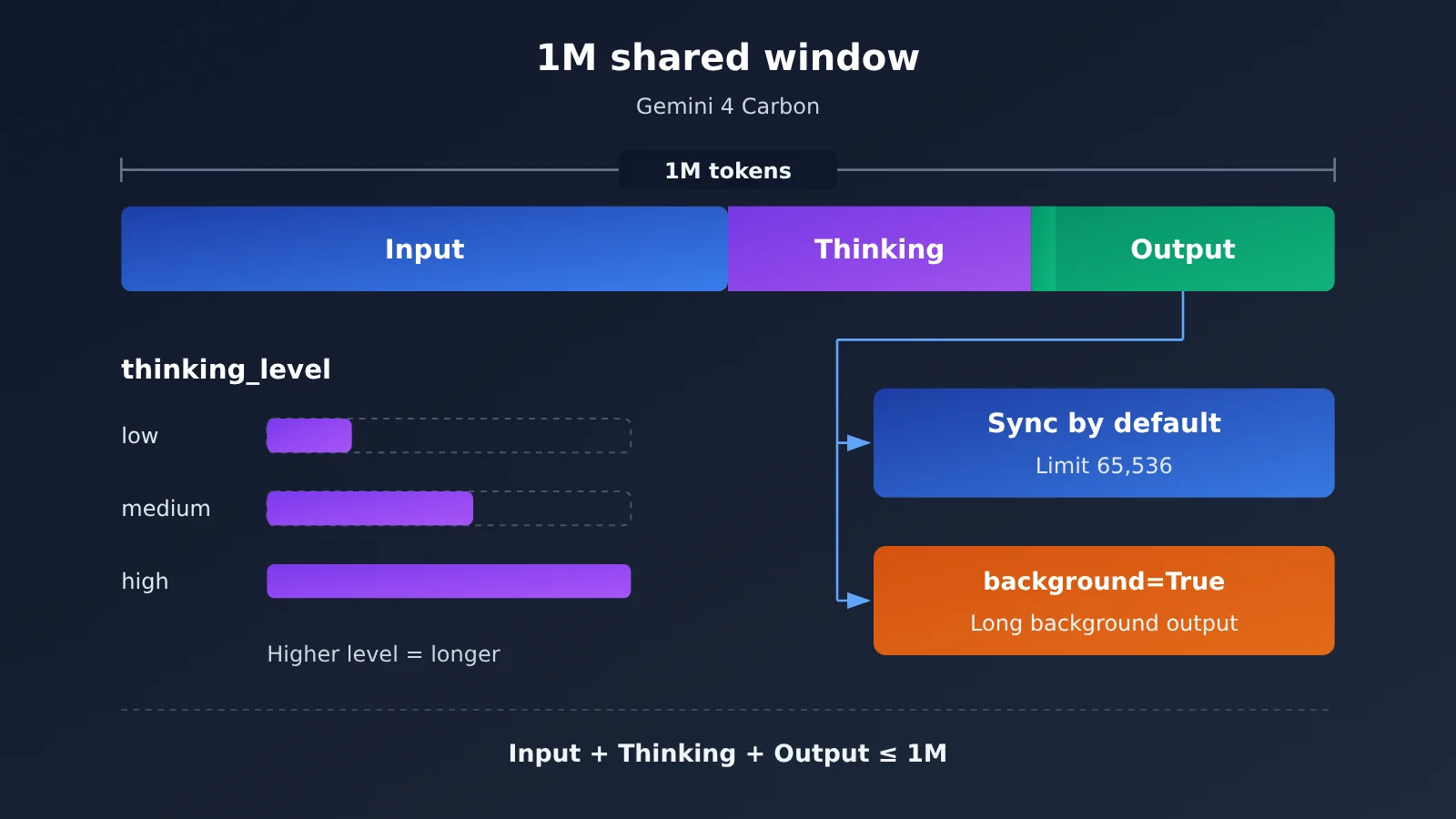
| Context window | 1M tokens, shared across input, thinking, and output | Older models capped “thinking + answer” at 64K |
| Default synchronous output limit | 65,536 tokens | For longer output, set background=True on the Interactions API |
| Knowledge cutoff | March 2026 (per the model card) | Some domains may be earlier |
The Three thinking_level Settings in Gemini 4 Carbon
thinking_level has just three settings, and the default is medium. Here’s how the developer guide divides them up:
low: Lightweight tasks like classification, routing, and targeted extraction.medium: The default. It balances speed, cost, and getting it right on the first try.high: Multi-file root-cause analysis, security patches, formal mathematics, and upfront architecture design.
If you need more than 65,536 tokens of output, set background=True on the Interactions API and raise max_output_tokens above 65536. Also leave headroom for the thinking process, or the answer may get truncated.
Migration Notes: Moving from Argon to Gemini 4 Carbon
Switching from gemini-4-argon to gemini-4-carbon only requires changing the model name. The thinking_level setting and the 1M window are the same. The developer guide lists a few gotchas to watch for during migration:
- thinking_budget is deprecated, and passing it triggers a warning.
- Custom temperature, top_p, and top_k values are ignored, with a warning.
- Don’t create or pass an explicit cached_content anymore. Implicit caching is on by default, and cached input gets a 95% discount.
- Hard prompts can run for several minutes, so set your client timeout to at least 15 to 20 minutes, or switch to background=True.
Calling Gemini 4 Carbon on APIYI
As of 2026-11-11, gemini-4-carbon is listed in the APIYI pricing API. Like gemini-4-argon, it’s available in the default and svip groups, and the endpoints include the native Gemini endpoint and OpenAI-compatible chat. Here are the key details for calling it:
- Model ID:
gemini-4-carbon - OpenAI-compatible base_url:
https://api.apiyi.com/v1, with the request path/v1/chat/completions - Native Gemini endpoint:
/v1beta - Groups:
default,svip(both with a multiplier of 1)
APIYI currently lists the price as $2 per 1M input tokens, $10 per 1M output tokens, and $0.10 per 1M cached-read tokens (as of 2026-11-11), the same as Argon. Keep in mind that the 2 / 10 price on Google’s site is a promotional rate that runs through 2026-11-30. Starting December 1, the global standard price is $4 for input and $20 for output. The snapshot time of the APIYI docs summary table is 2026-11-10 15:40 (UTC+8), which is earlier than the public launch, so if you don’t see this row when you open it, go by the console and the pricing API at api.apiyi.com/api/pricing. Models and prices are subject to the platform’s model list.
🚀 Quick-start tip: If your project already uses the OpenAI SDK, just point base_url at
https://api.apiyi.com/v1and change the model name togemini-4-carbon. You can then run side-by-side tests against Argon with the same key. You can find the full list of models on the model list at apiyi.com.
Gemini 4 Carbon Model Card Results (as of October 2026)
The table below is taken from the model card’s results table. Results are as of October 2026 and are officially published comparison data, not APIYI test results. The three cybersecurity benchmarks reflect performance under the Fairwind Program and are labeled separately. The Argon cell for Terminal-Bench 4.0 is misprinted in the model card and isn’t a plausible percentage, so this article doesn’t cite it.
| Benchmark | Carbon | Argon | GPT-6 Astra | Opus 5.5 | Fable 5.1 |
|---|---|---|---|---|---|
| AA Index v5.0 | 59 | 50 | 57 | 58 | 49 |
| Vals Index v2.2 | 70.4% | 69.2% | 65.0% | 70.2% | — |
| SWE-sweep | 9.6% | 4.3% | 9.5% | 3.6% | 2.9% |
| FrontierSWE 2 | 61.2% | 55.0% | 65.5% | 62.3% | 56.3% |
| Terminal-Bench 4.0 (AA) | 65.2% | Not cited | 59.1% | 59.6% | 52.0% |
| Agents’ Last Exam v1.1 | 77.4% | 69.0% | 73.1% | 71.6% | — |
| OSWorld-2.1 offline subset | 81.5% | 74.7% | 80.9% | 87.2% | 76.8% |
| AutomationBench (Zapier) | 53.9% | 51.3% | 41.4% | 42.5% | 31.4% |
| GraphWalks 256k–1M BFS (F1) | 96.2% | 84.2% | 71.8% | 66.8% | 65.0% |
| RiemannBench | 80.0% | 76.0% | 72.0% | 69.6% | 65.6% |
| Terminal-Bench-Science 0.1 | 64.8% | 52.9% | 63.3% | 59.0% | 43.3% |
| CWE-bench (Fairwind) | 71.0% | 68.0% | 68.0% | 67.0% | 58.0% |
| ExploitGym (Fairwind) | 54.8% | 42.0% | 42.4% | 34.5% | — |
| SEC-bench Pro (Fairwind) | 88.2% | 83.4% | 85.4% | — | — |
A clear pattern shows up in the table: long-context retrieval (GraphWalks), scientific reasoning (RiemannBench, Terminal-Bench-Science), and long-horizon agent tasks (Agents’ Last Exam, Terminal-Bench 4.0) are where Carbon pulls ahead the most. On computer use and software engineering in public repositories, though, it isn’t the leader.
A few of the gaps are actually very small. On Vals Index, Carbon scores 70.4% against Opus 5.5’s 70.2%, and on SWE-sweep it’s 9.6% against Astra’s 9.5%. Those count as ties and shouldn’t be read as clear leads.
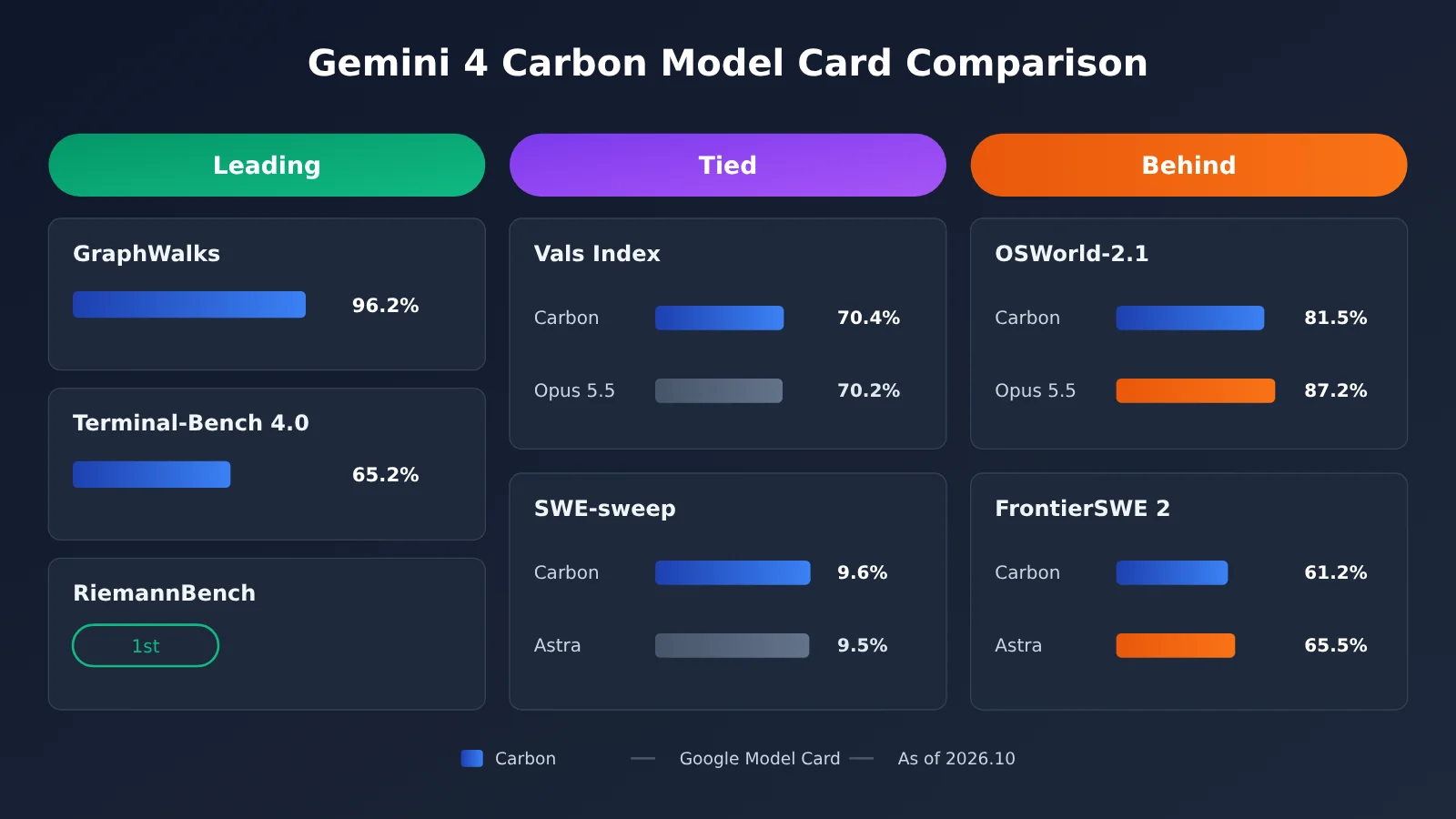
📊 Chart note: The data above comes from Google’s model card and is as of October 2026. If you want to verify the gaps on your own workloads, you can use a single key through APIYI (apiyi.com) to call both
gemini-4-carbonandgemini-4-argonand compare them side by side.
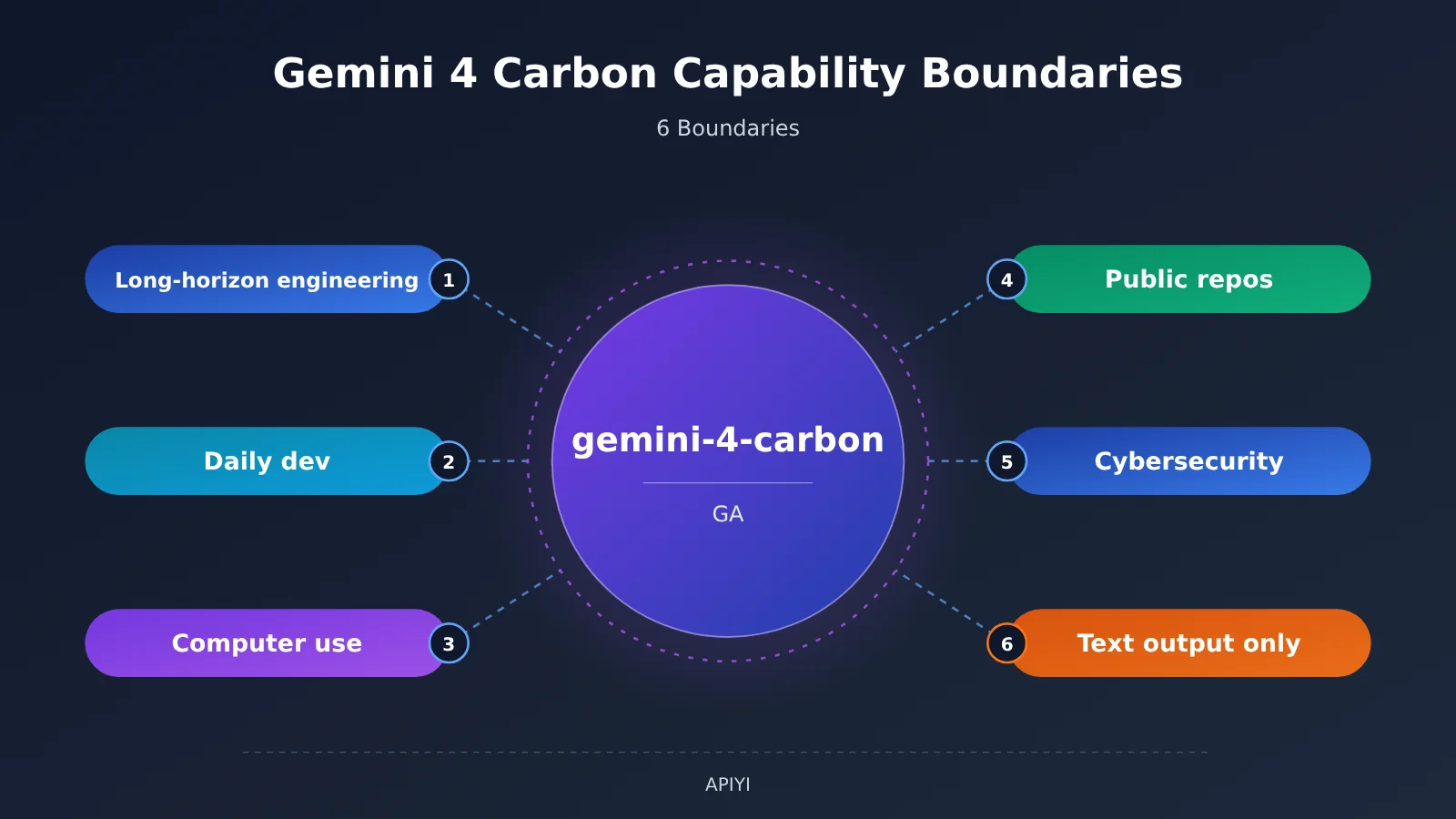
The 6 Capability Boundaries of Gemini 4 Carbon
Here’s a quick table summarizing all 6 boundaries. We’ll go through each one in detail below.
| # | Capability Boundary | One-Line Takeaway | Source Level |
|---|---|---|---|
| 1 | Long-horizon, multi-step engineering | Stronger, but burns more thinking tokens | Model card + official self-reported |
| 2 | Everyday feature development | Google still recommends Argon | Official stance |
| 3 | Computer use | Opus 5.5 at 87.2% beats Carbon at 81.5% | Model card |
| 4 | Public-repo engineering | On FrontierSWE 2, Astra’s 65.5% beats Carbon’s 61.2% | Model card |
| 5 | Cybersecurity | The high score comes from the Fairwind pipeline, not just from swapping in a different model name | Model card + launch post |
| 6 | Output and availability | Text output only; no release date for the free tier | Official docs + unknown |
Boundary 1: Gemini 4 Carbon Is Stronger at Long-Horizon, Multi-Step Engineering, but Burns More Thinking Tokens
On the model card, Carbon ranks first in the table on Terminal-Bench 4.0 (65.2%), Agents’ Last Exam (77.4%), and GraphWalks long-context retrieval (96.2%). It also posts the highest simulated business balance on Vending-Bench 2, at $16,484. What these tasks have in common is that they involve long chains of steps and need repeated verification, which lines up with what Google calls “running the verification loop longer.”
The cost is spelled out in the official materials too. Carbon uses more thinking tokens than Argon, and the model card lists “higher thinking levels use more tokens” as a known limitation. The two models have the same entry-level price, but the total bill for a single task can be higher, and complex prompts may take a few minutes to return.
Boundary Two: For Everyday Feature Development, Google Still Recommends Gemini 4 Argon
Google is pretty blunt about this: keep using Argon for most software engineering and knowledge work, because it’s cheaper on tokens and more responsive. Carbon is reserved for the hardest multi-step engineering, architecture and auditing, formal math and scientific discovery, high-precision financial or legal synthesis, and vulnerability research.
The model card backs up this split. On the Vals Index, Carbon scores 70.4% versus Argon’s 69.2%, a very small gap. The /swarm feature in the Antigravity preview follows the same logic: Google recommends putting Carbon in the roles that need the deepest reasoning, like architecture, coordination, and auditing, and handing the parallel implementation slices to gemini-4-argon or gemini-3.8-flash.
Boundary Three: For Computer-Use Tasks, Opus 5.5 Scores Higher on the Model Card
The OSWorld-2.1 offline subset is the benchmark the model card uses to measure desktop and computer operation. Here Claude Opus 5.5 scores 87.2%, ahead of Carbon at 81.5% and Astra at 80.9%. If your main use case is having a model operate desktop apps, click through interfaces, and complete workflows across different software, Carbon isn’t the top performer on this one.
Also, Carbon is accessed through the native Gemini or OpenAI-compatible chat interface, not the Anthropic messages protocol. If your workflow is already tightly tied to Claude Code or the messages protocol, factor in the migration cost too.
Boundary 4: On the Public-Repo Benchmark FrontierSWE 2, GPT-6 Astra Scores Higher
On FrontierSWE 2, GPT-6 Astra scores 65.5%, the highest in the table. Opus 5.5 comes second at 62.3%, and Carbon third at 61.2%. So the claim that “Carbon leads Astra across the board in software engineering” doesn’t hold up.
One distinction matters here. The November 10 open draft says Carbon ranks first on CursorBench 4.0. That’s a self-reported figure from the vendor, and both the evaluator and the methodology differ from the model card, so it shouldn’t be compared side by side with the table above. On SWE-sweep, Carbon’s 9.6% and Astra’s 9.5% are essentially tied, and the gap is within the margin of error.
Boundary 5: The Strong Cybersecurity Scores Come from the Fairwind Path
On CWE-bench, ExploitGym, and SEC-bench Pro, Carbon ranks first on the model card, but the card notes that these results come from the Fairwind Program path. The October 28 release post also states that these cybersecurity benchmarks were evaluated without guardrails.
That means swapping the model name in a paid API call to gemini-4-carbon doesn’t get you the same specialized cybersecurity capability. The defense-oriented capability requires applying to Fairwind, and only verified defenders can use it. Gemini 4 Carbon Cyber Permissive, which is listed separately on the official pricing page, also isn’t eligible for the $2 promotional price.
There’s also a set of self-reported safety numbers worth a look. On the 375 agentic honesty tests, the pass rate is 92% (Argon scores 70%), and when experimental data is missing, the model refuses to fabricate results 98% of the time. The Gray Swan IPI attack success rate is reported as 0%. But Google also acknowledges that tougher automated red-team testing can still push the model out of bounds on some distributions, so prompt injection robustness still needs work.
Boundary 6: Text-Only Output, and No Date for the Free Tier
Carbon can understand text, images, audio, and video, but it only outputs text. It isn’t an image generation model or a video generation model, so any workflow that needs image or video generation will need a different model.
On availability, the consumer app and Antigravity currently list Google AI Ultra as the requirement, and the API is a paid tier. Google hasn’t given a date for when free users and lower-tier subscribers will get access. The model card also lists a few other limitations: the usual hallucinations you’d expect from a foundation model, jailbreak resistance that’s still being strengthened, and occasional slowdowns or timeouts.
Gemini 4 Carbon Impact Analysis
What Gemini 4 Carbon Means for Developers
- Clearer model tiers: Argon handles the day-to-day work, and Carbon steps in only for the hardest parts. Routing or /swarm-style orchestration helps keep token consumption under control.
- Low migration cost: Swapping the model name is enough, but you’ll want to clean up parameters like thinking_budget and temperature, and remove any explicit cached_content.
- Timeout settings need adjusting: A 15 to 20 minute client timeout or background=True affects your existing gateway and retry logic.
- The pricing window is time-limited: The 2 / 10 promotional price on the official site runs only through November 30. When you estimate long-term costs, use the standard price that starts in December.
💡 Which model to pick: Among “hard tasks,” long-context retrieval and scientific reasoning lean toward Carbon, computer use leans toward Opus 5.5, and public-repo engineering leans toward Astra. We’d suggest running the same set of your own business samples through each model on APIYI (apiyi.com) first, then deciding on your routing rules.
What Gemini 4 Carbon Means for the Industry
- “Strongest model” is getting more nuanced: On the model card, no single vendor comes out first on every benchmark, so splitting work by task type will become the norm.
- Security capabilities are being released in tiers: Cybersecurity-specific capabilities are opened selectively through Fairwind, and no-guardrail evaluation scores are labeled separately. Other vendors may well adopt this approach.
- Thinking tokens are becoming the main cost variable: With the same unit price, different thinking depths produce very different bills, which will push teams to tune thinking_level more carefully.
FAQ
Q1: What is Gemini 4 Carbon?
Gemini 4 Carbon is a text-output model from Google, built on Gemini 4 Argon. Its model ID is `gemini-4-carbon`, and it became available to paid developers and enterprises on 2026-11-10. It accepts text, image, audio, and video input. Its 1M-token window is shared across input, thinking, and output.
Q2: How do I choose between Gemini 4 Carbon and Gemini 4 Argon?
The two models share the same thinking_level options, the same 1M window, and the same entry-level pricing. Google recommends Argon for everyday development because it uses fewer tokens and responds faster. Save Carbon for the hardest tasks, like multi-step engineering, architecture audits, and scientific reasoning, but keep in mind that it burns more thinking tokens.
Q3: Can the model card scores be taken as a direct measure of API performance?
Mostly, yes, but there are two caveats. First, the results are current as of October 2026. Second, the three cybersecurity results come from the Fairwind path with no guardrails in the evaluation, so you shouldn’t treat them as the default scores for everyday coding through the paid API. Rankings in the launch announcement, such as CursorBench, are self-reported by Google and use a different methodology from the model card.
Q4: How do I quickly call Gemini 4 Carbon through the API?
Follow these three steps:
1. Sign up at APIYI (apiyi.com) and get your API key. New users get free test credits.
2. Set the OpenAI SDK’s base_url to `https://api.apiyi.com/v1` and set the model name to `gemini-4-carbon`.
3. Set thinking_level based on how hard the task is, and remember to extend the client timeout for difficult tasks.
The same key also works for `gemini-4-argon`, so you can run side-by-side comparisons easily.
Q5: What are the known limitations of Gemini 4 Carbon?
The model card lists these limitations: it can still hallucinate, its resistance to jailbreaks is still being strengthened, it occasionally slows down or times out, and token consumption is higher at high thinking levels. It also only outputs text, there’s no known date for free-tier availability, and it doesn’t rank first on the model card for computer use or FrontierSWE 2.
Gemini 4 Carbon Key Takeaways
- Positioning: The strongest Gemini text model built on Argon, GA on 2026-11-10.
- Strengths: Leads the model card on long-horizon agents, long-context retrieval, and scientific reasoning.
- Trade-off: Entry pricing matches Argon, but it uses more thinking tokens, so each task costs more.
- Where it trails: Loses to Opus 5.5 on OSWorld and to Astra on FrontierSWE 2.
- Security scores: The high cybersecurity scores come from the Fairwind path, not from default API capability.
- Scope: Text output only, and there’s no announced date for a free tier.
- Getting started: APIYI has listed
gemini-4-carbon, so you can compare it against Argon using the same API key.
Summary
Gemini 4 Carbon’s capabilities boil down to three points:
- What to hand it: Long-horizon, multi-step engineering, long-context retrieval, scientific reasoning, and architecture and auditing work. These are the areas where the model card shows a clear lead.
- What you don’t need to hand it: Keep using Argon for everyday feature development. On computer use and public-repo engineering, the model card shows Opus 5.5 and Astra scoring higher, respectively.
- What to read carefully: The cybersecurity scores belong to the Fairwind path, the open-draft ranking is self-reported by the vendor, and the free tier is still unknown.
The safest approach is to split your work by task type first, then use your own samples to check whether Carbon’s improvement justifies the extra thinking tokens. We recommend using APIYI (apiyi.com) to run Carbon and Argon side by side under the same interface, then deciding your routing rules from there.
📚 References
- Gemini 4 Carbon General Availability Announcement: Google official blog, 2026-11-10
- Link:
blog.google/innovation-and-ai/models-and-research/gemini-models/gemini-4-carbon-now-available -
Notes: Scope of availability, and the official self-reported benchmarks from the announcement
-
Introducing Gemini 4 Carbon: Initial launch post, 2026-10-28
- Link:
blog.google/innovation-and-ai/models-and-research/gemini-models/introducing-gemini-4-carbon -
Notes: Background on the Fairwind debut and how the cybersecurity benchmarks were defined
-
Gemini 4 Carbon Model Card: Results as of October 2026
- Link:
deepmind.google/models/model-cards/gemini-4-carbon -
Notes: Source of the data in this article’s comparison table, plus known limitations
-
Gemini 4 Carbon Developer Guide: Google AI Studio
- Link:
aistudio.google.com/learn/gemini-4-carbon-developer-guide -
Notes: thinking_level, the 1M context window, and migration considerations
-
Gemini 4 Carbon Safety Report: Google DeepMind
- Link:
storage.googleapis.com/deepmind-media/gemini/gemini_4_carbon_safety_report.pdf -
Notes: Data on honesty, red teaming, and prompt injection
-
Google Cloud Model Pricing: Official pricing page
- Link:
cloud.google.com/model-garden/pricing -
Notes: Promotional pricing, standard pricing starting in December, and Cyber Permissive pricing
-
APIYI Gemini 4 Argon Documentation: Model invocation guide for the same model series
- Link:
docs.apiyi.com/models/gemini-4-argon - Notes: Argon and Carbon share the same interface, so this works as a migration reference
Author: APIYI Technical Team
Get in touch: Reach us through the APIYI homepage. For more model invocation resources, visit the docs.apiyi.com documentation center.