
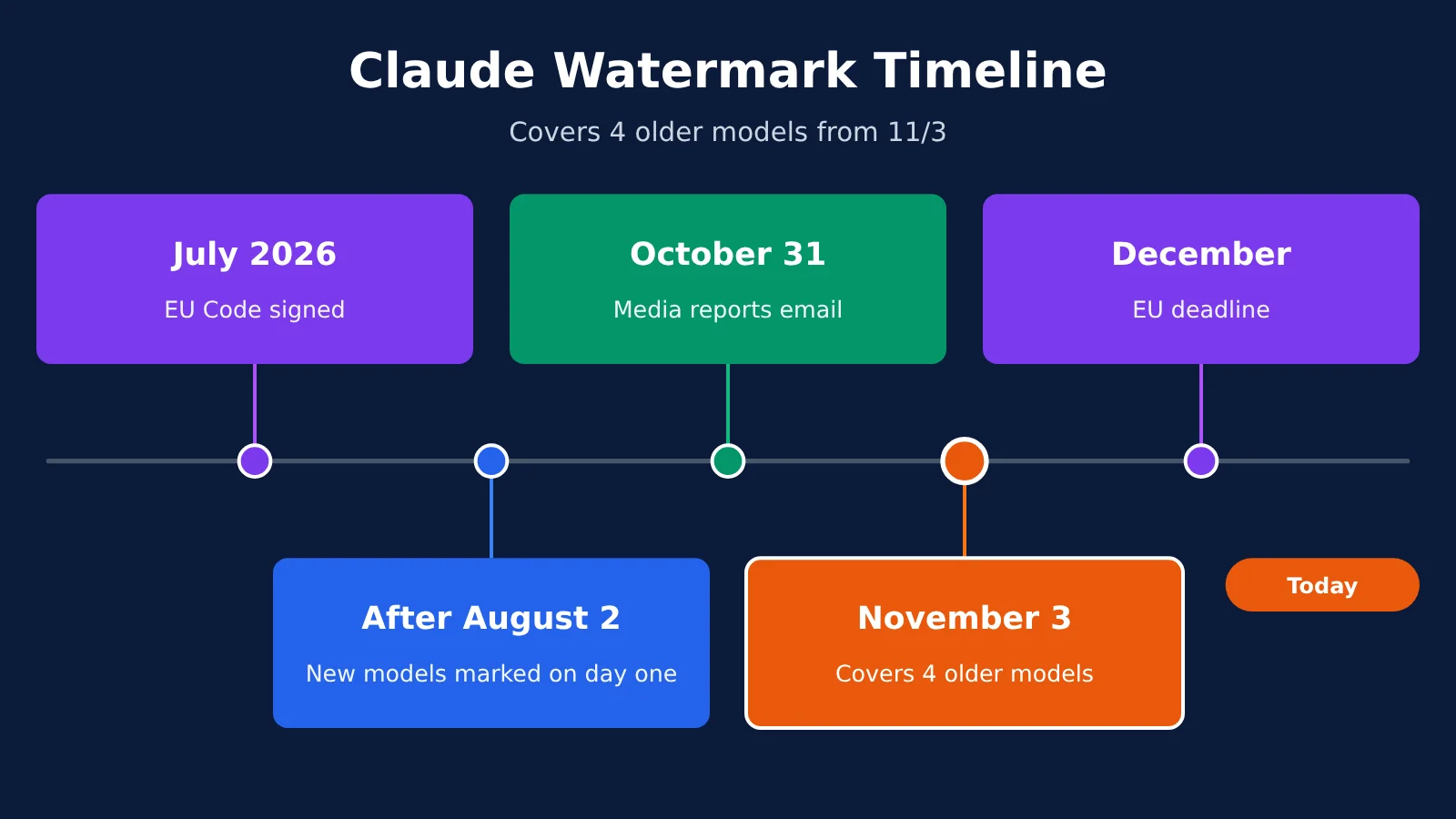
According to an Anthropic email seen by The Decoder, Claude text watermarking covers four older models—Mythos 5, Opus 4.7, Opus 4.6, and Sonnet 4.6 starting today, November 3. Anthropic says the watermark adds no cost or tokens. The detection API is still in private preview, so regular users can’t check for it yet.
This isn’t a detection report, and we haven’t tested any content for watermarks. Below, we’ve gathered publicly available information and identified what’s officially confirmed versus third-party reporting or opinion. This should help you decide whether the model you use is affected and whether you need to adjust your content workflow.
What Changed With Claude Watermarking on November 3?
The main change is broader coverage, not a change to the API or billing rules. According to an email seen by The Decoder (2026-10-31), Anthropic told API customers it would add watermarks to Mythos 5, Opus 4.7, Opus 4.6, and Sonnet 4.6. Newer models, including Opus 5.5, were already watermarked. The same email noted that the rollout on Amazon Bedrock could arrive a few days later.
This watermark doesn’t add hidden text to the end of a response. Anthropic’s official article explains that it uses a variant of Google DeepMind’s SynthID-Text. When either of two words would make sense, it uses a key and the preceding words to determine the source of randomness. In simple terms, the watermark is embedded in the statistical patterns of word choice. Readers can’t see a difference, and no characters are added to the text.
Anthropic ties the work to the EU AI Act’s transparency code of practice. The code was signed in July 2026 and has around 190 signatories; we won’t get into the policy details here. What’s more relevant for developers is that Anthropic says it currently has no reliable way to define regions, so watermarking is enabled globally rather than affecting users in just one region.
The table below separates the key claims by source. When citing them, don’t conflate claims with different levels of confirmation.
| Information | Details | Source level |
|---|---|---|
| How it works | A SynthID-Text variant; adds no characters and contains no user, organization, or conversation information | Officially confirmed (Anthropic’s official article, marked as updated 2026-09-01) |
| Cost impact | Requires no extra tokens and doesn’t cost more | Officially confirmed; the email also says pricing and request and response formats are unaffected |
| Channels covered | API, Claude app, Claude Code, Cowork, Tag; also applies to AWS, Google Cloud, and Microsoft Foundry | Officially confirmed (Anthropic Help Center, accessed 2026-11-03) |
| Enablement for 4 older models | The email says watermarking will be added starting November 3 | Third-party report (based on an email seen by The Decoder) |
| Parameter conditions for the 4.6 series | Watermarking applies only when three sampling parameters remain at their defaults | Third-party report (based on an email seen by The Decoder) |
| Effect on writing style | Synonyms aren’t perfectly interchangeable, so word choice may affect style | Third-party opinion (blogger John Gruber, quoted by The Decoder) |
There’s also a timing discrepancy worth noting: when Anthropic’s Help Center model table was accessed on November 3, the text watermark column was still blank for these four models, inconsistent with the email’s “starting November 3” timeline. The safest interpretation is that the email says the rollout starts today, while the table may be lagging. Check actual outputs and subsequent official updates for confirmation.
Claude Watermark: Four-Model Checklist
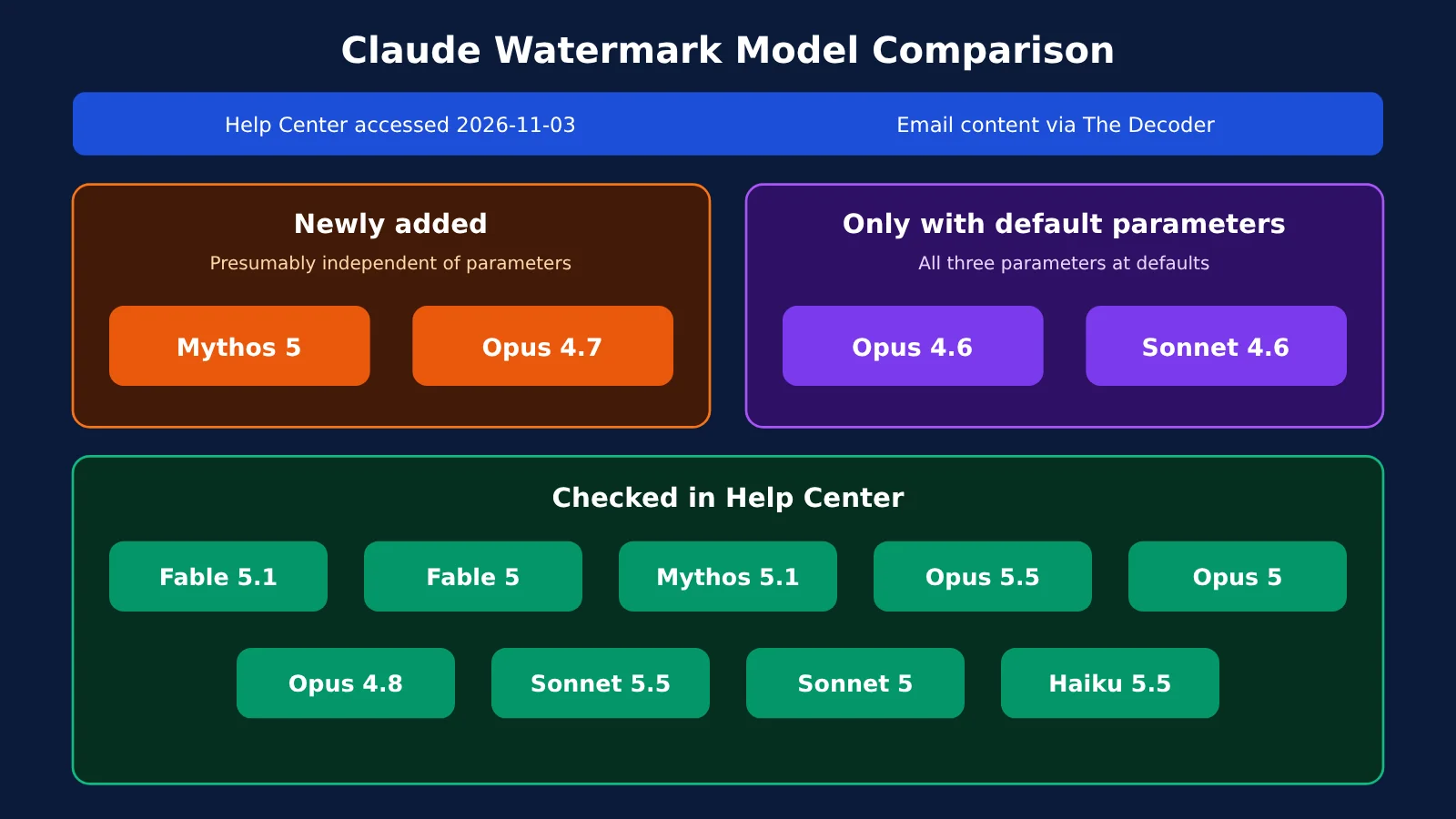
First, check the model name. If you use one of the four models below, plan for its output to potentially carry a watermark starting today. For the 4.6 series, there’s an additional condition to check. The table lists the help center status and the email’s claims separately because they currently don’t match.
| Model | Help center text watermark column (retrieved 2026-11-03) | Email’s claims (according to The Decoder) | Sampling parameter condition |
|---|---|---|---|
| Mythos 5 | Blank; only C2PA is checked | Watermarked starting November 3 | Not specified in the email; the report suggests parameters don’t matter |
| Opus 4.7 | Blank; only C2PA is checked | Watermarked starting November 3 | Not specified in the email; the report suggests parameters don’t matter |
| Opus 4.6 | Blank; only C2PA is checked | Watermarked starting November 3 | Only watermarked when all three sampling parameters remain at their defaults |
| Sonnet 4.6 | Blank; only C2PA is checked | Watermarked starting November 3 | Only watermarked when all three sampling parameters remain at their defaults |
[Screenshot placeholder: Anthropic help center model table, with retrieval date]
According to the help center, models already checked for text watermarking include Fable 5.1, Fable 5, Mythos 5.1, Opus 5.5, Opus 5, Opus 4.8, Sonnet 5.5, Sonnet 5, and Haiku 5.5. Anthropic also says models released on or after August 2, 2026, support machine-readable markers from day one, while older models are being updated in batches. This article makes no claims about models mentioned in neither the table nor the email; check for future official updates.
Self-check tip: First, confirm the actual model ID in your code or configuration. Don’t rely on the product name alone. If you make calls through APIYI apiyi.com, you can also check the platform’s model list for available Claude models.
What Claude Watermarks Can and Can’t Tell You
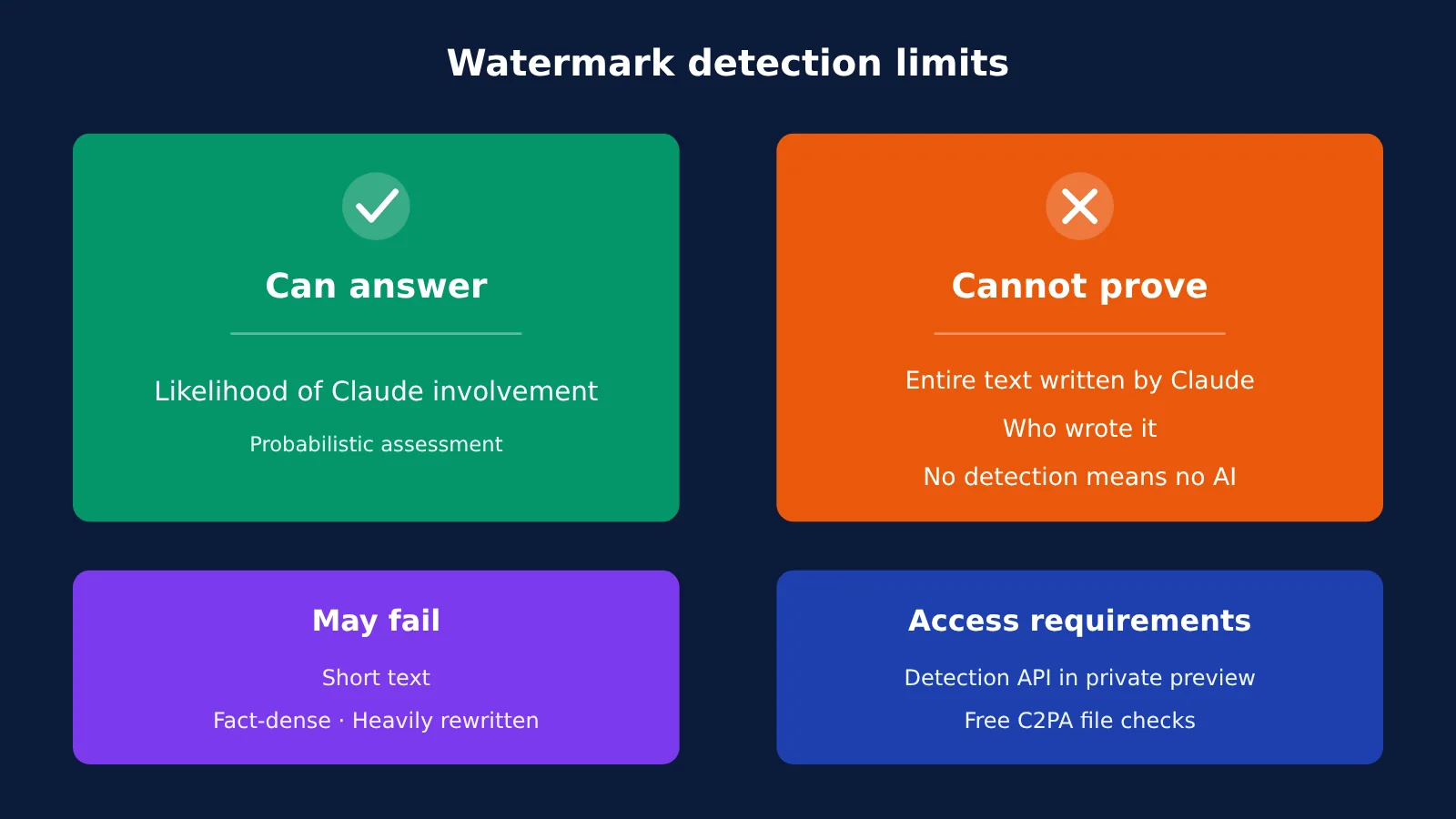
Watermark detection can only provide a probabilistic assessment. It can’t prove that an entire piece was written by AI. According to Anthropic, the detection answers “how likely Claude was involved in producing this text.” That limitation means it shouldn’t be the sole basis for determining authorship.
| Question | Can it answer? | Official basis |
|---|---|---|
| How likely is it that Claude contributed to this text? | It can provide a likelihood assessment | The official article’s description of detection capabilities |
| Was the entire article written by Claude? | It can’t prove that | Anthropic explicitly states this |
| Who, which organization, or which conversation generated it? | It can’t trace the text back to them | The watermark contains no user, organization, or conversation information |
| Can it detect short text, fact-dense passages, or heavily rewritten text? | Detection may fail | Failure cases listed by Anthropic |
| If no marker is detected, can we conclude the text wasn’t AI-generated? | No | The Help Center lists cases including older models, heavy rewriting, translation, text that’s too short, and removed metadata |
Beyond its capabilities, access is another important limitation. The detection API is currently in private preview for regulators, law enforcement, media, fact-checkers, independent researchers, educational institutions, EU civil society organizations, and businesses with equivalent compliance obligations. Anthropic provides an application form. There’s currently no public self-service option for ordinary developers or content creators, making it difficult to independently check a piece of text for a watermark.
Text watermarks and file markers aren’t the same thing, either. Text watermarks are embedded in word-choice patterns and are primarily assessed through the detection API. Files such as PNGs and JPEGs carry C2PA Content Credentials, which act as credentials attached to the file and can be checked for free at claude.com/check-content. That free tool checks file markers; it can’t replace text watermark detection.
Why Only the Claude 4.6 Series Has a “Default Parameters” Condition
The short answer is that publicly available information doesn’t give an official reason. What we do know is that, among these four models, Opus 4.6 and Sonnet 4.6 are watermarked only when the three sampling parameters—temperature, top_p, and top_k—are left at their defaults. This information comes from an email seen by The Decoder, so it’s a third-party account rather than a statement on an official page.
The email also includes a point worth noting for compliance teams: “If you rely on watermarking for your own compliance, please keep these settings at their defaults.” This is compliance configuration guidance, not a way to manipulate watermarks. This article doesn’t provide any such instructions either. The key takeaway is that systems relying on watermarks can’t assume every output from the 4.6 series is watermarked.
As for Mythos 5 and Opus 4.7, the email didn’t include the same warning. The Decoder inferred from this that watermarking for those two models doesn’t depend on sampling parameters. That’s only an inference from the email; Anthropic hasn’t explicitly confirmed it.
In principle, both watermarking and sampling parameters affect “word choice,” which might explain the limitation for the 4.6 series. But that’s our speculation, not an explanation from Anthropic. It also doesn’t explain why the same warning wasn’t given for Opus 4.7. Until Anthropic provides an explanation, it’s best to record this as a configuration fact without trying to supply a definitive technical explanation.
What Content Teams and API Users Should Do About Claude Watermarking
The takeaway differs for each group: content teams should adjust their expectations of watermarking and review their disclosure processes, while API users should check their models and configurations. Most projects don’t need to change their APIs or adjust their budgets just because of watermarking.
What content teams can do:
- Put disclosure rules first: Follow your clients’, platforms’, and industry’s requirements for disclosing AI involvement. “Others can’t detect it right now” doesn’t mean “there’s no need to disclose it.”
- Don’t treat detection results as a verdict: A watermark can’t prove that an entire piece was written by AI, and a negative result doesn’t mean AI wasn’t involved. Reviewers should also consider source records and editing workflows.
- Document the generation process: Keep records of the model used, its purpose, and the extent of human edits. When Claude only corrects grammar in a human-written draft, there’s little text for a watermark to attach to, making process records especially important.
- Watch for stylistic differences: The official position is that watermarking doesn’t change meaning, quality, or readability, while Gruber questions whether synonyms are truly equivalent. Neither claim is enough to settle the question for your team. If style matters to you, consider a blind human review of responses to the same prompt.
What API users can do:
- Check the configuration scope: If your business relies on watermarking for compliance, include the 4.6 series’ sampling parameters in your configuration review and make sure they remain at their defaults.
- Allow for timing differences: The Bedrock rollout may arrive a few days later, and official pages may also lag behind. Don’t use a single screenshot to judge the status across all channels.
- Keep an eye on latency: The official position is that the speed impact is negligible, while the email describes it as “a tiny bit slower.” If your service is latency-sensitive, keep watching your own monitoring data.
- No code changes are needed for watermarking: The email says request and response formats are unaffected, so there’s no need to change your existing invocation logic.
Process tip: If your team uses multiple Claude models, consider managing model IDs and sampling configurations centrally to make upgrades easier to review. If you’re using APIYI apiyi.com as a unified access point, you can also move model switching into the configuration layer to reduce changes scattered throughout your application code.
How to Choose a Claude Model on APIYI
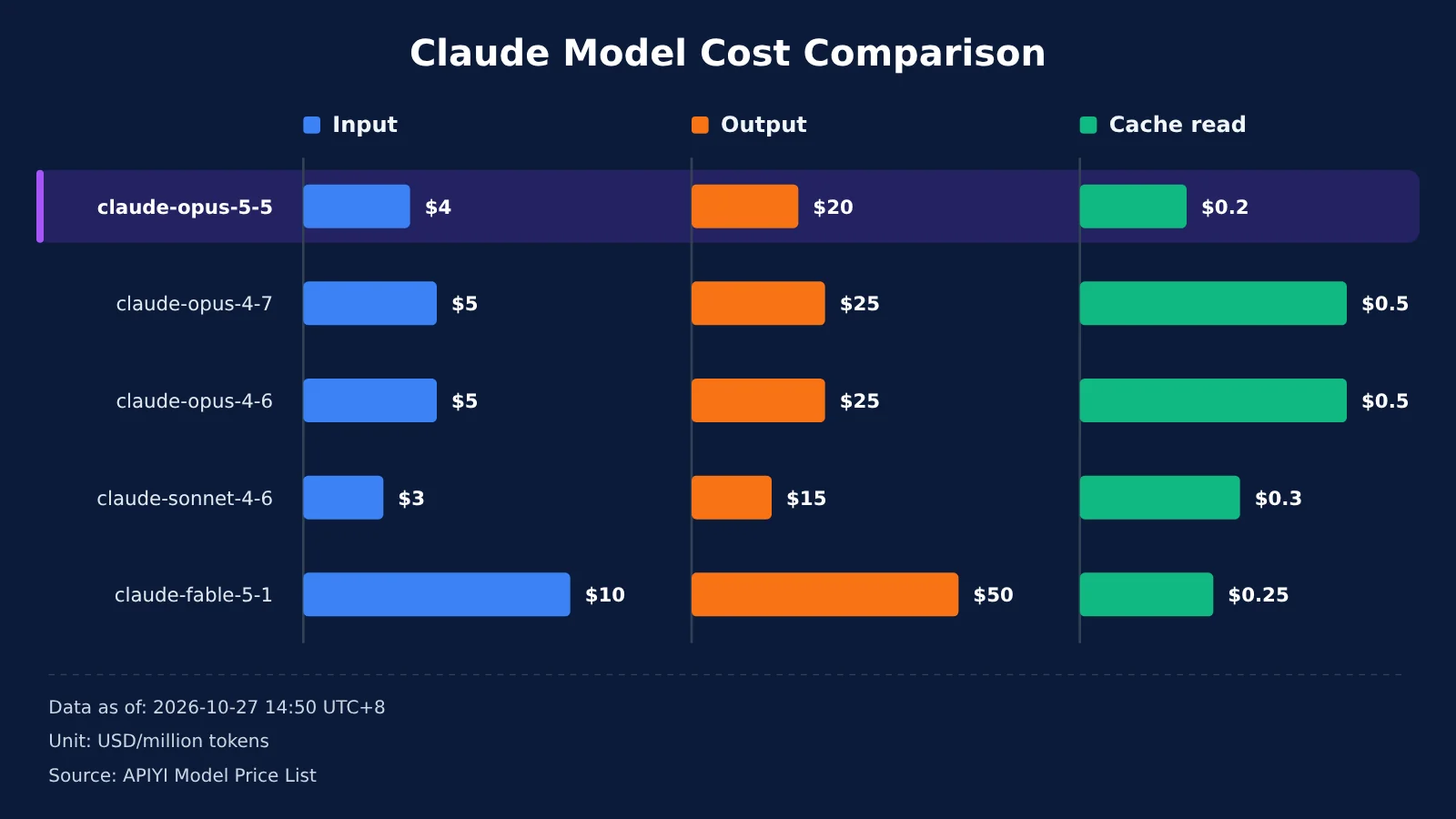
Start with quality and cost when choosing a model, and record its watermark status for compliance. Whether a model has a watermark shouldn’t be the only deciding factor. APIYI at apiyi.com offers an OpenAI-compatible interface with https://api.apiyi.com/v1 as the base URL. You can use the same API key to switch between opus-5-5, opus-4-7, and sonnet-4-6. Run 20 samples using the same prompts on each before deciding.
| Model | Input | Output | Cache read |
|---|---|---|---|
claude-opus-5-5 |
$4 | $20 | $0.2 |
claude-opus-4-7 |
$5 | $25 | $0.5 |
claude-opus-4-6 |
$5 | $25 | $0.5 |
claude-sonnet-4-6 |
$3 | $15 | $0.3 |
claude-fable-5-1 |
$10 | $50 | $0.25 |
Data as of 2026-10-27 14:50 UTC+8, in USD per million tokens, from the APIYI model pricing table.
[Screenshot: APIYI model pricing table, filtered for Claude]
The table shows that claude-opus-5-5 has lower input and output prices than both claude-opus-4-7 and claude-opus-4-6, and its cache reads are cheaper too. Unless you have a reason to stick with an older version, it’s worth testing first. claude-sonnet-4-6 has the lowest input and output prices in the table, making it a good starting point for tasks such as batch first drafts and summaries. claude-fable-5-1 has the highest prices, so it’s better evaluated separately for tasks that genuinely need it.
The 20 samples should cover your real-world tasks, such as long-form first drafts, rewrites, summaries, and translations. When evaluating the results, look at factual errors, the amount of manual editing needed, style consistency, and cost per piece. Together, these give you a better picture of the actual effort and expense than any single metric. Keep in mind that this comparison can help you choose a model, but it can’t verify watermark status.
The official coverage includes the API and three cloud platforms, but doesn’t specifically mention third-party aggregation platforms. So you shouldn’t assume that a watermark’s status changes when using an aggregation platform. For planning purposes, use the model’s official status, and rely on actual outputs and future official updates for the final assessment. Also, the Mythos series wasn’t available on APIYI as of 2026-11-03; we’ll make the model available as soon as possible.
Testing tip: New users can use the free testing credits at APIYI apiyi.com to run a small batch of samples, then scale up model invocations once they’re happy with the quality and cost.
Claude Watermark FAQ
Q1: Will Claude’s watermark increase prices or use more tokens?
Anthropic’s article says the watermark requires no extra tokens and won’t cost more. According to an email seen by The Decoder, it also doesn’t affect pricing or request and response formats. Note that the pricing data referenced in this article may be outdated. Check the platform’s model list for current models and prices; you can find the latest information at APIYI apiyi.com.
Q2: Could a platform flag my finished draft as AI-generated?
There’s no universal answer. Public information doesn’t say which content platforms have integrated the detection API, though the preview includes media organizations, educational institutions, and businesses with compliance obligations. Detection can only assess the likelihood of Claude’s involvement; it can’t prove that Claude wrote the entire piece. Whether a platform flags content as AI-generated and how it handles it depends on its own rules. The safer approach is to disclose AI use as required.
Q3: Do translations and code carry the Claude watermark?
Anthropic’s article says Claude-generated translations are watermarked because Claude chooses every word. Code has little watermarking because it requires precision and offers fewer interchangeable word choices, though comments may contain watermarks. The help center also lists “translation” as a situation where a mark may be absent. Our understanding is that this refers to previously marked text losing its original mark when translated again.
Q4: Can I turn off Claude’s text watermark?
The official materials referenced in this article don’t describe a user-facing switch. They say the watermark is enabled globally. For the 4.6 series, the default-parameter conditions limit when the watermark applies; they shouldn’t be treated as a way to turn it off, and this article doesn’t provide instructions for doing so. If your business relies on the watermark for compliance, keep the default settings as advised in the email.
Q5: Can ordinary users access the Claude watermark detection API?
Not at the moment. The detection API is in private preview for regulators, law enforcement, media, fact-checkers, independent researchers, educational institutions, EU civil society organizations, and businesses with equivalent compliance obligations. Eligible organizations can apply through the official form. Ordinary users can check a file’s C2PA mark for free at `claude.com/check-content`.
Claude Watermarking: Key Takeaways
- Coverage: According to an email seen by The Decoder, Mythos 5, Opus 4.7, Opus 4.6, and Sonnet 4.6 are being added starting November 3.
- Timing discrepancy: When the help center table was retrieved, entries for these four models were still blank. The email says coverage starts today, but the table may lag behind. Check actual outputs and future official updates.
- Parameter requirements: Opus 4.6 and Sonnet 4.6 outputs are watermarked only when all three sampling parameters remain at their defaults. Teams relying on watermarking for compliance should include this in their review.
- Cost and quality: Anthropic says watermarking adds no cost or tokens and doesn’t affect meaning or quality. Gruber’s concerns about its effect on writing style are a third-party view.
- Detection limits: Detection can only assess the likelihood that Claude contributed to a text. It can’t prove an entire piece was AI-written or trace it back to a specific person.
- Access: The text detection API is still in private preview. A free checker is available for C2PA markings on files.
You can start with two things: verify which models your production systems actually use, then make sure your team’s AI disclosure process doesn’t rely on the assumption that AI involvement can’t be detected. If you’re choosing between Claude models, you can use APIYI apiyi.com to compare quality and cost using the same set of samples before deciding whether to switch.
References
- Anthropic, “How Claude’s text watermarking works”: How watermarking works, costs, detection limitations, and private preview scope
- Link:
anthropic.com/news/claude-text-watermark - Anthropic Help Center, “How Claude marks AI-generated content”: Covered channels, C2PA, and the model table
- Link:
support.claude.com/en/articles/16266773-how-claude-marks-ai-generated-content - Anthropic Platform API release notes: Watermarking updates for Fable 5.1 and Mythos 5.1
- Link:
platform.claude.com/docs/en/release-notes/api.md - The Decoder (2026-10-31): API customer email and third-party concerns
- Link:
the-decoder.com/anthropics-watermark-rollout-leaves-a-loophole-on-two-older-claude-models - APIYI model pricing list: Claude model prices, updated 2026-10-27 14:50 UTC+8
- Link:
docs.apiyi.com/models