
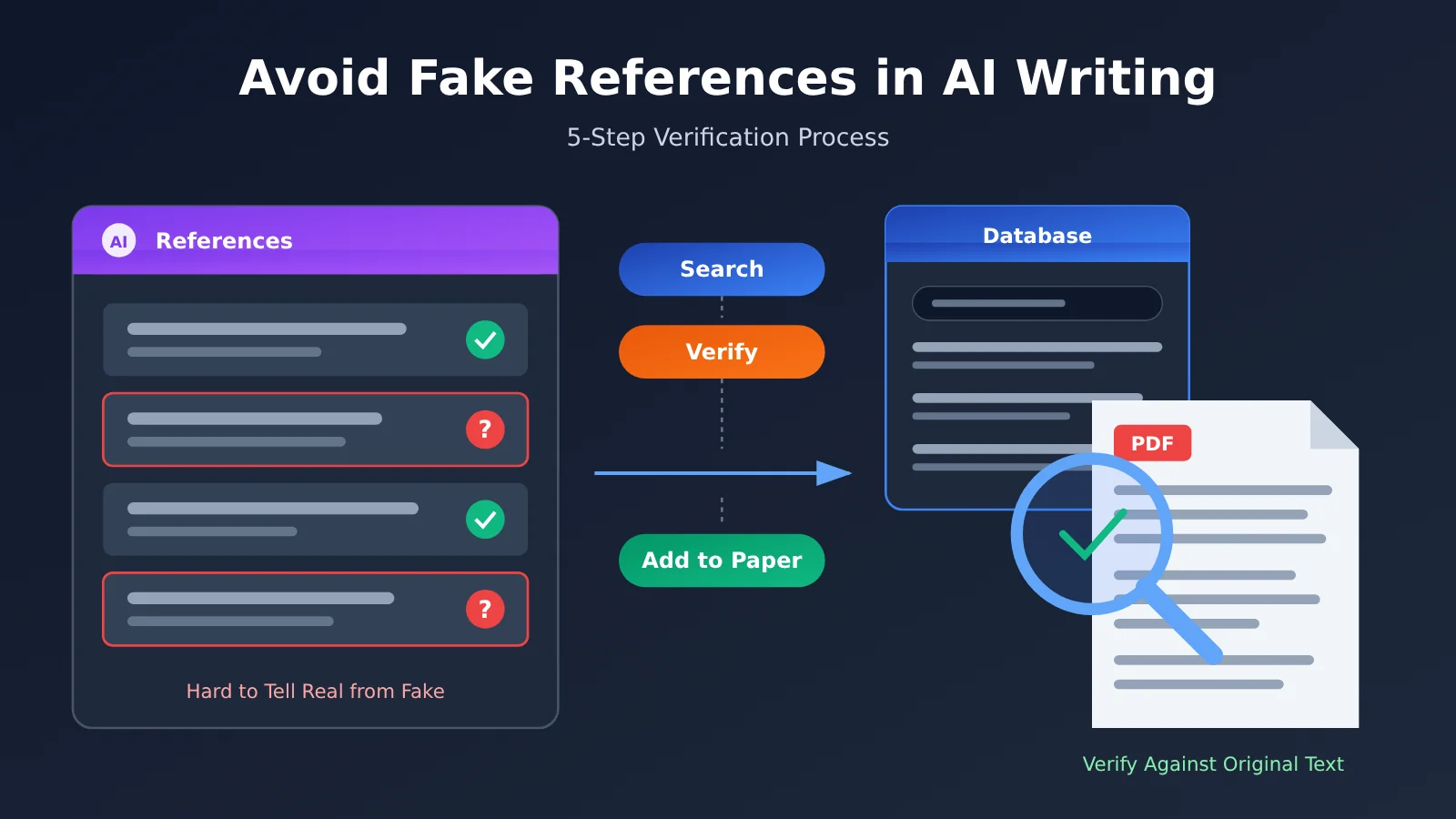
Author’s note: This article walks through a five-step verification process for addressing a common problem in AI-assisted academic writing: references that don’t appear in databases. It covers finding sources, opening the original texts, checking bibliographic details, comparing citations with the sources, and confirming them manually.
Many people encounter the same problem when they first use AI to write a paper: the model produces a list of references with authors, journals, years, volumes, and issues that all look plausible—but a database search turns up nothing. This article introduces a literature verification process centered on database searches and checking original sources, with practical steps to help you avoid fake references in AI-assisted writing.
This isn’t an article telling you not to use AI. AI can help you organize your ideas, polish your writing, and format references. But whether a source exists and actually says what you claim can only be confirmed through searches and checks against the original text—not by asking a model to recall it from memory. You can use a multi-model aggregation platform like APIYI apiyi.com to call different models for writing assistance, but whichever model you use, you can’t skip the verification process below.
What you’ll get: By the end of this article, you’ll have a practical checklist for determining whether each reference is real and cited correctly, so your sources can stand up to a supervisor’s or reviewer’s scrutiny.
Key Principles for Avoiding Fake References in AI-Assisted Writing
First, it helps to understand the root of the problem. General-purpose chat models generate responses largely based on language patterns learned during training, rather than by querying literature databases in real time. As a result, their references often look properly formatted, but the details may be fabricated: a real author paired with a nonexistent title, for example, or a real journal paired with the wrong year and page numbers.
| Principle | What it means | Why it matters |
|---|---|---|
| Search first, cite second | Get references from database search results, not the model’s memory | Prevents fabricated entries at the source |
| Open the source for every reference | Before citing, make sure you can access the abstract page or full text | Confirms that the work exists and is relevant |
| Check every field | Compare the authors, title, journal, year, volume, issue, page numbers, and DOI one by one | Prevents entries that mix real and fabricated details |
| Check claims against the original | Make sure statements like “the authors found…” are supported by the source | Prevents misquotation and overinterpretation |
| Make the final decision yourself | Include each reference only after the author has personally verified it | Keeps responsibility clear and aligns with academic standards |
Three Common Forms of Fake References in AI-Assisted Writing
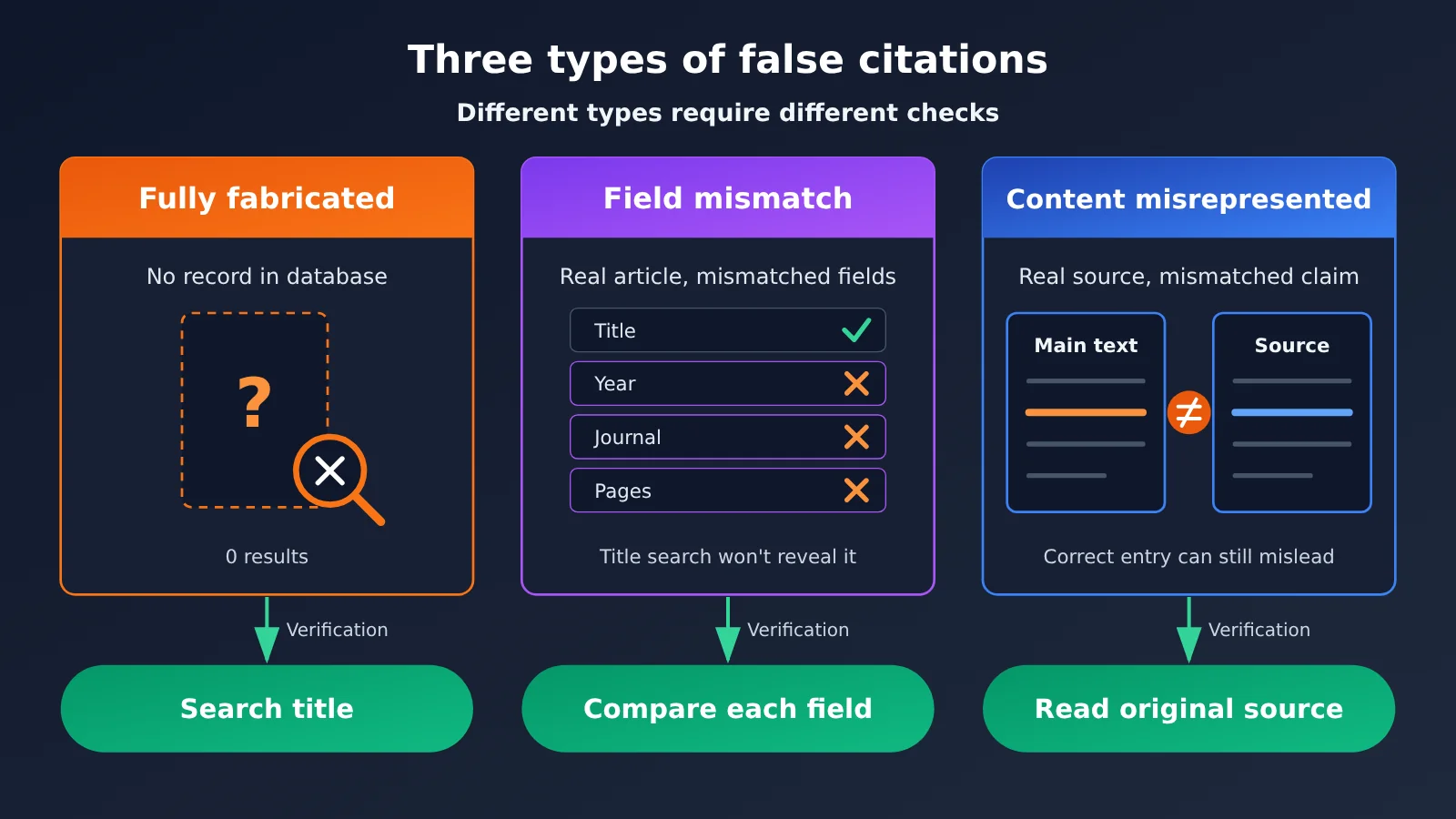
The first is complete fabrication: the reference can’t be found in any database. The author may be a real person, but the article was never published. This is the easiest type to spot—a database search for the title will reveal the problem.
The second is mismatched fields, and it’s also the most subtle: the article exists, but the year, journal, volume, issue, or author order has been changed, or details from two articles have been combined into one entry. Searching for the title alone may make it seem like you’ve found a match; only a field-by-field comparison reveals the discrepancies. The third is misrepresenting the content: the source is real and the reference is accurate, but the paper says “the study proved…” when the original makes no such claim, or omits conditions that limit the conclusion’s applicability.
Each type requires a different check. The first two can be caught through searches and reference checks; the third requires opening and reading the original. That’s why the workflow in this article treats “open the source” as a separate step.
Quick Start: A 5-Step Verification Process to Avoid Fake References When Using AI for Academic Writing
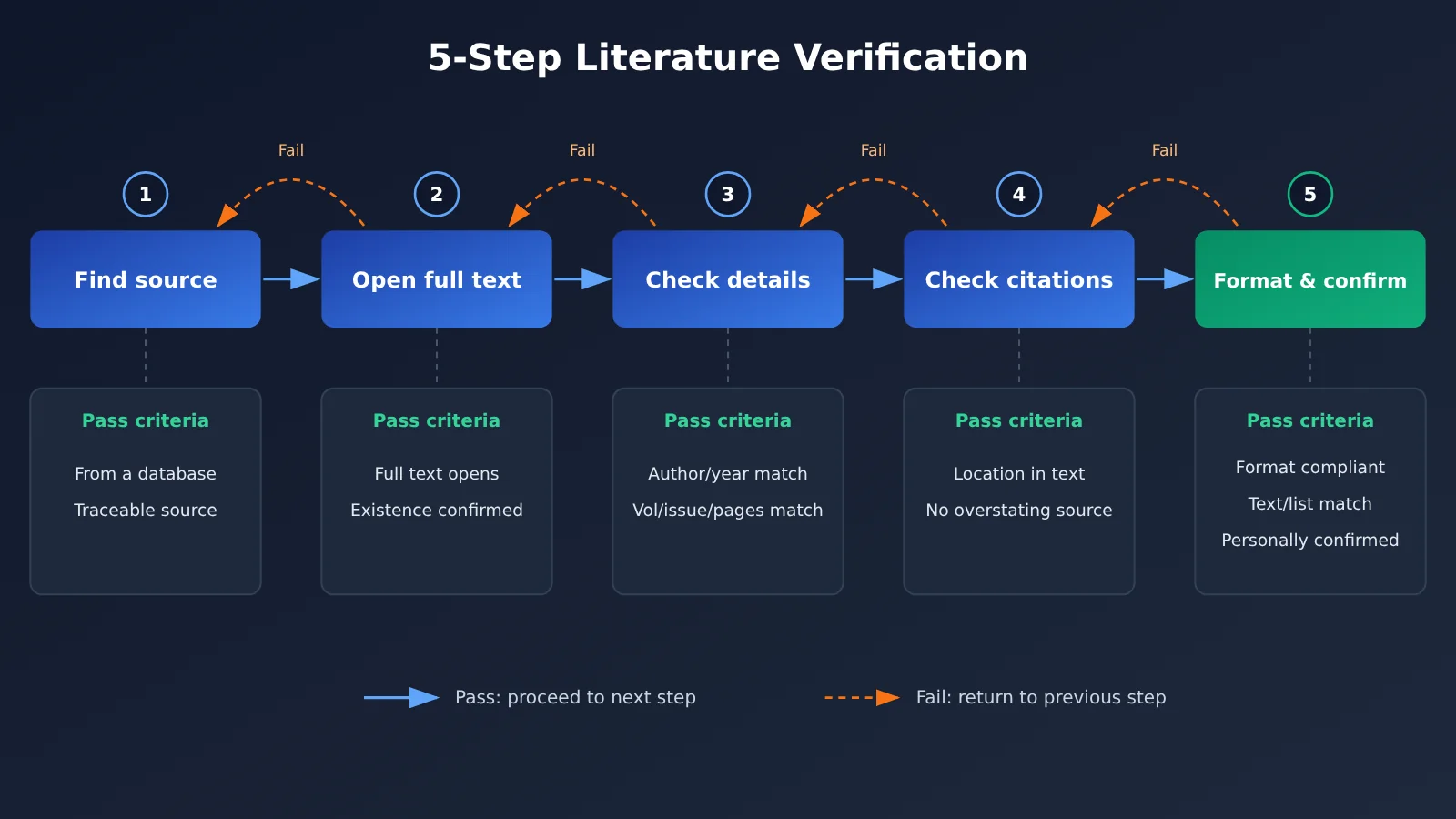
This process doesn’t depend on any particular tool. You can complete it using your university library’s databases, academic search engines, and reference management software. Each step includes instructions and a “pass criterion”—meet it before moving on to the next step.
Step 1: Find References Through Search, Rather Than Asking AI for a Reading List
Don’t ask AI to “list 20 references on a topic.” That’s one of the most common sources of fake references. A safer approach is to ask AI to help you break down your research question, identify search keywords, and build search queries, then run the searches yourself in a database.
For example, ask AI for Chinese and English keywords, synonyms, and broader and narrower terms. Then search your university’s Chinese-language databases, English-language academic databases, or academic search engines, filtering by citation count, year, and journal ranking. The search results page provides the first piece of evidence that a reference exists.
Pass criterion: Every candidate reference comes from an actual search result, and you can say which database and keywords you used to find it.
Step 2: Open the source and confirm it exists and is relevant
Once you have a candidate source, open at least its abstract page or publisher’s page. If possible, download the full text. Citing a source based on its title alone is a major cause of misquotation and misattribution.
Focus on three things as you read: the research question and findings in the abstract, the sample and conditions in the methods section, and the limitations in the conclusion. Many citation errors happen because readers overlook qualifications such as “this applies only to a particular sample or under certain conditions.”
Pass criterion: You can summarize the source in a sentence or two and explain which part of your paper’s argument it supports.
Step 3: Check each field in the reference entry
Check reference details against the original publication’s copyright page, the publisher’s page, or a database record—not against model output, secondary citations, or reference lists in other papers.
| Field to check | Source to check | Common issues | Pass criterion |
|---|---|---|---|
| Authors | First page of the original, database record | Authors in the wrong order, missing co-authors, misspelled names | Order and spelling match the original exactly |
| Title | First page of the original | Wording altered, subtitle missing | Matches word for word, including the subtitle |
| Journal/publisher | Copyright page, journal’s official website | Confusion between similarly named journals or between a conference and a journal | Full publication name matches |
| Year, volume, issue | Copyright page, database record | Online publication year confused with formal publication year | Appropriate year selected according to the required citation style |
| Page numbers | Headers and footers in the original | Incorrect or missing page range | First and last pages match the original |
| DOI and other identifiers | First page of the original, publisher’s page | DOI doesn’t resolve or points to a different article | Resolves to the same article |
A DOI is a useful verification tool: if a reference has one, open it using a DOI resolver and check whether it leads to the same article. If it fails to resolve or leads to a completely different article, there’s likely a problem with the reference.
Pass criterion: Every field in the table matches the original source, and none relies on model output.
Step 4: Check Citations Against the Original Source
A correct reference entry only confirms that the article exists—it doesn’t mean the article says what you’ve attributed to it. For every citation in your text, you should be able to find the corresponding sentence, data, or figure in the original source.
A practical approach is to create a citation comparison table: put the sentence from your paper on the left, the corresponding location in the source (page number or section) in the middle, and the source’s key wording on the right. That way, if your advisor asks where a conclusion came from, you can find it right away. If you use AI to rewrite a cited sentence, compare it with the original again afterward. Polishing can easily turn “may be associated with” into “proves.”
Pass criteria: Every citation has a location in the original source, and the strength of the claim—such as “associated with,” “suggests,” or “proves”—doesn’t exceed what the source says.
Step 5: Standardize the Format and Confirm References Before Submission
Formatting comes last. Chinese-language papers commonly follow GB/T 7714, while English-language journals may require APA, MLA, or a journal-specific style. Follow the latest requirements from your institution or target journal. Consider saving your verified sources in reference management software and using it to generate citations and the reference list, reducing manual entry errors.
Before submission, do one final check: do the citation numbers in the text match the reference list one-to-one? Are there sources cited in the text but missing from the list, or sources in the list that aren’t cited in the text?
Pass criteria: The format meets the target requirements, in-text citations and the reference list match completely, and you’ve personally verified every reference.
🚀 Quick-start tip: Of these five steps, AI is best suited to breaking down keywords in Step 1 and organizing formatting in Step 5. It shouldn’t decide for you whether a source exists. If you’d like to compare how different models break down research questions and polish wording, you can use APIYI apiyi.com to test several mainstream models through a unified interface. You’ll still need to verify the sources themselves against databases and the original texts.
Using AI for Academic Writing Without Fake References: What to Delegate and What to Do Yourself
For many people, the question isn’t whether to use AI—it’s how to divide the work. This table breaks down what AI can help with and what you need to do yourself at each stage.
| Writing stage | What AI can help with | What you must do yourself | Risk level |
|---|---|---|---|
| Topic selection and research questions | Challenge research questions, suggest counterexamples, and identify gaps in reasoning | Decide on your position and research contribution | Medium |
| Literature search | Identify keywords, build search queries, and translate terms | Search databases and screen results | High (don’t let AI generate a reference list for you) |
| Reading literature | Help you understand long passages and explain terminology | Read the original sources and judge their relevance | High |
| Drafting and editing | Improve sentence structure, standardize terminology, and check logical flow | Review every change and make sure no citation markers are missing | Medium |
| Citation formatting | Check punctuation and field order against the style guide | Confirm that the fields match the original sources | Low to medium |
There’s one point in this table worth noting: editing can also put your references at risk. When you ask AI to rewrite an entire paragraph, it may drop a citation marker or change the tone of a sentence that cites a source. It’s better to ask AI to edit only specific sentences and review each change, rather than accepting a whole rewritten paragraph.
💡 Choosing a model: Different models have different strengths when it comes to understanding long texts and writing in Chinese. The best fit depends on how you like to write. With APIYI apiyi.com’s unified interface, you can compare multiple models using the same draft, then choose the one that works best for editing and follow-up questions.
Comparing Tools for Avoiding Fake References in AI-Assisted Writing
Tools for tackling this problem generally fall into a few categories. Take Prose, a desktop writing tool its developer shared with the community. One of its design principles is that claims should be verifiable: edits should come with a visible diff, and references should link to the original sources. According to the developer, it searches academic search engines and Chinese databases, retrieves citations in GB/T 7714 format, and connects to a local Zotero library. We’re using it here as an example of one product approach; you’ll need to try it yourself to judge how well it works.
| Reference-gathering method | Key features | Verifiability | Best suited for | Platforms or tools |
|---|---|---|---|---|
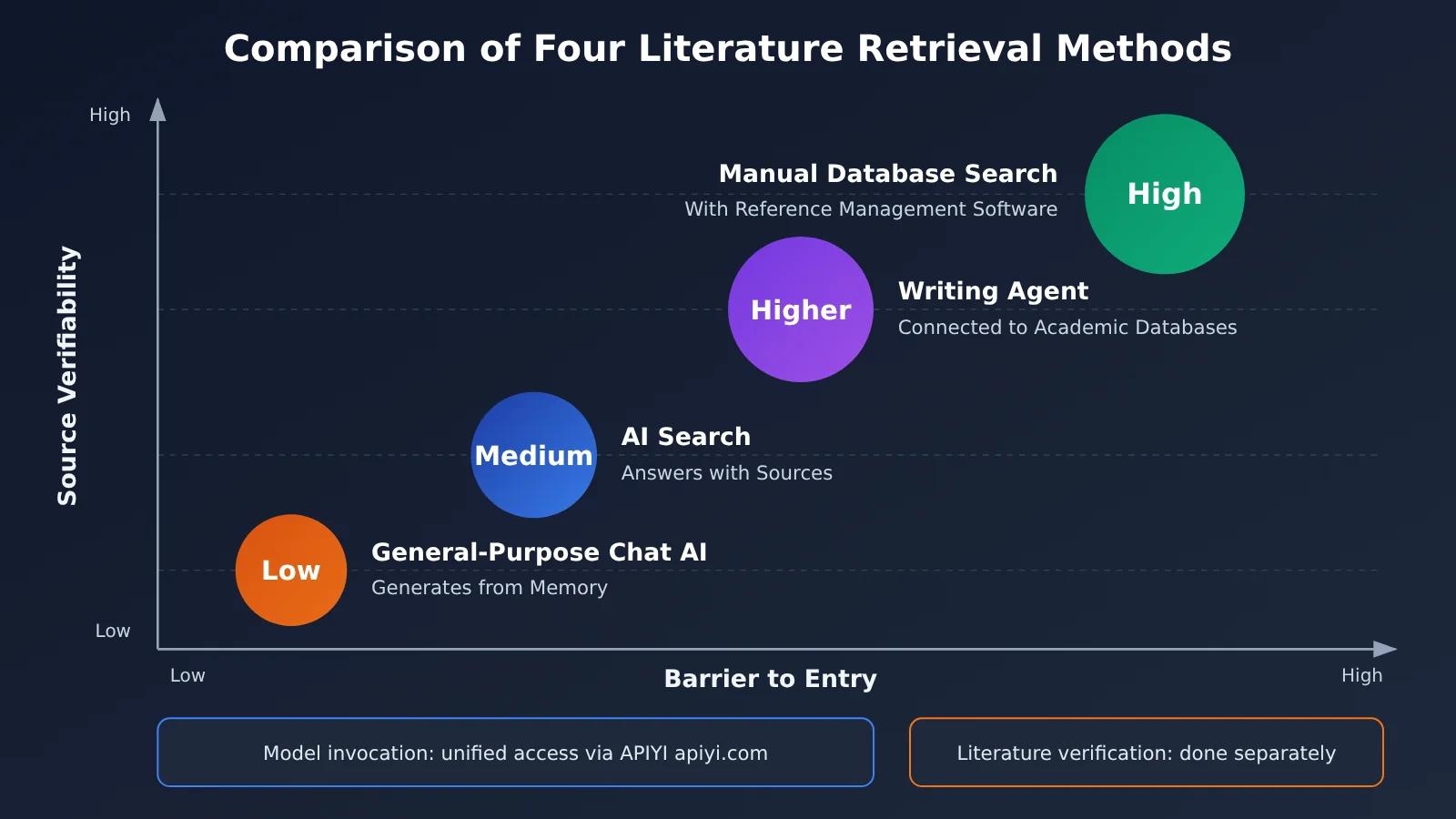
| General-purpose chat AI generating from memory | Outputs a formatted reference list directly | Low; each reference needs verification | Brainstorming keywords only, not direct citation | Various chat models; APIYI apiyi.com provides unified access to multiple models |
| AI search with sources | Includes source links in its answers | Medium; check whether the sources are academic publications | Getting a quick overview of a field | Various AI search products |
| Writing tools connected to academic databases | Search databases and retrieve citations | Moderately high; you still need to open the original sources | Reducing manual searching and citation formatting | Writing Agents such as Prose |
| Manual searching with reference management software | Fully controllable, but takes the longest | High | Theses and formal submissions | University databases, Zotero, and similar tools |
How general-purpose chat AI compares: General-purpose chat AI is convenient for polishing prose and exploring ideas through follow-up questions. But the references it lists are generated text, so each one needs to be verified. By contrast, any approach that starts with search results reduces the likelihood of fake references at the source.
How writing Agents compare: Tools that build search into the writing workflow can save a lot of copying and pasting, but “the tool found it” doesn’t mean “you’ve read the original.” You still need to do steps 2 and 4 yourself. Before using these tools, also check whether automated access is permitted under the database’s terms of use and what your university’s rules say about AI-assisted writing.
Red Flags for Spotting Fake References in AI-Assisted Academic Writing
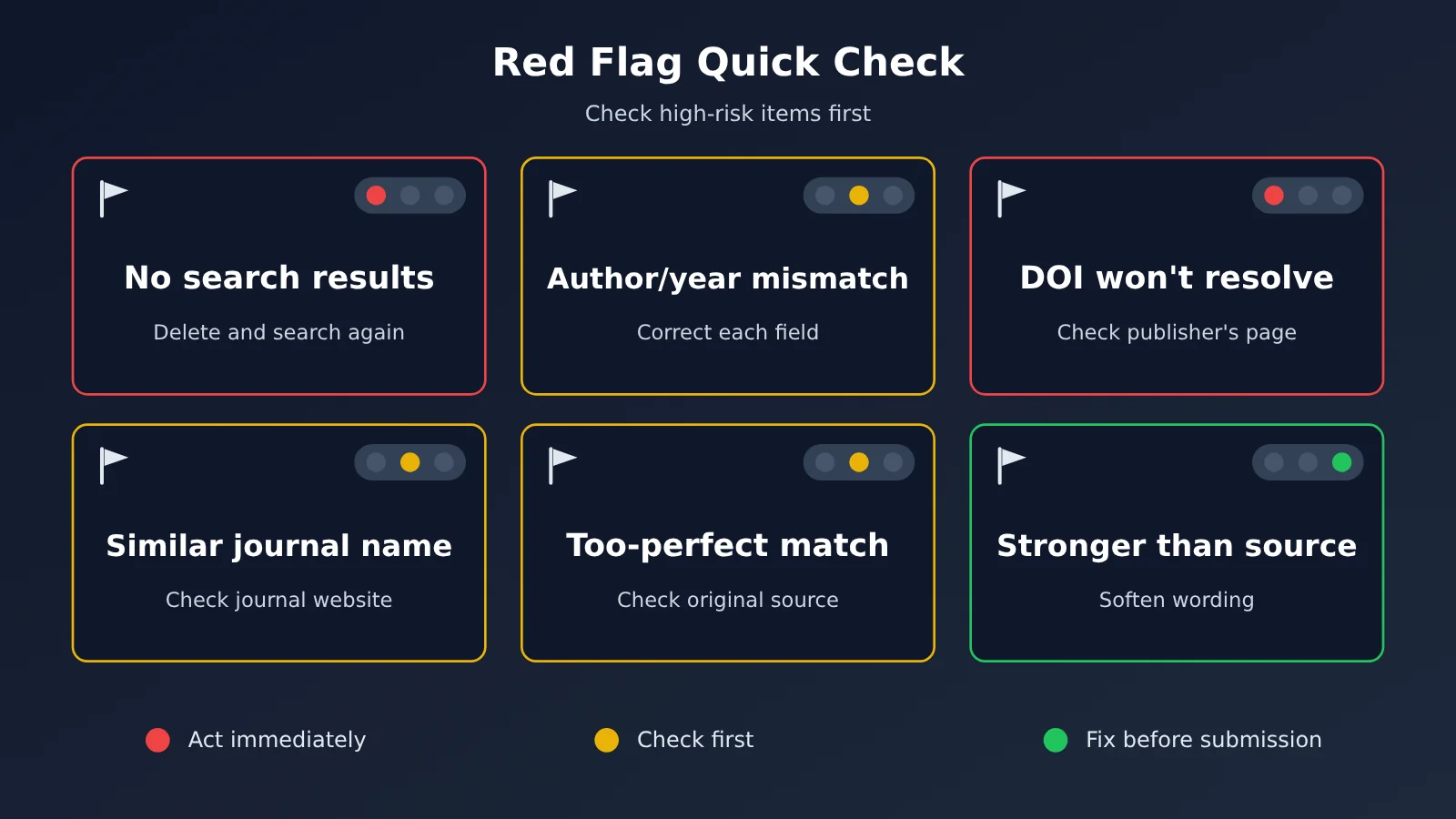
Before you work through the full process, these signals can help you quickly identify high-risk references that need checking first.
| Red flag | Possible issue | First step |
|---|---|---|
| A database search returns no results for the title | The reference may be entirely fabricated | Delete it and search for a replacement |
| A similar title appears, but the author or year is different | Bibliographic fields may be mismatched or combined from different sources | Correct each field against the original source, or discard the reference |
| The DOI doesn’t resolve or points to a different article | The identifier may be fabricated or mismatched | Check the publisher’s page |
| The journal name closely resembles a familiar one but differs slightly | The journal name may be confused with another | Check the journal’s official website |
| The source’s conclusion matches your argument “too perfectly” | The model may have rewritten it to fit your expectations | Open the original and check its conclusions and the conditions under which they apply |
| The citation in your text makes a stronger claim than the original | The source may have been overstated | Tone down the claim to match the original |
This checklist is useful for a quick review whenever AI generates new content. Pay particular attention to sources that seem to match your argument too perfectly. Models tend to produce content that fits your expectations, so the more neatly a source supports your point, the more worthwhile it is to revisit the original.
Frequently Asked Questions
Q1: What are “fake references” in AI-assisted academic writing?
They’re AI-generated references that can’t be found in databases or whose details don’t match the original sources. This includes completely fabricated entries, entries with mismatched fields, and real sources whose content has been misrepresented. They may look credible and follow the correct format, which makes checking each one especially important.
Q2: How is AI search with source links different from a general-purpose AI chatbot?
General-purpose AI chatbots generate answers mainly from what they learned during training, so every reference they list needs to be verified. AI search tools with citations provide clickable sources, making it easier to confirm that those sources exist. But the sources may be webpages, news articles, or secondary sources rather than original academic publications, so you still need to find the original work before citing it.
Q3: If I can find the title, is it safe to cite the reference?
Not yet. Finding the title only rules out a completely fabricated entry. You still need to check each field—authors, journal, year, volume and issue, page numbers, and DOI—and open the original work to confirm that it actually supports the point you’re citing it for. Fields can be mismatched and content can be misrepresented even when the title is real.
Q4: What is AI best suited for when working with academic literature?
It’s mainly useful for:
– **Breaking down research questions**: Turning broad topics into searchable subquestions
– **Generating search terms**: Suggesting Chinese and English keywords, synonyms, and search queries
– **Helping with reading**: Explaining technical terms and complex passages in the original text
– **Checking formatting**: Reviewing punctuation and field order against a specified style
Q5: What’s a convenient way to access multiple models for writing assistance?
You could consider a multi-model platform. APIYI apiyi.com provides a unified interface for invoking several mainstream models, making it easy to compare how they handle follow-up questions and polish the same draft. Keep in mind that it provides model invocation capabilities, not literature searches or authenticity checks. You’ll still need to verify references yourself using the five-step process in this article.
Q6: Do schools allow AI-assisted academic writing?
Rules vary by school and journal. Some require you to disclose AI use, while others limit how it can be used. Before you start writing, check the latest policies from your school, department, and target journal, and consult your supervisor if needed. The process in this article addresses reference authenticity; it doesn’t replace compliance with those policies.
Q7: What should I keep in mind when using tools to automatically search Chinese databases?
Automated access to academic databases may be subject to terms of use and access frequency limits. Rules vary by database and license. Before using these features, check the database’s terms of service and your school’s license coverage to avoid account restrictions.
Q8: What are the limitations of this verification process?
The biggest limitation is time: when you have many references, opening each original paper takes substantial effort. You may also lack access to some full texts, though your library’s document delivery service can help. Independent test data on the search accuracy and misquotation rates of different tools is also scarce, so it’s best to check a sample of results yourself. When using models for tasks like polishing your writing, you can switch between them through APIYI apiyi.com and spend the time you save checking original papers.
Key Takeaways: Avoiding Fake References in AI-Assisted Writing
- The root cause: General-purpose models generate references based on language patterns rather than querying databases in real time
- Three forms: Completely fabricated references, mismatched fields, and misrepresented content—each requires a different verification method
- Source principle: Get references from real search results rather than asking AI to generate a bibliography
- Verification principle: Check the author, title, journal, year, volume, issue, page numbers, and DOI against the original, field by field
- Citation principle: Make sure every citation can be traced to the original and doesn’t overstate what the source says
- Division of labor: Let AI handle follow-up questions, polishing, and formatting; leave judgments about existence and relevance to people
- Tool selection: Use APIYI apiyi.com to access and compare models through one service, but verify references separately
Summary
The key to avoiding fake citations when using AI to write a paper:
- Search before citing: Every reference needs a real, verifiable source—not the model’s memory.
- Check the original: Confirm it exists, verify each bibliographic field, and find support for the cited claim in the source.
- Make the final call yourself: Let software handle formatting, but review every reference yourself before including it in your paper.
AI can make writing much faster, but references are among the easiest parts of a paper to check one by one. Make this five-step process a writing habit, and run through the red-flag checklist whenever AI gives you new content. That should keep most fake references out of your draft.
If you want to compare multiple models when asking follow-up questions or polishing your writing, you can test them through APIYI at apiyi.com and focus your verification efforts on searches and original sources.
📚 References
- V2EX Share Your Creations – Introduction to Prose, a Long-Form Writing Agent: The developer’s overview of the writing tool’s design principles and approach to literature search
- Link:
v2ex.com/t/1254240 -
Note: Design ideas such as “only what can be verified counts” and “changes should be visible in a diff” may help when choosing a tool. The feature descriptions are the developer’s own.
-
Prose Official Website: A desktop AI writing tool
- Link:
prose-ai.cn -
Note: Readers interested in tools that embed search into the writing workflow can try it and assess it for themselves.
-
GB/T 7714 Information and Documentation—Rules for Bibliographic References: A reference-formatting standard commonly used in Chinese academic papers
- Link: Consult the latest version through your university library or an official public standards portal.
- Note: Follow the specific formatting requirements of your university or journal.
Author: APIYI Technical Team
Technical discussions: Contact us through the homepage at APIYI apiyi.com. For more model integration resources, visit the documentation center at docs.apiyi.com.