
Summary: When choosing a model for game development, look at the success rate on the same task, execution time, API costs, and manual repair costs. Price sheets and general code benchmarks are only supporting evidence.
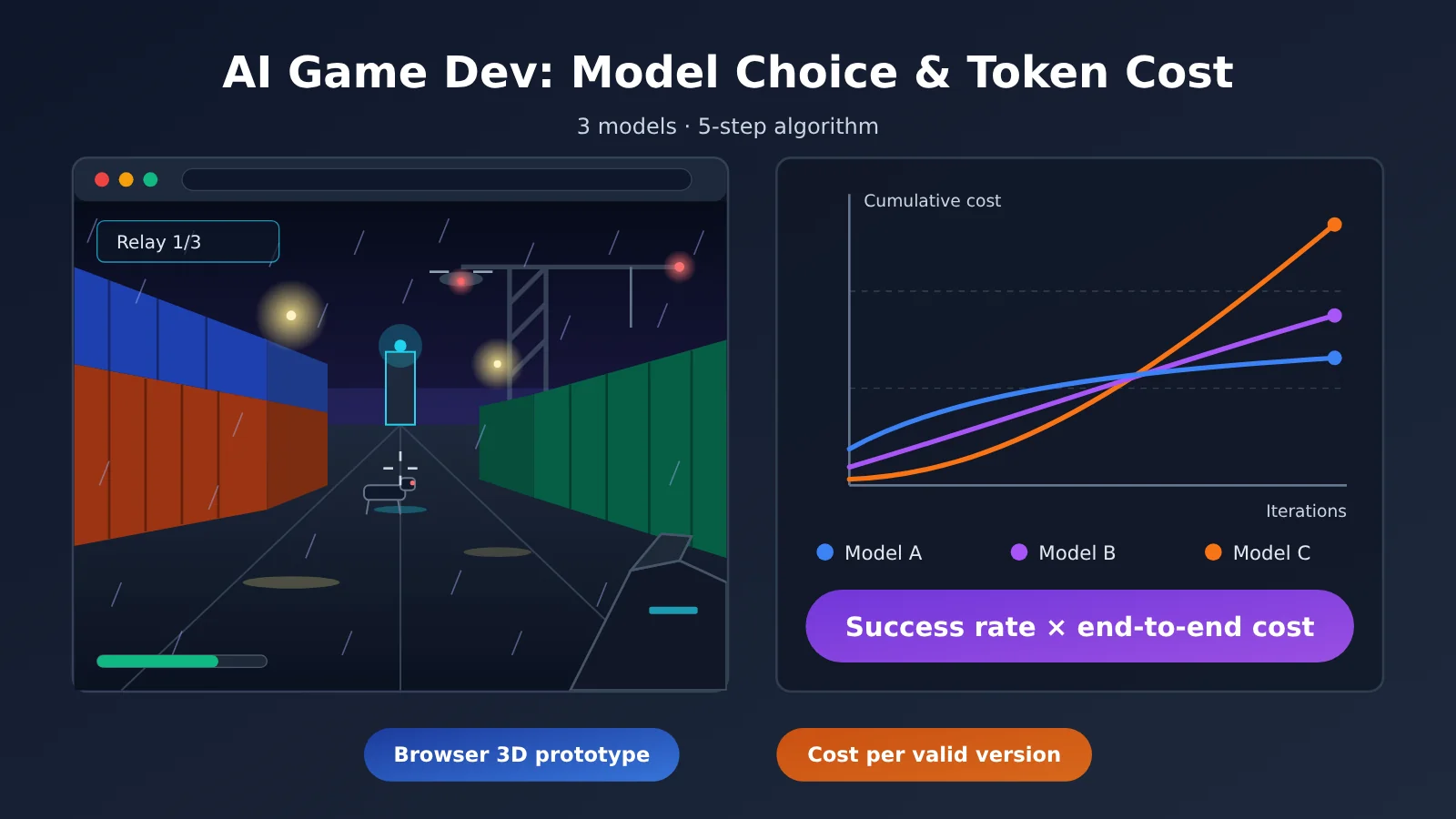
Bottom line up front: When you let AI build a game on its own, the real comparison is the end-to-end cost of producing a shippable version, not the listed price per million tokens. In the Saltline case, Claude Fable 5.2 used about 8 hours, roughly 445 million input tokens, and about 2.7 million output tokens to generate a browser-playable 3D shooter prototype. Based on API pricing, the developer estimated the cost at about $550, and most of the input went through cache. As of November 16, 2026, the standard API unit prices of the three models differ by up to about 5x, but when a lower-priced model needs more rounds, its total cost can be higher. So a reliable way to choose is: give the same game task to candidate models, run it multiple times, track success rate, tokens, elapsed time, and manual repair effort, then calculate the “cost per acceptable version.”
What’s inside: Section 1 uses Saltline to break down the token bill structure of one AI game development experiment. Section 2 compares the official prices of the three models and explains how caching affects total cost. Section 3 explains what SWE-bench Verified, Aider Polyglot, and NIST historical evaluations can each tell you. Section 4 provides a reproducible game-development-specific evaluation plan and code. Section 5 turns the results into a model selection strategy.
To Know: AI Game Development Model Selection Terminology
| Term | Explanation |
|---|---|
| — | — |
| Input tokens | The unit of content submitted to the model for processing, including prompts, code files, tool return results, and so on |
| Output tokens | The unit of content generated by the model, such as code, explanatory text, and tool call parameters |
| Cache reads | Reusing context that’s already cached; billed far lower than regular input |
| Cache writes | The cost of storing context in the cache for the first time, usually slightly higher than regular input |
| SWE-bench Verified | A benchmark of 500 human-verified software engineering tasks drawn from real open-source projects |
| Aider Polyglot | A code-editing evaluation covering 225 exercises across 6 programming languages |
| Harness | An execution framework that organizes the model, tools, and task loop—for example, an agent scaffold |
| Task success rate | The share of tasks completed according to pre-defined acceptance criteria |
| End-to-end cost | The sum of model invocation, tool execution, and human costs for completing an entire task |
| Manual fixes | Human edits made to bring generated results up to acceptance criteria |
| Procedural generation | Generating geometry, textures, and sound with code and mathematical functions instead of importing asset files |
| Shader | A program running on the GPU that computes visual effects such as color, lighting, and materials |
1 A Cost Case Study of AI Solo Game Development: How Many Tokens Did Saltline Burn
1.1 Just how big is Saltline
On November 9, 2026, Anthropic engineer Felix Rieseberg published a Claude Fable 5.2 coding experiment. He gave the model a single prompt: build a small-scale first-person shooter whose visuals come as close to a AAA game as possible — and no human feedback at any point. The result was Saltline: a 3D shooter that runs directly in the browser, set in a container port on a rainy night, where the player has to shut down three signal relay stations and then extract, while air patrol drones and ground mechanical hounds hunt them.
In terms of scope, Saltline is a single-player, single-level playable prototype. “AAA” here is an experiment target and a visual analogy used to describe the art style; its actual content volume is far from a commercial AAA product. The Chinese-circulated “几猫·国产3A大作” is a Chinese-language version or repackaged version of Saltline — the name came from the distribution process and doesn’t reflect development attribution.
1.2 The developer’s own numbers for time, tokens, and cost
All figures below come from the developer’s own posts on X. They’re self-reported estimates and haven’t been audited by a third party:
- Development time: about 8 hours
- Input tokens: about 445 million, a large portion of it cached
- Output tokens: about 2.7 million
- Estimated cost at API pricing: about $550
- Development method: single prompt, no human-feedback iteration
That money is a one-time generation cost. Once the game file is generated, it runs locally in the player’s browser — playing it doesn’t call the Claude API — so the $550 can’t be amortized into a “per-player AI cost.”
1.3 Breaking the bill down with official unit prices
At Claude Fable 5.2’s official standard pricing ($40 per million output tokens), 2.7 million output tokens comes to about $108. The remaining ~$440 corresponds to the input side: cache writes, cache reads, and regular input. The developer didn’t disclose how those three split out, so we can’t break it down further.
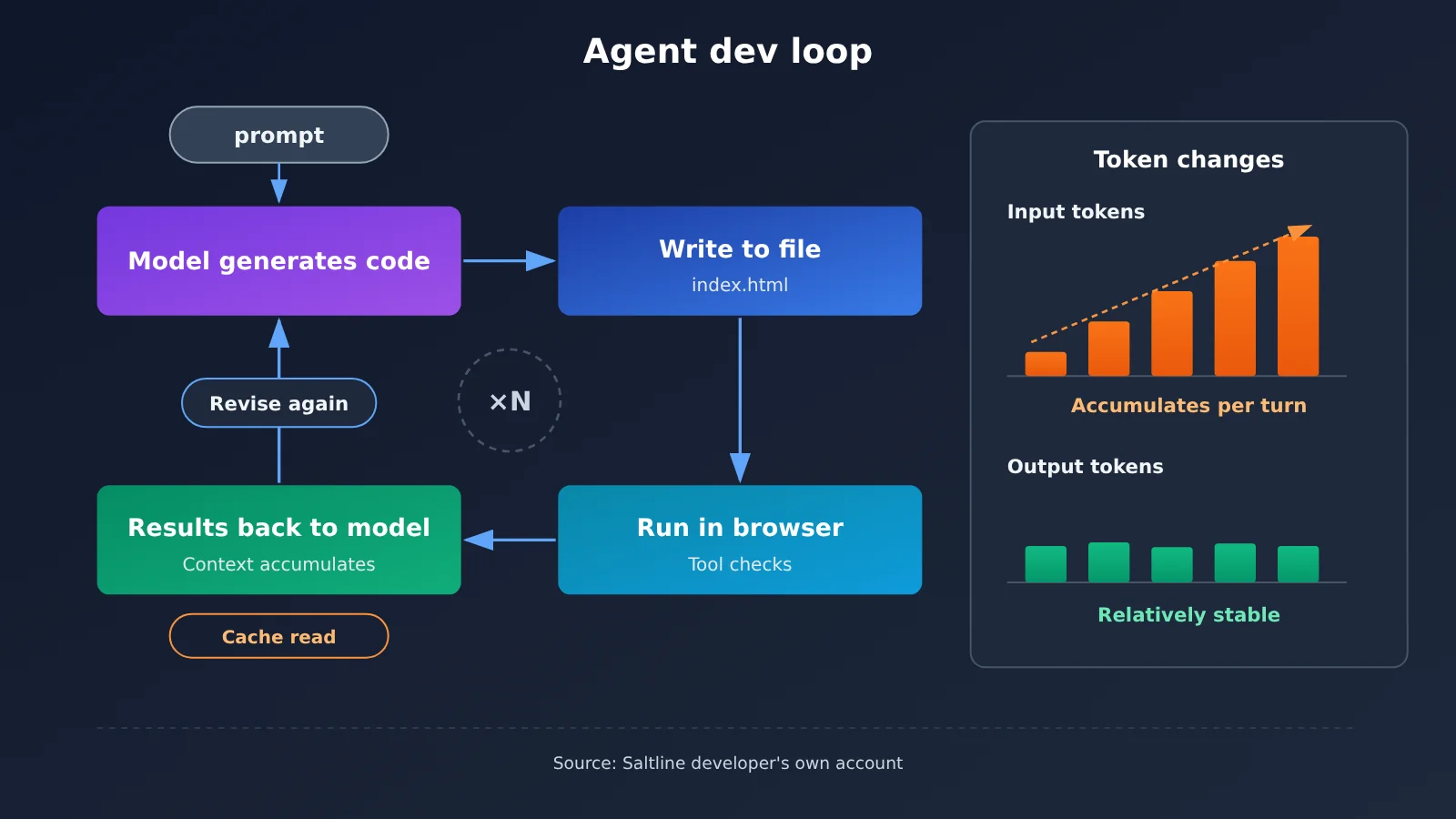
Comparing the two boundary values shows what caching did: if all 445 million input tokens were billed at the regular input price of $8, that’s about $3,560; if all of it were billed at the cache-read price of $0.20, that’s about $89. The actual estimate sits between the two, and clearly closer to the lower bound. That tells you that in long-running Agent development tasks, the cache hit rate on the input side determines the order of magnitude of the bill, while the output unit price matters comparatively little.
1.4 Why a 1.4MB file can consume 445 million tokens
Saltline’s standalone HTML build is about 1.43MB (1,425,707 bytes). The developer explains that the models and textures in the game are all code — geometry is constructed procedurally, surface detail is computed by shaders, and the audio is generated programmatically too. There are no separate image or 3D model assets.
The artifact is small; the process is long. Over those 8 hours the Agent repeatedly read the ever-growing code file, ran tools, inspected results and made changes again — and every round had to feed a large amount of context back into the model. The final token spend comes mainly from this loop, not from the length of the final file. That’s exactly why “process cost” has to be measured when evaluating game-development models.
2 Game Development Model Price Comparison: Token Billing Differences Across Three APIs
2.1 Official Standard Pricing for the Three Models
The prices in the table below all come from each vendor’s official pages, as of November 16, 2026, and are in USD per million tokens. They reflect standard API pricing tiers and exclude discounts from other channels or regional surcharges.
| Model | Standard input | Output | Cache read | Notes |
|---|---|---|---|---|
| Claude Fable 5.2 | $8 | $40 | $0.20 | 5-minute cache write $10, 1-hour cache write $16; 1M context, 128K max output |
| GPT-6 Astra | $10 | $50 | $1 | Standard processing tier; pricing may differ for other speed, batch, and regional options |
| Gemini 4 Argon | $2 | $10 | $0.10 | This price applies through November 30, 2026; starting December 1, it’s planned to change to $4 input and $20 output |
Claude Fable 5.2 also offers a Fast Mode at $16 input and $80 output, which the vendor says can boost output speed by up to 2.5x. For long tasks that need to finish within a fixed time window, the speed tier changes both elapsed time and cost, so you should record it as a separate configuration during evaluation.
💡 Comparison tip: The three models have different interfaces and billing fields, so you’ll need to integrate with each one separately when building your own evaluation environment. APIYI apiyi.com offers an OpenAI-compatible unified interface where a single API key lets you call Claude, GPT, Gemini, and other models, making it easy to switch models within the same evaluation script. Available models and prices are subject to the platform’s listing.
2.2 Price Differences at the Same Token Volume
To get an intuitive sense of the unit price gap, you can plug Saltline’s output volume (2.7 million tokens) into each vendor’s pricing: Claude Fable 5.2 comes to about $108, GPT-6 Astra about $135, and Gemini 4 Argon about $27. If all 445 million input tokens hit cache reads, the three would come to roughly $89, $445, and $45 respectively.
These numbers only illustrate the billing structure, and they assume all three models consume exactly the same number of tokens — an assumption that almost never holds in practice. Different models need different numbers of turns to complete the same task, read different amounts of context per turn, and generate code of different lengths. Rerunning after a failure also multiplies costs.
2.3 Cache Pricing Matters More Than Input Pricing
In agent-style development, most of the input is repeated context. GPT-6 Astra’s cache read price is 1/10 of its standard input, Claude Fable 5.2 is 1/40, and Gemini 4 Argon is 1/20. The lower the ratio of cache read price to standard input price, the easier it is to compress input costs on long tasks.
Caching also comes with write costs and expiration. Claude’s 5-minute and 1-hour cache writes are priced differently, and if an agent’s two calls are spaced further apart than the cache’s lifetime, the cache must be written again. When estimating the cost of a long task, you need to factor in the number of cache writes, the hit rate, and the cache lifetime together.
What Programming Benchmarks Can Tell Us: A Capability Reference for Game Development Models
3.1 SWE-bench Verified: Software Engineering Tasks in Real Repositories
SWE-bench Verified contains 500 manually screened and verified problems drawn from real open-source projects. Models need to understand repository context and complete tasks such as fixing bugs, modifying existing code, resolving test failures, and making cross-file changes—work that is much closer to real engineering than simple code completion.
When using it, pay attention to the impact of the harness. The official documentation states that the full leaderboard mixes different agent systems, and pure model comparisons should use the unified mini-SWE-agent configuration. Agent configuration, tools, prompts, and versions all change scores, so results from different configurations should be viewed separately.
3.2 Aider Polyglot: Recording Both Accuracy and Cost
Aider Polyglot uses 225 coding exercises covering C++, Go, Java, JavaScript, Python, and Rust, and uses test cases to determine whether a model’s code modifications are correct. Its public results include not only accuracy but also token consumption, running cost, error output, formatting errors, and execution time for each task.
For model selection, this “accuracy + cost” recording approach is very valuable, and it aligns with the evaluation framework later in this article. The problems themselves are standalone exercises, and their scale and form differ significantly from a complete 3D game project.
3.3 NIST Historical Evaluation: Mind the Model Versions and Timing
In a model evaluation report released in 2025 by CAISI, part of the U.S. National Institute of Standards and Technology (NIST), a set of models was tested on SWE-bench Verified. The data below are historical models and experimental configurations from that report and do not represent the rankings of the latest models as of November 2026.
| Model (version tested in the 2025 report) | SWE-bench Verified score |
|---|---|
| Anthropic Opus 4 | 66.7% |
| GPT-5 | 63.0% |
| DeepSeek V3.1 | 54.8% |
| DeepSeek R1-0528 | 44.6% |
| gpt-oss | 42.6% |
| DeepSeek R1 | 25.4% |
The report also provides standard errors, showing that scores on the same benchmark have statistical fluctuation. A difference of a few percentage points may have no practical discriminative power within the margin of error. Claude Fable 5.2, GPT-6 Astra, and Gemini 4 Argon, which are compared in this article, do not appear in this report. When selecting models, you need to look for the latest evaluations targeting the current versions with clearly stated configurations, or test them yourself.
3.4 The Gap Between General Coding Ability and Game Development Ability
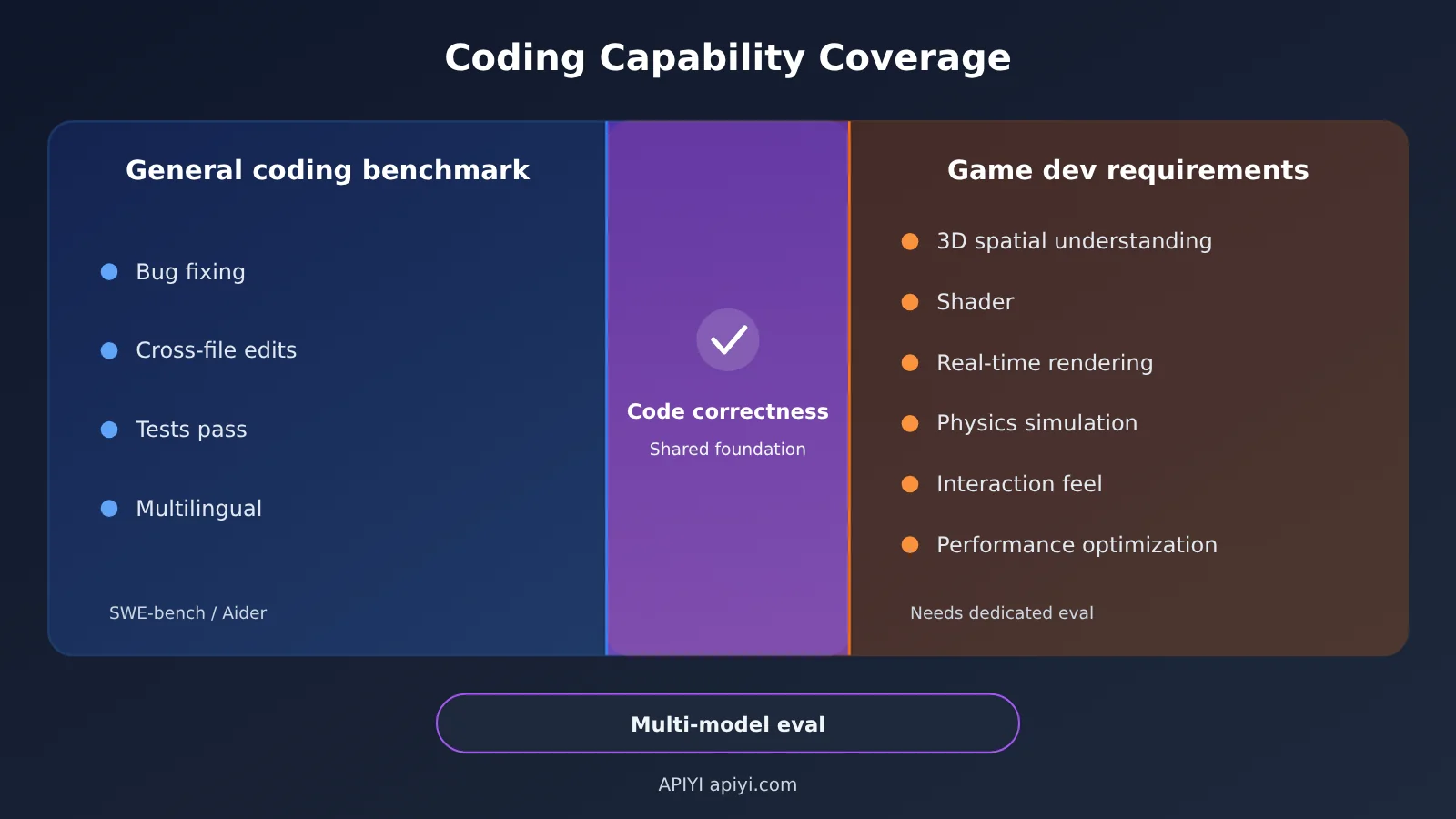
Game development involves a lot of work that general software engineering benchmarks do not adequately cover: 3D spatial understanding, shader authoring, real-time rendering, animation systems, physics simulation, interactive feel, and runtime performance optimization. Projects like Saltline also require models to generate visual assets with code, which depends on a grasp of graphics and visual effects.
A model may be very good at fixing bugs in a Python repository yet perform mediocrely on complex WebGL scenes. SWE-bench and Aider are suitable for filtering out candidates whose coding ability is clearly insufficient; the final ranking needs to be determined by game-development-specific evaluations.
4 How to Compare AI Game Development Models: A Dedicated Evaluation Plan for One Shared Task
4.1 Designing a Consistent Browser-Based 3D Game Task
Drawing on the format of Saltline, you can define the task as: generate a 3D game prototype that runs in a browser from a single prompt. All candidate models get exactly the same requirements:
- Generate a complete project that opens and runs directly in the browser
- Include a controllable character and a 3D environment
- Include collision or basic physics
- Include a clear objective with win/loss conditions
- No manual edits to the core code during evaluation
The difficulty of the task should stay close to your actual needs. Teams building casual mini-games will overestimate the model tier they need if they test with an FPS prototype; teams building complex 3D projects will underestimate if they test with a simple 2D task.
4.2 Ten evaluation metrics
| Dimension | What to evaluate | Suggested recording method |
|---|---|---|
| Feature completeness | Whether core game features are implemented | Tick off each item against the feature checklist |
| Visual quality | Scenes, materials, lighting, animation | Multi-rater blind scoring |
| Runnability | Whether it launches normally | Yes / No |
| Interaction completeness | Whether input and feedback work properly | Test each item against the operation checklist |
| Stability | Whether there are obvious crashes | Record crash count during a fixed-length play session |
| Performance | FPS, startup time, memory | Measured on fixed hardware |
| Code quality | Readability, modularity, error handling | Code review scoring |
| Token cost | Input, output, cache | Accumulated from the API usage fields |
| Total time | From start to a runnable version | Timed |
| Manual fixes | Human intervention needed to reach the bar | Record human hours |
“Runnability,” “feature completeness,” and “interaction completeness” should serve as hard acceptance criteria for deciding whether a run succeeded; visual quality, performance, and code quality are used to rank successful results against each other.
4.3 Controlling the test environment
Whether evaluation results are comparable depends on whether the variables are controlled. The conditions that need to be unified include: the same browser, the same device, the same prompt, the same test process, the same time budget, and whether internet access is allowed. If models are allowed to call tools, search for information, or create files on their own, tool permissions must also be identical across all models.
The harness must be fixed as well. The same model run through a different Agent framework can show drastically different success rates and token consumption, so the evaluation report should state the framework, version, and parameters used — for example, temperature, maximum output length, and speed tier.
4.4 Run Each Model Multiple Times
Large Language Model generation is stochastic — a single success could be luck, and a single failure could be a fluke. You should run each model several times under identical conditions (say, 5 to 10 runs), then tally the success rate along with the average token count, latency, and quality score across the successful samples. Saltline itself was a single-shot experiment: it proves the task can be done, but it can’t tell you what success rate a given model will achieve on similar tasks.
The script below calls models through the OpenAI-compatible interface and uses the usage field to compute the per-call cost at the prices from Section 2:
import openai

client = openai.OpenAI(
    api_key="YOUR_API_KEY",
    base_url="https://api.apiyi.com/v1"  # APIYI unified endpoint — to switch models, just change model
)

# Unit: USD per million tokens, official list prices as of 2026-11-16
PRICES = {
    "claude-fable-5.2": {"input": 8,  "output": 40, "cache_read": 0.20},
    "gpt-6-astra":      {"input": 10, "output": 50, "cache_read": 1},
    "gemini-4-argon":   {"input": 2,  "output": 10, "cache_read": 0.10},
}

def call_and_price(model: str, messages: list) -> tuple[str, float]:
    resp = client.chat.completions.create(model=model, messages=messages)
    u = resp.usage
    cached = getattr(getattr(u, "prompt_tokens_details", None), "cached_tokens", 0) or 0
    p = PRICES[model]
    cost = ((u.prompt_tokens - cached) * p["input"]
            + cached * p["cache_read"]
            + u.completion_tokens * p["output"]) / 1_000_000
    return resp.choices[0].message.content, cost
Always defer to the actual model list of the platform you’re calling for model names. Cache write fees and speed-tier surcharges need to be added on top according to each provider’s own rules.
View the multi-run evaluation and cost summary script
import time
import openai

client = openai.OpenAI(
    api_key="YOUR_API_KEY",
    base_url="https://api.apiyi.com/v1"  # Call multiple candidate models through APIYI
)

PRICES = {
    "claude-fable-5.2": {"input": 8,  "output": 40, "cache_read": 0.20},
    "gpt-6-astra":      {"input": 10, "output": 50, "cache_read": 1},
    "gemini-4-argon":   {"input": 2,  "output": 10, "cache_read": 0.10},
}

TASK_PROMPT = "Generate a single-file 3D game prototype that runs in a browser... (all models use the same prompt)"

def price(model, usage):
    cached = getattr(getattr(usage, "prompt_tokens_details", None), "cached_tokens", 0) or 0
    p = PRICES[model]
    return ((usage.prompt_tokens - cached) * p["input"]
            + cached * p["cache_read"]
            + usage.completion_tokens * p["output"]) / 1_000_000

def run_once(model, max_rounds=30):
    """Simplified agent loop: generate → check → feed the results back → revise"""
    messages = [{"role": "user", "content": TASK_PROMPT}]
    total_cost, start = 0.0, time.time()
    for _ in range(max_rounds):
        resp = client.chat.completions.create(model=model, messages=messages)
        total_cost += price(model, resp.usage)
        code = resp.choices[0].message.content
        report = check_game(code)  # implement it yourself: write the file, launch a headless browser, run the feature checklist
        if report["passed"]:
            return True, total_cost, time.time() - start
        messages += [{"role": "assistant", "content": code},
                     {"role": "user", "content": f"Check results: {report['log']}. Please fix."}]
    return False, total_cost, time.time() - start

def evaluate(model, trials=5, human_fix_cost=0.0):
    results = [run_once(model) for _ in range(trials)]
    successes = sum(r[0] for r in results)
    api_cost = sum(r[1] for r in results)
    rate = successes / trials
    per_success = (api_cost + human_fix_cost) / successes if successes else float("inf")
    print(f"{model}: success rate {rate:.0%}, total API cost ${api_cost:.2f}, "
          f"cost per qualified version ${per_success:.2f}")

for m in PRICES:
    evaluate(m)
🚀 Quick start: When you’re setting up an evaluation like this, it’s worth running the script end-to-end on a small task first, then swapping in the full game task. APIYI (apiyi.com) gives new users free trial credits, so you can validate your harness and the cost-accounting logic with them before committing your real evaluation budget.
5 How to Choose a Model for AI Game Development: Controlling Token Costs on Complex Tasks
5.1 Success Rate Determines Total Cost
The full development cost breaks down into three parts:
Total task cost = model invocation cost + tool execution cost + human repair cost
Once you factor in the success rate, a more practical comparison metric is “cost per qualified version”—the total spend across all attempts divided by the number of successes. Suppose Model A costs $100 per attempt with an 80% success rate: that works out to roughly $125 per qualified version. Model B costs $30 per attempt with a 20% success rate: that’s about $150 per qualified version, plus the extra time spent investigating failed versions. In this example, the cheaper model actually ends up costing more.
Human repair is often the biggest line item. When an engineer spends a few hours fixing a generation result, the labor cost can easily exceed the entire API bill. That’s why, during evaluation, you should honestly log the hours of human intervention and fold them into the total cost at your team’s actual labor rate.
5.2 Three Model Selection Strategies
| Strategy | Where it fits | Advantages | Costs to watch out for |
|---|---|---|---|
| High-capability model | Complex architecture, long-context development, multi-module collaboration, tracking down tricky bugs | High success rate, fewer reruns and manual fixes | High unit price; you need to rely on caching to control input costs |
| Low-cost model | Simple features, code explanations, repetitive edits, test assistance | Low unit price, good for high-frequency calls | Complex tasks may fail over multiple rounds, and the total cost ends up higher |
| Multi-model collaboration | One model handles architecture, another handles implementation, an independent model does code review | Matches capability and price to each stage | Context gets re-sent between models at every handoff, adding tokens and coordination overhead |
How much money multi-model collaboration actually saves depends on the handoff cost. Every handoff means sending the project context to another model again, and caches can’t be shared across different models. The collaborative approach only pays off when the low-cost model handles enough of the work and the handoffs are few enough — which, again, you’ll need to confirm with real testing.
💰 Cost tip: Multi-model collaboration means calling several providers within a single project. With APIYI apiyi.com, you can access them through the same API key and the same codebase, which cuts down on managing multiple accounts and adapting interfaces. That makes it easier to hand architecture, implementation, and review off to different models while tracking the bill in one place.
5.3 An Actionable Five-Step Selection Process
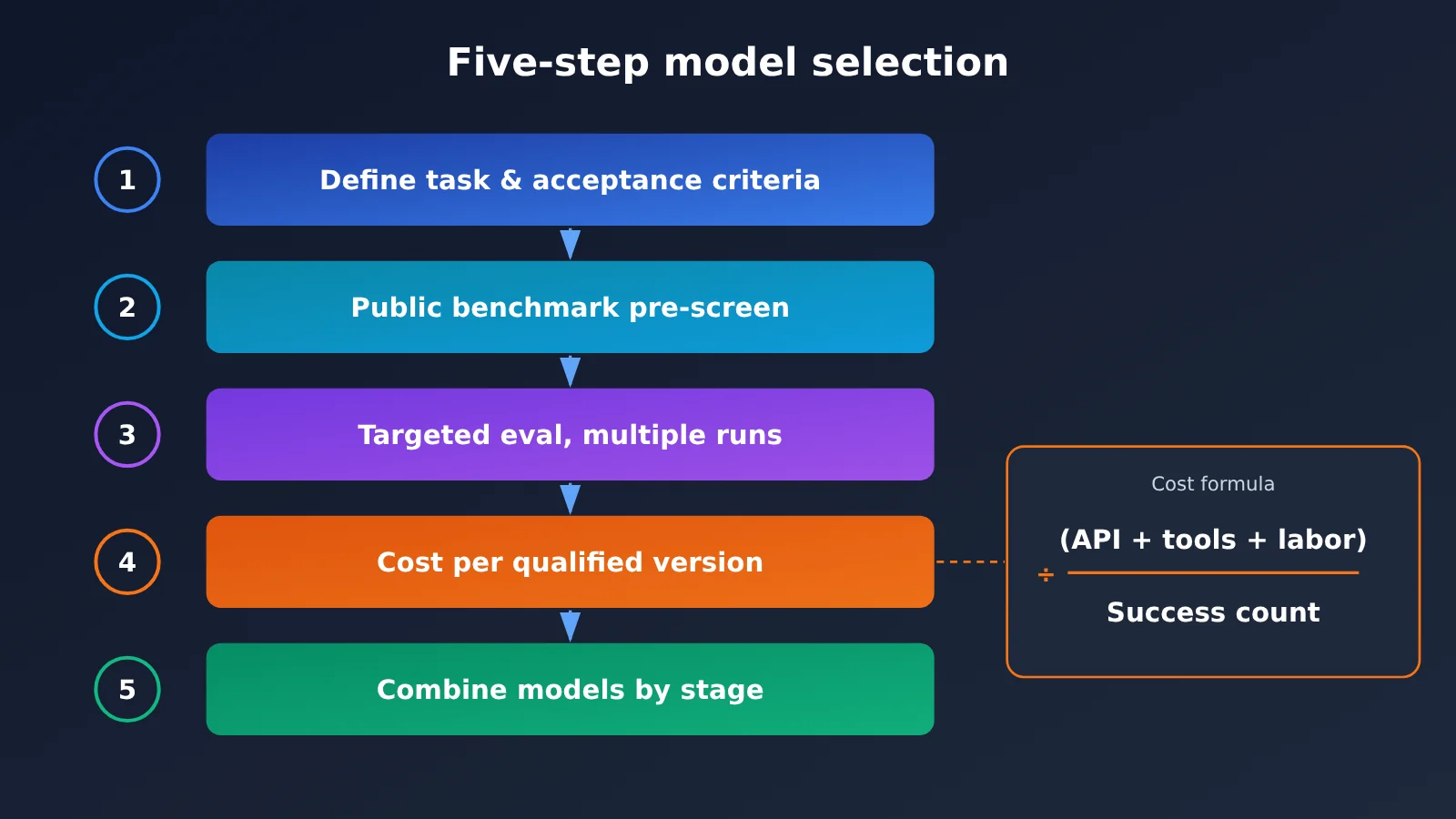
- Define the task and acceptance criteria: Write down the feature list, target platforms, and performance floor as the basis for deciding whether the model succeeds.
- Use public benchmarks for initial screening: Refer to current, clearly configured SWE-bench Verified and Aider Polyglot scores to rule out models with clearly insufficient coding ability.
- Run targeted evaluations: In the same environment, run the same game task 5 to 10 times for each candidate model, and record the ten metrics from Section 4.2.
- Calculate the cost per qualifying version: API costs plus tool costs plus manual repair costs, divided by the number of successful runs.
- Combine models by stage: Assign complex stages to models with high success rates and repetitive stages to low-cost models, then test whether the combined setup really saves more.
Prices change. For example, Gemini 4 Argon has announced a price adjustment effective December 1. Evaluation results should retain the raw token data; when prices change, you only need to plug in the new unit prices to update the conclusions.
6 AI Game Development Model Selection FAQ
Q1: Is Saltline’s $550 an actual bill?
No, it’s not an audited bill. The $550 is an estimate by developer Felix Rieseberg based on API pricing, and the accompanying data (about 8 hours, about 445 million input tokens, and about 2.7 million output tokens) also comes from his own account. Much of the input used caching, and the exact ratio of cache writes to reads wasn’t disclosed.
Q2: Is the lowest-priced model the most cost-effective?
It depends on the success rate. Unit price only determines the price per token. How many tokens a model needs to complete a task, how many reruns it takes, and how much manual fixing is required are all determined by model capability. Comparing “total cost ÷ number of successes” is what actually makes sense.
Q3: Is the model ranked No. 1 on SWE-bench the best fit for game development?
SWE-bench Verified measures software engineering ability in real open-source repositories, so it has limited coverage of shaders, 3D spatial understanding, real-time rendering, and interaction feel. It’s suitable for an initial screen, but final ranking for game development requires task-specific evaluation.
Q4: Can the scores in the NIST report represent current models?
No. The NIST CAISI report was published in 2025 and tested historical models such as GPT-5, Opus 4, and DeepSeek V3.1, along with specific experimental setups. New models from November 2026 need new evaluations targeting their versions.
Q5: How can I quickly set up a multi-model comparison evaluation?
The easiest way is to use an aggregation platform with an OpenAI-compatible interface. After registering with APIYI at apiyi.com and getting an API key, set the script’s base_url to `https://api.apiyi.com/v1` and change the model parameter to test multiple models in the same script. New users can first validate the script with free credits.
Q6: How do I track token costs most accurately during evaluation?
Use the usage field in the API response as the source of truth. Accumulate regular input, cache-read, and output tokens call by call, then calculate using the official prices and billing tiers on the day of the call. Additional charges such as cache writes and speed tiers need to be added separately according to each provider’s rules. When calling through APIYI at apiyi.com, you can also reconcile your calculations against the consumption records in the platform dashboard.
Q7: Can an AI-generated game prototype go live directly?
Prototypes like Saltline prove that models can produce playable versions without human feedback, but commercial launch also involves cross-browser compatibility, mobile adaptation, performance optimization, and long-term maintenance. Browser games are constrained by local hardware and the browser, and Saltline’s page also notes issues such as slow initialization and the need to switch to lower graphics settings when it stutters. Pre-launch testing and optimization costs should be factored into the total development cost.
7 Key Takeaways for Choosing an AI Game Development Model
- Core metric: Compare the end-to-end cost per qualified build, not the price per million tokens.
- The Saltline bill: The roughly $550 figure is the developer’s own estimate. Output accounts for about $108, with the rest on the input side.
- Caching sets the order of magnitude: On long tasks, input dominates, so cache-read pricing and hit rate matter most.
- Prices are time-sensitive: Prices in this article are as of 2026-11-16. Gemini 4 Argon is scheduled for a price change starting December 1.
- Benchmarks are for initial screening: SWE-bench and Aider measure general programming ability; game-specific capability needs dedicated evaluation.
- Run it multiple times: Run each model 5 to 10 times under identical conditions, and base conclusions on success rate rather than a single run.
- How to get started: Switch models through the unified APIYI apiyi.com interface so you can compare costs easily with the same script.
8 Conclusion: How to Choose a Model for Letting AI Develop a Game Independently
When letting AI develop a game on its own, model selection comes down to three key points:
- Count the full bill: Total task cost includes model invocation, tool execution, and manual fixes. API fees are just one line item.
- Test capabilities for real: Public benchmarks are for initial screening. The final ranking for game development comes from repeated, task-specific evaluations under identical conditions.
- Combine models by stage: Use high-success-rate models for complex stages and low-cost models for repetitive stages. The combined setup also needs to be validated with real tests.
Saltline gives you a reference order of magnitude: a single prompt, about 8 hours, and an estimated cost of roughly $550, producing a playable browser-based 3D prototype. How much your project needs depends on task complexity and the success rate of the models you choose. The most reliable approach is to run your own evaluation using the framework in this article.
We recommend using APIYI apiyi.com to quickly set up a multi-model comparison environment. The platform offers OpenAI-compatible interfaces and free credits for new users, making it easy to measure price and success rate within a single set of scripts.
References
- Saltline Standalone Demo Page: Game demo and FAQ
- Link:
saltline.games -
Description: Covers experience details such as initialization, graphics quality switching, and controls
-
Saltline Code Mirror and README: Developer data attribution notes
- Link:
github.com/realcodebear/saltline-fable-5.2 -
Description: Records the sources for generation time, token counts, and estimated costs
-
Jimao Chinese Version Repository: Archive of the Chinese-packaged Saltline version
- Link:
github.com/Megasu/jimao-3a-game -
Description: Provides data such as the
index.htmlfile size -
Claude Fable 5.2 Model Specs and Pricing: Anthropic official documentation
- Link:
platform.claude.com/docs/en/models/fable-5-2/overview -
Description: Input, output, cache, and Fast Mode pricing
-
GPT-6 Astra Model Documentation: OpenAI official pricing
- Link:
developers.openai.com/api/docs/models/gpt-6-astra -
Description: Standard processing tier pricing is based on this
-
SWE-bench Verified: Official software engineering benchmark page
- Link:
swebench.com/verified.html -
Description: 500 human-verified tasks and a unified mini-SWE-agent configuration guide
-
Aider Leaderboards: Aider Polyglot evaluation results
- Link:
aider.chat/docs/leaderboards -
Description: Records accuracy, token consumption, and runtime cost together
-
NIST CAISI Evaluation Report (2025): Independent evaluation of historical models
- Link:
nist.gov/system/files/documents/2025/09/30/CAISI_Evaluation_of_DeepSeek_AI_Models.pdf - Description: Includes historical SWE-bench Verified scores and standard errors
Author: APIYI Technical Team
Technical Discussion: Feel free to contact us on the APIYI website homepage at apiyi.com. For more integration resources, visit the docs.apiyi.com documentation center.