
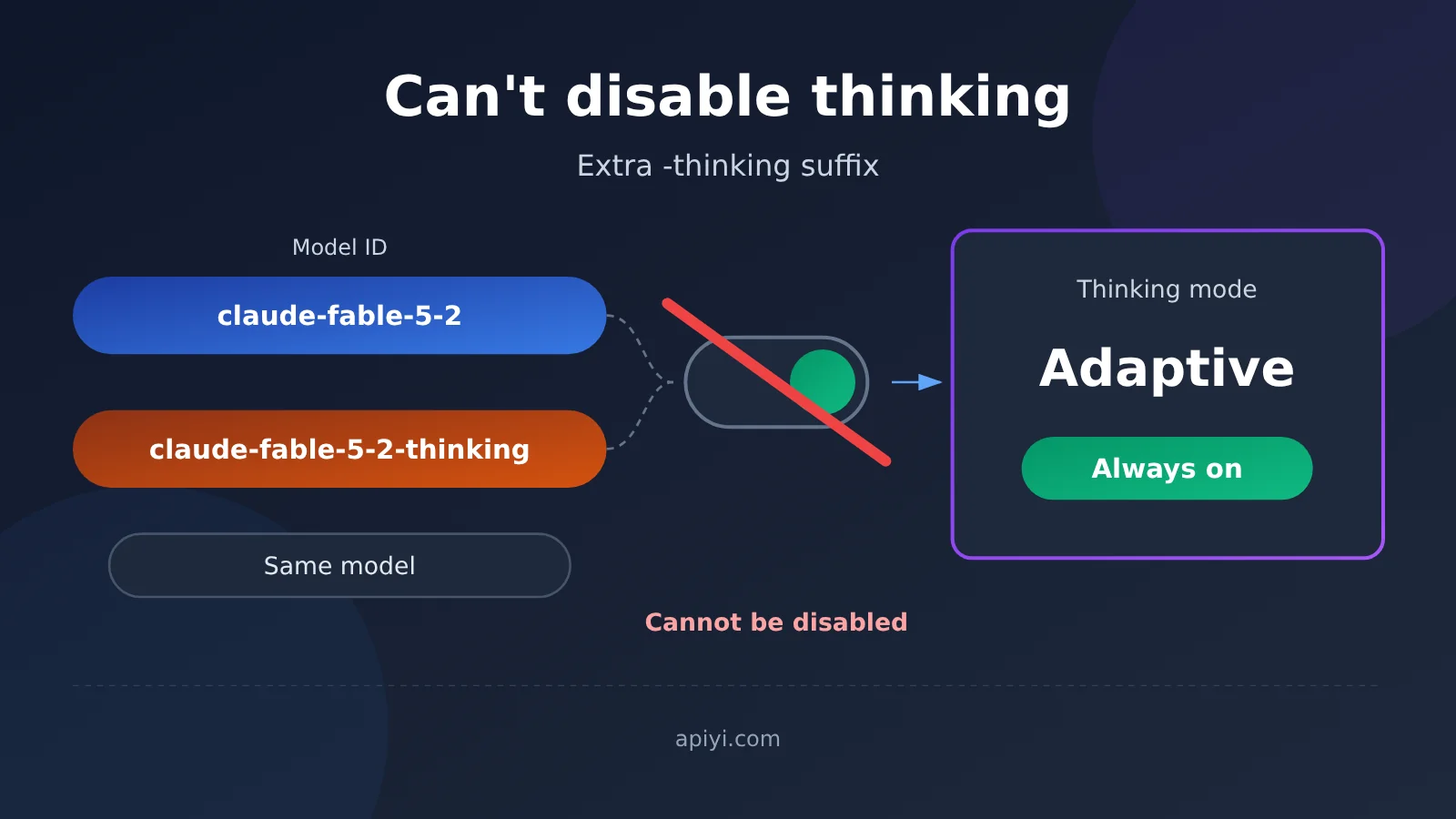
Author’s note: claude-fable-5-2-thinking is not a switch for turning thinking off. Both IDs have the same price, endpoint, and group. Anthropic lists Fable 5.2’s thinking as adaptive and always on. This article covers how to choose between the two IDs and how to troubleshoot.
If you’re already calling claude-fable-5-2, you’ve probably noticed a claude-fable-5-2-thinking row sitting right next to it in the APIYI apiyi.com model catalog. It’s easy to jump to a conclusion: the suffixed version has thinking on, and the plain one must be a “fast mode” with thinking off. Here’s the answer up front: the -thinking suffix is not a thinking switch. Fable 5.2’s thinking is always on under both IDs.
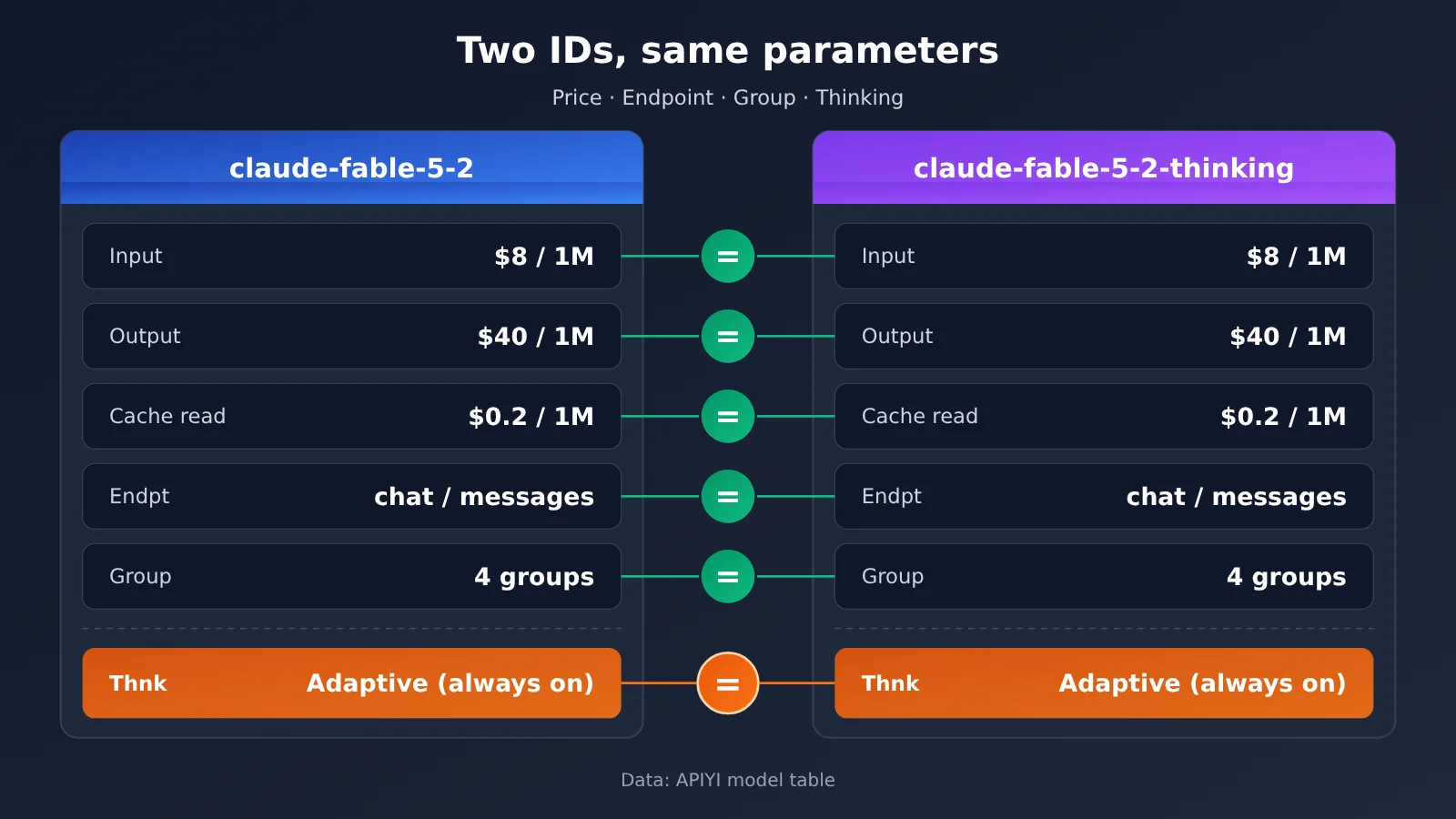
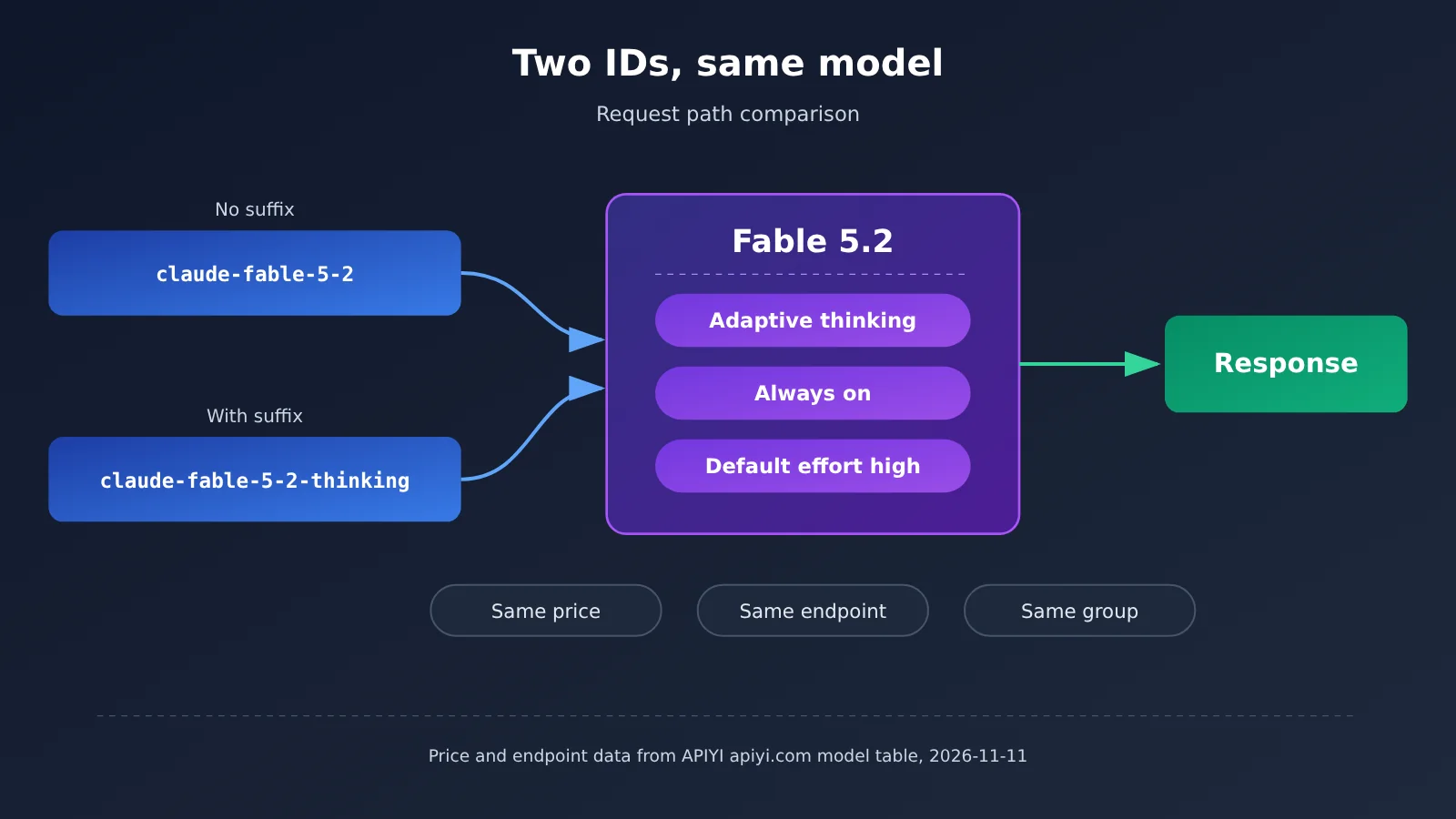
This isn’t a guess based on naming. It rests on two public sources. The first is the APIYI model catalog, where the two IDs have identical pricing, endpoints, and groups. The second is the Fable 5.2 model page Anthropic published on 2026-11-09, which lists thinking as Adaptive (always on). The two sources agree, so the suffix is just another entry point for calling the same model.
What you’ll get from this article: You’ll know you don’t need to switch IDs to “turn thinking off,” and you shouldn’t treat -thinking as a more powerful tier. We’ll also cover where to look when you actually want to control thinking costs.
Fable 5.2 and the -thinking Suffix: Key Takeaways
Here are the three most important points in one table, so you can quickly decide whether you need to change any code.
| Takeaway | Details | What it means for you |
|---|---|---|
| Both IDs cost the same | Input $8, output $40, cache read $0.2, all per 1M tokens | Switching IDs won’t save you money or cost you more |
| Thinking is always on | The official model page lists Fable 5.2 thinking as Adaptive (always on) | There’s no “no suffix, no thinking” version |
| The suffix is just an entry point | Both IDs have identical endpoints, groups, and pricing | No need to migrate, and don’t treat it as a stronger tier |
How Thinking Works in Fable 5.2
In the comparison table on the Fable 5.2 model page, Anthropic lists thinking as Adaptive (always on). That phrase carries two meanings: thinking is always enabled, and the model adjusts how deeply it thinks based on the task. In other words, thinking is simply how this model works. It isn’t a feature you add by changing the model ID.
The same page also states that the default effort for API calls is high. So if you pass no parameters at all, the model thinks with a fairly high level of effort. If responses feel slow or output token counts run high, the cause is usually the default effort setting and the complexity of your task. Whether the ID has a suffix has nothing to do with it.
Here are the key specs from the official model page, all officially reported.
| Spec | Claude Fable 5.2 (officially reported, model page dated 2026-11-09) |
|---|---|
| Thinking mode | Adaptive (always on) |
| Default API effort | high |
| Context window | 1M |
| Max output | 128K |
| Official pricing | Input $8 / Output $40 (per 1M tokens) |
Where the -thinking Suffix Actually Sits in the Fable 5.2 Price List
Now let’s look at the APIYI model catalog. The data is dated 2026-11-11, and the conclusions below come from checking the docs field by field (verified against the docs). As the table shows, the claude-fable-5-2-thinking row is identical to claude-fable-5-2 in every field except the name.
| Field | claude-fable-5-2 |
claude-fable-5-2-thinking |
|---|---|---|
| Type / billing | Text, pay-as-you-go | Text, pay-as-you-go |
| Input price | $8 / 1M tokens | $8 / 1M tokens |
| Output price | $40 / 1M tokens | $40 / 1M tokens |
| Cache read price | $0.2 / 1M tokens | $0.2 / 1M tokens |
| Supported endpoints | chat, messages | chat, messages |
| Available groups | ClaudeCode, Claude_Enterprise, Default, SVIP | ClaudeCode, Claude_Enterprise, Default, SVIP |
| Thinking status (per official docs) | Adaptive, always on | Adaptive, always on |
Data sources: APIYI model catalog at docs.apiyi.com/models, dated 2026-11-11 (verified against the docs); thinking status per Anthropic’s official model page (officially reported).
Why -thinking Isn’t a Thinking Switch for Fable 5.2
A lot of people treat -thinking as an on/off switch, carrying over the old naming habit that “a suffix means reasoning is turned on.” For Fable 5.2, that logic doesn’t hold up, for two reasons.
The first is logic. If -thinking meant “thinking enabled,” then claude-fable-5-2 would have to be the version with thinking turned off. But the official docs clearly say it’s always on, so there’s no Fable 5.2 variant with thinking disabled. The “off” end of the switch has no matching model. The second is pricing. If the two IDs behaved noticeably differently, say one thinks and one doesn’t, you’d normally see that reflected in the price list. In reality, input, output, and cache-read prices are identical down to the cent, and the endpoints and groups are exactly the same too.
Taking the official description of thinking into account, there’s no distinguishable difference between the two IDs anywhere in the public materials. The safer interpretation is that -thinking is a parallel naming entry point, possibly there for compatibility with clients or tools that identify reasoning models by suffix. Nothing in the docs says it’s stronger, deeper, or more expensive, so you shouldn’t treat it as an upgrade tier.
| Common Misconception | What the Docs Actually Say | What to Do Instead |
|---|---|---|
| No suffix means thinking is off | Official docs mark thinking as always on | Don’t switch IDs to turn thinking off |
| The suffix means deeper, stronger thinking | Both IDs share the same price, endpoints, and groups; no capability difference is documented | Don’t treat it as an upgrade tier |
| Switching IDs lowers cost | Input $8, output $40, and cache read $0.2 are identical | Optimize cost through effort and prompts |
| The suffix unlocks more groups | Both belong to ClaudeCode, Claude_Enterprise, Default, and SVIP | For group issues, check your key and token configuration |
How to Get Started Calling Fable 5.2 (Without Switching IDs to Control Thinking)
As this article requires, there are no code blocks here. The key integration points are laid out as lists instead. As long as your project already uses the OpenAI-compatible or Anthropic Messages format, you only need to change the settings below.
Minimal Integration Steps for Fable 5.2
- Set the base_url: Point your client’s base_url to
https://api.apiyi.com/v1and use the API key generated in the APIYI dashboard. - Pick a model ID: We recommend using
claude-fable-5-2directly. If a tool only accepts names with a suffix, you can useclaude-fable-5-2-thinking. According to the documentation, the two behave the same and are billed the same. - Pick an endpoint format: Use the chat endpoint for the OpenAI SDK or compatible tools, and the messages endpoint for the native Anthropic format. Both IDs support both endpoints.
- Confirm your group: Make sure your token belongs to one of the
ClaudeCode,Claude_Enterprise,Default, orSVIPgroups. Otherwise, neither ID will work. - Plan your lengths: The maximum context is 1M and the maximum output is 128K (self-reported by the vendor), so for long-document tasks you can plan your max_tokens around those limits.
What to Adjust to Cut Down Fable 5.2’s Thinking Overhead
Since thinking can’t be turned off, what you can adjust is how much the model thinks, not whether it thinks. The official default effort is high, so the first step is to check the model page’s notes on the effort parameter, see which levels Fable 5.2 supports, and then try a lower level for simple tasks. For the exact parameter name and allowed values, go by the official documentation. This article doesn’t fill in any values that the source material doesn’t provide.
The second step is to work on your prompts and task breakdown. Splitting one big, messy request into several small requests with clear goals, or spelling out the output format and length requirements in the system prompt, is usually more effective than agonizing over which model ID to use. For long context you reuse often, you can take advantage of cache reads, which cost $0.2 / 1M tokens, far below the regular input price of $8.
🚀 Quick start: Once your base_url and key are set up, we recommend using the free credits for new users on APIYI (apiyi.com) to send the same prompt to both IDs, then compare the responses and billing details yourself. Once you’ve confirmed there’s no difference, standardize on a single ID in your config.
Fable 5.2 vs. -thinking: Troubleshooting Guide for Invocation Errors
If something breaks or behaves oddly after you switch IDs, it’s usually a configuration issue. The table below is organized by symptom. The source material doesn’t list specific error codes, so the table only covers symptoms and things to check. For the actual error message, go by what the API returns.
| Symptom | Likely Cause | What to Check |
|---|---|---|
| “Model not found” or “no permission” message | The ID is misspelled, or your token’s group doesn’t include this model | Compare your spelling of claude-fable-5-2 against the master model list, and check the group |
| Still slow after switching to -thinking | Thinking is always on, and the default effort is high | Adjust effort and your prompt instead of swapping IDs |
| Still getting thinking content after switching back to the ID without the suffix | The official thinking mode is always on | This is normal behavior, not a broken config |
| Bill doesn’t match expectations | You assumed the two IDs are priced differently | Both are priced the same: $8 input, $40 output, $0.2 cache read |
| chat works but messages doesn’t (or vice versa) | The request format doesn’t match the endpoint | Both IDs support both endpoints, so check your request body format |
If you run into something the table doesn’t cover, start by checking the invocation logs in the APIYI (apiyi.com) dashboard to confirm which model ID and group the request actually used. Then you can tell whether the problem is on the client side or in the configuration. Many “I changed the ID but nothing happened” cases turn out to be a client that cached the old config.
Frequently Asked Questions (FAQ)
Q1: What is claude-fable-5-2-thinking?
It’s another model ID listed alongside `claude-fable-5-2` in the APIYI model master list. Both have the same pricing, endpoints, and group. According to the official description, thinking is adaptive and always on for both, so you can think of it as a second entry point to the same model.
Q2: If I use claude-fable-5-2 without the suffix, can I turn off thinking?
No. The official model page lists Fable 5.2’s thinking as Adaptive (always on), and there’s no version with thinking turned off. If you want to cut down on thinking overhead, look at parameters like effort and at how you design your prompts.
Q3: Is the -thinking version a tier with deeper thinking and stronger capabilities?
Nothing in the public materials supports that. The two IDs are priced identically, and the official docs don’t list separate specs for the suffixed version, so we don’t recommend treating it as an upgrade tier.
Q4: How current is this information?
Anthropic’s Fable 5.2 model page was published on 2026-11-09, and the APIYI model master list data is dated 2026-11-11. Pricing and groups may change, so we recommend checking the master list again before going live.
Q5: How do I quickly call Fable 5.2 through the API?
Sign up at APIYI (apiyi.com) and get your API key. Set `base_url` to the platform address and use `claude-fable-5-2` as the model. You can then use the chat endpoint with the OpenAI-compatible format, or the messages endpoint with the Anthropic format. New users get free test credits, so you can start with a small-scale trial.
Q6: My project already uses -thinking. Do I need to change it back?
You don’t have to. Based on the available information, the two IDs behave the same, so a project that’s already working can stay as is. For new projects, we suggest standardizing on `claude-fable-5-2` without the suffix, so teammates don’t mistake it for a toggle.
Q7: Is thinking content billed separately?
The reference materials don’t give a separate unit price for thinking content, so we won’t speculate here. What we can confirm is that the input, output, and cache-read prices are the same for both IDs. For the specifics, refer to your APIYI billing details and the official documentation.
Fable 5.2 With the -thinking Suffix: Key Takeaways
- The suffix isn’t a switch:
-thinkingis just a parallel entry point. You can’t use it to turn thinking on or off. - Thinking is always on: The official docs list Fable 5.2’s thinking as adaptive and always on.
- Both IDs cost the same: $8 input, $40 output, $0.2 cache read (per 1M tokens, as of 2026-11-11).
- Endpoints and groups match: Both support chat and messages, and both belong to the same four groups.
- It’s not a stronger tier: Nothing in the available material says the suffixed version differs in capability.
- Control costs through effort: The default effort is high, so adjusting parameters and prompts works better.
- Getting started is easy: Enter
claude-fable-5-2under the APIYI unified interface and you can start calling it.
Summary
On the question of “there’s a -thinking suffix, but Fable 5.2’s thinking still can’t be turned off,” three points sum it up:
- The facts: The two IDs have identical pricing, endpoints, and groups, and the official docs describe thinking as adaptive and always on.
- The takeaway:
-thinkingis simply another entry point. It’s neither a switch for turning thinking off nor a stronger tier. - What to do: If you want to control thinking costs, adjust effort and your prompts instead of swapping IDs.
If you’re evaluating how to integrate Fable 5.2, we recommend using the free credits at APIYI (apiyi.com) to run both IDs and confirm they behave the same. Then standardize on claude-fable-5-2. The configuration is clearer, and your team is less likely to get confused.
📚 References
- APIYI Model Master List: Pricing, endpoints, and groups for the two Claude Fable 5.2 IDs
- Link:
docs.apiyi.com/models -
Note: Data dated 2026-11-11, used to verify whether the two IDs share the same price and endpoint (re-tested against the docs)
-
Anthropic Claude Fable 5.2 Model Page: Thinking mode, default effort, and specs
- Link:
platform.claude.com/docs/en/models/fable-5-2/overview - Note: Released 2026-11-09. Covers Adaptive (always on), default effort high, 1M context, 128K max output, and more (self-reported by Anthropic)
Author: APIYI Technical Team
Technical Discussion: If you run into issues with ID selection or group configuration while using Fable 5.2, feel free to reach out to us through the APIYI homepage at apiyi.com