Author’s note: I need to call the API today, so I’m sticking with grok-4.7. As of 2026-11-13, Grok 4.8 still doesn’t have a model ID. This article checks Grok 4.7’s three weak spots against their sources to see whether there’s any evidence that 4.8 has closed them.
If you’re already running grok-4.7 in production, you’re probably wrestling with one question lately: should you pause and wait for Grok 4.8? Here’s the verdict up front: if you need to call the API today, use grok-4.7. As of 2026-11-13, Grok 4.8 has no model ID, no model card, no leaderboard scores, and no pricing. What Musk called “this week” is just a small-scale soft rollout for Grok Bot users—not an open API.
This is not a “the new version is bound to be stronger” preview piece. It only examines the three weak spots in Grok 4.7’s public data that we can actually verify. Each one is labeled with its source: official self-reported figures, third-party leaderboards, or Musk’s own words. Then we look at whether there’s currently any evidence that Grok 4.8 has closed them.
Key takeaway: after reading this, you’ll know exactly where Grok 4.7’s weak spots are, whose data backs them up, and how to control costs across 200K-token tiers before Grok 4.8 ships.
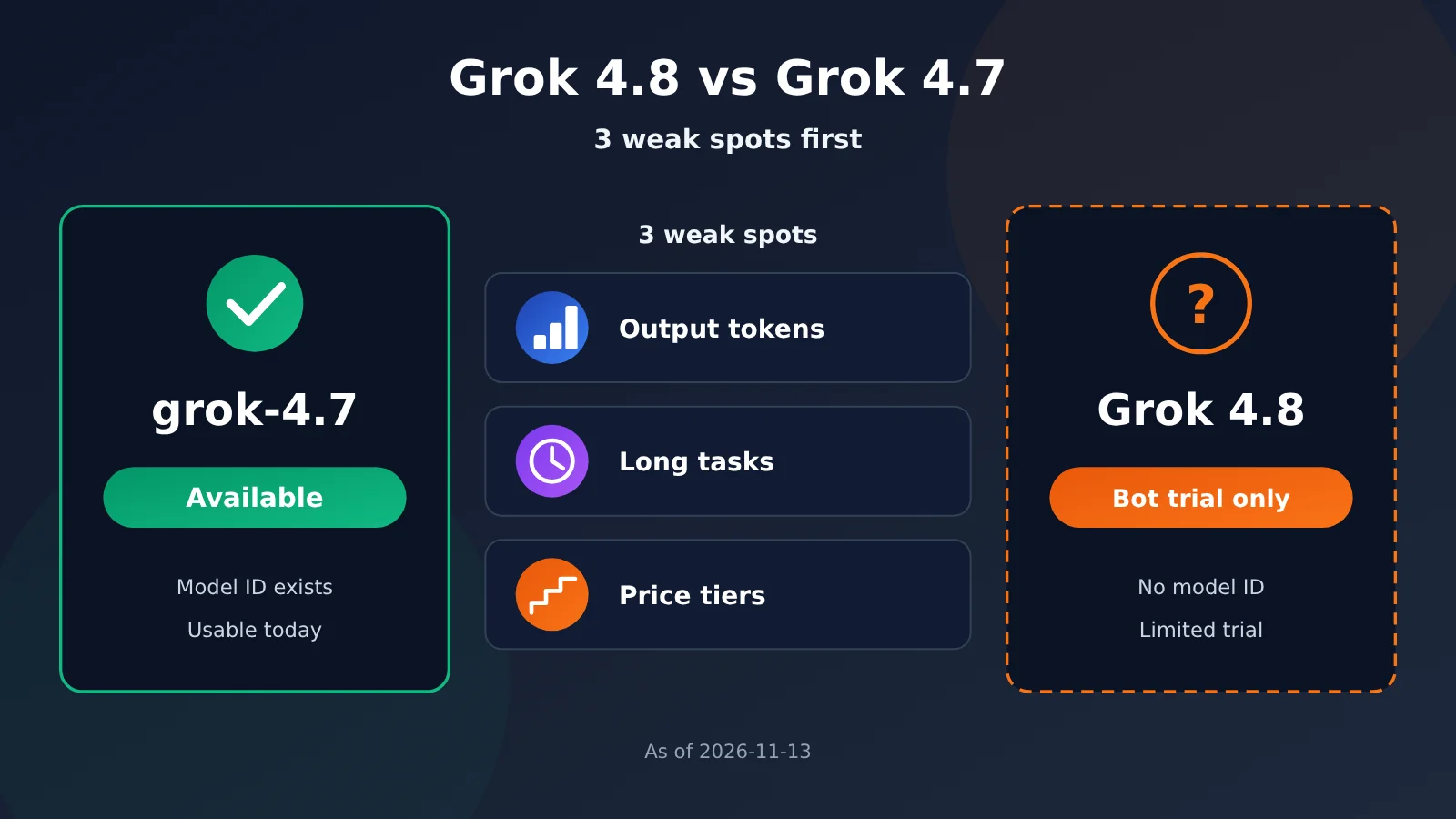
Grok 4.8 vs Grok 4.7: How to Choose Today
This comparison isn’t like your typical new-version-vs-old-version breakdown. Right now, Grok 4.8 consists of little more than a few lines from Musk on X — there are no benchmark scores anyone can verify. So what “comparison” really means here is: which of Grok 4.7’s weak spots are already documented in public data, and whether Grok 4.8’s known changes actually address them.
| Your Situation | Recommendation | Why |
|---|---|---|
| You need to ship or change your integration this week | Use grok-4.7 | It’s the only model listed on the platform |
| You’re evaluating long-term options | Run baselines with grok-4.7 first | 4.8 has no leaderboard presence, so there’s nothing to compare against |
| You want to try 4.8 ASAP | Keep an eye on the platform’s model list | A Bot soft rollout doesn’t mean the API is available |
| You have extremely high demands for long-running tasks | Don’t pin your hopes on 4.8 | There’s no evidence the long-task gap has closed |
One thing worth clarifying: “Bot users” means users of Grok Bot, not hardware robots. A “soft rollout” is a limited-scope release, not an interface opened up to developers. Treating it as “a model ID you can switch to right now” will land you straight in a call error.
Grok 4.8 vs. Grok 4.7: Core Differences — Where the 3 Weaknesses Come From
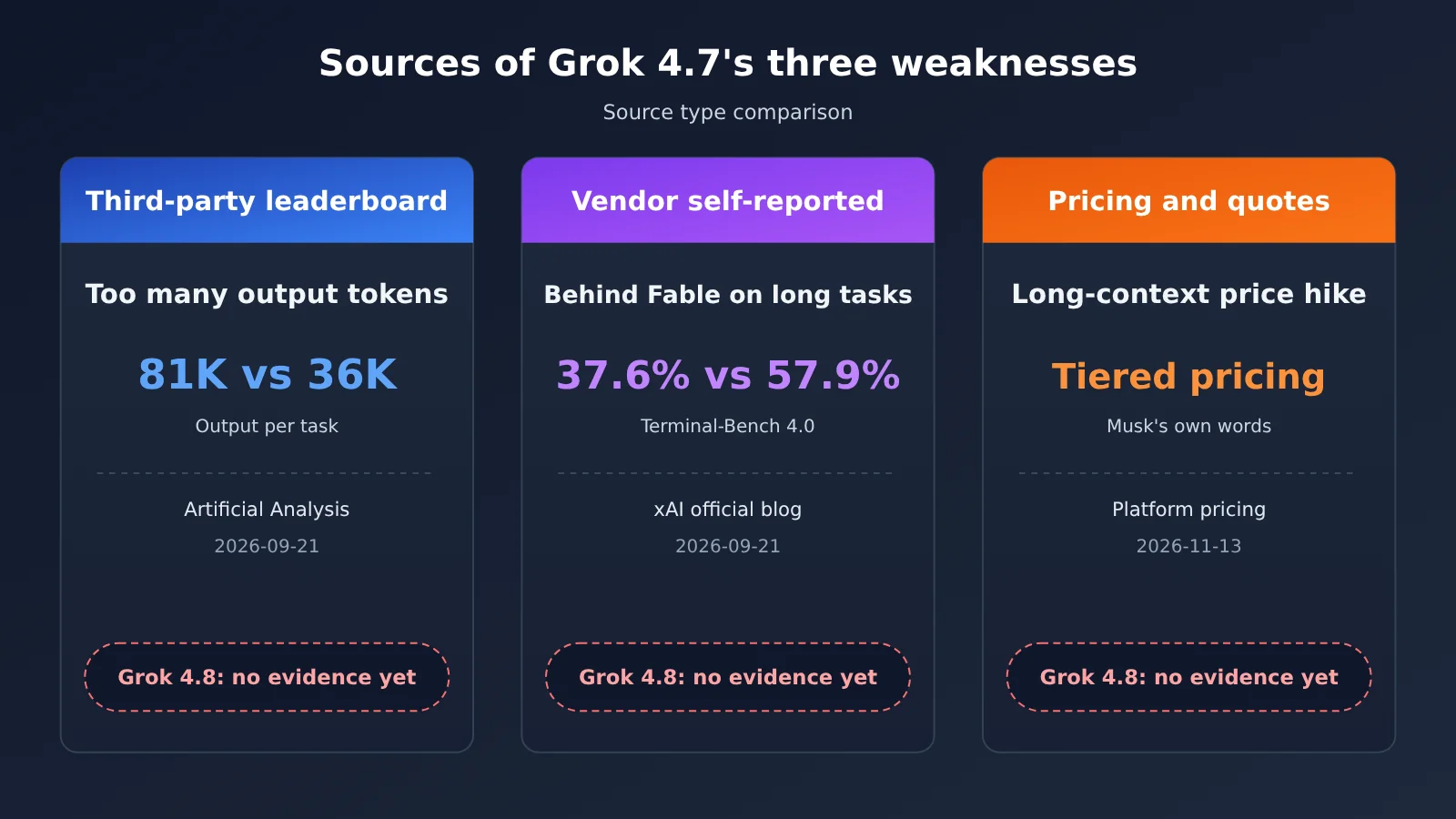
The table below first lists where each of the three weaknesses comes from. The sections that follow stick strictly to that order.
| Weakness | Source type | Source date | Does Grok 4.8 have evidence to fill the gap? |
|---|---|---|---|
| Output token count is on the high side | Third-party leaderboard (Artificial Analysis) | 2026-09-21 | No |
| Falls behind Fable on multi-hour long tasks | Official self-report (xAI blog table) | 2026-09-21 | No |
| Long-context tiered price increase + Musk doesn’t accept the underlying baseline | Platform price list + Musk’s own words | 2026-11-13 / 2026-11-10 | No |
Weakness 1: Grok 4.7 outputs too many tokens (third-party leaderboard)
The source here is Artificial Analysis’s Grok 4.7 evaluation, published on 2026-09-21. It’s a third-party leaderboard — not official data, and not a test run by the author of this article. They tested at the xhigh tier, and Grok 4.7 scored 46 on the intelligence index, 2 points higher than Grok 4.6. The score went up, but the cost was a clearly larger number of output tokens.
Here’s the output volume comparison from the same evaluation. Note that the two Grok 4.6 numbers correspond to different tiers and can’t be combined into one:
- Grok 4.7 (xhigh): about
81,000output tokens per intelligence-index task - Grok 4.6 (high): about
36,000output tokens - Grok 4.6 (xhigh): about
38,000output tokens; the evaluation says 4.7 is more than twice that - GPT-6 Astra (max): about
27,000output tokens
To get a sense of the scale, you can use the official output price of $6 / 1M tokens for a rough calculation: 81K output tokens is about $0.49, and 36K is about $0.22. This is just a conversion method for the leaderboard tasks, meant to show “where the money goes for the same question” — it’s not an actual bill from any platform.
Artificial Analysis also states that Grok 4.7 has a 500K context window, with list pricing of $2 / $6 and cache hits at $0.50, all the same as 4.6. In other words, the unit price didn’t go up, but each task outputs more tokens, so the actual per-task cost is rising.
Weakness #2: Grok 4.7 Still Trails Fable on Multi-Hour Long-Horizon Tasks (Vendor Self-Report)
This comes from a comparison table in the official xAI blog (2026-09-21), so it’s a vendor self-report. The four column headers are, in order: Grok 4.7 xHigh, Grok 4.6 High, GPT-5.6 Sol Max, and Fable 5.1 Max. The two items below best illustrate the long-task gap:
- Terminal-Bench 4.0: Grok 4.7 at
37.6%, Fable 5.1 Max at57.9%(Grok 4.6 was20.3%, GPT-5.6 Sol was37.3%) - CursorBench 4.0: Grok 4.7 at
46.3%, Fable 5.1 Max at51.8%(Grok 4.6 was40.4%, GPT-5.6 Sol was41.7%)
But the official table doesn’t show Grok 4.7 as “universally behind.” Its gains over 4.6 are real, and it ranks first on two specialized benchmarks:
- EEBench: Grok 4.7 at
64.0%, above 4.6’s53.0%, GPT-5.6 Sol’s39.4%, and Fable 5.1’s56.4% - Harvey Legal Agent Benchmark: Grok 4.7 at
19.6%, above15.8%/2.5%/6.7% - DeepSWE v1.1: Grok 4.7 at
71.0%, officially noted as high effort rather than xhigh, slightly below GPT-5.6 Sol’s72.7% - AA Briefcase v1.1: Grok 4.7 at
1657, slightly below Fable’s1678 - HealthBench Professional: Grok 4.7 at
56.7%, below GPT-5.6 Sol’s60.5%and Fable’s62.1%
| Official Table Benchmark | vs. Grok 4.6 | vs. GPT-5.6 Sol | vs. Fable 5.1 |
|---|---|---|---|
| Terminal-Bench 4.0 | Notably higher | Roughly on par, slightly higher | Clear gap |
| CursorBench 4.0 | Higher | Higher | Lower |
| DeepSWE v1.1 | Higher | Slightly lower | Slightly higher |
| EEBench | Higher | Higher | Higher |
| Harvey Legal Agent | Higher | Higher | Higher |
| HealthBench Professional | Higher | Lower | Lower |
There’s another set of data from third-party leaderboards that needs a separate note. Artificial Analysis’s evaluation shows that, compared with Grok 4.6, Grok 4.7 is 4.5 points higher on Terminal-Bench 4.0 and 3.0 points higher on GDP.pdf; but it’s 3.7 points lower on AA-LCR and 1.1 points lower on AutomationBench-AA. Here, “+4.5 points” and the official table’s 37.6% vs. 20.3% aren’t the same absolute scoring system, so they can’t be mixed.
Shortcoming 3: Grok 4.7’s Pricing Tiers and Musk’s Own Words (Price List + Quotes)
The third shortcoming has two parts: the pricing for long contexts, and Musk’s own take on 4.7. Let’s start with the price. The platform’s model summary table and the pricing API don’t line up exactly when it comes to anything above 200K tokens:
| Price item | Platform model summary table | Pricing API billing_expr |
|---|---|---|
| ≤ 200K tokens input / output / cache read | Specified | Specified, consistent with the summary table |
| Input above 200K | Specified | Specified, consistent with the summary table |
| Output above 200K | Not listed separately | Specified |
| Cache read above 200K | Not listed separately | Specified |
Here are the actual numbers, with pricing data dated 2026-11-13 and all figures per 1M tokens:
- Lower tier (0–200,000 tokens): input
$2, output$6, cache read$0.5— the summary table and the pricing expression agree - Higher tier (200,001–500,000 tokens) input:
$4— the summary table and the pricing expression agree - Higher-tier output: the pricing expression says
$12, but the summary table’s tier breakdown doesn’t mention it - Higher-tier cache read: the pricing expression says
$1, but the summary table’s tier breakdown doesn’t mention it
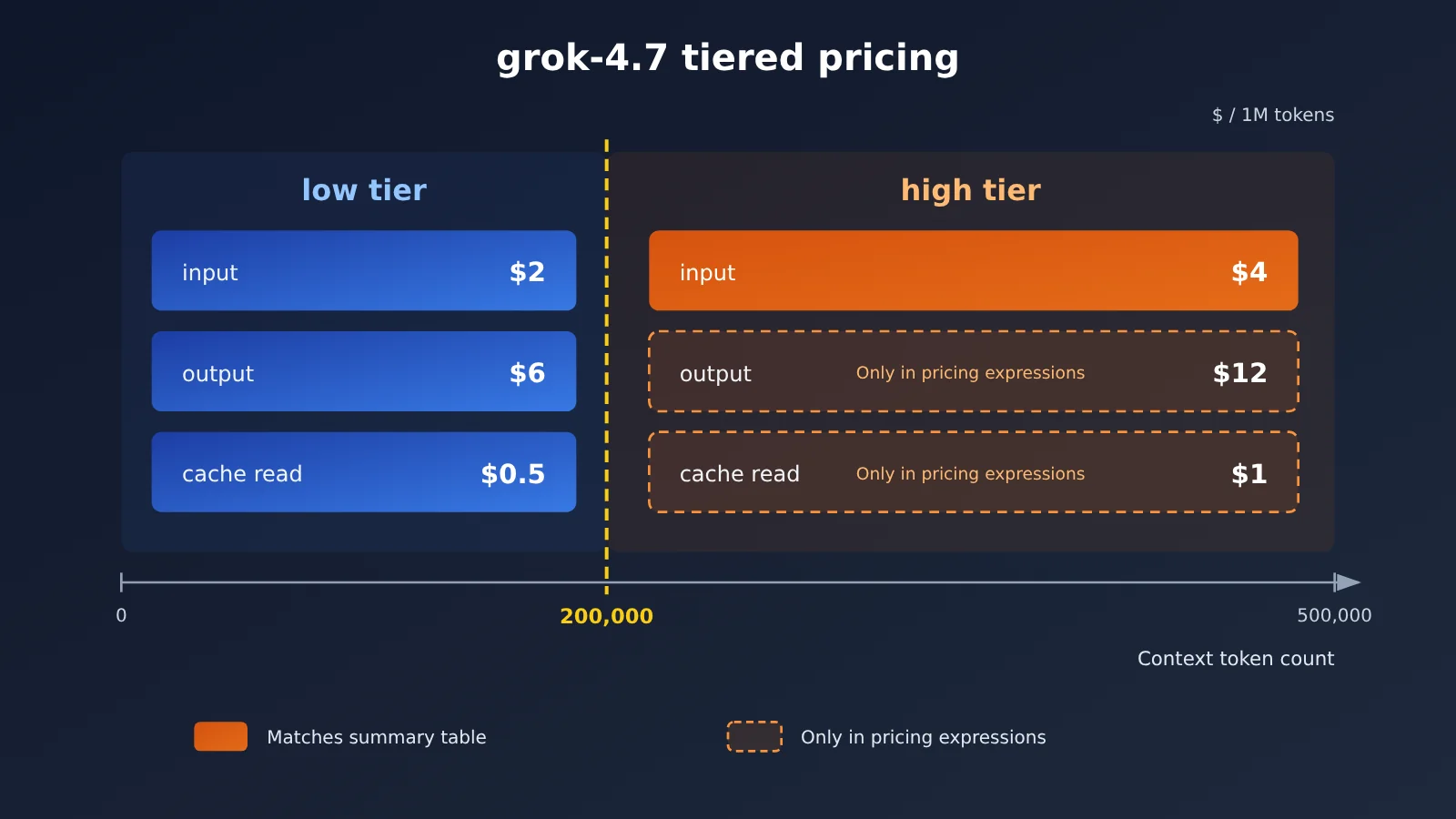
The pricing information in the diagram above comes from the pricing API and model summary table at APIYI apiyi.com, checked on 2026-11-13, with the platform’s model list as the authority.
Now for the quotes. On 2026-11-10 at 17:35, Musk said on X that Grok 4.8 “will bear no resemblance to 4.7 (thankfully). It is not yet incredible”. At 18:22 the same day, he added in a reply, “Not as good. Opus 5.5 is a masterpiece.” — meaning 4.8 still isn’t a match for Opus 5.5. He also predicted that Grok 5 could overtake Opus 5.5 within two or three months.
These are attitudes, not scores for Grok 4.8. A founder saying the new version “doesn’t resemble 4.7 — thankfully” only tells you he doesn’t approve of 4.7’s foundation; it doesn’t prove that 4.8 has fixed any of the three shortcomings above.
Can Grok 4.8 Close These Three Gaps?
All we have to go on is what’s in Musk’s original post. He mentioned dropping JAX/SGLang and rewriting the reinforcement learning (RL) and inference stacks from scratch in C/C++; pretraining is done; the SFT data got a major cleanup; and 4.8 is currently in the RL phase, with “evals are starting to climb.” The post doesn’t name a single benchmark or score, and there’s no parameter count either.
Compare that against the three gaps and the conclusion stays pretty conservative:
- Too many output tokens: the RL phase could certainly affect output length, but he never mentions token efficiency.
- Lagging Fable on long tasks: no mention of Terminal-Bench or CursorBench, and no long-task data at all.
- Pricing above 200K tokens: no pricing info whatsoever, and 4.8 isn’t on any price sheet yet.
So the speculation has to stop at “they rewrote the RL and inference stacks and cleaned up the SFT data.” There’s currently no evidence that the three gaps above have been closed. Once 4.8 has a model card and third-party benchmarks, it’ll make sense to go through them one by one.
Calling grok-4.7 Today: How the 200K Token Tiers Work
Until 4.8 ships, the practical move is to get grok-4.7’s costs under control. The key line is 200K tokens: once input crosses it, the unit price doubles outright, and per the pricing expression, output and cache reads double too. Here’s the actionable access info and tiering advice:
- Model ID:
grok-4.7, chat endpoint, with groupsCodexResponses,Default, andSVIP - API address: OpenAI-compatible format — set base_url to
https://api.apiyi.com/v1and model togrok-4.7 - Low-tier control: keep each request’s context under
200,000tokens where possible; use summaries or retrieved chunks instead of stuffing in entire documents - High-tier budget: when you really need long context, estimate input at
$4, output at$12, cache reads at$1— and watch out for the inconsistency where the summary table doesn’t list high-tier output - Output length: given gap #1, set max_tokens for tasks that need it, so output doesn’t run away in high-reasoning modes
Model names and prices follow the platform’s model list; check docs.apiyi.com/models for the latest. The official blog also mentions Grok 4.7 has a fast variant at roughly twice the output speed and twice the price, but the platform summary table has no separate fast model ID — don’t assemble one yourself when calling it.
🚀 Quick start: once grok-4.8 ships, APIYI apiyi.com will list it as soon as possible. Until then, use the same API key to get a grok-4.7 baseline working, and when 4.8 becomes available you only need to change the model parameter to compare.
Grok 4.8 vs Grok 4.7: Scenario Recommendations
When to stick with Grok 4.7
- Legal and engineering professional tasks: On the official table, Grok 4.7 ranks first on both EEBench and Harvey Legal Agent — there’s no reason to wait on these.
- Workloads you can keep under a 200K context: You’ll stay reliably in the lower pricing tier, and the per-unit price is the same as 4.6.
- Projects that need to ship right now: grok-4.7 is currently the only version you can actually call.
When it’s worth waiting on Grok 4.8
- Multi-hour agents / long terminal tasks: The gap on Terminal-Bench 4.0 and Fable 5.1 is significant, so evaluate other models as backups in parallel.
- Batch jobs sensitive to output token cost: Third-party leaderboards show 4.7 tends to produce long outputs. If 4.8 improves on that, it cuts costs directly — but there’s no evidence yet.
- Apps that lean heavily on contexts over 200K: The high tier doubles in price, so keep an eye on how 4.8 is priced once it’s listed.
Grok 4.8 vs Grok 4.7: Decision Guide
| What you care about | What to do now | When to re-evaluate |
|---|---|---|
| Launch stability | Use grok-4.7 | When 4.8 shows up in the platform’s model list |
| Per-task cost | Control context and output length | When third-party token usage data for 4.8 exists |
| Long-task capability | Evaluate alternative models in parallel | When 4.8 publishes scores like Terminal-Bench |
| Price transparency | Budget based on the pricing API | When the platform’s master table fills in high-tier output pricing |
💡 Recommendation: Which version to pick depends on whether your tasks are long-running and whether you frequently cross the 200K token mark. Run your own samples through the same set of endpoints on APIYI apiyi.com, then decide whether to move long tasks to another model.
FAQ
Q1: Can Grok 4.8 be called through the API right now?
No. As of 2026-11-13, Grok 4.8 has no model ID — both the platform’s model master list and the pricing endpoint only show grok-4.7. The soft launch Musk mentioned this week is for Grok Bot users only.
Q2: Grok 4.8 vs Grok 4.7 — which one is actually stronger?
It’s impossible to say right now. Grok 4.8 has no public leaderboard results or scores. Musk only said that “benchmarks are trending up,” that it’s “not stunning yet,” and that it’s “not as good as Opus 5.5.” Those are attitudes, not comparable data.
Q3: Where does the claim about Grok 4.7 producing more output tokens come from?
It comes from a third-party evaluation by Artificial Analysis dated 2026-09-21, run at the xhigh setting. Roughly 81K output tokens per task, compared with 36K for 4.6 high and 38K for 4.6 xhigh. This is not official data.
Q4: Is Grok 4.7 worse than Grok 4.6 across the board?
No. In the official tables, Grok 4.7 beats 4.6 on several benchmarks including Terminal-Bench, CursorBench, and EEBench. Third-party leaderboards show it 3.7 points lower on AA-LCR and 1.1 points lower on AutomationBench-AA — those are isolated regressions.
Q5: How can I call grok-4.7 right now?
Sign up at APIYI (apiyi.com) and get an API key — new users get free trial credits. Use an OpenAI-compatible SDK, set base_url to the platform’s API endpoint, and set model to grok-4.7.
Q6: How exactly is output above 200K tokens billed?
The pricing expression states $12 for output and $1 for cache reads; the master table’s tier section only lists $4 for high-tier input and doesn’t separately list high-tier output. The two records don’t fully agree, so when budgeting I’d estimate conservatively based on the pricing expression and defer to the platform’s model list.
Q7: Once Grok 4.8 is listed, how do I migrate?
There’s no Grok 4.8 listing record in the platform’s live updates yet. Once it’s available, usually you just swap the model parameter — but I’d recommend first comparing output tokens, long-task success rate, and tiered cost on the same batch of samples before switching traffic over.
Grok 4.8 vs Grok 4.7: Key Takeaways
- Today’s choice: If you want to call the API, go with grok-4.7 — Grok 4.8 doesn’t have a model ID yet.
- Shortcoming #1 (third-party leaderboard): At xhigh it burns roughly 81K output tokens per task — too long.
- Shortcoming #2 (vendor’s own numbers): Still behind Fable 5.1 on Terminal-Bench and CursorBench.
- Not behind across the board: Grok 4.7 ranks first on both EEBench and Harvey.
- Shortcoming #3 (pricing page + direct quote): Input above 200K tokens doubles in price, and Elon won’t credit 4.7 as the foundation.
- Known changes in 4.8: Rewritten RL and inference stack, cleaned-up SFT — no evidence any of it fixes the three shortcomings.
- How to get started: Run a grok-4.7 baseline through APIYI apiyi.com first, then compare directly once 4.8 ships.
Summary
The key points of Grok 4.8 vs Grok 4.7:
- Availability: As of 2026-11-13, only grok-4.7 is callable. A soft launch in the Bot doesn’t mean the API is open.
- Three shortcomings: Output tokens run long (third-party leaderboard), it trails Fable on long tasks (the vendor’s own report), and long-context price hikes plus the founder’s remarks (pricing page and direct quote) — each from a different source.
- The evidence for 4.8: For now there are only claims about rewritten RL and inference stack and SFT cleanup — no scores, no pricing, no model card.
Rather than sitting around waiting, get grok-4.7’s context tiering and output length under control first, and then compare item by item once 4.8 has data you can actually verify. A good move is to use APIYI apiyi.com to validate how grok-4.7 performs on your workloads through a unified interface, so you’ve got a solid baseline ready for the eventual switch.
📚 References
- xAI Official Blog – Grok 4.7 Release: the official self-reported benchmark comparison table and pricing
- Link:
x.ai/news/grok-4-7 -
Notes: source for Terminal-Bench 4.0, CursorBench 4.0, EEBench, and other data
-
Artificial Analysis – Grok 4.7 Evaluation: a third-party leaderboard, including output token usage
- Link:
artificialanalysis.ai/articles/benchmarking-grok-4-7 -
Notes: intelligence index, output token comparison, changes in metrics such as AA-LCR
-
Elon Musk X post (2026-11-10): direct quote on Grok 4.8 progress
- Link:
x.com/elonmusk/status/2120088070443655190 -
Notes: RL and inference stack rewrite, SFT cleanup, Bot soft launch
-
Elon Musk X reply (2026-11-10): remarks comparing 4.8 with Opus 5.5
- Link:
x.com/elonmusk/status/2120099798078656909 -
Notes: source of “Not as good”
-
APIYI Model List: grok-4.7 models, groups, and tiered pricing
- Link:
docs.apiyi.com/models - Notes: models and prices should be verified against this, checked on 2026-11-13
Author: APIYI Technical Team
Technical inquiries: Feel free to contact us via the APIYI homepage. For more resources, visit the docs.apiyi.com documentation center.