
Author’s note: Grok 4.8 hasn’t been released yet. This article reviews three statements from Elon Musk, separates confirmed information from unconfirmed claims, and uses real-world Grok 4.7 test data to assess what a 2.5T model might bring to the table.
The bottom line: As of October 30, Grok 4.8 hasn’t been released and isn’t available through an API. That day, Musk said only that it “will not be a disappointment” and that it isn’t being optimized for benchmarks. What we can verify right now comes down to three dates and the foundation Grok 4.7 has already established.
“I know it’s taken longer than expected, but Grok 4.8 will not be a disappointment. We’re not optimizing for benchmarks and I really don’t care how Grok does on those, but it will be incredibly useful.”
— Elon Musk, 2026-10-30 05:17 UTC (13:17 Beijing time)
Original post:
x.com/elonmusk/status/2116036703538606301
The post was a reply to a complaint from @techdevnotes the previous day: “SpaceXSI has almost no SOTA models, except voice.” It’s worth noting that Musk didn’t say Grok 4.8 “performs poorly on benchmarks.” He said it wasn’t being optimized for benchmarks and that he didn’t care about the scores. Some people online have interpreted that as “4.8 won’t score well,” but that’s a third-party inference, not what he said.
This isn’t a launch analysis, because there’s no launch to analyze yet. Instead, we’ll do three things: separate Musk’s statements from official specifications; use third-party Grok 4.7 data to estimate 4.8’s starting point; and explain how teams in China can get started now and switch models later.
To avoid treating verbal claims as specifications, we’ve labeled information in this article using three categories:
- 【Officially reported】: Official announcements, documentation, and in-house benchmarks from xAI (now SpaceXSI). These can be useful references, but they aren’t independently verified.
- 【Third-party testing】: Tests or reporting from outside organizations such as Artificial Analysis and Bloomberg.
- 【Musk’s statements】: Musk’s own posts on X, including claims about 2.5T parameters, the C++ stack, and RL progress. These aren’t backed by an official model card.
🚀 Quick start: While waiting for Grok 4.8 API access, developers in China can use APIYI at apiyi.com to call the already available
grok-4.7. Its OpenAI-compatible interface lets you compare it with Claude, Gemini, and other models using a single API key.
Grok 4.8 at a Glance: 3 Key Dates
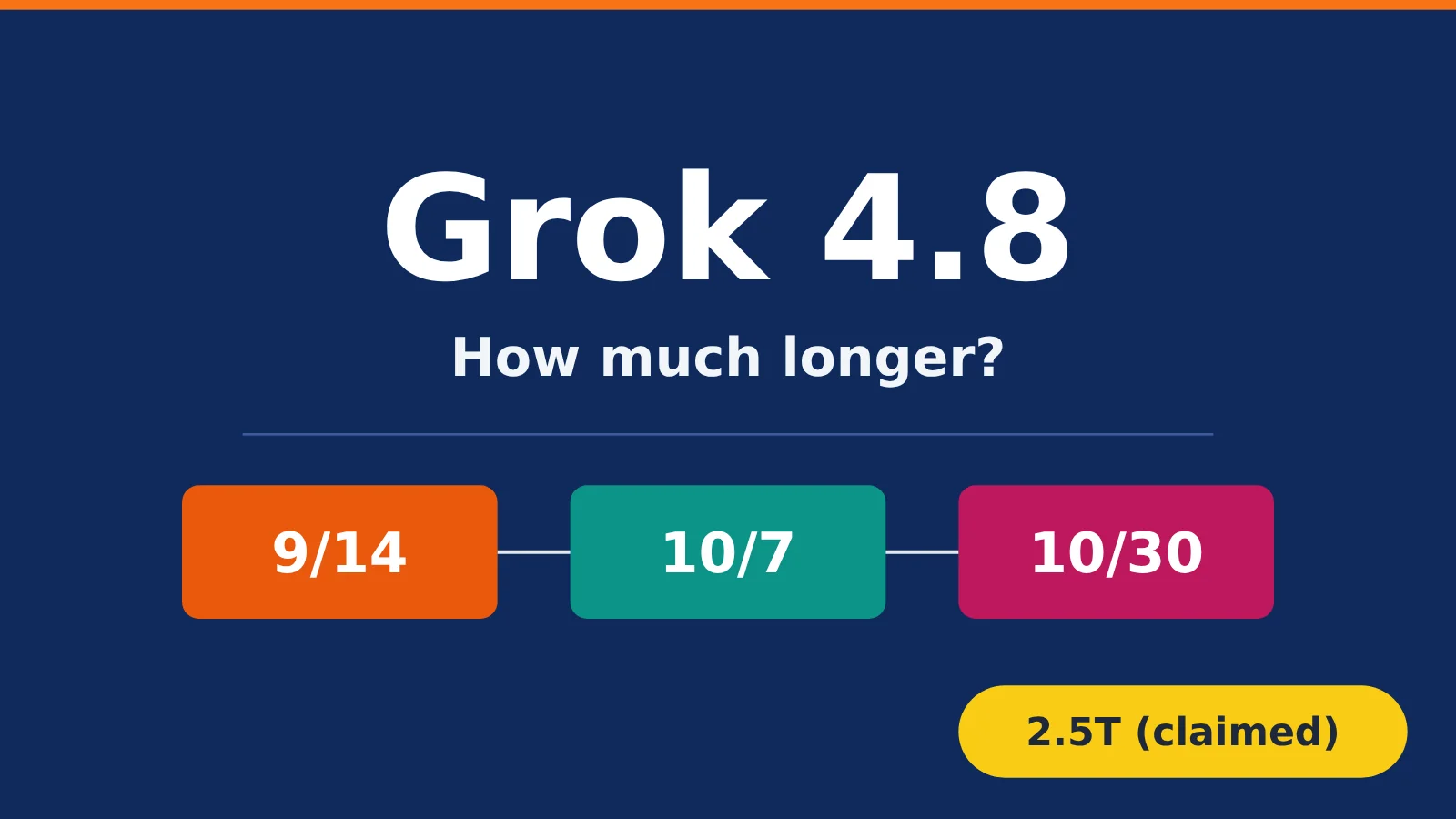
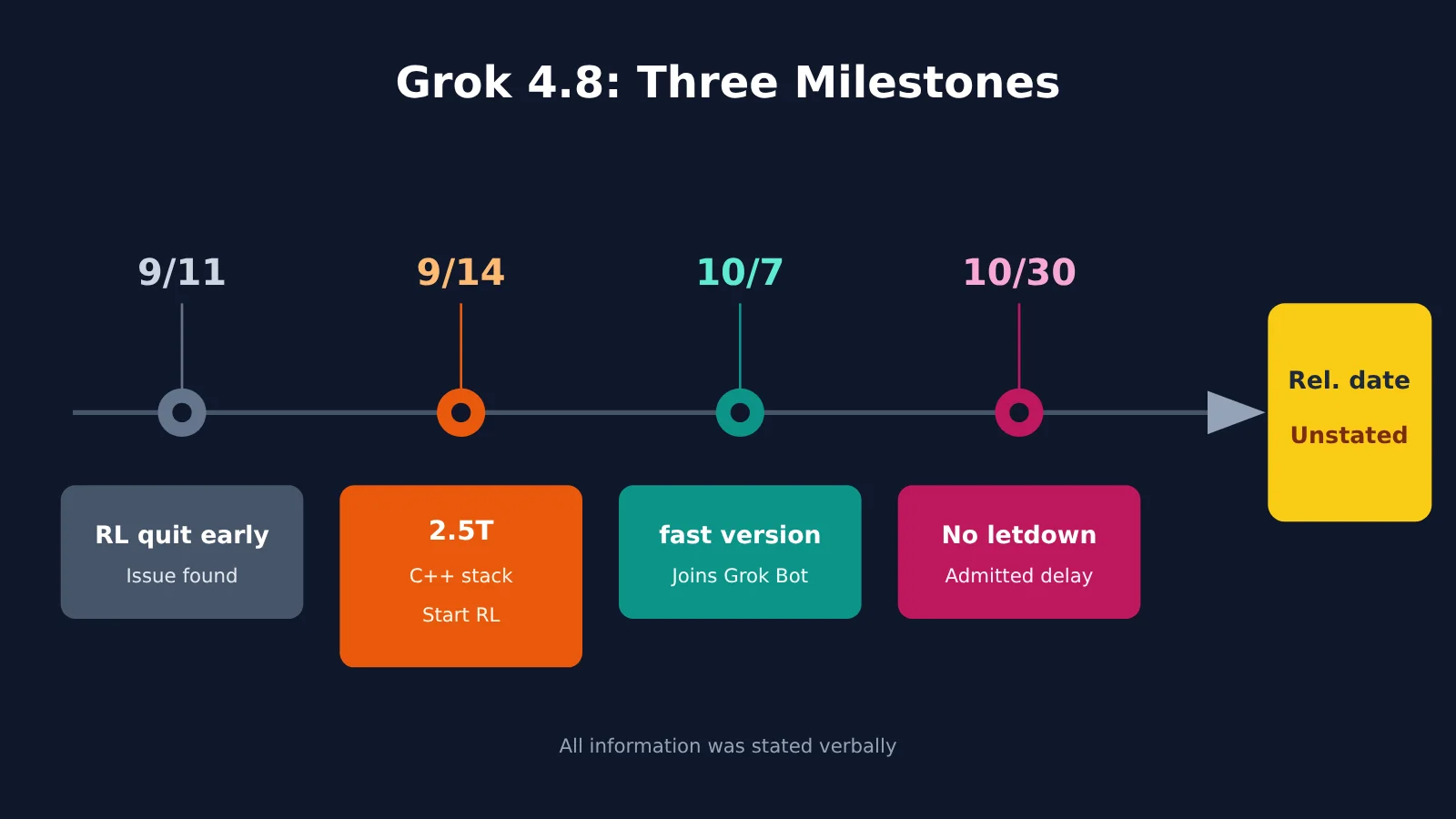
All publicly available information about Grok 4.8 comes from Elon Musk’s posts on X. As of an October 27 check, xAI’s official documentation contained no mention of Grok 4.8. Here’s a summary of the three key dates.
| Date (UTC) | Highlights from Musk’s statements | What they reveal | Evidence level |
|---|---|---|---|
| 2026-09-14 | “a 2.5T model trained with our new C++ software stack, will finish training this week and start RL” | 2.5 trillion parameters, a new C++ pretraining stack, and plans to finish training that week and start RL | [Musk’s statement] |
| 2026-10-07 | “a lightning-fast version of Grok 4.8” handles most Grok Bot requests | A fast version will handle Grok Bot’s routine, simpler requests | [Musk’s statement] |
| 2026-10-30 | “will not be a disappointment”; “not optimizing for benchmarks” | Acknowledged that it’s taking longer than expected and emphasized practical use over benchmark scores | [Musk’s statement] |
Grok 4.8 Milestone One (9/14): A 2.5T Model and a New C++ Stack
The September 14 post was the most informative. Musk said Grok 4.8 was a 2.5T model trained with a new C++ software stack, with training set to finish that week before RL (reinforcement learning) began. He added two more details that day: the pretraining software had been replaced with an in-house C/C++ stack written mainly by the Starlink software team, while the RL stack was still “somewhat of a legacy pile”—essentially a pile of legacy code.
There’s an important distinction here. “Finish training this week” referred to pretraining; RL and post-training still had to follow. So it would be inaccurate to say “Grok 4.8 has finished training.” Also, the pretraining stack was new, but the RL stack was old. That alone could help explain why Musk said on October 30 that it was taking longer than expected. The RL stage may well be the real bottleneck.
That same day, he also shared a roadmap: Grok 4.7 was roughly on par with Opus 5.0 (not 5.1), Grok 4.8 would be a “noticeable improvement,” Grok 4.9 would “probably” be “Astra/Fable class,” and Grok 5 might be “better than anything.” These are all [Musk’s statements] and should be treated only as indications of direction.
Grok 4.8 Milestone Two (10/7): A Lightning-Fast Version Comes to Grok Bot
On October 7, Musk discussed how Grok Bot chooses models. He said most Bot requests are simple, and once Grok 4.8 is released, they’ll be handled by “a lightning-fast version of Grok 4.8.” That suggests Grok 4.8 won’t come in just one version: there’ll be at least one fast version designed for high throughput and low latency.
For developers, this is more useful than the parameter count. Grok 4.7 Fast offers a point of comparison: it costs twice as much as the standard version and is available only in Cursor and Grok Build, according to official statements. Whether the 4.8 fast version will be available through an API, and how it’ll be priced, are still unknown.
Grok 4.8 Milestone Three (10/30): “Won’t Disappoint”
The October 30 post didn’t provide any new technical details. It did two things: acknowledged the delay and shifted the focus from benchmark scores to usefulness. Given that Grok 4.7 is already highly competitive across multiple benchmarks, this sounds like an attempt to manage expectations: 4.8 might not top every leaderboard, but it’ll emphasize usefulness in real-world tasks.
Grok 4.8: What’s Confirmed and What Isn’t
When writing about Grok 4.8, the easiest mistake is treating public statements as specifications. You can use this checklist to keep your team aligned.
| Item | Status | Details |
|---|---|---|
| Released? | ❌ Not released | As of October 27, there was no grok-4.8 on the xAI models page, the Grok 4.8 news page returned a 404, and the latest text model in the release notes was still Grok 4.7 from September 21 |
| Release date | ❌ Unconfirmed | No official date has been announced |
| Pricing | ❌ Unconfirmed | No input, output, or cache read pricing has been announced |
| Context length | ❌ Unconfirmed | Grok 4.7 has a 500k context window; no length has been announced for 4.8 |
| API model name | ❌ Unconfirmed | grok-4.8 doesn’t appear in the official documentation |
| 2.5T parameters | ⚠️ Statement only | Based on Musk’s September 14 post; there’s no model card |
| New C++ pretraining stack | ⚠️ Statement only | Mentioned in the September 14 post; there’s no technical report |
| RL started | ⚠️ Statement only | All we can say is that Musk claimed pretraining would finish and RL would start that week |
| Fast version | ⚠️ Statement only | Mentioned in an October 7 post for use with Grok Bot |
| Benchmark results | ❌ Unconfirmed | There’s no official or third-party data |
A check of APIYI’s real-time pricing API on October 30 showed 12 models in the Grok series, with no grok-4.8 among them. The reason is simple: it hasn’t been officially released, so no platform can offer it ahead of time. If you see a provider claiming it has “integrated Grok 4.8,” check which model it actually returns.
Grok 4.8 Impact Analysis: What Grok 4.7 Tells Us About the Potential of a 2.5T Model
Since there’s no data on 4.8, we can judge its potential impact by looking at two things: how quickly xAI iterates and how strong its starting point is with Grok 4.7.
The Pace Before Grok 4.8: Three Iterations in Ten Weeks
| Version | Release date | Key changes【Official claims】 |
|---|---|---|
| Grok 4.5 | 2026-07-08 | First version trained specifically for coding and agents, trained alongside Cursor using tens of thousands of NVIDIA GB300 GPUs |
| Grok 4.6 | 2026-08-12 | Longer supplemental training, with SFT data regenerated using 4.5; agentic RL covered kernel optimization, web development, and CAD |
| Grok 4.7 | 2026-09-21 | Larger base model, longer RL focused on multi-hour tasks, and stronger self-checking; 500k context window and a May 2026 knowledge cutoff |
From July 8 to September 21, xAI released three versions in roughly ten weeks, with no change in price: $2 per million input tokens and $6 per million output tokens. The official 4.7 pricing table separately listed cache reads at $0.50 per million tokens; the 4.5 and 4.6 announcements didn’t list a separate cache-read price. That pace of iteration is unusual among leading labs. By that standard, 4.8 is already noticeably later than expected, which lines up with Musk’s statement that it had “taken longer than expected.”
Independent testing: Grok 4.7 puts SpaceXAI among the top four labs
Artificial Analysis reported the following results on September 21【independent testing】:
- Intelligence Index: 46: 2 points higher than Grok 4.6, putting SpaceXAI among the top four labs.
- Coding Agent Index: 56: Grok 4.7 xhigh with Grok Build scored 9 points higher than 4.6, ranking fourth in its native harness, behind only Claude Fable 5.1, GPT-6 Astra, and Claude Opus 5.
- AA-Briefcase: 1,657 Elo: 111 points higher than 4.6, putting it in the same tier as Claude Opus 5 and Fable 5.1.
- GDPval-AA: 1,695 Elo: 90 points higher than 4.6.
- Individual benchmark gains: DeepSWE rose from 65% to 73%, Terminal-Bench 4.0 from 18% to 33%, and SWE-Atlas-QnA from 58% to 63%.
The results are even more striking for voice. Grok Voice 3.0, released on October 14, scored 86.9 on the Artificial Analysis Speech-to-Speech Index, ranking first worldwide. It beat GPT-Live-1 (Astra, medium) at 83.2 and Gemini 3.8 Live Extended Thinking at 82.6【independent testing】. That shows xAI can take the top spot in a specific area.
Grok 4.7 vs. GPT-5.6 Sol and Fable 5.1
The table below uses comparison data from xAI’s Grok 4.7 announcement. These are【official self-reported results】, not independent test results.
| Benchmark | Grok 4.7 xHigh | GPT-5.6 Sol Max | Fable 5.1 Max | Availability |
|---|---|---|---|---|
| CursorBench 4.0 | 46.3% | 41.7% | 51.8% | Grok 4.7: APIYI apiyi.com, xAI official |
| Terminal-Bench 4.0 | 37.6% | 37.3% | 57.9% | — |
| DeepSWE v1.1 | 71.0% (high) | 72.7% | 70.0% | — |
| EEBench | 64.0% | 39.4% | 56.4% | — |
| AA Briefcase v1.1 | 1,657 | 1,487 | 1,678 | — |
| Harvey Legal | 19.6% | 2.5% | 6.7% | — |
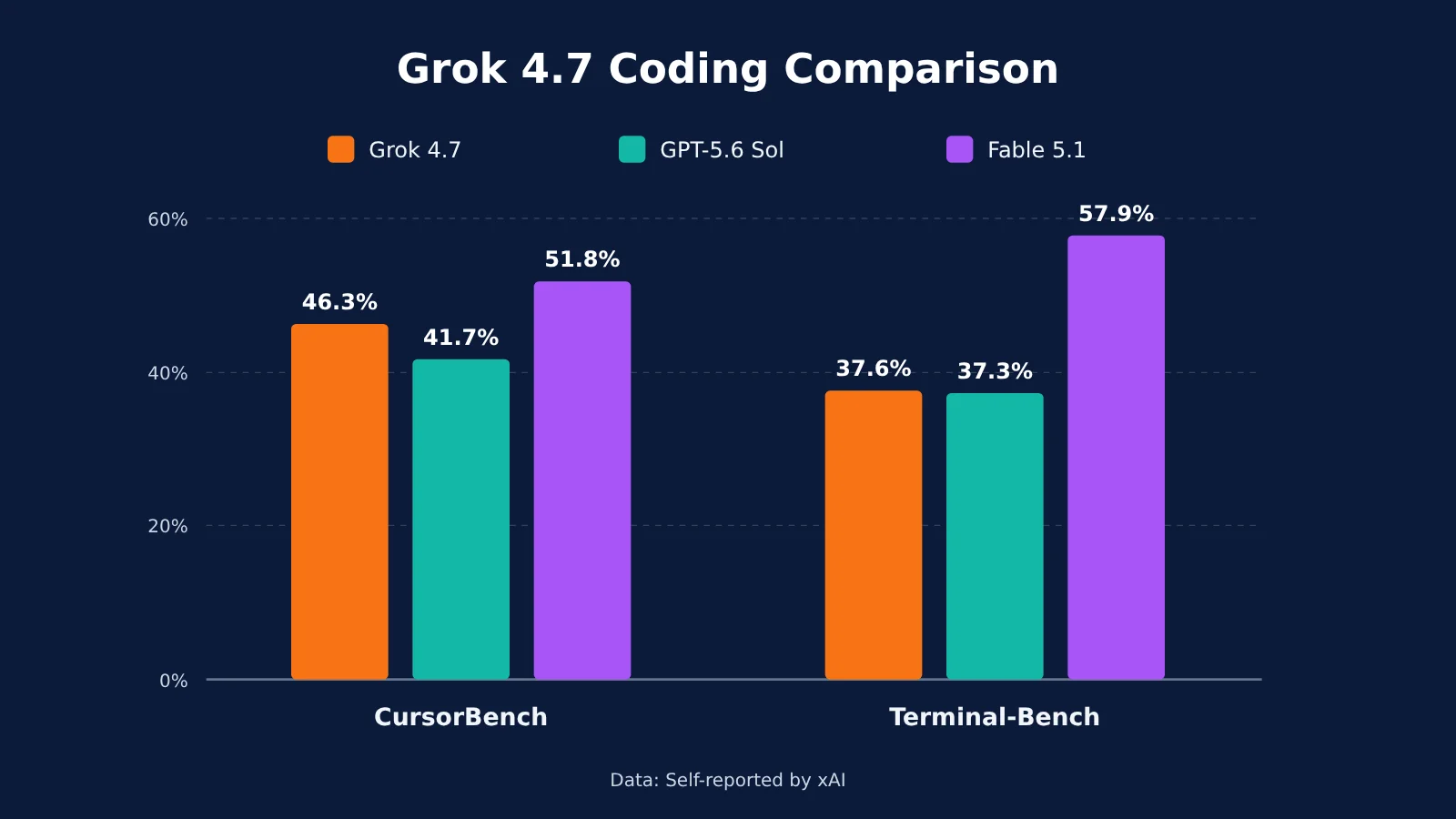
As the table shows, Grok 4.7 sits between GPT-5.6 Sol and Fable 5.1 on CursorBench, and leads on EEBench (electrical engineering) and Harvey Legal (law). It isn’t the strongest across the board, but it has clear advantages in coding price-performance, electrical engineering, law, and voice.
💡 About the comparison: The figures above are self-reported by the vendor, and results can vary considerably across harnesses. It’s worth retesting with your own real-world tasks. With APIYI apiyi.com, you can invoke Grok, Claude, and GPT models through the same interface and run A/B comparisons by changing the
modelparameter.
Ecosystem and Compute: Grok 4.8’s Distribution Foundation
Whether a model gets used depends heavily on its distribution channels and available compute. xAI is well positioned on both fronts:
- User base: As of March 31, 2026, Grok had 117 million monthly active users, according to SpaceX’s S-1/A filing, up from 89 million at the end of 2025. That’s roughly 21% of X’s 550 million monthly active users.
- Grok Bot growth: Grok Bot entered beta on August 11 and reached roughly 418,000 weekly active users by September 14, up 24% week over week [third-party measurement reported by Bloomberg]. In a September 26 interview, Musk said Grok Bot was growing by roughly 100% per month [Musk’s statement, relayed by wccftech].
- Cursor acquisition: On August 14, SpaceX completed its $60 billion acquisition of Cursor. Cursor said it would use SpaceX’s largest GPU cluster to help improve Grok Build, Grok Bot, Grok API, and Cursor. Grok 4.6 was the first result of the collaboration.
- Enterprise channels: Grok 4.7 became available on Microsoft Foundry on October 7.
That means Grok 4.8 can reach users through Cursor, Grok Build, Grok Bot, and X as soon as it launches. The fast version, designed to handle Grok Bot’s everyday requests, is built for this distribution pipeline.
Where Grok 4.8 Needs to Improve
Focusing only on strengths would paint an incomplete picture. Grok 4.7’s weaknesses are just as clear:
- It lags on terminal-based agent tasks: It scored just 37.6% on Terminal-Bench 4.0, more than 20 percentage points below Fable 5.1’s 57.9% [official figures].
- It consumes a lot of tokens: In the Intelligence Index test, it generated an average of 81k tokens per question—more than twice as many as Grok 4.6 xhigh (38k) [third-party testing]. Although its per-token price is low, the actual bill for long reasoning tasks can add up.
- Musk has acknowledged the gap: On September 26, he called Grok 4.7 a “solid workhorse” but said it wasn’t as good as Anthropic’s new Opus. Catching up to the frontier could take until “sometime next year” [Musk’s remarks].
- Lingering RL issues: On September 11, while explaining the delay to 4.7, he said RL may have penalized response length too heavily, causing the model to give up early on hard problems and check its work less rigorously [Musk’s remarks].
3 Things to Watch for in Grok 4.8
Based on the information above, here are three things worth watching after Grok 4.8 launches:
- Can the 2.5T base model deliver? Parameter count alone doesn’t determine capability. Watch for an official model card and meaningful gains on third-party benchmarks like Artificial Analysis’s Intelligence Index and Coding Agent Index—not just incremental improvements of 1–2 points.
- Will RL fix the tendency to give up early on hard problems? Musk explicitly identified this issue on September 11, and the RL stack is still the old one. Watch whether Grok can significantly narrow the gap with Fable 5.1 on long-running agent tasks, such as Terminal-Bench and multi-hour coding, while also reducing token consumption per question.
- Can the fast version handle Grok Bot’s everyday requests? The fast version needs to strike a balance between low latency and quality. It’s also worth watching whether, like 4.7 Fast, it’ll be available only through Cursor and Grok Build, or whether developers will be able to access it via the API.
How to Use Grok Before 4.8 Launches: Official Pricing and APIYI Access
Official xAI Grok 4.7 Pricing
Here’s xAI’s official pricing, in USD per million tokens:
| Pricing tier | Input | Output | Cache reads |
|---|---|---|---|
| Standard (prompt < 200k) | $2 | $6 | $0.5 |
| Long context (prompt ≥ 200k) | $4 | $12 | $1 |
A few other rules apply: the Batch API gets a 20% discount, US regional endpoints are billed at 1.1 times the standard rate, and Grok 4.7 Fast costs twice the standard rate and is available only in Cursor and Grok Build. Grok 4.7 supports text and image input with text output. Its reasoning levels are low, medium, high (default), and xhigh.
Current Grok Model Pricing on APIYI
The following data comes from APIYI’s model list (updated October 27, 2026, at 14:50). Prices are in US dollars per million tokens, with account top-ups converted at a rate of $1 to ¥7. These prices are listed separately from official pricing:
| Model | Input | Output | Cache read | Interface / Group |
|---|---|---|---|---|
grok-4.7 |
$2 | $6 | $0.5 | chat, CodexResponses; Default, SVIP |
grok-4.6 |
$2 | $6 | $0.5 | chat, CodexResponses; Default, SVIP |
grok-4.5 |
$2 | $6 | $0.5 | chat, responses |
grok-4.3 |
$1.25 | $2.5 | $0.2 | chat, responses |
grok-build-0.1 |
$1 | $2 | $0.2 | chat |
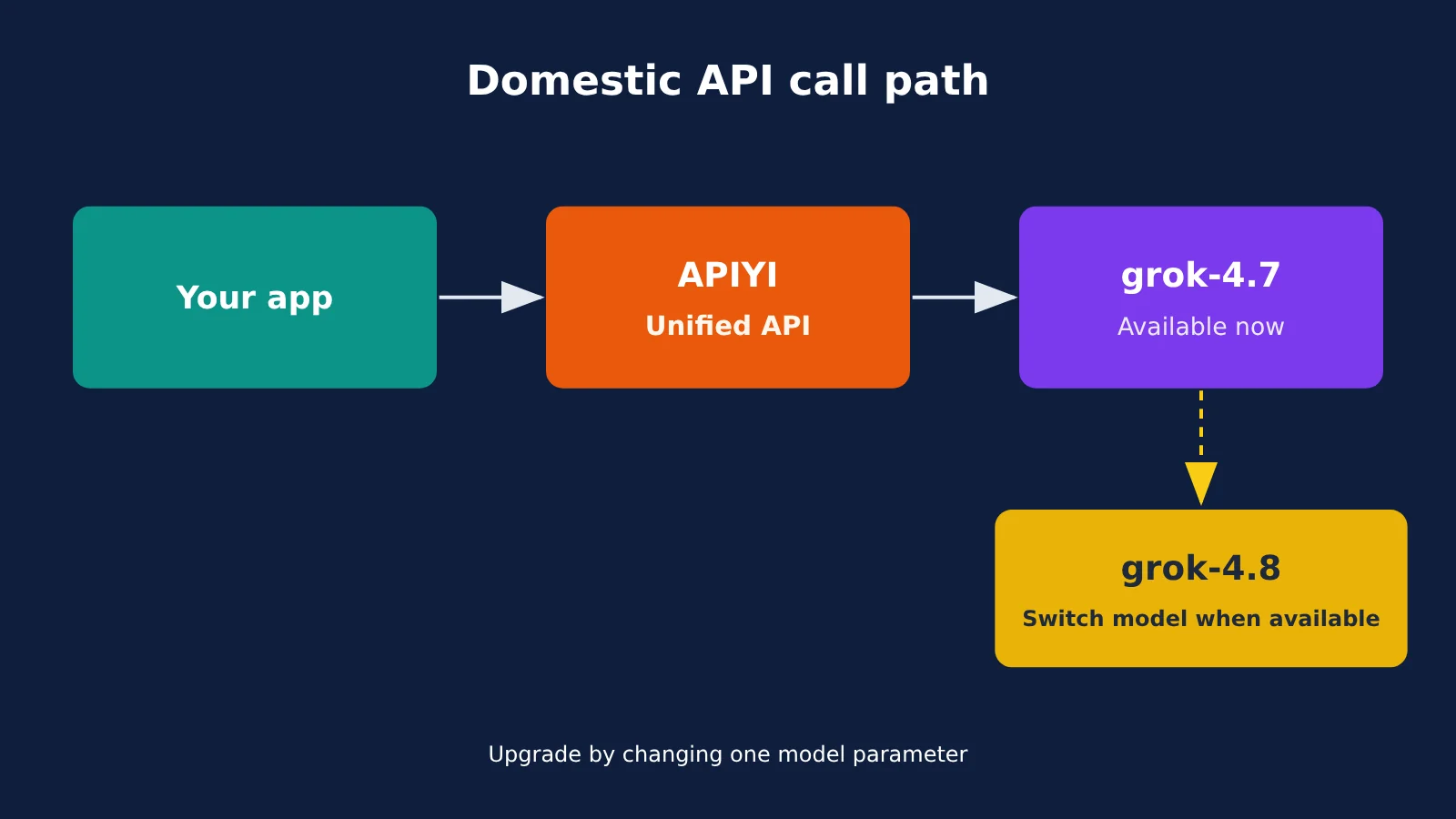
grok-4.7 is available on APIYI and ready to use. Grok 4.8 hasn’t been released or made available through an API yet, so it isn’t in any platform’s model list at the moment.
How to Access grok-4.7 from China
There are no code blocks in this article. To get started, you only need to change a few parameters:
base_url: Set this tohttps://api.apiyi.com/v1and use an OpenAI-compatible SDKapi_key: The key you create in the APIYI consolemodel: Usegrok-4.7for now, or switch togrok-4.3if you need a lower-cost option- Interface: Use
/v1/chat/completionsfor chat; in tools like Codex, you can connect using CodexResponses - Switching strategy: Put
modelin a configuration file instead of hard-coding it. Once Grok 4.8 is available, you can upgrade by changing a single value to match the model list
🎯 Technical tip: Once the Grok 4.8 API is officially available, APIYI will add it as soon as possible. Existing
grok-4.7calls won’t be affected or interrupted. We recommend getting your application running withgrok-4.7on APIYI at apiyi.com and keeping an evaluation set ready. Once 4.8 is available, you can use the same test cases to compare the old and new versions.
What This Means for Developers in China
- Don’t wait: There’s no release date for Grok 4.8, so don’t hold up your projects for an unreleased model. Grok 4.7 already ranks among the top four in third-party evaluations and is capable enough for coding agents and legal and engineering document processing.
- Look at total costs: Grok 4.7 has low per-token prices, but it consumes a lot of tokens. Compare the total cost per task, not just the unit price. Cache reads at $0.5 per million tokens can save a lot when you’re reusing long contexts.
- Plan for a switch: Grok 4.5 and 4.7 have had the same pricing, so 4.8 might follow a similar pattern. But that’s speculation—there’s no official information, so leave some room in your budget.
Grok 4.8 FAQ
Q1: When will Grok 4.8 be released?
There’s no official release date yet. On September 14, Musk said pretraining would finish that week and RL would begin. On October 30, he acknowledged that it was “taking longer than expected.” Neither statement gave a release date. For now, any reports claiming a specific date can’t be verified.
Q2: Can I use Grok 4.8 now?
No. Grok 4.8 hasn’t been released or made available through the API, and there’s no `grok-4.8` model in xAI’s official documentation. The latest version currently available is `grok-4.7`. You can call it directly through an OpenAI-compatible interface at APIYI apiyi.com, with pricing of $2 for input, $6 for output, and $0.5 for cache reads per million tokens.
Q3: What does 2.5T mean?
2.5T means 2.5 trillion parameters. The only source is Musk’s September 14 post; there’s no official model card, and it’s unclear whether that’s the parameter count for a dense model or the total for a mixture-of-experts (MoE) model. It suggests xAI is scaling up pretraining after Grok 4.7’s “larger base model,” but the model’s final capabilities will also depend on the RL stage. Musk himself has said the RL stack is still legacy code. Parameter count is a signal of potential, not proof of capability.
Q4: When will APIYI offer Grok 4.8?
APIYI will offer Grok 4.8 as soon as xAI officially makes it available through the API. The timing depends on xAI’s release schedule, so there’s no date to share yet. In the meantime, you can use `grok-4.7`. Once 4.8 is available, check the model list at APIYI apiyi.com for the new model name. You’ll only need to change the `model` parameter to switch, and your existing calls won’t be interrupted.
Grok 4.8 Key Takeaways
- Not released yet: Grok 4.8 has no announced release date, pricing, context window length, or API model name.
- Three key dates: On 9/14, Musk disclosed the 2.5T model and C++ stack; on 10/7, he mentioned a fast version; on 10/30, he said it wouldn’t disappoint.
- Verbal claims aren’t specifications: The 2.5T figure, C++ stack, and start of RL training all come from Musk’s statements. There’s no model card.
- A strong starting point: Grok 4.7 scores 46 on the AA Intelligence Index, ranks fourth on the Coding Agent Index, and holds the top spot globally for Voice 3.0.
- Clear weaknesses: On Terminal-Bench, it trails Fable 5.1 by about 20 percentage points and uses more than twice as many tokens per task as 4.6.
- Three things to watch: Whether the base model delivers, whether RL can fix its tendency to give up early, and whether the fast version can support Grok Bot.
- Available now: APIYI already offers
grok-4.7. Once 4.8 is available, you can upgrade by changing the model name.
Summary
How much longer will we have to wait for Grok 4.8? Right now, nobody knows—not even Musk’s public comments provide enough information to infer a date. Here’s what we do know:
- The scale is growing: According to Musk, 4.8 is a 2.5T model built with a new C++ pretraining stack.
- RL is the bottleneck: The old RL stack and the model’s tendency to give up early on difficult problems are the most plausible explanation for the delay—and the most important things to verify after release.
- The foundation is already there: Three iterations in ten weeks, unchanged pricing, a top-four ranking in third-party evaluations, and the compute and distribution brought by Cursor make 4.8 promising. But it’s still too early to draw conclusions.
For technical teams, the safest approach is neither to wait nor to bet on the release: get your application running with 4.7, prepare an evaluation set, and use the results to decide whether to upgrade once 4.8 is available.
Developers in China can use grok-4.7 on APIYI now and upgrade once 4.8 is available: https://api.apiyi.com. Check the platform’s model list for current availability and pricing.
📚 References
- Musk’s October 30 post: The original “won’t disappoint” quote
- Link:
x.com/elonmusk/status/2116036703538606301 -
Notes: The quote cited at the beginning of this article
-
Musk’s September 14 post: 2.5T model, new C++ stack, and RL underway
- Link:
x.com/elonmusk/status/2099308197802631191 -
Notes: The only source for information on Grok 4.8’s size
-
Musk’s October 7 post: Lightning-fast version coming to Grok Bot
- Link:
x.com/elonmusk/status/2107894231922876510 -
Notes: The source for the fast version
-
xAI Grok 4.7 announcement and pricing: Official benchmarks and pricing
- Links:
x.ai/news/grok-4-7,docs.x.ai/developers/pricing -
Notes: Officially reported data and pricing at the ≥200k threshold
-
Artificial Analysis Grok 4.7 review: Independent testing
- Link:
artificialanalysis.ai/articles/benchmarking-grok-4-7 -
Notes: Intelligence Index, Coding Agent Index, and token consumption data
-
Cursor joins SpaceX: Compute and distribution collaboration
- Link:
cursor.com/blog/joining-spacex - Notes: GPU clusters and product synergies following the acquisition
Author: APIYI Technical Team
Technical discussions: Contact us through the APIYI homepage. For more resources on integrating Grok models, visit the documentation center at docs.apiyi.com.