Conclusion
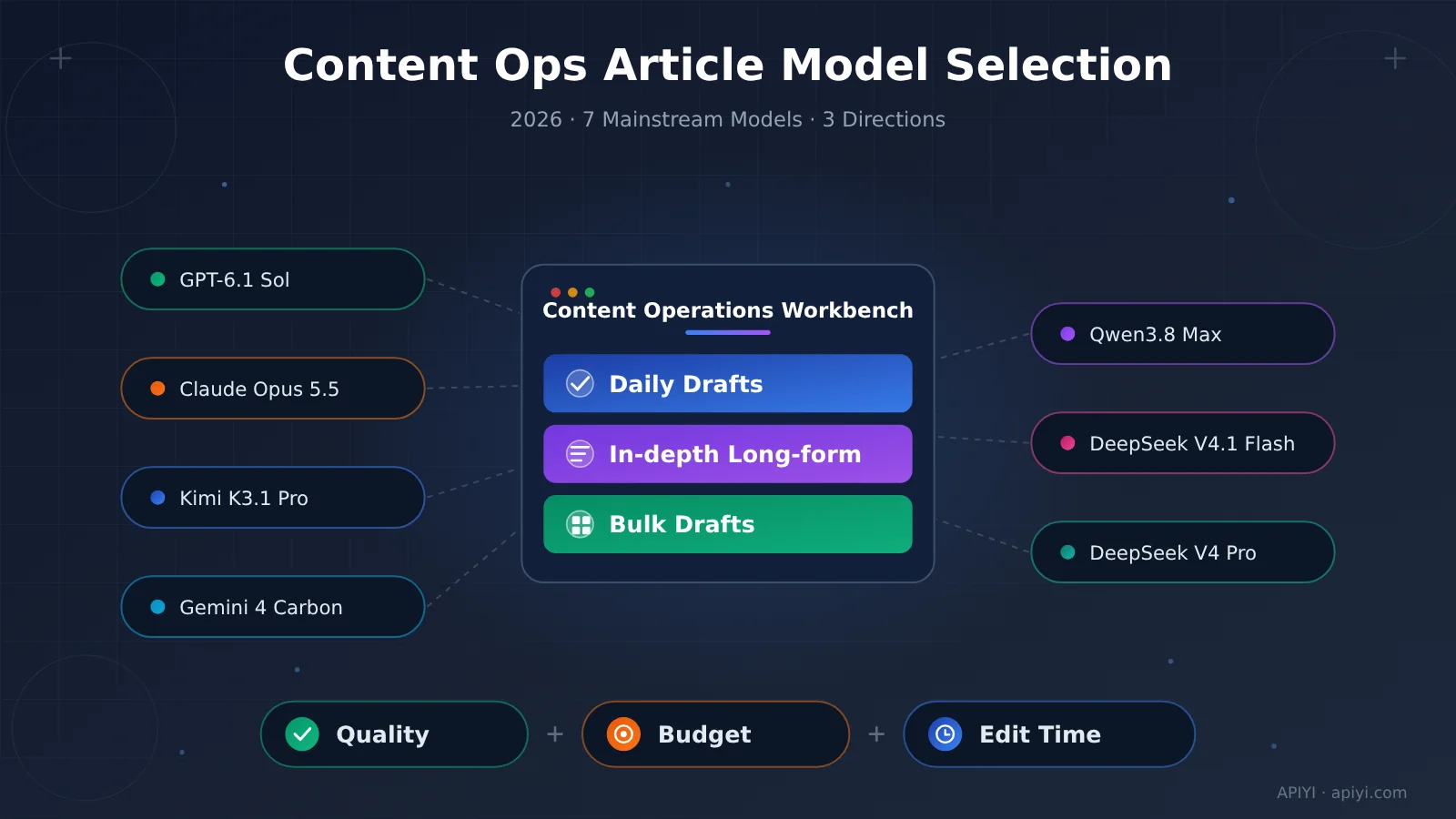
For everyday articles, test GPT-6.1 Sol first; for important long-form pieces, test Claude Opus 5.5 first; for batch first drafts, test DeepSeek V4.1 Flash first. For data-intensive tasks, also bring in Kimi and Gemini; for structured production, add Qwen; and validate DeepSeek Pro on a task-by-task basis.
These are testing candidates, not a champion list for Chinese writing. A truly cost-effective combination has to weigh material comprehension, article quality, invocation cost, and editing time all at once.
What We’ll Cover
- What each of the three writing tests reveals.
- Where the seven models actually differ.
- How to pair a primary and a backup model for different operational tasks.
- How to calculate costs and run blind tests through a unified API.
Which Large Language Model to Choose for Operations Articles: Start by Understanding the Testing Criteria
A model benchmark is a set of tests that measures model performance on standardized tasks. When choosing a model, operations teams should prioritize tests that closely mirror real production workflows: the same source materials, the same planning, the same length — then compare the finished drafts.
Which Large Language Model Should You Choose for Marketing Articles? English Scores for Screening Candidates
The AI Writing Benchmark was updated on November 11, 2026. It uses shared English writing tasks and comparisons with hidden model names, covering 115 models and 131,507 blind evaluations.
GPT-6.1 Sol has an overall English score of 95.3, with a score of 98.5 in the articles, blogs, and editing category. Claude Opus 5.5 and Kimi K3.1 Pro have overall scores of 92.9 and 91.9, respectively—both baseline scores.
Put simply, GPT deserves a spot in the blog-writing candidate pool; whether it can reduce the number of edits needed for Chinese WeChat public-account articles still requires local testing. The project is maintained by an individual, so language and evaluation method should also factor into your assessment.
Pay close attention to versions: Kimi K3 leads the explanation and popular-science category; in ToneBench, the 89.0 score for the “less template-like phrasing” item corresponds to GPT-6 Sol. Both results belong to older version names.
Which Large Language Model Should You Choose for Marketing Articles? Script Testing Is Closer to Resource-Pack Writing
The November 10, 2026 snapshot of ToneBench evaluates English long-video scripts: the model reads the creative brief and research pack, then generates the script closed-book, covering 87 models, 151 configurations, and 7,550 drafts.
The table below excerpts the Writing Score for the selected configurations. Claude uses the xhigh configuration; each row follows the reasoning configuration from its respective test, and compute budgets were not standardized, so only scores are listed here—model leaderboard and configuration leaderboard rankings are not mixed together.
| Model | Writing Score | Estimated per-script cost from the test |
|---|---|---|
| GPT-6.1 Sol | 82.4 | $0.239 |
| Claude Opus 5.5, xhigh | 85.8 | $1.003 |
| Kimi K3.1 Pro | 82.5 | $0.251 |
| Gemini 4 Carbon | 80.1 | $0.586 |
| Qwen3.8 Max | 76.8 | $0.207 |
| DeepSeek V4.1 Flash, 1017 version | 81.6 | $0.014 |
| DeepSeek V4 Pro | 80.1 | $0.077 |
The key takeaway is: Opus is the one to test first for high-quality long drafts, while Flash shows strong low-cost competitiveness. The costs in the table reflect the script workload in that test and shouldn’t be directly applied as quotes for Chinese marketing articles.
The test uses model judging and may have vendor bias; the confidence intervals for the leading configurations overlap, and changes to the reference scripts can also shift the top spot. It’s useful for narrowing the candidate pool, which editors should then validate.
Chart note: The chart below presents the candidate distribution by quality and cost; the data comes from the ToneBench snapshot above. When you re-test through APIYI apiyi.com, record your own tokens, configurations, and editing time separately.
Choosing a Large Language Model for Operational Articles: Scope of Chinese Evidence
OmniTools tested in-depth Chinese financial journalism between October 26 and November 3, 2026, with 10 models producing 26 articles. Opus 5.5 received an AI blind-review score of 8.25, while GPT-6.1 Sol scored 6.33.
This gives Opus a basis for being a candidate on long-form Chinese content. But the sample is small, each model produced a different number of articles, and the testing organization has a commercial routing service background — so the conclusion is best limited to that financial long-form case.
Choosing a Large Language Model for Operational Articles: Seven Models, One by One
Choosing a Large Language Model for Operational Articles: How GPT and Claude Split the Work
GPT-6.1 Sol: top candidate for everyday drafts. It stands out in the English article category, so it’s a good fit for testing tech blogs, product analyses, and news commentary first. Its Chinese naturalness and citation accuracy should be scored separately.
Claude Opus 5.5: top candidate for important long-form pieces. Both the scripted test and the Chinese financial case support it. You can try it first for feature stories and brand long-form content; for high-frequency short drafts, compare whether the incremental quality justifies the higher cost.
Choosing a Large Language Model for Operational Articles: How to Use Kimi, Gemini, and Qwen
Kimi K3.1 Pro: candidate for long-material tasks. With roughly 1M token context and its English general writing results, it’s worth including in tests for knowledge-intensive articles. K3’s scores in the popular-science category should be viewed separately.
Gemini 4 Carbon: candidate for complex material analysis. You can have it first sort out multi-step questions, evidence relationships, and article outlines, then compare that against writing the draft directly. Current evidence is better suited to supporting a candidate judgment.
Qwen3.8 Max: candidate for structured production. Good for testing product descriptions, recurring columns, and templated content. Its batch inference context limit is 256K per request, so check regional support before integrating.
Choosing a Large Language Model for Operational Articles: DeepSeek Flash vs. Pro
DeepSeek V4.1 Flash: top candidate for low-cost first drafts. In the scripted test above it balanced score and cost, making it suitable for batch first drafts, rewrites, and knowledge explanations. Keep human fact-checking before publishing.
DeepSeek V4 Pro: candidate for task-specific work. The API is still serving requests, but Flash scored higher in that scripted test. Only upgrade the budget when blind tests on a specific task prove the payoff.
Which Large Language Model to Choose for Operations Content: A Tiered Plan by Task
Here’s the testing order we’ve built from the available evidence. For Chinese output, the team decides which models get adopted through blind review.
| Operations task | Priority candidates | Alternative or complementary options |
|---|---|---|
| Tech news, everyday blog posts | GPT-6.1 Sol | Flash writes the first draft, GPT revises |
| Deep industry analysis, long-form brand articles | Claude Opus 5.5 | GPT blind-tested on the same topic |
| Technical tutorials, knowledge explainers | GPT, Kimi K3.1 Pro | Flash as a low-cost control |
| Synthesizing long materials, complex issues | Kimi, Gemini | Gather evidence first, then hand off to the drafting model |
| Marketing articles, short social content | Test GPT on short content first | Include Opus for long-form brand pieces |
| Batch structured content | Qwen, Flash | Pick the main model based on adoption rate |
| Available platforms | Each vendor’s official API | APIYI apiyi.com for unified calls and comparison |
The leading English model for marketing and sales categories is Claude Sonnet 5.5, which sits outside these seven. If marketing copy is your core business, you can expand the candidate pool instead of only picking a champion among the long-form models.
Quick start tip: APIYI apiyi.com offers a single API key that calls multiple models through an OpenAI-compatible interface, with free trial credits for new users. Start by comparing three models on the same topic, then widen the test.
Choosing a Large Language Model for Operations Writing: Costing It Down to a Publishable Draft
A token is the unit models use to process text. Input tokens cover the prompt, source material, and context; output tokens cover the generated content. The context window is the range a single call can handle.
The figures below use the APIYI price snapshot from 10:45 on November 12, 2026 (UTC+8), in USD per million tokens. Examples assume 10,000 input tokens and 3,000 output tokens.
| Model | Input price | Output price | Cost per example call |
|---|---|---|---|
| GPT-6.1 Sol | $2 | $10 | $0.05000 |
| Claude Opus 5.5 | $4 | $20 | $0.10000 |
| Kimi K3.1 Pro | $2 | $10 | $0.05000 |
| Gemini 4 Carbon | $2 | $10 | $0.05000 |
| Qwen3.8 Max | $1.65 | $4.95 | $0.03135 |
| DeepSeek V4.1 Flash | $0.30 | $1.20 | $0.00660 |
| DeepSeek V4 Pro | $1.32 | $3.96 | $0.02508 |
The formula is “input volume ÷ 1 million × input unit price + output volume ÷ 1 million × output unit price.” This table compares the base cost of one generation; retries, review, and editing time should be counted separately.
Route differences can also change the bill and the features you get:
- Qwen official regional pricing: Singapore is $2 / $6; Beijing and Virginia, USA, are $1.65 / $4.951.
- Gemini official direct access: introductory pricing runs through November 30; from December 1, it’s $4 / $20, with reasoning tokens counted as output cost. Check each third party’s own announcement.
- DeepSeek official direct access: off-peak prices are halved; check the official rules for the applicable time windows.
- Kimi batch capability: batch rules on the Moonshot channel need to be confirmed separately; Alibaba Cloud’s K3.1 Pro documentation notes that batch inference isn’t supported.
Prompt caching reuses repeated input and charges for it under the provider’s rules. A unified interface makes switching easier, but caching, search, reasoning modes, and batch capabilities still need to be confirmed route by route.
Which Large Language Model to Choose for Writing Operations Articles: How to Run a Practical Blind Test
A minimal call is enough to verify that the endpoint is reachable. The following example demonstrates only text generation; it doesn’t enable search or any other tools.
import os
from openai import OpenAI

client = OpenAI(
    api_key=os.environ["API_KEY"],
    base_url="https://api.apiyi.com/v1",
)
result = client.chat.completions.create(
    model="gpt-6.1-sol",
    messages=[{"role": "user", "content": "根据给定资料写运营文章大纲。"}],
)
print(result.choices[0].message.content)
For a complete comparison, use the same source material and the same task, and have each model generate independently at least three times. The code below keeps the drafts and usage data; during review, hide the model labels, then have editors record revision time and whether the draft was adopted.
import os
from openai import OpenAI

client = OpenAI(
    api_key=os.environ["API_KEY"],
    base_url="https://api.apiyi.com/v1",
)
models = ["gpt-6.1-sol", "claude-opus-5-5", "kimi-k3.1-pro"]
packet = "在此粘贴同一份已核验资料包。"
results = []

for model in models:
    for trial in range(3):
        response = client.chat.completions.create(
            model=model,
            messages=[
                {"role": "system",
                 "content": "仅依据资料写作,缺少依据的观点请省略。"},
                {"role": "user",
                 "content": f"写一篇运营文章,先回答问题,再展开论证。\n资料:{packet}"},
            ],
        )
        results.append({
            "model": model,
            "trial": trial,
            "text": response.choices[0].message.content,
            "usage": response.usage.model_dump() if response.usage else None,
        })
I recommend evaluating factual accuracy, how well the content plan is executed, naturalness of the Chinese, readability, and content added value. Also track editor retention rate and cost per acceptable article: if a cheap first draft needs a full rewrite, you save pocket change and spend an afternoon.
Which Large Language Model to Choose for Writing Operations Articles: FAQ
On a limited budget, which models should I test first?
Start by comparing Flash, GPT, and Opus, covering low-cost, everyday finished drafts, and important long-form pieces. Switching models through APIYI apiyi.com can reduce the configuration work of integrating each one separately.
Can a single interface make the comparison completely fair?
APIYI apiyi.com can standardize the invocation format; fairness also requires consistent source material, tool permissions, length, and reasoning settings. Record model versions and endpoints so you don’t mix different working conditions together.
Which Large Language Model to Choose for Operational Articles: Closing Recommendations
Adopt a tiered selection approach: use low-cost candidates for routine first drafts, high-quality candidates for important articles, hand fact-checking to an independent review process, and keep human verification in the loop. The final model recommendation should ultimately align with your team’s actual adoption rate.
We suggest validating the above combinations through the APIYI apiyi.com, testing on a pay-as-you-go basis and checking the latest pricing. The goal of model selection is to consistently produce publishable articles — not to assign every task to the leaderboard champion.
References
- AI Writing Benchmark: aiwritingbenchmark.com, updated November 11, 2026.
- ToneBench: benchmark.towardsai.com/models/, snapshot from November 10, 2026.
- OmniTools Chinese long-form real-world test: omnitools.ai/evals/longform-writing.
- Alibaba Cloud official pricing: alibabacloud.com/help/en/model-studio/model-pricing, retrieved November 12, 2026.
- Gemini official pricing adjustment: blog.google/innovation-and-ai/models-and-research/gemini-models/gemini-4-carbon-now-available/.
Author: APIYI Technical Content Team. We welcome discussion around model invocation and operational article evaluation on apiyi.com — when making comparisons, please include the version, configuration, and task definitions.