Author’s note: This article compares Gemini 4 Carbon and Claude Opus 5.5 across seven dimensions (specs, pricing, thinking mechanism, protocol, and official model card scores) and ends with a “which tasks go to which model” recommendation.
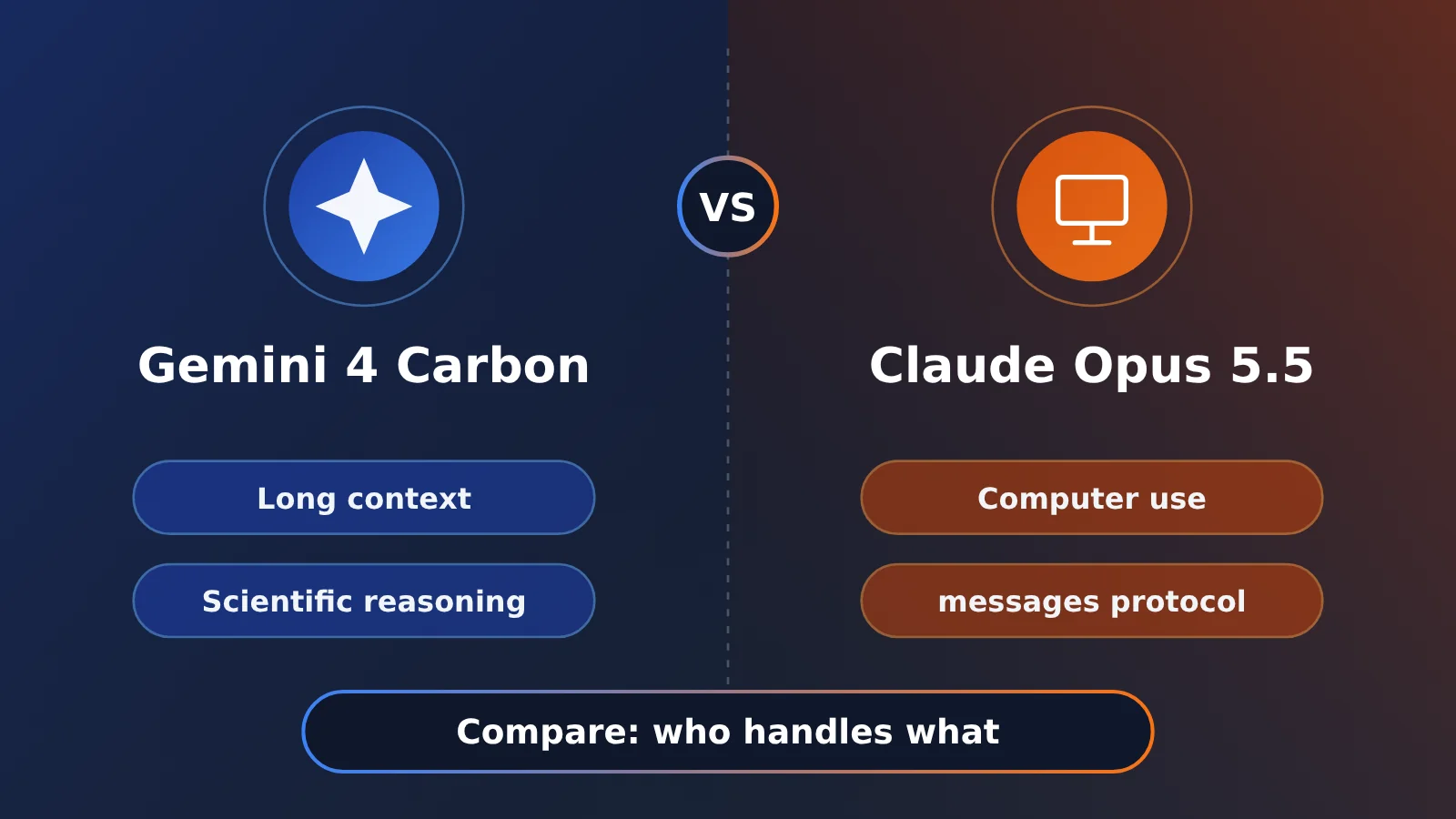
Here’s the bottom line first. Hand long-context retrieval, scientific reasoning, and long-horizon multi-step engineering to Gemini 4 Carbon. Hand computer use, desktop automation, and any workflow already built on the Anthropic messages protocol to Claude Opus 5.5. Neither model is “better across the board.” It comes down to which one fits the job.
This isn’t a “both have their strengths” cop-out. Every score in this article comes from official model cards and vendor documentation, and is labeled as self-reported by the vendor. For pricing, I list both the official list price and APIYI’s list price as of 2026-11-11, so you can compare them directly.
Key takeaway: After reading this Gemini 4 Carbon vs. Claude Opus 5.5 comparison, you’ll have a side-by-side table you can use for model selection. You’ll also see why Carbon’s lower unit price doesn’t necessarily mean a lower bill.
Gemini 4 Carbon vs. Claude Opus 5.5: Core Differences
Both models are flagships released in the second half of 2026. Anthropic released Claude Opus 5.5 on 2026-09-22. Gemini 4 Carbon was first announced on 2026-10-28, and at that point it was only available to cybersecurity defenders verified through the Fairwind Program. It didn’t reach GA for paying developers and enterprises until 2026-11-10.
Google’s positioning for Carbon is clear: it’s built on Gemini 4 Argon and designed for tasks that push up against the ceiling of intelligence, such as complex multi-step coding and debugging, and open-ended scientific research. It uses more thinking tokens than Argon, working through each hypothesis one by one and running its verification loops for longer. Opus 5.5, on the other hand, is known for adaptive thinking, 128K large outputs, and computer use capabilities. Both models are now available on APIYI (apiyi.com), so you can switch between them with the same API key.
Gemini 4 Carbon vs. Claude Opus 5.5 Spec Comparison
| Item | Gemini 4 Carbon | Claude Opus 5.5 |
|---|---|---|
| Model ID | gemini-4-carbon |
claude-opus-5-5 |
| Release date | Announced 2026-10-28, GA 2026-11-10 | 2026-09-22 |
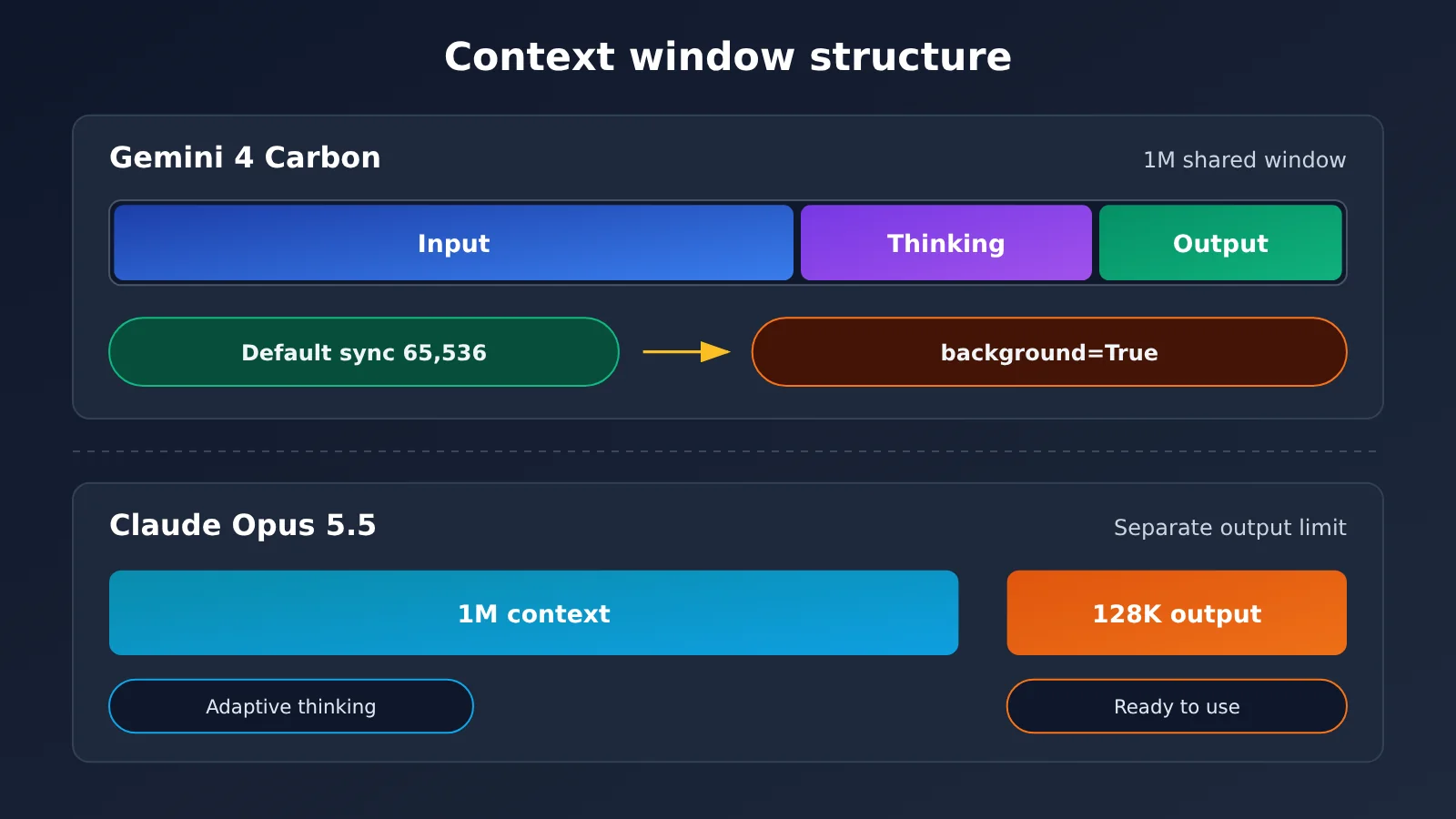
| Context | 1M, with input, thinking, and output sharing a single window | 1M |
| Output limit | Default 65,536 for synchronous requests; can be raised in background mode, sharing the 1M with input | 128K |
| Thinking control | thinking_level: low / medium / high, default medium |
Adaptive thinking can’t be turned off; default effort is medium |
| Knowledge cutoff | March 2026 (may be earlier in some domains) | Reliable knowledge cutoff of June 2026 |
| Input modalities | Text, images, audio, video | See official documentation |
| Output modalities | Text (can’t generate images or video) | Text |
There are two easy-to-miss gotchas in this table. The first is the output limit. Carbon’s 1M is a shared window, and by default a synchronous request can output at most 65,536 tokens. If you need longer output, you have to set background=True on the Interactions API and raise max_output_tokens above 65536, while also leaving headroom for thinking. Otherwise, the answer may get truncated. Opus 5.5’s 128K, by contrast, is a limit you can use directly.
The second is the thinking mechanism. Carbon’s three levels can be tuned per task: low suits classification, routing, and targeted extraction; medium is the default and balances speed, cost, and getting it right on the first try; high suits multi-file root cause analysis, formal mathematics, and up-front architecture design. Opus 5.5’s adaptive thinking can’t be turned off, and you can only adjust the effort. If your use case needs a “no thinking at all” low-latency mode, neither of these flagships is the best choice.
Gemini 4 Carbon vs. Claude Opus 5.5: Pricing and Billing
Going by list price alone, Carbon is clearly cheaper. But Carbon’s low price on the official channel is a promotional rate, and it also burns more thinking tokens, so the gap in unit price doesn’t translate directly into a gap in your bill.
Official Pricing vs. APIYI List Pricing
All prices are in USD per 1M tokens. APIYI list prices are the default-group prices as of 2026-11-11, not discounted prices.
| Price item | Carbon official (through Nov 30, global) | Carbon official (from Dec 1, global) | Opus 5.5 official | APIYI gemini-4-carbon |
APIYI claude-opus-5-5 |
|---|---|---|---|---|---|
| Input | 2 | 4.00 | 4 | 2 | 4 |
| Output (incl. reasoning) | 10 | 20.00 | 20 | 10 | 20 |
| Cache read | 0.10 | 0.20 | 0.20 | 0.10 | 0.20 |
| Cache write | Implicit caching, no separate charge | Same as left | 5 min: 5 / 1 hr: 8 | No separate cache-write multiplier | 5 (1.25× multiplier) |
| Available groups | — | — | — | default, svip | ClaudeCode, ClaudeCodeReverse, ClaudeOfficial, default, svip |
A few more details on the official side. During the promotional period, Carbon’s non-global endpoints are priced at 2.20 / 0.11 / 11. Gemini 4 Carbon Cyber Permissive isn’t eligible for the promotion and is billed at 4 / 0.20 / 20 straight away. Opus 5.5 Fast mode costs 8 for input and 40 for output, and US-only inference adds another 1.1× multiplier on top.
APIYI group multipliers are applied separately. For Opus, the ClaudeCode group is 0.95, ClaudeCodeReverse is 0.5, ClaudeOfficial is 1.2, and default and svip are 1. Carbon only has the default and svip groups, both at a multiplier of 1. Top-ups use a fixed 1:7 exchange rate, and you can stack them with top-up bonuses and group discounts. The actual charge is whatever the console shows. Models and prices are subject to the model list on apiyi.com. If the master table in the docs hasn’t picked up the Carbon row yet, go by the console and the pricing API.
Why a Unit-Price Gap Isn’t a Billing Gap
The cost of a single request is roughly: input tokens × input price + (thinking tokens + answer tokens) × output price. Carbon’s output price is half of Opus’s, but Google says outright that it spends more thinking tokens than Argon on verification loops. Take the same task: once Carbon’s thinking + answer total exceeds twice Opus’s, the output portion of the bill flips and Carbon ends up costing more.
On the official channel, from December 1 onward Carbon and Opus have identical unit prices, so whichever model uses fewer tokens will give you the lower bill. Anthropic also makes its own savings claim: it self-reports that Opus 5.5 finishes the same work with roughly 40% fewer billed tokens than Opus 5. That’s a vendor-reported figure, not a head-to-head comparison between these two models. The safer approach is to run a batch of your own real tasks on each model and compare the actual charges in the console.
Caching works differently too. Carbon enables implicit caching by default, with a 95% discount on cached input, and the developer guide says not to create or pass an explicit cached_content anymore. Opus caching requires a write, with the 5-minute write priced at $5, which suits repeated calls with a long, fixed system prompt.
Gemini 4 Carbon vs. Claude Opus 5.5: Official Model Card Scores
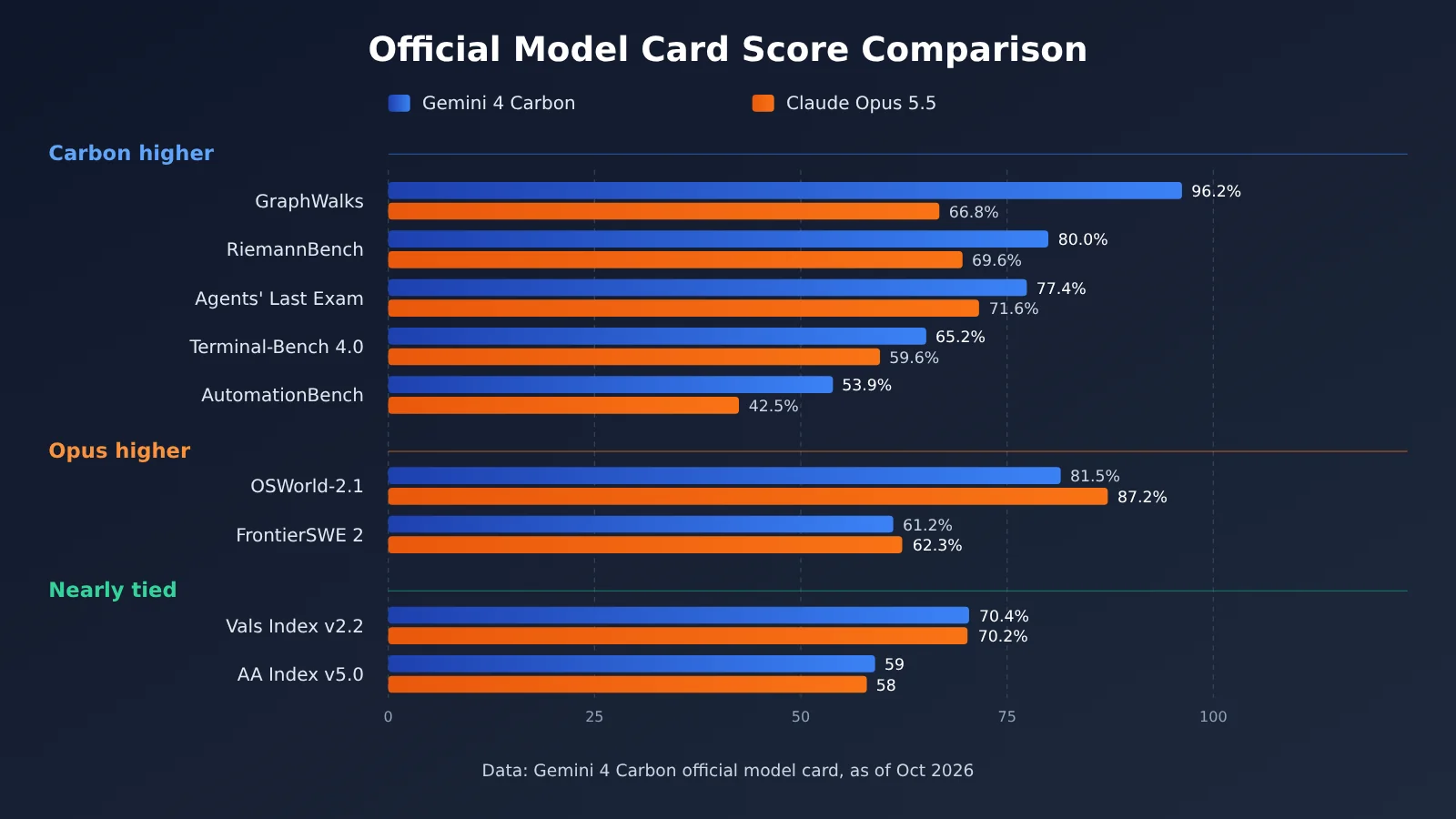
All the numbers below come from Google’s official Gemini 4 Carbon model card, with results as of October 2026. They’re self-reported by Google. The Opus 5.5 figures are also quoted from this model card, not from Anthropic’s own independent testing.
| Benchmark (official model card) | Gemini 4 Carbon | Claude Opus 5.5 | Takeaway |
|---|---|---|---|
| OSWorld-2.1 offline subset (computer use) | 81.5% | 87.2% | Opus higher, and the highest score in the table |
| FrontierSWE 2 | 61.2% | 62.3% | Opus slightly higher; both trail GPT-6 Astra’s 65.5% |
| Vals Index v2.2 | 70.4% | 70.2% | Roughly tied |
| AA Index v5.0 | 59 | 58 | Roughly tied |
| SWE-sweep | 9.6% | 3.6% | Carbon higher |
| Terminal-Bench 4.0 (AA) | 65.2% | 59.6% | Carbon higher |
| Agents’ Last Exam v1.1 | 77.4% | 71.6% | Carbon higher |
| AutomationBench (Zapier) | 53.9% | 42.5% | Carbon higher |
| GraphWalks 256k–1M BFS (F1) | 96.2% | 66.8% | Carbon clearly higher (long context) |
| RiemannBench | 80.0% | 69.6% | Carbon higher (scientific reasoning) |
| Terminal-Bench-Science 0.1 (AA) | 64.8% | 59.0% | Carbon higher |
| Chartography | 72.5% | 66.3% | Carbon higher |
This table tells us three things. First, long context and scientific reasoning are where Carbon pulls furthest ahead, with a gap of nearly 30 percentage points on GraphWalks. If your tasks involve multi-hop retrieval across hundreds of thousands of tokens of material, this is the benchmark most worth paying attention to.
Second, computer use is Opus 5.5’s home turf. On the OSWorld-2.1 offline subset, Opus beats Carbon by about 6 percentage points. If you’re building desktop agents, browser automation, or GUI automation, Carbon isn’t the top performer here.
Third, on software engineering tasks drawn from public repositories, neither model comes out on top. On FrontierSWE 2, GPT-6 Astra scores highest, Opus is second, and Carbon is third, though the gaps are small. On SWE-sweep, Carbon’s 9.6% beats Opus’s 3.6%, but the absolute numbers are very low, and Carbon is essentially tied with Astra’s 9.5%, so I wouldn’t read this as an order-of-magnitude advantage.
The model card also lists three cybersecurity results: CWE-bench, ExploitGym, and SEC-bench Pro. However, these reflect performance under the Fairwind Program, and the October 28 release announcement notes they were evaluated without guardrails. The paid API doesn’t give you the same capabilities by default, so don’t use these three scores as a basis for choosing a model for everyday coding.
Scenario Recommendations: Gemini 4 Carbon vs. Claude Opus 5.5
When to Choose Gemini 4 Carbon
- Retrieval and synthesis over very long materials: Multi-hop Q&A across regulatory libraries, entire codebases, or long research collections. You can make full use of the shared 1M window and Carbon’s edge on GraphWalks.
- Scientific reasoning and formal math: Carbon leads on both RiemannBench and Terminal-Bench-Science. Set
thinking_levelto high so the model has room to verify its work. - Long-horizon, multi-step engineering and architecture audits: Google recommends using Carbon in Antigravity’s /swarm for the roles that need the deepest reasoning, such as architecture, coordination, and auditing, and handing the parallel implementation slices to
gemini-4-argonorgemini-3.8-flash. - Multimodal documents: Input supports text, images, audio, and video, and Carbon scores higher on Chartography, which makes it a good fit for parsing chart-heavy reports.
When to Choose Claude Opus 5.5
- Computer use and desktop agents: It posts the highest score in the table on OSWorld-2.1, so it should be your first pick for GUI automation.
- Existing Claude Code / messages-protocol workflows: No protocol changes needed. Just swap in the new model ID.
- Very long single-pass output: You can use the full 128K output limit directly, without having to switch to background mode the way you would with Carbon.
- Fresher knowledge: Its reliable knowledge cutoff is June 2026, three months later than Carbon’s March 2026.
When Neither Is the Best Fit
For everyday feature development and interactive coding, Google officially recommends sticking with Gemini 4 Argon. It costs the same per token as Carbon, but it uses fewer tokens and responds faster. If you’re already on the Responses API and need a 1.05M context window and max-tier reasoning, GPT-6 Astra is worth considering. Just keep in mind that its list price is roughly 5x Carbon’s promotional price (10/50 vs. 2/10), and it adds tiered surcharges once input goes past 272K.
Gemini 4 Carbon vs. Claude Opus 5.5: How to Integrate Them
Protocol differences often affect your engineering workload more than benchmark score differences do. Opus 5.5 natively uses the Anthropic messages protocol. Carbon uses the native Gemini protocol or OpenAI-compatible chat completions, and doesn’t support Anthropic messages.
| Integration Aspect | Gemini 4 Carbon | Claude Opus 5.5 |
|---|---|---|
| Native protocol | Native Gemini (/v1beta) | Anthropic messages |
| APIYI endpoints | gemini, openai (/v1/chat/completions) | anthropic (messages), openai (chat) |
| Thinking parameters | thinking_level; thinking_budget is deprecated |
effort; thinking can’t be turned off |
| Sampling parameters | Custom temperature, top_p, and top_k are ignored with a warning | Set according to the Anthropic docs |
| Timeout recommendation | Hard problems can take several minutes. Set the client timeout to at least 15–20 minutes, or use background=True |
Use your usual settings for long-running tasks |
Switching Quickly via the OpenAI-Compatible Interface
If you want to test both models with a single codebase, the easiest route is the OpenAI-compatible interface. Here’s how:
- Create an API key in the console and pick the default or svip group (both groups cover both models).
- In the OpenAI SDK, set
base_urltohttps://api.apiyi.com/v1and put your key inapi_key. - When calling chat completions, set
modeltogemini-4-carbonorclaude-opus-5-5. The messages structure stays the same. - When testing Carbon, drop sampling parameters like temperature, and raise the client timeout to 15 minutes or more.
- Compare token usage and actual charges for both models in the console, rather than looking only at the unit price.
If your project already uses Claude Code or the Anthropic SDK, Opus 5.5 can simply keep using the messages endpoint. If you need a Claude Code-specific group, choose ClaudeCode or ClaudeOfficial.
🚀 Quick-start tip: Start with the OpenAI-compatible interface on APIYI (apiyi.com) and send the same batch of real tasks to both models, then compare output quality and console charges. Once you’ve settled on how to split the work, decide whether Opus should switch back to the native messages protocol.
Gemini 4 Carbon vs. Claude Opus 5.5: Which Should You Pick?
Here’s everything above boiled down to one decision table:
| Your main task | Recommendation | Key evidence |
|---|---|---|
| 1M-scale long-context retrieval, multi-hop synthesis | Gemini 4 Carbon | GraphWalks 96.2% vs. 66.8% (official model card) |
| Scientific reasoning, formal math | Gemini 4 Carbon | Leads on RiemannBench and Terminal-Bench-Science |
| Computer use, desktop/browser agents | Claude Opus 5.5 | OSWorld-2.1 87.2% vs. 81.5% |
| Existing messages / Claude Code workflows | Claude Opus 5.5 | Native protocol support, 128K output |
| Software engineering on public repos | Close call between the two; consider Astra | Astra scores highest on FrontierSWE 2, with Opus slightly ahead of Carbon |
| Everyday development, interactive coding | Gemini 4 Argon | Same price as Carbon, but more token-efficient and faster |
| General knowledge work | Either works; choose by cost | Vals Index 70.4% vs. 70.2%, nearly a tie |
💡 Our advice: Most teams don’t actually need to pick just one. Route by task type: send long-context and research requests to Carbon, and send GUI automation and messages-based workflows to Opus. Both models are available in the default and svip groups on APIYI (apiyi.com), so routing only requires changing the
modelfield.
One more thing to keep in mind: specialized defensive cybersecurity capabilities go through the Fairwind Program. Swapping the model name to gemini-4-carbon doesn’t mean you’ve gotten the Cyber Permissive version, and Cyber Permissive isn’t eligible for the $2 promotional price on official channels.
FAQ
Q1: Which is stronger, Gemini 4 Carbon or Claude Opus 5.5?
Neither one wins across the board. According to the official model cards (as of October 2026), Carbon scores higher on long context, scientific reasoning, and terminal tasks. Opus 5.5 scores higher on OSWorld computer use and FrontierSWE 2. On the Vals Index and AA Index, the two are nearly tied.
Q2: Carbon costs half as much as Opus per token. Does that always mean it’s cheaper?
Not necessarily. Carbon uses more thinking tokens, and thinking tokens are billed at the output price. The $2 promotional price on the official channel only runs through 2026-11-30, and from December 1 it costs the same as Opus. Your final bill depends on what the same task actually costs you in practice.
Q3: When will both models be available through the API?
Opus 5.5 was released on 2026-09-22. Carbon was first announced on 2026-10-28 and was only available to Fairwind defenders at that point. Starting 2026-11-10, the Gemini API is generally available (GA) to paid developers and enterprises. The official sources haven’t given a date for when free and lower-tier consumer plans will get access.
Q4: Can I call Carbon with the Anthropic messages protocol?
No. Carbon works through the native Gemini protocol or the OpenAI-compatible chat completions endpoint. If your code is built on the Anthropic SDK, you’ll need to switch to the OpenAI SDK or the Gemini SDK to use Carbon. Opus 5.5, on the other hand, supports both the messages and chat endpoints.
Q5: What’s the fastest way to compare the two models on my own workload?
Sign up at APIYI (apiyi.com) and create an API key in the default group. Point the OpenAI SDK at the `/v1` endpoint, then set `model` to `gemini-4-carbon` and `claude-opus-5-5` in turn and run the same batch of tasks. New users get free test credits, which is enough for a small side-by-side comparison.
Q6: Why is Carbon’s output getting truncated?
The default output limit for synchronous requests is 65,536 tokens, and thinking tokens count against that budget. If you need longer output, set `background=True` on the Interactions API and raise `max_output_tokens`, making sure to leave headroom for thinking.
Q7: What are the known limitations of each model?
Carbon’s model card lists hallucinations, jailbreak resistance that’s still being strengthened, occasional slowdowns or timeouts, and higher token consumption at high thinking levels. Its knowledge cutoff is also earlier (March 2026). With Opus 5.5, thinking can’t be turned off, which makes it a poor fit for low-latency scenarios. It also scores lower than Carbon on the model card’s long-context and science benchmarks.
Gemini 4 Carbon vs. Claude Opus 5.5: Key Takeaways
- Pick Carbon for long context and scientific reasoning: It leads clearly on official model card benchmarks like GraphWalks and RiemannBench.
- Pick Opus 5.5 for computer use: Its 87.2% on the OSWorld-2.1 offline subset is the highest in the table.
- Software engineering is close: On FrontierSWE 2, Opus is slightly ahead and Astra scores highest; on SWE-sweep, Carbon comes out higher.
- Unit price isn’t your bill: Carbon burns more thinking tokens, and the official promotional pricing only runs through November 30.
- The protocol determines your migration cost: Opus uses the messages API, while Carbon uses the native Gemini API or an OpenAI-compatible interface.
- Output and thinking work differently: Opus supports 128K output and its thinking can’t be turned off; Carbon defaults to 65,536 output tokens and offers three
thinking_levelsettings.
Summary
When you compare Gemini 4 Carbon and Claude Opus 5.5, the point isn’t who wins. It’s how you divide the work:
- Carbon handles the deepest thinking: long context, scientific reasoning, architecture, and auditing. The tradeoff is more thinking tokens.
- Opus 5.5 handles hands-on work and compatibility: computer use, messages-based workflows, and large 128K outputs.
- Look at actual consumption for your bill: Carbon’s unit price is lower during the promotion, but your final charge depends on total token usage.
We’d suggest running a small routing test by task type before you pick your primary model. With APIYI (apiyi.com), you can call both models with a single key on pay-as-you-go billing, which makes comparing and switching easy.
📚 References
- Google Blog – Gemini 4 Carbon Availability Announcement: Opened to paid developers on 2026-11-10
- Link:
blog.google/innovation-and-ai/models-and-research/gemini-models/gemini-4-carbon-now-available -
Notes: Scope of availability, plus the new officially self-reported evaluations added in November
-
Gemini 4 Carbon Official Model Card: Benchmark results as of October 2026
- Link:
deepmind.google/models/model-cards/gemini-4-carbon/ -
Notes: The source of every score in this article, including known limitations
-
Gemini 4 Carbon Developer Guide: thinking_level, the 1M shared window, and migration notes
- Link:
aistudio.google.com/learn/gemini-4-carbon-developer-guide -
Notes: Background mode, timeouts, and implicit caching configuration
-
Google Cloud Model Pricing: Carbon promotional pricing and the standard pricing starting December 1
- Link:
cloud.google.com/model-garden/pricing -
Notes: Global and non-global endpoint pricing
-
Claude Opus 5.5 Official Documentation: Specs, thinking mechanism, and pricing
- Link:
platform.claude.com/docs/en/models/opus-5-5/overview -
Notes: 128K output, knowledge cutoff, and cache write pricing
-
APIYI Model Master List: Platform models and default list prices
- Link:
docs.apiyi.com/models -
Notes: If it hasn’t been refreshed yet, defer to the console
-
APIYI Pricing API: Real-time multipliers and group information
- Link:
api.apiyi.com/api/pricing - Notes: The data source for the 2026-11-11 list prices in this article
Author: APIYI Technical Team
Technical discussion: Feel free to reach out to us on the APIYI homepage. For more resources, visit the docs.apiyi.com documentation center.