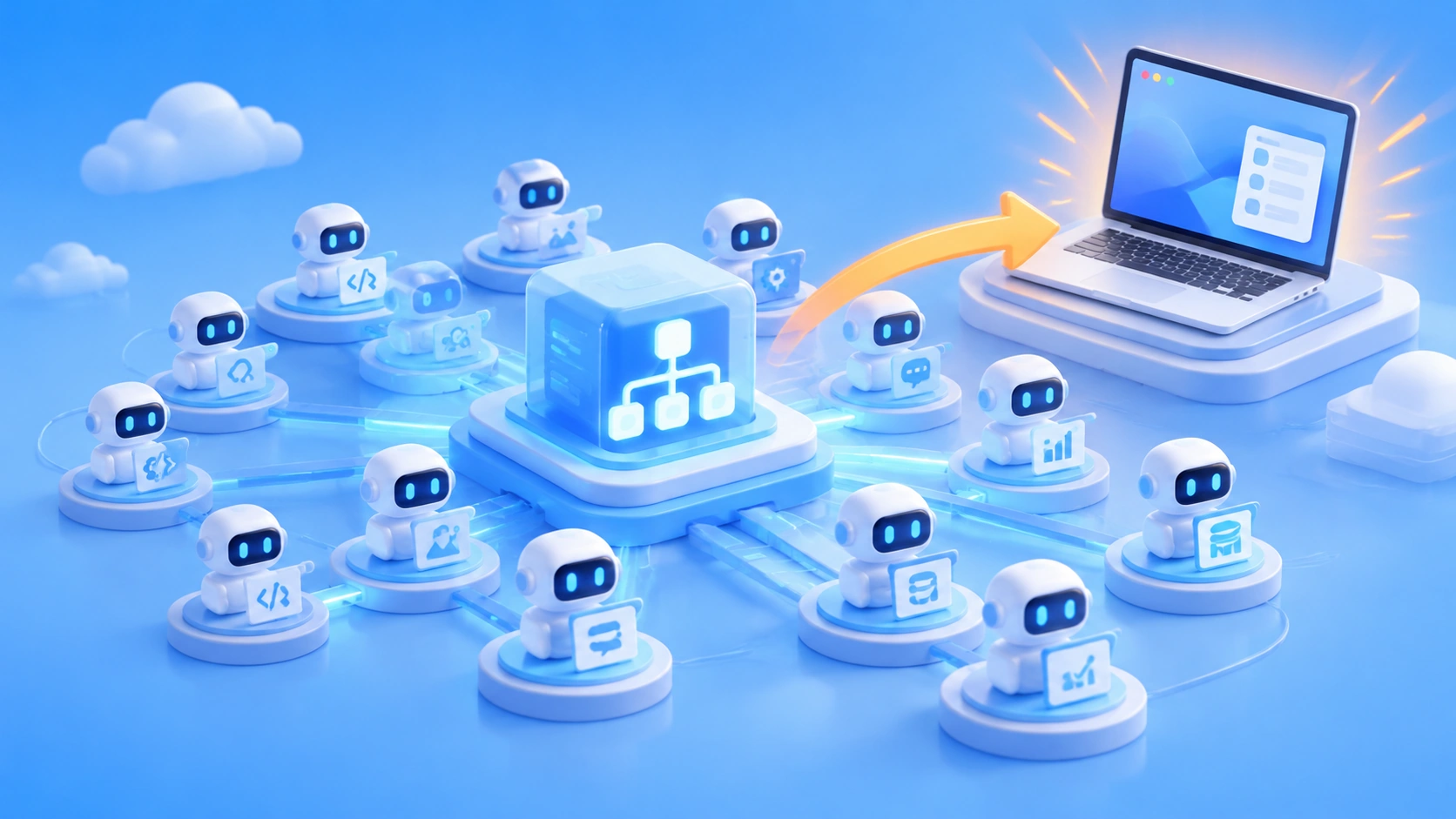
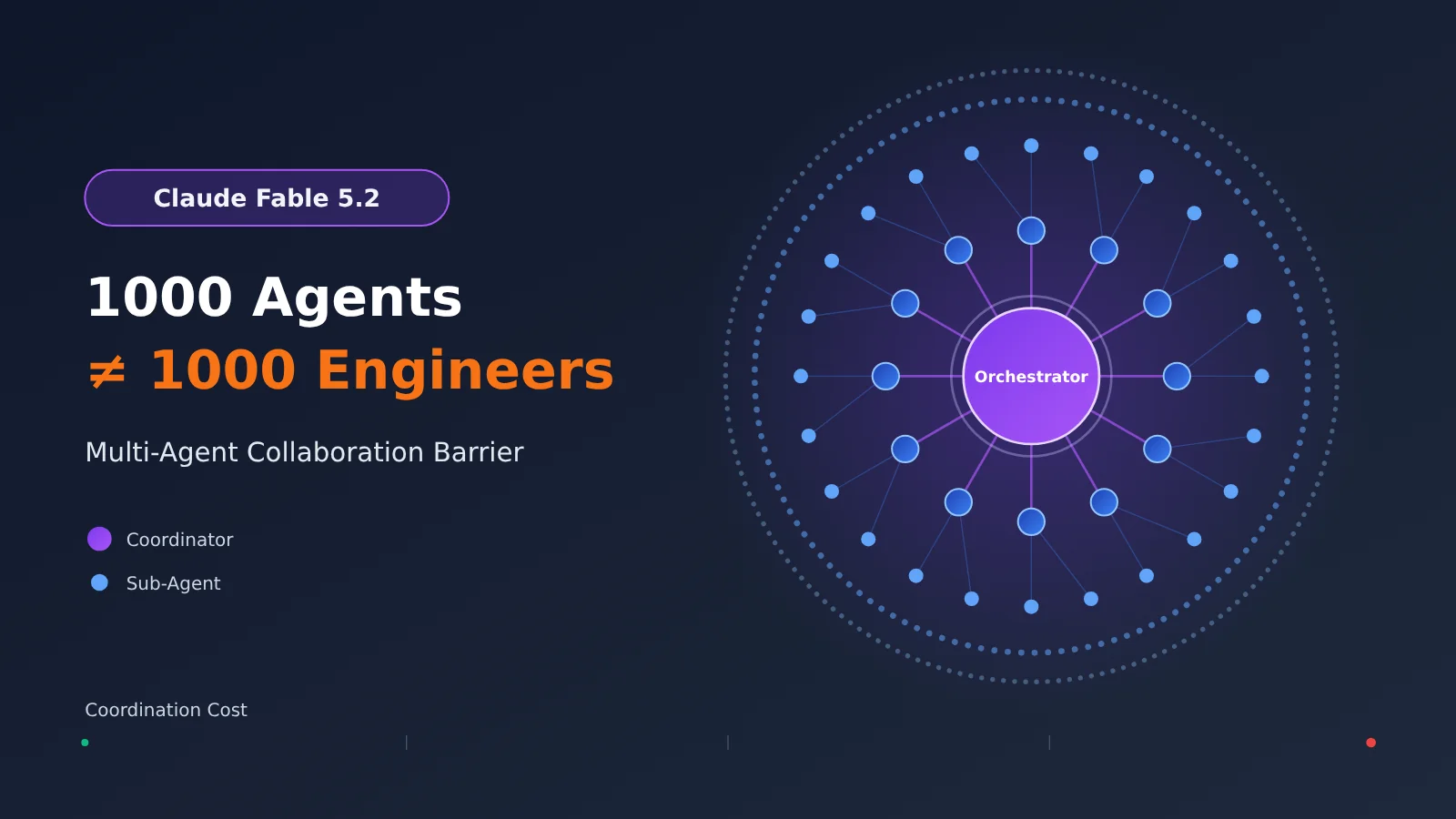
On November 9, 2026, Anthropic released Claude Fable 5.2 and shared details of an internal experiment. Starting from an empty folder, Fable 5.2 coordinated more than 1,000 subagents, working continuously for eight days to build an operating system prototype that can boot on a laptop.
Why it matters: This article goes beyond the announcement. Drawing on Anthropic’s public materials about multi-agent engineering, it explains the roles of the Orchestrator, Subagent, Advisor, and Workflow, how to break down tasks, why costs can rise, and how to design for reliability. It ends with a practical checklist developers can put to use right away.
Claude Fable 5.2 Operating System Experiment: Key Facts at a Glance
First, let’s separate what’s been confirmed from what hasn’t been disclosed. That’s essential to understanding the challenges of multi-agent collaboration.
| Item | Details |
|---|---|
| Release date | November 9, 2026, disclosed alongside Claude Fable 5.2 |
| Released by | Anthropic |
| Starting point | An empty folder; the task was to design and build an operating system prototype |
| Scale | More than 1,000 subagents working around the clock for eight days to write, test, review, and revise code |
| Final result | A prototype system with a kernel, disk/keyboard/network drivers, persistent file storage, a window system, a login screen, an installer, and built-in Claude features. It can boot on a real laptop. |
| Not disclosed | Agent roles and structure, harness, communication protocol, amount of code, programming language, total token usage, experiment cost, third-party security audit |
Anthropic described it as a “working prototype operating system”—in other words, a functioning OS prototype, not a mature commercial operating system. Also note that Anthropic shared details of other experiments around the same time. For example, an experiment related to Fermat’s Last Theorem reportedly used “1 Lead + 999 Helpers.” That was a separate experiment and shouldn’t be assumed to reflect the structure of the operating system project.
What makes this experiment worth paying attention to isn’t how much code was written. It’s that the model could organize a long-running software engineering project over eight days: break down tasks, move work forward in parallel, consolidate results, find errors, and coordinate fixes. That brings us to the central point of this article: behind 1,000 agents, the real challenge is organization.
How Multi-Agent Collaboration Works: Role Division Behind Claude Fable 5.2
Before discussing whether to use multiple Agents, let’s clarify a few concepts that are easy to confuse. The table below summarizes them based on the Anthropic Managed Agents documentation.
| Concept | Role | Typical example |
|---|---|---|
| Agent | An intelligent agent that can perform tasks and call tools | A coding assistant that can read code and run tests |
| Orchestrator | Coordinates task assignment and combines results | Breaking “build a blog system” into multiple modules and bringing the results together |
| Subagent | An agent that accepts delegated work and completes subtasks, with its own context | Implementing the comments module and writing its tests |
| Advisor | Doesn’t do the work directly; provides specialized advice at key points | Asking a more capable model for a solution when the main Agent gets stuck |
| Workflow | An execution process that organizes task order, concurrency, and handoffs | A multi-stage process: “research → implement → review → redo if rejected” |
| Harness | The outer system that calls models and tools and manages execution | Your own orchestration code or a hosted Agent platform |
Three Multi-Agent Collaboration Patterns
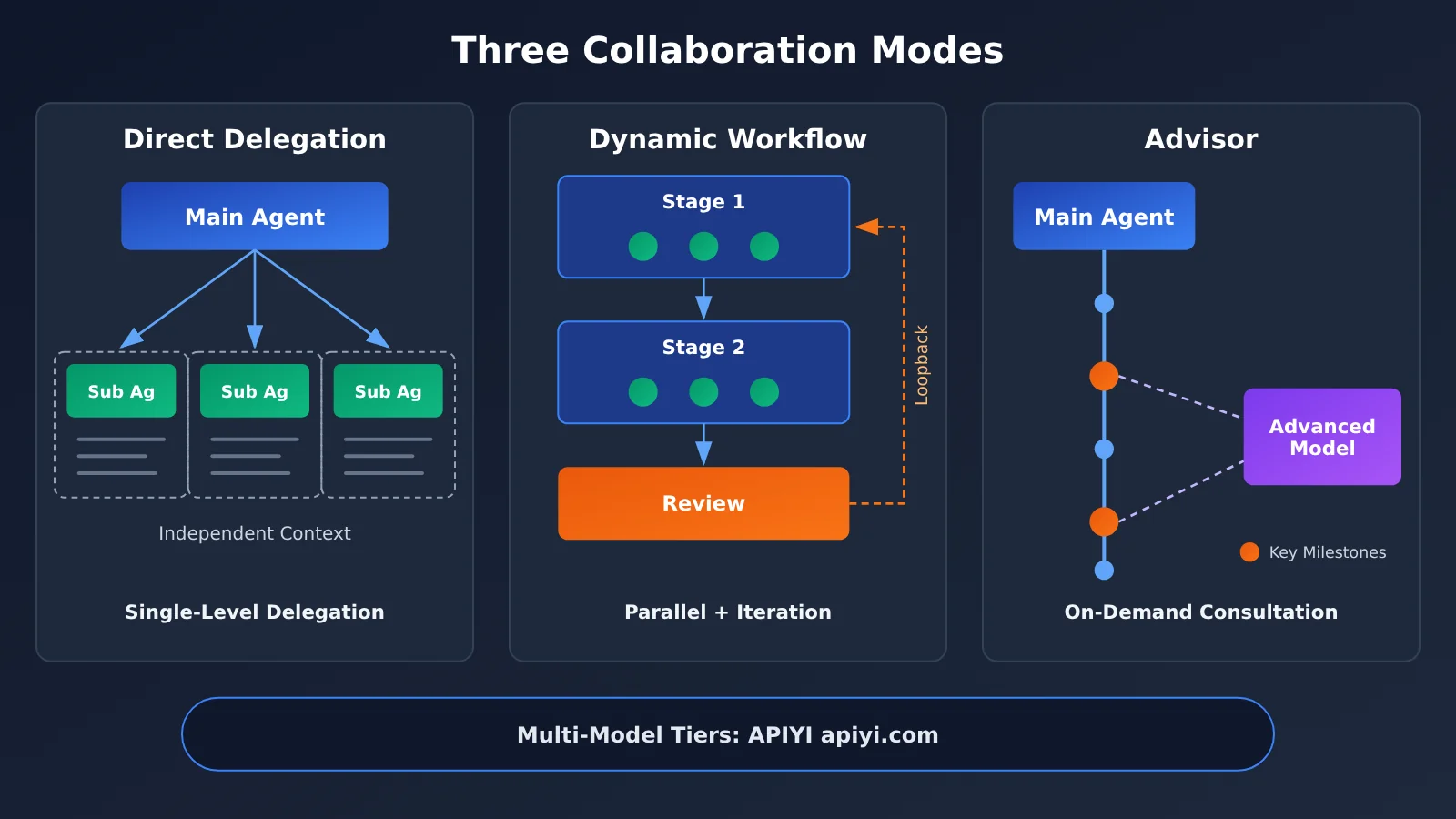
Anthropic’s Managed Agents documentation divides multi-agent collaboration into three patterns, each suited to different scenarios.
- Direct delegation to Subagents: The main Agent decides which Subagents to create, what tasks to assign, when to retrieve their results, and whether to ask follow-up questions. Each Subagent has its own Session Thread, but delegation is limited to one level, with a maximum of 25 direct child threads per Session. This works well for a small number of specialized tasks that need ongoing follow-up.
- Dynamic Workflows: Instead of managing Subagents one by one, the main Agent generates a workflow program. The program can divide work into stages, run multiple Agents in parallel, pass results between them, choose the next stage based on those results, and repeat work after a failed review until it reaches the iteration limit. This works well for tasks like reviewing large numbers of files or migrating code across multiple modules.
- Advisor mode: The main Agent still does the work itself, consulting a more capable model only at difficult or critical points. The advantage is that there’s no need to split up the task, so coordination overhead is minimal.
A concrete example can help illustrate the differences. Suppose you need to migrate an e-commerce backend from Python to Go. If you’re migrating only the payments and inventory modules, direct delegation is enough. If you need to migrate 200 independent APIs and review each one, a dynamic workflow is a better fit. If a single engineer-level Agent is doing the work and only occasionally needs a more advanced model to review a database transaction design, Advisor mode is the most efficient option.
When to Add Agents: The Right Way to Break Down Multi-Agent Tasks
In its January 23, 2026 article, “Building multi-agent systems: When and how to use them,” Anthropic points to a real phenomenon: teams spend months building complex multi-agent systems, only to find that improving a single agent’s prompt delivers similar results. So the first question should always be “Should we split this up?”—not “How many agents should we use?”
Three situations where multi-agent systems really add value
According to the article, multi-agent systems consistently create value in three main situations:
- Context isolation: For example, a customer support agent might read through extensive order history before diagnosing a technical issue. The order data can crowd the context window and interfere with its judgment. If a separate agent handles order lookups and returns only a concise summary, the main agent can stay focused.
- Parallel processing: Researching different regional markets, reviewing separate files, or checking different code modules at the same time. Anthropic specifically notes that the main benefit of this architecture is often greater task coverage and completeness—not necessarily shorter overall execution time.
- Specialized roles: Different agents can be configured with different system prompts, tools, MCP servers, skills, and models, so a single agent doesn’t have to take on too many responsibilities at once.
Split by context boundaries, not by roles
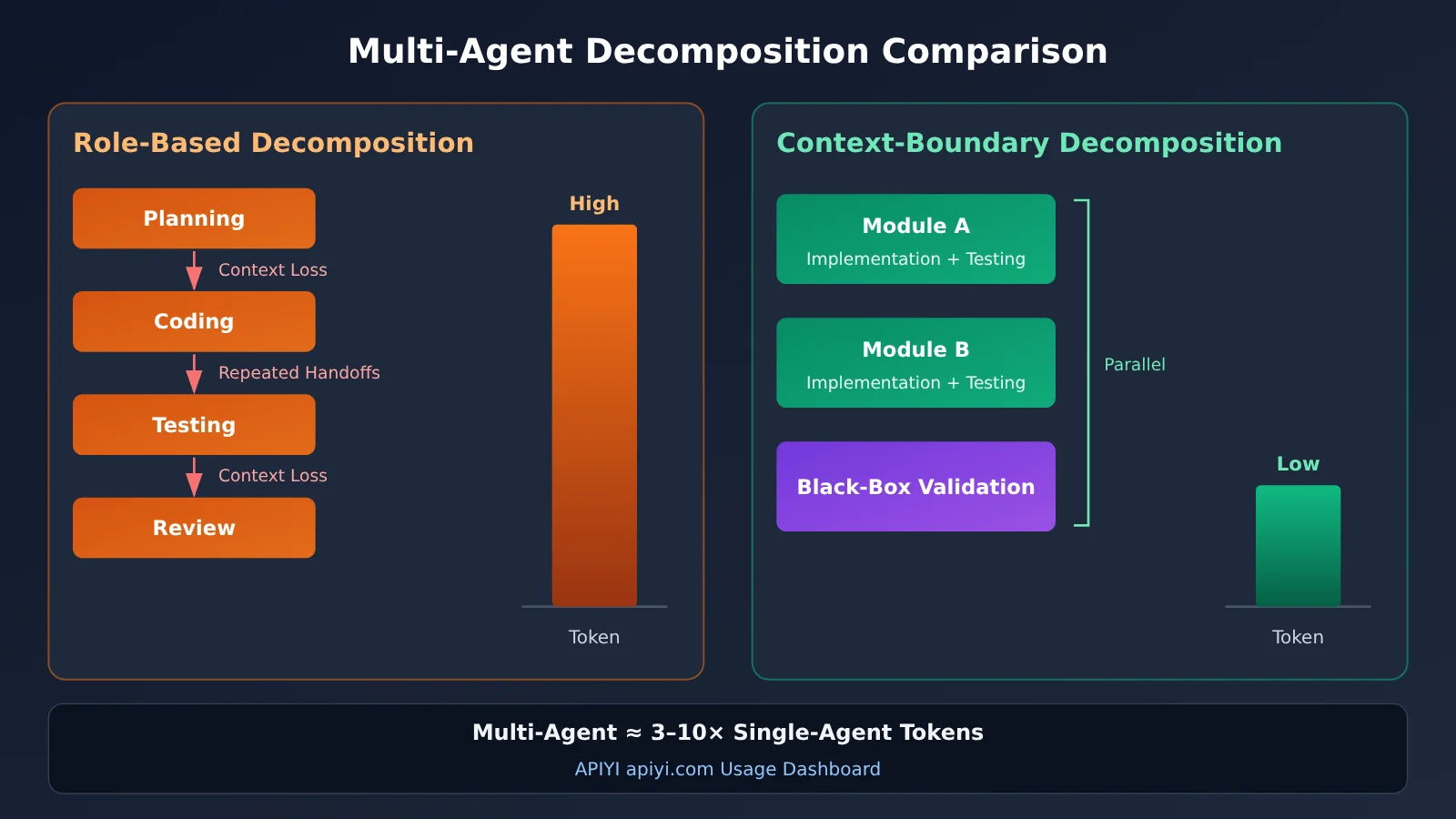
Anthropic’s design principle is context-centric decomposition: split work along context boundaries rather than mechanically dividing it by stages. Many teams’ first instinct is to set up a “planning agent + coding agent + testing agent + review agent.” That looks like a well-organized engineering team, but it has significant drawbacks.
The testing agent doesn’t know why the code was designed that way, and the review agent lacks context about the earlier exploration. Information gets passed back and forth between agents and can become distorted, much like in a game of telephone. A better approach is to have one agent handle a complete feature module, including implementation and its corresponding tests; another handle a module with an independent interface; and a third perform black-box verification, with only the work to be tested, clear acceptance criteria, and testing tools.
| Task type | Suitability for multi-agent systems | Reason |
|---|---|---|
| Independent market research across multiple regions | High | Subtasks share very little information |
| Parallel review of many documents | High | Each document can be handled independently, then the results can be consolidated |
| Independent development of different modules | High | Clear interfaces create natural context boundaries |
| Independent testing and verification | High | Black-box verification only requires the deliverable and criteria |
| Tightly coupled code changes | Low | A change in one place affects many others, making handoffs costly |
| Tasks that require sharing a lot of real-time state | Low | The cost of synchronizing state may outweigh the benefits of parallelism |
| Simple factual lookup | Usually unnecessary | A single agent can handle it in one call |
Consider operating system experiments: the kernel, drivers, file system, and window system do have relatively clear module boundaries. That’s one reason they’re better suited to large-scale parallel work than a major refactor of a complex business system. Of course, Anthropic hasn’t disclosed how the work was divided in practice, so this is a reasonable inference—not a fact.
Why Multi-Agent Systems Cost More: The Token Ledger in the Claude Fable 5.2 Era
It’s tempting to assume that splitting a task among more Agents and running them in parallel will spread out the cost. In practice, the opposite is often true. An article published by Anthropic in January 2026 states clearly that for the same task, a multi-agent architecture typically uses 3–10 times as many Tokens as a single Agent.
Those extra Tokens mainly come from five sources: each Agent has to build its own context; Agents have to exchange task descriptions and results; the lead Agent has to read and summarize multiple subagents’ outputs; breaking down the task requires additional invocations; and multiple Agents may end up doing the same work.
Two Sets of Cost Data, with Different Baselines
When people discuss multi-agent costs, they often mix data from different sources. This table keeps them separate:
| Data source | Metric | Comparison baseline |
|---|---|---|
| “Building multi-agent systems,” January 2026 | Multi-agent Token usage is 3–10 times that of a single Agent | A single Agent performing the same task |
| Anthropic Research system, June 2025 | Token usage is about 15 times that of ordinary chat | Ordinary chat |
| Anthropic Research system, June 2025 | Internal Research Eval scores 90.2% higher than single-Agent Opus 4 | Single-Agent Opus 4, on a specific internal evaluation |
| Anthropic Research system, June 2025 | Research time for complex queries is reduced by up to about 90%; early implementations typically run 3–5 Subagents in parallel | Single-threaded research in the same system |
It’s important to note that both the 90.2% and 15× figures come from the 2025 Research system. The former reflects relative performance on a specific internal evaluation; it doesn’t mean accuracy improves by 90.2% on every task. These figures have nothing to do with the 2026 operating-system experiments, and they can’t be directly compared with the 3–10× figure.
Total Compute, Execution Time, and Coverage Are Three Different Things
To understand multi-agent costs, you need to distinguish among three metrics. Total compute usually increases because context gets copied and results are read repeatedly. Execution time may decrease, provided the subtasks are truly independent. Task coverage often improves because multiple Agents can explore more directions at once.
Based on official API pricing, Fable 5.2’s standard mode costs $8 per million input Tokens and $40 per million output Tokens. The Batch API offers a 50% discount, and cached reads cost $0.20/MTok. If a single-Agent task already consumes a substantial number of Tokens, scaling that by 3–10× can make a significant difference. Anthropic hasn’t published the actual bill for the operating-system experiment, so any claim about “how much it cost for eight days” has no basis.
How to Design Reliable Multi-Agent Systems: Engineering Lessons from Claude Fable 5.2
Model tiers: Not every Agent needs the strongest model
Managed Agents supports two ways to define Agents. Predefined Agents are configured in advance and can have their own model, System Prompt, tools, MCP Server, and Skills. Inline Agents are defined dynamically during execution and, by default, inherit the main Agent’s model and tool configuration.
This makes it possible to balance cost and capability: use a powerful model like Fable 5.2 for the coordinator and complex reviews, a Sonnet-level model for routine research, and a Haiku-level model for simple classification. This is just one example of a design approach—not a fixed architecture prescribed by Anthropic. Test and adjust it for your actual tasks.
Validation: A review Agent isn’t the same as real verification
Anthropic’s Fable 5.2 Prompting documentation notes a new behavior: at higher Effort settings like xhigh and max, Fable 5.2 proactively calls a Subagent to check its work. Fable 5.1 didn’t do this on the same test tasks. This is an improvement in orchestration, but it shouldn’t be treated as quality assurance.
A review Agent is still making a judgment based on a model. Reliable verification requires three things: clearly defined acceptance criteria, executable black-box tests, and real checks of code and external system changes—for example, actually running tests and starting services. The most convincing aspect of the operating system experiment was the hard requirement that it “boot on a real laptop,” not an Agent saying it “looks fine.”
Avoiding over-delegation and rule buildup
Whether an Agent delegates a task depends not only on the model’s capabilities, but also on the Harness and tool descriptions. Anthropic found that when the Subagent tool description spelled out “the extra cost of each Subagent, which tasks are worth delegating and which aren’t, and how to describe a task,” the model delegated short tasks about a third less often than with a version that only emphasized the reasons to delegate—while task success rates remained unchanged.
Another easily overlooked issue is rule buildup. Fable 5.2 tends to follow restrictive instructions accumulated in its context closely. If historical files, Reviewer feedback, and System Prompts keep adding prohibitions, the model may become reluctant to take actions that are actually allowed during routine work. So it’s important to regularly clean up an Agent’s memory, rules, and approval requirements.
Runtime limits: The real ceilings in the public product
“1,000 Agents” also has clear limits in the public product. The following limits are listed in the Managed Agents documentation. They apply to the public product and don’t mean the internal operating system experiment used the same scheduler:
| Metric | Limit |
|---|---|
| Direct Subagent child threads | Up to 25 |
| Concurrent workers in a Dynamic Workflow | 64 |
| Agents started during a single Workflow lifecycle | 1,000 |
| Default Workflow lifecycle | 24 hours |
| Workflows open concurrently per Session by default | 10 |
In addition, Agents within a Workflow can’t create nested Workflows. Once the budget is reached, running Workflows are paused. If an Agent fails, the system typically retries once; if it fails again, the Workflow decides how to handle it. In other words, 1,000 Agents means “started cumulatively over the lifecycle”—far fewer are actually running at any given moment.
Long-running tasks also present a usability issue: Fable 5.2 may produce very little user-facing text during extended tool calls, leading users to think the task is stuck. The official recommendation is to enable thinking.display: "updates" or have the Harness prompt the model to report progress after several consecutive tool calls. In official tests, adding progress prompts cut the longest stretch without feedback by about half.
Get Started with Multi-Agent Systems: Build a Minimal Orchestrator with Claude Fable 5.2
The example below doesn’t rely on any hosted platform. It uses an OpenAI-compatible API to demonstrate the most basic step: having a coordinator model split a task along context boundaries.
from openai import OpenAI

client = OpenAI(
    api_key="YOUR_API_KEY",
    base_url="https://api.apiyi.com/v1"  # APIYI OpenAI-compatible API
)

resp = client.chat.completions.create(
    model="claude-fable-5-2",  # Use the actual name listed in the platform's model catalog
    messages=[{"role": "user", "content": "把“为博客增加评论功能”按上下文边界拆成子任务,每个子任务包含实现和测试,输出 JSON"}]
)
print(resp.choices[0].message.content)
The full version adds model tiers, concurrent execution, a token budget, one retry on failure, and black-box acceptance checks. Its structure reflects the engineering approach discussed earlier:
View the Full Multi-Agent Orchestration Example
import json
from concurrent.futures import ThreadPoolExecutor
from openai import OpenAI

client = OpenAI(
    api_key="YOUR_API_KEY",
    base_url="https://api.apiyi.com/v1"  # Use one key to call models from multiple providers
)

ORCHESTRATOR_MODEL = "claude-fable-5-2"   # Powerful model for coordination and review
WORKER_MODEL = "your-fast-model"          # Faster, cheaper model for subtasks; replace as needed
TOKEN_BUDGET = 200_000                     # Token budget for the entire task
used_tokens = 0


def call(model, system, user):
    global used_tokens
    if used_tokens >= TOKEN_BUDGET:
        raise RuntimeError("超出预算,暂停工作流")
    r = client.chat.completions.create(
        model=model,
        messages=[{"role": "system", "content": system},
                  {"role": "user", "content": user}],
    )
    used_tokens += r.usage.total_tokens
    return r.choices[0].message.content


def plan(goal):
    text = call(ORCHESTRATOR_MODEL,
                "你是协调者。按上下文边界拆分任务,简单任务不要拆。"
                "只输出 JSON 数组,每项含 name、spec、acceptance 字段。",
                goal)
    return json.loads(text)


def run_subagent(task):
    # Each sub-agent receives only the context it needs; retry once on failure
    for _ in range(2):
        try:
            return call(WORKER_MODEL,
                        "你负责一个完整模块,同时给出实现和测试。",
                        f"任务:{task['spec']}\n验收标准:{task['acceptance']}")
        except Exception:
            continue
    return "FAILED"


def review(task, output):
    # Black-box acceptance check: provide only the result and criteria, not the exploration process
    return call(ORCHESTRATOR_MODEL,
                "你是审核者,只依据验收标准判断,输出 PASS 或 FAIL 及理由。",
                f"验收标准:{task['acceptance']}\n成果:{output}")


if __name__ == "__main__":
    tasks = plan("为博客系统增加评论功能,含后端接口与前端组件")
    with ThreadPoolExecutor(max_workers=4) as pool:  # Control concurrency
        outputs = list(pool.map(run_subagent, tasks))
    for t, o in zip(tasks, outputs):
        print(t["name"], "->", review(t, o)[:80])
    print("累计 Token:", used_tokens)
This code is for demonstration purposes only; the review step still relies on model judgment. In production, review should be replaced or supplemented with real test execution, such as running unit tests or starting the service to probe its endpoints.
🚀 Getting started: The key to multi-agent systems is assigning different models to different roles and being able to compare their costs at any time. We recommend using APIYI at apiyi.com to connect to models such as Claude, OpenAI, and Gemini with a single API key. First, use the free trial credits for new users to establish a single-agent baseline, then gradually add the collaboration layer.
Analyzing the Impact of Multi-Agent Collaboration on Developers
Impact on Developers
- Start with a single agent: Establish a baseline with one agent and a strong prompt. Add a collaboration layer only when you hit one of three bottlenecks: context contamination, independently parallelizable subtasks, or the need for specialized configurations.
- Treat infrastructure as a first-class concern: Model APIs, tool APIs, budget limits, concurrency controls, and invocation logs determine whether a multi-agent system can run reliably. Without logs, you can’t identify which sub-agent is duplicating work.
- Dividing work across models is becoming standard: Using different models for coordinators, executors, and reviewers is one of the main ways to control a 3–10× increase in costs.
Impact on the Industry
- The boundaries of AI capabilities are expanding: The focus is shifting from “completing a coding task” to “organizing a long-term software engineering project.” Feedback from early testing partners such as Vercel, Shopify, and Datadog points in the same direction. For example, a Datadog engineer described it as an “incident commander” that can delegate tasks to faster models. Keep in mind that these were partner comments shared at launch, not results from an independent blind study.
- Orchestration matters more than the number of agents: The real efficiency of a multi-agent system depends on how much of the work can be parallelized, coordination overhead, shared state, code conflicts, test coverage, and invocation costs.
Frequently Asked Questions
Q1: What did the Claude Fable 5.2 experiment with 1,000 agents actually achieve?
Anthropic disclosed that Fable 5.2 started from an empty folder and coordinated more than 1,000 subagents working continuously for 8 days to build an operating system prototype that boots on a real laptop. It includes a kernel, drivers, file storage, a window system, a login screen, and an installer. Anthropic described it as a “working prototype.” The source code, code volume, total Token usage, and cost haven’t been disclosed, and there’s been no third-party audit.
Q2: Are multiple agents always better than a single agent?
Not necessarily. Anthropic has explicitly said that multiple agents aren’t always better than a single agent. Some teams spent months building multi-agent systems, only to find that optimizing a single-agent prompt produced similar results. For the same task, multiple agents typically use 3–10 times as many Tokens as a single agent. The benefits are most consistent in three scenarios: context isolation, parallel processing, and specialized task assignments.
Q3: Can the 90.2% improvement and 15x Token usage figures be used to evaluate Fable 5.2?
No. These figures come from Anthropic’s Research system, released in June 2025. The 90.2% figure reflects performance on a specific internal Research Eval compared with single-agent Opus 4, while the 15x figure uses regular chat as its comparison baseline. Neither figure is related to Fable 5.2’s 2026 operating system experiment, and they shouldn’t be conflated with the 3–10x figure for the same task.
Q4: How can I quickly build my own multi-agent prototype using an API?
We recommend these steps:
1. Sign up at APIYI apiyi.com to get an API key and free testing credits.
2. Set `base_url` in the code in this article to `https://api.apiyi.com/v1`.
3. Run a single-agent baseline first, and record Token usage and success rate.
4. Then assign different models to the coordinator and subagents, and compare the changes in cost and quality.
Q5: How can I control the cost of a multi-agent system?
There are four key strategies: Split tasks along context boundaries to reduce information handoffs; use faster, cheaper models for subtasks and reserve stronger models for planning and critical reviews; clearly document delegation costs and tasks that aren’t worth delegating in tool instructions to avoid over-delegation; and set a global Token budget and concurrency limit. For offline batch tasks, consider the Batch API discount. For everyday calls, APIYI apiyi.com’s pay-as-you-go pricing and usage statistics can also help you track costs in detail.
Q6: What are the known limitations of multi-agent systems today?
First, cost: Token usage for the same task typically increases by 3–10 times. Second, scheduling limits: In the public Managed Agents offering, there can be at most 25 direct child threads, 64 concurrent Workflow threads, and 1,000 total launches over the system’s lifetime. Third, verification: A review agent isn’t a substitute for real testing. Finally, rule buildup and long periods without feedback can create a poor user experience, so rules need regular cleanup and progress updates should be enabled.
Claude Fable 5.2 Multi-Agent Collaboration: Key Takeaways
- More agents don’t automatically mean more efficiency: The value of 1,000 agents lies in how well they’re organized, not in the number itself.
- Make roles clear: The Orchestrator coordinates, Subagents execute, Advisors offer recommendations, and Workflows manage the process.
- Split work along context boundaries: Have one agent handle a complete module, including its tests, rather than passing work between role-based agents and risking information loss.
- Understand the costs: For the same task, using multiple agents typically consumes 3–10 times as many tokens as using a single agent.
- Make verification practical: In addition to review agents, you need acceptance criteria and real tests.
- Start with a single agent: Add collaboration layers only when you hit a real bottleneck. You can use APIYI (apiyi.com) for multi-model access and layered testing.
Summary
The Claude Fable 5.2 operating system experiment offers a few important lessons:
- Orchestration is the new bar: Fable 5.2’s progress lies in its growing ability to act as a coordinator, including proactively calling on subagents to review its work at high Effort levels.
- Multi-agent systems have clear boundaries: Context isolation, parallel processing, and specialized roles are worth splitting up. Tightly coupled tasks and simple queries aren’t.
- Cost, concurrency, and verification are hard constraints: Token overhead, scheduling limits, and real-world testing determine whether a system can keep running over time.
For most developers, the right approach is to establish a baseline with a single agent, then introduce Subagents, Workflows, or Advisors to address actual bottlenecks. At the same time, make sure your model APIs, budget, concurrency, and logging are solid. API infrastructure is the real foundation of multi-agent applications.
We recommend using APIYI (apiyi.com) to quickly test your multi-agent setup. The platform provides a unified OpenAI-compatible interface and free testing credits for new users, making it easier to compare how different models perform in different roles.
📚 References
- Anthropic Official Announcement: Claude Fable 5.2 and Mythos 5.2 (2026-11-09)
- Link:
anthropic.com/claude-fable-and-mythos-5-2 -
Notes: Primary source for operating system experiments, coding benchmarks, and pricing
-
Building multi-agent systems: When and how to use them: Use cases and costs for multi-agent systems (2026-01-23)
- Link:
claude.com/resources/articles/building-multi-agent-systems-when-and-how-to-use-them -
Notes: Data on 3–10× token usage and the principle of splitting work along context boundaries
-
How we built our multi-agent research system: Anthropic Research system (2025-06-13)
- Link:
anthropic.com/research/multi-agent-research-system -
Notes: Orchestrator-worker architecture, 90.2% on internal evaluations, and 15× token usage
-
Managed Agents multi-agent orchestration and Workflow documentation: Collaboration patterns and runtime limits
- Link:
platform.claude.com/docs/en/managed-agents/multiagent-orchestration -
Notes: Definitions of Subagents, Dynamic Workflows, and Advisor, plus concurrency limits
-
Prompting Claude Fable 5.2: Official prompt engineering guide
- Link:
platform.claude.com/docs/en/build-with-claude/prompt-engineering/prompting-claude-fable-5-2 -
Notes: Self-review behavior, over-delegation experiments, and recommendations for progress updates
-
Fable 5.2 model specifications: Context, output limits, and pricing
- Link:
platform.claude.com/docs/en/models/fable-5-2/overview - Notes: 1M context window, 128K maximum output, and API model ID
Author: APIYI Technical Team
Technical discussions: Visit the APIYI homepage at apiyi.com to contact us and discuss multi-agent architectures and multi-model integration practices.