
Author’s note: Using information available on November 4, 2026, this article compares Hy4 and DeepSeek V4.1 Flash on specs, benchmarks, pricing, and availability, then recommends a model for three types of tasks.
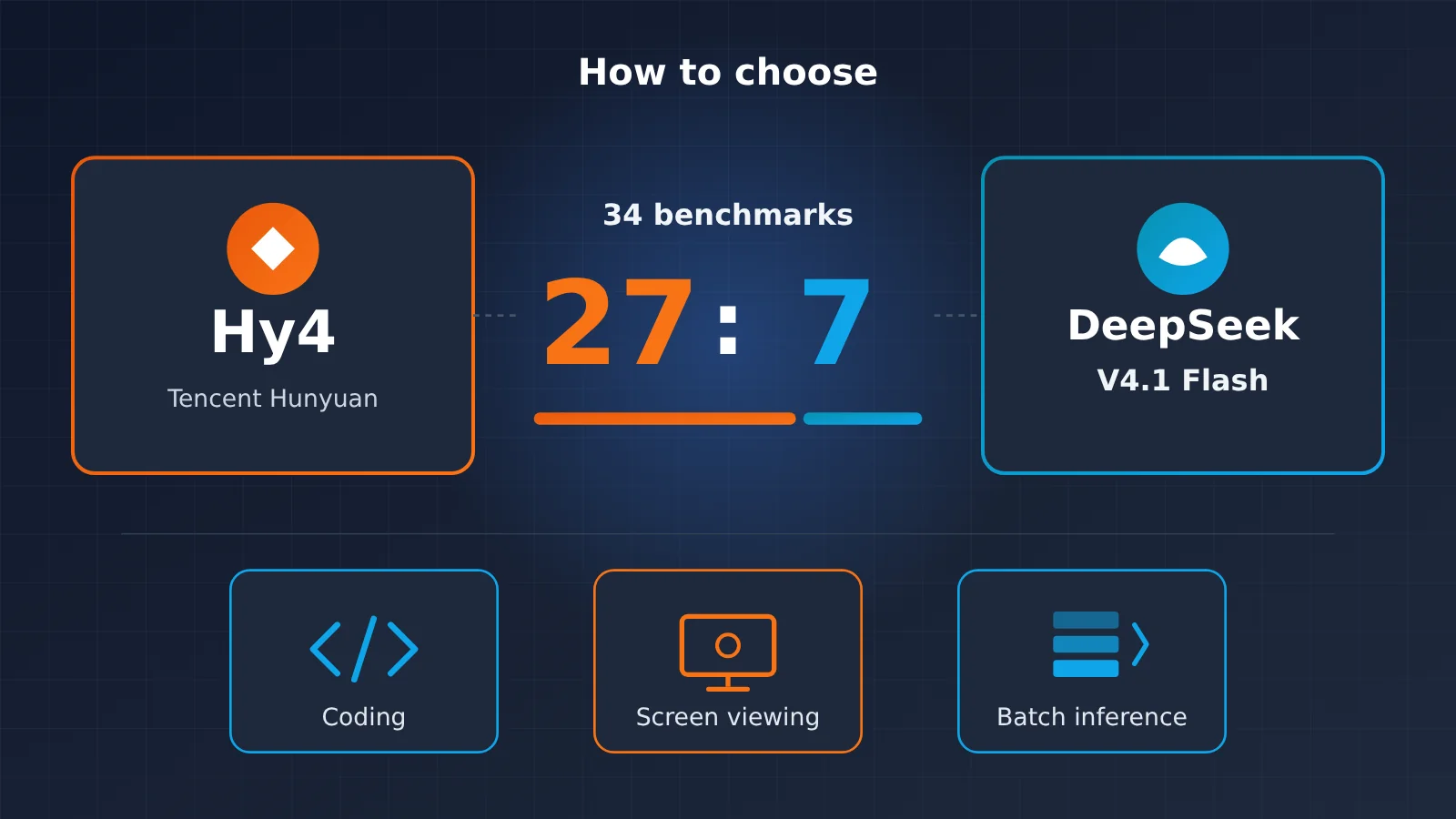
Here’s the bottom line. In the appendix to Tencent’s Hy4 release page, both models have results for 34 benchmarks. Hy4 wins 27, and DeepSeek V4.1 Flash wins 7. DeepSeek’s seven wins are concentrated in coding and automation: DeepSWE, SWE-Marathon, Hy-CompanyBench, AutoCath, AutomationBench, PPTOGen, and Foundation Model Bench.
The short version: choose DeepSeek V4.1 Flash for coding and batch tasks; choose Hy4 when you need to interpret screens, operate software, or work with Chinese-language office documents.
This isn’t a compromise that says “both have their strengths.” We’ll spell out Tencent’s benchmark methodology, the scope of third-party evaluations, and the price differences between the two models. By the end, you’ll have three checklists: what to choose by task, by cost, and by availability.
Hy4 vs. DeepSeek V4.1 Flash: Specifications
Both models use an MoE architecture and have a 1M context window. The main differences are in activated parameters, maximum output, and computer-use capabilities. The table below draws on Tencent News, the TokenHub preview documentation, and the DeepSeek model card.
| Specification | Hy4 (Tencent Hunyuan, 2026-11-04) | DeepSeek V4.1 Flash (2026-09-10) |
|---|---|---|
| Total / activated parameters | 770B / 49B | 552B / 8B for prefill, 16B for decoding |
| Context window | 1M | 1M |
| Maximum output | 64K (per the preview; the release documentation hasn’t been updated) | 384K |
| Vision | Yes (introduced for the first time) | Yes (native multimodal) |
| Computer use | Yes (CLI + GUI, trained for Blender and CAD) | No GUI operation |
| Weights | Planned for open-source release; preview already available under Apache 2.0 | Available on Hugging Face under the MIT license |
| Protocols | OpenAI Chat / Responses, Anthropic Messages | Same three |
| Price (per million tokens, input/output) | List price: 6 / 18 yuan | Peak: $0.30 / $1.20; off-peak: $0.15 / $0.60 |
| Available platforms | Tencent Cloud TokenHub, OpenRouter, and others | Official API, APIYI apiyi.com, OpenRouter |
One takeaway from this table: DeepSeek activates far fewer parameters per token than Hy4, a structural reason for its lower price and faster speed. Its KV cache uses 890 bytes per token, about a quarter of V4 Flash’s, saving GPU memory in long-context scenarios. Hy4 activates more parameters and adds computer-use capabilities, making it a better fit for agents that need to take hands-on action.
Hy4 vs. DeepSeek V4.1 Flash: How to Read the 34 Benchmark Results
First, the Methodology: These Are Tencent’s Own Reruns
All 34 benchmark results were rerun or compiled by Tencent. The scores in the DeepSeek column weren’t reported by DeepSeek itself, nor do they come from an independent third-party leaderboard. Take ProgramBench: DeepSeek’s model card reports 20.3, while Tencent’s rerun produced 29.1—a difference of 8.8 points. This shows how much the harness, tool configuration, and timeout settings can affect scores.
There are also inconsistencies within the same release. In the main chart, DeepSeek scores 40.0 on Terminal-Bench 4.0; in the appendix, it scores 42.3. For AutomationBench, the main chart shows 54.3, while the appendix shows 60.5. Figures published by the same company differ by 1 to 6 points, so a lead of 1 to 2 points can generally be treated as within the margin of error. This article uses the appendix figures throughout.
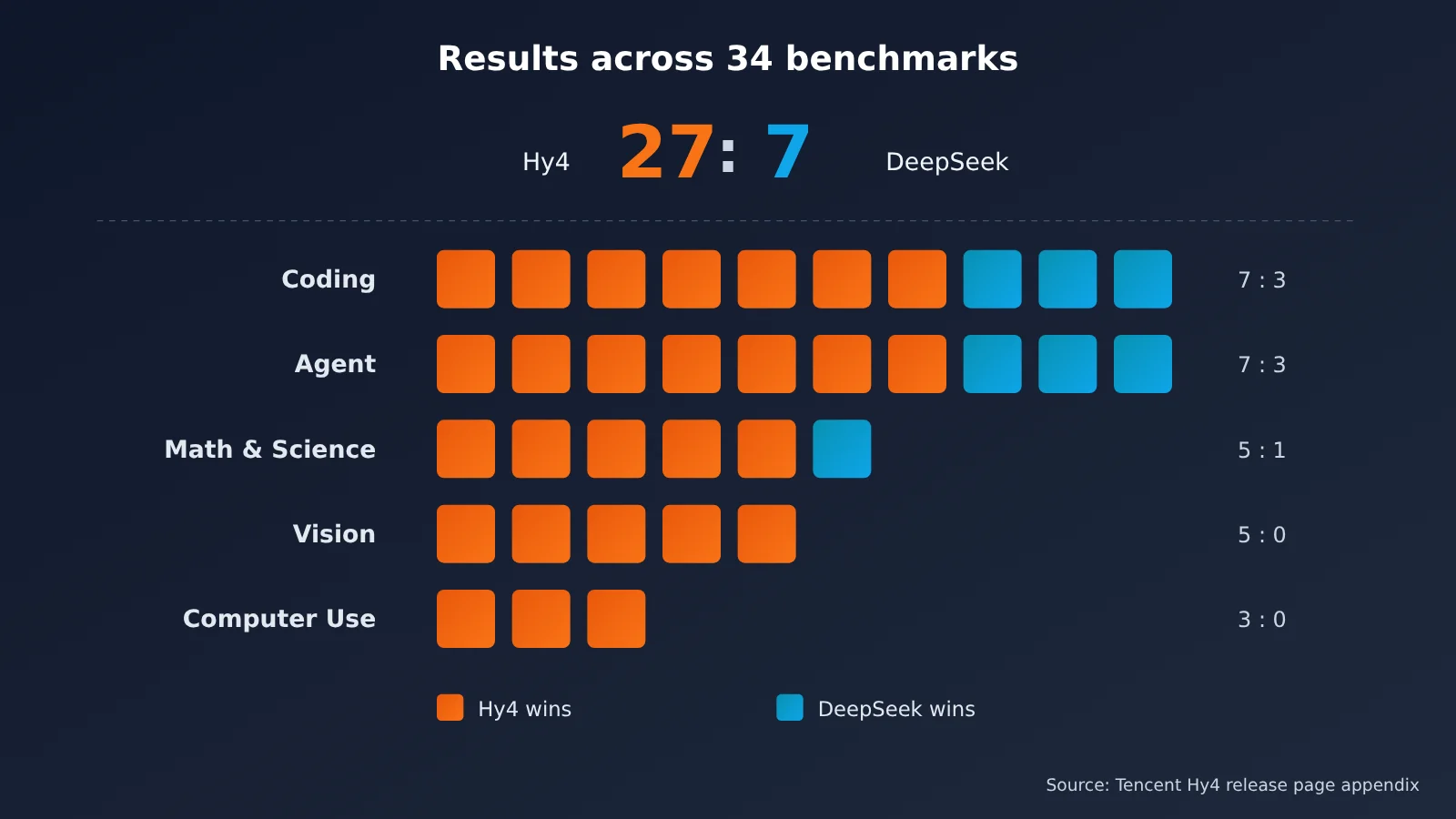
The 7 Benchmarks DeepSeek Wins and Where Hy4 Leads by the Largest Margins
| DeepSeek Wins | DeepSeek / Hy4 | Hy4’s Largest Leads | Hy4 / DeepSeek |
|---|---|---|---|
| DeepSWE (real-world repository fixes) | 77.0 / 74.9 | OSWorld 2.1 (computer use) | 78.9 / 68.4 |
| SWE-Marathon (long-horizon engineering) | 46.3 / 43.8 | Hy-Backend 3.0 | 45.1 / 37.3 |
| Hy-CompanyBench | 79.5 / 78.8 | E-Bench 2.0 | 70.0 / 66.8 |
| AutoCath (code understanding) | 58.1 / 57.2 | Terminal-Bench-Science | 19.8 / 13.7 |
| AutomationBench | 60.5 / 56.2 | BuddyVQA without tools | 55.6 / 43.7 |
| PPTOGen (PPT generation) | 62.5 / 60.9 | Agents’ First Exam-IF | 79.9 / 68.7 |
| Foundation Model Bench | 36.3 / 28.1 | Hy-LifeSearch | 60.2 / 53.0 |
Three things stand out:
- Hy4’s largest leads are in computer use (OSWorld +10.5), visual question answering (BuddyVQA +11.9), instruction following (+11.2), and scientific terminal tasks—precisely the areas where it has added capabilities.
- Of the benchmarks DeepSeek wins, half involve real-world repository fixes and long-horizon engineering, the tasks closest to everyday coding.
- Many of Hy4’s 27 wins are by around one point, such as ProgramBench +0.9 and Tag-bench +0.5. Given the differences in how results were reported discussed above, these shouldn’t be treated as clear advantages. Winning 27 benchmarks doesn’t mean Hy4 leads across the board. Tencent itself acknowledges that Hy4 “still has a significant gap” compared with top closed-source models (such as Claude Opus 5.5 and GPT-6.1 Sol) on challenging benchmarks for frontier mathematics, long-horizon development, and visual question answering.
Third-Party Evaluations Only Cover Hy4 Preview
So far, independent evaluations have only tested Hy4 preview (the 2026-08-28 version). The final release hasn’t been retested by a third party.
| Third-Party Source | DeepSeek V4.1 Flash | Hy4 preview | Conclusion |
|---|---|---|---|
| Vals AI (19 shared benchmarks) | Won 7 | Won 12 | Hy4 preview scored 75.00% vs. 54.00% in math |
| LMArena overall leaderboard (November 2) | 21st (Max) | 24th | DeepSeek slightly ahead |
| CWE-bench (250 questions) | 57.6% | 47.3% | DeepSeek leads, at $0.04 vs. $0.43 per run |
| LLMBenchmark coding index | 70.3 | 44.3 | DeepSeek leads by a wide margin |
The third-party data points in the same direction as Tencent’s appendix: DeepSeek is stronger at coding, while Hy4 has an edge in math, reasoning, and general-purpose tasks. But the final release of Hy4 hasn’t been independently retested, so the official scores should only be used as a reference. Before deploying it, it’s best to run it against your own task set.
Hy4 vs. DeepSeek V4.1 Flash: Pricing Breakdown
Unit Prices and Multipliers
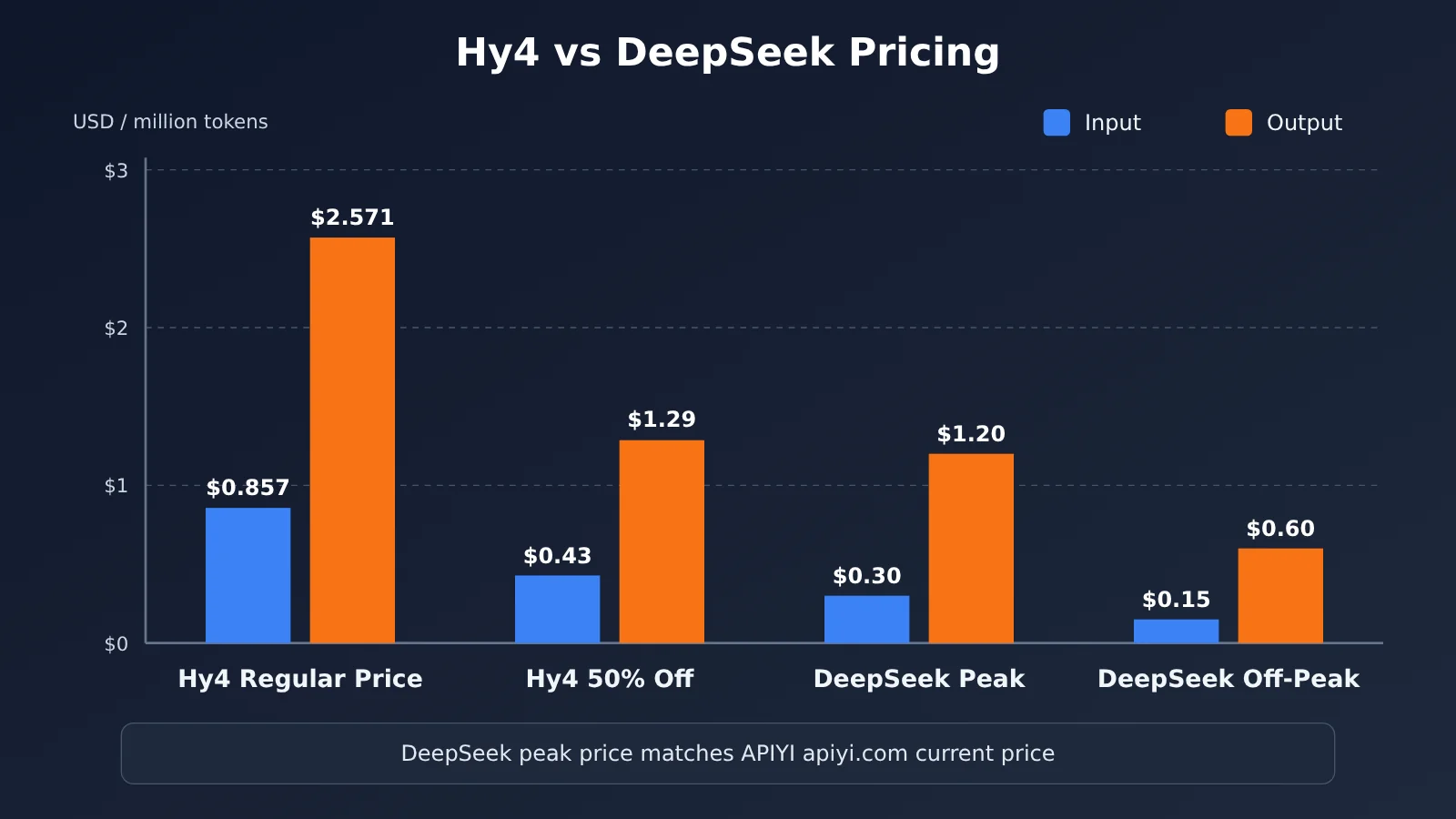
All prices below are per million tokens, based on prices listed on 2026-11-04 and an estimated exchange rate of $1 ≈ 7 yuan.
| Plan | Input | Output | Cache | Hy4 price multiple (input / output) |
|---|---|---|---|---|
| Hy4 list price (TokenHub: 6/18/0.3 yuan) | $0.857 | $2.571 | $0.043 | Baseline |
| Hy4 at 50% off (through December 31, 3/9/0.15 yuan) | $0.429 | $1.286 | $0.021 | Baseline |
| Hy4 OpenRouter list price / 50% off | $0.834 / $0.417 | $2.501 / $1.2505 | $0.042 / $0.021 | Close to TokenHub |
| DeepSeek peak (same as current APIYI apiyi.com pricing) | $0.30 | $1.20 | $0.006 | List price: 2.9× / 2.1×; 50% off: 1.4× / 1.07× |
| DeepSeek off-peak | $0.15 | $0.60 | $0.003 | List price: 5.7× / 4.3×; 50% off: 2.9× / 2.1× |
DeepSeek’s peak hours are 09:00–12:00 and 14:00–18:00 Beijing time on weekdays, excluding Chinese public holidays.
You can estimate monthly costs with this formula: Monthly cost = input volume × input unit price + output volume × output unit price + cache-hit volume × cache unit price. Measure each volume in millions of tokens.
Here’s a hypothetical scenario: 100 million input tokens and 20 million output tokens per month, excluding cache for now.
- Hy4 list price: 100 × 0.857 + 20 × 2.571 ≈ $137
- Hy4 at 50% off: approximately $69
- DeepSeek peak: approximately $54
- DeepSeek off-peak: approximately $27
The takeaway is clear. At list price, Hy4’s input price is 2.9 times DeepSeek’s peak price. During the 50%-off period, Hy4’s output price is only 7% higher than DeepSeek’s peak price, narrowing the gap considerably. After the discount ends on December 31, the gap will return to 2 to 3 times.
💰 Cost tip: Budget-conscious teams can start by calling
deepseek-v4.1-flashthrough APIYI apiyi.com ($0.3 for input, $1.2 for output, and $0.006 for cache reads), calculate their monthly cost using real traffic, and compare it with Hy4’s 50%-off pricing.
Hy4 vs. DeepSeek V4.1 Flash: Availability and Migration
Where to access them
- Hy4: Tencent Cloud TokenHub, OpenRouter (page path
tencent/hy4), WorkBuddy/CodeBuddy (free for a limited time from November 4 to 15), Yuanbao, WeCom, and ima. - DeepSeek V4.1 Flash: Official API, APIYI, and OpenRouter. You can also download the MIT-licensed weights from Hugging Face and deploy them yourself.
4 things to watch for when migrating
- Protocols: Both support OpenAI Chat Completions, Responses, and Anthropic Messages. Switching generally only requires changing
base_urlandmodel. - Output limit: DeepSeek can output up to 384K tokens, while Hy4’s preview limit is 64K. When moving from DeepSeek to Hy4, you’ll need to split up tasks like long reports and whole-repository code generation.
- Thinking mode: DeepSeek enables thinking by default, and
reasoning_effortcan be adjusted from 1 to 100. All official scores were measured at 100. Lowering this setting after migration can save tokens, but scores may also drop. - Speed: On OpenRouter, Hy4 has a P50 speed of about 63 tok/s and a time to first token of about 2.9 seconds. On Artificial Analysis, DeepSeek reaches 182 tok/s in reasoning mode and 256 tok/s in non-reasoning mode. Allow some headroom for latency-sensitive use cases.
🚀 Integration tip: On APIYI, you can call DeepSeek directly using the OpenAI-compatible interface. Set
base_urltohttps://api.apiyi.com/v1andmodeltodeepseek-v4.1-flash. Hy4 isn’t available on APIYI yet; check the platform’s model list for current availability and pricing. We’ll add this model as soon as possible.
Hy4 vs. DeepSeek V4.1 Flash: Which to Choose for 3 Types of Tasks
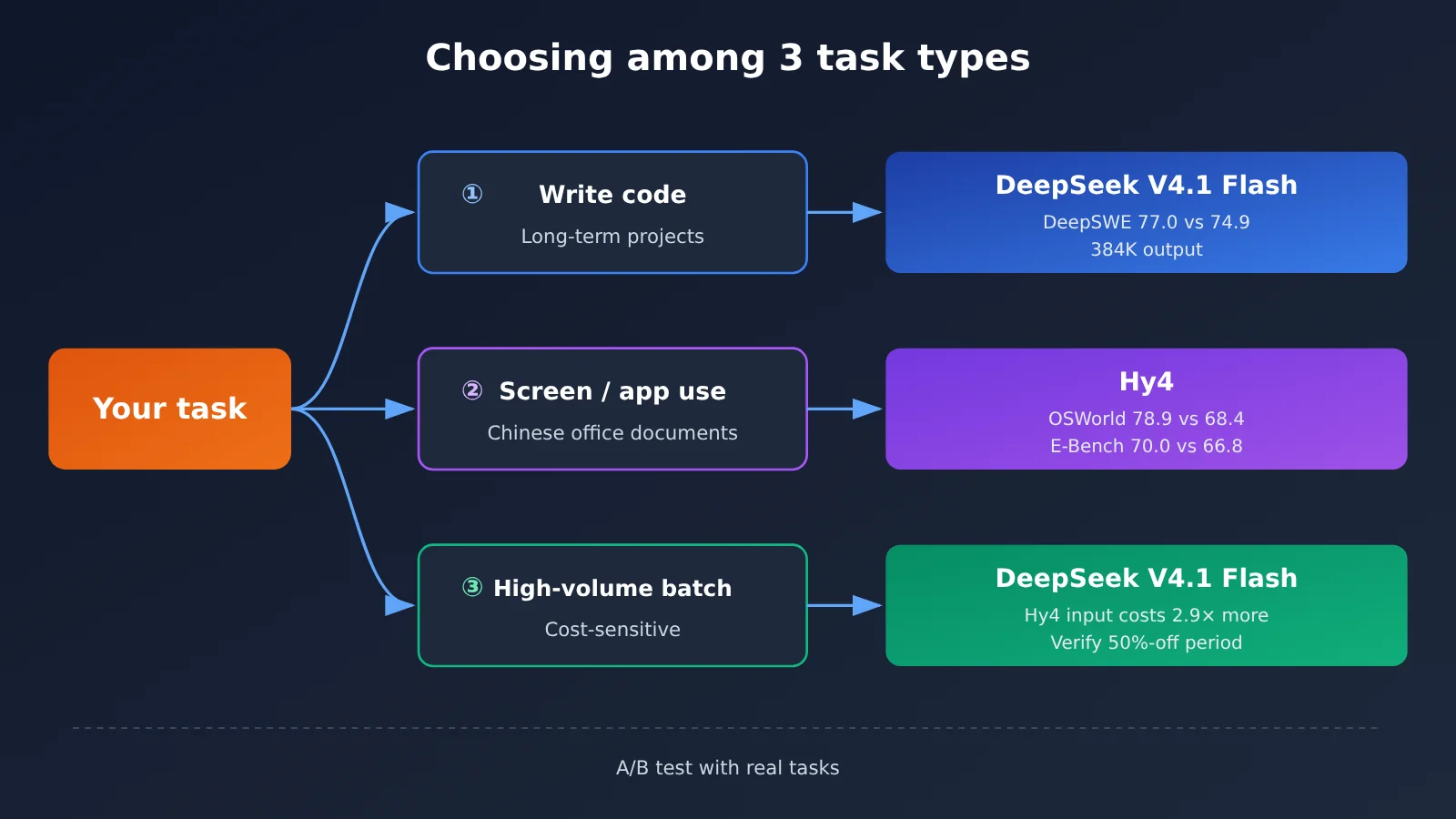
| Task type | Recommendation | The numbers |
|---|---|---|
| ① Coding and long-running engineering | DeepSeek V4.1 Flash | DeepSWE: 77.0 vs. 74.9 in Tencent’s appendix; third-party CWE-bench: 57.6% vs. 47.3%; 384K output |
| ② Screen understanding, software operation, office documents, and Chinese business workflows | Hy4 | OSWorld: 78.9 vs. 68.4; E-Bench: 70.0 vs. 66.8; supports GUI operation |
| ③ High-concurrency, batch, and cost-sensitive workloads | DeepSeek V4.1 Flash | At list price, Hy4 input costs 2.9 times as much; DeepSeek’s off-peak price is half its standard rate; during Hy4’s half-price period, its output costs just 7% more, so it’s worth checking again |
There’s one exception worth calling out: DeepSeek has a narrow lead in PowerPoint generation (PPTOGen: 62.5 vs. 60.9). If your office tasks mainly involve generating files rather than operating an interface, there’s little difference between the models, so you can choose based on cost.
💡 Recommendation: The safest approach is to run an A/B test on 20 to 50 of your own real tasks. For DeepSeek, you can use APIYI apiyi.com to quickly test at scale, then compare the results with Hy4. Your own data is more reliable than any leaderboard.
Frequently Asked Questions
Q1: Does Hy4’s 27-category lead mean it’s better than DeepSeek V4.1 Flash?
Not necessarily. Tencent reran all 34 benchmarks, and differences in testing methodology accounted for up to 8.8 points on a single benchmark. Many of Hy4’s 27 wins were by around one point. Third-party coding evaluations, meanwhile, put DeepSeek ahead.
Q2: Can I use Hy4 through APIYI now?
Not yet. As of the 2026-11-04 snapshot, Hy4 isn’t on APIYI’s list of available models. You can use DeepSeek V4.1 Flash directly through APIYI at apiyi.com, and new users get free test credits.
Q3: Is Hy4 still worth using after its 50% discount ends?
If your business depends on GUI operations or visual question answering, Hy4 offers capabilities that are hard to replace. For text-only or coding tasks, its unit price after the discount ends is two to three times DeepSeek’s peak price, making it less cost-effective.
Q4: Which should I choose for self-deployment?
Choose DeepSeek V4.1 Flash. Its weights are available under the MIT license, it activates fewer parameters per token, and its KV cache is smaller. The weights for Hy4’s official release haven’t been made available yet.
Hy4 vs. DeepSeek V4.1 Flash: Key Takeaways
- Benchmark methodology: Tencent independently reran all 34 benchmarks. Hy4 won 27, and DeepSeek won 7.
- DeepSeek’s strengths: Real-world repository fixes, long-running engineering tasks, automation, and support for up to 384K output.
- Hy4’s strengths: Computer use (OSWorld +10.5), visual question answering, and instruction following.
- Pricing: At list price, Hy4 input costs 2.9 times as much; during the 50%-off period, its output costs just 7% more.
- Third-party data: Only covers Hy4 preview, with DeepSeek clearly ahead in coding.
- Getting started: You can call DeepSeek directly through APIYI at apiyi.com using an OpenAI-compatible interface.
Summary
Choosing between Hy4 and DeepSeek V4.1 Flash comes down to this: Use DeepSeek to write code and handle batch tasks; use Hy4 to view screens and operate software.
- Benchmarks: Tencent’s 27:7 result is useful as a reference, but Tencent alone determined the methodology. Differences of 1 to 2 points can be ignored.
- Cost: During the 50%-off period through December 31, Hy4’s price gap is smallest, making it a good time to evaluate it.
- Availability: DeepSeek is available through more channels, has open weights, and supports a higher output limit; Hy4 offers GUI operation capabilities that DeepSeek doesn’t.
Start by running your main workflow with deepseek-v4.1-flash through APIYI at apiyi.com, then evaluate Hy4 separately for steps that need computer-use capabilities.
Suggested locations for screenshots: The main benchmark graphic and appendix table on Tencent’s Hy4 launch page (in the “How to Read the 34 Benchmarks” section); the peak and off-peak pricing details on DeepSeek’s official pricing page (in the “Pricing Breakdown” section); and the pricing and speed data on OpenRouter’s Hy4 page (in the “Availability and Migration” section).
📚 References
- Tencent Hunyuan Hy4 release page: 34 benchmark results from the appendix and main charts
- Link:
hy.tencent.com/research/hy4 - Tencent Cloud TokenHub model pricing: Hy4 list prices and 50% discount
- Link:
cloud.tencent.com/document/product/1823/130055 - DeepSeek official pricing: Peak and off-peak pricing
- Link:
api-docs.deepseek.com/quick_start/pricing - DeepSeek V4.1 Flash model card: Parameters, KV cache, and self-reported benchmark results
- Link:
huggingface.co/deepseek-ai/DeepSeek-V4.1-Flash - OpenRouter Hy4: Pricing, speed, and time to first token
- Link:
openrouter.ai/tencent/hy4 - Vals AI comparison / CWE-bench / LLMBenchmark: Independent third-party evaluations
- Links:
vals.ai,cwe-bench.com,llmbenchmark.ai
Author: APIYI Technical Team
Technical discussions: Contact us through the APIYI homepage at apiyi.com. For more resources, visit the documentation center at docs.apiyi.com.