Author’s note: Both models have identical peak-hour pricing, but they excel at different tasks. This article uses four tables—covering parameters, pricing, benchmarks, and task allocation—to help you decide which model to use for each job.
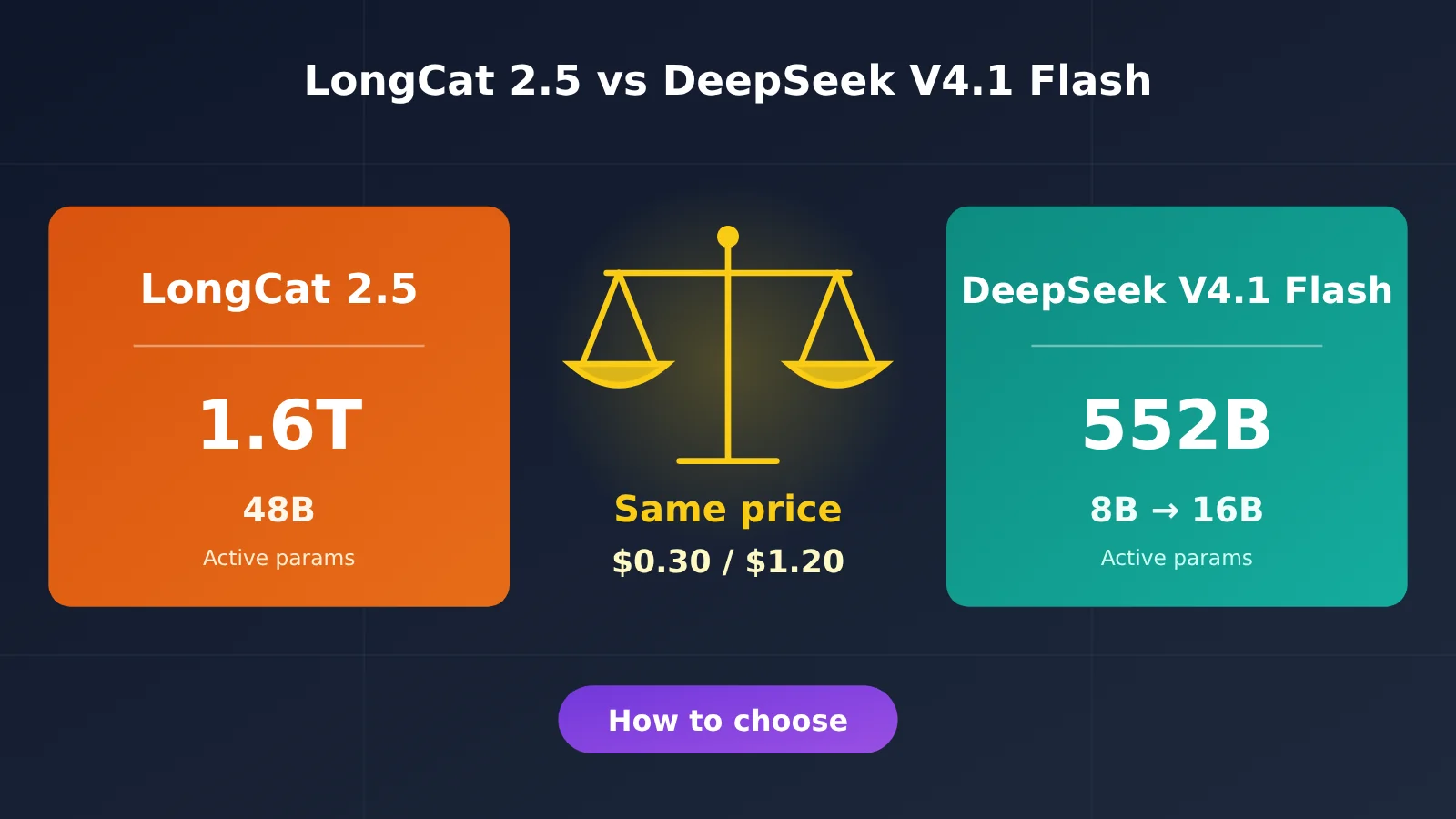
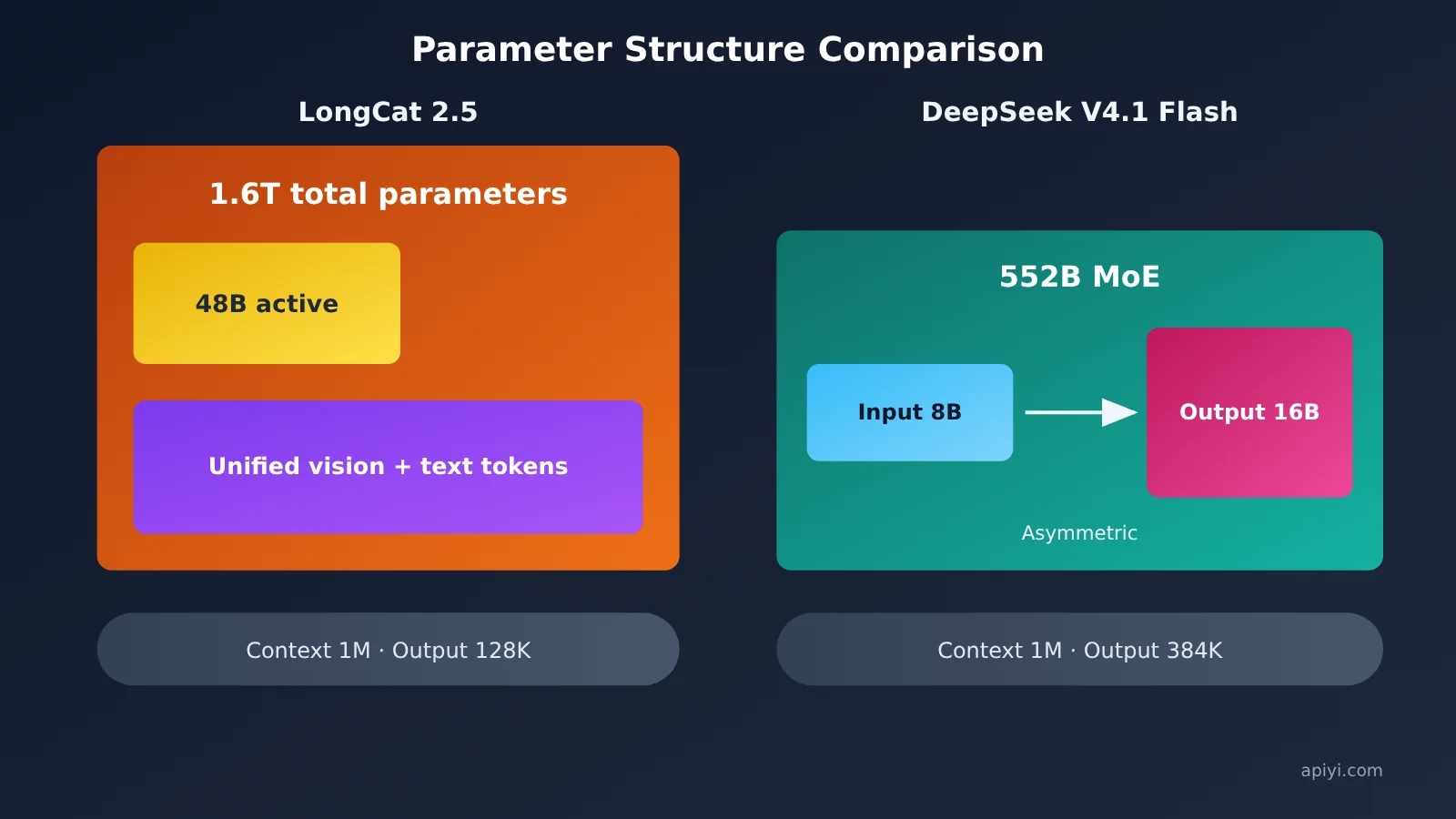
Peak-hour pricing is identical for both: $0.30 for input, $0.006 for cached input, and $1.20 for output per million tokens. The difference is what they’re good at, so the right choice depends on your workload. LongCat 2.5 is a native multimodal model with 1.6T total parameters and roughly 48B activated per token. DeepSeek V4.1 Flash is a 552B asymmetric MoE model that activates 8B for input and 16B for output. Its weights are open-source.
This isn’t a “both have their strengths” compromise piece. All figures below come from the companies’ official blogs, technical reports, and pricing pages. Both sets of benchmark results are self-reported, so this article uses them for like-for-like reference only. We won’t rank the models overall or claim hands-on results for tests we haven’t run.
What you’ll get: By the end, you’ll be able to match each task in your project to a model, decide which to use as your primary and which as a backup, and calculate how much you can save by moving batch jobs to off-peak hours.
LongCat 2.5 vs. DeepSeek V4.1 Flash: At a Glance
Here’s the takeaway: LongCat 2.5 has more total parameters and activates more of them per token. DeepSeek V4.1 Flash is smaller and activates fewer parameters, while offering a longer maximum output and downloadable weights. Both have a 1M context window. The three factors that matter most when choosing between them are the maximum output length—128K versus 384K—whether the weights are open source, and the number of activated parameters.
| Dimension | LongCat 2.5 | DeepSeek V4.1 Flash |
|---|---|---|
| Total parameters | 1.6T (1.6 trillion) | 552B |
| Activated parameters | About 48B per token | 8B for input, 16B for output |
| Architecture | Agent-focused native multimodal model, with vision and text handled through unified tokens | MoE, asymmetric Causal-Encoder-Decoder architecture |
| Context window | 1M | 1M |
| Maximum output | 128K | 384K |
| Native vision | Supported; visual signals are represented as multilevel discrete tokens | Supported (Vision) |
| Open-source weights | Weights not released; both GitHub and HuggingFace say “coming soon” | Open source; weights and a technical report are available on HuggingFace |
| Thinking controls | Official benchmark results were achieved with thinking enabled | Thinking mode is enabled by default; use reasoning_effort to adjust the level |
LongCat 2.5 Architecture Highlights
LongCat 2.5 is positioned for long-horizon agent tasks. Compared with version 2.0, it focuses on two areas: native visual understanding and agentic coding. For vision, it discretizes images at their native resolution using SAE+RVQ, preprocesses them offline into visual tokens, and then trains them jointly with the backbone. The backbone processes visual and text tokens together, making it natively multimodal.
For training, LongCat 2.5 makes extensive use of long-horizon trajectory data and large-scale long-horizon RL. The official blog highlights a few details: failed trajectories from real agents are turned into verifiable tasks; asynchronous RL uses partial rollouts and filters out sample groups that are entirely correct or incorrect and produce zero gradients; and repetitive reasoning and tool calls are penalized. That last point matters for agent developers: the model is less likely to get stuck in tool-use loops, wasting fewer tokens.
On the inference side, compared with W8A8 INT8, W4A4 improves prefill throughput by 43.3% and decode throughput by 42.77%, while reducing TTFT by 15.91% and TPOT by 19.72%. On the training side, dual-sharding FSDP delivers 86% higher per-GPU throughput for long-sequence SFT than the DDP baseline. These numbers show that the 1.6T model has undergone compression for server-side deployment, though the team hasn’t published rate limits.
DeepSeek V4.1 Flash Architecture Highlights
DeepSeek V4.1 Flash is the smallest model in the new architecture lineup. It uses an asymmetric design: it activates just 8B parameters when reading input and 16B when generating output. Agent workloads typically have much more input than output—think reading repositories, logs, and tool responses—so this design reduces the compute needed on the input side.
The cost savings are even bigger. The new generation’s KV cache is much smaller, cutting HBM requirements to 1/4 and SSD requirements to 1/8 of the previous generation’s. Compared with the first-generation model, the KV cache has shrunk by a factor of 437. There’s another change worth noting: after 12:00 on 2026-09-14, requests to deepseek-v4-pro will be routed to V4.1 Flash and billed at Flash rates until V4.1 Pro launches. Projects still using the old model name are actually calling Flash.
LongCat 2.5 vs. DeepSeek V4.1 Flash Pricing: They Match Only During Peak Hours
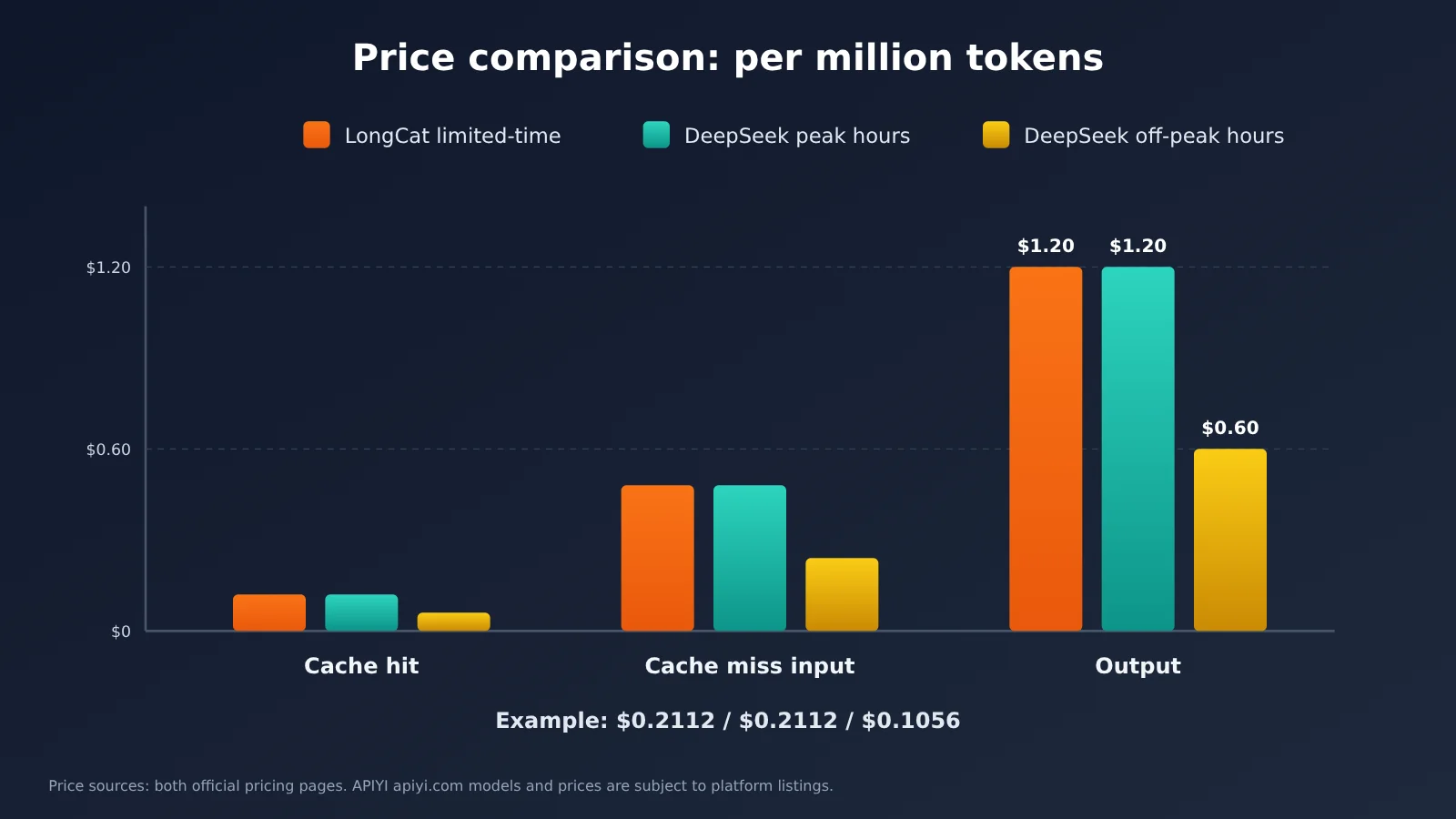
The bottom line: LongCat 2.5’s limited-time discount matches DeepSeek V4.1 Flash’s peak-hour prices across the board. During off-peak hours, DeepSeek cuts those prices in half, so the same task costs 50% less. The two are priced the same only during weekday peak hours.
| Per 1 million tokens (USD) | LongCat 2.5 (limited-time discount) | DeepSeek peak | DeepSeek off-peak |
|---|---|---|---|
| Cache-hit input | $0.006 | $0.006 | $0.003 |
| Cache-miss input | $0.30 | $0.30 | $0.15 |
| Output | $1.20 | $1.20 | $0.60 |
Let’s do the math. Suppose an agent task uses 500,000 input tokens (300,000 cache misses and 200,000 cache hits) and 100,000 output tokens:
- LongCat 2.5 (limited-time discount): 0.3×0.30 + 0.2×0.006 + 0.1×1.20 = $0.2112
- DeepSeek peak: Same calculation, $0.2112
- DeepSeek off-peak: 0.3×0.15 + 0.2×0.003 + 0.1×0.60 = $0.1056
That’s a difference of about 10 cents per task—not much on its own. Scale up to 1,000 tasks of the same size per day, though, and LongCat and DeepSeek peak pricing both come to $211.2, while DeepSeek off-peak costs $105.6. For teams running batches, the monthly difference adds up.
DeepSeek’s peak hours are 09:00–12:00 and 14:00–18:00 Beijing time on weekdays, corresponding to 01:00–04:00 and 06:00–10:00 UTC Monday through Friday, excluding Chinese public holidays. All other times qualify for the half-price off-peak rate, including weekday lunch hours, evenings, and overnight, as well as all day on weekends and public holidays. In other words, out of 168 hours in a week, peak pricing applies for just seven hours per weekday.
A few details about LongCat 2.5’s billing are worth noting:
- You’re charged only for HTTP 200 responses. Responses with status codes 401, 403, 429, and 500 aren’t billed, so failed retries don’t cost you anything.
- Token packages are available in limited-quantity flash sales daily at 10:00, 16:00, 21:00, and 23:00 Beijing time. They’re valid for 30 days, and unused tokens are fully refundable; cache hits don’t count against the package.
- Free tokens: New users get 10M tokens, and existing users get 5M. They’re credited automatically, and cache hits don’t consume the free allowance.
- Prices are marked as a limited-time discount. Check the official pricing page for future changes.
On DeepSeek’s side, web search and web scraping are separately billed APIs, each costing $0.75 per 1,000 successful requests. If your agent frequently accesses the web, factor those costs into your budget separately.
💰 Cost tip: If you use DeepSeek V4.1 Flash through APIYI apiyi.com, billing is based on the platform’s model list and may not match the official peak and off-peak rates. For the most accurate estimate, run a small batch in the platform console and check your bill before deciding on a larger batch.
LongCat 2.5 vs. DeepSeek V4.1 Flash: Official Benchmark Scores
The takeaway: The two models are less than 3 points apart on most agent benchmarks, putting them broadly in the same tier. LongCat 2.5 leads on Terminal Bench v4.0, Program Bench, JobBench, and 3D generation; DeepSeek V4.1 Flash leads on DeepSWE, NL2Repo, and AutomationBench, with larger margins on some benchmarks.
| Benchmark | LongCat 2.5 | DeepSeek V4.1 Flash |
|---|---|---|
| Terminal Bench v2.1 | 88.4 | 90.6 |
| Terminal Bench v4.0 | 38.5 | 31.2 |
| Program Bench | 25.5 | 20.3 |
| DeepSWE v1.1 | 64.6 | 74.2 |
| NL2Repo | 60.5 | 65.4 |
| BrowseComp | 91.9 | 91.5 |
| HLE w/tools | 63.1 | 63.9 |
| AutomationBench | 51.8 | 54.8 |
| MCP Atlas | 83.1 | 84.4 |
| JobBench | 65.4 | 63.2 |
| 3DCodeBench (Text to 3D) | 55.4 | 53.3 |
| Vision2Web | 78.6 | 79.2 |
Methodology note (please read): Both sets of scores come from the companies’ own tests. LongCat 2.5 was tested using its own harness, with thinking enabled, temperature=1.0, and top_p=0.95. Most scores in the DeepSeek column come from its public technical report, using DeepSeek’s own harness and Max reasoning mode. The harnesses, evaluation dates, and reasoning settings differ, so this table is only a rough comparison of models in the same tier—not a ranking.
How to Read the Benchmark Scores
The two biggest gaps point in opposite directions. On Terminal Bench v4.0, LongCat 2.5 leads DeepSeek by 7.3 points (38.5 vs. 31.2). On DeepSWE v1.1, DeepSeek leads LongCat by 9.6 points (74.2 vs. 64.6). The former tests harder, longer terminal tasks; the latter tests bug fixes in real repositories. That’s where their strengths diverge: LongCat excels at extended terminal workflows, while DeepSeek is better at making precise changes to existing codebases.
On the older Terminal Bench v2.1, DeepSeek actually leads by 2.2 points, suggesting that LongCat’s advantage emerges as the tasks get harder. LongCat leads by 5.2 points on Program Bench, while DeepSeek leads by 4.9 points on NL2Repo. NL2Repo tests the ability to generate an entire repository from a natural-language description, making it closer to building a project from scratch.
The gaps on vision-related benchmarks are small. DeepSeek leads by 0.6 points on Vision2Web, while LongCat leads by 2.1 points on 3DCodeBench. In the official table, LongCat scores 90.2 versus 87.7 on CharXiv-RQ w/tools; on MathVision w/tools, DeepSeek scores 97.4 versus 96.5. For visual understanding alone, the two are roughly on par. LongCat’s main advantage is combining visual understanding with 3D and interactive page generation. Its eight official demos include real-time fluid simulation, an interactive 3D artifact display, a city model, and miniature scene assets—making its focus clear.
The gaps on BrowseComp, HLE w/tools, and MCP Atlas are all within 1.3 points. For general agent capabilities such as web search and MCP tool calls, you can consider them roughly tied.
DeepSeek’s Reasoning Effort Is a Cost Lever
Section 5.3.3 of the DeepSeek technical report offers some useful data. Raising reasoning effort from 25 to 100 increased average Pass@1 across eight reasoning benchmarks from 67.1% to 76.3%, and DeepSWE v1.1 from 66.0 to 74.2. The trade-off: roughly 2.5 times as many output tokens. The 60–80 range already comes close to maximum accuracy with less than half the token budget. Pushing all the way to 100 increases agent trajectory length by another 1.6–1.8 times for only marginal gains.
Also note that DeepSeek API’s reasoning_effort defaults to high, while the official results were achieved at the Max setting. To reproduce the DeepSeek scores in the table above, you must explicitly set it to max. For everyday tasks, use a medium setting; save the maximum for the hardest problems. Output tokens are the most expensive line item on both providers’ bills ($1.20), so this setting directly determines where your money goes.
LongCat 2.5 vs. DeepSeek V4.1 Flash: How to Divide the Work
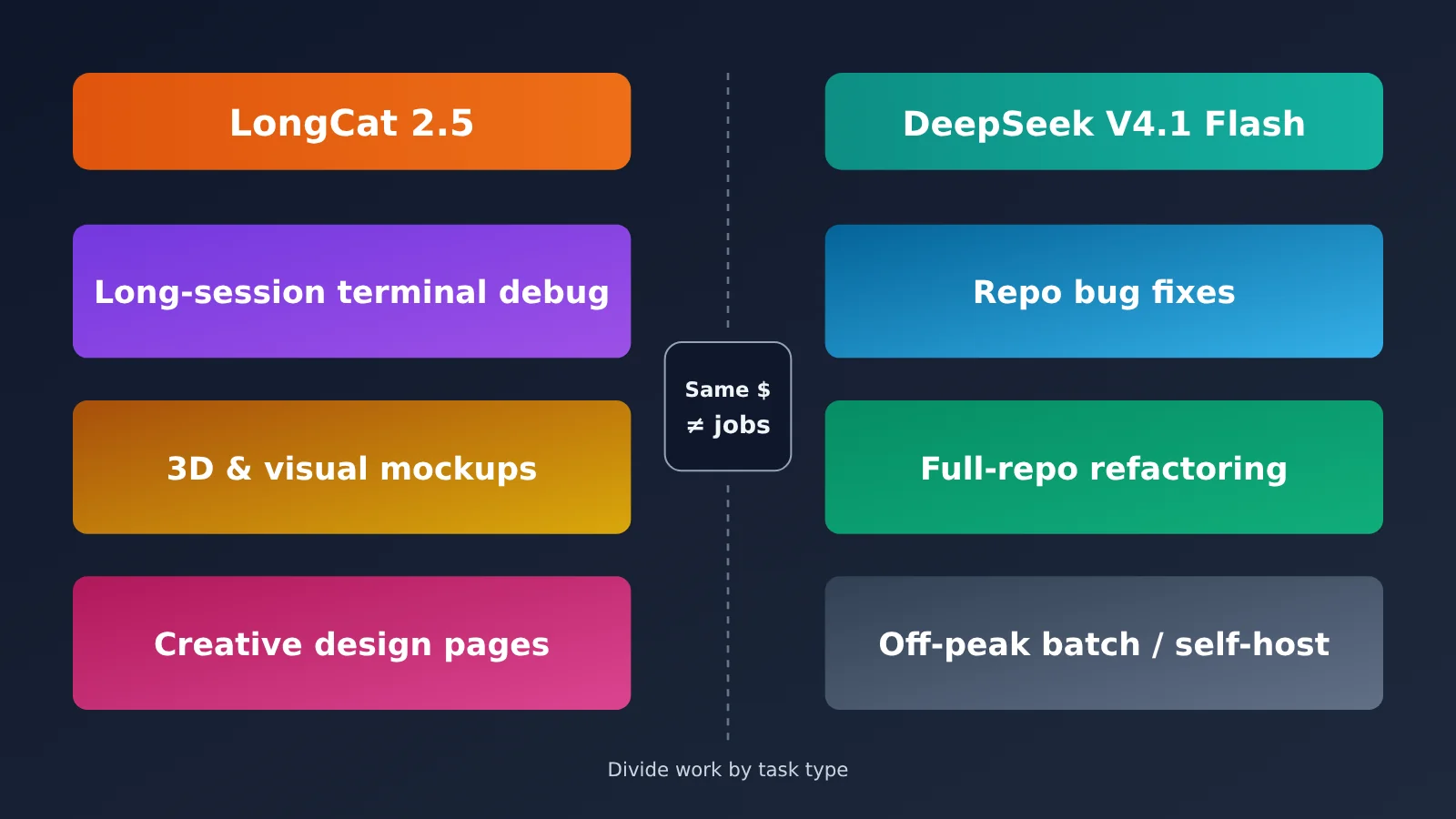
The takeaway: same price, different jobs. Give long-horizon terminal tasks, visual and 3D work, and creative design pages to LongCat 2.5. Use DeepSeek V4.1 Flash for code changes in real repositories, SWE bug fixes, automation pipelines, and scenarios that require self-hosting.
| Better suited to LongCat 2.5 | Better suited to DeepSeek V4.1 Flash |
|---|---|
| Long-horizon terminal troubleshooting: logging into a server, checking logs, changing configurations, restarting, and verifying the results (7.3 points higher on Terminal Bench v4.0) | Bug fixes in real repositories: reading issues, locating files, making changes, and passing tests (9.6 points higher on DeepSWE) |
| 3D assets and visual mockups: generating 3D scenes from text and building interactive showcase pages (55.4 on 3DCodeBench) | Repository-wide refactoring and building repositories from scratch: generating multi-file projects from requirements (4.9 points higher on NL2Repo) |
| Creative design pages: event invitations, stylized color pages, and data visualization reports (featured in official demos) | Automation pipelines and batch jobs: overnight processing, data cleaning, and report generation (3.0 points higher on AutomationBench, half price during off-peak hours) |
| Programming-challenge-style code construction and general professional tasks (leads on Program Bench and JobBench) | Self-hosted or private deployments: weights are open-sourced on HuggingFace; long single responses (up to 384K) |
Why Choose LongCat 2.5
LongCat 2.5’s most compelling result is on Terminal Bench. It trails by 2.2 points on v2.1 but leads by 7.3 points on v4.0, suggesting that its relative advantage grows as tasks get longer and harder. That fits with its training approach, which uses extensive long-horizon trajectories and penalizes repetitive tool calls. If your Agent often needs to run dozens of consecutive steps in a terminal, LongCat 2.5 is worth trying first.
The second reason is tasks that combine visual understanding and generation. Native multimodal capabilities, along with training focused on 3D and interactive pages, make it a better fit for work like creating designs from images or generating 3D content from text. New users also get 10M tokens, and cache hits don’t count against that allowance, so it’s inexpensive to try.
Why Choose DeepSeek V4.1 Flash
DeepSeek V4.1 Flash’s strongest result is its 74.2 on DeepSWE, the largest gap across the benchmarks compared for the two models. A common day-to-day coding task is making changes in an existing repository, and that’s exactly where it excels. Its maximum output of 384K is three times LongCat’s, making it less likely to get cut off when generating long files or large patches.
The third reason is its cost structure. Off-peak pricing is half price, and reasoning levels are adjustable. Together, these two options offer much more flexibility for batch-task costs than LongCat’s fixed, limited-time pricing. The official documentation also specifies a concurrency limit of 2,500, giving you a concrete figure for throughput planning. Teams that need a private deployment can download the weights directly, though the official documentation says large-scale deployment requires around 2,000 GPUs. Smaller teams should assess their hardware before self-hosting.
💡 Recommendation: A table can only narrow down your options—the final choice depends on your own tasks. Pick 10–20 representative tasks from your projects and run them through both models, then compare success rates and token consumption. You can test DeepSeek V4.1 Flash through APIYI at apiyi.com without opening a separate account.
How to Connect LongCat 2.5 and DeepSeek V4.1 Flash
The bottom line: both support OpenAI and Anthropic API formats. To connect either one to Claude Code, you only need to change a few environment variables in ~/.claude/settings.json. DeepSeek also supports the Responses API.
Connect LongCat 2.5
- OpenAI format (any OpenAI SDK): Set base_url to
https://api.longcat.ai/openaiand the model name toLongCat-2.5. - Anthropic format (Anthropic SDK): Set base_url to
https://api.longcat.ai/anthropic. - Claude Code (edit the env field in
~/.claude/settings.json): Set all four variables: - Set
ANTHROPIC_AUTH_TOKENto your LongCat API key - Set
ANTHROPIC_BASE_URLtohttps://api.longcat.ai/anthropic - Set
ANTHROPIC_MODELtoLongCat-2.5 - Set
CLAUDE_CODE_MAX_OUTPUT_TOKENSto131072 - Rate limit handling (in your own application code): Requests that exceed the limit return a 429 error (
rate_limit_exceeded,retry_after 60). LongCat recommends exponential backoff. The documentation doesn’t publish RPM or TPM limits, and 429 responses aren’t billed.
Connect DeepSeek V4.1 Flash
- OpenAI format (any OpenAI SDK): Set the model name to
deepseek-flash. The old namesdeepseek-v4-flashanddeepseek-v4-flash-vision-expstill work; they’re routed to V4.1-Flash-1017 and billed at Flash rates. - Claude Code (edit the env field in
~/.claude/settings.json): - Set
ANTHROPIC_AUTH_TOKENto your DeepSeek API key - Set
ANTHROPIC_BASE_URLtohttps://api.deepseek.com/anthropic - Set
ANTHROPIC_MODELtodeepseek-flash - Reasoning level (OpenAI SDK request parameter): Set
reasoning_effortto the medium level for everyday tasks, and switch tomaxfor harder problems. - Ready-to-use tools: WorkBuddy (including CodeBuddy) and OpenCode are official partner tools with full integration.
Access Models Through APIYI
If you’re running several models side by side, APIYI lets you switch between them with one account and one API key, without signing up for each provider separately.
- OpenAI SDK configuration (in your project code): Set base_url to
https://api.apiyi.com/v1and api_key to the API key generated in the APIYI console. - Model name (switch in the same request parameter): Use
deepseek-v4.1-flashordeepseek-v4.1-flash-1017for DeepSeek V4.1 Flash. Billing follows the platform’s model listing. - Comparison testing (using the same code): Change only the model parameter to run the same batch of tasks against other models on the platform. The base_url stays
https://api.apiyi.com/v1.
Check the platform’s model listing for current availability and pricing. LongCat-2.5 isn’t available on APIYI yet, but it’s coming soon. Until then, use the official endpoint for LongCat 2.5 and manage DeepSeek through APIYI at apiyi.com.
🚀 Quick start: New users get free testing credits when they register with APIYI at apiyi.com. Connect DeepSeek V4.1 Flash to your existing OpenAI SDK project and get started by changing a single base_url.
LongCat 2.5 vs. DeepSeek V4.1 Flash: FAQ
Q1: Are the two models really priced the same?
Only during DeepSeek’s peak hours. LongCat 2.5’s limited-time discounted prices are $0.30 / $0.006 / $1.20, matching DeepSeek’s peak-hour prices in each category. DeepSeek offers a 50% discount on all prices during off-peak hours: any time outside 09:00–12:00 and 14:00–18:00 on weekdays. LongCat’s prices are also a limited-time offer and may change later.
Q2: Can the benchmark scores tell us which model is better?
Not directly. Both sets of results come from the providers’ own tests, and the test harnesses, dates, and reasoning settings differ. The DeepSeek column also shows results from its Max setting. It’s more useful to look at benchmarks with large gaps: LongCat leads by 7.3 points on Terminal Bench v4.0, while DeepSeek leads by 9.6 points on DeepSWE. For differences of 1–2 points or less, it’s reasonable to call them a tie.
Q3: When will LongCat 2.5 be open-sourced?
The team hasn’t announced a timeline. Both GitHub and HuggingFace currently say “coming soon,” and the weights haven’t been released. If your project requires self-deployment, DeepSeek V4.1 Flash is the only option for now. Its weights and technical report are already public.
Q4: Can I call both models through APIYI?
For now, only DeepSeek V4.1 Flash is available, under the model IDs `deepseek-v4.1-flash` and `deepseek-v4.1-flash-1017`. Billing follows the platform’s model listing. LongCat-2.5 isn’t available on APIYI yet, but it will be added as soon as possible. Check the model listing on APIYI at apiyi.com for the latest model IDs and prices.
Q5: How can I reduce costs for batch jobs?
When using DeepSeek, take advantage of two settings: schedule jobs during off-peak hours to cut the unit price in half, and set `reasoning_effort` to a medium level. The report shows that levels 60–80 achieve accuracy close to the maximum setting while using less than half its token budget. Cache hits cost just 1/50 as much as cache misses, so placing fixed system prompts and tool definitions at the beginning of requests can improve your cache hit rate.
Summary: How to Choose Between LongCat 2.5 and DeepSeek V4.1 Flash
The takeaway is straightforward: similar prices, different strengths. Split work by task, and run batch jobs during off-peak hours.
- Scale: LongCat has 1.6T parameters with 48B activated, while DeepSeek has 552B parameters with 8B activated for input and 16B for output. Both have a 1M context window.
- Output limit: LongCat supports 128K, while DeepSeek supports 384K. Choose DeepSeek for long-output tasks.
- Pricing: LongCat’s limited-time price matches DeepSeek’s peak-hour price. DeepSeek is half-price during off-peak hours: $0.2112 versus $0.1056 in the example.
- Benchmarks: LongCat leads by 7.3 points on long-running terminal tasks, while DeepSeek leads by 9.6 points on fixing bugs in repositories. Most other scores are roughly tied.
- Open source: DeepSeek is open source; LongCat hasn’t released its weights.
- Integration: Both support OpenAI and Anthropic formats. You can switch between them in Claude Code by changing environment variables.
In short: use the task comparison table to pick a primary model and keep the other as a backup. Schedule batch jobs during off-peak hours whenever possible. For DeepSeek V4.1 Flash, you can use APIYI at apiyi.com to run small-scale tests through a unified interface before choosing your primary setup.
📚 References
- LongCat-2.5 official blog: Model positioning, architecture, training, and engineering details
- Link:
longcat.ai/blog/longcat-2.5 -
Details: Parameter counts, visual token approach, W4A4 inference data, and official evaluation tables
-
LongCat Open Platform documentation: Pricing, endpoints, and Claude Code integration
- Link:
longcat.ai/platform/docs -
Details: Limited-time discounted pricing, 429 error handling, quota packages, and bonus credit rules
-
DeepSeek V4.1 Flash release announcement: Architecture, open-source release, and API changes
- Link:
deepseek.com/news/deepseek-v4-1-flash -
Details: Asymmetric MoE, KV cache compression, and model name migration guidance
-
DeepSeek API pricing page: Peak and off-peak pricing and concurrency limits
- Link:
api-docs.deepseek.com/quick_start/pricing -
Details: Peak and off-peak hours, 2,500 concurrent requests, and separate billing for search and content fetching
-
DeepSeek-V4.1-Flash weights repository: Open-source weights and technical report
- Link:
huggingface.co/deepseek-ai/DeepSeek-V4.1-Flash - Details: Benchmark scores in Table 3 and inference tier analysis in Section 5.3.3
Author: APIYI Technical Team
Technical discussions: Contact us through the APIYI homepage at apiyi.com. For more integration resources, visit the documentation center at docs.apiyi.com.