Author’s note: This piece separates GPT-6.2 Astra and Claude Fable 5.2’s third-party composite leaderboard results, official self-reported single-task results, and list prices into three layers, explaining the cache-read difference and which one you can currently call on APIYI.
On 2026-11-17, OpenAI released GPT-6.2 Astra and GPT-6.2 Sol. About a week earlier, on 2026-11-09, Anthropic’s documentation went live for Claude Fable 5.2. Both flagships list short-context input at $8 and output at $40 per million tokens, so the selection debate naturally centered on GPT-6.2 Astra vs. Claude Fable 5.2.
The catch is that the two kinds of leaderboards point in different directions. On the third-party Artificial Analysis composite index, Fable 5.2 scores higher. In several professional tasks that OpenAI’s launch post self-reports, Astra leads, and the official per-task cost is lower. If you mash the two sets of numbers together, you’ll end up with a “who’s stronger” conclusion—but neither side’s data can actually support that conclusion.
This is not an article declaring a winner. This article breaks the numbers into three layers: third-party composite leaderboard, official self-reported single-task results, and official list prices. We’ll look at each layer on its own, then finish by explaining which model you can currently call on APIYI.
Core value: After reading this, you’ll be able to look up the leaderboard that matches the task you care about, see the difference in cache-read pricing, and know the current access status of both models.
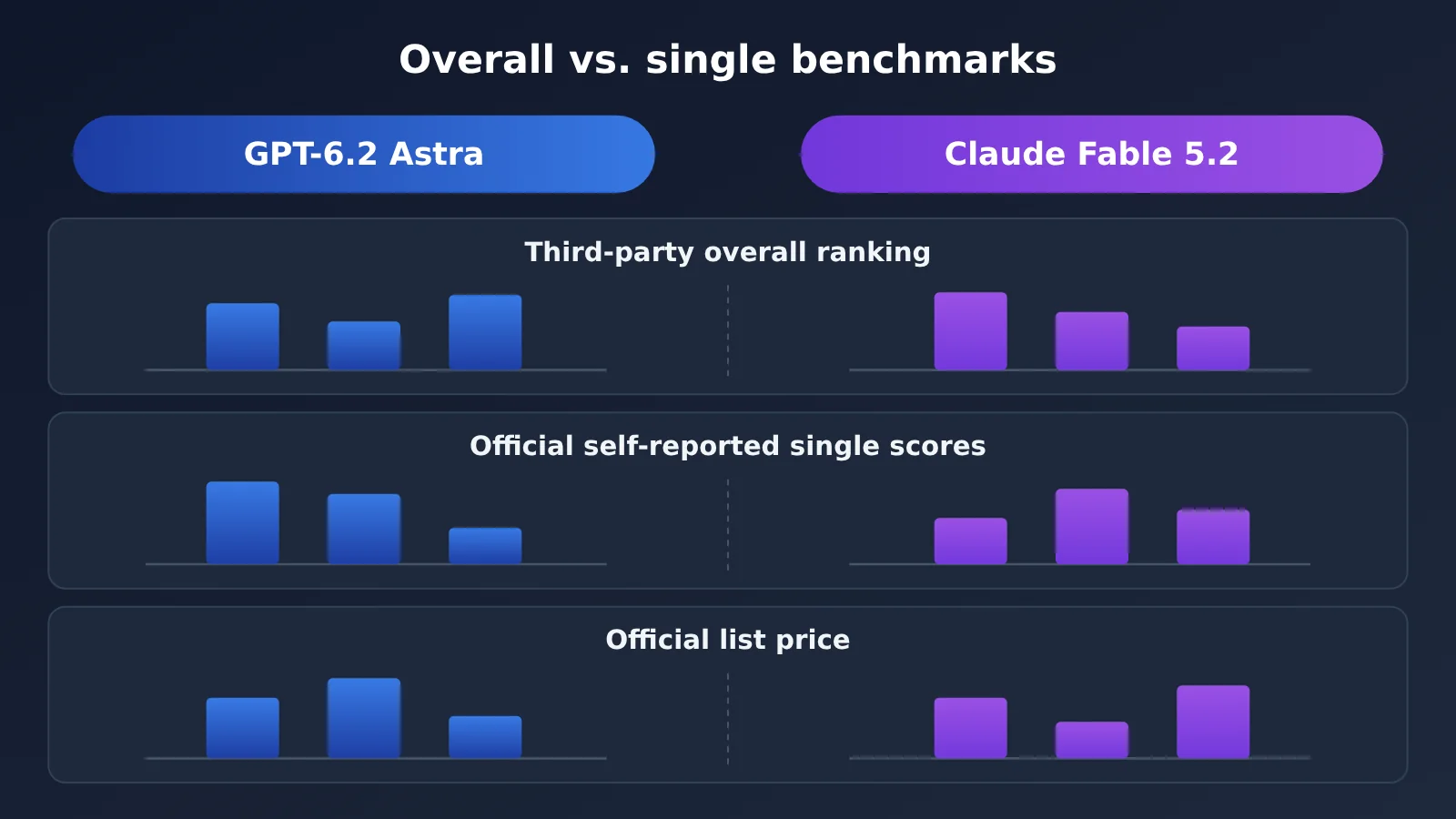
GPT-6.2 Astra vs. Claude Fable 5.2 — Key Points: Don’t Mix Up the Three Layers of Numbers
When comparing GPT-6.2 Astra and Claude Fable 5.2, the easiest mistake is dropping numbers from different sources into the same conclusion. The table below separates the source and meaning of each of the three layers first.
| Number layer | What kind of source | What this layer points to | Watch out for |
|---|---|---|---|
| Aggregate leaderboard | Third-party Artificial Analysis, Intelligence Index v5.0.1 | Fable 5.2 at 65, Astra (Max) at 62 | You must state the reasoning tier — scores swing a lot between tiers |
| Individual tasks | Self-reported by OpenAI in its launch post; AA-3D is a third-party blind evaluation relayed by the vendor | Astra leads on Agents’ Last Exam, Harvey LAB-AA, and AA-3D | On the ALE leaderboard, Fable’s entry leaves out the nine backup-model tasks |
| List price | Both vendors’ official model pages and docs | Input and output cost the same; Fable’s cache reads are cheaper | Cache-write retention differs, and long-context rules differ |
Why GPT-6.2 Astra and Claude Fable 5.2 Each “Win” a Different Category
The composite index measures average performance across a fixed set of tasks, with the weights set by the third party. What OpenAI’s launch post highlights, on the other hand, are specific scenarios — long-horizon professional workflows, legal work, 3D generation — and the vendor itself defines the test setup. They’re answering different questions to begin with: the first looks at the average level, the second looks at performance inside a particular workflow. A disagreement doesn’t mean either side’s data is broken.
Cost works the same way. The “cost per task” that Artificial Analysis reports is what it costs to run its own composite-index task suite. OpenAI’s “ALE cost is about 5% of Fable’s” comes from a different task suite and a different accounting basis. You can’t divide these two numbers, and you can’t convert one into the other.
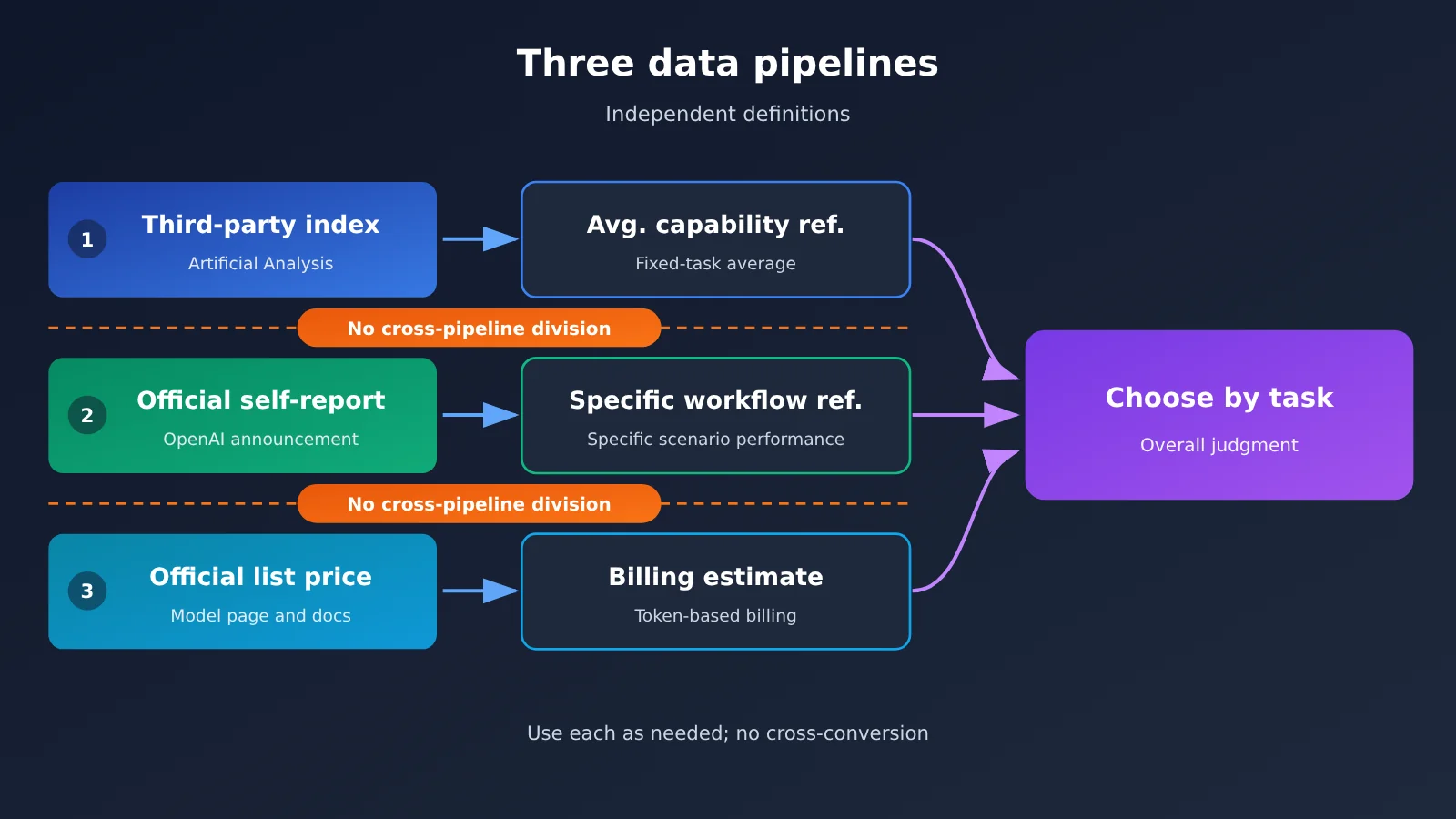
GPT-6.2 Astra vs. Claude Fable 5.2: The Core Differences on Third-Party Composite Leaderboards
Artificial Analysis published an article on 2026-11-17 and updated its model pages. All scores below use Intelligence Index v5.0.1 and come from third-party evaluation — none of them are self-reported by either vendor.
| Model | Reasoning tier | Intelligence Index v5.0.1 | Blended index cost per task (from each model’s page) |
|---|---|---|---|
| Claude Fable 5.2 | Highest reasoning tier | 65 (No. 1 on the leaderboard) | $26.54 |
| GPT-6.2 Astra | Max / Xhigh | 62 | $4.00 (Max) |
| GPT-6.2 Astra | High / Medium / Low | 60 / 57 / 46 | — |
| GPT-6.2 Sol | Max | 57 | $1.01 (Max) |
| Gemini 4 Carbon | Highest tier | 60 | — |
| Claude Opus 5.5 | Highest tier | 59 | — |
On this third-party leaderboard, Fable 5.2’s composite score sits 3 points above Astra’s top tier. Astra is 5 points above the previous generation, GPT-6 Astra, and it also edges past the top tiers of Gemini 4 Carbon and Claude Opus 5.5. One thing to keep in mind: Astra drops to just 46 points at the Low tier. If your workload dials down reasoning effort to save money, you shouldn’t expect 62-point results.
The Artificial Analysis article also breaks out several sub-results, which are likewise third-party data. In the AA-Robotics v0.1 research preview, Astra scores 79 and Fable 5.2 scores 75. On science tasks, Astra leads on Terminal-Bench-Science 0.1 and is second only to Fable 5.2 on the hard subset of CritPt v2. On the Coding Agent Index (Codex harness, max), Astra is on par with GPT-6 Astra. For the AA-Omniscience hallucination rate (Max), Astra comes in at 59%.
GPT-6.2 Astra vs Claude Fable 5.2: The Core Differences, One Benchmark at a Time
The numbers below come from OpenAI’s release post and model pages, and they’re all self-reported by the vendors. For items where the release post doesn’t give an absolute score, this article only reports the relative gap.
| Task | Official self-reported result | Official cost framing | Footnote you need to read |
|---|---|---|---|
| Agents’ Last Exam (long-horizon professional workflows) | Astra scores 5.5 points higher than Fable 5.2 | Cost is roughly 5% of Fable’s | Fable 5.2’s score on the leaderboard excludes the nine tasks that used a fallback model |
| Harvey LAB-AA v1.1 (legal) | Astra’s pass rate is more than double Fable 5.2’s | Cost is roughly one-sixth | The release post gives no absolute pass rate; the “Astra for Law” configuration aimed at lawyers is a higher-spec setup |
| AA-3D (human blind-review Elo) | Astra 1318, Fable 5.2 1271, Sol 1259 | Not given | Third-party blind review, but relayed by the official release post |
| Terminal-Bench-Science 0.1 | Astra is 9 percentage points higher than GPT-6 Astra | Cost is less than one-third of the previous generation | Fable has two numbers from different tests — see below |
The Agents’ Last Exam footnote needs its own explanation. OpenAI states explicitly that Fable 5.2’s result on the leaderboard excludes the nine tasks that used a fallback model. So when you read that “5.5 points higher,” you should know the two sides aren’t covering exactly the same set of tasks.
On Terminal-Bench-Science 0.1, Fable 5.2 has two numbers from different sources. One comes from Artificial Analysis, using mini-swe-agent. The other is Anthropic’s self-reported 74.6%, measured in a Claude Code environment at Max reasoning effort. These two numbers aren’t results from the same test run, so they can’t stand in for each other, and neither can be compared directly against Astra.
The 1318 and 1271 in AA-3D are themselves Elo scores from a third-party human blind review, but what this article cites is OpenAI’s retelling in the release post. When you quote them, it’s best to phrase it as “third-party blind review as relayed by the vendor” — don’t call it purely self-reported, and don’t call it something this article independently verified.
💡 Selection advice: A single-task leaderboard is only worth consulting when the task type is close to your own business. Fable 5.2 is already callable through the APIYI proxy service at apiyi.com, so you can run a round with your own real samples first, then combine that with the two tables above to make a judgment.
GPT-6.2 Astra vs Claude Fable 5.2 List Pricing: Cache Reads Differ
At official list prices, the two models have exactly the same short-context standard pricing for input and output. The differences are concentrated in cache-related line items and long-context rules. All prices in the table below are in USD per 1 million tokens.
| Pricing item | GPT-6.2 Astra (OpenAI official) | Claude Fable 5.2 (Anthropic official) | Platform availability (APIYI master table, 2026-11-17 15:54 UTC+8) |
|---|---|---|---|
| Input | 8 | 8 | Astra not yet listed; Fable: 8 |
| Output | 40 | 40 | Astra not yet listed; Fable: 40 |
| Cache read | 0.40 | 0.20 | Astra not yet listed; Fable: 0.2 |
| Cache write | 10 (30-minute retention), 20 (12-hour retention) | 10 (5-minute retention), 16 (1-hour retention) | Refer to the platform list |
| Context / max output | 1,050,000 / 128,000 (max input 922,000) | 1M / 128K | — |
| Batch | 50% of standard price | Input and output at 50% of standard price | — |
GPT-6.2 Astra’s official OpenAI list price is $8 for input, $0.40 for cache reads, and $40 for output. It’s not listed yet. We’ll list this model as soon as possible. Model names and prices are subject to the platform’s model list. As of 2026-11-17, gpt-6.2-astra cannot be found in APIYI’s model master table at docs.apiyi.com/models.md or in the public pricing API. Please don’t use the already-listed gpt-6-astra (short-context 10 / 50 / 1) to estimate 6.2 pricing; these are not the same model.
The difference in cache reads matters a lot for agents and long-conversation use cases. For the same 100 million cached tokens read, at list price Astra costs $40, and Fable 5.2 costs $20. If your system prompt is very long, or you repeatedly reference the same set of documents, this line item will show up directly on your bill. On paper, cache writes both cost $10, but Astra retains them for 30 minutes while Fable retains them for 5 minutes. Hit rates depend on request intervals, so you can’t just compare unit prices.
Long-context rules also differ. Astra’s model page states that when a single request’s input exceeds 272K tokens, input and cache unit prices double, output becomes 1.5x the short-context price, and the entire request is billed at those rates. The Fable price excerpt referenced in this article has no similar tier, so please check Anthropic’s documentation yourself before integrating.
The accelerated tiers also differ between the two. Astra’s Fast tier is 2x the standard price; Ultrafast is 3x through 2027-02-28 (Pacific Time), and becomes 6x starting 2027-03-01. Fable’s Fast mode is up to about 2.5x faster, priced at $16 for input and $80 for output.
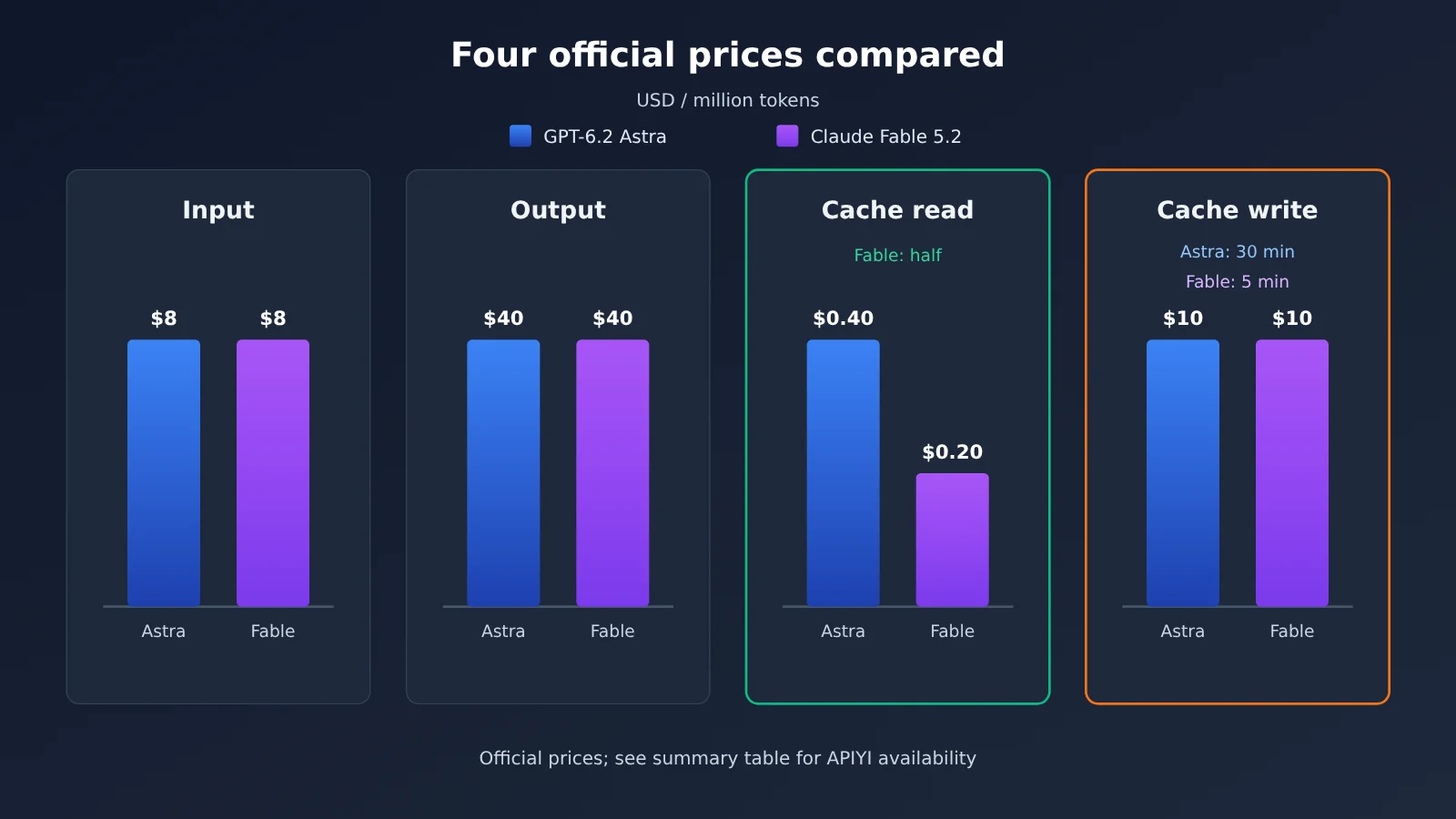
🎯 Data note: The chart above only shows both vendors’ official list prices. For the models and prices actually available on the platform, refer to the APIYI apiyi.com model list. Astra 6.2 is currently not on the list.
Scenario Recommendations for GPT-6.2 Astra vs. Claude Fable 5.2
Below, I go row by row through “what this particular leaderboard actually shows” and match it to scenarios — without drawing any conclusions about overall strength.
Scenarios where GPT-6.2 Astra deserves a first look
- Long-horizon professional workflows: Astra leads on the vendor-reported Agents’ Last Exam — but you also need to factor in the footnote that Fable excludes nine of the tasks.
- Legal document tasks: The vendor-reported Harvey LAB-AA v1.1 pass rate is more than double Fable’s, so this is a good area to test first.
- Preference evals tied to 3D generation: The vendor-cited AA-3D blind eval Elo is 1318 vs. 1271.
- Sensitivity to per-task cost on the composite index: Astra (Max) shows $4.00 on the third-party page — but that only applies to the composite-index task set.
Scenarios where Claude Fable 5.2 deserves a first look
- General-purpose apps that need a solid all-around baseline: Fable 5.2 scores 65 on the third-party composite index, ranking first on the leaderboard.
- Apps with a high cache-read ratio: Cache reads are listed at $0.20, half of Astra’s.
- When you need to integrate right away:
claude-fable-5-2andclaude-fable-5-2-thinkingare already in the APIYI master list.
| What you care about | Which layer to check first | What that layer says | Heads-up |
|---|---|---|---|
| Average capability | Third-party composite leaderboard | Fable 5.2 is higher | Mind the reasoning tier |
| Professional workflows / legal | Vendor-reported individual results | Astra leads | Vendor-reported; read the footnotes |
| Long-conversation cache cost | Vendor pricing | Fable’s cache reads are cheaper | Cache write retention differs |
| Can I call it today? | APIYI master list | Only Fable is available | Astra 6.2 is awaiting listing |
GPT-6.2 Astra vs Claude Fable 5.2 Quick Start: A Three-Step Decision
Step 1: Start with the benchmark that matches your task
First, figure out which category your business falls into. For general-purpose assistants or mixed workloads, refer to the Artificial Analysis composite index, and note the reasoning tier you plan to use. For long-horizon agents, legal, or 3D work, refer to OpenAI’s self-reported benchmark for that specific area, and read the footnotes. Don’t add the composite leaderboard gap and the specific-benchmark gap together into some “total score.”
Step 2: Then look at cache reads
Estimate what share of your requests is a repeated prefix — system prompts, knowledge base chunks, or multi-turn conversation history. The higher the cache read ratio, the more obvious the gap between 0.20 and 0.40 becomes. If a single input regularly exceeds 272K, also factor in Astra’s whole-invoice surcharge rule.
Step 3: Then check which one APIYI can call right now
At the moment, the only one available in APIYI’s master table is Fable 5.2, with model ID claude-fable-5-2. When you need the explicit thinking version, use claude-fable-5-2-thinking. Listed pricing is 8 for input, 40 for output, and 0.2 for cache reads, and the endpoint supports both chat and messages. The model’s detail page currently returns a 404, so go by the master table for pricing.
If you’re integrating through the OpenAI-compatible mode, set base_url to https://api.apiyi.com/v1 in the SDK, set model to claude-fable-5-2, and pass the other parameters exactly as you normally would for Chat Completions. Keep in mind that Fable 5.2’s thinking is always on and can’t be turned off, with a default effort of high. If you later switch to Astra, its API doesn’t accept setting reasoning effort to none.
🚀 Quick start: We recommend starting with the free trial credits on APIYI apiyi.com, testing
claude-fable-5-2with your own samples, and recording output quality and cache hit rate. Oncegpt-6.2-astrais available, run the same samples through it again — that’ll give you a fairer comparison.
Frequently Asked Questions (FAQ)
Q1: What exactly are GPT-6.2 Astra and Claude Fable 5.2?
GPT-6.2 Astra is OpenAI’s flagship model, released on 2026-11-17 with the model ID `gpt-6.2-astra`; the cheaper GPT-6.2 Sol shipped alongside it. Claude Fable 5.2 is Anthropic’s model, with documentation dated 2026-11-09. Both support roughly a 1M context window and up to 128K max output.
Q2: So which one is actually stronger, GPT-6.2 Astra or Claude Fable 5.2?
The available data doesn’t give you a single answer. On the third-party composite index, Fable 5.2’s score of 65 beats Astra (Max) at 62. Astra leads on the officially self-reported ALE and Harvey results, plus the officially cited AA-3D blind review. Look at the layer of data that matches your task type.
Q3: Can I cross-check ALE’s “5% of the cost” against Artificial Analysis’s per-task cost?
No. “About 5%” is OpenAI’s own claim on Agents’ Last Exam. The $4.00 and $26.54 figures are what it costs Artificial Analysis to run that composite-index task set. The tasks and the accounting are different, so you can’t divide one by the other, and you can’t use them to validate each other.
Q4: Is the GPT-6.2 Sol data third-party?
No. Sol is OpenAI’s own model, and every number about it in the release post is an official self-report. Artificial Analysis did test Sol separately too — Max tier scored 57, and that part is the third-party data. Sol’s official list prices are 2 for input, 0.10 for cached reads, and 10 for output. It isn’t listed yet; we’ll get this model up as soon as we can. Model IDs and pricing are subject to the platform’s model list.
Q5: How do I call Claude Fable 5.2 through the API right now?
Register at APIYI apiyi.com and grab an API key, then point the base URL at `https://api.apiyi.com/v1` in an OpenAI-compatible SDK and set the model ID to `claude-fable-5-2`. If you’re on the native Anthropic protocol, you can go through the messages endpoint.
Q6: What are the known limitations of GPT-6.2 Astra?
The official docs say Astra hits the “severe” cybersecurity level in the Preparedness Framework, so guardrails are tighter and some legitimate vulnerability research requests will get refused. In alignment evaluations, it’s more likely to miss blocking problems on two tests — things like a missing file or an unavailable search tool. Its third-party AA-Omniscience hallucination rate (Max) is 59%. It also doesn’t support audio or video input, and doesn’t support Realtime or fine-tuning.
Q7: Will list prices change after December?
In the reference material for this article, neither model has announced a December price change. What does change is Astra’s Ultrafast multiplier: starting 2027-03-01 it moves from 3x to 6x. Actual billing on the platform is whatever the model list at APIYI apiyi.com says.
GPT-6.2 Astra vs. Claude Fable 5.2: Key Takeaways
- Composite rankings come from third parties: On the AA Intelligence Index v5.0.1, Fable 5.2 scores 65 and Astra (Max) scores 62.
- Individual benchmarks come from vendor self-reports: Astra leads on ALE, Harvey, and the officially cited AA-3D, but you need to read the footnotes.
- The two cost figures can’t be divided by each other: ALE’s ~5% and AA’s per-task cost come from different tasks and different measurement conventions.
- Same price for input and output: Both short-context models are $8 / $40, with cached reads at 0.40 and 0.20 respectively.
- Astra has tiers for long context: Once a single input exceeds 272K, the entire request is billed at the higher rate.
- Availability differs: Fable 5.2 is already in the APIYI apiyi.com master list; Astra 6.2 is still pending listing.
Summary
When comparing GPT-6.2 Astra and Claude Fable 5.2, the key is to keep the sources of the numbers separate:
- Third-party composite rankings: Fable 5.2 is higher — when you cite it, always specify the reasoning tier.
- Vendor self-reported individual benchmarks: Astra leads on several specialized tasks, and the per-task cost the vendor reports is also lower — but that’s self-reported data.
- Official list prices: Input and output are identical; cached reads are half the price on Fable, and the long-context rules are different too.
Neither model wins on every dimension. A more reliable approach is to pin down your own task type first, then check cached costs, and finally test with real samples. Fable 5.2 is already callable through APIYI apiyi.com, and once Astra 6.2 is listed you can run the same batch of samples against it for comparison. We’ll get this model listed as soon as possible.
📚 References
-
OpenAI release post: release notes and official self-reported evaluations for GPT-6.2 Astra and Sol
- Link:
openai.com/index/introducing-gpt-6-2-astra-sol - Notes: source for individual benchmark figures such as ALE, Harvey, and AA-3D, along with their footnotes
- Link:
-
OpenAI model page: GPT-6.2 Astra specs and list pricing
- Link:
platform.openai.com/docs/models/gpt-6.2-astra - Notes: cache write pricing and the 272K pricing rule are based on this page
- Link:
-
Artificial Analysis article: third-party evaluation of GPT-6.2 Astra and Sol
- Link:
artificialanalysis.ai/articles/openai-has-the-2-model-in-the-intelligence-index-with-the-release-of-gpt-6-2-astra-and-gpt-6-2-sol - Notes: scores for each reasoning tier on Intelligence Index v5.0.1
- Link:
-
Artificial Analysis model page: Claude Fable 5.2
- Link:
artificialanalysis.ai/models/claude-fable-5-2 - Notes: overall score and per-task cost on the composite index
- Link:
-
Anthropic documentation: Claude Fable 5.2 overview
- Link:
platform.claude.com/docs/en/models/fable-5-2/overview - Notes: list pricing, cache reads and writes, effort, and thinking settings
- Link:
Author: APIYI Technical Team
Technical inquiries: Feel free to reach out through the APIYI homepage. For models and pricing, please refer to the platform’s model list.