On May 14, 2026, Anthropic officially announced a major restructuring of its Claude subscription billing, effective June 15. The Agent SDK, the claude -p command, Claude Code GitHub Actions, and all third-party Agent applications—including OpenClaw, Conductor, Zed, and Jean—will be removed from the existing subscription usage pool and migrated to a brand-new, independently billed "Agent SDK Credit pool."
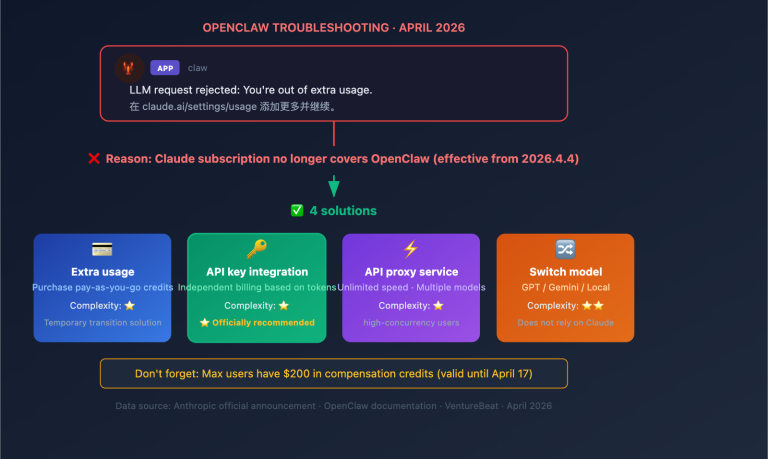
This marks the second major adjustment to Anthropic's subscription policy in 2026 and serves as a critical turning point following the February ban, the tightened restrictions in April, and now this "split-pool" rollout. For developers, independent entrepreneurs, and enterprise teams relying on Claude as a productivity tool, this change directly impacts your monthly AI cost structure and is worth breaking down point by point.
1. Core Changes to Claude Subscription Billing: What are the two billing pools?
To understand this change, you first need to see how Anthropic has split its subscription service into two parts.
The core of the new policy is moving from a simple "one subscription tier, one unified quota" structure to a parallel model of "one subscription fee, two independent pools." Pool 1 is the Interactive Usage Pool, serving all scenarios where you interact with Claude "by hand." Pool 2 is the Agent SDK Credit Pool, serving all programmatic invocation scenarios where you "let code operate Claude for you."
The following table outlines the service boundaries for each pool, providing a clear guide to help you determine which category your monthly usage falls into:
| Billing Pool | Applicable Services | Billing Method | Impact after June 15? |
|---|---|---|---|
| Interactive Pool | Claude.ai web/desktop/mobile chat, Claude Code terminal interaction, Claude Cowork | Retains original subscription usage limits | No, remains unchanged |
| Agent SDK Credit Pool | Claude Agent SDK, claude -p headless mode, Claude Code GitHub Actions, third-party tools like OpenClaw/Conductor/Zed/Jean |
Monthly independent Credit + standard API pricing for overages | Yes, all programmatic calls migrate here |
In short, if you're manually chatting with Claude Code in your terminal or talking to Claude via the web interface, you're completely unaffected. However, once you integrate Claude into CI/CD pipelines, run batch tasks, or use external Agent schedulers like OpenClaw, you will fall into the new Agent SDK Credit pool.
For developers, if your business model primarily relies on API paths rather than subscription leverage, this change actually makes billing more transparent and closer to your true costs. We recommend comparing your access solutions with API proxy services like APIYI (apiyi.com), which utilize standard API pricing. Since they don't rely on subscription subsidies, their pricing is generally stable and predictable.
Why is Anthropic splitting subscription billing?
On the surface, this split might look like a simple price hike. However, looking at Anthropic's own supply-and-demand structure, two forces are at play.
First, token supply is struggling to keep up with demand. Since the beginning of 2026, the actual usage of Claude models has continued to grow super-linearly. Following the launch of Sonnet 4.6 and Opus 4.7, inference compute has remained tight, forcing Anthropic to reallocate resources to protect the core interactive experience.
Second, there is the issue of "subscription arbitrage" caused by third-party Agent frameworks like OpenClaw. Simply put, some users pay only $20 to $200 per month for a subscription but use tools like OpenClaw to run long-cycle tasks, consuming tokens worth hundreds or even thousands of dollars. Anthropic banned this usage in February, tightened the ban in April, and has now reopened it in May via this "split-billing" approach, which essentially formalizes cost accountability.
{ANTHROPIC POLICY UPDATE}
{Claude subscription billing has undergone major changes}
{Agent SDK separate billing pool}
{Interactive Pool}
{Claude.ai Chat}
{APIYI provides Large Language Model API proxy service, supporting prompt optimization, model invocation, image generation, text-to-image, image-to-image, multimodal, context window, face consistency, reference image, and API key management.}
{Claude Code terminal}
{Unaffected · Continue using subscription limits}
{Agent SDK Pool programmatic pool}
{SDK}
{Agent SDK / -p}
{API}
{Third-party Agent tools}
{Independent Credit · API price overage}
{⏰ Effective June 15, 2026}
{⏰ Starting June 15, 2026 · Two pools in parallel}
{Claude subscription: comparison of two independent billing pools}
{Interactive Pool}
{✓ Not affected}
{Claude.ai web / desktop / mobile}
{Claude Code terminal interaction}
{Claude Cowork}
{Billing rules}
{Continue using the original subscription usage limits}
{Keep the status quo completely}
{Agent SDK credit pool}
{⚠ Independent billing}
{Claude Agent SDK}
{claude -p (headless mode)}
{Claude Code GitHub Actions}
{OpenClaw / Conductor / Zed / Jean}
{Billing rules}
{Independent monthly Credit (Pro $20 / Max5x $100)}
{Excess usage is billed according to API standards · cleared at the end of the month}
2. Agent SDK Monthly Credit Comparison by Subscription Tier
Once you've sorted out the two pools, the burning question is: How much Agent SDK Credit do I actually get each month? Anthropic’s model is straightforward: the Agent SDK Credit for every tier is equal to the monthly subscription fee.
It sounds like a "no-loss" deal, but there are two critical catches: credits do not roll over, and usage beyond the limit is billed at standard API rates.
| Subscription Tier | Monthly Fee | Agent SDK Credit | Rollover | Over-limit Policy |
|---|---|---|---|---|
| Pro | $20/mo | $20/mo | No, resets at month-end | Pay-as-you-go at API rates (requires usage credits) |
| Max 5x | $100/mo | $100/mo | No, resets at month-end | Same as above |
| Max 20x | $200/mo | $200/mo | No, resets at month-end | Same as above |
| Team | Per seat | $100/seat | No | Same as above |
| Enterprise | Per contract | $200+/seat | Per contract | Per enterprise API agreement |
Keep in mind a detail often overlooked: credits reset on a natural monthly cycle. There’s no "if you don't use it, you can double up next month" perk. In other words, you can't save the unused $20 from May to run a massive model evaluation in June. Anthropic is actually stricter here than most traditional telecom carriers.
For teams running production workloads, this "use it or lose it" policy is rarely the most cost-effective. We recommend moving core Agent workflows to an API proxy service like APIYI (apiyi.com), which offers pay-as-you-go pricing without mandatory subscriptions or month-end expiration, allowing your token budget to scale elastically with your business cycles.
How Many Tokens Can You Actually Buy with the Claude Agent SDK Credit?
Looking at $20, $100, or $200 doesn't give you a clear picture, so let's reverse-engineer this using official Sonnet 3.5 API pricing. With standard rates of $3 per million input tokens and $15 per million output tokens, we can estimate the monthly capacity for each tier.
| Subscription Tier | Monthly Credit | Equivalent Input Tokens | Equivalent Output Tokens | Typical Agent Tasks (Est.) |
|---|---|---|---|---|
| Pro $20 | $20 | ~6.6 M | ~1.3 M | ~30-50 medium Coding Agent tasks |
| Max 5x $100 | $100 | ~33 M | ~6.6 M | ~150-250 medium tasks |
| Max 20x $200 | $200 | ~66 M | ~13.3 M | ~300-500 medium tasks |
These estimates assume an average of 200K input and 40K output tokens per task. If you're using Opus 3.5 for complex agents, your actual capacity will be cut in half, as Opus is significantly more expensive than Sonnet.
More importantly, Anthropic’s first-party applications benefit from automatic prompt caching, whereas third-party tools (like OpenClaw) often can't achieve the same cache hit rates. This means the same task might burn 30%-50% more tokens via the Agent SDK than it would using the Claude Code terminal. For teams with heavy Agent usage, we suggest running a small A/B test at the start of the month to compare your subscription credit burn rate against the actual cost of a pure API proxy service to find the most economical path.
3. What Happens When You Exceed Your Agent SDK Credit?
The new rules aren't as simple as "service stops when you run out." You have two choices, but both come with trade-offs.
The first is enabling usage credits (the over-limit billing switch). Once enabled, when your Agent SDK Credit runs out, the system seamlessly switches to standard API pricing. It sounds convenient, but beware: your actual cost becomes "subscription fee + the difference burned at API rates," which completely negates the value of the subscription discount.
The second option is to disable over-limit billing. In this case, Agent SDK requests will be rejected the moment your credit hits zero until the next billing cycle. This can cause CI/CD pipelines, automated ops scripts, or batch data processing tasks to crash, leading to production incidents.
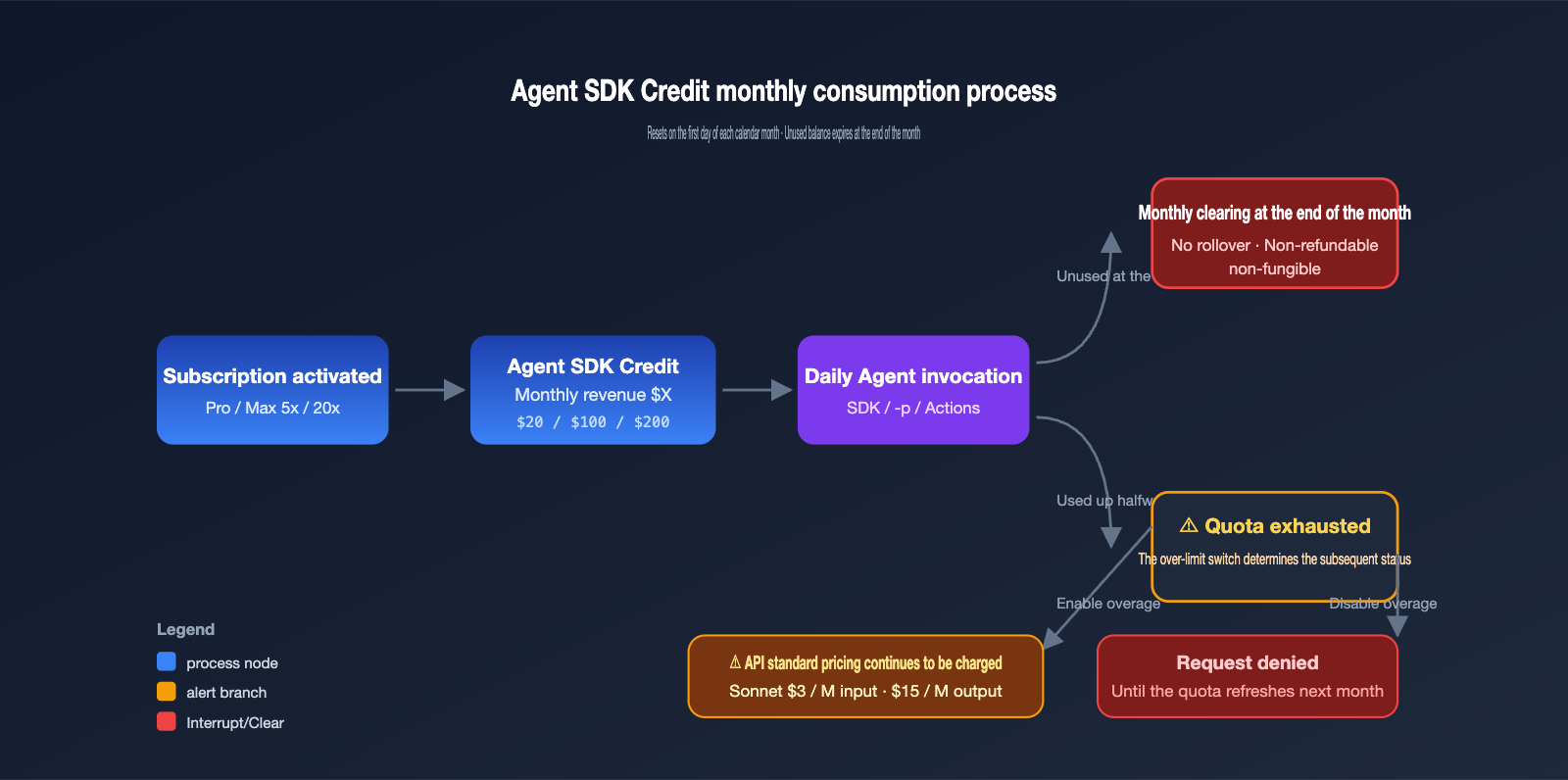
The table below summarizes the real-world impact of these two strategies:
| Over-limit Policy | Behavior After Credit Exhaustion | Business Continuity | Cost Predictability | Best For |
|---|---|---|---|---|
| Enabled (Pay-as-you-go) | Auto-switch to API standard rates | High, no interruption | Low, monthly bill can exceed subscription | Production tasks that can't tolerate downtime |
| Disabled | Rejects Agent SDK requests | Low, causes service outages | High, cost capped at subscription fee | Experimental projects, side hustles |
For teams running production Agent workflows, if you're worried about the dilemma of "uncontrolled bills" vs. "broken tasks," there's a safer path: route your Agent calls through APIYI (apiyi.com) using pure API mode. You'll settle based on actual usage, avoiding both service interruptions from credit exhaustion and surprise bills from switching between pricing pools.
How to Maximize Your Anthropic Agent SDK Credit
While the rules aren't exactly friendly, you can still make every cent of your subscription count with these practical tips:
- Plan Usage Early: On the 1st of each month, confirm your subscription tier and credit balance, then schedule known batch tasks (like weekly report generation or CI testing) within the current cycle.
- Prioritize Sonnet, Use Opus Sparingly: For the same Agent task, Opus 3.5 burns through credits several times faster than Sonnet 3.5. Only upgrade when absolutely necessary.
- Enable Prompt Caching: Ensure your first-party SDK calls reuse system prompts and tool definitions to lower input token costs.
- Set Over-limit Alerts: Configure internal monitoring to trigger an alert when you hit 80% of your monthly credit to prevent a runaway Agent from wiping out your balance before the month ends.
If you find that your subscription credits are always just a bit short at the end of the month but too much at the start, that’s a signal: your actual business usage has outgrown the subscription model, and it's time to consider switching to a pay-as-you-go API proxy service.
IV. The Real-World Impact of Claude's Subscription Billing Split
The impact of this policy varies significantly across different user groups. We’ve broken it down in the quadrant table below:
| User Type | Primary Usage | Impact After June 15 | Recommended Strategy |
|---|---|---|---|
| Casual Subscriber (Claude.ai chat only) | Web/Desktop chat | Almost none | Keep as is |
| Individual Developer (Claude Code terminal) | Interactive terminal coding | Almost none | Keep as is |
| Heavy Automation User (OpenClaw / claude -p) | Programmatic Agent invocation | Severe; budget needs recalculation | Evaluate API proxy service alternatives |
| CI/CD Integration User (Claude Code GitHub Actions) | Automated pipeline calls | Moderate; monthly credits may fall short | Rate limiting or enable overage |
| Team / Enterprise | Multi-user mixed usage | Moderate; seat-based billing is complex | Renegotiate contracts with Anthropic sales |
As you can see, the ones truly hit aren't the casual chat users, but the heavy automation users who rely on Claude as their productivity backbone.
For heavy automation and CI/CD integration users, this change is essentially like "paying for a subscription that doesn't cover your needs," because the actual costs of programmatic calls will be fully deducted from your Agent SDK credits, which often won't cover real-world business volume. We recommend these users immediately evaluate two paths: either upgrade to the Max 20x plan to secure the full $200 credit, or migrate your Agent workflows to an API proxy service model. For domestic access, APIYI (apiyi.com) provides Claude model interfaces consistent with the official ones, offering low latency and high stability, allowing you to seamlessly replace the base_url configuration in your Agent SDK.
What Should OpenClaw Users Do Under Claude's New Billing?
OpenClaw users are the group most directly "targeted" by this policy. Looking back at the timeline: the February ban, the April tightening, and the May reopening via split billing—Anthropic has effectively brought third-party Agent frameworks like OpenClaw back into the compliant ecosystem, but at the cost of having to pay for their actual usage.
For OpenClaw users, I have three straightforward suggestions:
First, if you've been relying on a $20 Pro subscription to run massive OpenClaw tasks, that approach is effectively over after June 15; you'll need to re-plan your costs. Second, if your task volume is stable and predictable, connecting directly to the API is more cost-effective than maintaining a subscription plus enabling overage charges. Third, if you need low-latency access in a Chinese environment, you can switch the model endpoint in OpenClaw to APIYI (apiyi.com), keeping your OpenClaw workflow intact while only replacing the underlying API path.
V. Industry Signals and Long-Term Impact of Anthropic Claude's Billing Changes
Stepping back from the technical details, this adjustment sends several noteworthy industry signals.
First, Anthropic is shifting from "subsidizing growth with subscriptions" to "aligning with real costs." GitHub Copilot followed a similar path in the second half of 2025, transitioning from unlimited subscriptions to a hybrid model of seat-based + usage-based billing. Anthropic is clearly following the same script.
Second, the third-party Agent ecosystem is moving from a "gray area" to "transparent compliance." Tools like OpenClaw, Conductor, Zed, and Jean are no longer prohibited, but they must be paid for by usage just like standard API users. This actually makes the ecosystem more sustainable—developers can build products on these tools with confidence, without worrying about waking up to a banned account.
Third, the value of API proxy services is being further amplified. The subscription model is essentially a "bundled resource sale," whereas programmatic Agent calls are characterized by volatile, bursty usage—a trait that conflicts with "subscription smoothing." We have always believed that for teams running real business operations, pure pay-as-you-go API billing is a healthier cost model. APIYI (apiyi.com) provides a unified interface for mainstream models like Claude, GPT, and Gemini, designed specifically for these scenarios.
Finally, this serves as a reminder: In the multi-model era, keeping all your eggs in one vendor's single subscription basket is becoming increasingly risky. Whether it's Anthropic's billing split or OpenAI's previous restrictions on enterprise usage, it's clear that the honeymoon period of "one-stop subscription + unlimited usage" is over. The rational approach is to build a multi-model infrastructure that allows for switching and price comparison.
FAQ
Q1: I only use the Claude.ai web chat. Will my costs increase after June 15th?
No. The new policy only affects programmatic calls (Agent SDK / claude-p / GitHub Actions / third-party tools). Standard web, desktop, and mobile chat, as well as Claude Code terminal interactions, remain completely unaffected and will continue to follow the original subscription usage limits.
Q2: Can my monthly Agent SDK Credits roll over to the next month?
No. Anthropic has clearly stated that credits reset at the end of each subscription month. Unused portions expire at the end of the month and cannot be carried over, refunded, or exchanged for other benefits. We recommend planning your usage at the start of the month or switching to a pay-as-you-go solution like APIYI (apiyi.com) to avoid expiration issues.
Q3: If I subscribe to the Max 20x plan and also use a direct API key, will the billing conflict?
No. The subscription credit pool and direct API key billing are two separate accounts, calculated independently. Many teams currently use subscriptions for interactive chat while running production agents via pure API calls. This "subscription + API dual-channel" approach will become even more common after June 15th.
Q4: Can I still use Claude Code GitHub Actions?
Yes, but every Action trigger will consume Agent SDK Credits. For high-frequency CI/CD scenarios, we suggest evaluating your actual monthly consumption. If you find that your credits aren't enough and the overage charges exceed the cost of a pure API plan, consider switching your Actions to use an API proxy service like APIYI (apiyi.com).
Q5: Will Enterprise contracts automatically adopt these new rules?
They will not be applied automatically. Enterprise contracts are governed by separate agreements, which typically include customized credit amounts, overage pricing, and expiration rules. We recommend confirming your contract terms with your Anthropic sales representative before June 15th to avoid unexpected price hikes caused by "auto-renewal + credit expiration" rules when billing by seat.
Summary: How to Handle Claude's Subscription Billing Split
This split in Anthropic's subscription billing effectively ends the era of "running $1,000 worth of tokens on a $20 subscription." It brings all programmatic calls onto a baseline of "Subscription Credits + Standard API Pricing." For casual chat users, this is virtually transparent, but for heavy automation users, it represents a significant restructuring of costs.
There are three safe ways to respond: For low-frequency users, keep your current subscription tier; for medium-frequency users, plan your usage at the start of the month and be cautious about enabling overage billing; for high-frequency production users, migrate your agent workflows to a pay-as-you-go API proxy platform. We recommend adding APIYI (apiyi.com) to your multi-model infrastructure evaluation list. It supports the entire Claude model family, offers transparent billing, and remains unaffected by subscription policy fluctuations, making it a stable alternative to your Anthropic subscription.
Regardless of which path you choose, June 15, 2026, is a date worth marking on your calendar. We suggest performing a self-audit this week: How many of your Claude calls over the past month were programmatic, used the Agent SDK path, and would fall into the new credit pool? This number will determine whether you need to adjust your subscription tier, migrate workflows, or renegotiate contracts before June 15th.
🎯 Quick Decision Advice: If your monthly programmatic consumption is stable and exceeds your subscription credit limit, migrating to a pay-as-you-go API proxy solution is more cost-effective. You can experience the unified interface for the full Claude model family via APIYI (apiyi.com) to prepare for the policy shift on June 15th.
Reference sources: theregister.com, thenewstack.io, devtoolpicks.com, infoworld.com, the-decoder.com
Author: APIYI Team — Focused on AI Large Language Model billing, enterprise-grade API integration, and multi-model infrastructure practices.