Abstract: On VibeVideoBench’s code-driven video tasks, GPT-6 Astra is already on par with Claude Opus 5.5 — slightly better overall quality at a lower cost, while Opus 5.5 delivers more reliably. OpenAI’s next-generation general model hasn’t shipped yet, so its video chops will have to be measured after release.
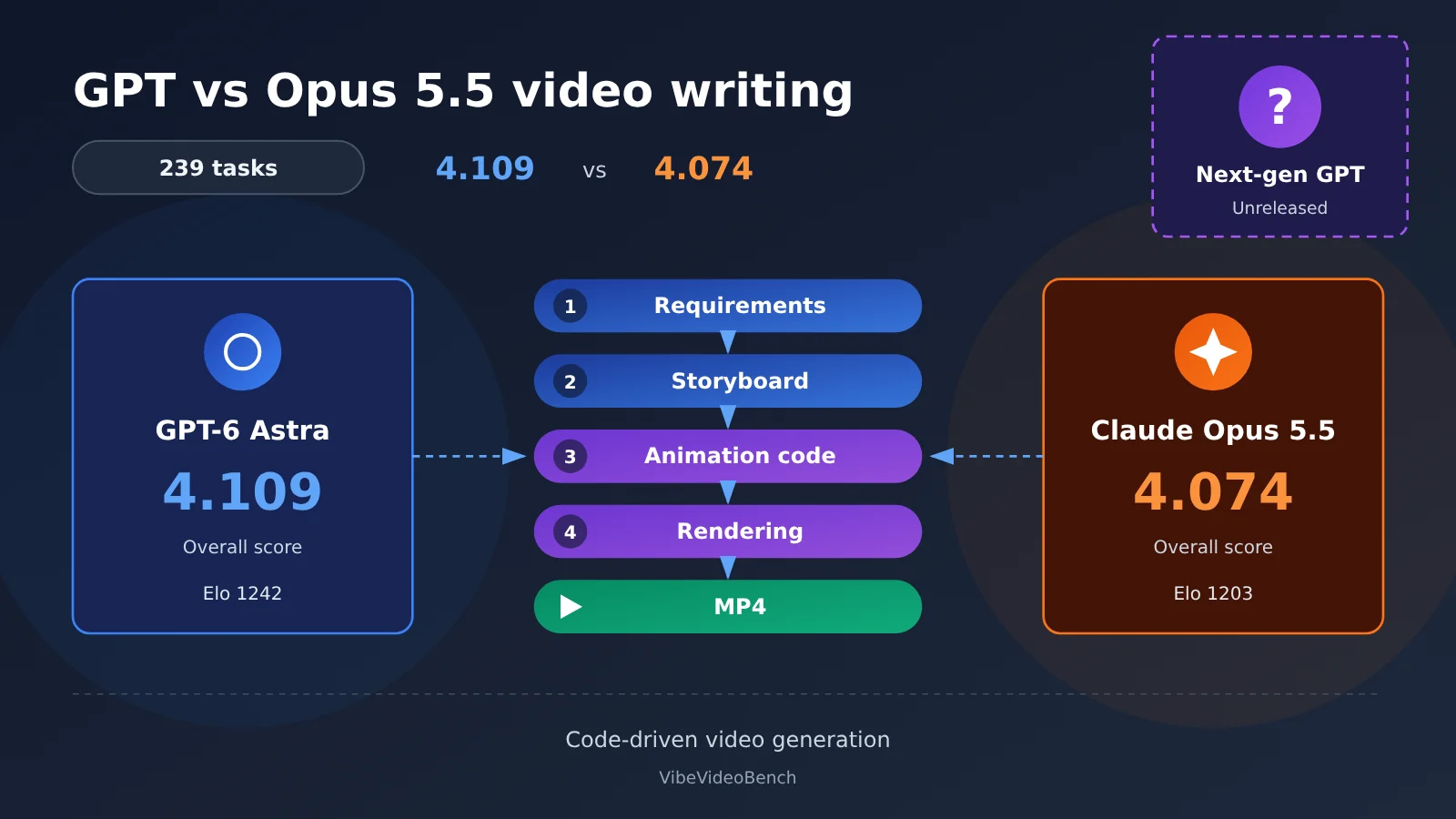
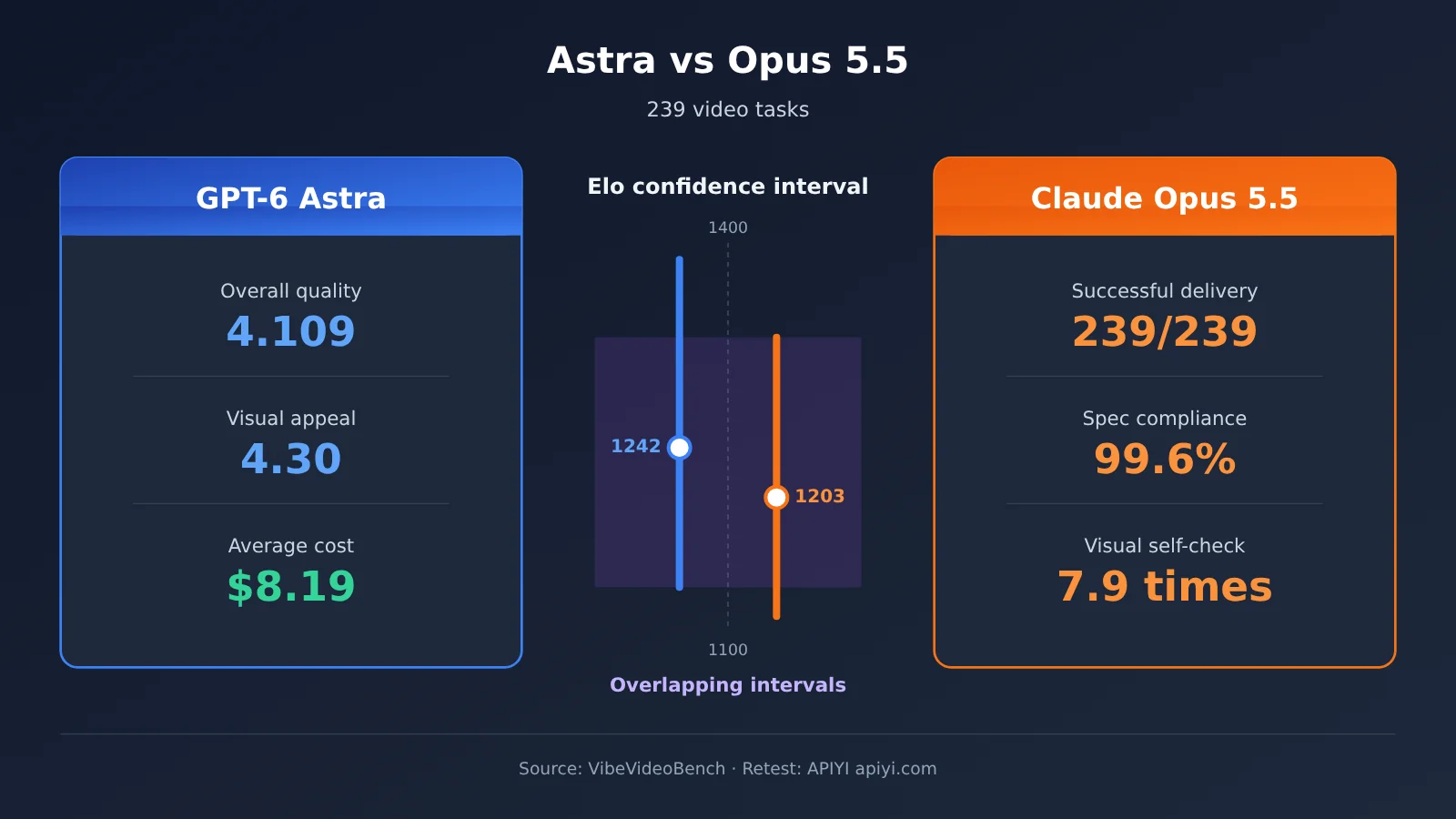
Bottom line up front: As of November 15, 2026, on the “agent writes code, calls rendering tools, ships a complete MP4” path, GPT-6 Astra and Claude Opus 5.5 are the two closest systems in VibeVideoBench. Astra scores 4.109 on overall quality versus 4.074 for Opus 5.5, and their human blind-test Elo ratings are 1242 and 1203 — statistically indistinguishable. Opus 5.5 delivered all 239 tasks with a strict task success rate of 76.3%, ahead of Astra’s 74.5%. Astra’s average API cost per task is $8.19, about half of what Opus 5.5 costs. OpenAI has published evidence that two internal models are significantly stronger than Astra, but the name, release date, and video-specific benchmarks of the next-generation general GPT are all still under wraps. So the answer to the headline question is: the current GPT has caught up, and whether the next generation opens up a gap depends on testing once it ships.
What’s ahead: This article starts by scoping the evaluation, then breaks down VibeVideoBench’s overall scores, per-category results, human preferences, and cost data to show where each system’s edge comes from. Next, it walks through the public signals around OpenAI’s internal models and the release status of the next-generation model, and digs into where the real bottleneck is for video agents. Finally, it lays out a comparison testing method you can reuse as-is once the new model drops — so you can judge whether it’s worth swapping out your current setup.
To Know: Terms You Need Before Reading
| Term | Explanation |
|---|---|
| Code-driven Video Generation | Code-driven video generation: the AI writes animation and rendering programs, and ultimately outputs an MP4 |
| Native Video Generation | Native video generation: the model generates video frames directly from text or images; representative products include Sora and Veo |
| VibeVideoBench | A benchmark built specifically to test whether AI Agents can autonomously produce a complete video, released on October 26, 2026 |
| Harness | The environment a model runs in, providing code execution, file access, tool invocation, and more — such as Codex CLI and Claude Code |
| L1 / L2 / L3 | The three evaluation layers: program delivery checks, item-by-item checks against task requirements, and multimodal review scoring of video quality |
| Strict task success rate | The share of tasks where the video is delivered successfully and satisfies every constraint — stricter than a plain “delivery rate” |
| Bradley–Terry Elo | A scoring method that derives a model’s relative preference from human pairwise comparison results |
| Multi-agent Orchestration | Multi-agent orchestration: having multiple Agents divide up the work and collaborate, then merging the results |
| Render Pipeline | Video rendering pipeline: frame generation, audio processing, encoding and compositing, all the way to the final output |
| Remotion / FFmpeg | The former writes video animation in React code; the latter handles audio/video encoding and compositing |
| ffprobe | An inspection tool bundled with FFmpeg, used to read a video’s resolution, frame rate, duration, audio tracks, and other details |
| Cache Hit | Cache hit rate: the share of repeated context read from cache, which directly affects API costs on long tasks |
| BenchCAD 2.0 | An engineering benchmark testing AI’s ability to reconstruct 3D parts, design mechanical assemblies, and recognize PCB connections |
1 Starting with the Verdict: GPT Is Now Competing with Opus 5.5 in Video Creation
1.1 Which Kind of “Writing Video” This Article Compares
AI video creation currently follows two paths. Native video generation has the model directly output continuous frames, and it excels at characters, physical motion, and camera language. Code-driven video generation puts the model in the dual role of director and programmer: it understands the requirements, writes the script and storyboards, builds animations with Remotion, Three.js, Cairo, or Blender, generates voiceover with TTS, then composites and reviews the final cut with FFmpeg.
This article focuses on the second path — the ability to deliver a complete MP4 and an editable project through agents like Codex CLI and Claude Code. That path suits data visualization, product introductions, educational explainers, animated infographics, and brand promos, and it’s also the area where GPT and Claude currently have independent benchmarks that allow for a direct comparison.
OpenAI’s own native video product line has already shifted: the Sora product stopped service on April 26, 2026, and the Sora 2 model and Videos API were shut down on September 24, with the official deprecation notice noting there’s no one-to-one replacement API. GPT-Image-2.6, released on November 4, supports GIF animation output of 2–16 frames, which works well for memes, looping animations, and storyboard previews — a different workflow from full MP4 production. So for now, the GPT series’ ability to “write video” shows up mainly on the code-driven path.
1.2 One-Sentence Answer to the Title’s Question
In VibeVideoBench, GPT-6 Astra comes extremely close to Opus 5.5 — scoring slightly higher overall, with slightly lower delivery reliability. OpenAI’s next-generation model shows technical signals for further gains, but the publicly available video-specific results still use Astra as the benchmark.
2. 239 Real-World Video Tasks: GPT-6 Astra vs. Opus 5.5 — Who Comes Out on Top?
2.1 How VibeVideoBench Tests the Video Capabilities of GPT and Opus 5.5
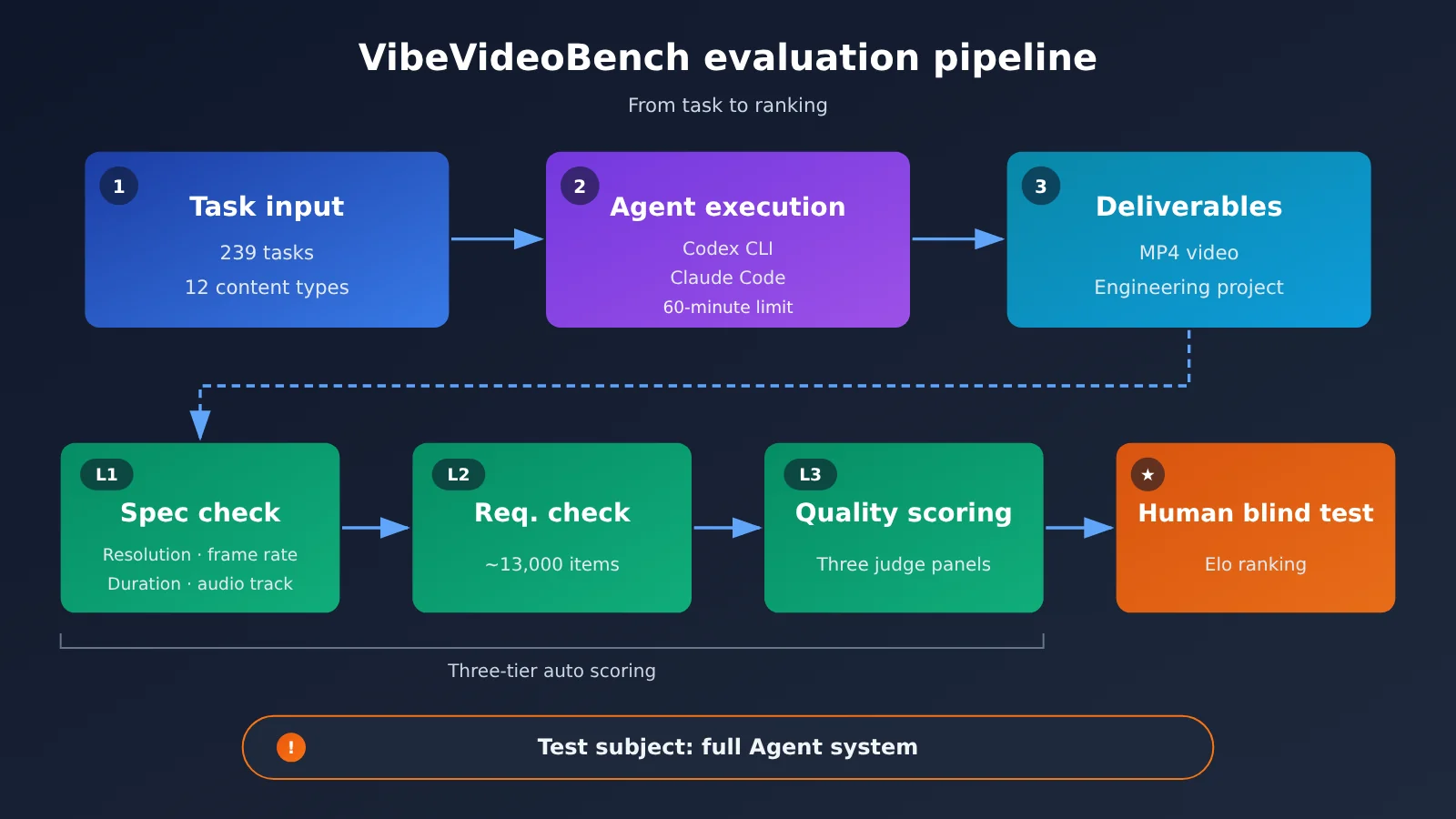
VibeVideoBench assembled 239 real-world video production tasks spanning 12 content categories, and put 9 agent systems through 2,151 total runs. Each task requires the AI to work autonomously inside a sandbox and deliver a playable MP4, a project that can regenerate the video, and production notes. Every task has a 60-minute time limit, and all systems use their own native development environment at the highest reasoning effort available, with no human instructions injected mid-run.
GPT-6 Astra ran inside Codex CLI, while Claude Opus 5.5 ran inside Claude Code. The other systems in the lineup were Claude Sonnet 5.5, Gemini 4 Argon, DeepSeek V4.1 Flash, Kimi K3, GLM-5.3 Flash, GPT-5.6 Sol, and Gemini 3.8 Flash. Scoring happens on three levels: L1 checks whether an MP4 was actually delivered and whether its specs — resolution, frame rate, duration, audio track — hold up; L2 verifies roughly 13,000 individual task requirements one by one; L3 has three multimodal review systems assess image quality, aesthetics, content logic, motion pacing, and audio sync.
2.2 Overall Results: GPT-6 Astra vs. Opus 5.5
| Metric | GPT-6 Astra | Claude Opus 5.5 | Leader |
|---|---|---|---|
| Videos successfully delivered | 238/239 | 239/239 | Opus |
| Video delivery rate | 99.6% | 100% | Opus |
| Spec compliance rate | 93.7% | 99.6% | Opus |
| Task requirement pass rate | 97.1% | 97.3% | Opus |
| Video quality | 4.08 | 3.99 | Astra |
| Visual appeal | 4.30 | 4.19 | Astra |
| Content logic | 4.20 | 4.18 | Astra |
| Motion and pacing | 3.95 | 3.95 | Tie |
| Audio quality and sync | 4.10 | 4.07 | Astra |
| Overall quality score | 4.109 | 4.074 | Astra |
| Strict task success rate | 74.5% | 76.3% | Opus |
| Human preference Elo | 1242 | 1203 | Statistically indistinguishable |
Data comes from the average of three judging panels, with scores on a 1–5 scale. Both systems outperformed all other systems tested.
This table shows a clear division of labor: Astra holds a slight edge in “how good the finished video looks,” leading by 0.035 points in overall quality and 0.11 points in visual appeal; Opus 5.5 is more reliable at “whether it can deliver to spec,” with a spec compliance rate 5.9 percentage points higher and a strict task success rate 1.8 percentage points higher. The 0.035-point gap is tiny, and when you factor in the Elo confidence interval, the two are in the same tier.
2.3 Where GPT and Opus 5.5 Excel Across Video Types
| Video Category | Astra | Opus 5.5 | Leader |
|---|---|---|---|
| Brand & Marketing | 4.18 | 4.18 | Tie |
| Product & Feature Showcase | 4.20 | 4.24 | Opus |
| Music & Sound-Driven | 3.83 | 3.92 | Opus |
| Paper Walkthroughs | 4.03 | 4.07 | Opus |
| Concept & Process Explanation | 4.19 | 4.15 | Astra |
| Data & Factual Stories | 4.14 | 4.01 | Astra |
| Visual Art | 3.94 | 3.91 | Astra |
| Games & Sports | 4.15 | 4.12 | Astra |
| Events & Personal Expression | 4.03 | 3.93 | Astra |
| Storytelling & Visual Comedy | 4.00 | 3.88 | Astra |
| Building & Making Processes | 3.97 | 3.94 | Astra |
| Classroom Teaching | 4.47 | 4.45 | Astra |
The data comes from Appendix E.4 of the paper, with a zero score counted for any video that wasn’t delivered.
Astra leads in 8 of the 12 categories, with the largest gaps in Data & Factual Stories (0.13) and Storytelling & Visual Comedy (0.12). Opus 5.5 comes out ahead in Product & Feature Showcase, Music & Sound-Driven, and Paper Walkthroughs, with the Music & Sound-Driven gap at 0.09. Music-heavy tasks demand tight audio-visual alignment, while product showcases demand precision on specs and details — which lines up with where Opus tends to win on specification compliance. Most categories are separated by less than 0.05 points, so while task type is already starting to shape which model you’d pick, any single-category gap still needs repeated testing before you read too much into it.
2.4 Why Opus 5.5 Is Still Competitive
Human blind tests use the Bradley–Terry model to calculate Elo. Astra scores 1242 (95% confidence interval 1134–1387), while Opus scores 1203 (1111–1327). Both have a ranking confidence interval of 1–3, and the paper reports a comparison probability of P=0.69, so the conclusion is that they’re statistically indistinguishable. One caveat: human testing only evaluates videos that were actually delivered, and it can’t measure the ability to deliver on time — which happens to be Opus’s strength.
Its self-checking behavior explains this. On average, Opus inspects rendered images 7.9 times per run and uses ffprobe 3.9 times; Astra does so 3.4 and 2.1 times, respectively. Opus checks its own output more often and fixes problems when it finds them, which buys it a 100% delivery rate and a 99.6% spec-compliance rate. Anthropic positions Opus 5.5 as a long-running agentic coding model, and some community users report using it to finish an iOS app promo video in about 30 minutes, or to automatically produce a 1080×1920 vertical news short with SRT subtitles. These are individual cases, but they serve as anecdotal evidence that the workflow holds together end to end.
2.5 Video Task Costs: GPT-6 Astra Has a Higher Unit Price but a Lower Per-Task Cost
| Metric | GPT-6 Astra | Claude Opus 5.5 |
|---|---|---|
| Standard input price (USD per million tokens) | 10 | 4 |
| Standard output price (USD per million tokens) | 50 | 20 |
| Average task cost | $8.19 | $15.38 |
| Median task cost | $7.88 | $10.19 |
| P90 task cost | $11.88 | $31.22 |
| Average output tokens | 61K | 130.7K |
| API calls per task | 46 | 51 |
| Cache hit | 97% | 65% |
Astra’s standard unit price is 2.5× that of Opus 5.5, yet its average task cost is about 46.7% lower. There are two reasons: Astra produces about 53.3% fewer output tokens, and Astra’s cache hit rate reaches 97%, whereas roughly 76% of Opus’s task cost comes from cache writes. The gap is even wider at P90 — Opus’s costs fluctuate much more on complex tasks. The paper also notes that simply consuming more tokens doesn’t bring a corresponding quality improvement.
These costs are equivalent costs converted from public API pricing, and don’t include the human labor and asset costs of a complete commercial video. Opus 5.5’s official Batch API offers 50% off both input and output, so the cost structure changes for offline batch production.
💰 Cost optimization: A video agent’s per-task cost is heavily influenced by cache hits and output length, so looking at unit price alone can easily mislead you. We recommend running the same task on both models via APIYI apiyi.com and calculating based on “actual consumption per finished video” rather than comparing list prices.
3 Signals of Capability Gains in OpenAI’s Next-Generation GPT
3.1 Navier–Stokes Research: the Internal Model Is Notably Stronger Than GPT-6 Astra
On September 8, 2026, OpenAI published the results of its research on the Navier–Stokes Millennium Prize Problem. The official post states that the internal model used was significantly more capable than GPT-6 Astra, trained with large-scale reinforcement learning, and that training was still ongoing when the announcement went out.
The scale at which this research ran is a direct demonstration of multi-agent capability: roughly 10,000 agents worked in parallel, the study took about 88 hours, and produced 2.7 million messages and roughly 13 billion output tokens. Groups of agents investigated different versions of the problem, the groups exchanged information with each other, Codex integrated the intermediate results, and the system kept concentrating resources on the more promising lines of attack. The final Lean formal verification took an additional 17 hours and used GPT-6 Astra.
For video creation, what matters most here isn’t the math itself but long-horizon task scheduling and multi-agent collaboration. A complex video likewise requires parallel work on script, animation, and audio, followed by integration, review, and rework.
3.2 BenchCAD 2.0: Engineering Capability Jumps from 0.594 to 0.875
On November 3, 2026, OpenAI disclosed in Accelerating engineering for the physical world that a newer internal model scored an average of 0.875 on BenchCAD 2.0, while GPT-6 Astra scored 0.594 at the highest reasoning effort — a relative improvement of about 47.3%. The test covers 3D part reconstruction, mechanical assembly design, and PCB connection identification.
These two pieces of evidence should be viewed separately. OpenAI hasn’t said whether the model tested on BenchCAD and the one used for the Navier–Stokes research are the same, and neither its name nor a release date has been announced. BenchCAD is an engineering benchmark published by OpenAI itself, so it’s a signal of progress in spatial understanding and complex engineering knowledge, with no direct correspondence to video generation tasks.
3.3 When Will the Next-Generation GPT Ship: Public Status as of November 15
| Date | Public Progress |
|---|---|
| November 2 | According to The National, Altman said at ADIPEC that the math research used an upcoming GPT model, with about 10,000 agents collaborating for roughly four days; the report notes the claim was not independently verified |
| November 3 | OpenAI publishes BenchCAD 2.0 data for its internal model |
| November 4 | The Information, citing people familiar with the matter, reports that OpenAI may launch a new generation of Astra, Sol, and a cybersecurity model as early as November 6 |
| November 5 | The OpenAI API Changelog confirms the release of GPT-6 Cyber, but no new-generation general-purpose Astra or Sol |
| November 15 | The general-purpose flagships in the official model catalog are still GPT-6 Astra, GPT-6.1 Sol, GPT-6.1 Terra, and GPT-6 Luna |
Names circulating online such as GPT-6.2 Astra and GPT-6.2 Sol have not been confirmed by OpenAI. Note also that VibeVideoBench tested GPT-6 Astra and GPT-5.6 Sol — Astra’s scores can’t be directly carried over to GPT-6.1 Sol or Terra.
4 What Else Does the Next-Generation GPT Need to Surpass Opus 5.5 in Video Creation?
4.1 The Real Bottleneck for Video Agents: Time Management and Delivery
Of VibeVideoBench’s 2,151 total runs, 224 failed to deliver a playable video. Of those, 169 were time-management issues: final rendering started too late, ran too slowly, or never started at all—roughly 75% of all failures. The test environment was a standardized Docker container with 8 CPU cores, 32GB RAM, and no GPU, and rendering alone takes considerable time.
This shows that even after a model’s reasoning improves, those gains still have to translate into execution pacing. No matter how polished a model’s animation code is, if it doesn’t start rendering until minute 55, the result is still a zero. Astra and Opus 5.5 are already hard to separate on quality; the main room for the next-generation GPT to pull ahead is on the delivery side.
4.2 Seven Areas for Improvement for the Next-Generation GPT in Video Workflows
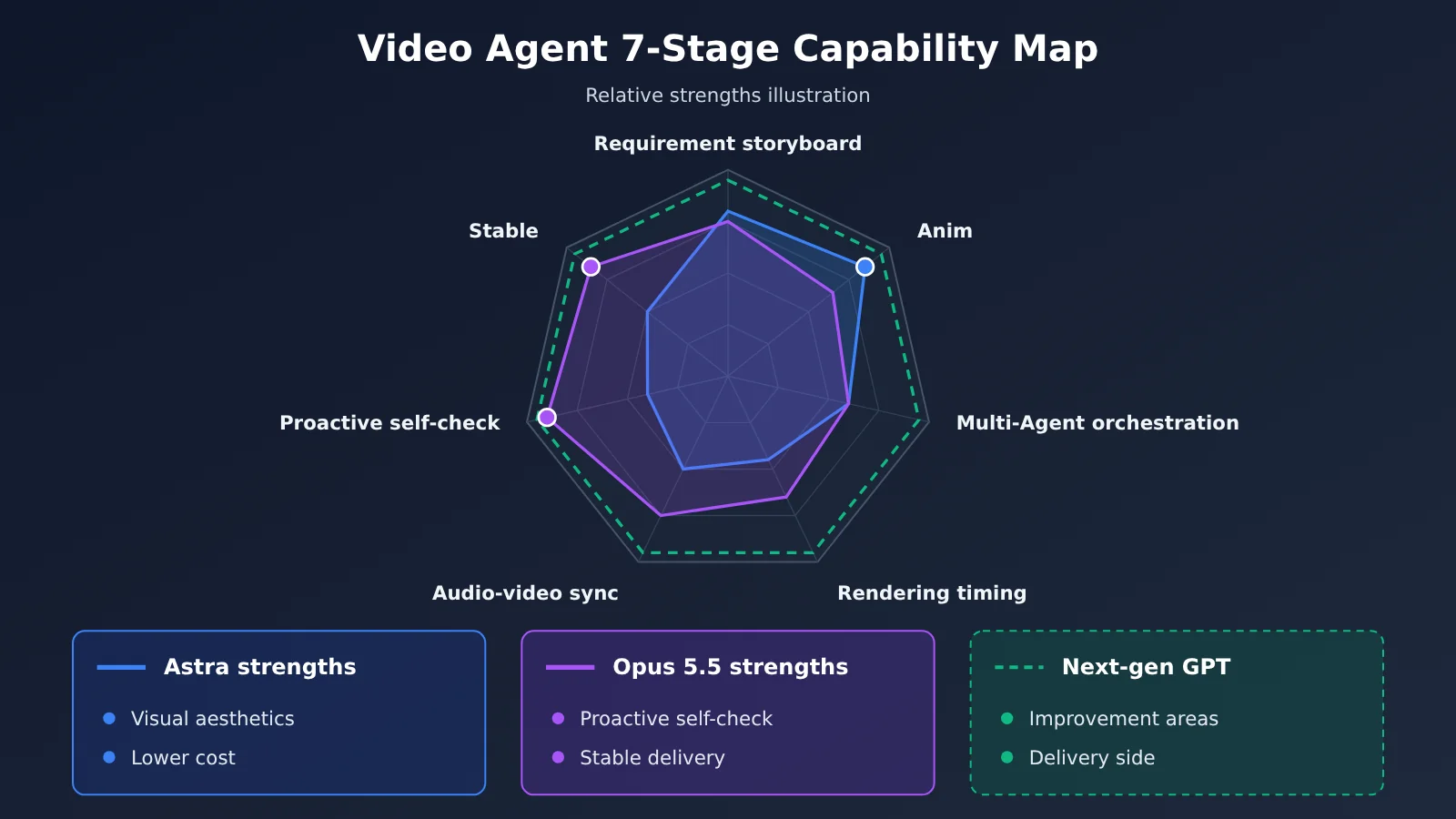
Given their current strengths and weaknesses, if the next-generation model is to clearly surpass Opus 5.5, it needs to improve across all of the following areas at once:
- Requirements and storyboard understanding: Accurately grasp the theme, audience, and style, and break the requirements down into shot order and a timeline.
- Complex animation code: Get Remotion, Three.js, and Python animations right the first time, reducing rework and re-rendering.
- Multi-agent orchestration: Parallelize scripting, animation, and audio; the orchestration capability the internal model demonstrated in mathematical research needs to carry over to these engineering tasks.
- Rendering timing: Reserve enough rendering time to avoid the time-management issues that account for roughly three-quarters of all failures.
- Audio-visual synchronization: Align narration, sound effects, and visual pacing; this is where Opus leads in music-driven tasks.
- Proactive self-checking: Opus checks images 7.9 times on average, while Astra does 3.4 times; self-check frequency is directly tied to specification compliance rate.
- Reliable delivery: A complete MP4 plus an editable project, meeting specifications on the first attempt.
5 After the Next-Gen GPT Launch, How to Verify It Really Surpasses Opus 5.5
5.1 A Seven-Step Comparative Testing Method
Public leaderboards run once, are capped at 60 minutes, and lean heavily on English tasks (209 of 239 are in English), so you’ll need to re-test your own Chinese business scenarios. The following method can be reused directly on launch day:
| Step | What to do | Metrics to watch |
|---|---|---|
| 1 Fix the task set | Pick 10–20 real business video requests covering scripts, animation, data visualization, and product showcases | Task coverage |
| 2 Fix the environment | Standardize the toolchain (Remotion/FFmpeg versions), machine specs, and time limits; log harness differences separately | Comparability |
| 3 Test by stage | First unit-test storyboard and animation code via the API, then run the full pipeline in the agent environment | Per-stage scores |
| 4 Record consumption | Wall-clock time per run, input/output tokens, cache hits | Cost per video |
| 5 Delivery checks | Use ffprobe to verify resolution, frame rate, duration, and audio track | Delivery rate, spec compliance rate |
| 6 Blind tests and repeats | Hide model names for pairwise comparison; run each task at least 3 times | Preference win rate, variance |
| 7 Overall scoring | Weight quality, success rate, revision cost, and cost per video | Final selection conclusion |
Step 3 separates “model capability” from “agent environment capability.” VibeVideoBench measures the full agent system, and Codex CLI and Claude Code differ in their own right. By calling both vendors’ models through the same OpenAI-compatible API to generate storyboards and animation code, you can strip out the harness influence first and see the real gap between the models themselves.
5.2 Code Example for Stage-Level Comparison Using a Unified Interface
The minimal example below calls two models through the same base_url to generate a storyboard for the same video request. Use the platform’s model list to confirm model names.
import openai

client = openai.OpenAI(
    api_key="YOUR_API_KEY",
    base_url="https://api.apiyi.com/v1"  # APIYI unified interface: one key for both GPT and Claude
)

prompt = "为一款记账 App 设计 30 秒竖屏宣传片:给出 6 个镜头的分镜、旁白和每个镜头的时长。"
for model in ["gpt-6-astra", "claude-opus-5-5"]:
    r = client.chat.completions.create(model=model, messages=[{"role": "user", "content": prompt}])
    print(model, r.usage.total_tokens, "\n", r.choices[0].message.content[:300])
View the full multi-round comparison test script (logs timing and tokens)
import time
import json
import openai

client = openai.OpenAI(
    api_key="YOUR_API_KEY",
    base_url="https://api.apiyi.com/v1"  # Unified access via APIYI for easy switching and comparison
)

MODELS = ["gpt-6-astra", "claude-opus-5-5"]  # Refer to the platform's model list; append new models directly when released
RUNS = 3  # Number of repeated runs per task

TASKS = {
    "storyboard": "为一款记账 App 设计 30 秒竖屏宣传片,输出 6 个镜头的分镜、旁白和时长(JSON)。",
    "remotion": "用 Remotion 写一个 10 秒的柱状图增长动画组件,数据为 [12, 30, 45, 80],带标题与数值标签。",
    "data_story": "把“某城市 2020-2025 年新能源车渗透率从 5% 升至 48%”写成 45 秒数据故事视频的脚本和镜头说明。",
}

SYSTEM = "你是视频导演兼前端动画工程师,输出可直接用于代码驱动视频制作的内容。"


def run_once(model: str, prompt: str) -> dict:
    start = time.time()
    resp = client.chat.completions.create(
        model=model,
        messages=[
            {"role": "system", "content": SYSTEM},
            {"role": "user", "content": prompt},
        ],
        max_tokens=4000,
    )
    return {
        "seconds": round(time.time() - start, 1),
        "prompt_tokens": resp.usage.prompt_tokens,
        "completion_tokens": resp.usage.completion_tokens,
        "output": resp.choices[0].message.content,
    }


results = []
for task_name, prompt in TASKS.items():
    for model in MODELS:
        for i in range(RUNS):
            try:
                rec = run_once(model, prompt)
            except Exception as e:
                rec = {"error": str(e)}
            rec.update({"task": task_name, "model": model, "run": i + 1})
            results.append(rec)
            print(task_name, model, i + 1, rec.get("seconds"), rec.get("completion_tokens"))

# Save results, anonymize model names, then hand them to reviewers for blind testing
with open("video_bench_results.json", "w", encoding="utf-8") as f:
    json.dump(results, f, ensure_ascii=False, indent=2)
🚀 Quick start: Stage-level comparison means calling both GPT and Claude. With APIYI at apiyi.com, a single API key and an OpenAI-compatible interface let you switch between the two models. New users get free trial credits — and once the next-gen GPT launches, just add its model name to the
MODELSlist to rerun the same set of tasks.
5.3 Things to Watch for in End-to-End Testing
Once the component-level tests pass, run the full video tasks in Codex CLI and Claude Code, then record the delivery rate and ffprobe check results. Manual blind evaluation only covers videos that were actually delivered — delivery rate has to be tracked separately, otherwise you’d be repeating the same blind spot as VibeVideoBench’s human testing. Run each task at least 3 times and take the mean and variance, so you don’t mistake a single run for stable performance.
6 Decision Guide: Choosing Between GPT and Opus 5.5 for Video Scenarios
6.1 Picking GPT-6 Astra or Opus 5.5 by Scenario
Based on VibeVideoBench’s category scores and delivery data, here’s a reasonable allocation for now:
- Prefer GPT-6 Astra: data- and fact-driven stories, concept and process explanations, narrative and game videos; batch production and cost-sensitive work, where the average task cost is $8.19 and even P90 cost stays more manageable.
- Prefer Claude Opus 5.5: product and feature demos, music-driven videos, paper walkthroughs; commercial deliverables with hard requirements on specs and delivery, such as fixed resolution, duration, and assets that must include an audio track.
- Brand marketing: both score 4.18, so decide based on cost and the toolchain your team already has.
6.2 Wait for the Next-Gen GPT, or Ship Now?
The two current models can already produce usable videos consistently, so there’s no business reason to wait for the next generation. The more practical move is to build your own task set and baseline scores using the method in Section 5, re-run them on launch day when a new model drops, and let the data decide whether to switch.
💡 Recommendation: The two models differ mainly in delivery reliability and cost structure, so the final choice comes down to your video types and delivery requirements. We suggest testing both on the same batch of real tasks through APIYI apiyi.com — a unified interface makes side-by-side comparison easy and lets you switch to a new model later without friction.
7 Final Takeaway: The Next-Generation GPT’s Competitive Target Is No Longer Just Matching Opus 5.5
7.1 Core Points on GPT vs. Opus 5.5 Video Capabilities
- Current state: GPT-6 Astra and Claude Opus 5.5 both sit in the top tier on VibeVideoBench code-driven video tasks, with overall quality at 4.109 versus 4.074.
- Astra’s strengths: visual aesthetics, higher scores in most content categories, and roughly 46.7% lower average task cost.
- Opus 5.5’s strengths: 239/239 successful deliveries, a 99.6% spec-compliance rate, and more frequent self-checks.
- Human preference: 1242 to 1203, with overlapping confidence intervals — statistically indistinguishable.
- Next-generation signals: the internal model scores 0.875 on BenchCAD 2.0 (Astra: 0.594) and demonstrated ten-thousand-scale agent collaboration; its name, release date, and video benchmark results remain unannounced.
- The real bottleneck: roughly 75% of delivery failures stem from time management, and the competitive focus is shifting from generation quality to execution and delivery.
- How to verify: fixed tasks, fixed environment, multiple blind test rounds, and per-unit video cost accounting — all of which you can reproduce at the component level on APIYI apiyi.com using a unified interface.
7.2 The Endgame Is End-to-End Production Efficiency
Back to the headline: GPT has caught up with Opus 5.5. The current Astra holds a slight edge on quality and cost, while Opus 5.5 retains its lead on delivery reliability. OpenAI’s internal model shows stronger general capabilities and multi-agent execution potential, giving the next-generation general-purpose GPT a real shot at pushing video production capability further. Just how far it goes is a question that independent evaluations after release — and your own business tests — will answer.
The next round of competition will come down to end-to-end production efficiency: from understanding a creative brief to shipping a reliable, precise, editable video, whoever can complete more tasks at lower cost wins. My suggestion: build your own video task baseline on APIYI apiyi.com right now, so you can compare directly the moment a new model ships.
References
- VibeVideoBench official evaluation site: video Agent leaderboard and quality scores
- Link:
vibevideobench.github.io -
Description: Overview of the overall leaderboard and evaluation design
-
VibeVideoBench paper: methodology, category-level scores, cost, human preference, and failure reasons
- Link:
arxiv.org/abs/2610.35864 -
Description: The main source for the table data in this article; category-level scores are in Appendix E.4
-
Anthropic Claude Opus 5.5 announcement: model positioning and official examples
- Link:
anthropic.com/claude-opus-5-5 -
Description: Anthropic’s official description of Opus 5.5’s capabilities and cost changes
-
OpenAI: On the Navier–Stokes Millennium Prize Problem: internal models and multi-Agent research
- Link:
openai.com/index/navier-stokes-solution -
Description: Data such as 10,000 concurrent Agents and 88 hours of research
-
OpenAI: Accelerating engineering for the physical world: BenchCAD 2.0 internal model results
- Link:
openai.com/index/accelerating-engineering-for-the-physical-world -
Description: Comparison of the internal model’s 0.875 against GPT-6 Astra’s 0.594
-
OpenAI API Changelog and model catalog: verification of release progress
- Link:
developers.openai.com/api/docs/changelog,developers.openai.com/api/docs/models -
Description: The GPT-6 Cyber release record and the current public flagship models
-
OpenAI API Deprecations: Sora 2 and Videos API shutdown information
- Link:
developers.openai.com/api/docs/deprecations - Description: The current state of the native video generation route
Author: APIYI Technical Team
Technical discussion: Feel free to contact us through the APIYI apiyi.com homepage to share your video Agent testing experience. For more integration resources, visit the docs.apiyi.com documentation center.