Author’s note: Compare Qwen4-Max and Claude Opus 5.5 across four task categories—terminal and codebase, long office tasks, multimodal long documents, and cost—on benchmark scores, specs, cache pricing, and migration cost, and offer actionable selection recommendations.
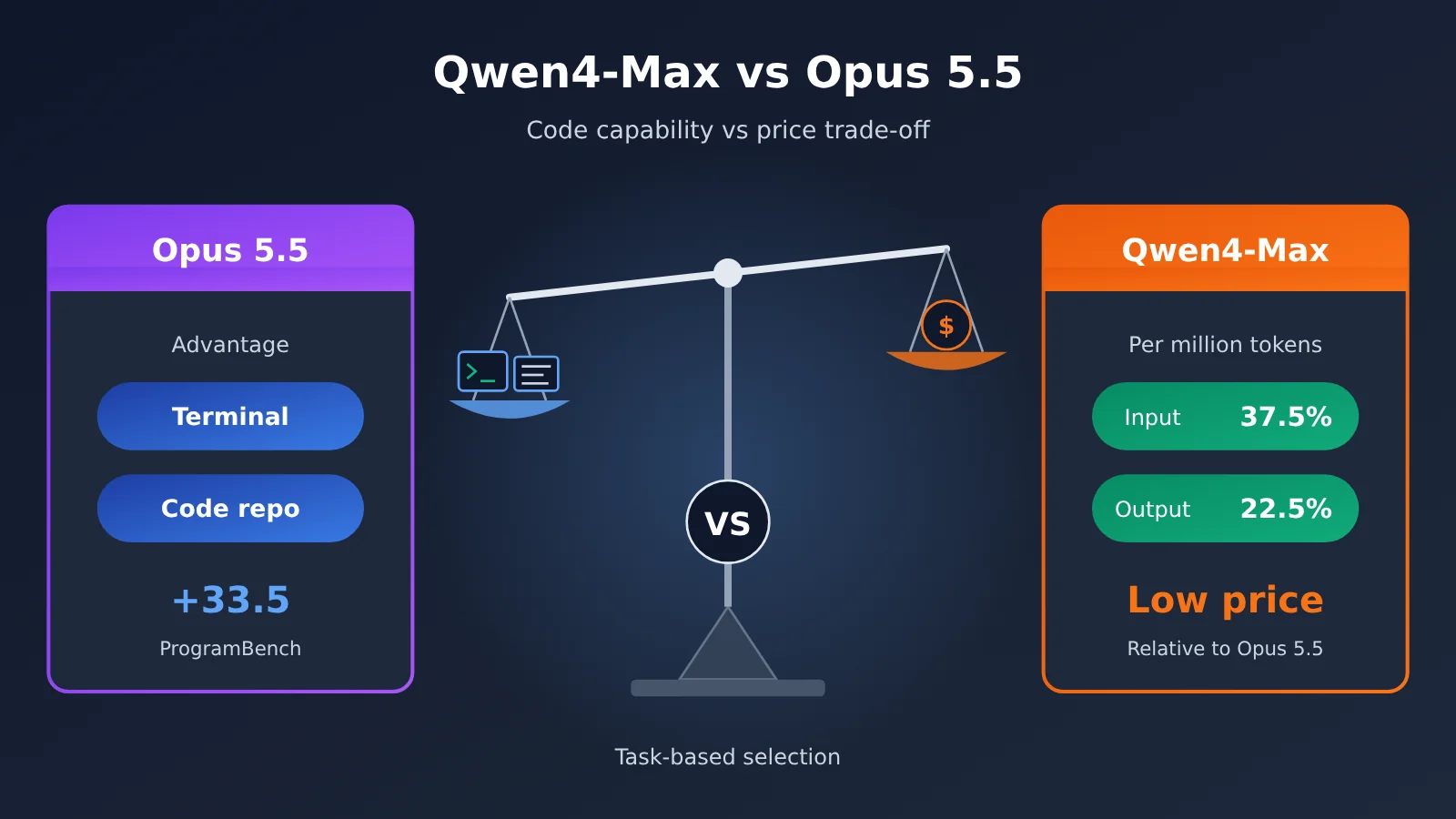
If your team already runs Claude Opus 5.5 as the workhorse in Claude Code or self-built agents in production, then Qwen4-Max, released on 2026-11-16, will make you redo the math: its input price is only 37.5% of Opus 5.5’s, and its output price is only 22.5%.
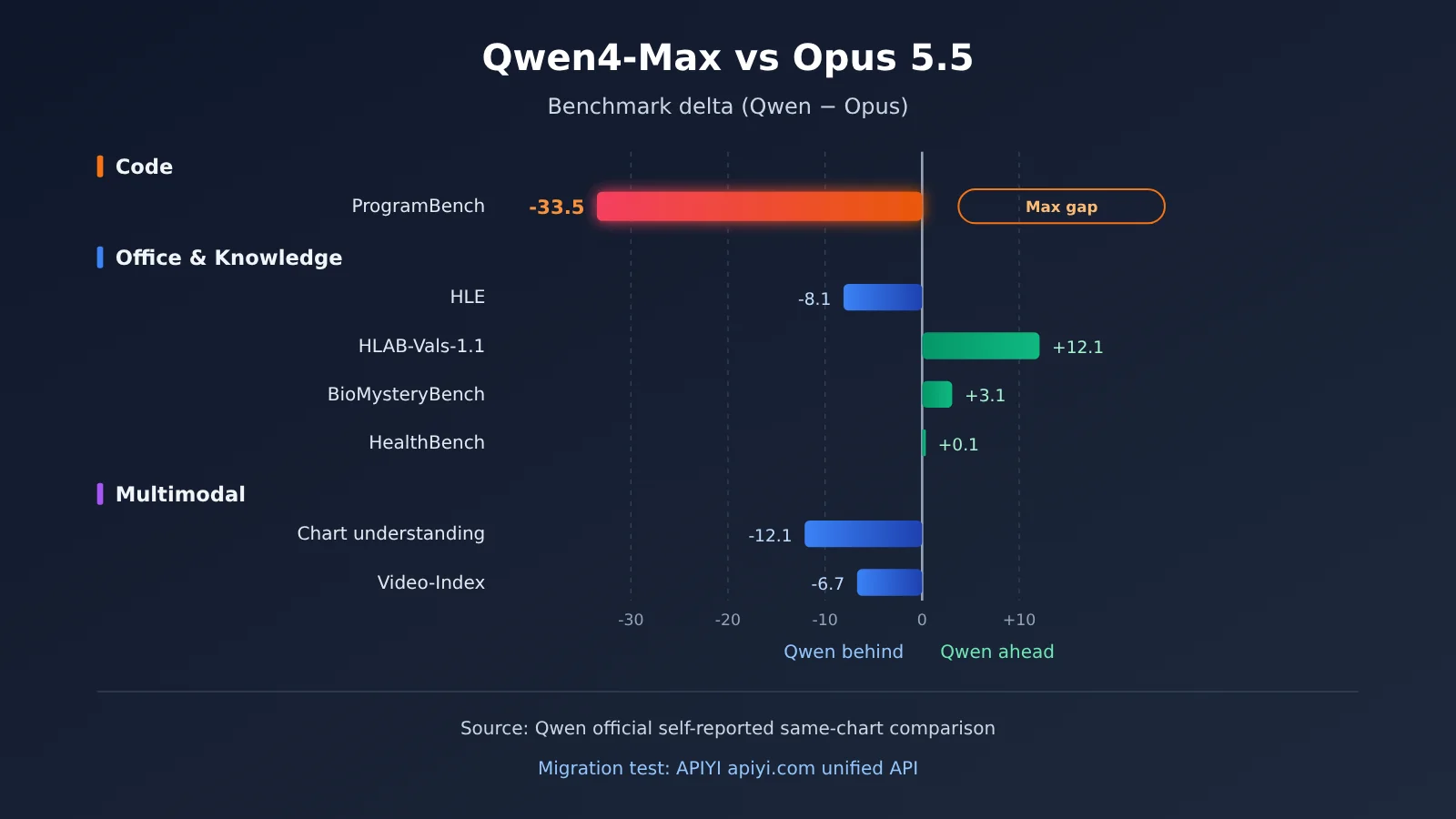
Bottom line first, no hedging: Keep terminal operations and repo-level refactoring on Opus 5.5—Qwen4-Max trails by 33.5 points on ProgramBench, the biggest weakness in this comparison. For workflow automation, cost-sensitive high-concurrency agents, and ultra-long-output document tasks, you can prioritize trying Qwen4-Max. For office deliverables and chart/video understanding tasks, Opus 5.5 still has a clear edge.
Key value: After reading this, you’ll get a task-by-task trade-off table and a clear picture of the differences in cache pricing, default reasoning tiers, and actual migration steps on both sides.
Qwen4-Max vs Opus 5.5: Core Differences at a Glance
Let’s get the data sources straight first. The numbers in this article come from three distinct sources, and you shouldn’t mix them:
- Qwen’s official self-reported same-chart comparison: Alibaba’s launch blog puts Qwen4-Max and Opus 5.5 scores in the same chart. This is a vendor-run benchmark, not a third-party reproduction.
- Public leaderboard snapshot, 2026-11-14: arena.ai’s Code Arena WebDev leaderboard, based on public votes.
- Anthropic’s own documentation: Opus 5.5’s specs and pricing come from Anthropic’s official model page and pricing page.
The table below distills the article’s conclusions; later sections break down the evidence item by item.
| Task type | Recommendation | Key evidence | One-line rationale |
|---|---|---|---|
| Terminal operations and repo-wide refactoring | Opus 5.5 | Qwen4-Max trails by 11.1 on Terminal-Bench and 33.5 on ProgramBench | Multi-step command chains and repo-wide changes are Qwen4-Max’s weakest link |
| Single-issue fix coding | Qwen4-Max (worth trying) | Qwen4-Max leads by 1.5 on DeepSWE | Localized fix capability is now on par, and the price advantage is clear |
| Office deliverables and long-running tasks | Opus 5.5 | Qwen4-Max trails by 115 Elo on AA-Briefcase and 6.9 on JobBench | The quality gap in documents and reports is noticeable |
| Workflow automation | Qwen4-Max | Qwen4-Max leads by 3.0 on AutomationBench | It holds its own on clearly rule-based process tasks and costs less |
| Chart and video understanding | Opus 5.5 | Qwen4-Max trails by 12.1 on Chartography and 6.7 on Video-Index | There’s still a gap in multimodal image understanding |
| Cost-sensitive, high-concurrency agents | Qwen4-Max | Input at 37.5% and output at 22.5% of Opus pricing | At high volume, the billing gap compounds |
Qwen4-Max vs Opus 5.5: Specification Differences
On specs, both have a 1M context window, but their output and reasoning defaults are quite different:
- Qwen4-Max: 2.4T backbone, 71B active parameters, plus 328B N-gram Embedding; native vision; max output 393K, max chain-of-thought 262K; default
reasoning_effortis high. - Opus 5.5 (per Anthropic’s documentation): positioned for long-running agentic coding and knowledge work; max output 128K; default effort is medium; knowledge cutoff June 2026.
The default setting is easy to miss. Qwen4-Max is set to high by default, and thinking tokens are billed at the output rate, so the real bill gap is usually smaller than the 22.5% output-price ratio would suggest. The pricing section later will provide corroborating evidence from a public leaderboard.
Qwen4-Max vs. Opus 5.5: Terminal and Codebase Tasks
This is the part current Opus users care about most—and the part where Qwen4-Max deserves the most caution.
| Benchmark (Qwen’s official self-reported, same-chart comparison) | Qwen4-Max | Opus 5.5 | Difference |
|---|---|---|---|
| DeepSWE v1.1 | 75.7 | 74.2 | Qwen higher by 1.5 |
| CodeArena WebDev Elo | 1750 | 1816 | Qwen lower by 66 |
| Terminal-Bench 4.0 | 48.5 | 59.6 | Qwen lower by 11.1 |
| ProgramBench | 31.5 | 65.0 | Qwen lower by 33.5 |
Let’s look at what each score means in practice:
- DeepSWE higher by 1.5: On tasks like targeted fixes for a given issue, Qwen4-Max is already on par with Opus 5.5. A 1.5-point difference is basically a tie, so it’s suitable for running low-risk bug-fix queues.
- WebDev lower by 66 Elo: For the overall look and feel of front-end page generation, user votes still favor Opus. When building landing pages and component prototypes, the gap is visible to the naked eye.
- Terminal-Bench lower by 11.1: It’s clearly behind at running commands consecutively in a terminal, reading output, and deciding what to do next. That’s everyday work in Claude Code-style workflows, so making the switch means more cases of getting stuck midway or requiring human takeover.
- ProgramBench lower by 33.5: This is the biggest weakness in this comparison, with the score nearly halved. For tasks that involve building a program from scratch or rewriting it at a large scale, Qwen4-Max isn’t suitable as a stand-in for Opus 5.5 right now.
The public leaderboard also provides similar positioning data. According to the public leaderboard snapshot on 2026-11-14, arena.ai Code Arena WebDev has 1,007,405 votes across 159 models: Opus 5.5 (Max) ranks 2nd with 1,816 points, while Qwen4-Max (xHigh) ranks 6th with 1,750 points. But Qwen4-Max has only 1,814 votes and is still marked Preliminary, so its ranking will keep shifting.
Recommendations for Qwen4-Max in Codebase Scenarios
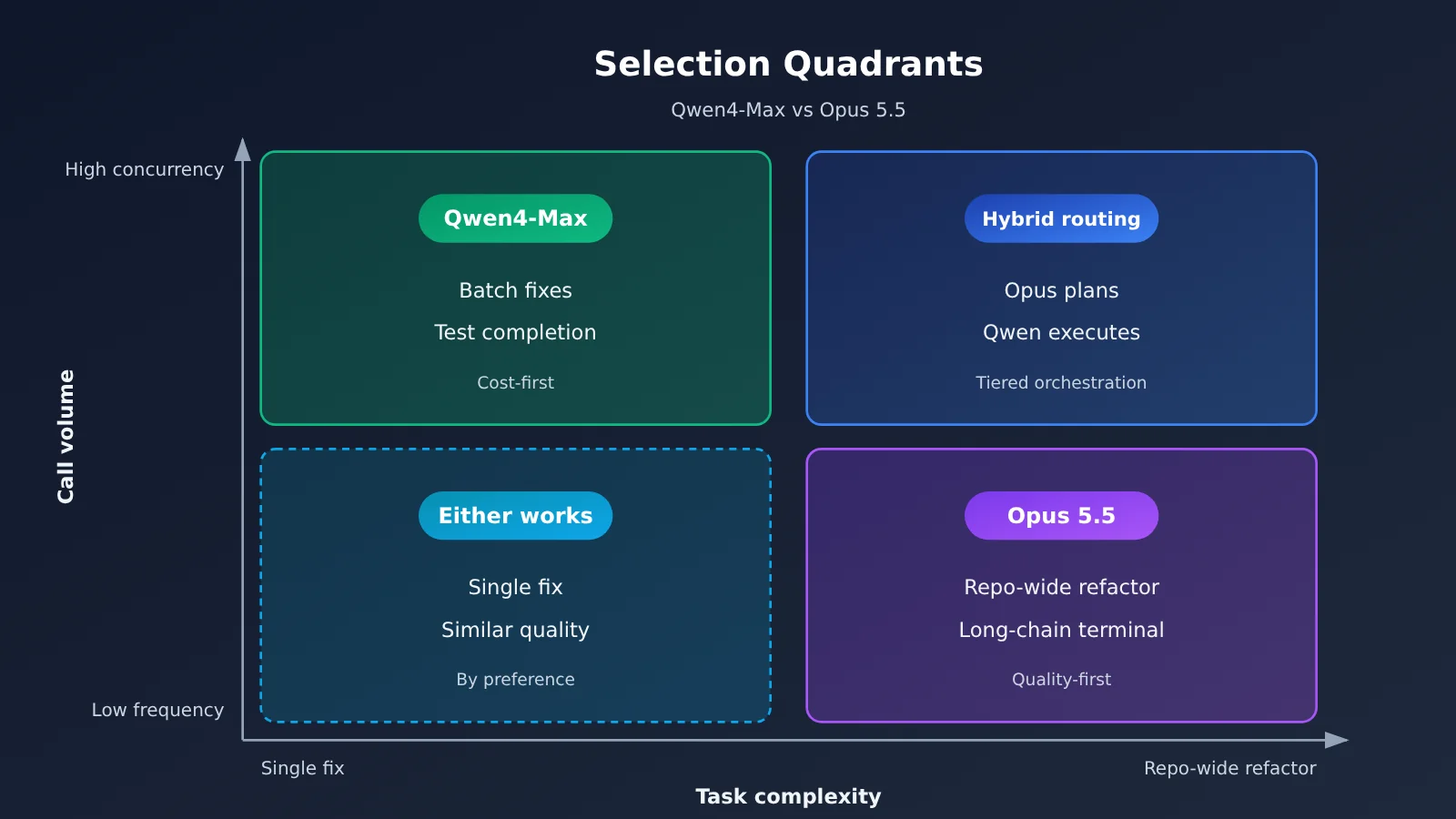
If your agent mainly does full-repo refactoring, cross-module migrations, or long-chain terminal operations, it’s better to keep Opus 5.5 in place. If you’ve split tasks into two layers—planning + execution—you can let Opus 5.5 handle planning and key changes, and route local tasks like single-file fixes and test completion to Qwen4-Max.
Qwen4-Max vs. Opus 5.5: Office and Long-Horizon Tasks
Results for office-style and long-horizon agent tasks are more mixed than coding—there are wins and losses on both sides.
| Benchmark (Qwen’s official self-reported, same-chart comparison) | Qwen4-Max | Opus 5.5 | Difference |
|---|---|---|---|
| AA-Briefcase v1.1 Elo | 1686 | 1801 | Qwen lower by 115 |
| JobBench | 68.5 | 75.4 | Qwen lower by 6.9 |
| APEX-Agents v1.1 | 72.1 | 73.5 | Qwen lower by 1.4 |
| AutomationBench-AA | 72.5 | 69.5 | Qwen higher by 3.0 |
| AgentArena Net Improvement | 7.5 | 18.2 | Qwen lower by 10.7 |
Translated into real work:
- AA-Briefcase lower by 115 Elo: For office deliverables like reports, proposals, and spreadsheets, Opus 5.5’s output is more likely to be adopted as-is. This is the biggest gap in the office scenario.
- JobBench lower by 6.9: Opus still leads on overall completion of tasks that closely mirror real job roles, which means end-to-end delivery may have a higher rework rate.
- APEX-Agents lower by 1.4: General agent tasks are essentially a tie; switching models won’t create a noticeable experience gap.
- AutomationBench higher by 3.0: Process automation with clear rules is actually a Qwen4-Max strength. Form processing, data movement, and scheduled task orchestration are good candidates to migrate first.
- AgentArena Net Improvement lower by 10.7: Its ability to keep improving over multiple rounds is weaker. The longer a long-horizon task runs and the more it depends on the model’s self-correction, the steadier Opus is.
Also, Qwen4-Max’s 393K max output and 262K chain-of-thought cap are a real advantage for long-horizon tasks that need to produce extremely long content in one go; Opus 5.5’s max output is 128K.
Qwen4-Max vs Opus 5.5: Chinese-Language and Multimodal Long Documents
One clarification up front: the comparison charts in the reference materials contain no dedicated Chinese-language benchmark, so this article can’t answer “who’s better at Chinese” with numbers. If Chinese quality is your core metric, run your own A/B test on your own sample set — don’t lean on anyone’s secondhand conclusion.
Where the numbers do the talking is multimodal and knowledge-heavy tasks:
| Benchmark (same-chart comparison, self-reported by Qwen) | Qwen4-Max | Opus 5.5 | Delta |
|---|---|---|---|
| Chartography | 54.2 | 66.3 | Qwen 12.1 lower |
| Video-Index | 68.1 | 74.8 | Qwen 6.7 lower |
| Humanity’s Last Exam | 51.7 | 59.8 | Qwen 8.1 lower |
| HLAB-Vals-1.1 | 21.3 | 9.2 | Qwen 12.1 higher |
| BioMysteryBench | 85.0 | 81.9 | Qwen 3.1 higher |
| HealthBench Professional | 60.0 | 59.9 | Essentially tied |
What these figures actually mean: on reading charts — pulling graphical data out of earnings reports and analyst research — Qwen4-Max trails by 12.1 points, and it’s prone to missing or misreading the axes. Video understanding shows a 6.7-point gap too, and on high-difficulty general knowledge questions (HLE) it’s 8.1 points behind. On the flip side, Qwen4-Max holds even or edges slightly ahead on biological reasoning and professional medical Q&A, leading HLAB-Vals by 12.1 points.
So long-document work needs to be broken down further: for text-dominant documents that demand very long output, Qwen4-Max is a solid first-choice candidate; for chart-dense PDFs or material with video content, stay with Opus 5.5.
Qwen4-Max vs. Opus 5.5: Per-Million-Token Pricing and Cache Math
Price is the strongest argument for Qwen4-Max. All units in the table below are per 1M tokens. Official prices are taken directly from the QwenCloud and Anthropic documentation, while current APIYI prices come from docs.apiyi.com/models; data collected on 2026-11-16.
| Billing item ($/1M tokens) | Qwen4-Max official | Opus 5.5 official | Qwen/Opus | APIYI qwen3.8-max |
APIYI claude-opus-5-5 |
|---|---|---|---|---|---|
| Input | 1.5 | 4 | 37.5% | 1.65 | 4 |
| Output | 4.5 | 20 | 22.5% | 4.95 | 20 |
| Cache read | 0.075 | 0.20 | 37.5% | 0.20625 | 0.2 |
| 5-minute cache write | 1.875 | 5 | 37.5% | See platform listing | See platform listing |
| 1-hour cache write | 3 | 8 | 37.5% | See platform listing | See platform listing |
The two providers’ cache structures are actually completely identical: cache reads are 5% of the input price, 5-minute cache writes are 1.25x the input price, and 1-hour cache writes are 2x. That means any cache strategy you designed for Opus can be moved over to Qwen4-Max as-is, with the bill scaling down proportionally to 37.5%. One thing to watch: on APIYI, cache reads for qwen3.8-max are 12.5% of the input price, which differs from Qwen4-Max official pricing, so when migrating, calculate separately based on the actual model.
A Concrete Cost Breakdown
Take 100M input tokens + 10M output tokens as an example: Qwen4-Max is about $195 (150 + 45), and Opus 5.5 is about $600 (400 + 200). The difference is about $405, or two-thirds of the Opus bill.
But list price isn’t the same as what you actually pay. Public leaderboard snapshot, 2026-11-14 gives the P50 per-task cost: Opus 5.5 (Max) at $8.99, Qwen4-Max (xHigh) at $4.18—a ratio of about 46%, not the 22.5% list-price ratio. The reason is that the two use different reasoning tiers: Qwen4-Max defaults to high, and chain-of-thought is billed as output, so it consumes more tokens. How much you actually save depends on your task length and reasoning tier, so it’s worth replaying your own traffic to measure.
💰 Cost tip: When comparing bills, record token counts for all four items—input, output, cache reads, and cache writes—instead of just looking at the unit price. Call both models in parallel under the same account through APIYI apiyi.com, and your usage details will line up in one place.
Qwen4-Max vs. Opus 5.5: Decision Guidance and a Three-Step Migration
Moving an agent from Opus to Qwen comes down to three unavoidable steps: check the model lineup, compare pricing, and match the protocol.
Step 1: Check the model lineup. As of 2026-11-16, Qwen4-Max isn’t listed on APIYI yet — we’ll get it up as soon as we can; the strongest Qwen model available right now is qwen3.8-max. On the Opus side you can use claude-opus-5-5, plus claude-opus-5-5-thinking at the same price. Confirm model names and prices against the model list in the apiyi.com documentation center; before Qwen4-Max goes live, you can build your staged rollout pipeline on qwen3.8-max.
Step 2: Compare pricing. Using the method from the previous section, estimate costs on both sides with a week of real traffic, and line up the reasoning tiers before you compare. The model list on APIYI apiyi.com puts input, output, and cache reads into one single table, which makes it a convenient data source for your cost worksheet.
Step 3: Match the protocol. APIYI provides an OpenAI-compatible interface with the endpoint https://api.apiyi.com/v1. To switch models you only change the model field — for example, from claude-opus-5-5 to qwen3.8-max — while api_key and base_url stay the same. There are two extra things to check: on the Qwen side the reasoning-strength parameter is called reasoning_effort and defaults to high, so set it explicitly if you want to align it with Opus’s medium; and cache write duration and hit rules also need to be re-verified for the target model.
🎯 Staged rollout advice: Don’t switch the whole agent in one shot. We recommend routing traffic under the same
base_url(https://api.apiyi.com/v1) by task type: migrate automation and localized-fix tasks first, keep terminal and whole-repo tasks on Opus 5.5, and watch the rework rate for two weeks before deciding what’s next.
FAQ
Q1: Which is better for coding agents, Qwen4-Max or Opus 5.5?
It depends on the task granularity. For single-issue fixes (DeepSWE), the two are on par, so you can save money with Qwen4-Max; for multi-step terminal operations and whole-repo builds (Terminal-Bench, ProgramBench), Opus 5.5 leads clearly — especially on ProgramBench, where it’s ahead by 33.5 points. Keep using Opus for those tasks.
Q2: Can the scores on Alibaba’s chart be compared directly with the arena leaderboard?
No, they’re not the same measurement basis. The former is Qwen’s officially self-reported comparison on the same chart; the latter is a snapshot of a public leaderboard (2026-11-14), and Qwen4-Max has only 1,814 votes there and is still marked Preliminary. The two can be used to cross-reference trends, but they shouldn’t be merged into a single conclusion about “how many points ahead” it is.
Q3: How much money can I actually save by switching to Qwen4-Max?
On list price, you save 62.5% on input and 77.5% on output. But the per-task cost P50 ratio on the public leaderboard is about 46%, because Qwen4-Max defaults to a higher reasoning tier and uses more thinking tokens. To know your real savings, you’ll need to measure them by replaying your own traffic.
Q4: Can I call Qwen4-Max on APIYI right now?
Not yet — Qwen4-Max hasn’t been listed, but we’ll get it up as soon as we can. For now you can use `qwen3.8-max` to build your migration path; once it’s listed, you’ll only need to change the `model` field. For model availability, always refer to the model list at APIYI apiyi.com.
Q5: How much code do I need to change to switch from Opus to Qwen?
If you’re already using an OpenAI-compatible interface, just point `base_url` at `https://api.apiyi.com/v1` and change the model name — plus set `reasoning_effort` as needed. After signing up at APIYI apiyi.com, you can use the free trial credits for new users to run an initial comparison.
Q6: What are the known limitations of Qwen4-Max?
Terminal and whole-repo coding are its biggest weak spots; it also trails by 12.1 points in chart comprehension, its Elo on office deliverables is 115 lower, and its multi-turn self-improvement ability is weaker too. On top of that, all comparison scores are vendor self-reported with no third-party reproduction yet, and there’s no dedicated benchmark data for its Chinese-language capabilities.
Qwen4-Max vs Opus 5.5: Key Takeaways
- Biggest weakness: 33.5 points lower on ProgramBench; keep using Opus 5.5 for full-repo builds and refactors.
- Parity areas: Essentially tied on DeepSWE, APEX-Agents, and HealthBench, so these can be offloaded first.
- Qwen advantages: Workflow automation, biomedical reasoning, 393K ultra-long output.
- Pricing structure: Input at 37.5%, output at 22.5%; all four cache ratios are structurally identical to Opus.
- Effective cost gap: The default reasoning tier is high; cost ratio on public benchmark tasks is about 46%.
- Migration path: On APIYI apiyi.com, run
qwen3.8-maxon the same endpoint first; once Qwen4-Max is available, swap it in directly.
Summary
Choosing between Qwen4-Max and Opus 5.5 comes down to three points:
- Leave terminals and code repositories to Opus 5.5: The gaps on Terminal-Bench and ProgramBench aren’t covered by the price difference when weighed against rework costs.
- Hand automation and high-concurrency workloads to Qwen4-Max: On tasks where capabilities are on par or ahead, 30–50% off the bill is pure gain.
- Route by task, not wholesale replacement: Using the same interface and routing by task type is the lowest-risk migration approach.
We recommend first running a round of your own task replays on APIYI apiyi.com with qwen3.8-max and claude-opus-5-5, then making the final switch decision once Qwen4-Max is available.
📚 References
- Qwen4-Max Launch Blog: Model specs and side-by-side comparison with officially reported benchmarks
- Link:
qwen.ai/blog?id=qwen4-max -
Notes: Includes architecture parameters, context and output limits, and side-by-side benchmark scores
-
Anthropic Model Overview: Opus 5.5 specifications
- Link:
platform.claude.com/docs/en/about-claude/models/overview.md -
Notes: Context, maximum output, default effort, and knowledge cutoff
-
Anthropic Pricing Page: Opus 5.5 input, output, and cache pricing
- Link:
platform.claude.com/docs/en/about-claude/pricing.md -
Notes: Includes 5-minute and 1-hour cache write pricing
-
APIYI Model List: Current platform pricing and available models
- Link:
docs.apiyi.com/models - Notes: Check model availability and pricing before migrating
Author: APIYI Technical Team
Technical Contact: Feel free to reach us through the APIYI homepage at apiyi.com. For more integration resources, visit the docs.apiyi.com documentation center.