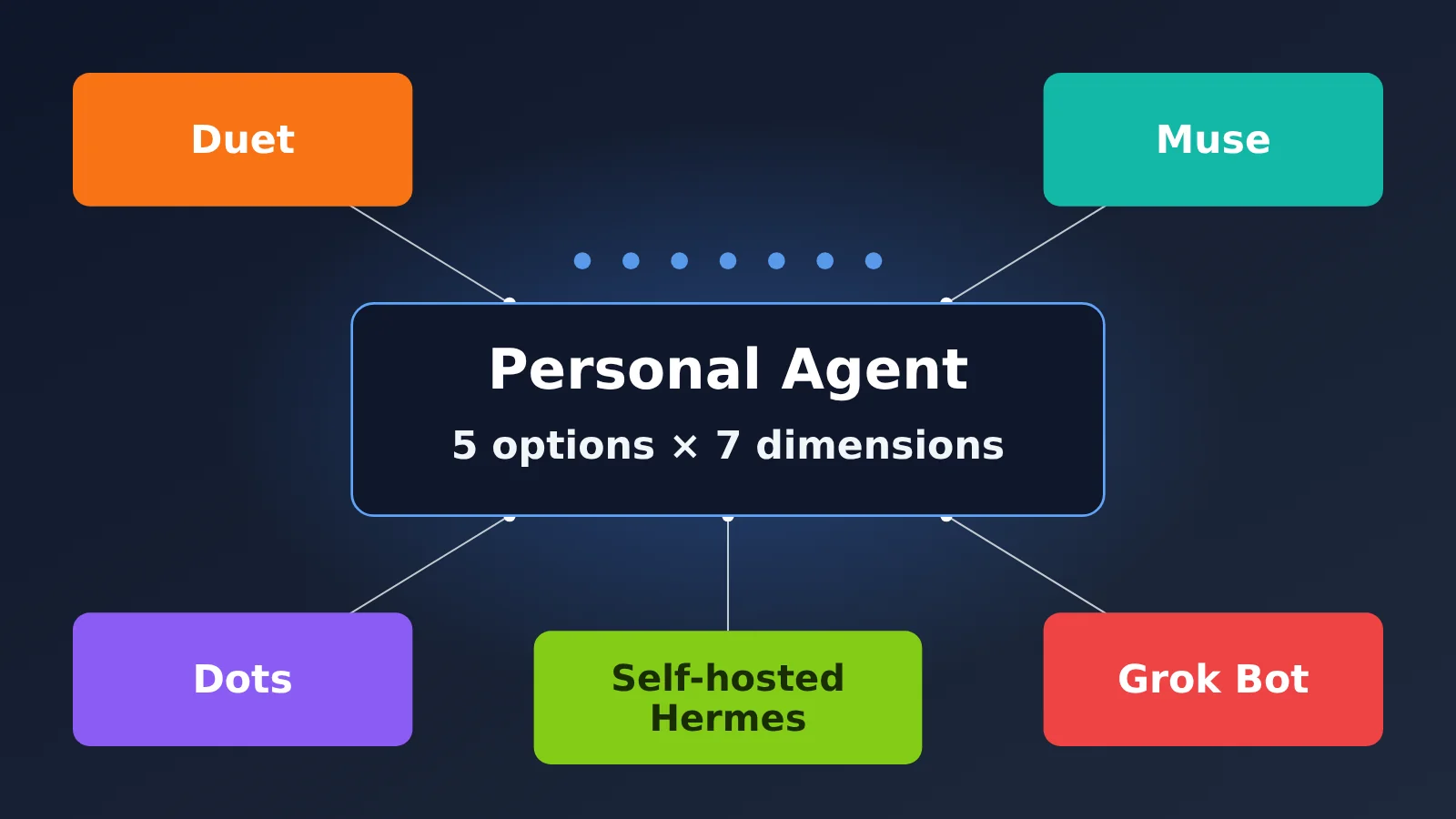
Author’s note: This article compares Claude Duet, Meta Muse, OpenAI Dots, xAI Grok Bot, and a self-hosted Personal Agent (using the open-source Hermes as an example) across seven dimensions: positioning and access, regional restrictions, pricing, execution environment, memory, permissions and approvals, and data sovereignty. It also offers a selection checklist for developers in China.
The bottom line: If you’re in China, want to choose your own model, and need to keep control of your data, all four hosted Personal Agents currently come with regional or account restrictions. A self-hosted Personal Agent paired with a model API proxy service is the most practical option right now. The trade-off is that you’re entirely responsible for security and operations.
A series of new products entered the personal agent space between August and October 2026. In chronological order: Grok Bot entered beta on August 11, Muse launched on September 8, Dots launched on September 29, Duet entered research preview on October 21, and the open-source Hermes Agent released v0.22.5 on October 22. This isn’t a “they all have their strengths” compromise piece. All facts below come from the providers’ official pages. Any figures from vendor marketing are labeled “vendor-reported,” and anything we haven’t tested is labeled “not independently tested.”
Let’s start with an overview before breaking things down dimension by dimension.
| Solution | Positioning and access | Regional restrictions and requirements | Pricing | Execution environment | Memory and self-learning | Permissions and approvals | Control and data sovereignty |
|---|---|---|---|---|---|---|---|
| Claude Duet | Proactive work agent; iOS/Android apps and claude.ai | US-only Pro/Max subscribers; waitlist required | Included with Pro/Max; shares usage limits | Dedicated cloud computer | Inherits Claude’s memory, skills, and connectors | Sending messages, making payments, signing documents, and deleting require approval | Fixed to Opus 5.5; no model choice |
| Meta Muse | Personal agent for everyday users; app, web, and WhatsApp | US only | Basic features are free; advanced features require a subscription | Muse Secure VM + Sentinel isolation | Goals for long-term objectives; you can ask it to forget memories | Can’t see passwords or payment methods; actions are audited | Meta chooses the model; data doesn’t enter its advertising system |
| OpenAI Dots | Around-the-clock agent; ChatGPT app, Slack, Teams, and voice | Pro plan; excludes the EEA, UK, and Switzerland | Conversations don’t count toward ChatGPT limits; tasks spawned by conversations are billed separately | Cloud computer + browser; can connect to one of your own computers | Memory persists across channels | ChatGPT permissions system + automated review | Powered by GPT-6 Astra; can’t switch providers |
| xAI Grok Bot | Multiple “AI teammates”; desktop and iOS | Requires an eligible subscription (beta) | $30/$100/$200 per month, including weekly usage; overages charged per token | Multiple bots share one persistent cloud computer (Cursor Cloud) | Demonstrate something once and it’s saved as a skill or routine | Enterprise DLP and network policies | Training opt-out available; model provided by xAI |
| Self-hosted (Hermes) | Open-source framework; one gateway connects multiple IM platforms | No regional restrictions; requires your own server | Free software (MIT); pay for model usage | Six backends, including local, Docker, and SSH | Learning loop creates its own skills | You must set up approvals and isolation yourself | Choose your own model; data stays under your control |
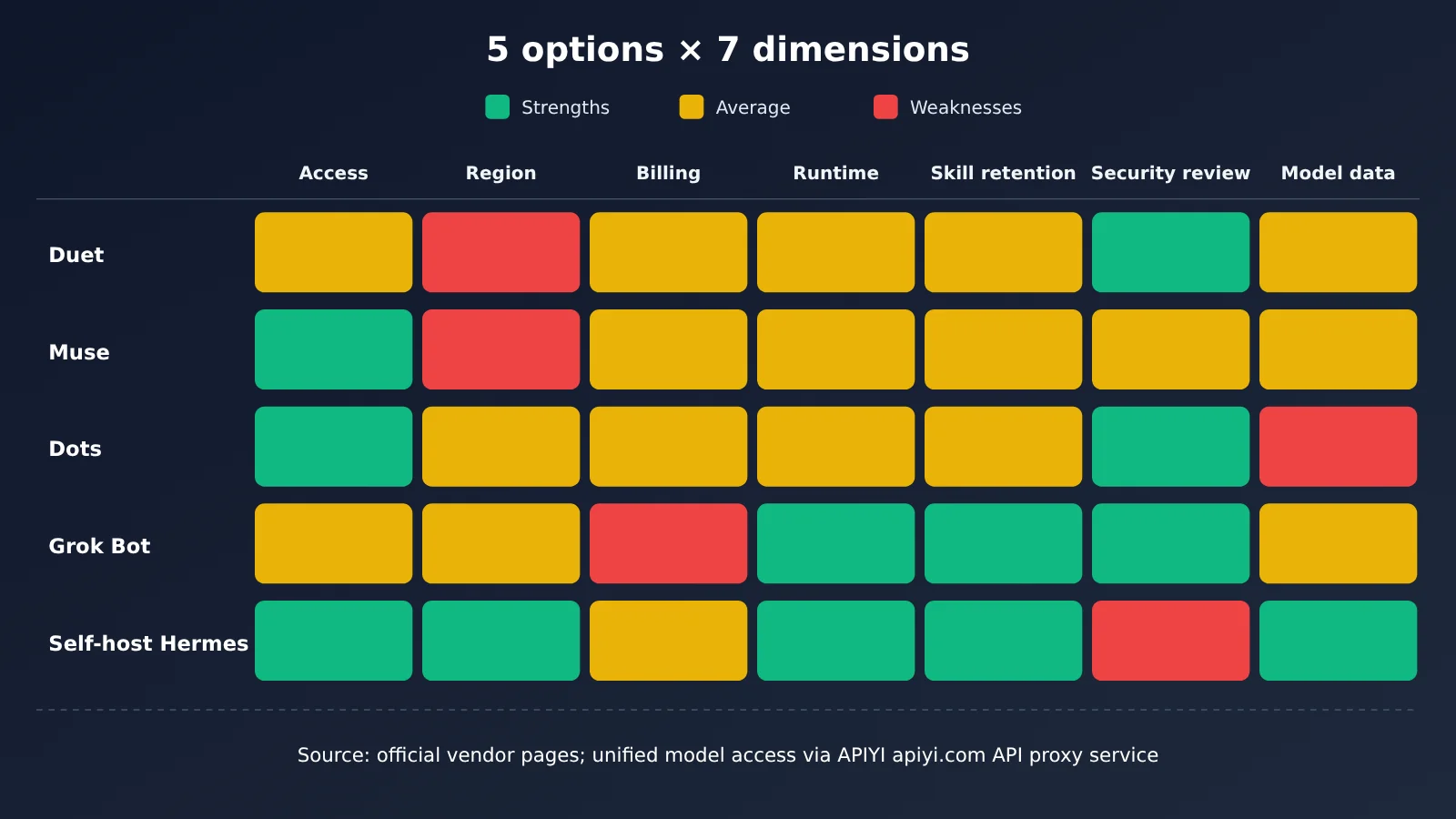
Key Differences Between Personal Agents: A Breakdown Across 7 Dimensions
Dimension 1: Personal Agent Positioning and Access
Duet is designed to let you delegate work “like messaging a colleague.” Give it a brief in the morning, and it’ll get back to you when the work is done or it needs your decision. It’s geared toward workplace tasks. Muse takes the opposite approach: its creators emphasize that “no technical background is required.” It can send emails, book travel, compare prices, negotiate deals, and chat directly in WhatsApp. Dots puts the same agent in ChatGPT, Slack, Teams, and voice calls, with a handle like @yourname-dot. Grok Bot lets one account create multiple bots, each with a name and a “role.” Its official examples include outbound sales calls and weekly reports.
With a self-hosted setup, you decide where to access your agent. Hermes uses a single gateway process to connect to Telegram, Discord, Slack, WhatsApp, Signal, and Email. A caveat for this dimension: If your team primarily collaborates in Feishu or WeCom, none of the four hosted products offers a native integration. You’ll need to consider a self-hosted setup and build the integration yourself.
Dimension 2: Personal Agent Availability and Access Requirements
This dimension matters most to readers in China. Here’s what each provider officially says:
- Duet: Available only to Pro and Max subscribers in the US, with a waitlist; Team and Enterprise aren’t supported yet;
- Muse: Available only in the US;
- Dots: The Pro 100, Pro 200, and Pro 500 plans require users to be 18 or older and exclude the European Economic Area, the UK, and Switzerland; Business Premium is rolling out globally; Enterprise is off by default and must be enabled by an administrator;
- Grok Bot: Included in eligible subscription plans. The public information used for this article doesn’t list separate regional restrictions; check xAI’s official list of supported regions;
- Self-hosted: No regional restrictions, but you’ll need to provide your own server and model API.
For availability in China, check each provider’s official list of supported regions. This article doesn’t provide methods for bypassing restrictions.
Dimension 3: Personal Agent Pricing Models
Most hosted products use a “subscription + usage allowance” model, while self-hosted setups are pay-as-you-go. Each has a different risk: with subscriptions, you might hit your allowance and get rate-limited; with pay-as-you-go, your token bill can spiral out of control.
| Option | Pricing | Usage allowance | What to watch out for |
|---|---|---|---|
| Duet | Included in Pro/Max at no extra charge during the research preview | Shares five-hour session and weekly limits with other Claude features | Background monitoring and large tasks like building financial models can consume substantial usage |
| Muse | Free for everyday use; subscriptions available for higher usage | No specific tier figures published | Subscription tiers aren’t yet transparent |
| Dots | Pro 100/200/500 plans | Conversations with dots don’t count toward ChatGPT limits, but tasks assigned to Work/Codex do; higher grace allowance in the first month (according to the provider) | Usage from delegated tasks is easy to overlook |
| Grok Bot | Premium $30/month, Super $100/month, Ultra $200/month | Includes a weekly allowance; Super offers 3.5× and Ultra 12× the usage (according to the provider) | Overage is billed separately based on token costs |
| Self-hosted | Free software; you pay for models and servers | No built-in cap; you set your own budget | You’ll need to configure usage alerts yourself |
Tip: If you need a strictly fixed monthly budget, set spending caps in advance for both Grok Bot’s token overages and a self-hosted setup’s pay-as-you-go costs.
Dimension 4: Where Personal Agents Run (Cloud Computer / VM / Local Machine)
Duet runs on “your own cloud computer.” Muse uses Muse Secure VM, a dedicated cloud virtual machine that also runs a Sentinel agent for system-level isolation. All of Muse’s outbound network requests must be approved by Sentinel. Dots comes with a cloud computer and browser, allowing it to “take over” pages and interact with them directly. On desktop, it can also connect to one of your own computers, as long as the ChatGPT app is online. It can connect to only one computer at a time.
Grok Bot takes a different approach: all bots under the same account share a persistent cloud computer running on Cursor’s cloud, including its files, browser, and login sessions. The company explicitly states that isolation is per user, not per bot. Hermes offers six terminal backends: local, Docker, SSH, Modal, Daytona, and Vercel Sandbox.
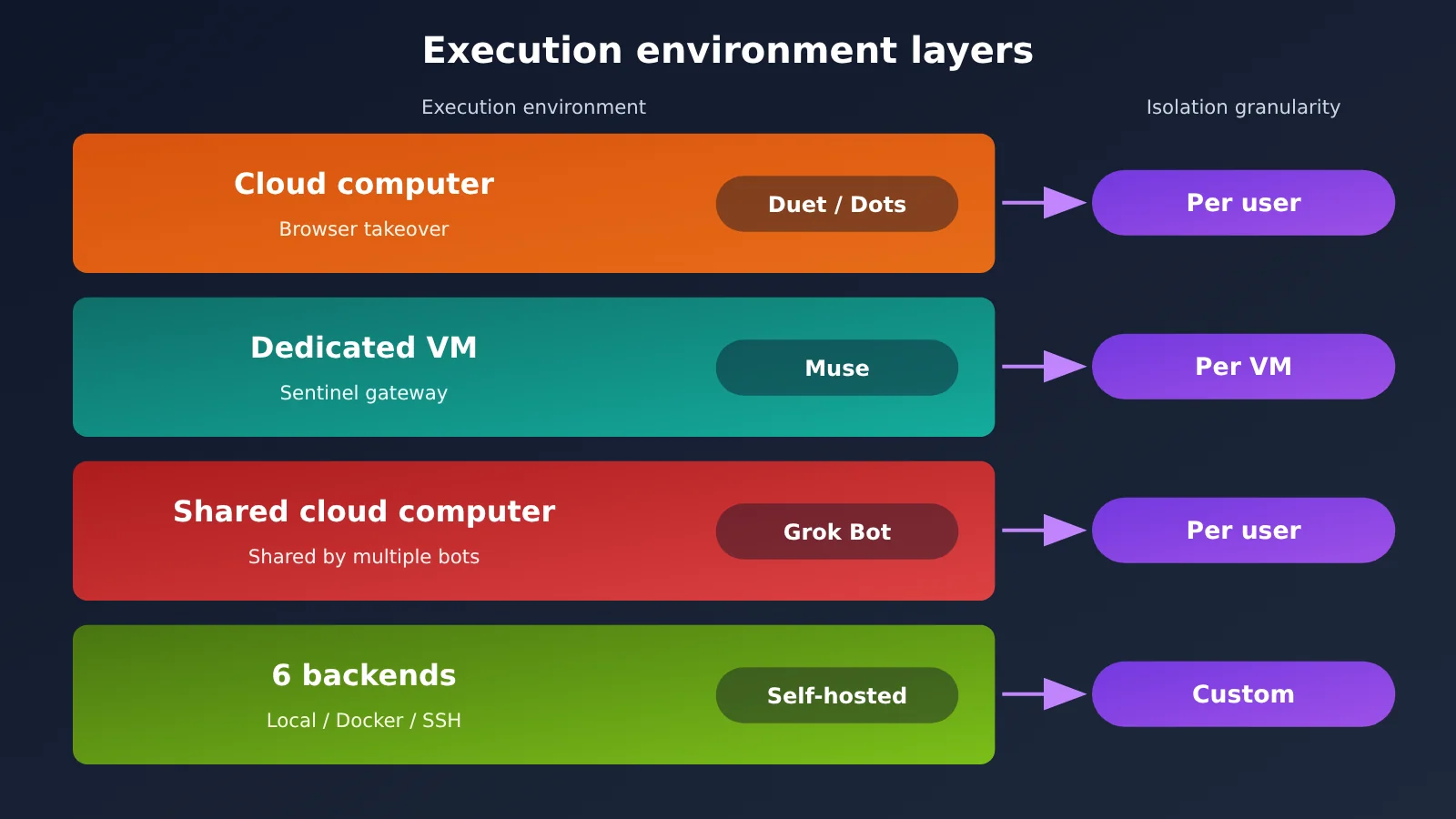
Watch out: If you want multiple bots to handle accounts with different levels of sensitivity, carefully evaluate Grok Bot’s design: isolation is per user, and login sessions are shared across bots.
Dimension Five: Personal Agent Memory and Self-Learning
Duet uses the memory, skills, and connectors already in your Claude account. It can also access more than 6,000 connectors and plugins in the Claude directory, according to the company. Muse uses a Goals tab to manage long-term objectives, lets you ask it to “forget” a memory, and continues running tasks after you close the app. Dots retains its memory when you switch channels, so it can keep working on tasks across conversations. With Grok Bot, you demonstrate something once, and it saves the process as a skill or routine to run automatically on a schedule.
Hermes uses a learning loop to create skills from experience and improve as it’s used. For recall across sessions, it combines FTS5 session search with LLM summaries, uses Honcho for user modeling, and supports the agentskills.io standard. We didn’t test how well any of these capabilities work.
Dimension Six: Personal Agent Permissions and Approvals
The biggest advantage of a hosted product often isn’t the strength of its model—it’s the ready-made approval interfaces and auditing mechanisms that come with it.
| Option | Actions requiring approval | Credential handling | Auditing and revocation |
|---|---|---|---|
| Duet | Sending messages, making payments, signing documents, deleting | Payments use Link by Stripe and Shop Pay; 1Password support is “coming soon” | Can’t yet show its complete internal reasoning process |
| Muse | Asks before sending emails, making purchases, and similar actions | Credentials go into secure storage; it can use them but can’t see them. Payments use single-use virtual cards | Full activity audit; individual services can be disconnected at any time |
| Dots | Requires approval before affecting an account or sharing information externally | Uses private forms to log in to websites; credentials don’t enter the conversation | Uses ChatGPT’s permission system and automated review |
| Grok Bot | Public materials provide limited detail on approval controls for individual users | Shares SSO, authentication, and privacy modes with Cursor | Enterprise features include DLP, certificates, proxies, and network policies |
| Self-hosted | You configure command approvals yourself | You need to design your own key management | You’ll need to add audit logs and one-click revocation yourself |
Dimension Seven: Control and Data Sovereignty (Can You Choose Your Model, and Who Controls Your Data?)
Duet doesn’t let you choose a model. It uses Claude Opus 5.5 exclusively and decides for itself how much effort to put into each task. Muse launched with Muse Spark 1.3. The Muse Wonder series, released on October 12, will gradually become available to subscribers, but Meta controls which models are offered. Meta says conversations and data inside the VM won’t enter its advertising systems. It also plans to introduce Muse Confidential VM, which will encrypt the entire VM with a key held only by the user.
Dots is powered by GPT-6 Astra. Grok Bot’s cloud computer encrypts data both in transit and at rest, and users can opt out of training. Only a self-hosted setup gives you true freedom to choose your model: run hermes model to switch providers. It supports Nous Portal, OpenRouter, OpenAI, Anthropic, and custom endpoints.
Which to Choose: What Each of the 5 Personal Agent Options Can’t Do
Who Claude Duet Is—and Isn’t—for
Duet is a good fit if you’re already a Claude Pro or Max user in the US and rely heavily on Claude for work. It can use your existing skills and connectors. What it can’t do yet: You can’t choose a model, it’s only available in the US with a waitlist, and it doesn’t support Team or Enterprise accounts. Claude also acknowledges that Duet can misread a conversation or misjudge urgency, and that it’s less effective at personal errands than work tasks.
When to skip it: You’re outside the US, need a team account, or want to switch models based on cost.
Who Meta Muse Is—and Isn’t—for
Muse has the most granular permissions of the five options: it can’t see your credentials, uses single-use virtual cards, and provides a full audit trail. It’s a good fit for everyday users who want to hand off tasks like booking travel and comparing prices. What it can’t do yet: It’s only available in the US, subscription pricing hasn’t been disclosed, and Meta controls when its most powerful models become available.
When to skip it: You’re outside the US, or your main needs are development and team collaboration.
Who OpenAI Dots Is—and Isn’t—for
Dots is a good fit for heavy Slack and Teams users. You can use the same dot across channels without losing its memory, and it can delegate tasks to Codex. What it can’t do yet: It’s unavailable in the European Economic Area, UK, and Switzerland, doesn’t support mobile browsers, and can connect to only one of your own computers at a time. OpenAI also warns that dots can make mistakes, so you should double-check important results.
When to skip it: You’re in an excluded region, or you don’t want delegated tasks quietly consuming your Codex quota.
Who Grok Bot Is—and Isn’t—for
Grok Bot is a good fit for small teams that want to “hire a group of AI teammates” and assign projects by role. Its “show it once and it learns” approach makes it easy to get started. What it can’t do yet: The beta doesn’t open until August, usage beyond the weekly allowance costs extra per token, and multiple bots share the same login sessions on one cloud computer.
When to skip it: You’re highly sensitive to monthly costs, or you need strong isolation between bots.
Who a Self-Hosted Personal Agent Is—and Isn’t—for
A self-hosted setup is a good fit for independent developers and small teams. You can choose your own models, keep data on your own server, and pay based on usage. You can also use hermes import-agent to import settings, memory, and skills from OpenClaw, Claude Code, Codex CLI, and Cursor. What it can’t do yet: There’s no ready-made approval interface, and no provider to fall back on if something goes wrong. Hermes is evolving quickly: v0.22.5 is a patch release, and the full feature notes won’t be published until v0.23.0.
When to skip it: Nobody on your team can take responsibility for server security and day-to-day operations.
Risks and Account Bans Are Your Responsibility
This deserves a clear, separate warning. Third-party open-source tools such as Hermes Agent are not affiliated with APIYI. APIYI does not endorse their security, stability, or compliance.
A self-hosted agent logs in to your email, messaging apps, and websites as you, then performs actions automatically. Each platform has its own rules for detecting automated activity, and your account could be rate-limited, asked to complete verification, or even banned. No vendor guarantees protection against these risks; you’re responsible for the consequences.
To reduce your risk:
- Start with a secondary or test account. Don’t connect your primary or payment accounts right away;
- Run the agent in an isolated environment, preferably using Docker or a dedicated VM backend. Don’t run it directly on your everyday computer that stores personal data;
- Enable command approval for all actions involving outgoing messages, payments, or deletions, even if it slows things down;
- Don’t store API keys in plain text, and rotate them regularly. Malware designed specifically to steal API keys for AI services has already appeared in the community;
- Check each platform’s terms of service. Whether automation is allowed depends on the platform’s rules.
Hosted products often provide approval interfaces, audit logs, and one-click revocation out of the box. With a self-hosted setup, you’ll need to put all of those in place yourself. That’s the cost of “data sovereignty.”
Decision Guide: Personal Agent Selection Checklist
If you’re a developer in China, an independent developer, or running a small team, use these four questions to compare your options:
| Question | Your situation | Recommended option |
|---|---|---|
| Budget | You want a fixed monthly fee and don’t want to manage tokens | Duet (if you already have a US Pro/Max subscription) or Dots |
| Budget | You’re comfortable paying based on usage | Self-hosting + an API proxy service |
| Data sensitivity | Customer data and internal documents must stay within your own environment | Self-hosting (locally or on a private server) |
| Data sensitivity | You mainly handle public information and personal tasks | Muse (requires you to be in the US) |
| Do you need control over the model? | You need to switch between Claude, GPT, and other models depending on the task | Self-hosting is your only option |
| Can you accept waitlists and regional restrictions? | No | Self-hosting |
| Can you accept waitlists and regional restrictions? | Yes, and you’re in a supported region | Choose Duet, Dots, or Grok Bot based on your preferred interface |
💡 Recommendation: Most small teams in China will eventually land on “self-hosting + a unified model interface.” Start by using the free testing credits from APIYI apiyi.com to connect different models to your agent and run them for a week. Compare the results and costs before choosing your primary model.
How to Connect a Self-Hosted Personal Agent to Models Through APIYI
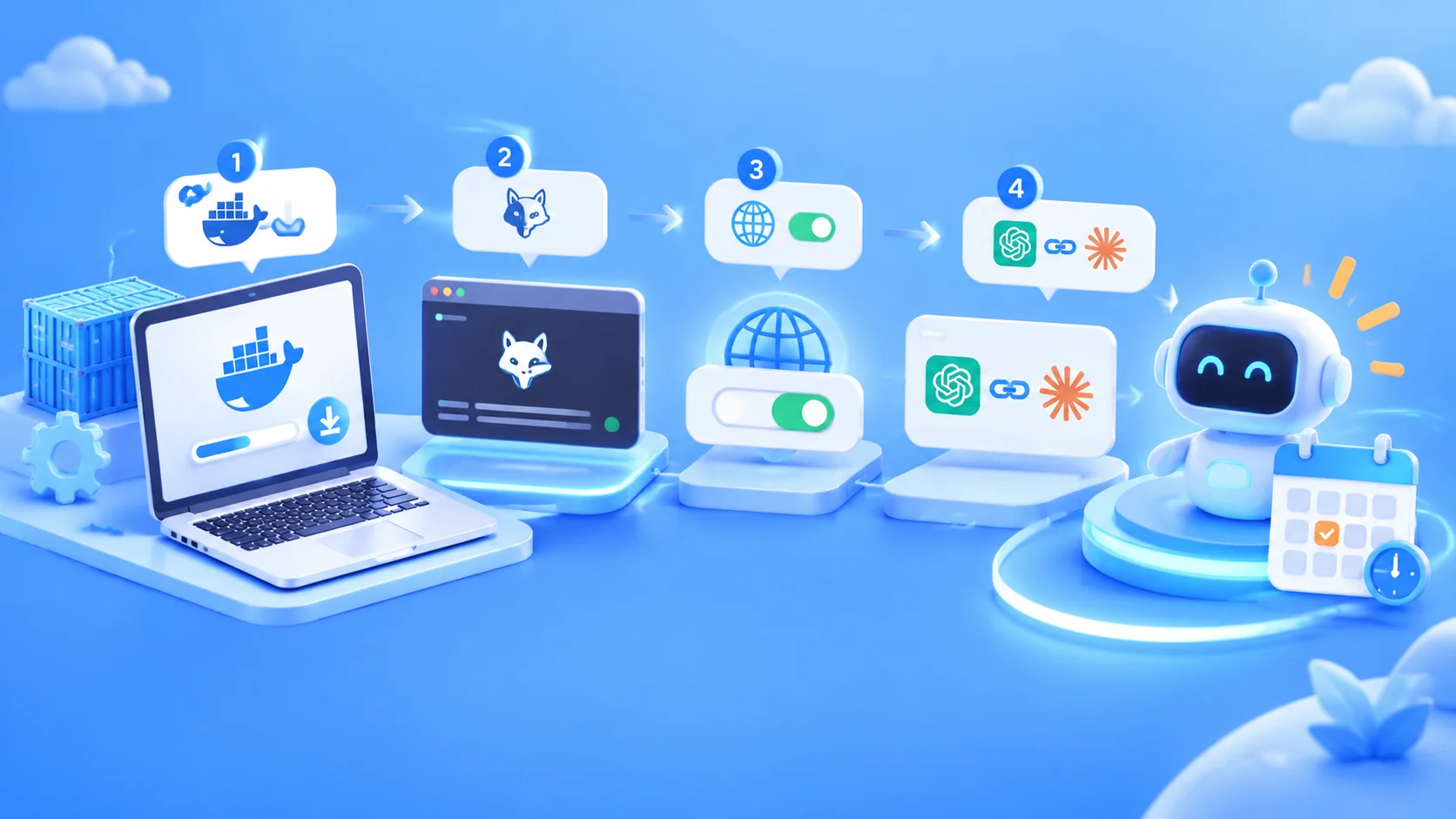
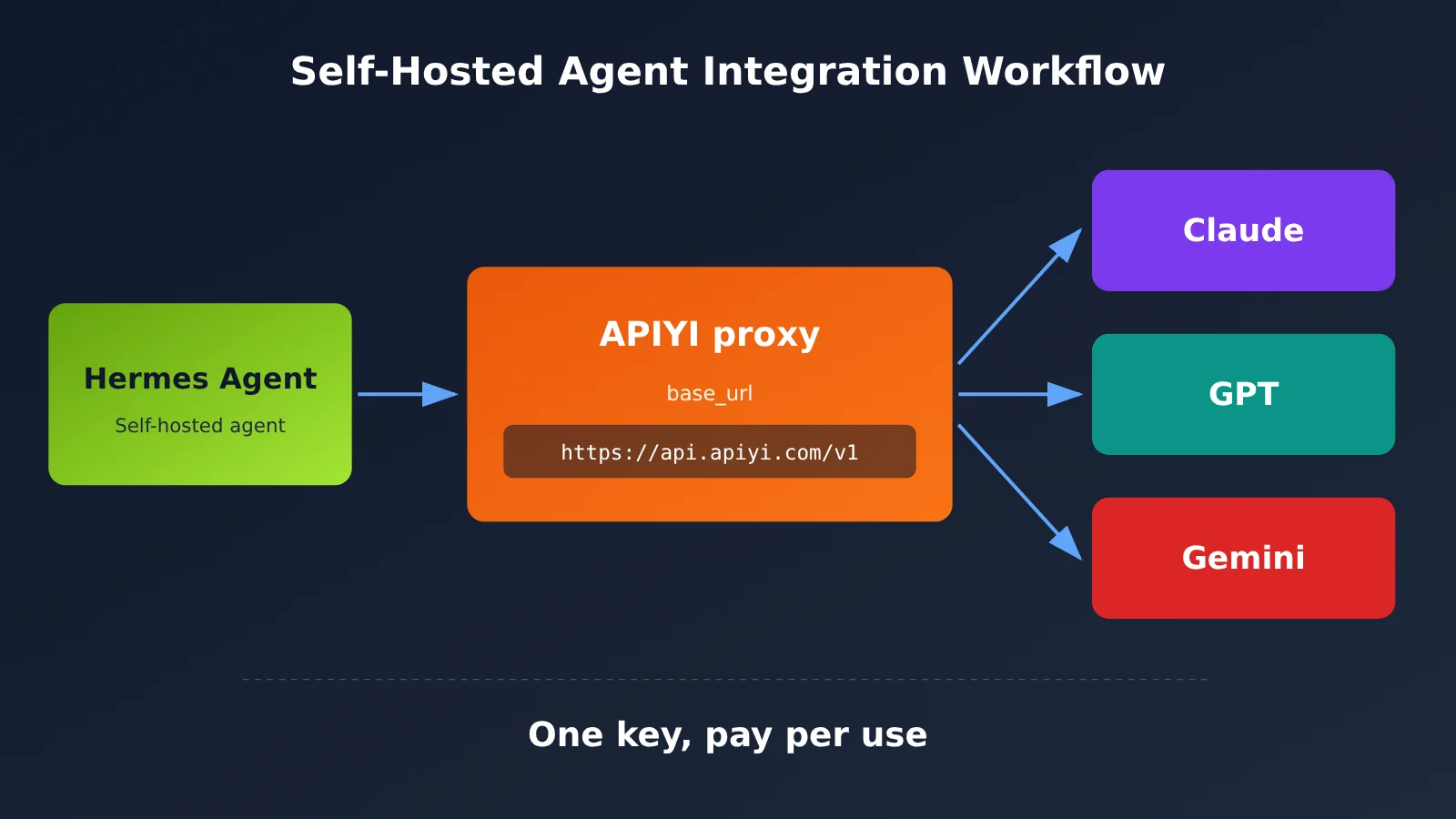
Hermes supports custom OpenAI-compatible endpoints, so you can use APIYI as an API proxy service and access models from multiple providers with one key. Here’s how to set it up (the exact prompts may vary depending on your version of Hermes):
- Install Hermes: On Linux, macOS, and WSL2, run
curl -fsSL https://hermes-agent.nousresearch.com/install.sh | bash; on native Windows PowerShell, runiex (irm https://hermes-agent.nousresearch.com/install.ps1); - Create an API key in the APIYI console at apiyi.com;
- Run
hermes modeland select a custom OpenAI-compatible endpoint; - Set
base_urltohttps://api.apiyi.com/v1; - Enter a model name, such as
claude-opus-5-5orclaude-sonnet-5-5; - Use a lower-cost model for everyday tasks, then switch to a flagship model for more complex work.
You can also use Magpie’s visual configuration interface. Enter your API key and Base URL in its GUI to connect Claude Code, Codex, Pi, Hermes, and almost any other agent to the same gateway—without editing each configuration file individually. For details, see Open-Source Magpie: Connect All Your Agents to One API Gateway With a Single Key.
According to the APIYI model list as of October 27, 2026, pricing is as follows (per million tokens):
| Model | Input | Output | Cache read | Available on |
|---|---|---|---|---|
claude-opus-5-5 |
$4 | $20 | $0.20 | APIYI apiyi.com |
claude-sonnet-5-5 |
$2 | $10 | $0.10 | APIYI |
Check the platform’s model list for current availability and pricing. If newer models such as GPT-6 Astra behind Dots and Muse Wonder from Muse aren’t listed yet, we’ll make them available as soon as possible.
🚀 Quick start: Agents can run in the background for long periods, so cache-read pricing can have a big impact on total costs. Check the usage details for each model in the APIYI console at apiyi.com before deciding whether to enable prompt caching.
Frequently Asked Questions
Q1: What is a Personal Agent, and how is it different from a chatbot?
A Personal Agent has its own execution environment—a cloud computer, VM, or local machine—and can keep working on tasks while you’re offline. It comes back to ask for approval when it encounters a sensitive action. A chatbot typically responds only when you prompt it.
Q2: What’s the biggest difference between Duet and Dots?
Duet inherits the ecosystem in your Claude account, uses Opus 5.5 exclusively, and is currently available only to Pro and Max users in the US. Dots excels at sharing memory across channels like Slack, Teams, and voice, and can delegate tasks to Codex. Neither lets you switch model providers.
Q3: Are these five solutions mature products yet?
Not yet. Duet is in research preview, Dots is rolling out gradually, Grok Bot’s beta doesn’t start until August, Muse is available only in the US, and Hermes releases a new version every few days. It’s best to start with non-critical tasks.
Q4: Can teams in China use Duet, Muse, or Dots directly?
Check each provider’s official list of supported regions: Duet and Muse are limited to the US, while Dots explicitly excludes the European Economic Area, the UK, and Switzerland. A more practical option for teams in China is to build their own agent and connect it to models through APIYI at apiyi.com, using the free allowance to test the results first.
Q5: How can I control model costs in a self-hosted setup?
Use `claude-sonnet-5-5` for everyday tasks and switch to `claude-opus-5-5` for complex ones. Enable caching, too. Set usage alerts in the APIYI console to prevent runaway background tasks from generating unexpected bills.
Q6: Were the figures in this article tested in practice?
This article doesn’t include performance tests of any solution. All capability descriptions come from official sources, and promotional claims such as performance multiples and connector counts are labeled as “self-reported.” Your own tests will be the best guide to actual results.
Personal Agent Comparison: Key Takeaways
- Geographic availability is the first filter: Duet and Muse are limited to the US, while Dots excludes the European Economic Area, the UK, and Switzerland;
- Only self-hosted agents let you choose your model: The providers choose the models for all four hosted products;
- Billing comes with caveats: Grok Bot charges for overages by token, while tasks spawned by Dots count against your Codex quota;
- Isolation varies: Muse provides a dedicated VM plus Sentinel, while Grok Bot isolates only at the user level;
- Hosted products make permission approvals easier: With a self-hosted setup, you need to build your own approval and audit processes;
- Self-hosting comes with risks: Start with a secondary account and an isolated environment; you may encounter rate limits or account bans;
- Getting started: To connect a self-hosted agent to multiple models through APIYI, enter the
base_urland model name.
Summary
The trade-offs between Duet, Muse, Dots, Grok Bot, and a self-hosted Personal Agent come down to three points:
- Hosted products are ready to use and include approval workflows, but geographic restrictions, waitlists, and model lock-in are hard limits;
- Self-hosting gives you model choice and data sovereignty, but you’re responsible for security, operations, and the risk of account bans;
- A practical path for developers in China is to start with an open-source framework, connect it to a unified model API, then gradually swap and compare models.
If you decide to self-host, try getting your agent running with the free test credits available through APIYI at apiyi.com. Once you have a clear picture of performance and costs, you can scale up.
📚 References
- Claude Duet Official Overview: Product positioning, availability, and usage limits
- Link:
claude.com/product/claude-duet -
Details: Covers usage during the research preview and known limitations
-
Meta Muse Launch Announcement: Secure VM, Sentinel, and permissions design
- Link:
about.fb.com/news/2026/09/introducing-muse-personal-ai-agent -
Details: A primary source for Muse’s privacy and payment mechanisms
-
OpenAI Dots Documentation: Plans, availability, and usage rules
- Link:
learn.chatgpt.com/docs/dots -
Details: Includes regional exclusions for the Pro plan
-
Grok Bot Documentation: Cloud computers, billing, and enterprise features
- Link:
docs.x.ai/grok-bot/overview -
Details: Includes billing rules for token overages
-
Hermes Agent Repository: Installation, model configuration, and version history
- Link:
github.com/NousResearch/hermes-agent - Details: The main reference for a self-hosted setup, under the MIT license
Author: APIYI Technical Team
Technical Discussions: Contact us through the APIYI homepage. For more integration resources, visit the documentation center at docs.apiyi.com.