Google provided an answer in the official Gemini FAQ that made many developers nervous: "Gemini Omni is our latest video editing and generation model that will replace Veo in the Gemini app." This statement sparked a wave of discussion in the English-speaking community—is Veo being phased out? Can we still use Veo 3.1 on Vertex AI? Do we need to migrate code already written for Veo?
If you only look at the headlines, it's easy to get the wrong impression that "Veo is dead." But if you look closely at the official documentation, you'll find that the "replacement" by Gemini Omni has very clear boundaries. This article breaks down the real fate of Veo in 2026 based on official statements, and how consumers, creators, and developers should each respond.
Core Value: After reading this, you'll know whether Veo is truly being "replaced," and how to make decisions based on the scope and timeline of these changes.
Official Statement: Is it true that Gemini Omni will replace Veo?
Let's start with the most authoritative facts. In the official Google Gemini help page, when answering the question "What happened to Veo," they wrote: "Gemini Omni is our latest video editing and generation model that will replace Veo in the Gemini app."
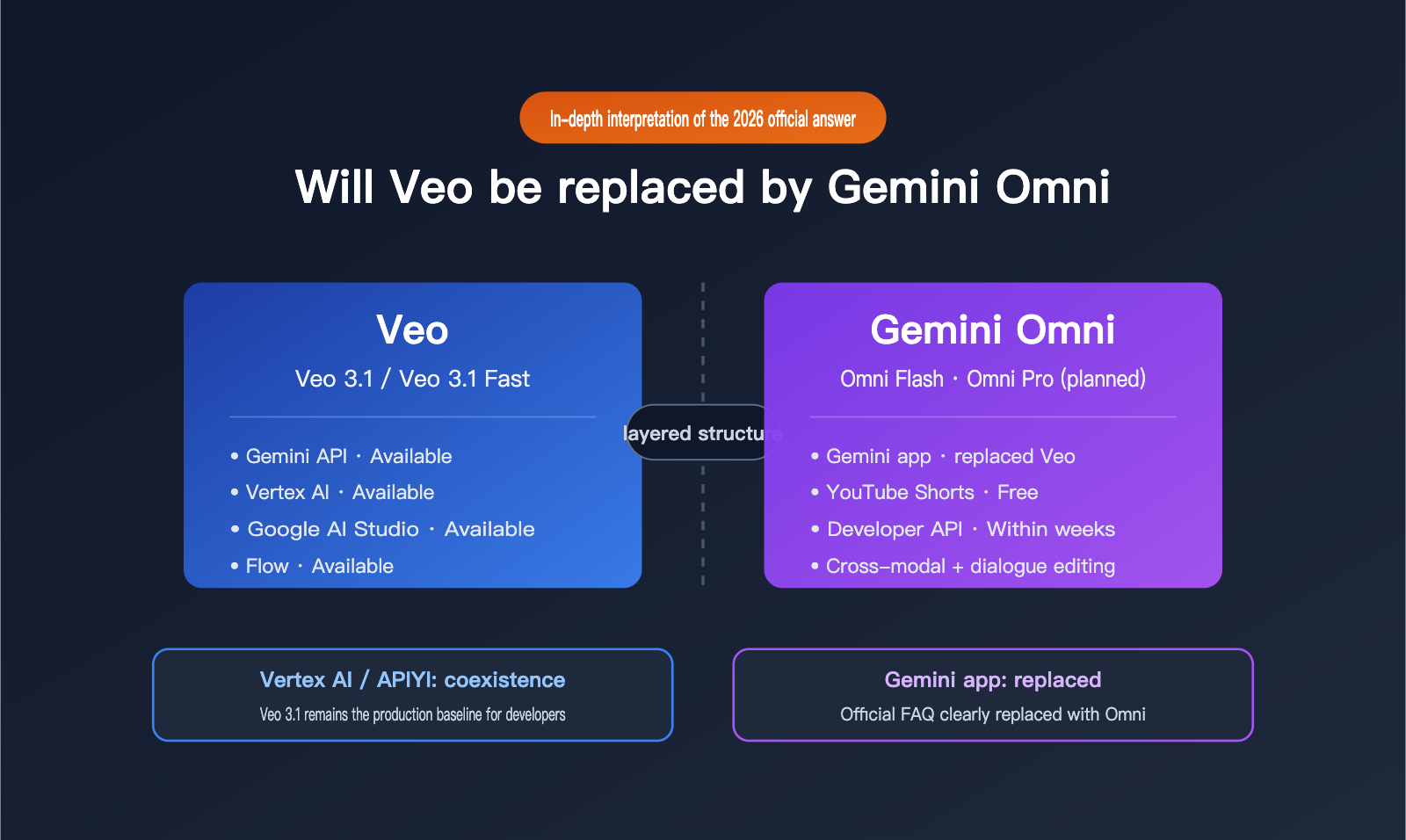
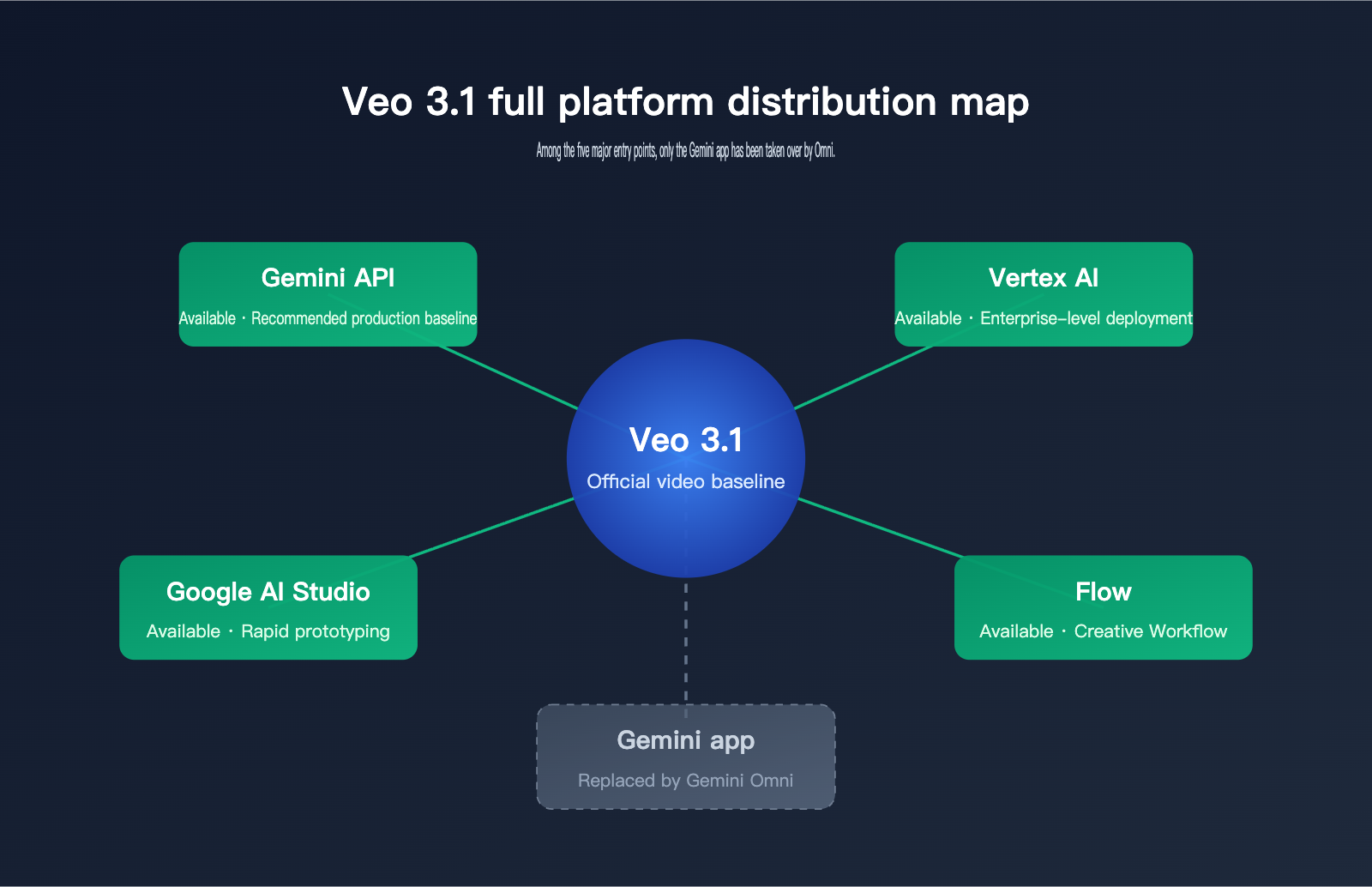
Note the two key qualifiers in this sentence. First, "latest video editing and generation model" indicates that Omni is positioned as the "next-generation video model." Second, and more easily overlooked, is the phrase "in the Gemini app," which means this "replacement" is strictly limited to the Gemini consumer application and does not cover other product entry points like Vertex AI, Gemini API, Google AI Studio, or Flow.
| Key Information | Details |
|---|---|
| Official Source | Google Gemini Help FAQ |
| Main Point | Gemini Omni is the latest video editing/generation model |
| Scope of Replacement | Strictly limited to the "Gemini app" |
| Affected Products | Video generation entry point within the Gemini app |
| Unaffected Products | Vertex AI, Gemini API, Google AI Studio, Flow |
| Release Date | During Google I/O, May 2026 |
💡 Important Reminder: "Replacement" does not mean "shutdown." For developers, the lifecycle of the Veo series on the Gemini API and Vertex AI is completely independent of the product updates in the Gemini app. We recommend using an API proxy service like APIYI (apiyi.com) to verify the current model before deciding on your migration timeline.
The Replacement Only Affects the Gemini App: The Key Boundary Between Consumer and Developer Sides
The most important step in understanding this change is to separate Veo into two layers: "consumer product form" and "developer model capability." Google's FAQ only addresses the former; there is no mention of "discontinuation" or "deprecation" for the latter in any official documentation.
What Happened on the Consumer Side?
If you open the Gemini app to generate a video, starting in May 2026, the backend will no longer call the Veo series by default, but rather Gemini Omni Flash. For the average user, this is a one-way improvement—stronger multimodal reasoning, conversational editing, and physical understanding are all advantages of Omni. For consumers, Veo has simply stepped quietly into the background.
No Replacement on the Developer Side
When developers invoke video generation via the Gemini API, Vertex AI, or Google AI Studio, Veo 3.1 remains the "video model baseline" explicitly recommended in official documentation. Its model ID, veo-3.1-generate-preview, is still valid, the pricing is the same as Veo 3, and its functionality is even richer than the version replaced in the Gemini app.
| Dimension | Gemini App (Consumer) | Vertex AI / Gemini API (Developer) |
|---|---|---|
| Default Model | Gemini Omni Flash | Veo 3.1 / Veo 3.1 Fast |
| Replaced? | ✅ Already replaced | ❌ Not yet replaced |
| User Type | Personal subscribers | Developers, enterprises |
| Documentation | Explicitly stated in FAQ | Still lists Veo 3.1 as the baseline |
| Migration Advice | Natural transition, no action needed | No migration needed, keep monitoring |
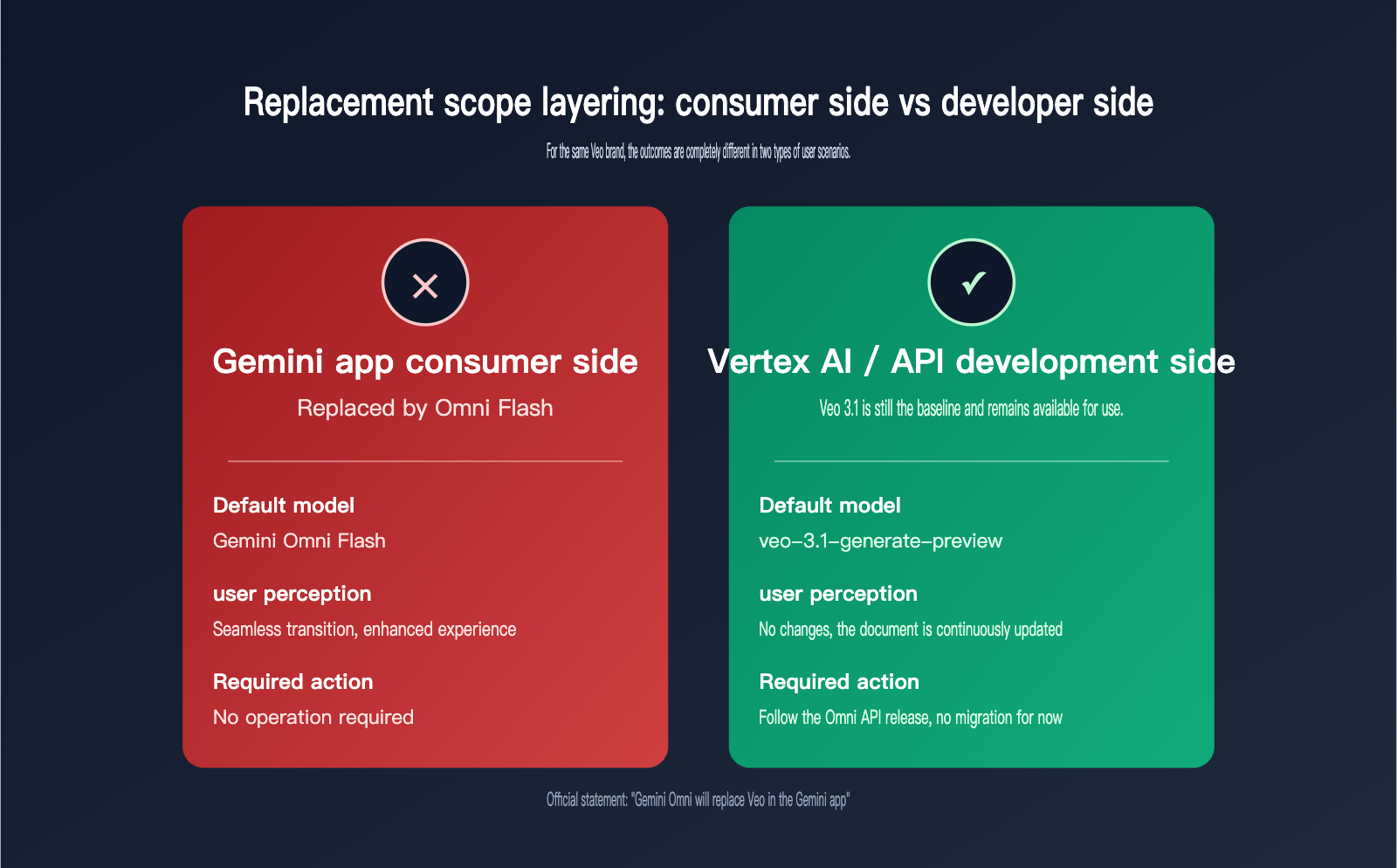
🎯 Developer Conclusion: If you only use the Gemini app, the change is default and smooth; if you are invoking the Veo API in a production environment, there is no need to migrate immediately. To flexibly call the Veo series and future open Omni models within the same project, we recommend using the unified interface from APIYI (apiyi.com), so you only need to change the
modelfield when switching between different models.
Veo 3.1's True Position in 2026: Still the Developer Baseline
Many developers who were scared by the "Omni replaces Veo" headlines might not have looked closely at just how new the latest version, Veo 3.1, really is. Veo 3.1 was officially released by Google on October 15, 2025, and was actually "enhanced" rather than "deprecated" at I/O 2026.
Three Core New Capabilities of Veo 3.1
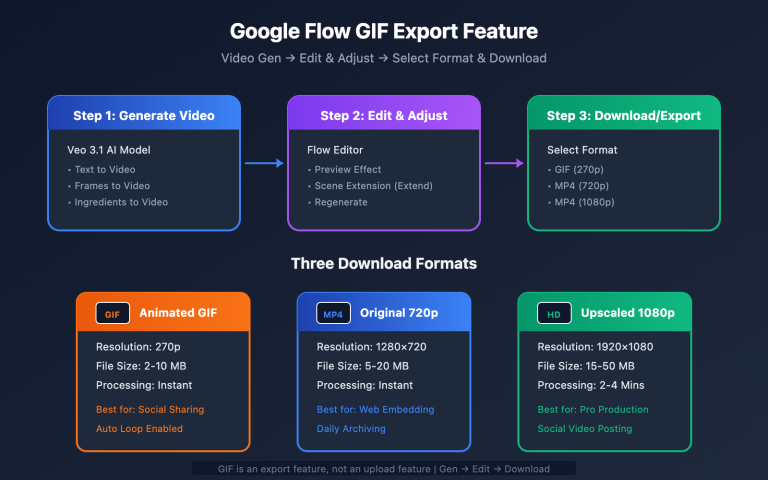
First is Ingredients to Video. It allows you to upload up to 3 reference images as "ingredients," and the model will maintain face consistency when generating the video. This is critical for brand advertising, short series, and IP-based creative work.
Second is Scene Extension. You can extend a continuous video to a minute or longer based on existing clips. The "short video limitation" of the Veo 3 era has been broken, which is the key to it truly entering professional content production pipelines.
Third is First and Last Frame. Given the first and last frames, the model will automatically generate the transition video in between and add synchronized sound effects. This is extremely valuable for editing transitions and special effect cuts.
Veo 3.1 vs. Omni Flash: Quick Capability Comparison
| Capability Dimension | Veo 3.1 | Gemini Omni Flash |
|---|---|---|
| Single Clip Duration | Can extend to 1+ minute (Scene Extension) | 10 seconds (deployment limitation) |
| Face Consistency | Ingredients to Video, 3 reference images | Built-in Avatar, requires biometric auth |
| Multimodal Input | Text + Images (3) | Text + Images + Audio + Video |
| Cross-modal Reasoning | Focused on rendering | Full Gemini reasoning |
| Audio Generation | Synchronized sound effects + dialogue | Currently video-focused, audio in planning |
| API Availability | Publicly available via Gemini API / Vertex AI | API launching in a few weeks |
| Model ID | veo-3.1-generate-preview |
Not yet announced |
| Suitable Scenarios | Long video, advertising, professional editing | Multimodal interaction, conversational editing |
🧭 Capability Comparison Advice: Veo 3.1 and Omni Flash are not in a "who replaces whom" relationship, but rather "which is better for which scenario." To run both types of models in your own project to compare results, we recommend using the unified interface from APIYI (apiyi.com) to access mainstream models from multiple vendors at once, significantly reducing evaluation costs.
When Will Gemini Omni Fully Replace Veo: Three Possible Paths
While Google currently only acknowledges that it will "replace it within the Gemini app," the question developers are really asking is: will Veo 3.1 on Vertex AI eventually be taken over by Omni? There’s evidence supporting three potential paths, and they're worth considering now.
Path 1: Gradual Deprecation of Veo After Omni API Launch
If the Gemini Omni developer API is officially released and its capabilities fully cover those of Veo 3.1 (especially Scene Extension and Ingredients to Video), Google will likely mark Veo as deprecated within 6–12 months. This is a common rhythm for Google's product transitions.
Path 2: Long-term Coexistence with Different Roles
A more likely medium-term scenario is "layered coexistence": Omni focuses on cross-modal reasoning and consumer interaction, while Veo focuses on professional video production and enterprise-grade long-form rendering. Both will hold their ground and continue to iterate. The fact that Veo 3.1 saw intensive updates as recently as October shows that Google hasn't abandoned this line.
Path 3: Omni Absorbs Veo Capabilities, Unifying into a Single Model Family
The most aggressive possibility: when Omni Pro launches, it directly integrates all of Veo 3.1's capabilities, forming a unified "Gemini Omni video model family," with the Veo brand name gradually fading away. Given the official phrasing about moving video from the "Veo line" to the "core Gemini system," this path also has some foreshadowing.
| Path | Probability (Subjective) | Time Window | Key Action for Developers |
|---|---|---|---|
| Omni Replaces Veo | Medium | 6–18 months | Prepare migration scripts in advance |
| Omni & Veo Coexist | Medium-High | 12–24 months | Develop for both scenarios |
| Omni Absorbs Veo | Medium | 12–36 months | Monitor announcements for unified model IDs |
What Developers Should Do Now: A Pragmatic Migration Strategy
Regardless of which path becomes reality, there’s a common answer to "what should I do now?": don't panic-migrate, but don't ignore the signals either. This four-step strategy is suitable for most teams already using or planning to use Veo.
Step 1: Confirm if your production environment relies on the Gemini app
If your product generates videos via Gemini app links for secondary processing (like some No-Code tools), that pipeline is now calling Omni Flash. You need to run end-to-end tests again to ensure that output style, duration, watermarks, and other factors haven't broken your existing workflow.
Step 2: Veo 3.1 remains the API production baseline
If your product calls veo-3.1-generate-preview, you can continue to use it with confidence. There is no "upcoming deprecation" language in the official Google documentation; in fact, the features are richer than they were a few months ago.
Step 3: Build your architecture to be "model-agnostic"
No matter when Omni fully replaces Veo, a model-agnostic architecture is an engineering decision worth making early. The specific approach: encapsulate your video generation module in an independent service layer, and drive model IDs, endpoints, and parameter objects via configuration rather than hardcoding them into your business logic.
# Example: Model-agnostic video generation layer (Unified access)
from openai import OpenAI

client = OpenAI(
    api_key="YOUR_API_KEY",
    base_url="https://api.apiyi.com/v1"  # Unified access to multiple models via APIYI
)

VIDEO_MODEL = "veo-3.1-generate-preview"  # Can be switched to an Omni model ID in one line later

response = client.chat.completions.create(
    model=VIDEO_MODEL,
    messages=[{"role": "user", "content": "Generate a prompt for a 10-second video of morning mist in a forest"}]
)
print(response.choices[0].message.content)
Step 4: Subscribe to official announcements, but don't bet on unreleased interfaces
The Omni developer API is still in the "coming in the next few weeks" phase; specific model IDs, pricing, and quotas haven't been released. During this window, stick to official Google Cloud announcements and the Google Developers Blog. Don't base your production planning on leaked "Omni price lists" from third parties.
💡 Pragmatic Advice: Before the official Omni API is released, we recommend maintaining production using the Veo 3.1 + APIYI (apiyi.com) combination. Once the Omni API is officially open, you'll only need to swap the model ID and a few parameters, with no need to rewrite your business logic.
{Developer decision tree}
{Migration paths for three typical scenarios}
{Should I migrate now?}
{Based on official information from May 2026}
{Only use the Gemini app}
{The backend has automatically switched to}
{Gemini Omni Flash}
{Use Veo API for production}
{Continue using Veo 3.1}
{Follow the Omni API announcements}
{Setting up a new project}
{Veo 3.1 baseline +}
{Replaceable model architecture}
{Action: No operation required}
{Better experience, you can continue to use it}
{Action: Do not migrate for now}
{Make the architecture replaceable}
{Action: configuration-driven}
{Extract model ID to configuration}
{Joint recommendation: Before Omni API is officially announced, Veo 3.1 remains the most stable production baseline}
FAQ
Q1: Has Veo been discontinued?
No, it hasn't. Veo has only been replaced by Gemini Omni Flash within the Gemini app product interface. Developers can still effectively use Veo 3.1 and Veo 3.1 Fast via Vertex AI, Gemini API, Google AI Studio, and Flow.
Q2: Is Veo 3.1 weaker than Gemini Omni Flash?
They each have their own strengths; it's not a simple case of one being better than the other. Veo 3.1 is more specialized in video duration (extendable to over 1 minute), character consistency (Ingredients to Video), and transition frame generation (First and Last Frame). Omni Flash is more comprehensive in cross-modal input, conversational editing, and physical understanding.
Q3: Should I migrate my Veo code to Omni right now?
We don't recommend migrating immediately. The Omni developer API hasn't been publicly released yet, and there is no official documentation for model IDs or pricing. The pragmatic approach is to continue using Veo 3.1 for production and prepare an architecture that allows you to "switch models by changing a field" using an aggregation platform like APIYI (apiyi.com), while waiting for the official Omni API launch.
Q4: Does Omni have a feature equivalent to Veo 3.1’s Scene Extension?
Not at the moment. The current deployment of Omni Flash limits single video segments to a maximum of 10 seconds, and Google has not announced any extension features corresponding to Scene Extension. This is precisely why Veo 3.1 remains difficult to replace in professional video production in the short term.
Q5: Should enterprise customers worry about Veo services being cut?
Not in the short term. Official documentation for Veo 3.1 on Vertex AI continues to be updated, and Google typically provides at least a 6-12 month deprecation window for enterprise products. If your workload is based on Vertex AI Veo, you can continue with your projects.
Q6: Will Gemini Omni Pro take over all of Veo’s capabilities once it launches?
That is a possibility. Omni Pro is a more powerful model designed to be a "step change above Flash," but Google has not provided a release date. If Omni Pro supports long-form video and character consistency upon launch, the probability of the Veo series being integrated will increase significantly.
Summary: Veo Won't Disappear in the Short Term, but Omni Will Likely Take Over Long Term
Returning to the original question—will Veo be replaced by Gemini Omni? Based on public information as of May 2026, we can provide a more precise answer:
First, the replacement that has already occurred is limited to the Gemini app consumer interface, which is a smooth transition for the average user. Second, there are no signs of deprecation for Veo 3.1 on Vertex AI, Gemini API, Google AI Studio, or Flow. In fact, it just received three core updates in October 2025: Ingredients to Video, Scene Extension, and First and Last Frame. Third, in the long run, the boundaries between Omni and Veo are gradually narrowing, and the launch of Omni Pro will likely be a key turning point for the industry landscape.
The safest strategy for developers is to continue using Veo 3.1 as the officially recommended baseline for video models today, while building your architecture to be "model-agnostic." By using an aggregation interface like APIYI (apiyi.com) to access Veo, the Gemini series, and other mainstream models simultaneously, you'll be able to switch seamlessly by simply changing a model ID in your configuration once the Gemini Omni API is officially released.
References
-
Google Gemini Official FAQ
- Link:
gemini.google/faq - Note: Official confirmation that Omni will replace Veo in the Gemini app.
- Link:
-
Google Developers Blog – Veo 3.1 Release Announcement
- Link:
developers.googleblog.com/introducing-veo-3-1-and-new-creative-capabilities-in-the-gemini-api - Note: Veo 3.1 launched on 2025-10-15, available simultaneously across Gemini API, Vertex AI, Flow, and the Gemini app.
- Link:
-
Vertex AI Documentation – Veo 3.1 Model Page
- Link:
docs.cloud.google.com/vertex-ai/generative-ai/docs/models/veo/3-1-generate - Note: Official model documentation for Veo 3.1 on Vertex AI, with no indication of deprecation.
- Link:
-
Google Blog – Gemini Omni Release Announcement
- Link:
blog.google/innovation-and-ai/models-and-research/gemini-models/gemini-omni - Note: Official positioning for Gemini Omni Flash and the upcoming Omni Pro.
- Link:
APIYI Team | If you're looking to experience Veo 3.1, Gemini Omni, and other mainstream video models firsthand, visit APIYI at apiyi.com to access a unified interface and free testing credits, helping you prepare your architecture for future model transitions.