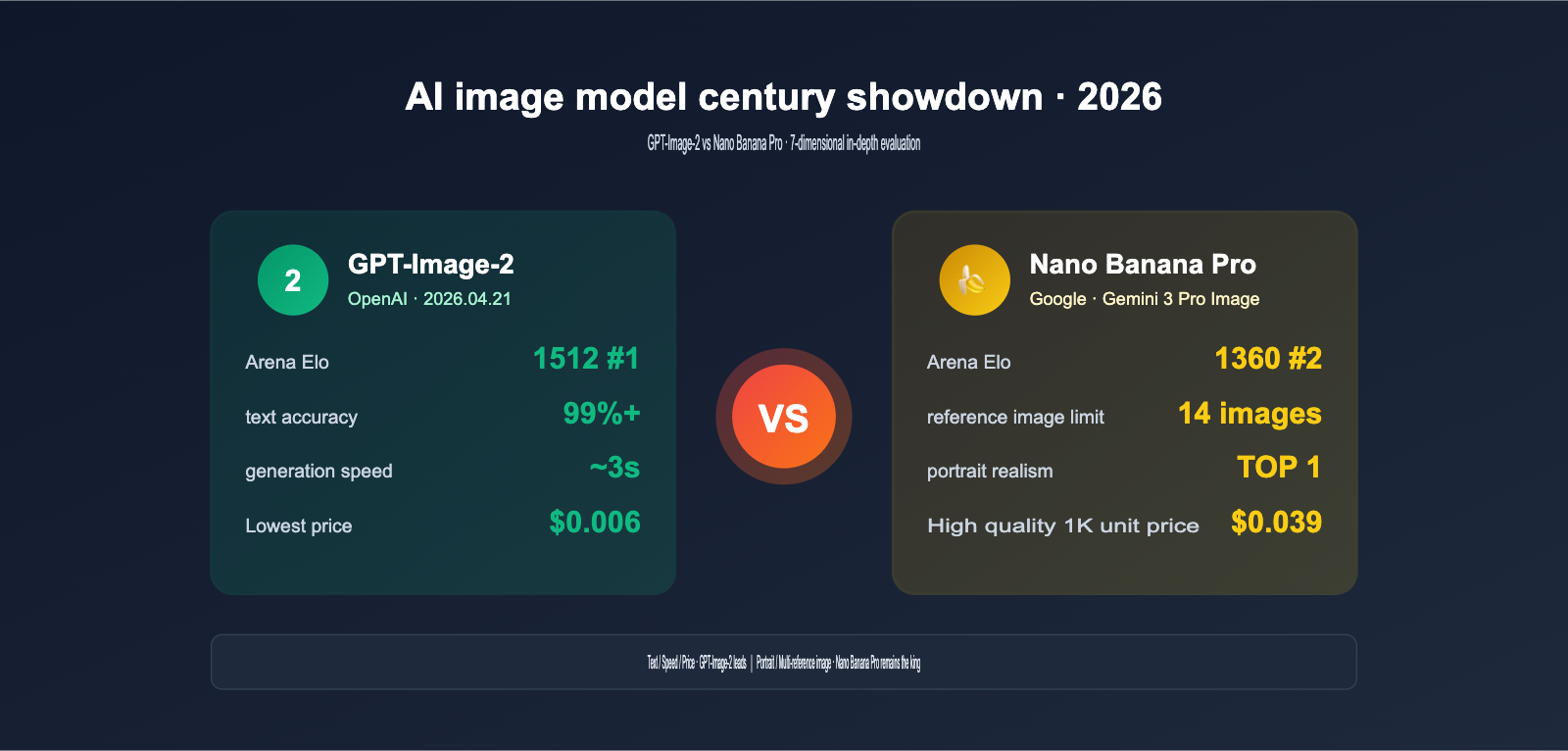
On April 21, 2026, OpenAI officially released GPT-Image-2. Just 12 hours after launch, it topped the LMArena Image leaderboard with an Elo score of 1512, leaving the previous champion, Google's Nano Banana Pro (Gemini 3 Pro Image), behind with a record-breaking lead of +242 points.
Suddenly, "How is GPT-Image-2? Is it really better than Banana?" has become a common question among designers, developers, operations teams, and enterprise users. In this article, we'll break down both models across 7 core dimensions based on official documentation, real-world Arena leaderboard data, and practical business scenarios to help you make an informed selection within 30 minutes.
If you just want the bottom line, feel free to jump to the "Selection Decision Matrix" at the end. If you're interested in the technical nuances behind each dimension, we recommend reading through in order.
Quick Overview: GPT-Image-2 vs. Nano Banana Pro
Before diving into the detailed comparison, here’s a quick reference table highlighting the key differences between the two models. We'll expand on each dimension in the following sections.
| Comparison Dimension | GPT-Image-2 (OpenAI) | Nano Banana Pro (Google) |
|---|---|---|
| Release Date | April 21, 2026 | November 2025 (Gemini 3 Pro Image) |
| Arena Elo | 1512 (#1) | 1360 (#2) |
| Base Model | GPT-5 Series + O-Series Reasoning | Gemini 3 Pro |
| Max Resolution | 2K Native / 4K Beta | 2K / 4K |
| Generation Speed | ~3 seconds (Instant) | 10-15 seconds |
| Text Rendering Accuracy | 99%+ (Multi-language) | ~95% |
| Multi-image Consistency | Up to 8 images per batch | Up to 8 images per batch |
| Reference Image Limit | Multi-image fusion (Limit unannounced) | 14 reference images / 5 characters |
| Reasoning Capability | Instant + Thinking dual modes | Based on Gemini 3 Pro reasoning |
| Price Range (1K) | $0.006 – $0.211 | $0.039 – $0.134 |
| Official Watermark | No mandatory visible watermark | SynthID invisible watermark |
| API Invocation | OpenAI compatible / API proxy service | Google AI Studio / API proxy service |
🎯 Quick Conclusion: Based on the Arena leaderboard and text rendering accuracy, GPT-Image-2 is currently the most powerful image model overall. However, Nano Banana Pro still holds irreplaceable advantages in portrait realism, multi-reference image consistency, and cost control. For developers looking to integrate both models and switch between them as needed, we recommend using the APIYI (apiyi.com) platform to access both through a single interface, saving you the hassle of managing multiple SDKs.
Dimension 1: Arena Rankings and Foundation Models
The Historic Surge in the LMArena Leaderboard
LMArena (formerly LMSys Chatbot Arena) is currently the industry's most authoritative blind-test arena, with Elo ratings generated by anonymous votes from global users. GPT-Image-2 shattered historical records on the very day it was released.
| Model | Arena Elo | Gap from #1 | Time to Top |
|---|---|---|---|
| GPT-Image-2 | 1512 | 0 (#1) | 12 hours |
| Nano Banana Pro | 1360 | -152 | – |
| Nano Banana 2 (Flash) | ~1270 | -242 | – |
| Midjourney V8 | ~1250 | -262 | – |
| FLUX Pro 1.1 | ~1180 | -332 | – |
Key Insight: GPT-Image-2 leads the runner-up, Nano Banana Pro, by 152 points and the third tier by 242 points. This gap is roughly equivalent to the lead Nano Banana Pro held over DALL-E 3—signifying a cross-generational leap in quality.
The "Brain" Differences Between the Two Models
The performance gap between these two models stems from the different design philosophies of their underlying foundation models:
- GPT-Image-2 is based on the GPT-5 series and natively integrates OpenAI's O-Series reasoning architecture. Instead of "drawing immediately upon receiving a prompt," it understands, plans, and then generates. This is the fundamental reason for its massive improvements in text rendering and layout capabilities.
- Nano Banana Pro is based on Gemini 3 Pro, possessing the same world knowledge as Gemini text models and real-time Google Search integration. It’s essentially the "Gemini of the image world," excelling at incorporating real-world information.
💡 Technical Advice: If your business requires image generation based on real-time information (weather, news, sports, geography), Nano Banana Pro's Google Search grounding is a significant advantage. If your core requirement is precise text and complex layouts, GPT-Image-2's reasoning architecture is the better choice.
Dimension 2: Text Rendering Capability—GPT-Image-2 Approaches 100% Accuracy
Text rendering has always been the "Achilles' heel" of AI image models. Previous generations, even Midjourney and DALL-E 3, often misspelled "Welcome" as "Wecolme" or produced distorted Chinese characters. GPT-Image-2 has achieved a qualitative leap in this dimension.
Multilingual Text Accuracy Test
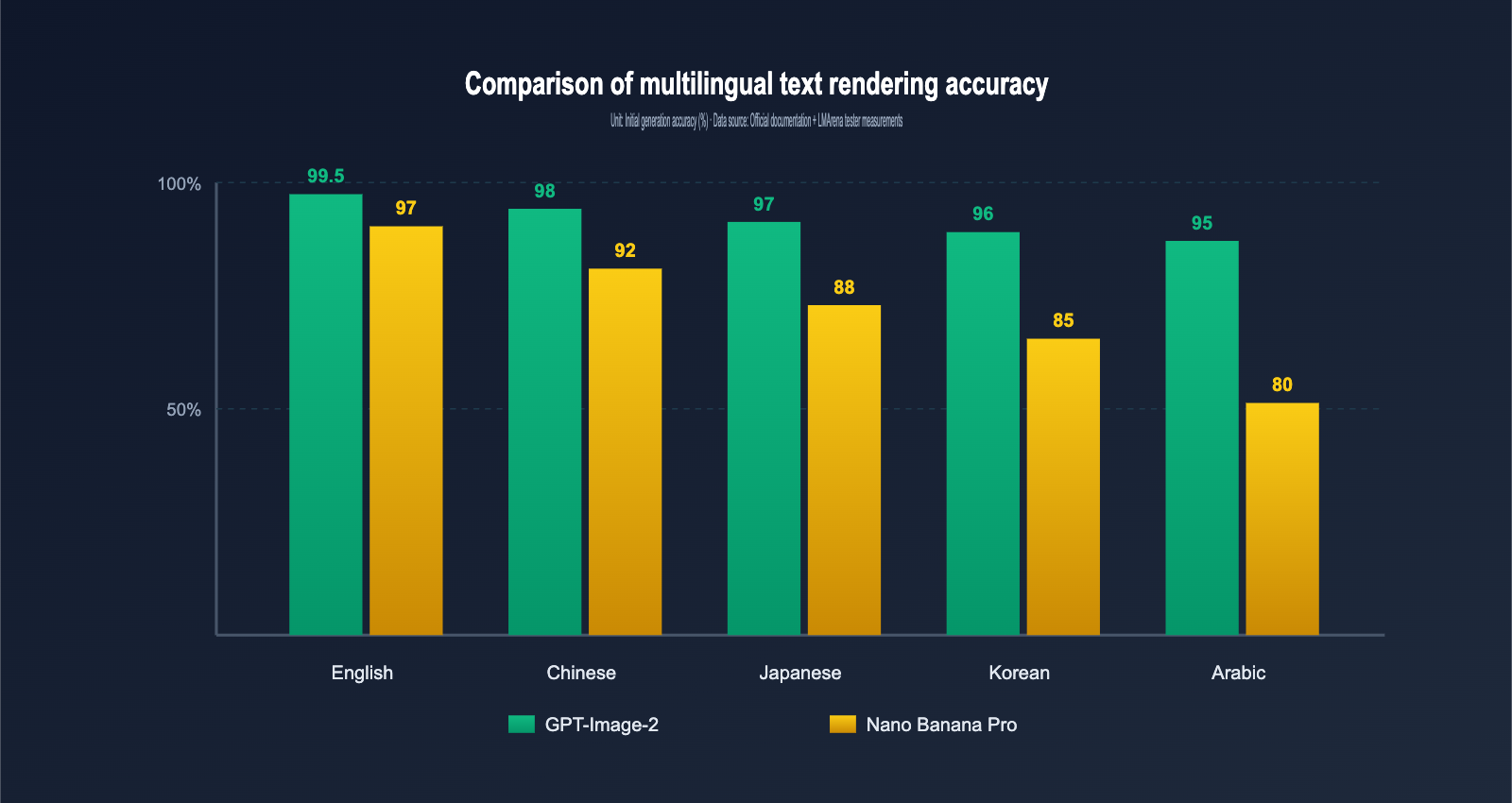
According to official data and feedback from LMArena testers, the text accuracy of both models upon initial generation is as follows:
| Language | GPT-Image-2 | Nano Banana Pro | Gap |
|---|---|---|---|
| English | 99.5%+ | 97% | +2.5pp |
| Chinese (Simplified/Traditional) | 98%+ | 92% | +6pp |
| Japanese (incl. Kanji/Kana) | 97%+ | 88% | +9pp |
| Korean | 96%+ | 85% | +11pp |
| Arabic | 95%+ | 80% | +15pp |
Conclusion: While the gap is narrow for Western languages, GPT-Image-2 holds a significant advantage in CJK (Chinese, Japanese, Korean) and RTL (Arabic) scenarios, representing nearly a full generation of improvement.
Ideal Scenarios for GPT-Image-2's Text Capabilities
- Marketing posters / Multilingual advertisements
- Infographics
- UI prototypes / Buttons / Labels
- Slide decks / Data visualization
- Comic book dialogue
- Menus / Road signs / Storefronts
Practical Example of Text Generation
# Generate a multilingual marketing poster with GPT-Image-2
from openai import OpenAI

client = OpenAI(
    api_key="YOUR_API_KEY",
    base_url="https://vip.apiyi.com/v1"  # Via APIYI proxy, compatible with OpenAI SDK
)

response = client.images.generate(
    model="gpt-image-2",
    prompt="""A tech poster with a black background, large centered title "AI Drives the Future",
            subtitle below "Powered by AI - 2026 Tech Summit", small date in the bottom right "2026.06.15",
            Overall style: neon blue-purple gradient, minimalist, business-oriented""",
    size="1024x1536",
    quality="high",
    n=1
)

print(response.data[0].url)
🎯 Deployment Tip: The code above points the
base_urltohttps://vip.apiyi.com/v1to use APIYI's stable API proxy service. APIYI supports image interfaces for both OpenAI and Google, allowing you to switch betweengpt-image-2andgemini-3-pro-imagewith the same codebase for easy comparison.
Dimension 3: Reasoning and Planning Capabilities—Thinking Mode is the Game Changer
The Dual-Mode Design of GPT-Image-2
GPT-Image-2 is the first in the image generation field to introduce OpenAI's O-Series chain-of-thought, featuring two distinct operating modes:
Instant Mode
- Goal: Rapid generation, returning results in under 3 seconds.
- Characteristics: Quality already surpasses the previous generation GPT Image 1.5.
- Best for: Avatars, memes, quick concept drafts, and social media visuals.
- Availability: Open to free ChatGPT users.
Thinking Mode
- Goal: Reasoning + Planning + Generation after search.
- Characteristics: Before generating, it "thinks" about composition and spatial relationships, and can invoke Web Search.
- Best for: Complex posters, multi-image sequences, brand assets, and research-based visualizations.
- Availability: Exclusive to ChatGPT Plus / Pro / Business users and API.
Reasoning Design in Nano Banana Pro
Nano Banana Pro is based on Gemini 3 Pro, which inherently possesses strong world knowledge and reasoning capabilities. However, it lacks an explicit Instant/Thinking toggle—its "thinking" is embedded, meaning users cannot manually disable or boost it.
Its unique advantage lies in Google Search Grounding: it performs real-time Google searches before generation, making it ideal for scenarios requiring the latest information.
| Comparison Item | GPT-Image-2 Thinking | Nano Banana Pro |
|---|---|---|
| Reasoning Intensity | Explicitly adjustable | Embedded by default |
| Web Search Source | Bing + OpenAI internal index | Google Search |
| Pre-generation Planning | Explicit composition reasoning chain | Implicit planning |
| Understanding of Long Prompts | Excellent | Excellent |
| Resistance to Prompt Conflicts | Excellent (actively reconciles) | Moderate |
Complex Instruction Execution Test
A typical test: Generate a 3×3 grid, with each of the 9 cells displaying a piece of clothing with a text label.
- GPT-Image-2: Precisely executes the grid layout; text labels in each cell are clear, and clothing corresponds correctly to the labels.
- Nano Banana Pro: The grid is interpreted as a "reference layout," but the actual output may result in mixed clothing and misaligned labels.
💡 Selection Advice: When you need to strictly follow structured instructions regarding spatial relationships, quantities, or hierarchies, we recommend prioritizing GPT-Image-2's Thinking mode. When you need to integrate real-time information (e.g., today's stock prices or current weather), Nano Banana Pro's Grounding is more suitable. For teams that need to switch between models frequently, using a unified gateway (such as APIYI apiyi.com) can significantly save time on trial and error.
Dimension 4: Portrait Realism and Multi-Reference Consistency—Nano Banana Pro Remains King
Portrait Realism Comparison
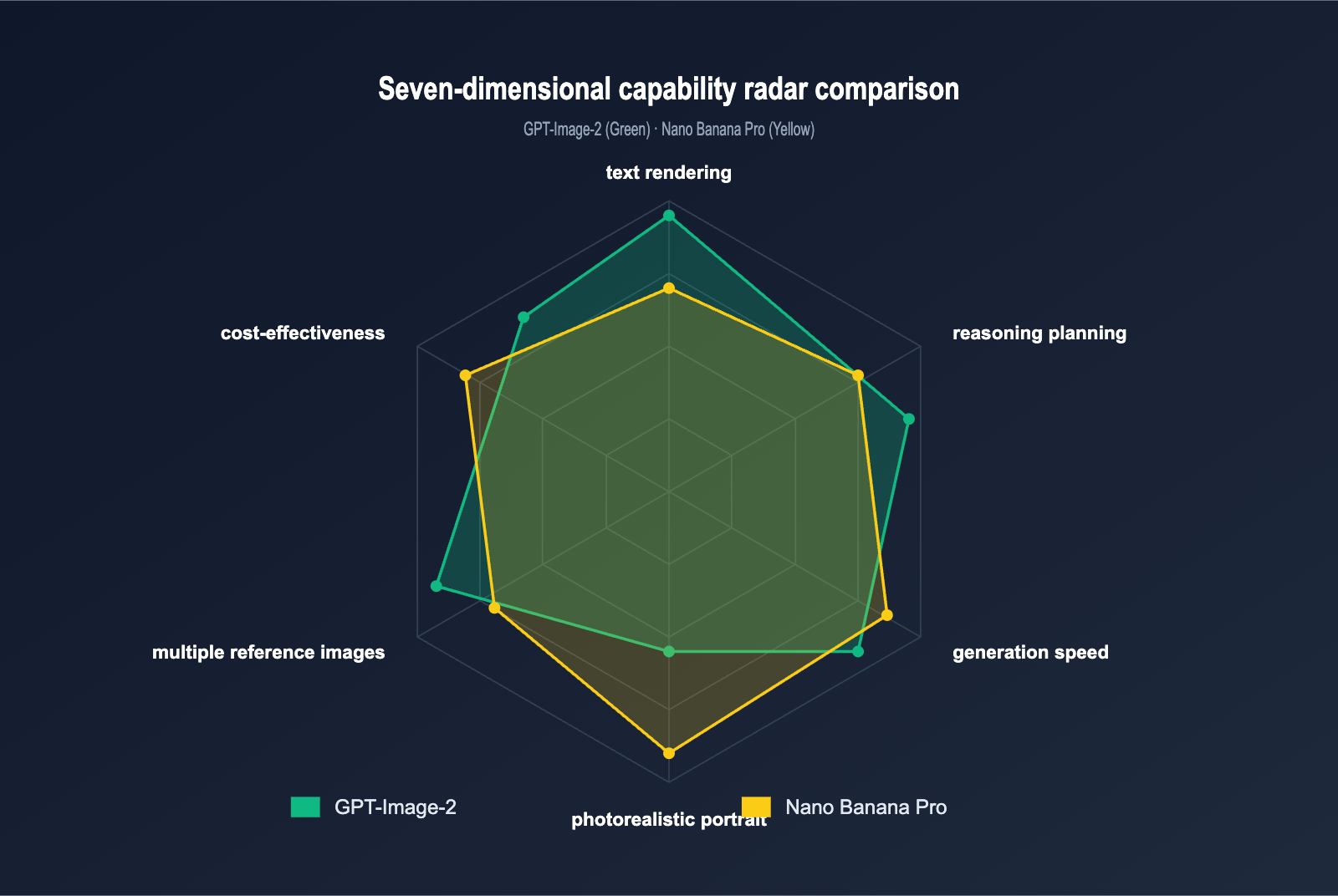
Although GPT-Image-2 leads the rankings overall, Nano Banana Pro maintains a clear advantage in terms of realistic portraits, skin texture, skin pores, and hair details.
| Portrait Dimension | GPT-Image-2 | Nano Banana Pro |
|---|---|---|
| Skin Texture | Slightly plastic | Natural, with pore details |
| Hair Details | Occasional broken strands | Clear strands, good layering |
| Lighting Realism | Good | Cinematic |
| Emotional Nuance | Moderate | High |
| Iris/Pupil Details | Average | Detailed |
| Body Proportions | Occasional errors | Stable |
Differences in Multi-Reference Image Synthesis
Nano Banana Pro has a significant advantage in the number of reference images it supports:
- Nano Banana Pro: Supports up to 14 reference images + 5 human characters appearing in the same image simultaneously, while maintaining consistent lighting, perspective, and style.
- GPT-Image-2: Also supports multiple reference images, but character consistency begins to drift slightly after 5-6 images.
For scenarios like e-commerce virtual try-ons, role-playing, brand visual systems, and comic character continuity, Nano Banana Pro's 14-image limit is currently the only production-ready solution in the industry.
Typical Scenario Recommendations
- 📸 Professional Photography Style: Nano Banana Pro feels more like "real photography," while GPT-Image-2 leans toward "retouched illustration."
- 👤 Face Retention: When uploading the same face for multiple edits, Nano Banana Pro's facial consistency is more stable.
- 👫 Group Photos: For photos with more than 3 people, Nano Banana Pro is the top choice.
- 🎭 Character Series: When the same fictional character appears in different scenes, Nano Banana Pro wins.
- 🏷️ Design with Text: GPT-Image-2 wins.
🎯 Business Advice: For e-commerce, photography post-processing, and short-drama industries, we recommend using Nano Banana Pro as the primary tool. For brand design, poster operations, and UI design, GPT-Image-2 is recommended. The APIYI apiyi.com platform integrates both models and allows you to share a single quota, enabling you to schedule them based on the specific scenario.
Dimension 5: Generation Speed and Throughput
Speed is often the watershed for user experience, especially for consumer-facing products, online editors, and high-volume production scenarios.
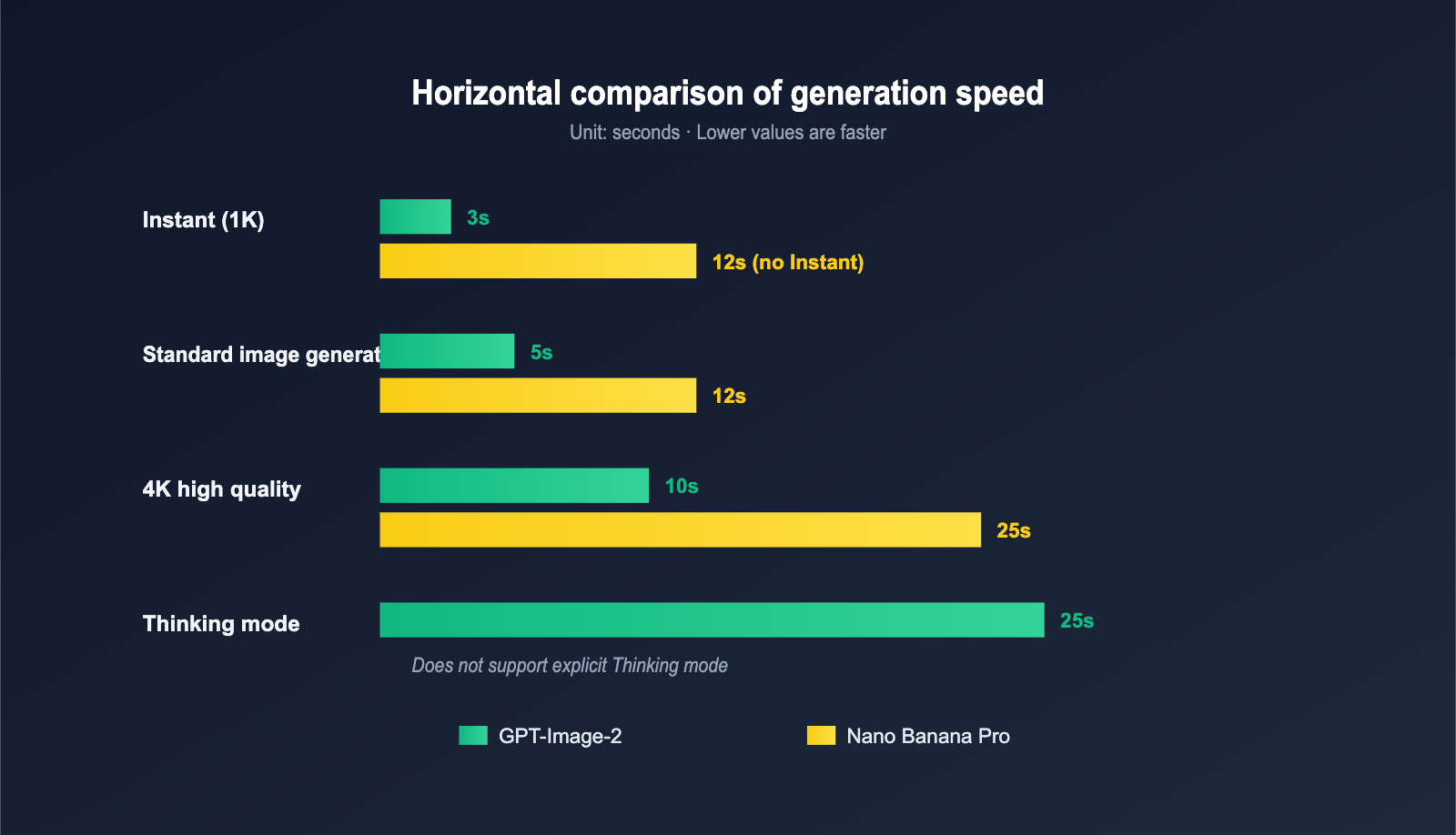
| Speed Metric | GPT-Image-2 | Nano Banana Pro |
|---|---|---|
| Time to First Token | ~1s | ~3s |
| Instant Mode Total Time | 3s | N/A |
| Thinking Mode Total Time | 15-40s | N/A |
| Standard Generation Time | 3-8s | 10-15s |
| 4K Output Total Time | 8-15s | 20-30s |
| Max Images per Request | 8 | 8 |
| Batch Concurrency | Excellent | Good |
The 3-second generation speed of GPT-Image-2's Instant mode is currently one of the fastest among 2K-level image models, offering a near "real-time" experience that's perfect for embedding into interactive products.
# Batch comparison of generation speeds for both models
import time
from openai import OpenAI

# Unified access via APIYI proxy service, using one SDK to call both models
client = OpenAI(api_key="YOUR_API_KEY", base_url="https://vip.apiyi.com/v1")

prompt = "cyberpunk street at night, neon signs, rainy ground, 8k cinematic"

for model in ["gpt-image-2", "gemini-3-pro-image"]:
    start = time.time()
    resp = client.images.generate(model=model, prompt=prompt, size="1024x1024", n=1)
    elapsed = time.time() - start
    print(f"{model}: {elapsed:.2f}s -> {resp.data[0].url}")
💡 Performance Tip: If you're building SaaS products, real-time editors, or live AI interactions, I recommend using GPT-Image-2 Instant as your primary choice. For offline batch processing or overnight rendering tasks, the speed difference between the two models is negligible. In production environments, it's recommended to use an API proxy service with connection pooling and regional optimization to effectively reduce long-tail latency.
Dimension 6: API Pricing and Commercial Costs
Official Pricing Comparison
The API pricing strategies for these two models are quite different: GPT-Image-2 uses "quality-tiered pricing," while Nano Banana Pro uses "resolution-tiered + token-based billing."
| Tier / Resolution | GPT-Image-2 (Price/Image) | Nano Banana Pro (Price/Image) |
|---|---|---|
| Low / 1024×1024 | $0.006 | $0.039 |
| Medium / 1024×1024 | $0.065 | $0.039 |
| High / 1024×1024 | $0.211 | $0.039 |
| High / 2K | $0.28 | $0.134 |
| High / 4K | $0.41 | $0.24 |
| Token Billing (input) | $5 / 1M | $2 / 1M |
| Token Billing (output) | $10 / 1M | $12 / 1M |
Key Insights:
- Low-Quality Tier: GPT-Image-2 is the cheapest ($0.006), making it the ultimate choice for bulk draft scenarios.
- High-Quality Tier: Nano Banana Pro has a lower unit price ($0.039 vs $0.211), making it suitable for high-quality single-image requirements.
- 4K Scenarios: Nano Banana Pro ($0.24) saves you 41% compared to GPT-Image-2 ($0.41).
- Thinking Mode: Keep in mind that GPT-Image-2's token fees will drive up costs, so budget accordingly.
Cost Estimation Example
Based on 10,000 high-quality 1K images per month:
| Model | Unit Price | Monthly Cost | Savings |
|---|---|---|---|
| GPT-Image-2 (High 1K) | $0.211 | $2,110 | – |
| Nano Banana Pro (1K) | $0.039 | $390 | 82% |
| Hybrid Strategy (50/50) | – | $1,250 | 41% |
🎯 Cost Optimization Tip: For budget-sensitive businesses, choosing Nano Banana Pro as a single model is more cost-effective. However, if your content requires significant text rendering, the savings on manual image editing provided by GPT-Image-2's text capabilities often outweigh the API price difference. We recommend using the APIYI (apiyi.com) platform for unified billing, which allows you to enjoy bulk discounts and eliminates the need to maintain separate accounts for OpenAI and Google.
Dimension 7: Compliance, Watermarking, and Controllability
Differences in Watermarking Strategies
The two models handle the "traceability" of generated images in completely different ways:
- GPT-Image-2: Output images have no forced visible watermarks, but the file metadata contains C2PA (Coalition for Content Provenance and Authenticity) information, which can be read by professional tools.
- Nano Banana Pro: All output images are automatically embedded with invisible SynthID watermarks. While invisible to the naked eye, they can be identified using Google's detection tools.
| Compliance Dimension | GPT-Image-2 | Nano Banana Pro |
|---|---|---|
| Visible Watermark | None | None |
| Invisible Watermark | C2PA Metadata | SynthID |
| Commercial License | Allowed (subject to Content Policy) | Allowed |
| Political/Public Figures | Strictly restricted | Strictly restricted |
| Child Content | Strictly restricted | Strictly restricted |
| NSFW | Prohibited | Prohibited |
Safety Filtering Intensity
- GPT-Image-2: Moderation is relatively strict. Requests involving celebrities, trademarks, or sensitive terms will directly return a
content_policy_violation400 error (if you encounter such errors, check our troubleshooting documentation). - Nano Banana Pro: Safety policies are similar, but restrictions on historical figures and art styles are relatively more lenient.
💡 Compliance Advice: For enterprise commercial scenarios, we strongly recommend retaining official watermarks or C2PA information to avoid downstream copyright disputes. Organizations requiring strict audit processes should consider using an API proxy service that supports request logging, prompt auditing, and output traceability to facilitate internal risk control reviews.
Scenario-Based Selection Matrix
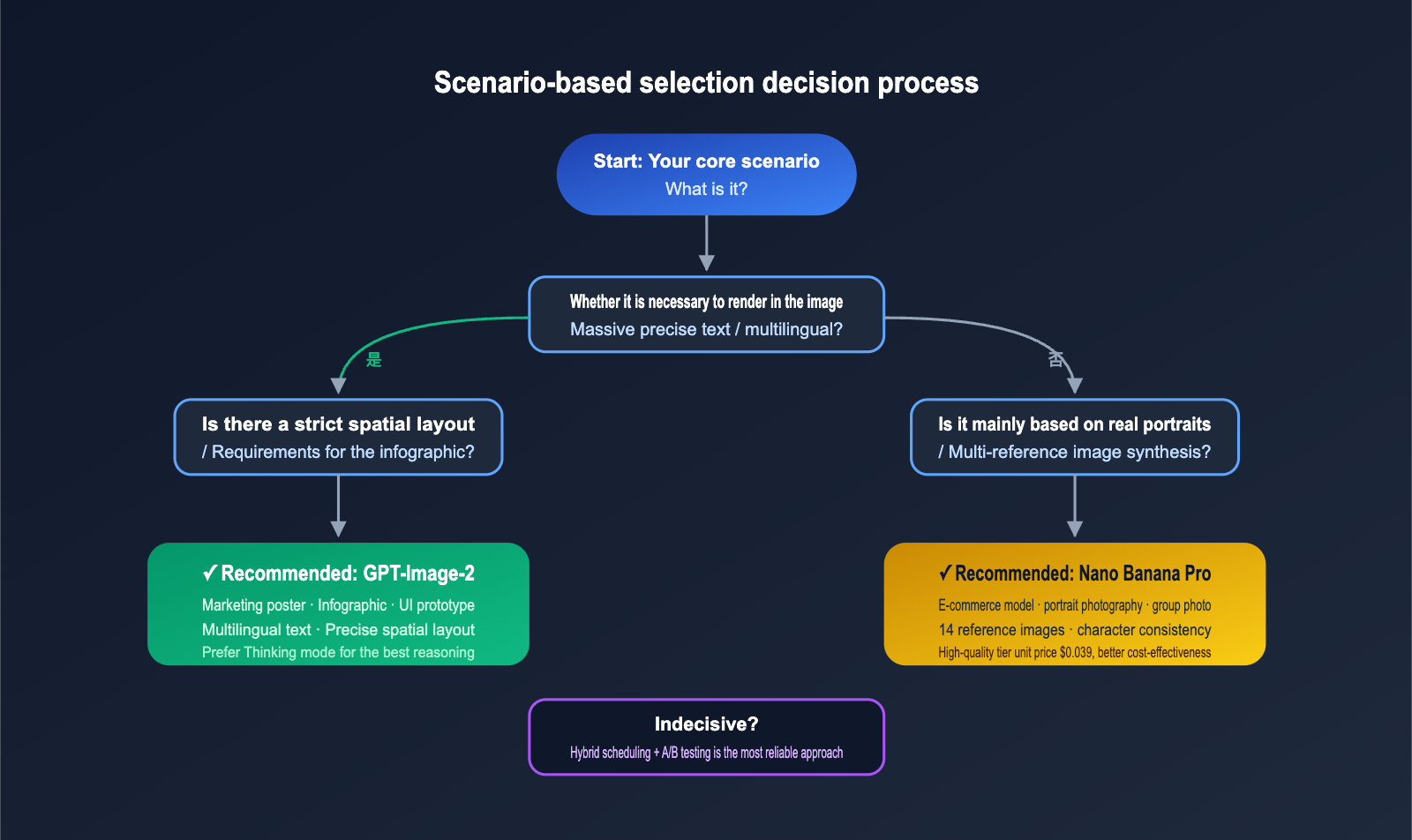
Based on the previous 7 dimensions, we have summarized the following scenario-based recommendations.
| Use Case | Preferred Model | Alternative Model | Key Reason |
|---|---|---|---|
| Marketing Posters / Multilingual Ads | GPT-Image-2 | Nano Banana Pro | 99%+ text rendering accuracy |
| Infographics / Data Visualization | GPT-Image-2 | Nano Banana Pro | Stronger layout reasoning |
| E-commerce Virtual Try-on | Nano Banana Pro | GPT-Image-2 | 14 reference images |
| Realistic Portrait Photography | Nano Banana Pro | – | Superior realism |
| Group Photos / Team Shots | Nano Banana Pro | – | Up to 5 characters |
| UI Prototypes / Mockups | GPT-Image-2 | Nano Banana Pro | Precise text + components |
| Bulk Concept Drafts (Low Cost) | Nano Banana Pro | GPT-Image-2 Low | Lower unit price |
| Real-time Editor / SaaS Products | GPT-Image-2 Instant | – | 3-second generation |
| Real-time Info (Weather/News) | Nano Banana Pro | GPT-Image-2 Thinking | Google Search grounding |
| Posters + Precise Numbers/Dates | GPT-Image-2 Thinking | – | Superior reasoning + text |
| Character Consistency (Comics/Scripts) | Nano Banana Pro | – | Better multi-image consistency |
| Artistic Stylization | Varies | – | A/B testing recommended |
Best Practices for Hybrid Routing
In a real production environment, relying on a single model is rarely the optimal strategy. Here are the typical division-of-labor patterns we've observed:
Pattern A: Text-First (Suitable for brand operations, social media, e-commerce)
- 70% traffic → GPT-Image-2 (for posters, infographics, UI)
- 30% traffic → Nano Banana Pro (for portraits, models, real-world scenes)
Pattern B: Portrait-First (Suitable for photography, weddings, e-commerce modeling)
- 70% traffic → Nano Banana Pro (for portraits, groups, editing)
- 30% traffic → GPT-Image-2 (for logos, annotations, cover fonts)
Pattern C: Cost-First (Suitable for high-volume production, content factories)
- 80% initial drafts → GPT-Image-2 Low ($0.006) / Nano Banana Pro ($0.039)
- 20% refinement → Select high-end models based on quality requirements
🎯 Engineering Advice: If you have a requirement for multi-model routing, you can point your
base_urldirectly tohttps://vip.apiyi.com/v1and switch models using themodelfield (e.g.,gpt-image-2/gemini-3-pro-image). This eliminates the need to maintain separate OpenAI and Google AI Studio keys, significantly reducing infrastructure complexity.
Quick Start: 3-Minute Dual-Model Integration
Environment Setup
# Install the latest OpenAI SDK (compatible with both models)
pip install --upgrade openai

# Or use the Node.js SDK
npm install openai@latest
Unified Invocation Example (Python)
from openai import OpenAI
import base64

client = OpenAI(
    api_key="YOUR_APIYI_KEY",
    base_url="https://vip.apiyi.com/v1"
)

def generate_image(model_name: str, prompt: str, size="1024x1024"):
    """Unified wrapper supporting both gpt-image-2 and gemini-3-pro-image"""
    resp = client.images.generate(
        model=model_name,
        prompt=prompt,
        size=size,
        n=1,
        quality="high"
    )
    return resp.data[0].url

# Comparative test with the same prompt
prompt = "A futuristic electric car brochure cover with the text 'EV 2026'"

url_openai = generate_image("gpt-image-2", prompt)
url_google = generate_image("gemini-3-pro-image", prompt)

print(f"GPT-Image-2: {url_openai}")
print(f"Nano Banana Pro: {url_google}")
Node.js Invocation Example
import OpenAI from "openai";

const client = new OpenAI({
  apiKey: process.env.APIYI_KEY,
  baseURL: "https://vip.apiyi.com/v1",
});

async function generate(model, prompt) {
  const res = await client.images.generate({
    model,
    prompt,
    size: "1024x1024",
    n: 1,
  });
  return res.data[0].url;
}

const prompt = "cyberpunk poster with Chinese text '人工智能'";
console.log(await generate("gpt-image-2", prompt));
console.log(await generate("gemini-3-pro-image", prompt));
💡 Integration Tip: Using a single
base_urland API key for both models is the standard approach we always recommend. When integrating via APIYI (apiyi.com), you only need to change a single string parameter to switch models—no need to modify any request body structures.
FAQ
1. Does GPT-Image-2 completely outperform Nano Banana Pro?
Not necessarily. While GPT-Image-2 has clear advantages in text rendering, spatial reasoning, and generation speed, Nano Banana Pro remains the gold standard for photorealistic portraits, multi-person consistency, and multi-reference image fusion. We recommend making a weighted decision based on your specific business scenario rather than assuming one model fits all.
2. Can these two model APIs be called stably from mainland China?
Official APIs have access restrictions for users in mainland China. We recommend using the optimized domestic routes provided by APIYI (apiyi.com). It supports the native OpenAI SDK protocol and covers both gpt-image-2 and gemini-3-pro-image, ensuring stable request success rates and sub-second latency.
3. Which one should I choose for marketing posters with text?
GPT-Image-2 is the top choice, especially for posters requiring non-Western scripts like Chinese, Japanese, Korean, or Arabic; its text accuracy is 6-15% higher than Nano Banana Pro. However, if the poster involves many real-life models, consider a hybrid workflow: "GPT-Image-2 for text layout + Nano Banana Pro for portrait assets."
4. How do I switch between Thinking mode and Instant mode in the API?
You can switch modes using the reasoning_effort parameter or by using specific model names (e.g., gpt-image-2-thinking). Please refer to the official OpenAI documentation for specific parameters. Note that Thinking mode consumes additional reasoning tokens, and the cost can be 2-3 times higher than Instant mode, so we recommend calculating costs before scaling up production.
5. Will the SynthID watermark on Nano Banana Pro affect commercial use?
SynthID is an invisible watermark that doesn't affect image quality or hinder commercial use. However, if your images are part of a workflow involving "watermark removal/copyright laundering," be aware that Google has the capability to detect image origins via SynthID, which could pose legal risks.
6. How do I perform A/B testing for these two models?
The most efficient way is to use the same key and base_url, then split traffic at the business layer based on weight. We recommend using the unified APIYI (apiyi.com) interface to run A/B tests for 1-2 weeks, tracking metrics like user preference, download rates, and re-editing rates before deciding on your primary model.
7. What should I do if GPT-Image-2 returns a 400 moderation_blocked error?
This usually happens because the prompt triggered OpenAI's content policy (e.g., involving celebrities, violence, pornography, or politics). You can try: ① Rewriting the prompt to avoid sensitive terms; ② Testing the same prompt with Nano Banana Pro (as policies may differ slightly); ③ Checking our dedicated documentation on troubleshooting moderation errors.
8. Are there any other competitors worth watching besides these two?
As of 2026, the second tier mainly consists of: Midjourney V8 (still the best for artistic style control), FLUX Pro 1.1 (a favorite in the open-source community), and Imagen 4 (a candidate for Google's next generation). However, based on LMArena's comprehensive scores, the gap between GPT-Image-2/Nano Banana Pro and these others has widened significantly.
Summary: The "Dual-King Landscape" of AI Image Models in 2026
After a systematic comparison across seven dimensions, we've reached three core conclusions:
- GPT-Image-2 is currently the most capable all-around image model. It has established a generational lead in text rendering, layout, reasoning, and speed, making it the go-to choice for branding, operations, UI design, and infographics.
- Nano Banana Pro remains the king of portraiture and multi-reference image tasks. It’s irreplaceable for photorealism, face consistency, and multi-person compositions, making it ideal for photography, e-commerce, short-form video production, and comics.
- Hybrid scheduling is the optimal strategy for 2026. The era of betting on a single provider is over. Routing between these two models based on the specific use case ensures the lowest costs and the highest quality.
For developers and enterprises looking to deploy quickly without the headache of maintaining multiple SDKs, we recommend using the APIYI (apiyi.com) platform to access both GPT-Image-2 and Nano Banana Pro. With a single API key, one base_url, and the standard OpenAI SDK, you can seamlessly switch between these two top-tier models while enjoying stable domestic access, unified billing, and bulk discounts.
🎯 Final Recommendation: If you haven't started using either yet, sign up for an account at APIYI (apiyi.com), run 20 comparison images using both models, and then decide on your primary direction. The cost of a single cup of coffee can save you from the future migration costs of choosing the wrong model.
Author: APIYI Technical Team | apiyi.com
Published: 2026-04-24
Technical Support: Visit APIYI (apiyi.com) for the latest AI Large Language Model API services, supporting unified access to major providers like OpenAI, Google, Anthropic, and more.