Author's Note: A detailed look at the latest developments in the OpenAI GPT Image 2 beta test, including the performance of the maskingtape/gaffertape/packingtape models in anonymous Arena testing, tips for triggering 16:9 widescreen output, and key differences from GPT Image 1.5.
OpenAI hasn't officially released GPT Image 2 yet, but this new model has been "leaked" across multiple fronts—three codenamed models have appeared in anonymous Chatbot Arena testing, and reports of ChatGPT users randomly triggering the new model are surfacing rapidly. This article provides a comprehensive breakdown of what we know about GPT Image 2, how to verify if you've "hit the jackpot" with the new model, and predictions for its capability upgrades.
Core Value: Get up to speed in 3 minutes on the latest GPT Image 2 leaks, how to tell if you've triggered the new model, and what this means for the AI image generation industry.
Core Information Leaked from GPT Image 2 Gray-Scale Testing
Quick Overview of Known GPT Image 2 Details
| Information Item | Details |
|---|---|
| Current Status | Gray-scale testing / Not officially released |
| Discovery Date | Community reports began appearing on April 4, 2026 |
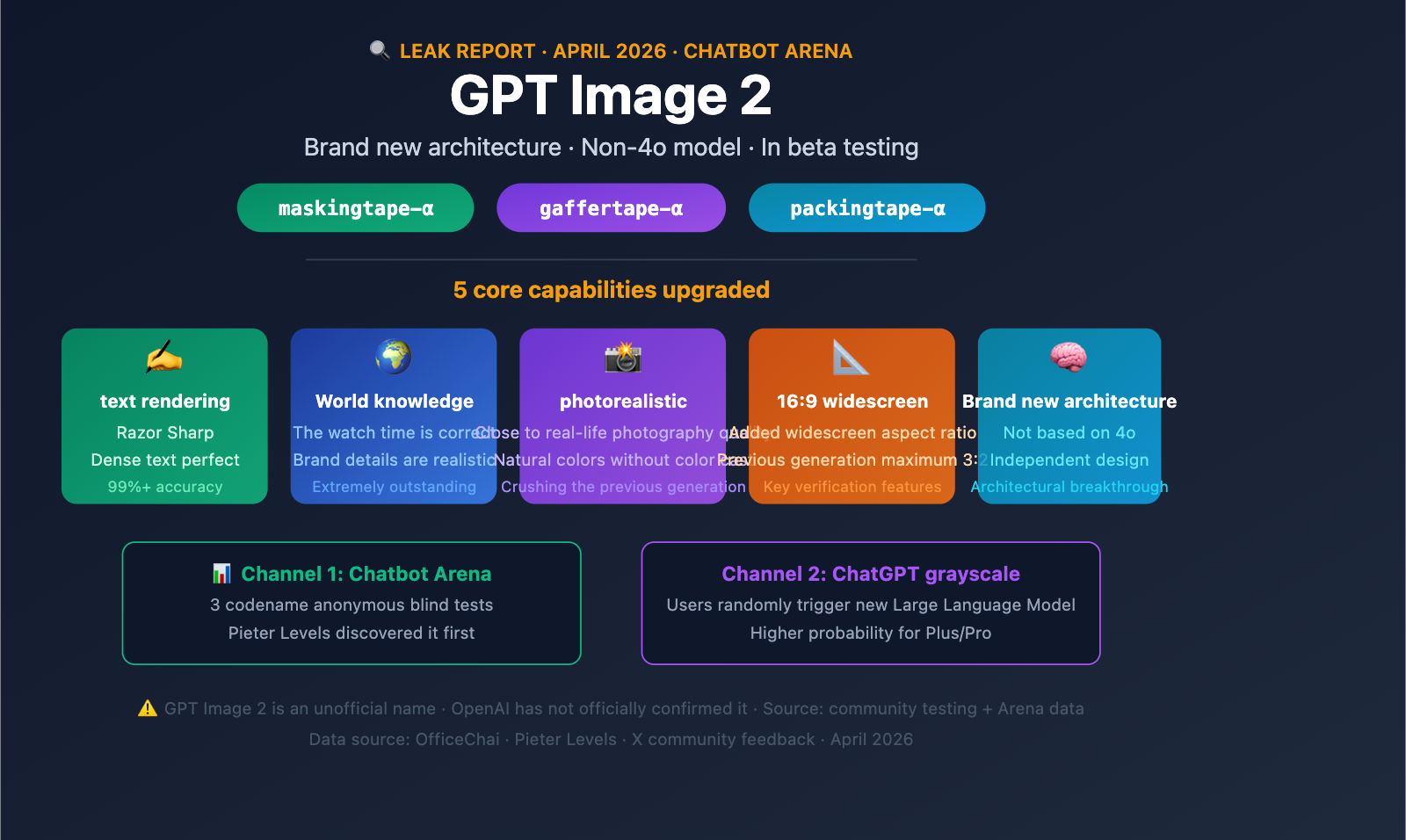
| Arena Codename | maskingtape-alpha, gaffertape-alpha, packingtape-alpha |
| Discovered By | First flagged by developer Pieter Levels |
| Architectural Features | Brand new architecture, not based on 4o |
| Core Breakthroughs | Text rendering, world knowledge, photorealism |
| ChatGPT Gray-scale | Randomly triggered for some users; higher probability for Plus/Pro |
| Official Confirmation | Not yet officially confirmed by OpenAI |
Two Leak Channels for GPT Image 2
News about GPT Image 2 has surfaced through two independent channels:
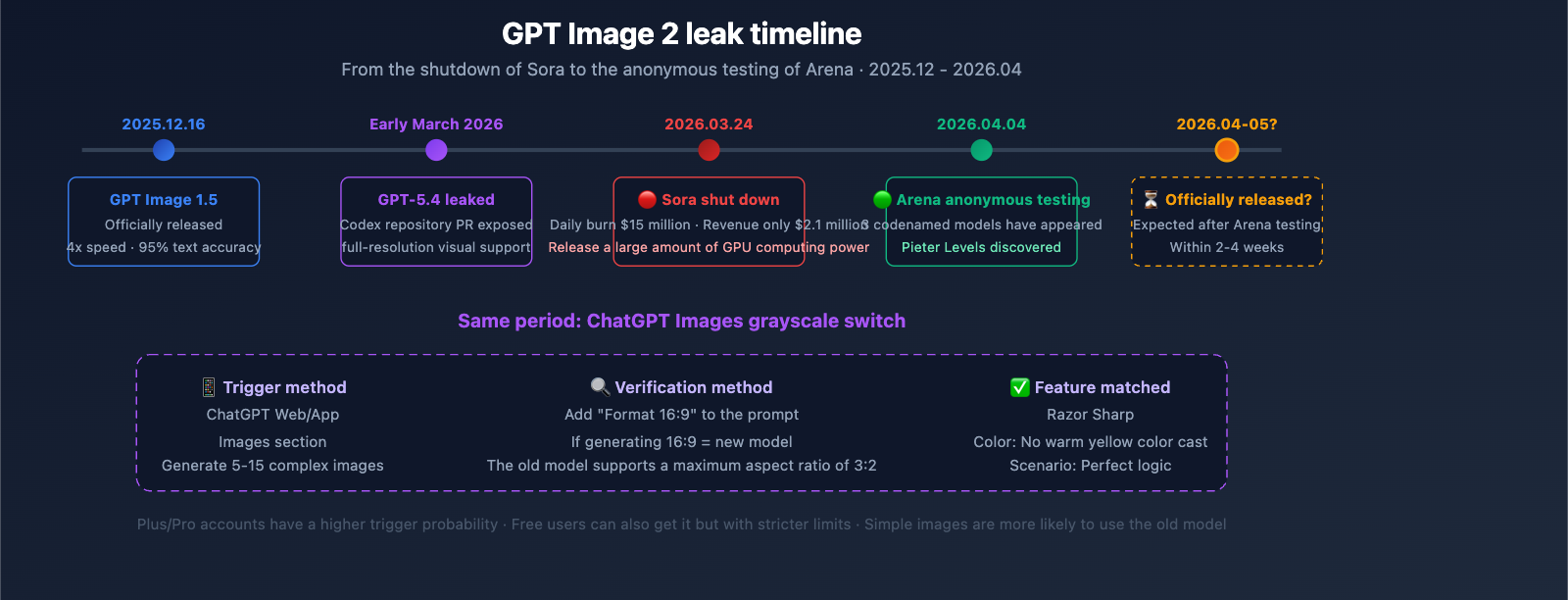
Channel 1: Chatbot Arena Anonymous Testing — Three models named after adhesive tapes (maskingtape-alpha, gaffertape-alpha, and packingtape-alpha) appeared in the Arena's blind test environment. The naming convention is consistent with OpenAI's existing gpt-image series. This strategy is highly similar to the anonymous testing method used by Google when they released Nano Banana.
Channel 2: Random ChatGPT User Triggers — A large number of users on X (formerly Twitter) have reported that when the ChatGPT Images feature generates complex images (such as those containing significant amounts of text, UI elements, or product shots), it randomly switches to a noticeably different new model, with output quality significantly higher than GPT Image 1.5.
Analysis of GPT Image 2's Performance in the Arena
Test Performance of the Three Codename Models
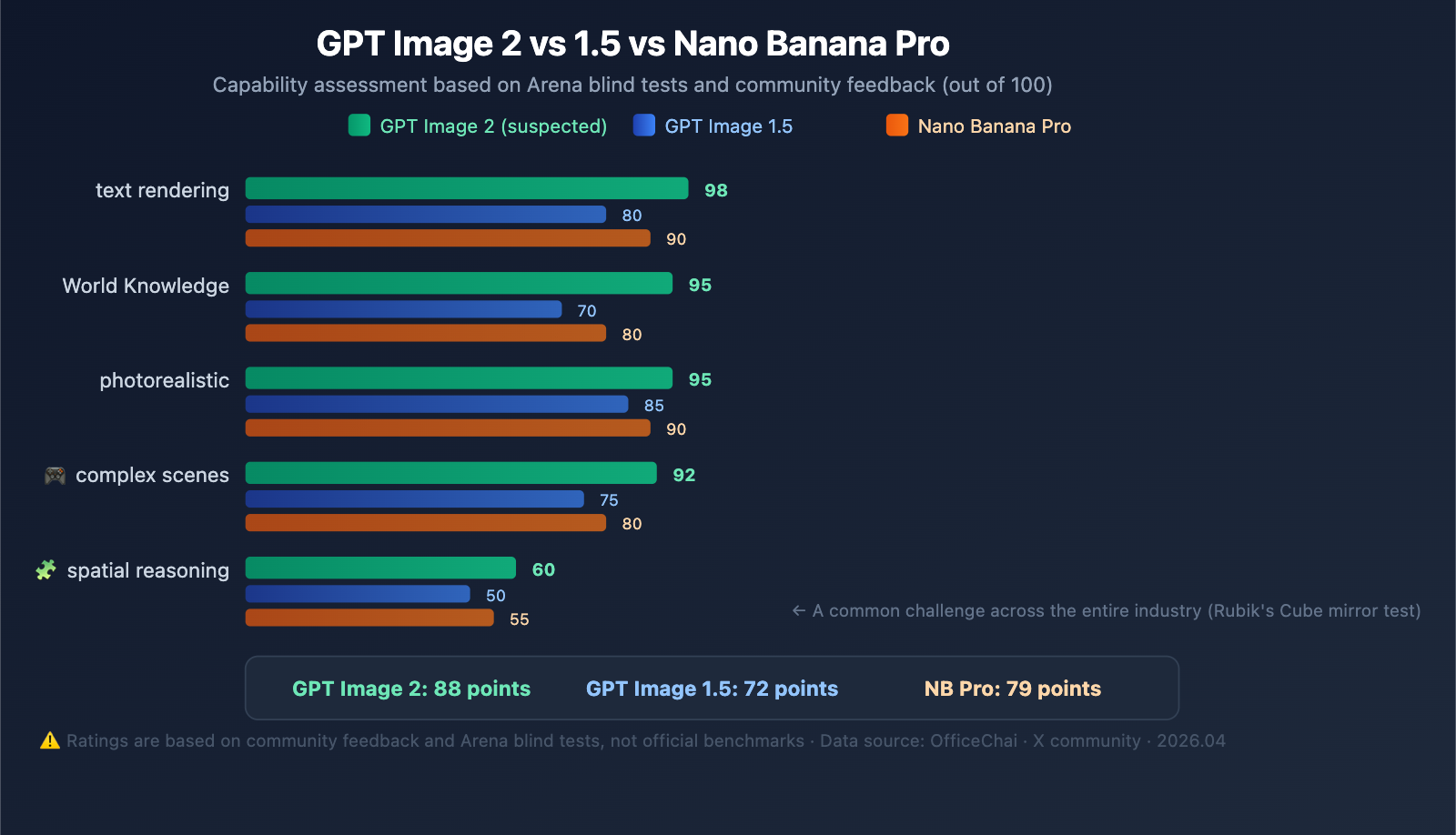
Renowned developer Pieter Levels was the first to tag these three models in the Chatbot Arena, noting that they exhibit "incredibly impressive world knowledge and excellent text rendering."
Subsequent large-scale community testing has revealed the following key performance metrics:
| Test Dimension | GPT Image 2 Performance | Competitor Comparison |
|---|---|---|
| Text Rendering | Text is finally "usable"—clear, accurate, and supports dense text | Significantly better than GPT Image 1.5 |
| World Knowledge | Correctly renders watch times, authentic brand details, and famous character features | packingtape correctly renders watch times; Nano Banana Pro fails |
| Photorealism | Texture and lighting approach real-world photography | Community feedback: "Makes NB Pro look like DALL-E" |
| Complex Scenes | Excellent performance in complex scenes like Minecraft gameplay | maskingtape wins in Minecraft comparisons |
| Spatial Reasoning | Rubik's cube mirror reflection test still fails | This remains an industry-wide challenge |
The Unique Value of Arena Blind Tests
The blind testing methodology of the Chatbot Arena allows users to judge output quality without knowing the model's source. If maskingtape-alpha and its sister models maintain their lead in ongoing community testing, the Elo rating will serve as a testament to the model's capabilities without any marketing spend.
This is likely a deliberate strategy by OpenAI—validating model strength and gathering community feedback through anonymous testing, ensuring that when it's officially released, it already has the backing of "community-verified" data.
🎯 Developer Note: The brand-new architecture of GPT Image 2 (not based on 4o) suggests it may be an independent image generation model, and the model invocation method might differ from GPT Image 1.5. If you're developing image generation applications, we recommend keeping an eye on model launch updates via APIYI (apiyi.com), as the platform will support API access for new models as soon as they become available.
How to Trigger GPT Image 2 in ChatGPT
Trigger Conditions and Verification Methods
According to aggregated feedback from the community on X, the Images feature in ChatGPT is currently routing a portion of requests to the new model as part of a phased rollout. Here are the verified methods to trigger and identify it:
Trigger Steps
- Log in to ChatGPT — Use
chatgpt.com(web) or the ChatGPT mobile app (iOS/Android). - Access the Images section — Navigate to the Images section on the left, or simply type "Generate a…" in the chat box.
- Generate complex images repeatedly — Generate 5-15 consecutive images containing the following elements:
- Images with lots of text (posters, infographics)
- Interface screenshots (YouTube screenshots, app UIs)
- Product shots (electronics, packaging design)
- Medical charts, information posters, and other professional content
- Simple content is more likely to use the old model — Simple landscapes or pure art are more likely to hit GPT Image 1.5.
Verifying if You've Hit GPT Image 2
The most reliable verification method is to add "Format 16:9" to the end of your prompt:
Generate an image: A realistic YouTube screenshot showing the
official launch promotional video for GPT Image V2 from OpenAI's
official account, with comments, 16:9 aspect ratio, 4K resolution.
Evaluation Criteria:
| Observation Metric | GPT Image 1.5 | GPT Image 2 (Suspected) |
|---|---|---|
| 16:9 Support | Maxes out at 3:2 (1536×1024) | Supports 16:9 widescreen |
| Text Clarity | Recognizable but blurry | Razor Sharp |
| Color Tone | Warm yellow tint | Natural colors, no warm yellow cast |
| Detail Realism | Good | Approaches photorealistic quality |
| Complex Scene Logic | Occasionally illogical | Significantly improved logical consistency |
Trigger Probability
| Account Type | Trigger Probability | Daily Limit |
|---|---|---|
| ChatGPT Pro | Higher | More generous limits |
| ChatGPT Plus | Medium | Standard limits |
| Free User | Lower (but still possible) | Stricter limits |
💡 Trigger Tip: The key is to generate complex images that contain a lot of text and interface elements. Simple landscapes or pure artistic creations are more likely to be routed to the older model. Generating multiple images in a row increases the probability of hitting the new model.
Expected Differences: GPT Image 2 vs. GPT Image 1.5
Core Capability Comparison
| Capability Dimension | GPT Image 1.5 (Current) | GPT Image 2 (Expected) |
|---|---|---|
| Architecture | Based on 4o | All-new architecture (non-4o) |
| Text Rendering Accuracy | ~95% | Expected 99%+ |
| Supported Aspect Ratios | 1:1, 3:2, 2:3 | Potential addition of 16:9 |
| Generation Speed | 8-12 seconds/image | TBD |
| Photorealism | High | Extremely high (near-photographic) |
| World Knowledge | Good | Significantly enhanced |
| Dense Text | Supported but occasional errors | Nearly perfect |
| API Availability | Released (gpt-image-1.5) | Not yet released |
| Price (1024² High) | $0.133/image | To be announced |
Current Status of GPT Image 1.5 API
For benchmarking purposes, here is the current API pricing for GPT Image 1.5:
| Size | Low Quality | Medium Quality | High Quality |
|---|---|---|---|
| 1024×1024 | $0.009 | $0.034 | $0.133 |
| 1024×1536 | $0.013 | $0.051 | $0.200 |
| 1536×1024 | $0.013 | $0.051 | $0.200 |
🎯 Advice for API Developers: API pricing is expected to change once GPT Image 2 is released. If your application requires image generation capabilities, you can use APIYI (apiyi.com) to access both GPT Image 1.5 and other models (like Nano Banana Pro). The platform will support GPT Image 2 as soon as it goes live.
Strategic Context for GPT Image 2
Sora Shutdown Frees Up Compute
To understand the timing of GPT Image 2, we need to look at a key event: OpenAI shut down Sora on March 24, 2026.
Sora, OpenAI's AI video generation tool, was closed just six months after its launch. The core reasons were:
- Unsustainable Inference Costs: According to Forbes, Sora was burning through $15 million in inference costs daily at its peak.
- Revenue Didn't Cover Costs: In-app purchase revenue for Sora's entire lifecycle was only $2.1 million.
- Stagnant User Growth: The global user base peaked at around 1 million before dropping to under 500,000.
CEO Sam Altman stated that shutting down Sora was intended to "focus compute and product capabilities on the next generation of automated researchers and enterprise applications." Looking at the timeline, it's highly likely that the massive GPU compute capacity freed up by the Sora shutdown was partially reallocated to the training and inference infrastructure for GPT Image 2.
Industry Competitive Landscape
The launch of GPT Image 2 should also be viewed through the lens of industry competition:
| Competitor | Core Advantage | GPT Image 2 Competitive Strategy |
|---|---|---|
| Nano Banana Pro | First-mover advantage, Google compute | Has already shown overwhelming superiority in Arena blind tests |
| Midjourney V7 | Artistic style, community ecosystem | Winning through photorealism and text rendering |
| FLUX Pro | Open source, local deployment | Differentiating via world knowledge and complex scene capabilities |
| Ideogram 3.0 | Specialization in text rendering | Comprehensive capability coverage, not just a single dimension |
5 Predictions for GPT Image 2
Based on existing leaks and industry trends, here are 5 core predictions for GPT Image 2:
Prediction 1: API pricing may increase — A brand-new architecture means higher inference costs, so the price per high-quality output could land between $0.15 and $0.20.
Prediction 2: Support for more aspect ratios — 16:9 widescreen support has already been verified in beta testing, and the official release will likely add more options like 9:16 vertical.
Prediction 3: Official release likely in April or May — Anonymous testing in the Arena and beta rollouts in ChatGPT are usually signals that a release is 2–4 weeks away.
Prediction 4: Enhanced image editing capabilities — Building on the precise editing strengths of GPT Image 1.5, we'll likely see even more granular local editing features.
Prediction 5: Potential joint release with GPT-5.4 — The leaked timeline for GPT-5.4 aligns closely with GPT Image 2, making a bundled release quite possible.
FAQ
Q1: Has GPT Image 2 been officially released?
It hasn't been officially released yet. GPT Image 2 is currently in the beta/leaked stage, and OpenAI hasn't provided official confirmation. However, thanks to anonymous model codenames in the Chatbot Arena and random reports from ChatGPT users, the community is highly confident that this is OpenAI's next-generation image generation model. If you need to use an image generation API in your apps, we currently recommend using GPT Image 1.5 or Nano Banana Pro via APIYI (apiyi.com).
Q2: How can I tell if I’ve triggered the new model in ChatGPT?
The most reliable method is to include "Format 16:9" in your prompt. If it successfully generates a 16:9 image with razor-sharp text, natural colors without a warm yellow tint, and perfect logic in complex scenes, you've likely hit the new model. Simple landscapes or pure artistic creations are more likely to fall back on the old model, while generating complex images with lots of text and UI elements is more likely to trigger the new one.
Q3: When will the GPT Image 2 API be available?
There's no exact timeline yet. Based on OpenAI's previous release cadence, there's usually a 2–4 week gap between anonymous Arena testing and the official API release. We recommend keeping an eye on official OpenAI announcements and model update notifications from APIYI (apiyi.com), as the platform will support API invocation as soon as the new model goes live.
Summary
Key takeaways from the GPT Image 2 gray-scale leak:
- Spotted in the Arena: Three codenamed models—maskingtape, gaffertape, and packingtape—have shown impressive performance in community testing.
- All-New Architecture: It’s not based on 4o; it’s an independently designed image generation model.
- Major Breakthroughs: Near-perfect text rendering, significantly enhanced world knowledge, and photorealistic quality.
- ChatGPT Gray-scale: Currently rolling out to random users. You can try triggering it with complex prompts combined with "Format 16:9."
- Strategic Context: The shutdown of Sora has freed up compute resources, and the anonymous Arena testing strategy suggests an official launch is expected around April or May.
The arrival of GPT Image 2 is set to shake up the AI image generation landscape. Its breakthroughs in text rendering and world knowledge mean that AI-generated images will become significantly more practical for commercial use cases like product photography, posters, and UI design.
We recommend keeping an eye on APIYI (apiyi.com) for updates on the GPT Image 2 API release. The platform already supports unified model invocation for mainstream image models like GPT Image 1.5 and Nano Banana Pro.
📚 References
-
OfficeChai Report: Three image generation models named maskingtape, gaffertape, and packingtape create buzz on Arena, rumoured to be OpenAI's GPT Image 2
- Link:
officechai.com/ai/three-image-generation-models-named-maskingtape-gaffertape-and-packingtape-create-buzz-on-arena-rumoured-to-be-openais-gpt-image-2 - Note: The most detailed analysis of the Arena leak.
- Link:
-
OpenAI Official: New ChatGPT Images feature page (GPT Image 1.5)
- Link:
openai.com/index/new-chatgpt-images-is-here - Note: Functional overview of the current official version.
- Link:
-
TechCrunch Report: Why OpenAI really shut down Sora
- Link:
techcrunch.com/2026/03/29/why-openai-really-shut-down-sora - Note: Analysis of the compute reallocation behind the Sora shutdown.
- Link:
-
OpenAI API Documentation: GPT Image 1.5 model specifications
- Link:
platform.openai.com/docs/models/gpt-image-1.5 - Note: Technical specs for currently available API models.
- Link:
-
GPT Image Wikipedia: Complete history of the GPT Image series
- Link:
en.wikipedia.org/wiki/GPT_Image - Note: A full evolutionary record from DALL-E to GPT Image.
- Link:
Author: APIYI Technical Team
Technical Discussion: Feel free to share your experiences triggering GPT Image 2 in the comments. For more AI development resources, visit the APIYI documentation center at docs.apiyi.com.