作者注:A deep dive into SynthID invisible watermarking technology in Nano Banana generated images, explaining its working principles, detection methods, tamper resistance, and commercial implications, to help developers understand AI image watermarking mechanisms.
When you're generating images using the Nano Banana API, you might have noticed a line in the documentation: "All generated images include a SynthID watermark." So, what exactly is SynthID? And how is it different from the visible watermarks we usually see? SynthID is an invisible digital watermarking technology developed by Google DeepMind. It's directly embedded into the image pixels, completely invisible to the naked eye, yet accurately detectable by machines.
Key Takeaway: By the end of this article, you'll understand the 5 core mechanisms of SynthID watermarking, grasp its impact on commercial scenarios, and learn how to detect and verify AI-generated images.
Key Takeaways for SynthID Watermarking
| Key Point | Description | Impact on Developers |
|---|---|---|
| Invisible Embedding | Watermark embedded at the pixel level, invisible to the naked eye | Doesn't affect image quality or commercial use |
| Embedded During Generation | Directly embedded during the image generation process, not added as post-processing | Cannot be removed by screenshots or re-saving |
| Tamper-Resistant Design | Detectable even after cropping, compression, or applying filters | Traceable even after distribution and editing |
| Probabilistic Detection | Detection results are three-state: "Watermarked / Not Watermarked / Uncertain" | Not a 100% absolute determination |
| Full Platform Coverage | Included in Nano Banana / Nano Banana Pro / Imagen | All Google AI image generation includes embedding |
The Essence of SynthID Watermarking
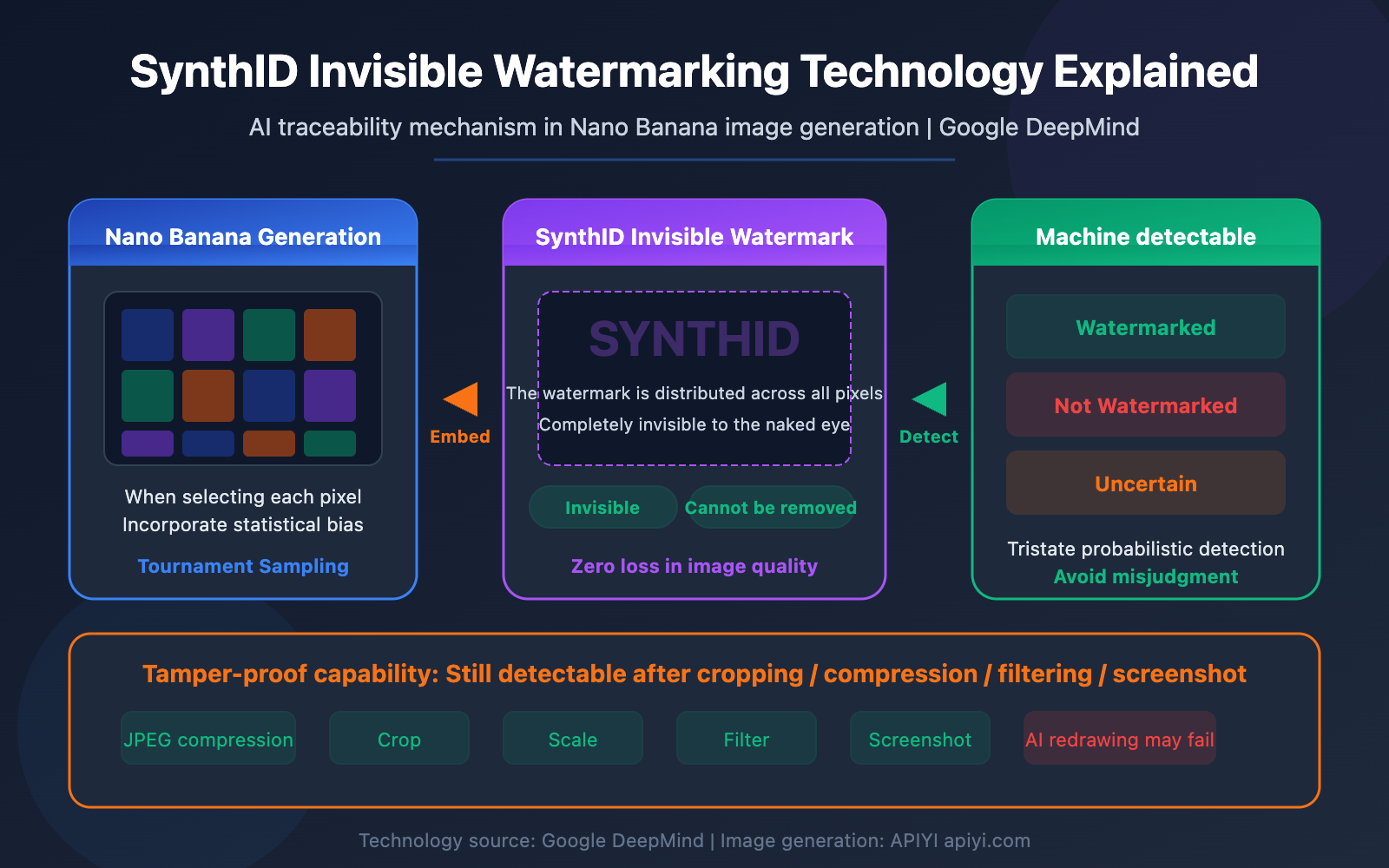
SynthID isn't a traditional watermark "pasted onto an image"—it's an inherent part of the image itself. During the Nano Banana image generation process, every pixel choice made by the model is subtly influenced by Google's private key. This influence is achieved through a mechanism called "Tournament Sampling."
To put it simply: regular image watermarks are layered onto an image after it's generated. SynthID, however, integrates statistical bias into every step of the image generation. It's like adding a special tracer to concrete during pouring, rather than sticking a label on the wall after it's finished.
SynthID Watermarks vs. Visible Watermarks
Many users confuse SynthID with Gemini's visible watermark (the Gemini sparkle icon). The two are completely different:
| Comparison Aspect | SynthID Invisible Watermark | Gemini Visible Watermark (sparkle) |
|---|---|---|
| Visibility | Completely invisible to the naked eye | Visible sparkle icon in the corner of the image |
| Removability | Cannot be removed (pixel-embedded) | Can be removed via subscription / API |
| Scope | All Google AI-generated images | Only for free and Pro tier users |
| Removal Conditions | Not removable | Google AI Ultra subscription or API invocation |
| Purpose | Machine detection of AI origin | Human identification of AI generation |
| Technical Level | Pixel-level statistical bias | Image overlay |
🎯 Developer Note: Images generated via APIYI (apiyi.com) using the Nano Banana API also include the SynthID invisible watermark (this is a model-level mechanism), but they won't have the visible Gemini sparkle watermark. The output from API invocation is consistent with images obtained by Google AI Ultra subscribers—clean visuals, but with SynthID embedded underneath.
5 Core Mechanisms of SynthID Watermarking
Mechanism One: Embedded During Generation (Not Post-Processing)
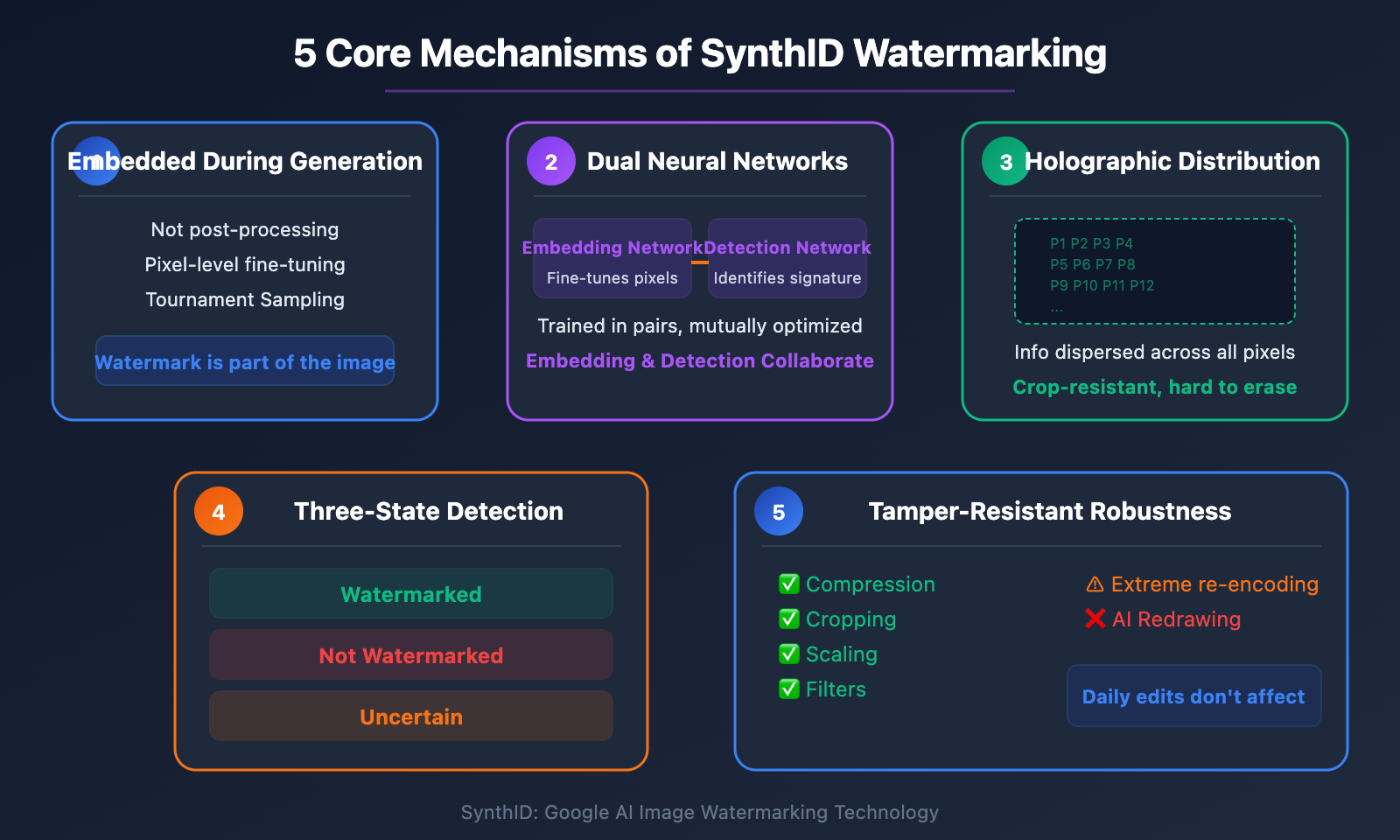
Traditional digital watermarking involves modifying certain pixels with an algorithm after an image has been generated to embed a mark. SynthID is completely different—it participates in the decision-making for pixel values at every step of the image generation process.
When Nano Banana generates an image, the model needs to select color values for each pixel. Normally, the model would choose the most probable color based on a probability distribution. SynthID uses Tournament Sampling technology to subtly adjust this probability distribution without significantly altering the visual appearance. This ensures that the final chosen pixel values carry a specific statistical signature.
Mechanism Two: Dual Neural Network Architecture
SynthID uses two neural networks that work together:
- Embedding Network: This network fine-tunes pixel color values during image generation. The changes are minimal (imperceptible to the human eye), but they create a detectable pattern at a statistical level.
- Detection Network: This network takes an image as input and analyzes its pixel distribution to determine if SynthID's statistical signature is present.
These two networks are trained in tandem—the embedding network learns how to embed the strongest signal without affecting image quality, while the detection network learns how to identify this signal under various interference conditions.
Mechanism Three: Holographic Watermark Distribution
SynthID's watermark information isn't concentrated in a specific area of the image; instead, it's holographically distributed across all pixels of the entire image. This means:
- If you crop any part of the image, the remaining portion still carries the watermark information.
- There's no possibility of "finding the watermark location and erasing it."
- Even if only a small section of the original image remains, the detection network still has a chance to identify it.
Mechanism Four: Probabilistic Three-State Detection
SynthID's detection results aren't a simple "yes/no" binary judgment. Instead, there are three states:
| Detection State | Meaning | Typical Scenario |
|---|---|---|
| Watermarked | High confidence that SynthID is present | AI-generated images without significant modifications |
| Not Watermarked | High confidence that SynthID is not present | Photos taken with a camera, non-Google AI-generated |
| Uncertain | Unable to make a reliable determination | Heavily edited or highly compressed images |
This three-state design helps prevent false positives. When an image is severely modified, blurring the statistical signature, the system opts for "Uncertain" rather than providing an incorrect answer.
Mechanism Five: Tamper-Resistant Robustness
One of SynthID's core design goals is to remain detectable even after various common image operations:
| Operation Type | SynthID Survival | Explanation |
|---|---|---|
| JPEG Compression | ✅ Survives | Lossy compression doesn't affect the statistical signature |
| Cropping | ✅ Survives | Holographic distribution means local parts are still detectable |
| Scaling/Resolution Adjustment | ✅ Survives | Statistical patterns are maintained across multiple scales |
| Adding Filters/Color Adjustments | ✅ Survives | Color shifts don't destroy the statistical structure |
| Screenshot | ✅ Survives | Equivalent to cropping + compression |
| Extreme Re-encoding | ⚠️ May be reduced | Multiple high-compression conversions can weaken the signal |
| AI Redrawing/Style Transfer | ❌ May fail | Completely regenerating pixels will overwrite the original signature |
💡 Practical Tip: For everyday use, common editing operations like cropping, compressing, or adding filters to Nano Banana-generated images will preserve the SynthID watermark. Only "redrawing" an image with another AI model, which involves completely regenerating its pixels, is likely to destroy the watermark.
Detecting and Verifying SynthID Watermarks
How to Detect SynthID Watermarks in Nano Banana Images
Here are the current ways to check if an image contains a SynthID watermark:
Method One: Use the Gemini App
The simplest way is to upload the image to the Gemini App and ask, "Was this image generated by Google AI?" Gemini will automatically check for SynthID watermarks and return the detection result.
Method Two: Use the SynthID Detector Online Tool
Google provides an online detection portal, the SynthID Detector, where users can upload images to check for SynthID watermarks.
Method Three: Check Image Metadata
Images generated by Google AI usually include AI source information in their IPTC metadata. However, metadata can be easily modified or deleted, which isn't the case with SynthID.
# Example of generating an image using Nano Banana via APIYI
import openai

client = openai.OpenAI(
    api_key="YOUR_API_KEY",
    base_url="https://vip.apiyi.com/v1"
)

# The generated image automatically includes a SynthID watermark
response = client.chat.completions.create(
    model="gemini-3.1-flash-image-preview",
    messages=[
        {
            "role": "user",
            "content": "Generate a photorealistic image of a sunset over the ocean"
        }
    ]
)
# The returned image has an embedded SynthID, invisible to the naked eye
View the complete code for invoking Nano Banana using Anthropic’s native format
import requests
import base64

# Invoke Nano Banana API via APIYI
url = "https://vip.apiyi.com/v1/chat/completions"
headers = {
    "Authorization": "Bearer YOUR_API_KEY",
    "Content-Type": "application/json"
}

payload = {
    "model": "gemini-3.1-flash-image-preview",
    "messages": [
        {
            "role": "user",
            "content": [
                {
                    "type": "text",
                    "text": "Generate a high-quality product photo of a coffee cup on a wooden table"
                }
            ]
        }
    ],
    "max_tokens": 4096
}

response = requests.post(url, headers=headers, json=payload)
result = response.json()

# Parse the returned image (already contains SynthID watermark)
# Image data is usually returned in base64 format
print("Image generated with embedded SynthID watermark")
print("The watermark has no impact on image quality and can be used commercially")
🚀 Quick Start: We recommend using the APIYI apiyi.com platform to invoke the Nano Banana API for image generation. The platform offers free trial credits, and the generated images are identical to those from Google's official API, all embedding SynthID watermarks without any visible marks.
Impact of SynthID Watermarks on Commercial Use Cases
Do SynthID Watermarks Affect the Commercial Use of Nano Banana Images?
This is a question developers often ask. The answer is: SynthID watermarks won't negatively impact normal commercial use.
| Commercial Scenario | SynthID Impact | Explanation |
|---|---|---|
| E-commerce Product Images | ❌ No impact | Watermark is invisible, doesn't affect buyer experience |
| Social Media Posts | ❌ No impact | Displays normally on all platforms, no loss of quality |
| Print Publishing | ❌ No impact | Watermark has no visual impact after printing |
| UI/UX Design Assets | ❌ No impact | No issues when used in design mockups |
| Need to prove non-AI generation | ⚠️ Has impact | SynthID reveals the image's AI origin |
| AI-generated content labeling compliance | ✅ Helpful | Meets labeling requirements for regulations like the EU AI Act |
SynthID Watermarks and Industry Compliance
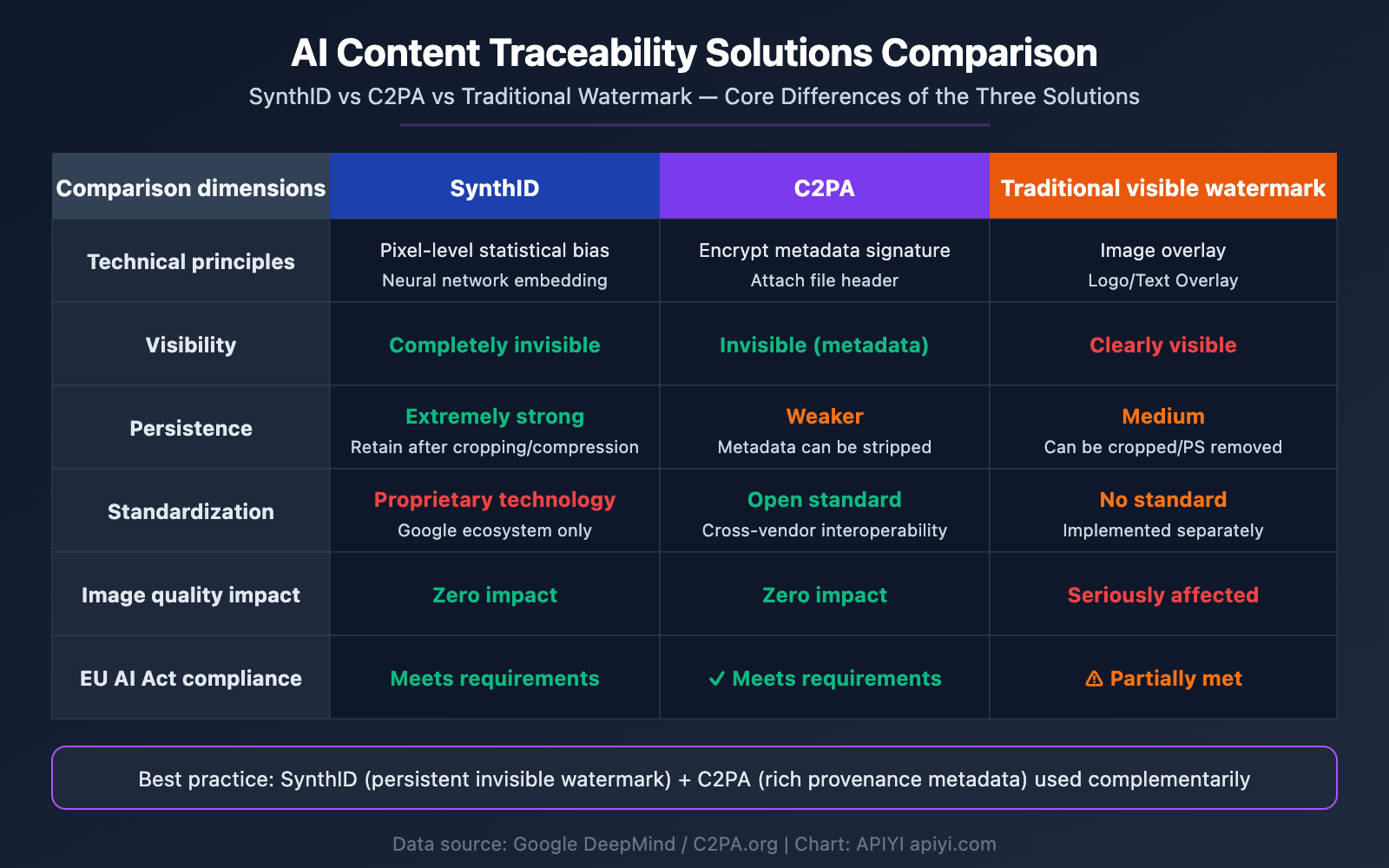
Starting August 2026, the EU AI Act will fully mandate that AI-generated content must be labeled in a machine-readable format. SynthID is one of the technical solutions that meets this compliance requirement.
Currently, there are two main AI content provenance solutions:
- SynthID (Google DeepMind): An invisible, pixel-level watermark embedded directly into the content, making it extremely difficult to remove.
- C2PA (Content Credentials): An open-standard metadata signature embedded in the file header, which can be stripped away.
These two are complementary: SynthID ensures the watermark's persistence (even if metadata is deleted), while C2PA provides rich provenance information (creator, tools, time, etc.). Google's AI-generated images use both SynthID and IPTC metadata labeling.
💰 Compliance Tip: If your product targets the European market, images generated using Nano Banana via APIYI apiyi.com come with SynthID watermarks, naturally fulfilling the EU AI Act's AI content labeling requirements without needing additional watermark development.
Technical Limitations of SynthID Watermarks
While SynthID is an advanced technology, it's not without its vulnerabilities:
Limitation 1: Not Absolutely Reliable
Google officially acknowledges that SynthID isn't foolproof. After extreme processing (like multiple high-compression re-encodings or AI style transfer), the detection confidence can drop significantly.
Limitation 2: Google Ecosystem Only
SynthID is Google's proprietary technology. Other AI image generation services (such as DALL-E, Midjourney, Stable Diffusion) don't use SynthID, so the SynthID detector can't identify images generated by those services.
Limitation 3: Limited Detection Tools
Currently, SynthID's detection capabilities are primarily offered through Google's own channels (Gemini App, SynthID Detector). A general third-party detection API isn't yet available.
Limitation 4: Cross-Platform Interoperability Issues
Watermarks embedded by SynthID can only be recognized by Google's detection network. Different vendors' watermarking solutions aren't compatible with each other—Adobe's Content Credentials and Meta's Video Seal each have their own detection systems. This is precisely the problem the C2PA open standard aims to solve.
Frequently Asked Questions
Q1: Does the SynthID watermark reduce the image quality of pictures generated by Nano Banana?
No, it doesn't. The modifications SynthID makes at the pixel level are extremely subtle, completely below the human perception threshold. Across various image quality evaluation benchmarks, images with and without SynthID watermarks show almost no difference in metrics like PSNR and SSIM. Images generated by calling Nano Banana through the APIYI apiyi.com platform can be used directly for commercial purposes without worrying about quality loss.
Q2: Can the SynthID watermark be removed?
Technically speaking, SynthID is embedded in the statistical distribution of pixels, unlike visible watermarks that can be simply erased. Currently, the only known way to potentially weaken SynthID is to completely redraw the image using another AI model (e.g., img2img style transfer), but this essentially creates a new image. Ordinary cropping, compression, or filter application won't remove SynthID.
Q3: Do images generated by non-Google AI have SynthID?
No, they don't. SynthID is proprietary technology from Google DeepMind and is only used for Google's own AI-generated content (including Gemini, Nano Banana, Nano Banana Pro, Imagen, etc.). Images generated by services like DALL-E, Midjourney, and Stable Diffusion do not contain SynthID. If you need to detect the source of images from these services, you'll need to use other solutions.
Q4: Do images generated by calling Nano Banana via API also have SynthID?
Yes, they do. SynthID is embedded during the model's image generation process. Regardless of the channel used for model invocation (Gemini App, Google AI Studio, Vertex AI, or through API proxy services like APIYI apiyi.com), the generated images will include the invisible SynthID watermark. But here's the good news—API invocation won't add the visible Gemini sparkle watermark.
Summary
Key takeaways about SynthID watermarks in Nano Banana image generation:
- SynthID is a pixel-level invisible watermark: It's embedded directly during image generation, not added as a post-processing step. It's completely invisible to the naked eye and doesn't affect image quality or commercial use.
- Strong tamper resistance: It can still be detected after cropping, compression, or applying filters. It's holographically distributed across all pixels, making it impossible to locate and erase.
- Three-state probabilistic detection: It outputs three states: "watermarked / not watermarked / uncertain," which helps avoid false positives.
- Aids compliance: It helps meet machine-readable labeling requirements for AI-generated content, as stipulated by regulations like the EU AI Act.
- Google ecosystem exclusive: SynthID is proprietary technology, so images from other AI services cannot be detected by SynthID.
For developers using the Nano Banana API for image generation, SynthID watermarks won't affect your daily commercial use at all. In fact, they provide an extra layer of assurance for compliance. We recommend calling the Nano Banana API through the APIYI apiyi.com platform to get free testing credits and quickly experience its AI image generation capabilities.
References
-
Google DeepMind SynthID Official Page: A comprehensive introduction to SynthID technology.
- Link:
deepmind.google/models/synthid/ - Description: Includes details on SynthID's applications across images, text, audio, and video.
- Link:
-
Google DeepMind Blog – Identifying AI-Generated Images: A technical blog post on SynthID image watermarking.
- Link:
deepmind.google/blog/identifying-ai-generated-images-with-synthid/ - Description: Explains the embedding and detection principles of SynthID image watermarks in detail.
- Link:
-
Gemini API Image Generation Documentation: Official usage guide for the Nano Banana API.
- Link:
ai.google.dev/gemini-api/docs/image-generation - Description: Covers API invocation methods, parameter configuration, and SynthID watermark details.
- Link:
-
SynthID Detector Online Tool: Google's official AI content detection portal.
- Link:
synthid.net - Description: Allows you to check online if an image contains a SynthID watermark.
- Link:
Author: APIYI Tech Team
Technical Discussion: Feel free to discuss SynthID watermarks and AI image generation-related questions in the comments section. For more Nano Banana API usage tips, visit the APIYI docs.apiyi.com documentation center.