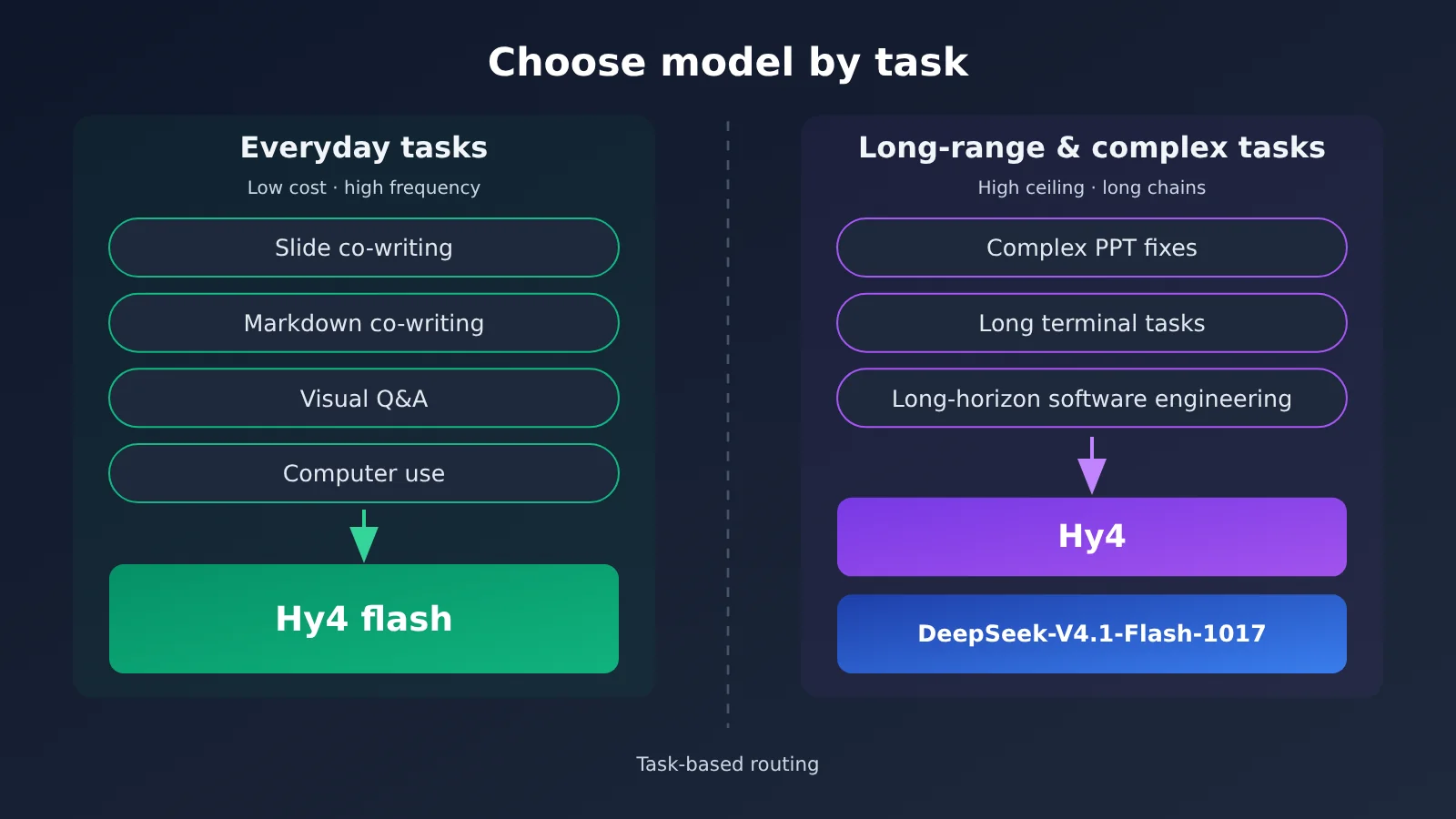
Author’s note: This article breaks down Hy4 flash task by task — specs, human blind tests, WorkIndex, and appendix scores. The takeaway: it’s worth considering for everyday work like collaborative slide writing, Markdown, visual question answering, and computer use. For complex PPT repair, long terminal tasks, and long-horizon software engineering, you’re still better off with Hy4 or DeepSeek-V4.1-Flash-1017.
Here’s the bottom line first. If you’re picking a model for everyday office work or lightweight agents, Hy4 flash is a good fit for day-to-day tasks like collaborative slide writing, collaborative Markdown writing, visual question answering, and computer use. When it comes to repairing complex PPTs, running long terminal tasks, or doing long-horizon software engineering, it’s not worth switching over from Hy4 or DeepSeek-V4.1-Flash-1017.
Tencent Hunyuan published a research page and an official post on 2026-11-16, claiming that Hy4 flash comes close to Claude Haiku 5.5 in human blind tests on everyday work — at a much lower cost per task. This isn’t a “one cheap model that does everything” story. The appendix of the same research page shows it trails Hy4 noticeably on terminal and long-horizon coding benchmarks. The blind tests, WorkIndex, appendix, and product testimonials cited in this article all come from Tencent’s own reporting or the original research page text; none of it has been independently reproduced.
What you’ll get out of this: a task-by-task selection table, plus a clear picture of where Hy4 flash is strong, where it’s weak, and when you shouldn’t switch to it.
How strong is Hy4 flash? Start with task-based choices
The table below organizes model choices by task type, based on the research page’s recommended uses and appendix scores. “Preferred choice” is only a selection judgment—it doesn’t mean a model is universally better at that task type.
| Task type | Preferred choice | Rationale (research page text/appendix) |
|---|---|---|
| Human-AI slide co-writing | Hy4 flash | PPTCoEditBench 74.0 vs Hy4’s 78.9; per-task cost is about 1/16 that of Hy4 |
| Markdown human-AI co-writing | Hy4 flash | MdCoEditBench 56.9, close to Hy4’s 57.7 and clearly above DeepSeek’s 29.2 |
| Visual question answering (no tools) | Hy4 flash is usable, but not the highest | BuddyVQA 48.5, above DeepSeek’s 43.7 and below Hy4’s 55.5 |
| Computer use | Hy4 flash is usable | OSWorld 2.1: 68.1, close to DeepSeek’s 68.4; Hy4 is 78.9 |
| Repairing complex PPTs | Hy4 or DeepSeek-V4.1-Flash-1017 | PPTFixBench 23.7; Hy4 is 45.6 and DeepSeek is 45.3 |
| Long-running terminal tasks | Hy4 or DeepSeek-V4.1-Flash-1017 | Terminal-Bench 4.0: only 19.2; Hy4 is 44.4 |
| Long-horizon software engineering | Hy4 | Explicitly recommended by the research page; ProgramBench 16.0 vs Hy4’s 30.0 |
The logic here is simple. Tasks with short deliverables, lots of back-and-forth, and cost sensitivity should go to Hy4 flash. Tasks with long step chains that need sustained reasoning and repeated repair should go to a model with a higher intelligence ceiling. The research page says the same: use Hy4 flash for deep search, document processing, making slides, simple front-end demos, and computer use, and keep using Hy4 for long-horizon software engineering.
The biggest pitfalls when choosing Hy4 flash
The most common misreading is taking “close to Haiku” as “better than Haiku across the board.” In the blind test, Hy4 flash’s satisfaction rating is 0.02 points lower than Haiku, and the research page’s wording is “close to.” The second misreading is mixing several sets of cost multipliers. WorkIndex’s 1/8, 1/13, and 1/20 are one basis, while the RMB per-task cost in the blind-test table is another; the two can’t be used interchangeably.
Hy4 flash Core Features and Specs
Here’s what the research page lists. It doesn’t give an API model ID, so this article won’t make one up. To call it, use whatever name shows up in the Tencent Cloud TokenHub console.
| Item | Hy4 flash (as stated on the research page) |
|---|---|
| Total parameters | 224B, of which 64B are Engram parameters |
| Activated per token | 12B |
| Modality | Natively multimodal, same as Hy4 |
| Context | 1M tokens |
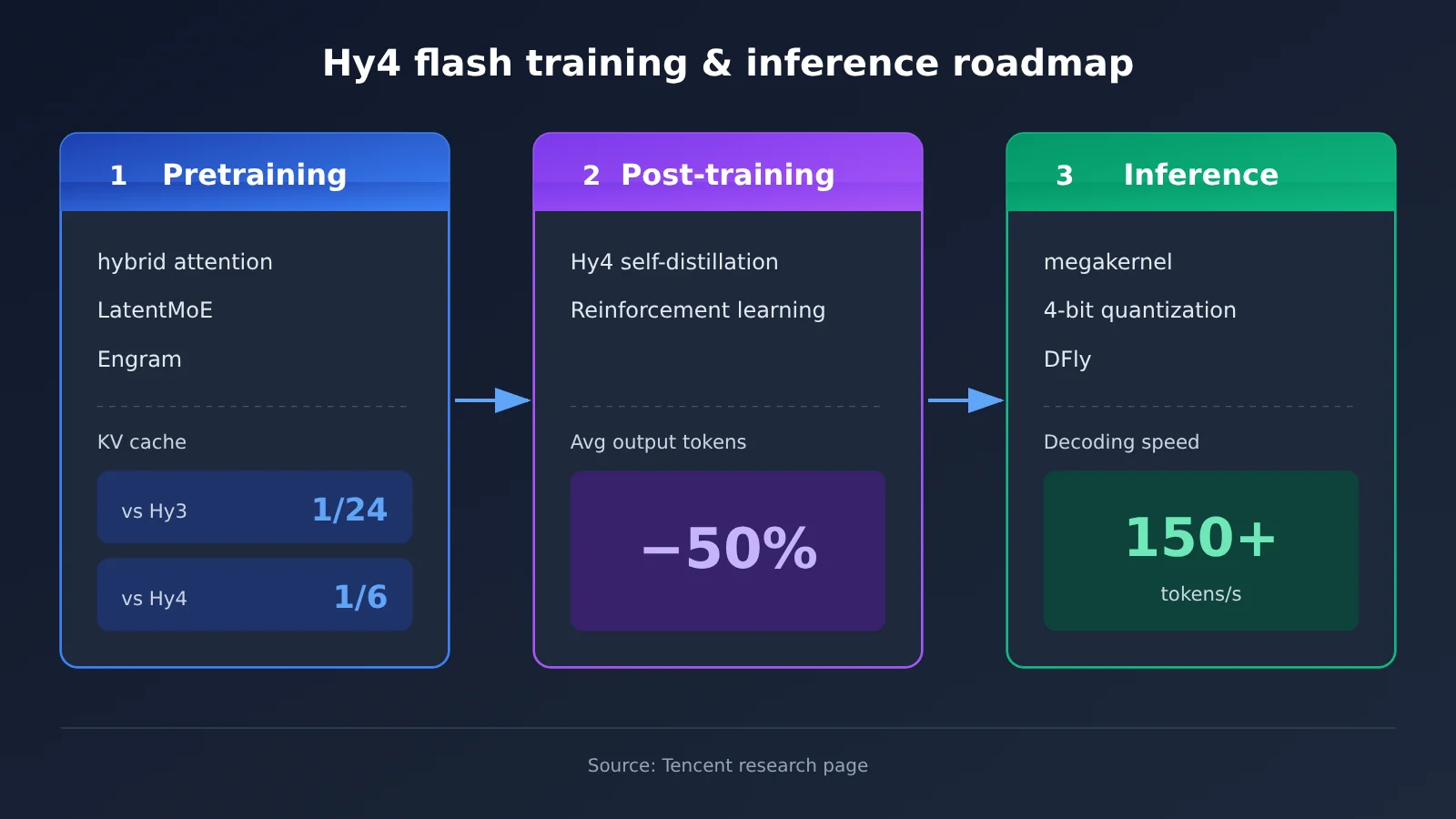
| KV cache | 1/24 of Hy3, 1/6 of Hy4 |
| Decoding speed | Over 150 tokens/s |
| Channels | Tencent Cloud TokenHub, WorkBuddy, Yuanbao, WeCom, QQ, ima, Marvis; coming soon to OpenRouter |
| Weights | Open-sourcing planned; the page doesn’t say they’ve been released yet |
How Hy4 flash Is Trained and How It Infers
Pretraining relied on three design choices — hybrid attention, LatentMoE, and Engram — and that’s the main reason the KV cache shrank so dramatically. Post-training starts with self-distillation from Hy4, then reinforcement learning cuts the average end-to-end output token count by 50%. For everyday office work, that part really matters: task cost depends not just on the unit price, but on how much the model says and how many steps it takes.
On the inference side it uses megakernel, 4-bit quantization, and DFly; the research page claims decoding speed above 150 tokens/s. For evaluation, Tencent didn’t lean on public leaderboard rankings — it built its own WorkIndex and paired it with human evaluation. What gets measured is delivery quality, single-turn output length, and task time. That framing is closer to “can it actually get the job done, and how much does it cost,” but it’s an internal Tencent set, so outsiders can’t reproduce it directly.
Hy4 flash real-world data point 1: human blind test against Haiku
The “close to Haiku” claim comes from a human blind test. The research page says the participants were 85 internal WorkBuddy users, covering 259 tasks across 27 categories. The data below is self-reported by Tencent.
| Model | Satisfaction (4-point scale) | Median end-to-end time | Cost per task (RMB) |
|---|---|---|---|
| DeepSeek-V4.1-Flash-1017 | 3.09 | 10.3 minutes | 1.20 RMB |
| Hy4 flash | 2.79 | 6.7 minutes | 0.26 RMB |
| Claude-Haiku-5.5 | 2.81 | 6.8 minutes | 4.73 RMB |
| GLM-5.3-Flash | 2.53 | 7.6 minutes | 0.81 RMB |
There are three things to keep in mind when reading this table. First, the highest satisfaction score belongs to DeepSeek-V4.1-Flash-1017 at 3.09, not Hy4 flash. Second, Hy4 flash scores 0.02 lower than Haiku — you can call that close, but not better. Third, the external models were all run at the high tier, while the Hy4 flash row doesn’t specify a tier.
Hy4 flash’s real edge is time and cost. It has the shortest median completion time and the lowest cost per task in the table. The “18x reduction in task cost” mentioned in the official post comes from dividing 4.73 RMB by 0.26 RMB, which is roughly 18.2, comparing against Haiku. That multiplier doesn’t apply to DeepSeek, and it doesn’t apply to Hy4 either.
Hy4 flash Measured Data Part 2: The WorkIndex Cost Basis
The research page’s overall verdict on WorkIndex: Hy4 flash’s overall task performance is slightly higher than Hy4 preview. On average cost per task, it comes in at 1/13 of Hy4 preview, 1/20 of Hy4, and 1/8 of DeepSeek-V4.1-Flash-1017 (Max tier, peak pricing).
Those three ratios apply to WorkIndex only. WorkIndex is made up of 8 internal sets, covering slide generation, slide editing, human-AI collaborative slide writing, Markdown human-AI co-writing, document editing, table repair, audio-video processing, and visual understanding. It and the 85-person blind test table above are two different task sets with two different cost algorithms. So you can’t apply the 1/8 to DeepSeek’s 1.20 yuan in the blind test table, and you can’t apply the 18x to WorkIndex either.
“Slightly higher than Hy4 preview” also deserves a cautious reading. It shows Hy4 flash has caught up with the previous-generation preview on everyday work, but that doesn’t mean it has caught up with the official Hy4 release. The appendix in the next section will show that gap.
Hy4 flash Benchmark Data, Part 3: The Hy4 vs. preview Gap in the Appendix
The appendix on the research page lists the scores for Hy4 flash, Hy4, Hy4 preview, DeepSeek-V4.1-Flash-1017, Qwen3.8-Flash-Next, GLM-5.3-Flash, and GPT-6 Luna, as well as the per-task cost in CNY. The table below pulls out only the four columns most relevant to model selection. All models are run at their highest reasoning tier, and the internal buddy index is evaluated on workbuddy cli. Claude Haiku 5.5 isn’t in this table, so don’t use it to infer Haiku’s score.
| Benchmark (as listed in the research page appendix) | Hy4 flash | Hy4 | Hy4 preview | DeepSeek-V4.1-Flash-1017 |
|---|---|---|---|---|
| PPTCoEditBench | 74.0 | 78.9 | 71.5 | 76.8 |
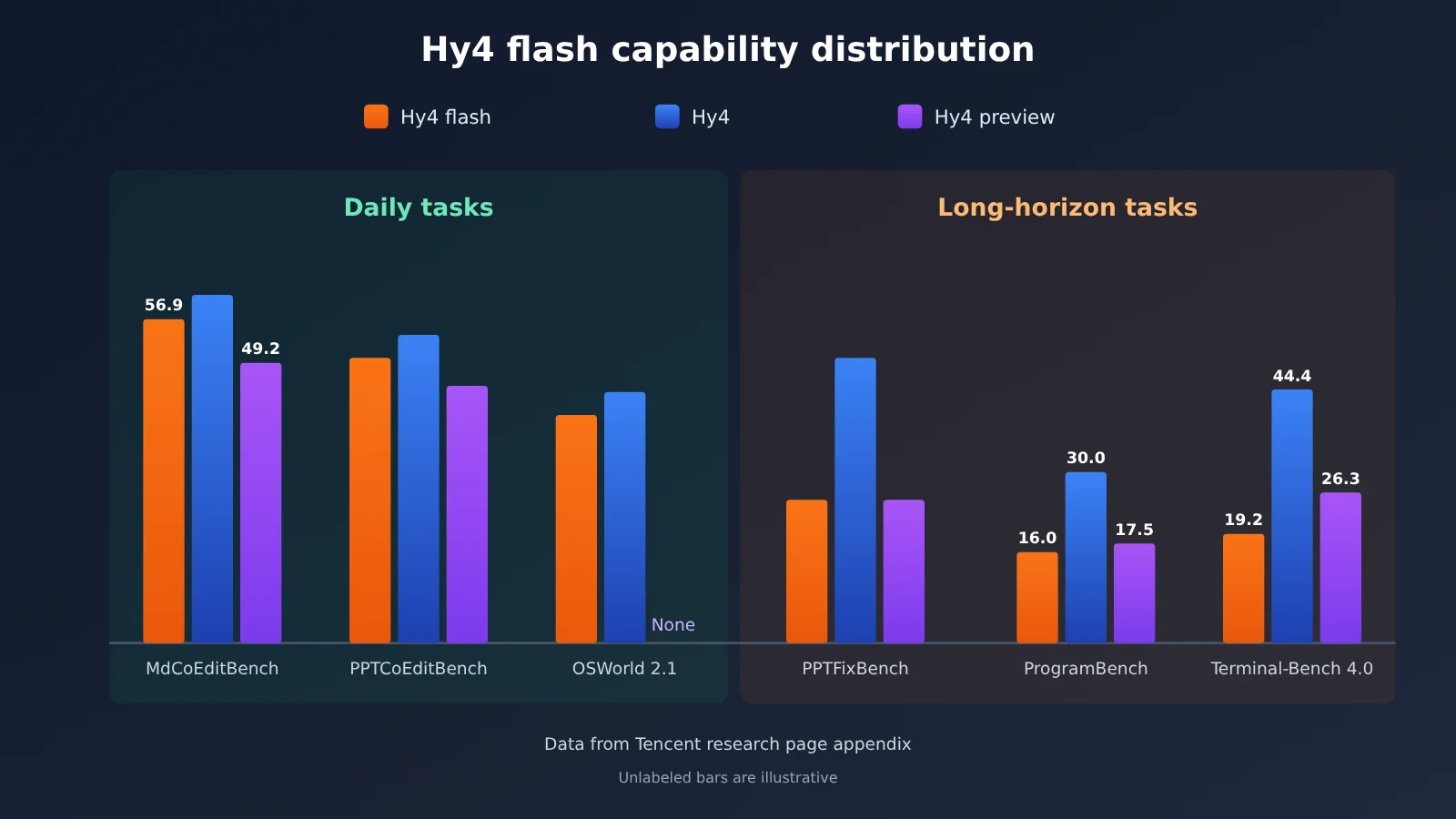
| MdCoEditBench | 56.9 | 57.7 | 49.2 | 29.2 |
| AutomationBench v1.0.6 | 52.2 | 56.2 | 36.3 | 54.3 |
| OSWorld 2.1 (Full, partial) | 68.1 | 78.9 | N/A | 68.4 |
| PPTFixBench | 23.7 | 45.6 | 23.8 | 45.3 |
| ExcelFixBench | 15.6 | 27.8 | 11.7 | 20.0 |
| DeepSWE v1.1 | 64.6 | 74.9 | 64.3 | 73.8 |
| ProgramBench (almost solved) | 16.0 | 30.0 | 17.5 | 29.0 |
| Terminal-Bench 4.0 | 19.2 | 44.4 | 26.3 | 40.0 |
Compared with preview, Hy4 flash is mostly on par or higher on co-writing and automation tasks. MdCoEditBench rises from 49.2 to 56.9, and AutomationBench rises from 36.3 to 52.2. On PPTFixBench and DeepSWE, however, it’s basically on par with preview. On ProgramBench and Terminal-Bench 4.0, it even falls below preview.
Against the production Hy4, the gap widens with task difficulty. For co-writing tasks, the difference is only a few points; for fix and terminal tasks, it’s roughly a factor of two. On cost, Hy4 flash is about CNY 0.105 per task on PPTCoEditBench, while Hy4 is about CNY 1.714 per task. These CNY figures are based on each model’s official price at 1 USD = 7.2 CNY, with DeepSeek using peak pricing. They’re the numbers Tencent used to build the table, not your actual bill.
Hy4 flash Weaknesses: Terminal-Bench 4.0 and ProgramBench
These two need to be covered separately because they’re exactly where Hy4 flash falls short. On Terminal-Bench 4.0, Hy4 flash scores only 19.2, while Hy4 scores 44.4 and DeepSeek-V4.1-Flash-1017 scores 40.0—even the preview’s 26.3 is higher. This benchmark uses the Claude Code harness, with up to 500 turns and a maximum of 13 hours per run. These long-horizon terminal tasks are precisely where a model’s intelligence ceiling matters most.
On ProgramBench’s almost solved metric, Hy4 flash is 16.0, Hy4 is 30.0, and DeepSeek is 29.0. The research page itself states that long-horizon software engineering should continue to use Hy4. WorkBuddy’s testimonial also mentions “slightly lower long-horizon coding.” If your agent mainly edits code in the terminal, runs tests, and repeatedly fixes issues, don’t switch to Hy4 flash just because the unit price is lower.
Hy4 flash Product Team Testimonials: Each Team Has Its Own Take
The research page includes testimonials from several internal products. All of the following are the product teams’ own accounts. Their comparison targets and metrics differ, so they can’t be combined into an “across-the-board lead” conclusion.
- WorkBuddy (Anne): Compared with Hy4, average task time is 70% lower and cost is about 1/15; everyday task quality is on par with Hy4, with slightly lower long-horizon coding. This 1/15 is WorkBuddy’s own estimate and is not the same number as WorkIndex’s 1/20.
- Yuanbao (Logan): Compared with Hy3, agent performance is 13.6% higher and human side-by-side evaluations are 7.56% higher; general conversation is 2.52% higher than GLM-5.3-Flash, with the most noticeable improvement in multi-turn conversation.
- WeChat Pay (Yilin and Simba): Compared with DeepSeek-V4.1-Flash-1017, average scores across four workflows are equal or higher; execution steps are about 6% fewer and single-turn output length is about 29% shorter; static code scan completion time is 37% lower, token usage is 46% lower, and reasoning performance is on par.
- WeCom (Dylan): Compared with Hy4, output speed is 88% higher, and thinking-mode output tokens are about 60% fewer.
- Honor of Kings (TH): Compared with DeepSeek-V4.1-Flash-1017 and GLM-5.3-Flash, root-cause localization ability is similar; model requests are 22.0% to 39.1% fewer, and tokens are 40.5% to 61.2% fewer; however, tool calls are 51.2% and 7.7% higher, respectively.
- ima (Kaycee): Compared with the above two, average wait time is 18% to 35% lower, reply score is 1.8% higher, and content quality is 8.1% higher.
- QQ (Red and Look): Compared with DeepSeek-V4.1-Flash (the original doesn’t specify 1017), satisfactory response rates across multiple scenarios are 0.92 to 6.16 percentage points higher; the channel assistant’s intent classification accuracy is on par, and P90 comment latency is 39% lower.
- Marvis (Baihan): Compared with DeepSeek-V4.1-Flash-1017, satisfaction is higher on sub-items such as app installation, system settings, and document research, while overall satisfaction is on par.
The common thread across these testimonials is “faster, fewer tokens, and equal or slightly better quality.” The comparison scenarios are mostly conversation, customer service, workflows, and everyday agents. None of them used it for long-horizon software engineering and claimed it was better. This is consistent with the conclusion in the appendix.
Hy4 flash Pricing and Protocol: How to Check Model Names and Compare Prices
Research-page list prices (USD per million tokens): Hy4 flash comes in at 0.003 for cached input, 0.070 for input, and 0.281 for output; Hy4 is 0.042, 0.834, and 2.501 respectively. Until 2026-11-30, Tencent Cloud TokenHub’s API runs at 50% off, and it’s free to use inside WorkBuddy. The research page doesn’t list the discounted prices separately. Halving the list price gives you roughly 0.035 input and 0.1405 output; after November 30, the list prices come back.
On APIYI, Hy4 flash isn’t listed yet — we’ll get this model up as soon as we can; model names and prices are governed by the platform’s model list. The hy4 currently on the platform is the standard Hy4, not flash. The table below separates APIYI’s master-list prices from official prices for the models that are already available (USD per million tokens, in the order input, output, cache read).
| Model | APIYI master-list price (apiyi.com model list) | Official / research-page price | Endpoint |
|---|---|---|---|
| Hy4 flash | Not listed yet | 0.070 / 0.281 / 0.003 (research-page list price) | — |
hy4 |
0.85 / 2.55 / 0.045 | 0.834 / 2.501 / 0.042 (research-page list price) | chat |
deepseek-v4.1-flash-1017 |
0.30 / 1.20 / 0.006 | Peak 0.30 / 1.20 / 0.006; off-peak halved | chat, messages |
claude-haiku-5-5 |
0.10 / 0.50 / 0.01 | ≤100K tokens: 0.10 / 0.50 / 0.01; >100K: 0.50 / 2.50 / 0.05 | chat, messages |
glm-5.3-flash |
0.15 / 0.50 / 0.03 | — | Chat Completions only |
A few details deserve their own note. On APIYI, DeepSeek’s three names deepseek-v4.1-flash, deepseek-v4.1-flash-1017, and deepseek-flash all carry the same price, matching the official peak rate; deepseek-v4-1-flash-260910 and deepseek-v4-1-flash-economy-261017 are separate channels with different prices, so they don’t represent the whole V4.1 Flash family. Under the official Haiku rules, when the prompt exceeds 100K tokens the entire request is billed at the higher tier; APIYI’s master-list footnote only mentions the second input tier of 0.50, so before calling long-prompt tasks, confirm the output tier on the apiyi.com model page.
Call the available models with an apiyi.com API key. Send requests to https://api.apiyi.com/v1 and fill in base_url and model in OpenAI-compatible format, for example hy4 or deepseek-v4.1-flash-1017. If you need the Anthropic Messages format, pick a model that supports the messages endpoint. glm-5.3-flash only supports Chat Completions, and deepseek-v4.1-flash-1017 isn’t in the CodexResponses group, so check the group before wiring it into Codex-style tools.
Hy4 flash: Pros and Cons
Strengths
- Great value for everyday tasks: Blind-test satisfaction is close to Haiku, at 0.26 yuan per task—about 1/18 the cost of Haiku (according to the vendor’s own numbers).
- Fast: It has the shortest median completion time in blind tests; the research page says decoding exceeds 150 tokens/s.
- Lean output: After reinforcement learning, average output tokens are halved, and testimonials from multiple products also mention fewer tokens and fewer steps.
- Solid co-writing skills: Markdown co-writing is almost on par with Hy4, and the slide co-writing gap is only a few points.
Limitations
- Weak at terminal and long-horizon coding: Terminal-Bench 4.0 and ProgramBench lag clearly behind Hy4—even below preview. For these tasks, keep using Hy4 or DeepSeek-V4.1-Flash-1017.
- Struggles with fix-oriented tasks: PPTFixBench and ExcelFixBench are only about half of Hy4. When fixing complex documents, it’s not a good idea to swap it in for your existing model.
- Single-source evidence: WorkIndex is an internal set, the blind-test participants are internal users, there’s no third-party reproduction yet, and the model ID hasn’t been published on the research page.
- Vision isn’t its strongest suit: Neither BuddyVQA nor MMMU-Pro is the highest in the table, so it’s best suited for “good enough” visual question answering scenarios.
Frequently Asked Questions (FAQ)
Q1: What is Hy4 flash?
Hy4 flash is a lightweight model released by Tencent Hunyuan on 2026-11-16, with 224B total parameters and 12B activated per token. It’s natively multimodal and has a 1M context window. It was self-distilled from Hy4, and it’s positioned for everyday productivity tasks.
Q2: Is Hy4 flash really stronger than Claude Haiku 5.5?
Not really. In the official blind test, its satisfaction score was 2.79 versus 2.81 for Haiku — the research page uses the word “close.” Its advantages are slightly shorter completion times and a much lower per-task cost. Also, the highest satisfaction score in the blind test went to DeepSeek-V4.1-Flash-1017.
Q3: When can I use Hy4 flash?
The research page says it’s already available on channels including Tencent Cloud TokenHub, WorkBuddy, and Yuanbao, with OpenRouter coming soon. The free access inside WorkBuddy and the 50%-off TokenHub API promotion run through 2026-11-30. The weights are planned to be open-sourced, but they haven’t been released yet.
Q4: Which tasks should you not move from Hy4 to Hy4 flash?
Long-horizon terminal tasks, long-horizon software engineering, complex PPT, and spreadsheet repair. In the appendix, scores for these task categories come in at roughly half of Hy4, and the research page also recommends sticking with Hy4 for long-horizon software engineering.
Q5: Can I call Hy4 flash through APIYI right now?
Not yet — the platform currently only offers the official `hy4`. Once it’s listed, refer to the name and pricing shown in the model list on apiyi.com. In the meantime, you can use the same API key to call `hy4`, `deepseek-v4.1-flash-1017`, and `claude-haiku-5-5` and get your comparison workflow set up.
Q6: Can the 18x from the blind test and the 1/20 from WorkIndex be converted into each other?
No. The 18x comes from the ratio of RMB per-task cost between Haiku and Hy4 flash in the blind-test table; the 1/8, 1/13, and 1/20 come from WorkIndex, where the comparison targets are DeepSeek, Hy4 preview, and Hy4 respectively. The 1/15 in the WorkBuddy testimonial is yet another evaluation. All three use different task sets and cost definitions.
Hy4 flash Key Takeaways
- Clear positioning: Hy4 flash is a low-cost model for everyday office work and lightweight agents.
- Close, not ahead: blind-test satisfaction is 2.79, versus 2.81 for Haiku and 3.09 for DeepSeek, the highest.
- Cost metrics use different baselines: 18x vs. Haiku; 1/20 vs. Hy4 in WorkIndex.
- Co-writing tasks can be used directly: Markdown and slide co-writing come close to Hy4.
- Clear weak spots: Terminal-Bench 4.0 score is 19.2, and ProgramBench score is 16.0.
- Integration status: APIYI hasn’t listed Hy4 flash yet; all listed models use the OpenAI-compatible interface.
Summary
How capable Hy4 flash is depends on what you give it:
- Everyday tasks: slide co-writing, Markdown, visual question answering, and computer use—it can deliver satisfaction close to Haiku at a very low cost (official blind test).
- Complex tasks: complex PPT repair, long terminal tasks, and long-horizon software engineering—it clearly trails Hy4, so keep using Hy4 or DeepSeek-V4.1-Flash-1017.
- Nature of the evidence: all data comes from Tencent’s own official reporting, so it’s suitable as a selection reference, but you still need to validate it with your own tasks before launch.
A more practical approach is to split traffic by task: move some everyday-task traffic to Hy4 flash first and keep long-horizon tasks unchanged. Once Hy4 flash is available on APIYI, you can use the same API key on apiyi.com to compare its real-world performance with hy4 and deepseek-v4.1-flash-1017.
📚 References
-
Tencent Hunyuan Hy4 Flash research page: specs, blind tests, WorkIndex, appendix, and product testimonials
- Link:
hy.tencent.ai/research/hy4-flash - Note: the original source for all the evaluation data in this article; the page is dated 2026-11-16
- Link:
-
Tencent Hunyuan official launch post: 18x task cost and API list prices
- Link:
x.com/TencentHunyuan/status/2122217770314301469 - Note: the official public statement; the comparison target is Claude Haiku 5.5
- Link:
-
DeepSeek official pricing page: V4.1 Flash peak and off-peak prices
- Link:
api-docs.deepseek.com/quick_start/pricing - Note: here you can see how peak hours are defined and how they map to invocation names
- Link:
-
Claude Haiku 5.5 official docs: model ID and two-tier billing rules
- Link:
platform.claude.com/docs/en/models/haiku-5-5/overview - Note: explains the rule that when a prompt exceeds 100K tokens, the whole request is billed at that tier
- Link:
Author: APIYI Tech Team
Technical discussion: Feel free to reach us through the APIYI website homepage; for model and endpoint details, check the docs.apiyi.com documentation center