Author's Note: This article breaks down the series of quota reduction events for Google Antigravity (AI Studio) from late 2025 to March 2026, analyzing policy shifts such as the 92% reduction in free tier limits, the introduction of a credit-based system, and the throttling of Ultra users, along with actionable strategies for developers.
If you've felt like Google Antigravity (Google AI Studio) has been getting "laggy" lately, it’s not your internet connection—it’s Google aggressively slashing quotas. From the 92% crash in free-tier RPD (Requests Per Day) in December 2025 to the introduction of AI Credits in March 2026, and even unannounced throttling for top-tier Ultra users, the Google AI developer forums have turned into a battlefield of complaints. This article provides a complete timeline of these policy changes, their specific impacts, and how developers can adapt.
Core Value: Understand the full context of Antigravity's quota cuts, determine if your current usage tier is affected, and find viable alternatives.
The Complete Timeline of the Antigravity Quota Cuts
Let's break down all the known policy changes chronologically.
| Date | Event | Impact Level | Developer Reaction |
|---|---|---|---|
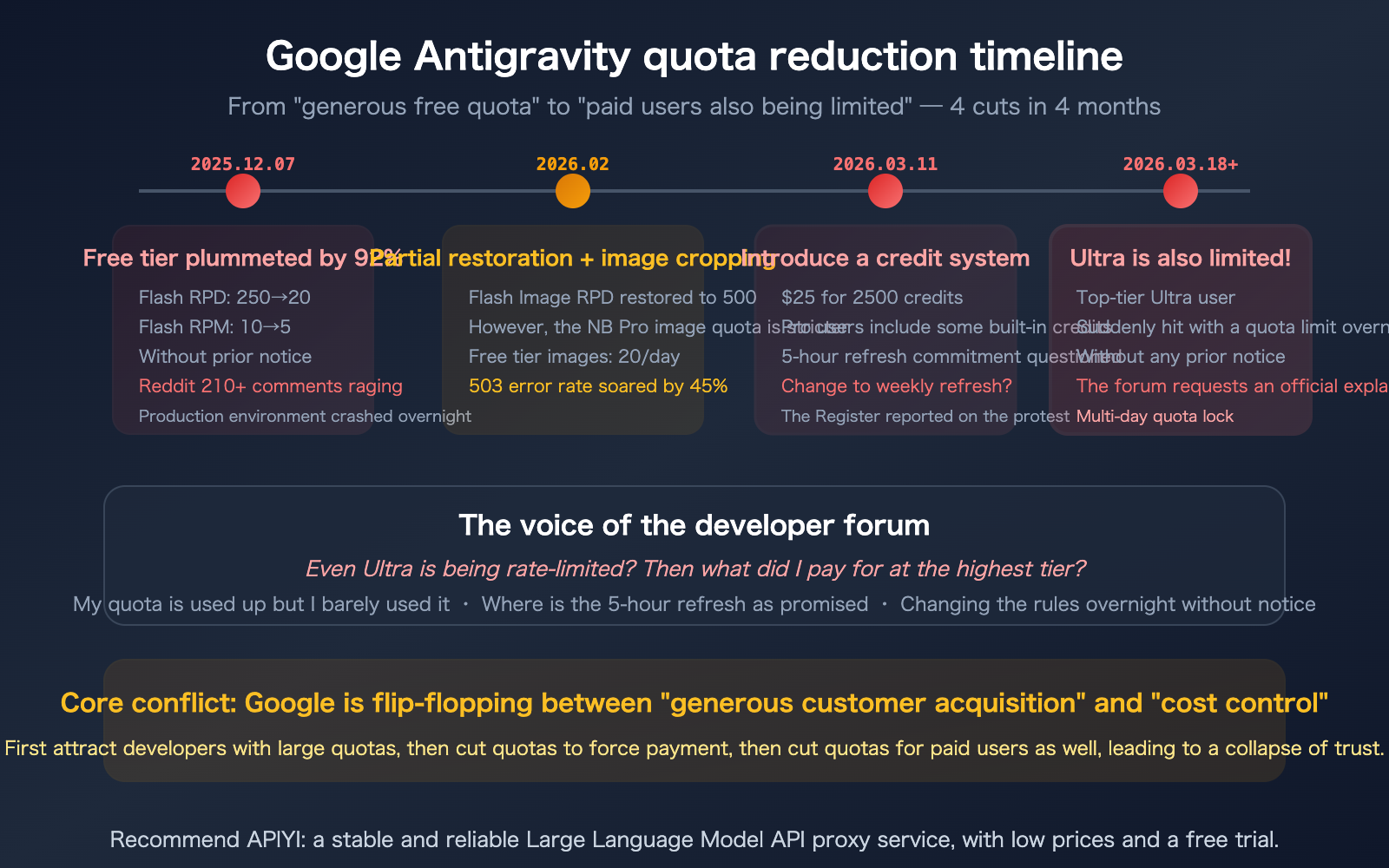
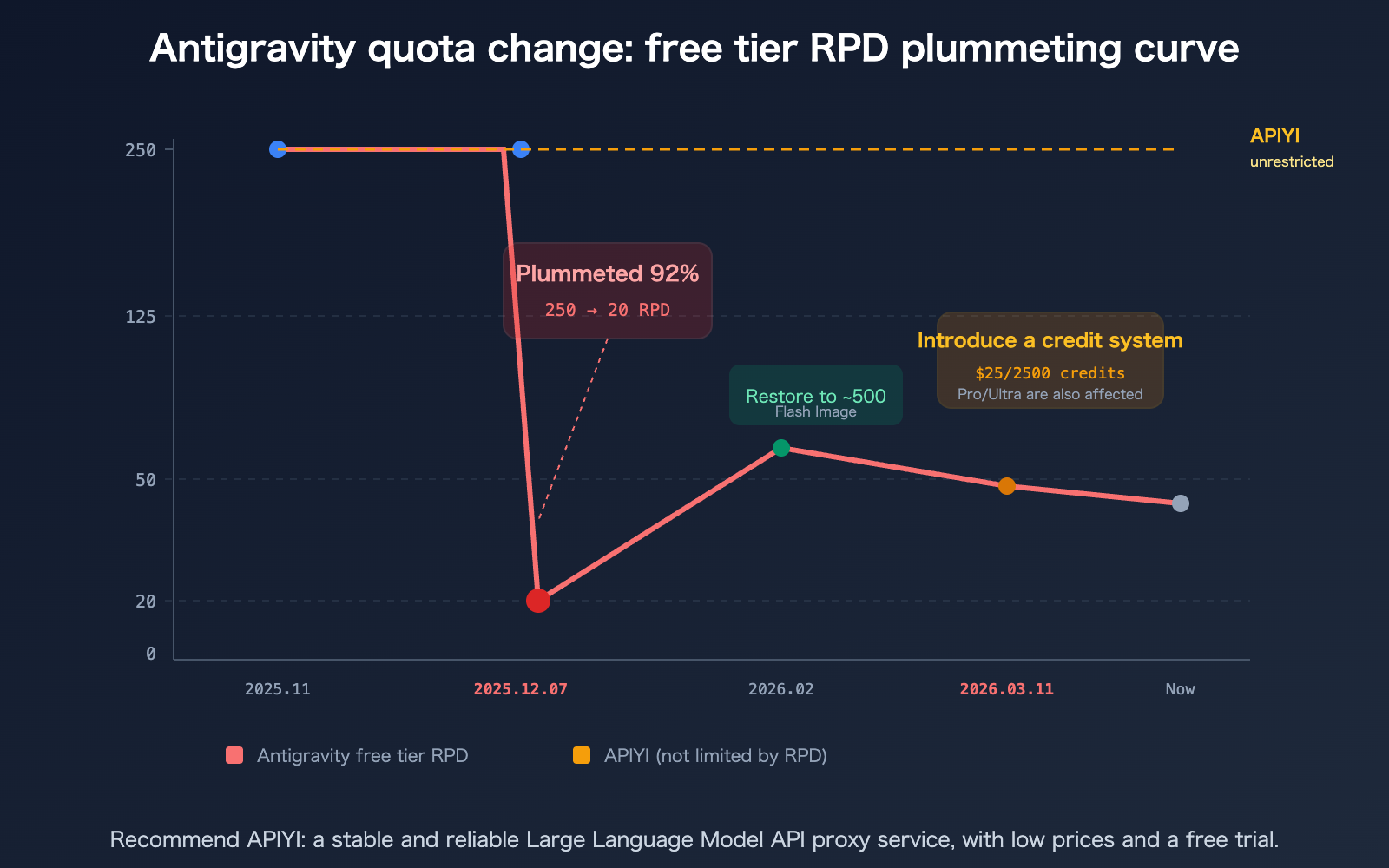
| 2025.12.07 | Free tier RPD slashed from 250 to 20 (-92%) | Free users | 210+ comments on Reddit, production environments crashed |
| 2025.12 | Free tier RPM dropped from 10 to 5 (-50%) | Free users | Frequent 429 errors, Home Assistant integration failed |
| 2026.02 | Flash Image RPD partially restored to ~500 | Free users | Slight relief, but didn't return to original levels |
| 2026.02 | Nano Banana Pro image quota tightened to 20/day | Free users | Image generation workflows severely impacted |
| 2026.03.11 | AI Credit system introduced ($25/2,500 credits) | All users | Protests reported by The Register and DevClass |
| 2026.03.11 | Pro user 5-hour refresh cycle questioned (actually weekly) | Pro users | Widespread complaints on forums about "broken promises" |
| 2026.03.12 | Pro users hit with multi-day quota lockouts | Pro users | PiunikaWeb reports on "weekly lockouts" |
| 2026.03.18+ | Ultra users hit with sudden quota limits | Ultra users | Demands for official explanation, "dramatic quota reduction" |
The Impact of Each Quota Cut
Wave 1: December 2025 — Free Tier Slashed by 92%
This was the most destructive event. On December 7, 2025, Google slashed free tier quotas without any prior notice:
| Model | Pre-change RPD | Post-change RPD | Reduction |
|---|---|---|---|
| Gemini 2.5 Flash | ~250 | 20 | -92% |
| Gemini 2.0 Flash | ~250 | 20-50 | -80%+ |
| Other free models | Varies | Significant cuts | -50%~92% |
RPM (Requests Per Minute) was also lowered from 10 RPM to 5 RPM.
Direct Impact:
- Countless production apps relying on the free Gemini API crashed overnight.
- Home Assistant smart home integrations failed due to constant 429 errors.
- Prototype projects and individual developers were forced to halt work or migrate.
- The r/GeminiAI subreddit saw 210+ comments, mostly from frustrated developers.
Google's explanation: "To ensure sustainable service quality"—but the community didn't buy it, especially since there was no advance warning.
Wave 2: March 2026 — Introduction of the Credit System
On March 11, 2026, Google announced an "AI Plan Upgrade," introducing the AI Credit system:
| Change | Details |
|---|---|
| Credit Pricing | $25 for 2,500 credits |
| Pro Users | Includes some built-in credits; must purchase more once depleted |
| Ultra Users | Includes more built-in credits, marketed as "the highest and most generous limits" |
| Refresh Mechanism | Marketed as "5-hour refresh," but users report it's actually weekly |
The core frustrations for developers:
- "5-hour refresh" promise not met: Multiple Pro users reported that once their quota is exhausted, it actually takes a full week to reset, not the promised 5 hours. "Outside of the cheapest models, the 5-hour refresh seems to be a myth."
- Credits run out fast: $25 buys 2,500 credits, but a single deep conversation can consume hundreds of credits, causing costs to skyrocket during heavy usage.
- Ghost consumption: Some users reported, "I haven't used Antigravity for two days, but my Gemini 3.1 Pro quota shows as exhausted."
Wave 3: Mid-March 2026 — Even Ultra Users Get Capped
This was the move that angered the community the most—even the highest-tier paid users had their quotas cut.
Forum thread titles were blunt: "[Ultra] Dramatic quota reduction after update — this needs an official explanation"
| Complaint | Details |
|---|---|
| Sudden limits | Ultra users woke up to find their model access restricted |
| No notice | Just like the free tier cuts, there was zero warning |
| All models affected | Not just Pro models; even Claude Sonnet and Opus (via Antigravity) showed as exhausted |
| Multi-day lockouts | Some users were locked out for days |
🎯 The Core Problem: Google's strategy seems to be "attract developers with high quotas → wait for the ecosystem to build up → cut quotas to force paid upgrades → keep cutting even after they pay." This has created a crisis of trust—developers are worried that "the quota given today will be taken away tomorrow," making them afraid to build long-term dependencies on Antigravity.
If your business requires stable Gemini API quotas, you can bypass single-account limits using an API proxy service like APIYI (apiyi.com).
Typical Complaints from Developer Forums
Representative voices collected from Google AI developer forums, Reddit, and The Register:
| Source | Complaint | Core Demand |
|---|---|---|
| Forum Post | "Ultra plan quotas were slashed overnight—we need an official explanation" | Paid users deserve stable quota commitments |
| Forum Post | "I subscribed to the highest Ultra tier, but all models show 100% quota exhausted" | Paying the most should guarantee corresponding service |
| "I haven't used Antigravity for two days, yet Gemini 3.1 Pro quota shows as exhausted" | Billing logic is flawed or contains bugs | |
| "Claude Sonnet and Opus quotas are also mysteriously exhausted, even though I rarely use them" | Quotas might be cross-contaminating between models | |
| The Register | "Users protest Google Antigravity price hikes" | The credit system is essentially a disguised price increase |
| DevClass | "Users protest Google Antigravity's fluctuating price increases" | Pricing is opaque, making it impossible to forecast costs |
| PiunikaWeb | "Some Pro users are experiencing multi-day quota lockouts" | Total inability to work during the lockout period |
Why is Google Cutting Quotas?
Official Reason: Cost Control
Google's official stance is to "ensure sustainable service quality" and "address demand growth that exceeded expectations."
However, there are deeper reasons behind this:
| Reason | Analysis |
|---|---|
| GPU Compute Scarcity | Demand surged after the release of the Gemini 3 series, with free users consuming massive GPU resources |
| Severe Abuse | Google cited "fraud and abuse" as one of the primary reasons for the cuts |
| Commercialization Pressure | The need to convert free users into paid users; the AI credit system is a monetization tool |
| The Sora Lesson | OpenAI's Sora proved that the compute costs for free/low-cost AI services are unsustainable |
| Competitive Strategy | Build an ecosystem with free quotas first, then gradually tighten them to drive migration to paid plans |
The Problem is "How," Not "If"
The community's anger isn't because Google started charging—developers understand that AI compute isn't free. The frustration stems from:
- Lack of Prior Notice: Rules change "overnight," causing production environments to crash instantly.
- Broken Promises: The "5-hour refresh" promise effectively turned into a weekly one.
- Paid Users Are Also Affected: Even those paying for the top tier are being throttled.
- Opaque Limits: Documentation states that "specified rate limits are not guaranteed"—which essentially means nothing is guaranteed.
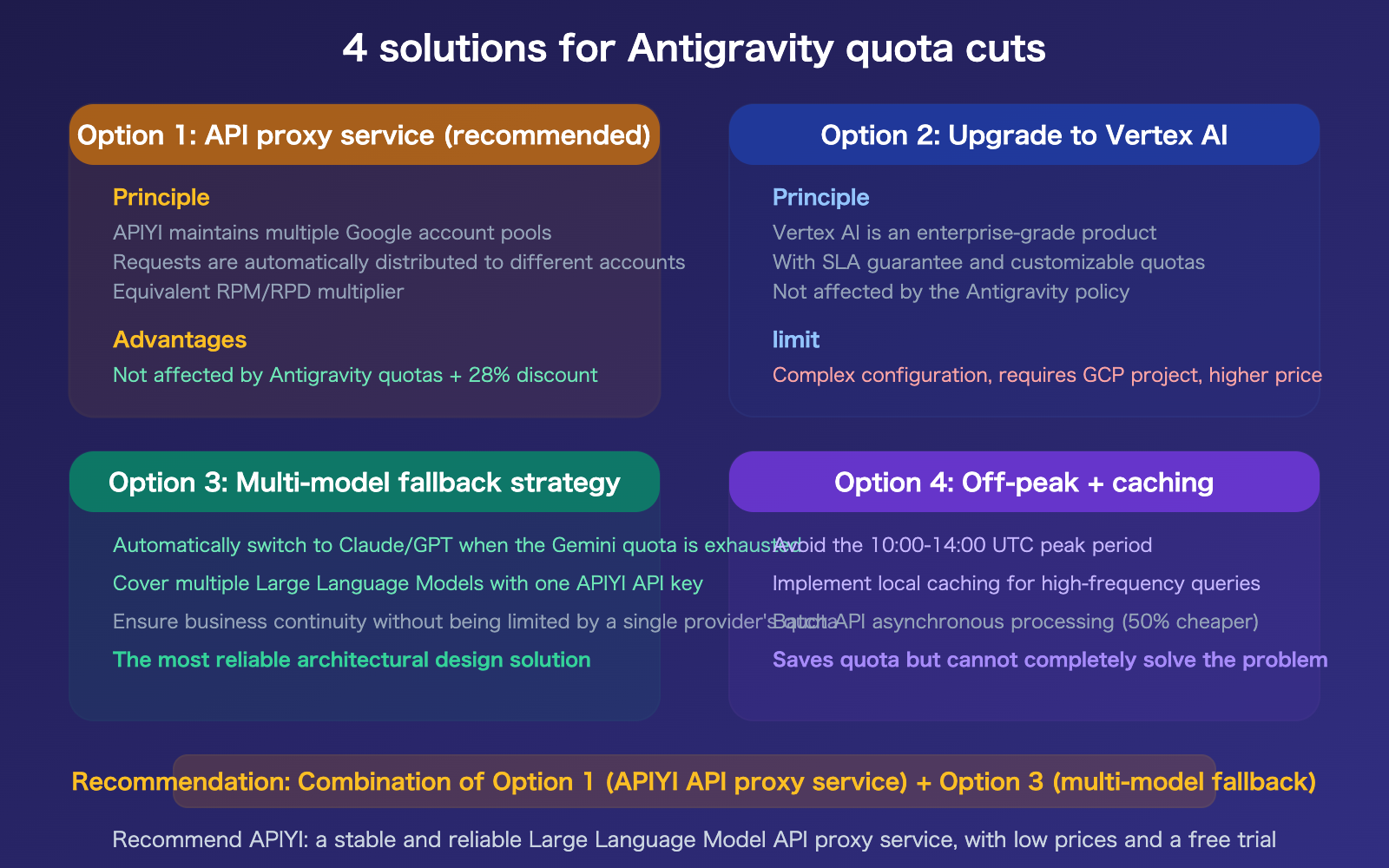
Tip: If your business relies on the Gemini API and you don't want to be repeatedly affected by Google's quota policies, using an API proxy service like APIYI (apiyi.com) is the most stable solution. It utilizes multi-account pools to bypass single-account limits and offers a 28% discount.
Developer Solutions
FAQ
Q1: Will Google continue to cut quotas?
Most likely, yes. Google's free tier policy for AI Studio has been tightening consistently, and their official documentation explicitly states that "specified rate limits are not guaranteed." Looking at the trend, the free tier will become increasingly restrictive, and the "value for money" of paid tiers will likely continue to decline. If your business relies on the Gemini API, don't bet your stability on Google's promises—use an API proxy service like APIYI (apiyi.com) to leverage a multi-account pool mechanism that shields you from individual account quota fluctuations.
Q2: Does purchasing an Ultra plan mean I’m unaffected?
Not at all. The events of March 2026 proved that even Ultra users can have their quotas slashed overnight without prior notice. The forum post titled "Dramatic quota reduction after update" was actually written by an Ultra user. Google only promises that Ultra has the "highest and most generous limits," but they don't commit to specific numbers or guarantee that those limits won't change.
Q3: Are the quotas for API developers and Antigravity consumers the same?
Not exactly. Antigravity (the consumer-facing product of Google AI Studio) has its own quota system (AI credit-based), while the Gemini API (developer interface) has an independent system for RPM/RPD/TPM limits. However, both share the same underlying GPU resources. The quota cuts in Antigravity reflect Google's overall compute scarcity, which inevitably impacts the API level as well (e.g., increased 503 error rates for Preview models).
Q4: Are there any alternatives unaffected by the Antigravity policy?
Yes. 1) Use an API proxy service like APIYI (apiyi.com) to call the Gemini API, where multi-account pools aren't affected by single-account limits; 2) Upgrade to Vertex AI (enterprise-grade, includes an SLA but is complex to configure); 3) Use alternative models—Claude Opus 4.6 currently ranks #1 on the Arena leaderboard for both Text and Code, and you can access it via APIYI at a 20% discount. The most robust approach is a multi-model architecture: use Gemini as your primary (via APIYI proxy) and fall back to Claude or GPT.
Summary
Key takeaways from the Google Antigravity quota cut events:
- 4 cuts in 4 months: Dec 2025: Free tier slashed by 92% → Feb 2026: Image quotas tightened → Mar 2026: Credit system introduced → Even Ultra users were throttled. All happened without prior notice.
- The core issue is trust: Developers don't mind paying; what they fear is having their quota taken away overnight. When the documentation says "limits are not guaranteed," it means there's no real commitment.
- Recommended strategy: Using an API proxy platform (like APIYI, which uses multi-account pools to bypass limits) combined with a multi-model fallback strategy (Gemini + Claude + GPT) is the most reliable setup.
We recommend accessing the Gemini API through APIYI (apiyi.com)—it's unaffected by Antigravity limits, offers a 28% discount, doesn't charge for failed requests, and supports Claude and GPT as fallback paths.
📚 References
-
The Register: Users protest as Google Antigravity prices hike: Community backlash over the credit-based system.
- Link:
theregister.com/2026/03/12/users_protest_as_google_antigravity/ - Note: Covers credit-based pricing and developer reactions.
- Link:
-
Google AI Developer Forum: Ultra quota dramatically reduced: Complaint thread from Ultra users.
- Link:
discuss.ai.google.dev/t/ultra-dramatic-quota-reduction-after-update-this-needs-an-official-explanation/135526 - Note: Discusses how top-tier users saw their quotas slashed overnight.
- Link:
-
Gemini API Rate Limits Official Documentation: Current rate limit specifications.
- Link:
ai.google.dev/gemini-api/docs/rate-limits - Note: Pay close attention to the disclaimer stating that "specified rate limits are not guaranteed."
- Link:
-
APIYI Documentation Center: Accessing Gemini API without being affected by Antigravity limits.
- Link:
docs.apiyi.com - Note: Features multi-account pooling to bypass limits, a 28% discount, and a no-charge policy for failed requests.
- Link:
Author: APIYI Technical Team
Technical Discussion: Feel free to join the conversation in the comments. For more resources, visit the APIYI documentation center at docs.apiyi.com.