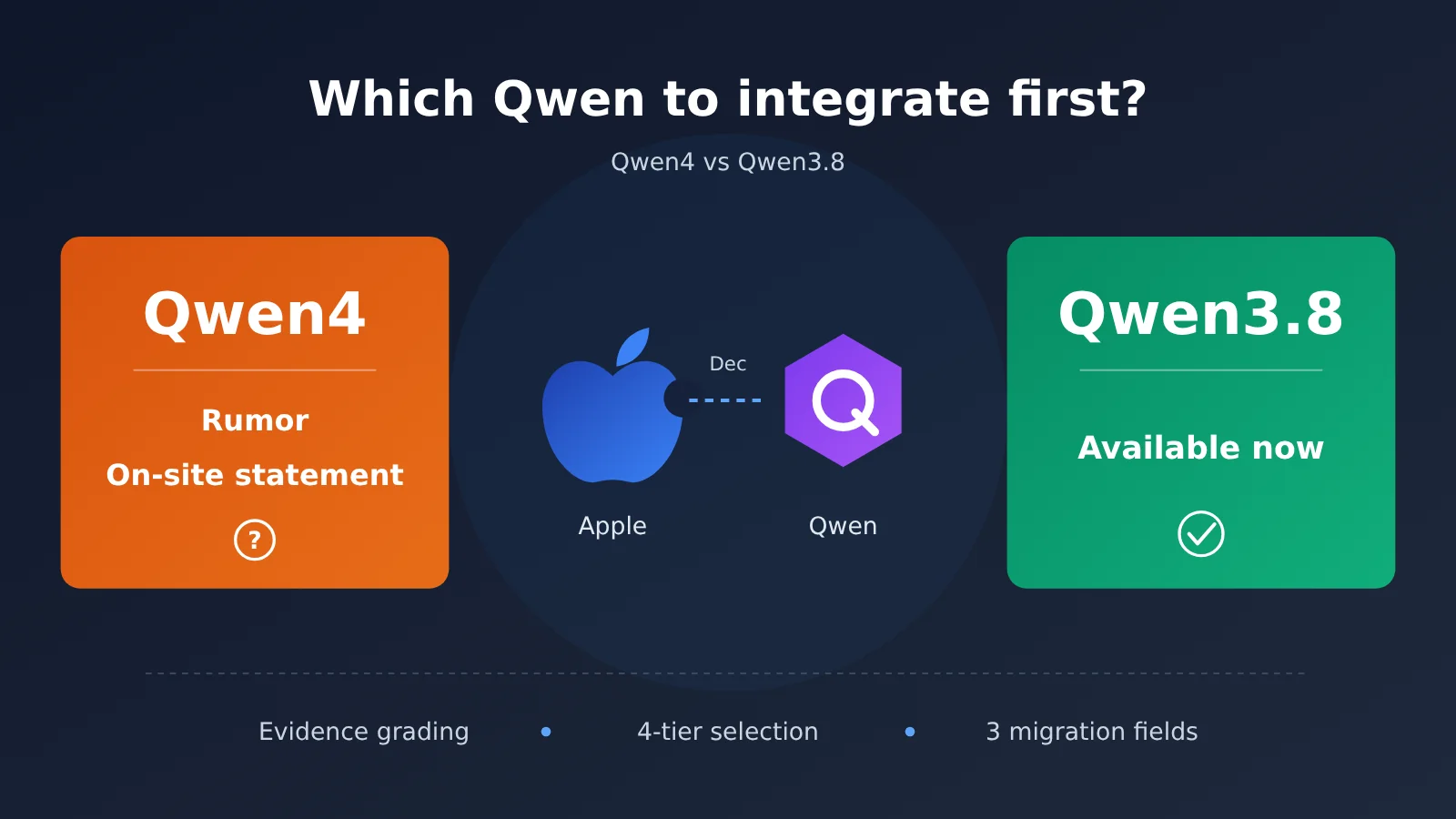
Here’s the bottom line: Qwen4 has only been discussed publicly and spotted in repository traces; Alibaba’s written position is still that it’s “being trained.” The highest tier you can put to work today is Qwen3.8. Apple’s December integration of Qwen into iPhones in China is a distribution story—it doesn’t give developers any additional API capabilities.
That’s not a knock on Qwen4. This article sorts what we know into four levels of confidence, separating what you can build into a project timeline from what’s merely worth watching. It also covers how to choose between Qwen3.8’s four tiers, their pricing, and the three fields you’ll need to change when migrating.
What you’ll get: By the end, you’ll be able to decide whether your Agent, writing, customer service, or moderation project should wait for Qwen4 or start with Qwen3.8—and know the cost per million tokens for each tier.
What Apple Is Integrating: Qwen Comes to Apple Intelligence in China
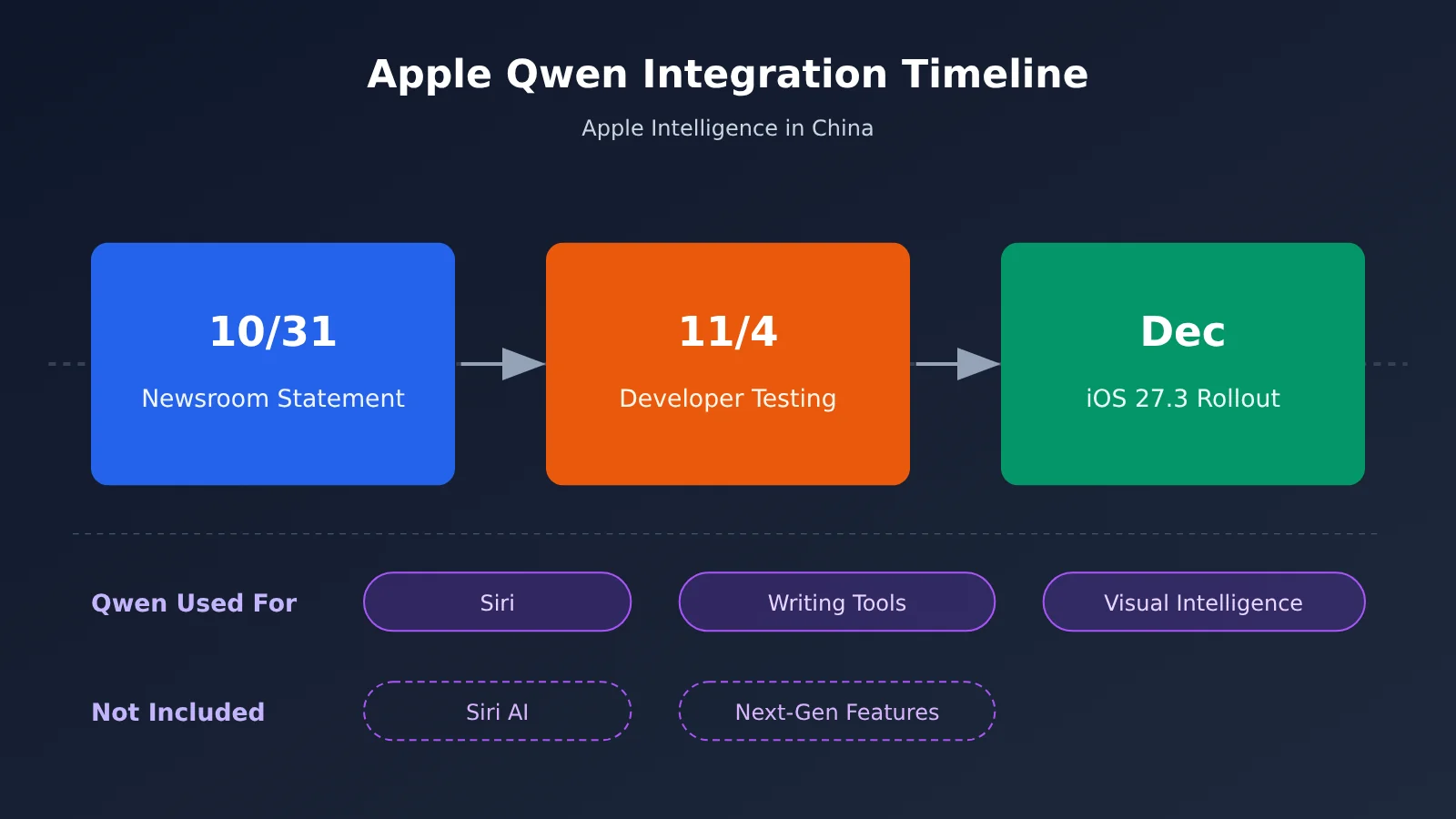
Apple is integrating Qwen capabilities for consumers, not opening a new Qwen API for developers. According to an Apple China Newsroom statement dated October 31, 2026, as reported by Tech Wire Asia on November 2, the first Apple Intelligence features will roll out to iPhone users in mainland China in December with iOS 27.3. Developers can start testing them on November 4. As of today, November 3, the features are still forthcoming and haven’t launched yet.
| Item | Apple’s October 31, 2026 statement |
|---|---|
| Timeline | Launching in December with iOS 27.3; developers can test from November 4 |
| Initial features | Live translation in Messages, FaceTime, and Phone; rewriting, proofreading, and summarization in Writing Tools; camera-based visual intelligence; Clean Up in Photos; mail and notification summaries, priority messages, and call transcription summaries |
| Qwen’s role | Apple runs its own generative models while partnering with Alibaba. Users can access Qwen directly in Siri, Writing Tools, and visual intelligence to understand text and images; Siri can pass some requests to Qwen |
| Sign-in options | Qwen account or Apple account |
| Not included | Siri AI and the next-generation Apple Intelligence features announced at WWDC 2026; Bloomberg reports that Image Playground also won’t be in the initial rollout |
| Eligible devices | Supported iPhones purchased in China, or devices with both the device region and Apple account region set to China |
| Data commitment | Alibaba says user requests and content generated by Qwen won’t be used to train models |
For context, Apple Intelligence was among seven generative AI services that completed registration with China’s Cyberspace Administration on July 15. The FT reported that Apple had also considered Tencent and ByteDance. Counterpoint data shows that Apple ranked second in Chinese smartphone shipments in Q3 2026 with a 19.5% share, behind Huawei at 21.3%. Overall shipments fell 10% year over year.
For developers, the news matters mainly on the user side: more everyday users will encounter Qwen at the system level and become familiar with its output style. Apple’s partnership won’t change which model your backend calls, how much you pay, or what latency you get.
Four Levels of Qwen4 Evidence: What to Trust and What to Plan Around
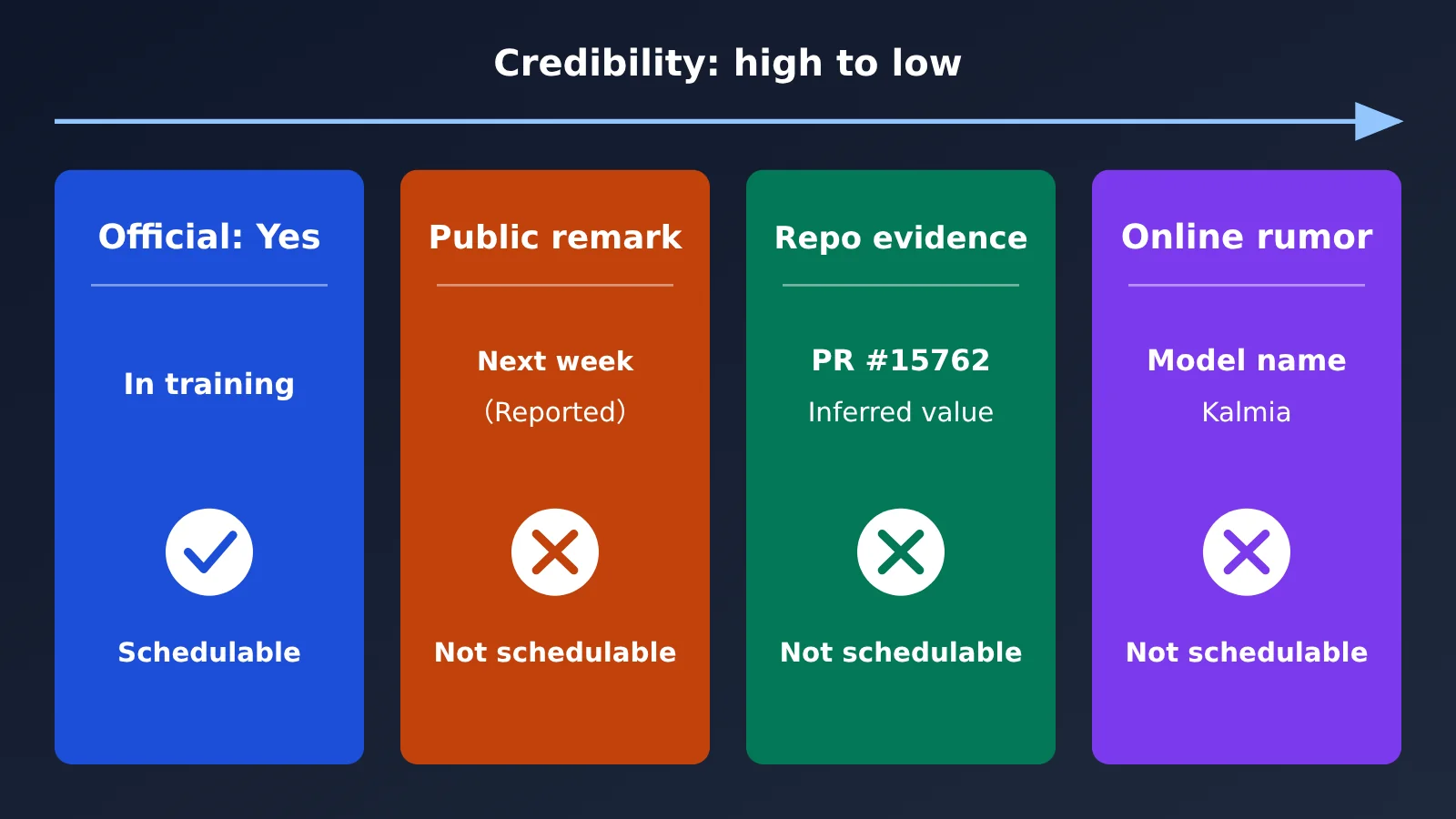
Only official written statements are reliable enough for planning, and they currently say Qwen4 is “currently in training.” The four levels of evidence below decrease in credibility from left to right.
| Dimension | Official Confirmation | On-Site Statement | Repository Evidence | Community Rumors |
|---|---|---|---|---|
| What it says | A 2026-09-22 Apsara Conference press release says Qwen 4 is “currently in training”; the 2026-10-29 Amsterdam event page mentions only “Qwen foundation models,” not Qwen4 | Qwen research scientist Xudong Guo said at the 2026-10-29 Amsterdam event that the Qwen4 series would launch “next week,” according to attendee John T Davies; EOGEE reported it on 2026-10-30 | qwen-code merged PR #15762 on 2026-10-28, setting the default recognized context window for model IDs beginning with qwen4 to 1M tokens | Four model names: Qwen4-Max / Flash / Plus / 27B; the anonymous Arena model Kalmia has been attributed to Qwen4 based on its tokenizer fingerprint |
| Source type | Alibaba written materials | Individual oral statement relayed by a third party | Official repository, but the value comes from the review notes | Third-party websites and forum speculation |
| Officially endorsed? | Yes | No; EOGEE explicitly says no announcement appeared through official channels | No; the PR itself says neither models.dev nor the built-in catalog had qwen4 entries at the time, so the value was inferred | No |
| Suitable for planning? | Yes, but it only supports the conclusion that Qwen4 “hasn’t been released yet” | No; it’s only a signal worth watching | No; it shows the toolchain is preparing in advance, not that the specification is official | No |
One important correction: a TRAE community post dated 2026-10-29 described this as an announcement by the “CTO,” which conflicts with the original account identifying the speaker as a “research scientist.” Use “research scientist” when citing it.
OmniaKey’s 2026-11-01 check offers firmer evidence: as of 2026-11-01 00:21 UTC, no qwen4 model IDs, weights, or prices could be found on the Qwen organization page on Hugging Face, Alibaba Cloud’s Model Studio, or OpenRouter. The Model Studio model page was last updated on 10-28 and recommended qwen3.8-max, qwen3.7-plus, and qwen3.8-flash as text models. The release notes were last updated on 10-30, with the latest entry covering qwen-audio-3.1-realtime-flash on 10-27.
An Official Reference for the Qwen4 Architecture: Qwen3.8-Flash-Next
If you want an early look at the direction of the Qwen4 architecture, Qwen3.8-Flash-Next is currently the only official reference. Its Hugging Face model card was created on 2026-08-24, and it’s officially described as an “experimental preview of the Qwen4 architecture.” Its configuration lists the model type as qwen4_exp, and llama.cpp v0.6.0 already supports the Qwen4Exp architecture. Keep in mind that it’s a preview model: its specifications can’t be used to infer the context window, parameter count, or license of the final Qwen4 release.
Choosing Among the Four Qwen3.8 Tiers
For a new project, start with qwen3.8-flash or qwen3.8-27b, and move up to qwen3.8-max for complex agents. Alibaba Cloud announced Qwen3.8-Max in an official blog post on 2026-08-03. It’s a flagship MoE model with 2.4T parameters. Subsequent official blog posts announced Qwen3.8-27B and released the Qwen3.8 flagship weights as open source.
| Tier | Positioning | Best for | Recommendation | Available platforms |
|---|---|---|---|---|
| qwen3.8-max | Official flagship, 2.4T MoE | Multi-step agents, long-form writing, complex reasoning | Use when quality matters most and call volume is low | APIYI apiyi.com, Alibaba Cloud Model Studio |
| qwen3.8-2.4t-a95b | Model name matches the flagship open-source weight specifications | Teams that need consistent behavior with a self-hosted version | Use for comparison when planning a private deployment | APIYI apiyi.com |
| qwen3.8-27b | Mid-sized, officially released | Customer support, content moderation, structured extraction | Default choice for balancing quality and cost | APIYI apiyi.com |
| qwen3.8-flash | Lightweight, high-speed tier | High-concurrency customer support, classification, summarization, first-pass filtering | First choice for high call volumes and latency-sensitive tasks | APIYI apiyi.com, Alibaba Cloud Model Studio |
Different workloads have different needs. Moderation and customer support typically involve high volumes of relatively simple requests. Using flash for most traffic and routing difficult cases to 27b or max can reduce overall costs. Writing and agent workflows depend more on stability over long task sequences, so you can start with max to establish a quality baseline, then see whether 27b meets your needs.
🎯 Selection tip: Use the same API key to run qwen3.8-max, qwen3.8-flash, and qwen3.8-27b against the same prompts for an A/B comparison. It’s faster than studying leaderboards. On APIYI apiyi.com, you only need to change the model field; the rest of your code stays the same. Differences measured on your own business samples are what really matter.
Pricing and Tiers: Qwen3.8 vs. Qwen3.5
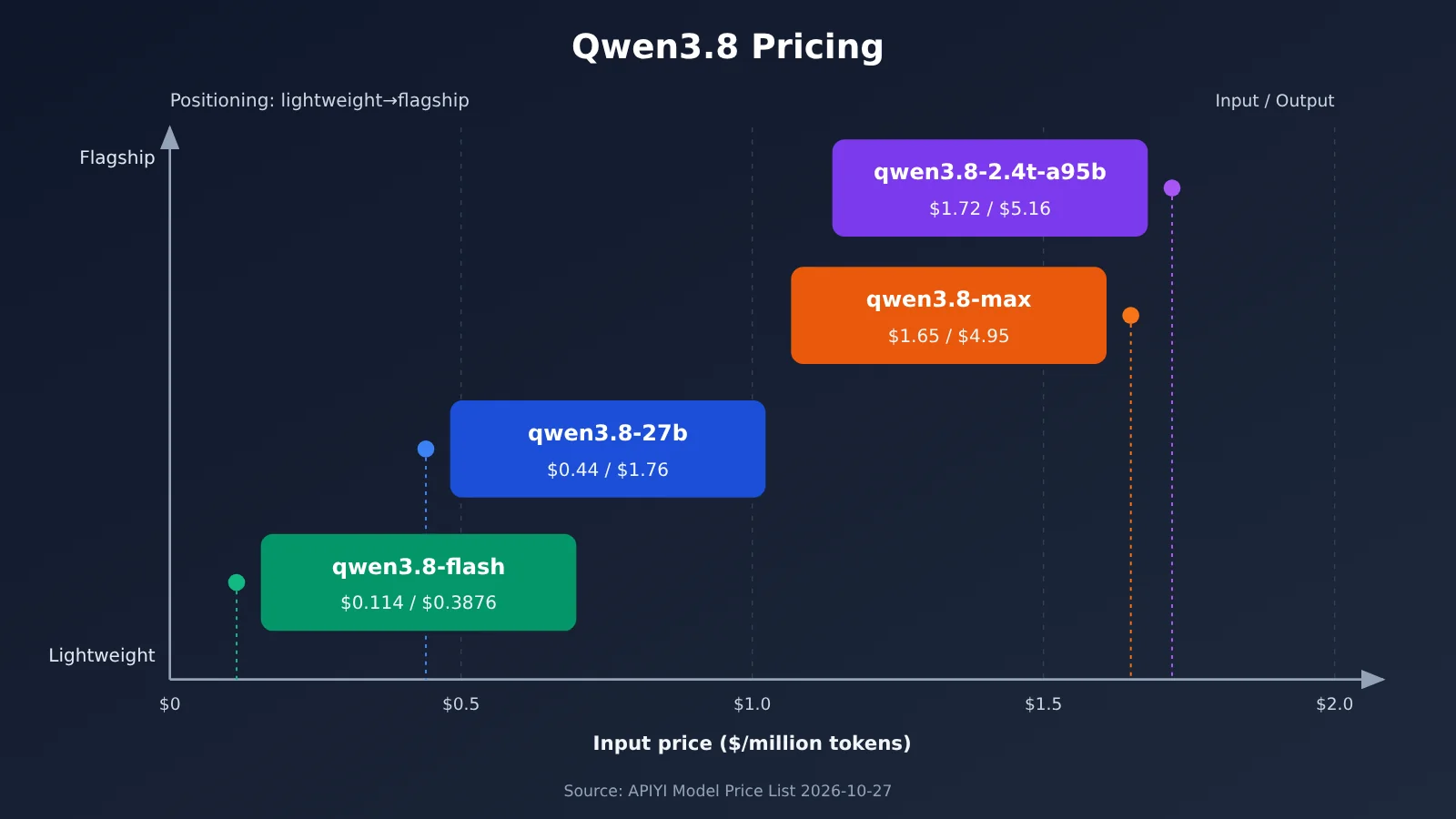
Of the four Qwen3.8 tiers, flash costs about 1/14 as much as max for input. That’s the biggest price difference to account for when choosing a model. The table below lists prices for nine Qwen models on APIYI.
| Model | Input | Output | Cache read |
|---|---|---|---|
| qwen3.8-max | $1.65 | $4.95 | $0.20625 |
| qwen3.8-2.4t-a95b | $1.72 | $5.16 | $0.215 |
| qwen3.8-27b | $0.44 | $1.76 | $0.088 |
| qwen3.8-flash | $0.114 | $0.3876 | $0.01425 |
| qwen3.5-plus | $0.114 | $0.684 | — |
| qwen3.5-flash | $0.03 | $0.3 | — |
| qwen3.5-397b-a17b | $0.18 | $1.08 | — |
| qwen3.5-122b-a10b | $0.12 | $0.96 | — |
| qwen3.5-35b-a3b | $0.06 | $0.48 | — |
Data as of 2026-10-27 14:50 UTC+8, in USD per million tokens, from the APIYI model pricing table (docs.apiyi.com/models).
[Screenshot placeholder: APIYI model pricing table, filtered for qwen3.8]
It’s easier to see the difference in a concrete workload. For 1 million input tokens and 300,000 output tokens, qwen3.8-max costs about $3.14, qwen3.8-2.4t-a95b about $3.27, qwen3.8-27b about $0.97, and qwen3.8-flash about $0.23. If you reuse a long system prompt, cache-read pricing can reduce input costs further. All four Qwen3.8 tiers offer cache-read pricing.
One detail worth noting: qwen3.8-flash and qwen3.5-plus have the same input price of $0.114, but qwen3.8-flash has a lower output price and supports cache reads. For output-heavy tasks such as writing and summarization, switching from qwen3.5-plus to qwen3.8-flash is cheaper on paper. You’ll need to test the quality difference with your own samples.
3 Fields to Check When Migrating to Qwen3.8
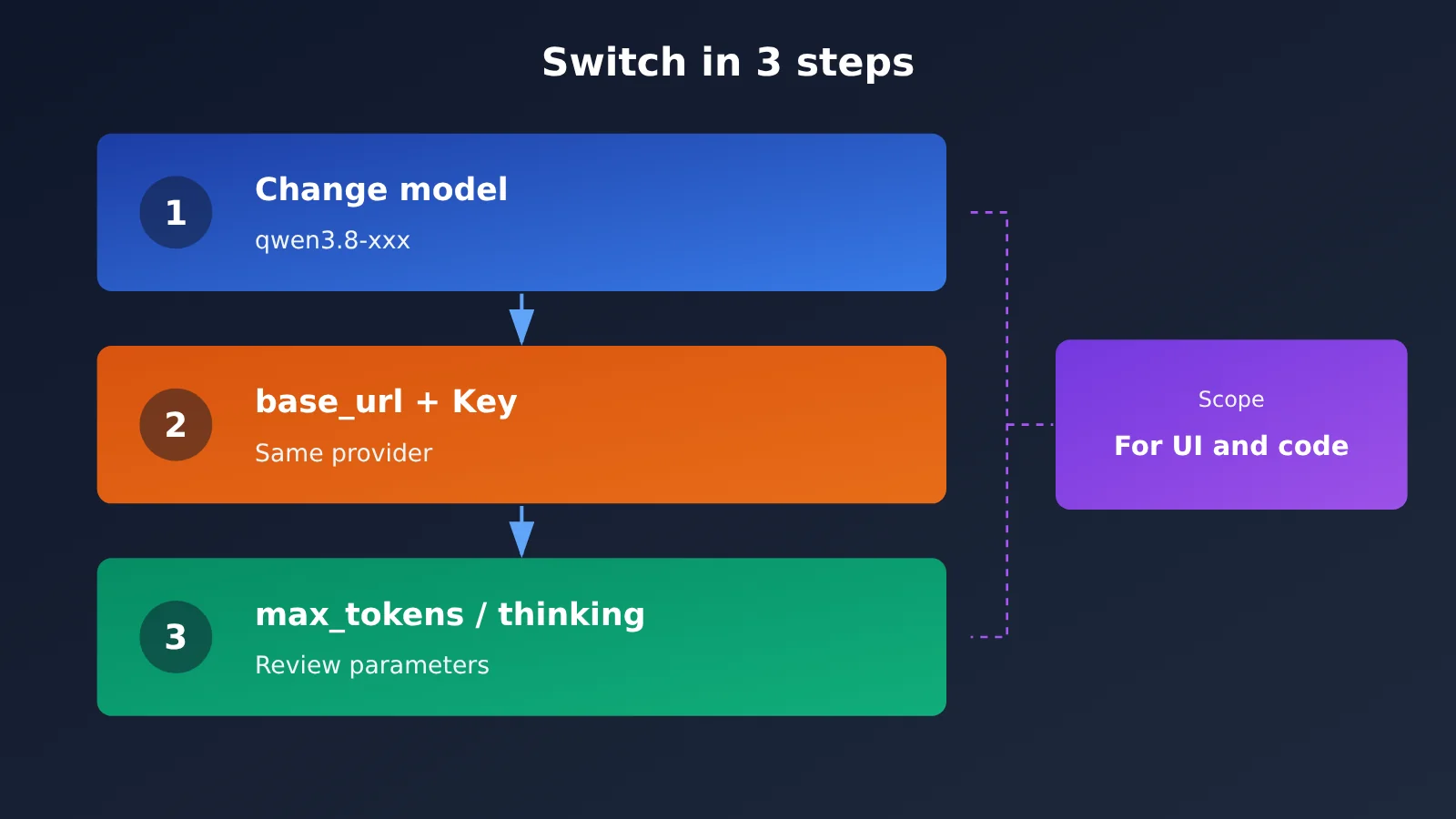
When switching from another model or Qwen3.5 to Qwen3.8, you typically only need to check three settings. The same checklist applies to GUI tools like Cherry Studio, Dify, and chat clients, as well as code projects.
| Order | Field | What to change | Where to find it in a GUI |
|---|---|---|---|
| 1 | model | Change it to qwen3.8-flash, qwen3.8-27b, or qwen3.8-max |
“Model” dropdown or “Model ID” input |
| 2 | base_url + API Key | Make sure both point to the same provider | “API URL / Endpoint” and “Key” fields |
| 3 | Output length and thinking parameters | Check max_tokens and reasoning-related switches | “Maximum Output” or “Advanced Parameters” panel |
Step 1: Change the model name. The name must exactly match the platform’s model list, including lowercase letters and periods. A typo will trigger a “model not found” error. It’s best to copy the name from the platform’s model list rather than type it manually.
Step 2: Make sure the base_url and Key are from the same provider. If you use APIYI, set the endpoint to https://api.apiyi.com/v1 and use the Key generated in your APIYI apiyi.com dashboard. Many “401 unauthorized” errors happen because the endpoint was changed but the Key still belongs to the old platform, or vice versa. To check which models your current Key can access, run curl https://api.apiyi.com/v1/models -H "Authorization: Bearer 你的Key" to retrieve the list.
Step 3: Check output length and thinking parameters. Default output lengths and reasoning behavior can differ between model generations. A max_tokens value hard-coded in an older project might truncate long responses. When thinking is enabled for a model with reasoning capabilities, latency and output tokens will increase. For latency-sensitive use cases like customer support and moderation, try running a round with thinking disabled first, then enable it as needed. Check the platform documentation for the exact parameter names.
When Is It Worth Waiting for Qwen4?
Most projects don’t need to wait. Qwen4 is worth watching only if your launch is already one or two months away and you have a hard requirement for a newer model generation.
Consider using Qwen3.8 now if:
- Your project needs to launch this quarter, and your schedule can’t depend on a model with no official release date
- Your main use cases are customer support, content moderation, or summarization, and flash or 27b already meets your needs
- Your API uses an OpenAI-compatible format, so switching later only requires changing the model field—integrating now won’t create sunk costs
Consider keeping an eye on Qwen4 if:
- Your product is still in the technical research phase, with plenty of time before launch
- You need open weights for private deployment and want to review Qwen4’s license terms after release
- You’re already using Qwen3.8-Flash-Next for early architecture research
While you wait, a practical approach is to use Qwen3.8 to build your evaluation set and establish your business metrics. Once Qwen4 is officially released, compare it using the same samples, then decide whether to switch. As of 2026-11-03, the Qwen4 series isn’t yet available on APIYI. We’ll make it available as soon as possible; once it’s listed, you’ll be able to find it directly in the model list at APIYI apiyi.com.
Frequently Asked Questions
Q1: When will Qwen4 be released?
There’s no official date yet. Alibaba’s clearest written statement appears in its 2026-09-22 Apsara Conference press release, which says Qwen4 is “being trained.” The claim that it will be “released next week” came from a research scientist’s remarks at the event, as relayed by attendees; there’s been no official announcement. Check the Qwen organization page on Hugging Face and the Bailian release notes for updates.
Q2: Which Qwen3.8 tier should I choose for a new project?
Start with qwen3.8-flash for high-concurrency workloads with simple individual tasks. Choose qwen3.8-27b for tasks like customer support, moderation, and extraction, where quality also matters. Use qwen3.8-max to establish a quality baseline for multistep agents and long-form writing. Check the platform’s model list for available models and pricing. You can test all three tiers with the same API key on APIYI at apiyi.com before deciding.
Q3: What does Qwen integration in the China version of Apple products mean for developers?
The direct impact is limited. Apple’s 2026-10-31 announcement covers system-level user features rolling out in December with iOS 27.3. Developers can test them starting November 4, but no new API has been made available. Indirectly, more iPhone users will become familiar with Qwen’s output style, so products serving those users may want to consider Qwen as a candidate model.
Q4: If I’m already using Qwen3.5, should I switch everything to Qwen3.8?
There’s no need to switch everything at once. Evaluate each task individually. qwen3.5-flash still has the lowest input price in the series at $0.03, so it’s fine to keep using it for ultra-lightweight tasks. For projects using qwen3.5-plus for writing or summarization, start by comparing it with qwen3.8-flash: both have the same input price, but the latter has a lower output price. On APIYI at apiyi.com, switching only requires changing the model field, so you can start with a gradual rollout to 10% of traffic.
Q5: Will I need a new API key when Qwen4 launches?
No. On an aggregation platform, the same API key can be used to invoke all available models. Once a new model is added, you only need to change the model name. As of 2026-11-03, the Qwen4 series isn’t yet available on APIYI, but we’ll add it as soon as possible. Once it’s available, you’ll be able to use your existing APIYI apiyi.com API key to invoke it directly.
Qwen4 vs. Qwen3.8: Key Takeaways
- Official Qwen4 status: The September 22, 2026 press release says it’s “in training.” There’s no release date, model ID, or pricing yet.
- “Launching next week”: A research scientist reportedly made this statement at an event. It’s a secondhand account, not a basis for scheduling.
- Repository clues: The 1M context window in qwen-code PR #15762 is an inferred value, not an official specification.
- Apple partnership: Launching in December with iOS 27.3, with developer testing available November 4. It doesn’t involve a new API.
- Top tier available now: Qwen3.8. Input pricing for flash is roughly 1/14 that of max.
- Migration effort: Change the model, check the base_url and key, and review output length and thinking parameters.
Summary
The latest Qwen news falls into three categories:
- Apple’s Qwen integration in December: This is progress on the distribution front. It affects user awareness, not the capabilities developers can invoke.
- Qwen4: There are statements from an event and clues in a repository, but the official written position is still “in training.” Don’t build it into your schedule yet.
- Qwen3.8: It’s officially released with clear pricing. Its four tiers cover major use cases, from high-concurrency workloads to complex agents.
A safer approach is to launch with Qwen3.8 now and build a set of evaluation samples. Once Qwen4 is officially released, you can compare it using the same samples. We recommend using APIYI apiyi.com to test all Qwen3.8 tiers with a single key. New users get free testing credits, so you can run A/B tests before choosing a tier.
📚 References
- Tech Wire Asia: Coverage of the Apple China newsroom’s 2026-10-31 announcement
- Link:
techwireasia.com/2026/11/apple-intelligence-china-alibaba-qwen-december/ -
Details: Apple’s December feature list, Qwen’s role, and supported devices
-
OmniaKey: “When Will Qwen 4 Be Released? What Has Alibaba Officially Confirmed So Far?”, 2026-11-01
- Link:
omniakey.com/zh/blog/qwen-4-release-date -
Details: Verification of official statements and search results across three platforms
-
EOGEE: “Qwen Teases Qwen4 Release Next Week”, 2026-10-30
- Link:
eogee.com/article/289 -
Details: Source for the reported remarks made in Amsterdam
-
Alibaba Cloud Official Blog: Qwen3.8-Max launch, 2026-08-03
- Link:
alibabacloud.com/blog/alibaba-unveils-qwen3-8-max-its-largest-and-most-capable-flagship-model-to-date_603420 -
Details: Official announcement of the Qwen3.8 flagship model
-
Alibaba Cloud Official Blog: Qwen3.8-27B launch and release of open-source flagship model weights
- Link:
alibabacloud.com/blog/alibaba-unveils-qwen3-8-27b-and-releases-weights-of-qwen3-8-flagship-model_603463 -
Details: The 27B model and open-source release
-
APIYI Model Pricing Table
- Link:
docs.apiyi.com/models - Details: Data source for the pricing table in this article