
Author’s note: As of 2026-11-24, the official GLM-5.4 token pricing still hasn’t been published. This article separates official information, third-party quotes, and claims that can’t be verified, then gives a conservative estimation method you can put straight into a budget.
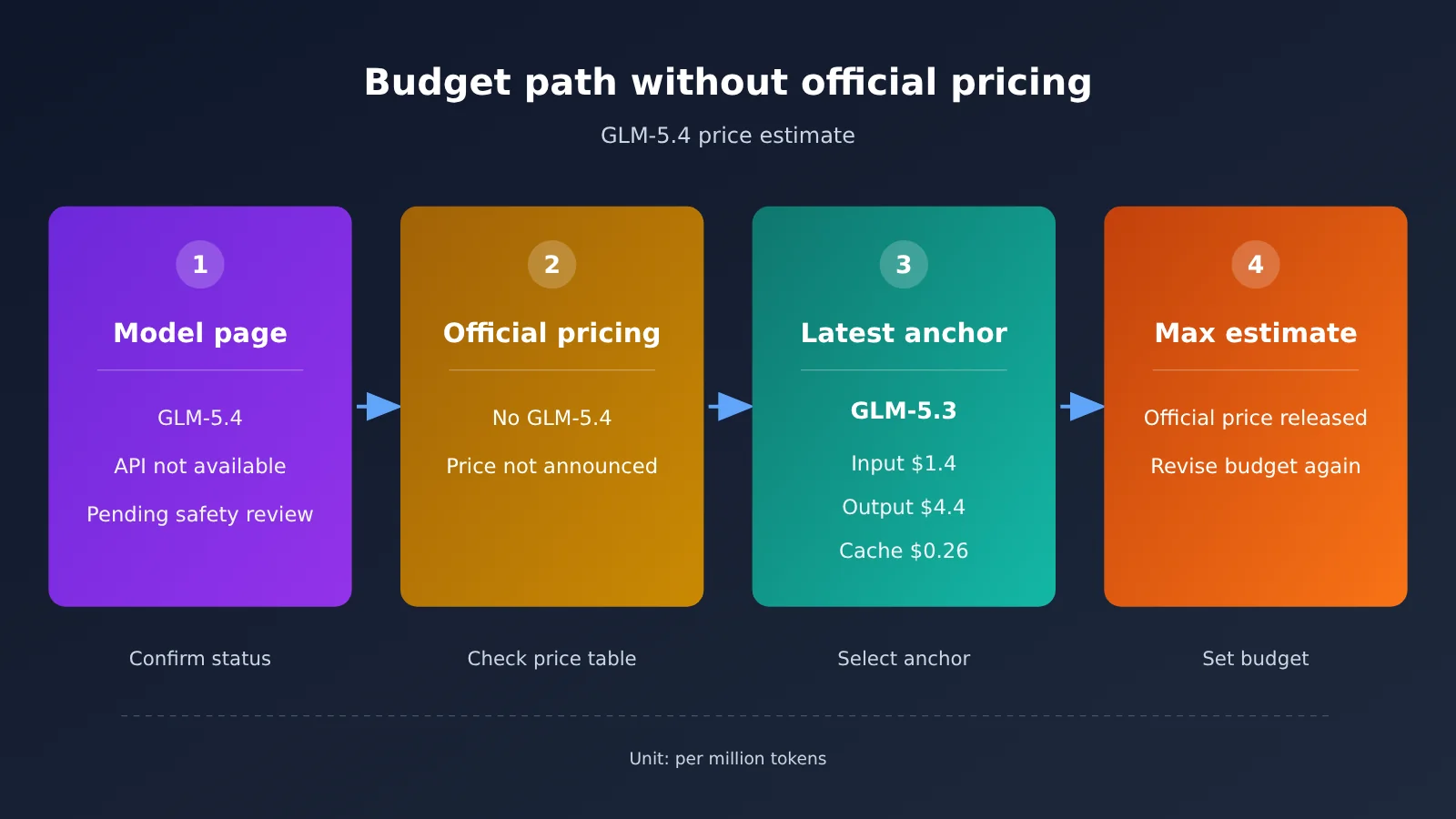
Bottom line first: the official price per million tokens for GLM-5.4 hasn’t been announced. The latest row on Zhipu’s Chinese pricing page and on Z.ai’s English pricing page is still GLM-5.3, listed at input ¥8 / output ¥28 ($1.4 / $4.4 on the USD page), with cache hits at ¥2 ($0.26). The GLM-5.4 model page only says “the model API will be available after the security assessment is complete” — no unit price, no launch date.
This isn’t some “insider look at an official price cut,” and it isn’t a low price someone guessed at either. The GLM-5.4 quotes floating around online come from two main sources: credit-deduction coefficients inside subscription plans, and prices that third-party gateways list on their own. Neither one is an official per-token unit price. The approach here is to use only numbers you can actually look up officially, then tag every other claim with its source and how credible it is.
Core value: After reading this, you’ll know whether GLM-5.4 can be called with token-based billing right now, how to estimate a budget before the official price lands, and which numbers you can put in a quote versus which you can’t.
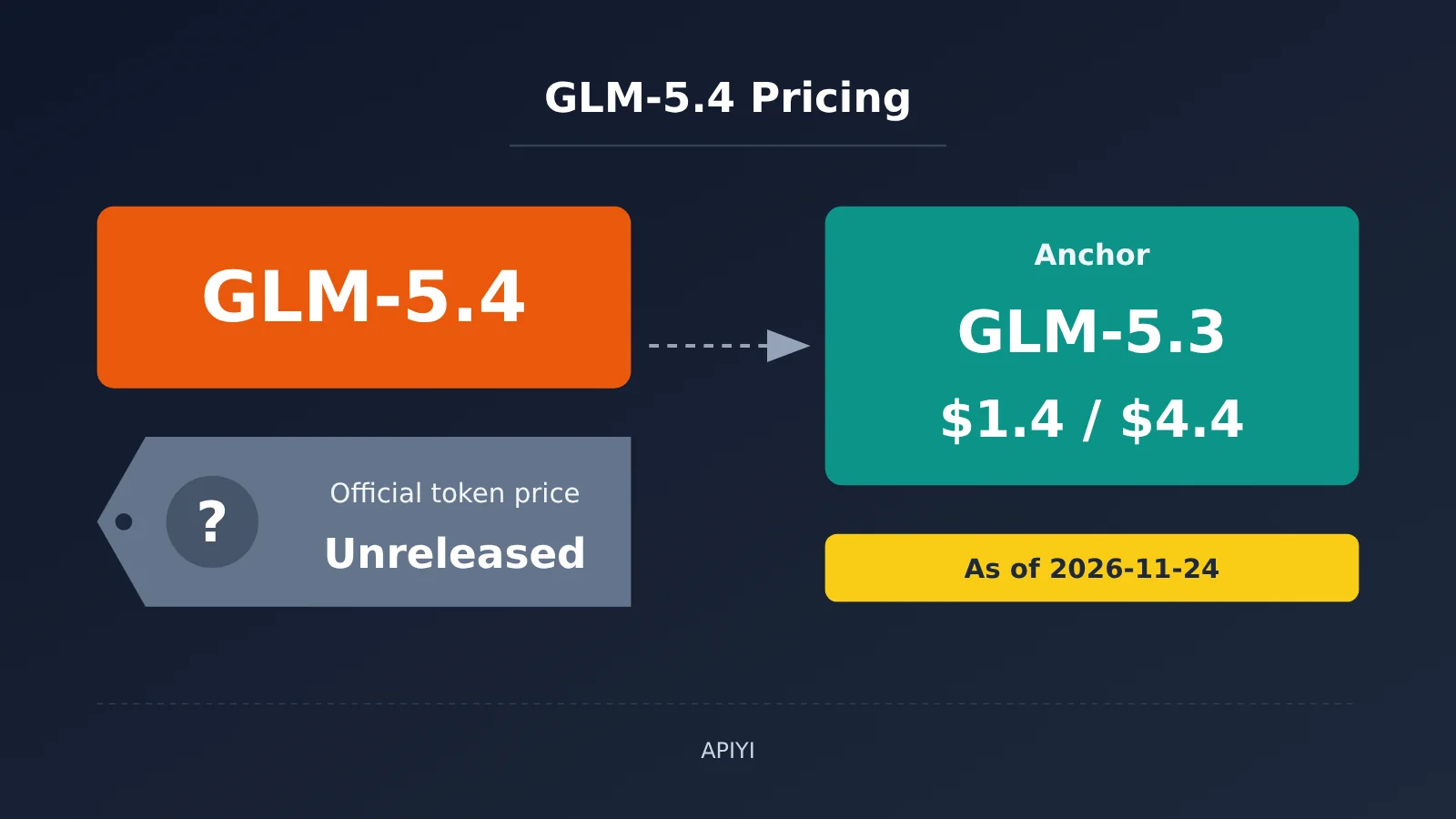
GLM-5.4 Pricing: Key Facts at a Glance
Let’s put together what we can confirm first. Each row in the table below corresponds to an official page, and all pages were checked on 2026-11-24.
| Information item | Details | Source type |
|---|---|---|
| GLM-5.4 token unit price | Not published; there is no GLM-5.4 row in the official price list | Official page (missing item) |
| GLM-5.4 API status | “The model API will open after the security evaluation is complete”; no date given | Official model page |
| Latest official token prices | GLM-5.3: input ¥8 / output ¥28 / cache hit ¥2 | Zhipu Chinese pricing page |
| USD basis | GLM-5.3: input $1.4 / cached input $0.26 / output $4.4 | Z.ai English pricing page |
| GLM-5.4 plan multipliers | Input 4.6 / cached input 1.1 / output 16 (credit multipliers, not unit prices) | Official plan documentation |
| Third-party gateway pricing | Two listings, with values differing by more than 50% | Unofficial, and they contradict each other |
What Exactly Is in GLM-5.4’s Official Price List?
The “Latest Models” table on Zhipu’s Chinese API pricing page has only three rows: GLM-5.3, GLM-5.3-Flash, and GLM-5.3-FlashX. The text model table doesn’t include GLM-5.4 either. Z.ai’s English pricing page also lists only these three models under Latest Models, and the Z.ai API platform homepage headline still reads “Start building with GLM-5.3”; the page shows prices for only two tiers, GLM-5.3 and GLM-5.3-FlashX.
So if someone quotes “the official GLM-5.4 price per million tokens,” the first thing to ask is which page that number came from. As of today, neither official pricing entry point provides that number.
| Model (official) | Input | Cached input / hit | Output | Notes |
|---|---|---|---|---|
| GLM-5.3 | ¥8 / $1.4 | ¥2 / $0.26 | ¥28 / $4.4 | Cache storage free for a limited time |
| GLM-5.3-FlashX | ¥2 / $0.37 | ¥0.57 / $0.075 | ¥7 / $1.25 | Mid-tier |
| GLM-5.3-Flash | ¥0.8 / $0.15 | ¥0.23 / $0.03 | ¥2.8 / $0.50 | Lightweight tier |
| GLM-5.4 | Not published | Not published | Not published | API opens after security evaluation |
All prices are per million tokens. RMB figures come from Zhipu’s Chinese page, and USD figures come from Z.ai’s English page. The two pages list prices separately; these are not conversions performed by this article.
GLM-5.4 Plan Credit Coefficients: Why They Aren’t Token Prices
Many claims that “GLM-5.4 is cheaper” come from the deduction coefficients in the official plan documentation. The docs do give GLM-5.4 numbers, but they’re calculated in credits—not the same thing as a USD or CNY list price per million tokens. Whether a subscription plan is worth buying is outside the scope of this article; here we’re only explaining what these coefficients mean.
| Model | Input coefficient | Cached input coefficient | Output coefficient |
|---|---|---|---|
| GLM-5.4 | 4.6 | 1.1 | 16 |
| GLM-5.3 | 6.9 | 1.7 | 24 |
| GLM-5.3-Flash | 2.3 | 0.56 | 8 |
The official credit formula is: credits consumed = (input tokens × input coefficient + cache-hit tokens × cached input coefficient + output tokens × output coefficient) ÷ 10000. Comparing them, all three coefficients for GLM-5.4 are about one-third lower than those for GLM-5.3—for example, 4.6 ÷ 6.9 ≈ 0.67 and 16 ÷ 24 ≈ 0.67.
The catch is that credits are an internal unit of account inside the plan, and plan quotas are further limited in tiers like “per 5 hours, per week.” Officially, there’s no API conversion standard for “1 credit = how many dollars.” So the only conclusion you can draw is that “within the plan, GLM-5.4 consumes fewer credits than GLM-5.3.” You cannot conclude that GLM-5.4’s API unit price will be two-thirds of GLM-5.3’s. If you use these coefficients to build an API budget, you’re using the wrong basis.
How to Read the GLM-5.4 Coefficients Correctly
- What you can say: Within the official plan, for the same token volume, GLM-5.4 consumes about one-third fewer credits than GLM-5.3.
- What you can’t say: GLM-5.4 input costs about $0.93 per million tokens. That infers a unit price from a coefficient ratio, and there’s no official basis for it.
- What it means for budgeting: These coefficients only show how the official plan positions GLM-5.4. They can serve as a reference signal, but they shouldn’t go into an API cost table.
GLM-5.4 vs Mainstream Models: A 1M Input + 1M Output Cost Comparison
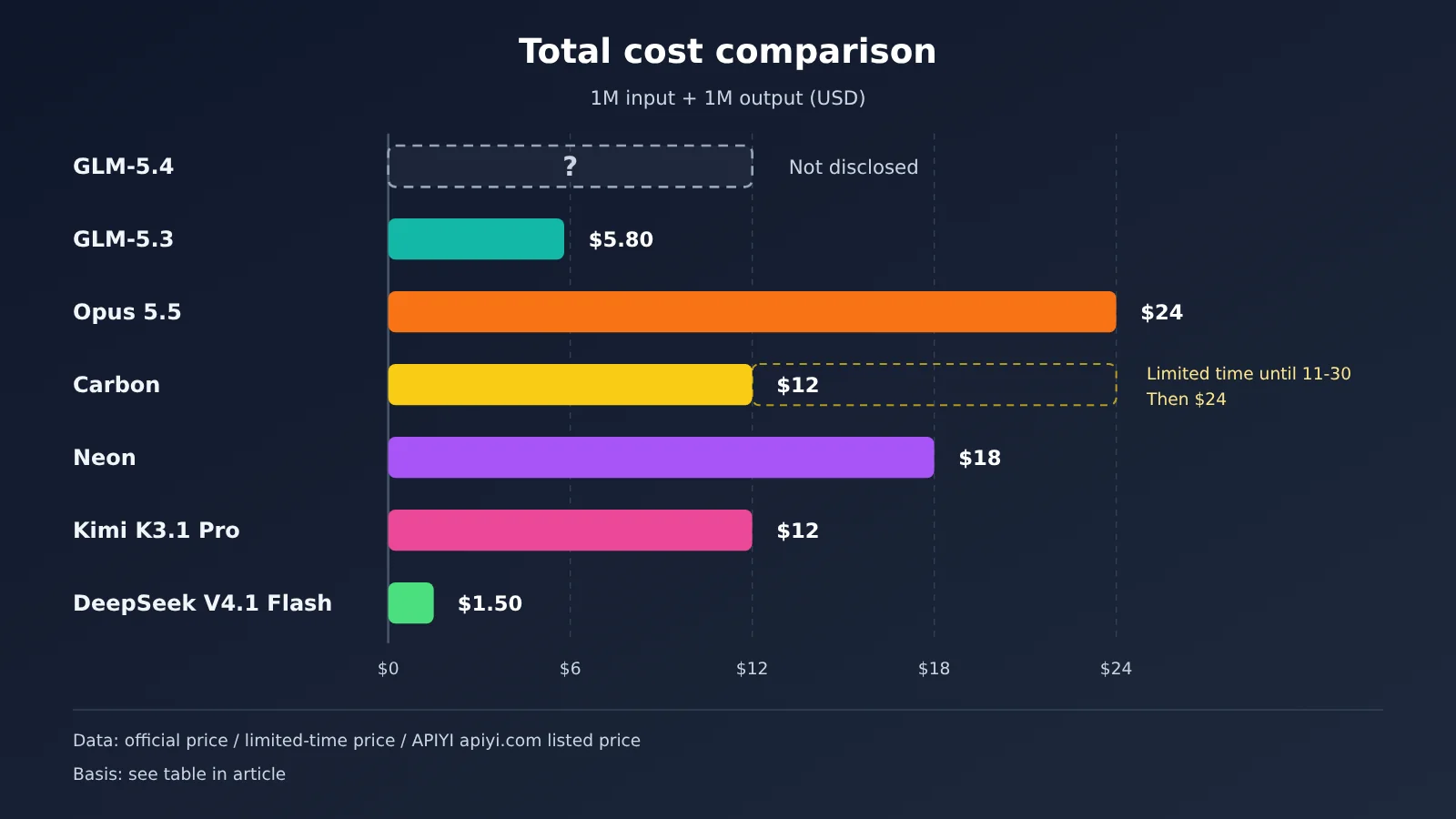
Since GLM-5.4 doesn’t have token pricing yet, the comparison table below uses GLM-5.3 as the anchor and lists the same-day list prices of other models. I’ve added a dedicated “Price type” column to distinguish official prices, limited-time prices, and APIYI listed prices, so numbers from different bases aren’t compared head-to-head.
| Model | Input | Output | Cache read | 1M in + 1M out | Price type |
|---|---|---|---|---|---|
| GLM-5.3 (anchor) | $1.4 | $4.4 | $0.26 | $5.80 | Official price |
| glm-5.3 (APIYI) | $1.4 | $4.396 | $0.259 | ~$5.80 | APIYI apiyi.com listed price |
| Claude Opus 5.5 | $4 | $20 | $0.20 | $24.00 | Public list price, same day |
| Gemini 4 Carbon | $2 | $10 | $0.10 | $12.00 | Limited-time price, through 11-30; reverts to $4/$20, i.e. $24.00, starting 12-01 |
| Gemini 4 Neon | $3 | $15 | $0.15 | $18.00 | Public list price, same day |
| Kimi K3.1 Pro | $2 | $10 | $0.20 | $12.00 | Public list price, same day |
| DeepSeek V4.1 Flash | $0.3 | $1.2 | $0.006 | $1.50 | APIYI listed peak price; official off-peak $0.12/$0.48 |
| GLM-5.4 | — | — | — | Unknown | Not announced officially |
Units are USD per million tokens; the worked example excludes cache hits. Price data dates range from 2026-11-23 to 11-24.
If GLM-5.4 ends up priced the same as GLM-5.3, one “1M input + 1M output” run costs $5.80. That’s just an assumption, not an official quote, so this article won’t estimate “how many times cheaper GLM-5.4 is than some model.” For now, the GLM-5.4 row can only say “unknown.”
Cache also has a clear effect on your actual bill. Using the official GLM-5.3 price again as an example: suppose half of the 1M input hits cache, the input cost becomes 0.5 × $1.4 + 0.5 × $0.26 = $0.83, plus $4.4 for output, for a total of about $5.23. For scenarios like multi-turn conversations and long system prompts, it’s best to factor the expected cache hit rate into your budgeting separately.
💡 Recommendation: If your project needs to go live right away, you can get the business running on GLM-5.3 and GLM-5.3-Flash first, and use real request volume to measure the input/output ratio and cache hit rate. APIYI apiyi.com connects to these models with the same Key; once GLM-5.4 opens up, switching only requires changing the
modelparameter.
GLM-5.4 Third-Party Gateway Pricing: Not Official Prices, Not Recommended for Budgeting
This section is broken out separately because third-party gateway numbers are the easiest to mistake for official prices. As of 2026-11-24, there are two publicly available quotes:
- One gateway’s blog (updated 11-19): lists
coding-glm-5.4at $0.06 for cache-miss input, $0.015 for cached input, and $0.22 for output. The post itself notes that these are gateway prices, not Zhipu’s official prices. - Another gateway’s model page (11-23): lists
glm-5.4at $0.09 for input, $0.33 for output, and $0.0225 for cache read, or ¥0.61 / ¥2.24 / ¥0.15 in RMB terms.
The two quotes differ by more than 50%, which shows they aren’t copied from the same official price list. On that same day, a commonly used public model catalog endpoint didn’t show any GLM-5.4 route either. With the official API not yet available, there’s no way to verify what invocation channel sits behind these quotes, how stable it is, or whether it’ll change later. If you use them to build a budget, your budget could end up off by several times once the official price is published.
| Information level | Details | Can it be used in a budget? |
|---|---|---|
| Official self-reported | GLM-5.3 unit price; GLM-5.4 API pending safety evaluation; GLM-5.4 plan multiplier | The first two can; the multiplier is reference only |
| Third-party individual quotes | GLM-5.4 quotes from two gateways that conflict with each other | Not recommended |
| Unverifiable | Claims like “the GLM-5.4 official price is about $X” or “it’ll open next week” | No |
How to Call GLM-5.4 Right Now: Quick Start
GLM-5.4’s API isn’t open yet. On APIYI, GLM-5.4 isn’t listed yet — we’ll get it up as soon as we can; model IDs and pricing follow the platform’s model list. What you can call today, with clearly published prices, is the GLM-5.3 family. APIYI’s listed prices (as of 2026-11-23 10:23 UTC+8) are: glm-5.3 input $1.4 / output $4.396 / cached read $0.259; glm-5.3-flash input $0.15 / output $0.5 / cached read $0.03.
The bare-minimum integration steps before GLM-5.4 launches
The platform uses an OpenAI-compatible API, so integration usually means changing just three things:
- Install the official OpenAI SDK:
pip install openai. - When creating the client, set
api_key="YOUR_API_KEY"andbase_url="https://api.apiyi.com/v1". - When calling
client.chat.completions.create(...), setmodeltoglm-5.3and passmessagesin the standard format, e.g.[{"role": "user", "content": "你好"}]; read the result fromresponse.choices[0].message.content.
Doing budget tracking properly for GLM-5.4
If you want to prepare a cost model for GLM-5.4 ahead of time, it’s worth logging the usage of every request in your calling code. The response.usage.prompt_tokens and response.usage.completion_tokens fields in the response correspond to input and output token counts respectively — and if the API returns a cache-hit field, log that too. Once you’ve worked out a monthly bill using GLM-5.3’s unit prices, that number can serve as an upper-bound reference for your GLM-5.4 budget. When official pricing comes out, you just swap in the new unit prices and recalculate — no need to re-estimate call volume.
🚀 Quick start: First run a round of real requests on APIYI apiyi.com using the free trial quota for new users, and get your input/output ratio and cache hit rate. That data is a better basis for a GLM-5.4 budget than any gateway price quote.
GLM-5.4 Pricing Impact Analysis
Impact on developers and team leads
- Make the pricing basis explicit in your quotes: Before official pricing is available, you can estimate GLM-5.4 in your budget as “based on GLM-5.3’s official price of $1.4/$4.4, as an upper bound,” and note that it should be “revised once official pricing is announced.”
- Don’t let a low price skew your solution: The $0.06/$0.22 from third-party gateways is an order of magnitude lower than GLM-5.3. If you make architecture decisions based on that number—for example, moving a large volume of offline tasks to GLM-5.4—you may have to redo them once official pricing is announced.
- Make model switching a configuration option: Put the
modelparameter in the configuration file. Once GLM-5.4 is available, you can run an A/B comparison by changing only the config.
Impact on model selection
Based on same-day pricing, GLM-5.3’s anchor price sits between DeepSeek V4.1 Flash and Kimi K3.1 Pro / Gemini 4 Carbon. Also note that Gemini 4 Carbon’s $2/$10 is a limited-time price; starting 12-01 it returns to $4/$20, putting it in the same price bracket as Opus 5.5. When budgeting for the year, use the restored price. Where GLM-5.4 ultimately lands will have to wait for the official announcement.
💰 Cost tip: If your budget is tight, you can use
glm-5.3-flashas the fallback tier for simple requests, and route complex requests toglm-5.3. On APIYI (apiyi.com), both use the same endpoint and the same API key—you just implement the routing logic in your own business code.
Frequently Asked Questions (FAQ)
Q1: What’s the official price of GLM-5.4 per million tokens?
There isn’t one yet. As of 2026-11-24, neither Zhipu’s Chinese pricing page nor Z.ai’s English pricing page has a GLM-5.4 row — the latest official token pricing is GLM-5.3’s: ¥8 input / ¥28 output ($1.4 / $4.4), and ¥2 for cache hits ($0.26).
Q2: GLM-5.4’s plan multipliers are a third lower than GLM-5.3’s — does that mean the API is a third cheaper too?
You can’t infer that. 4.6/1.1/16 and 6.9/1.7/24 are both plan credit deduction multipliers, and the official docs don’t give any conversion between credits and API unit prices. All it tells you is that GLM-5.4 burns fewer credits inside a plan — it can’t be used to estimate API unit pricing.
Q3: When will the GLM-5.4 API open up?
Both the Chinese and English versions of the official model page say only “available after the security evaluation is complete,” with no date given. Specific launch dates that have popped up online are, for now, unverifiable.
Q4: I can already see low prices for GLM-5.4 on gateways — can I use those to budget?
Not recommended. The two gateways quote $0.06/$0.22 and $0.09/$0.33 respectively — a gap of more than 50% — and one of them explicitly notes it’s “not Zhipu’s official price.” With the official API not yet live, there’s no way to confirm where these quotes’ calls come from or whether they’ll hold up over time.
Q5: I want to get started with the GLM series now — what’s the easiest way to call it?
You can connect to GLM-5.3 first through the OpenAI-compatible interface:
1. Register at APIYI apiyi.com to get an API key and a free trial quota;
2. Set `base_url` to `https://api.apiyi.com/v1`;
3. Set `model` to `glm-5.3` or `glm-5.3-flash`.
GLM-5.4 isn’t listed yet, but we’ll get it on the platform as soon as we can. Models and pricing are subject to the platform’s model list.
Q6: What are the limitations of budgeting for GLM-5.4 based on GLM-5.3?
GLM-5.3’s price is just a reference anchor — GLM-5.4’s official pricing could come in higher or lower. On top of that, your actual bill also depends on cache hit rate and the input-to-output ratio. I’d suggest labeling the budget “estimated from GLM-5.3, to be revised once official pricing is out,” and leaving some room for movement.
GLM-5.4 Pricing: Key Takeaways
- No official pricing yet: As of 11-24, neither of the two official pricing pages lists a GLM-5.4 row.
- API not open: The official model page states access will open after a safety evaluation is completed, with no date given.
- The only official anchor: GLM-5.3 is $1.4 / $4.4 / $0.26 cached, which works out to $5.80 for 1M input + 1M output.
- Coefficients aren’t unit prices: 4.6/1.1/16 are plan credit coefficients and can’t be converted into API unit prices.
- Gateway prices aren’t reliable: Two third-party quotes differ by more than 50%, so they shouldn’t be used for budgeting.
- Watch out for limited-time pricing: Gemini 4 Carbon’s $2/$10 runs only through 11-30, then reverts to $4/$20.
- Integrate first, switch later: You can start with GLM-5.3 through APIYI apiyi.com; once GLM-5.4 launches, you only need to change the
modelparameter.
Summary
There are three things to remember about GLM-5.4 pricing:
- An official token price doesn’t exist right now: Any GLM-5.4 unit price claiming to be “official” needs its source verified first.
- Budget using GLM-5.3’s $1.4/$4.4 as a ceiling: 1M input + 1M output comes to roughly $5.80, and you should note that this is an estimate.
- Credit coefficients and gateway prices are reference only: The former uses a different basis, and the latter contradict each other, so neither belongs in a budget.
The safer approach is to run real workloads on GLM-5.3 first to understand your actual usage mix, then swap in the official unit price and recalculate once it’s published. You can get started with the GLM-5.3 series through APIYI apiyi.com using a unified interface — new users get free trial credits, which makes it a good fit for finishing your cost modeling before GLM-5.4 opens up.
📚 References
-
Z.ai English pricing page: USD pricing for the GLM-5.3 series
- Link:
docs.z.ai/guides/overview/pricing - Note: Latest Models lists only GLM-5.3, GLM-5.3-Flash, and GLM-5.3-FlashX
- Link:
-
Zhipu Chinese API pricing page: RMB pricing for the GLM-5.3 series
- Link:
docs.bigmodel.cn/cn/guide/start/pricing - Note: Neither the latest models table nor the text models table includes GLM-5.4
- Link:
-
Z.ai API platform homepage: Currently featured models
- Link:
z.ai/model-api - Note: The page title is Start building with GLM-5.3
- Link:
-
Zhipu GLM-5.4 model page: API availability status
- Link:
docs.bigmodel.cn/cn/guide/models/glm-5.4 - Note: It states that “the model API will be available after the security assessment is complete”
- Link:
-
Zhipu plan documentation: Credit deduction coefficients and calculation formula
- Link:
docs.bigmodel.cn/cn/coding-plan/overview - Note: Compares the coefficients of GLM-5.4 and GLM-5.3, but only in terms of credits
- Link:
Author: APIYI Technical Team
Technical discussion: If you have questions about GLM series integration or cost estimation, feel free to reach us through the APIYI official website homepage. Model versions and prices are subject to the platform’s model list.