
Author’s note: Break down GLM-5.4 and DeepSeek V4.1 Flash by task — batch workloads go to cheap, stable API calls, visual coding and long-chain reasoning coding go to depth — and keep vendor-reported numbers, third-party single-run results, and unverifiable data clearly separated.
If your team runs high-volume extraction, cleaning, and translation jobs while also grinding through a few genuinely hard coding problems, then GLM-5.4, released by Z.ai on November 23, and DeepSeek V4.1 Flash from the October 17 checkpoint will almost certainly both land on your shortlist. The former leans on Loop Transformer for “deeper reasoning,” the latter on a large context window and a low per-token price.
This isn’t a wishy-washy “each has its strengths” analysis. Below I’ll give concrete division-of-labor recommendations by task type, and label the source of every number: which are vendor-reported, which come from a single third-party evaluation, and which can’t be verified at all right now.
The key takeaway: after reading this, you’ll know where GLM-5.4 and DeepSeek V4.1 Flash each belong in your pipeline when it comes to “depth” versus “batch cost” — and when you shouldn’t switch at all.
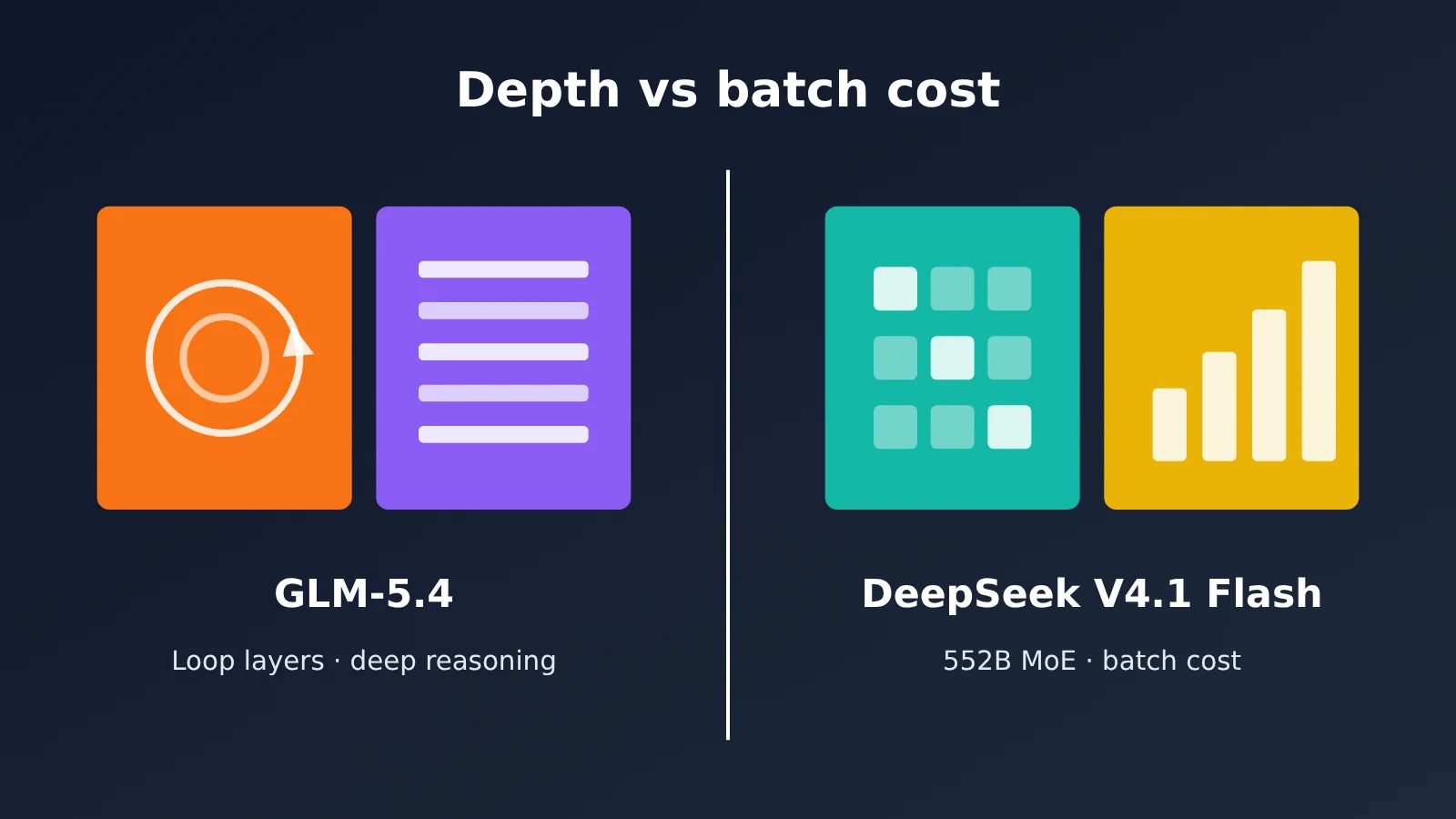
GLM-5.4 and DeepSeek V4.1 Flash: Key Points
Let’s start by putting the basic specs from both sides into one table. Note that GLM-5.4’s specs come from Z.ai’s official docs and DeepSeek V4.1 Flash’s come from its checkpoint notes — both are vendor figures.
| Dimension | GLM-5.4 | DeepSeek V4.1 Flash |
|---|---|---|
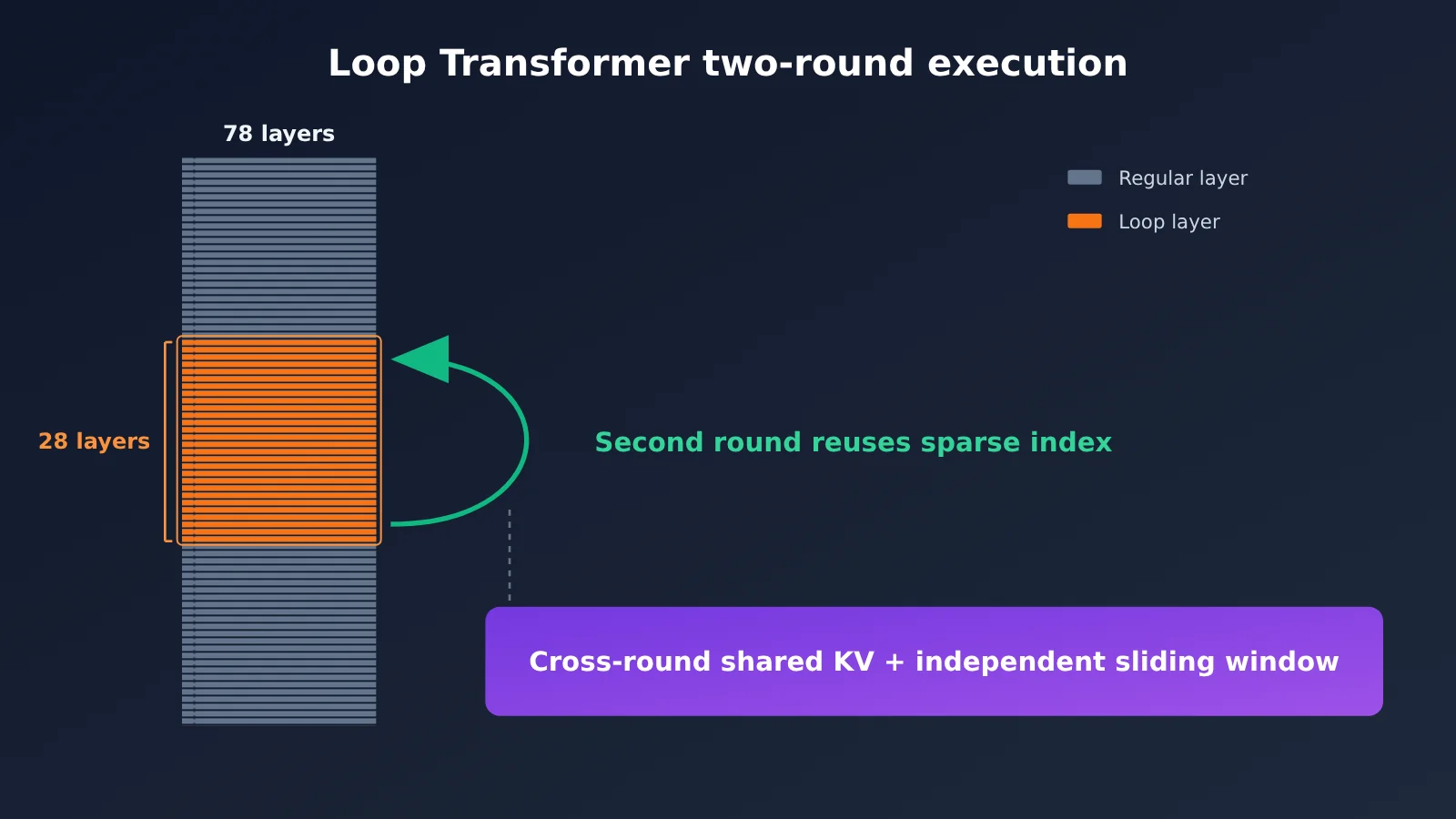
| Architecture | Loop Transformer on a GLM-5 base (750B scale), 28 of 78 layers share weights and loop twice | 552B total-parameter MoE, checkpoint V4.1-Flash-1017 |
| Context / max output | 1M / 128K | 1,024K / 384K (thinking chain capped at 128K) |
| Input modalities | Video, image, text, files | Image understanding + text |
| Tooling | Thinking mode, streaming, function calling, structured output, context caching | Function calling, MCP, prefix continuation, context caching |
| API status | Opens after safety evaluation, no timeline | Live, with official peak/off-peak pricing |
| Token price | Not published | Official off-peak $0.12/$0.48, peak $0.24/$0.96 |
Where GLM-5.4’s “depth” comes from
The core change in GLM-5.4 is turning 28 layers of the base into shared-weight layers that execute two rounds. The parameter count stays the same, but the network is effectively deeper. At 750B scale, the team paired this with three engineering changes: per-token gating with progressive write-back (the first round builds global context, the second refines it), cross-round KV Cache sharing plus an independent sliding window, and reusing the first round’s sparse attention indices in the second round. According to the official description, running one extra round only adds the KV overhead of a single sliding window.
The team also shared a controlled experiment at the same 30B parameter count: only about 10% more training compute, with AIME25 rising from 19.17 to 30.42 and GPQA-Diamond from 47.58 to 56.26. These numbers show that the “looping to add depth” direction works in itself, but it’s a 30B small-model control — not the results of the GLM-5.4 flagship itself. The official claim is that its intelligence level reaches that of 2T–3T parameter models, which is likewise a vendor’s own statement.
Where DeepSeek V4.1 Flash’s “batch” advantage lies
DeepSeek V4.1 Flash’s advantages are pretty simple: the API is already open, the price is low, and there are two peak/off-peak tiers. A 1,024K context paired with 384K max output is great for batch tasks where you “stuff a long chunk of source text in once and spit out a complete structured result in one go,” and prefix continuation plus context caching can further drive down the cost of repeated prefixes.
Its vendor-reported benchmarks are DeepSWE v1.1 at 77.0 and Terminal-Bench 4.0 at 42.3; the third-party Artificial Analysis index gives it 33. These numbers mean it isn’t a model that “can only handle grunt work,” but its positioning clearly leans toward cost-effectiveness rather than extreme depth.
GLM-5.4 vs DeepSeek V4.1 Flash: The Core Differences
Break “depth” and “batch cost” into a few concrete dimensions and the picture gets a lot clearer:
| Dimension | GLM-5.4 | DeepSeek V4.1 Flash | Edge |
|---|---|---|---|
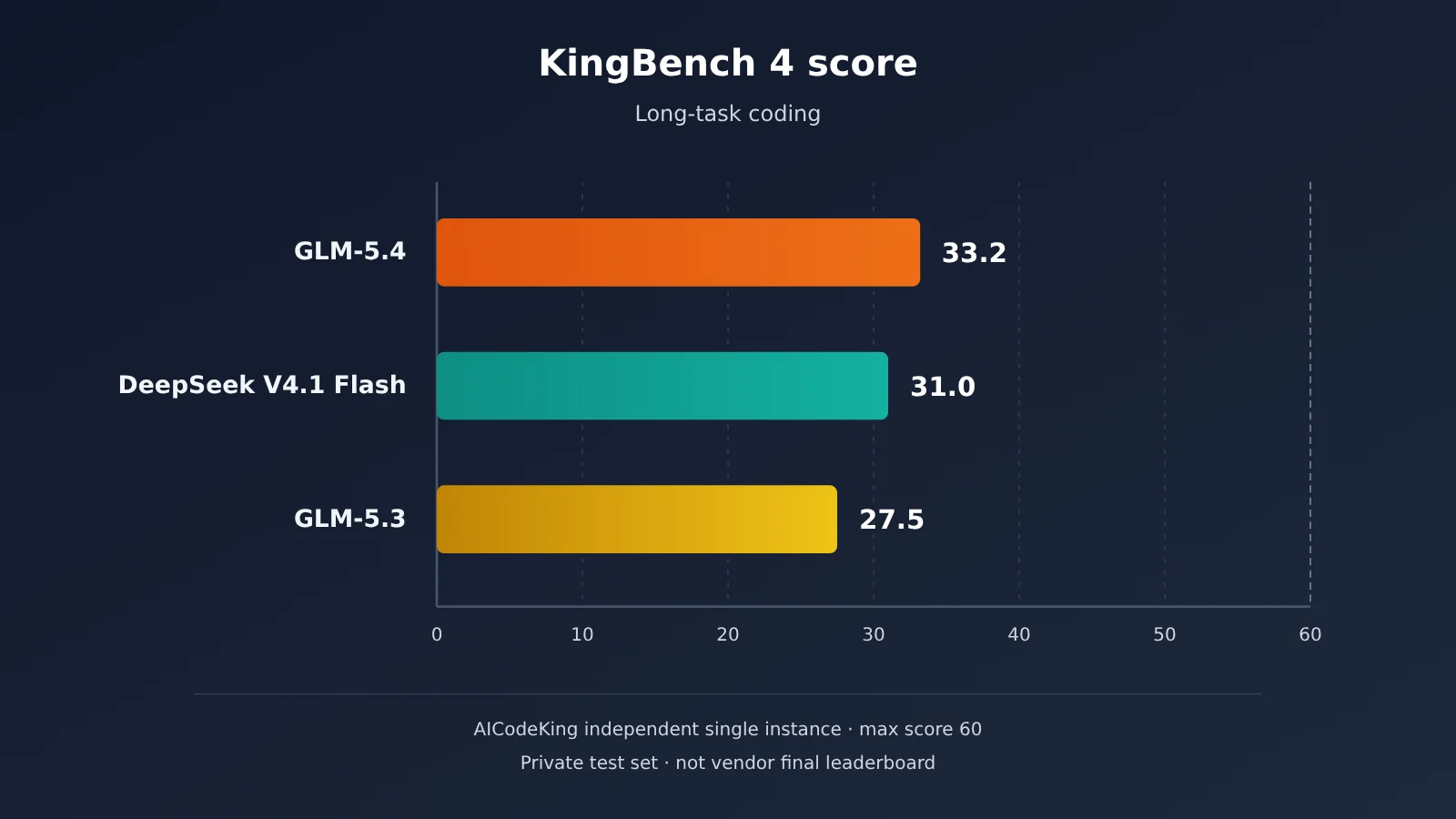
| Long-task coding score (KingBench 4, independent single run) | 33.2 | 31.0 | GLM-5.4 (by 2.2 points) |
| Composite index (Artificial Analysis) | No public score yet | 33 | Not comparable |
| Unit price | No token pricing | From $0.12/$0.48 off-peak | DeepSeek V4.1 Flash |
| Speed | Up to 200 token/s off-peak, 70–80 token/s at peak; long tasks take noticeably longer | No unified throughput published | Depends on the task |
| Vision and general coding | Video/image input; focused on visual coding, 3D, CAD | Image understanding | GLM-5.4 |
| Max output | 128K | 384K | DeepSeek V4.1 Flash |
| Available channels | Coding Plan, ZCode, Z.ai Chat, etc.; API not open yet | Official API, APIYI apiyi.com | DeepSeek V4.1 Flash |
Reading the comparison: keep three kinds of evidence separate
The data from both sides gets mixed together here and is easy to misread, so let’s split it into three tiers by evidence type:
| Evidence tier | What it contains | How to use it |
|---|---|---|
| Vendor self-reported | GLM-5.4: 30B controlled experiments, self-described 2T–3T scale, output length down 10%–14%, “among the leaders” across 200 internal coding scenarios (no scores released), 36.6% win / 30.2% tie / 33.2% loss against DeepSeek-V4.1-Flash-1017; DeepSeek: DeepSWE 77.0, Terminal-Bench 4.0 42.3 | Use as a sense of direction, not as a head-to-head conclusion |
| Third-party independent single run | AICodeKing’s KingBench 4: GLM-5.4 33.2 (7th), DeepSeek V4.1 Flash 31.0; Artificial Analysis: DeepSeek V4.1 Flash 33, GLM-5.3 32 | One evaluator, private test set — a useful signal |
| Unverifiable | GLM-5.4’s SWE-bench, Terminal-Bench, AA index; GLM-5.4 API availability date and token price | Don’t budget based on these |
DeepSeek V4.1 Flash, head-to-head: DeepSeek V4.1 Flash still leads on unit price, max output, and API availability. But on long tasks like KingBench 4 — where one sentence generates a complete app — it scores 2.2 points below GLM-5.4. For batch pipelines that need steady throughput and pay-as-you-go billing, it remains the safer choice.
GLM-5.4, head-to-head: GLM-5.4 has explicit design goals around visual coding and long-chain reasoning for coding, and on KingBench 4 it’s also the highest-scoring open-weight model here (by the evaluator’s reckoning). But it has no token price, its API isn’t open, and the vendor itself admits it tends to get stuck in overly long “marathon thinking” loops. Z.ai’s 36.6% win rate against DeepSeek is self-reported, not an independent conclusion — and its 33.2% loss rate isn’t far off from its win rate.
How to Calculate Batch Costs for GLM-5.4 and DeepSeek V4.1 Flash
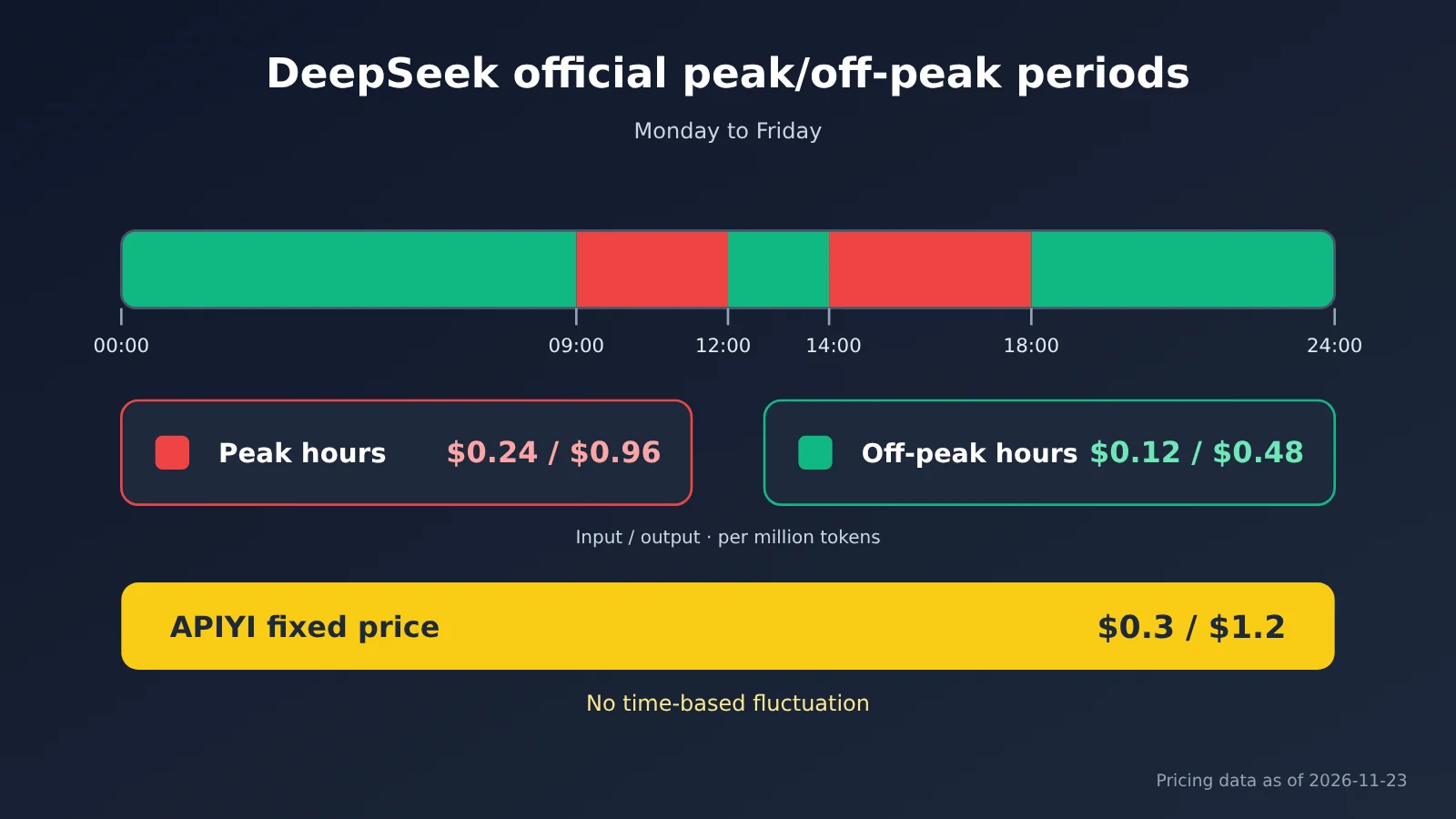
When budgeting a batch job, the key is to keep the three price tiers straight and not lump peak and off-peak rates into a single bucket. DeepSeek’s official peak windows are Monday to Friday 09:00-12:00 and 14:00-18:00 (UTC+8); every other time slot, weekends included, counts as off-peak.
| Channel / Tier | Model ID | Input ($/1M) | Output ($/1M) | Cache read ($/1M) |
|---|---|---|---|---|
| DeepSeek official off-peak | — | $0.12 | $0.48 | $0.002 |
| DeepSeek official peak | — | $0.24 | $0.96 | $0.005 |
| APIYI Standard (single peak-tier price only, no time-of-day fluctuation) | deepseek-v4.1-flash |
$0.3 | $1.2 | $0.006 |
| APIYI Economy (same weights, slower speed) | deepseek-v4-1-flash-economy-261017 |
$0.24 | $0.96 | — |
| GLM previous-generation reference (not the GLM-5.4 price) | glm-5.3 |
$1.4 | $4.396 | $0.259 |
| GLM previous-generation lightweight reference | glm-5.3-flash |
$0.15 | $0.5 | $0.03 |
The APIYI prices above come from the APIYI apiyi.com model price master list, with data dated 2026-11-23 10:23 (UTC+8); glm-5.3 is billed at 0.95× in the ClaudeCode group. GLM-5.4 currently has no published token pricing at all, so the glm-5.3 row here is only a “same-family, previous generation” reference — you can’t use it to project a GLM-5.4 bill.
Cost estimate for one batch job
Say a batch of cleaning tasks consumes 100M input tokens and 20M output tokens (ignoring cache). Converting using the unit prices in the table above:
- DeepSeek official off-peak: $12 + $9.6 = $21.6
- DeepSeek official peak: $24 + $19.2 = $43.2
- APIYI Economy: $24 + $19.2 = $43.2
- APIYI Standard: $30 + $24 = $54
glm-5.3reference: $140 + $87.92 = $227.92
This estimate only tells you the order of magnitude: for the same batch job, every DeepSeek V4.1 Flash tier costs clearly less than the previous-generation GLM flagship reference price. If you can shift your job into off-peak hours and you’re not latency-sensitive, the official off-peak rate is the cheapest; if you’d rather ignore the clock and pay a fixed unit price with a single key, APIYI’s Standard and Economy tiers are less hassle. For pipelines with lots of repeated system prompts, the cache-read price (APIYI Standard at $0.006) will push actual spend down even further.
How to Call DeepSeek V4.1 Flash and the GLM Series
DeepSeek V4.1 Flash can now be called directly through an OpenAI-compatible API. On APIYI, it uses /v1/chat/completions and supports the Default, SVIP, ClaudeCode, and CodexResponses groups. The simplest integration only requires changing three parameters:
- Sign up at APIYI apiyi.com and get an API key; new users receive free trial credits.
- Set the OpenAI SDK’s
base_urltohttps://api.apiyi.com/v1and put your key inapi_key. - Set
modeltodeepseek-v4.1-flash; for offline batch jobs that aren’t latency-sensitive, you can switch todeepseek-v4-1-flash-economy-261017.
For batch scenarios, we recommend adding three more practices: put a fixed system prompt at the very beginning of the messages to improve context cache hits; use function calling or JSON output constraints for structured extraction; and pair very long source texts with the 384K maximum output to get a complete result in one pass, reducing stitching errors caused by splitting.
On the GLM side, GLM-5.4 is currently only available in GLM Coding Plan, ZCode, Z.ai Chat, and some third-party coding tools. GLM-5.4 isn’t listed on APIYI yet, but we’ll make it available as soon as possible. Model versions and pricing are subject to the platform’s model list. For now, you can use glm-5.3 or glm-5.3-flash to set up the GLM branch’s invocation pipeline, prompts, and evaluation scripts. When the new model launches, just change the model parameter to switch.
🚀 Quick start: We recommend first running a small-sample comparison of
deepseek-v4.1-flashandglm-5.3on APIYI apiyi.com with the same key, then locking down the evaluation set and billing basis. Later, when switching models, you’ll only need to change one parameter.
Use-case recommendations: where GLM-5.4 and DeepSeek V4.1 Flash each fit
Scenarios for choosing DeepSeek V4.1 Flash
- Batch extraction: Pulling fields from contracts, tickets, and logs. The workload is large and each item is low-difficulty, so unit cost and a stable API come first.
- Data cleaning and standardization: Format conversion, deduplication, and normalization. These are good candidates to move to off-peak hours or run on the economy tier.
- Batch translation: Long context plus 384K output lets you send in a whole document and get a whole document back, reducing the need to split content into chunks.
- Online pipelines that need a stable SLA: The API is already available and pricing is clear, which makes budgeting and monitoring easier.
Scenarios for choosing GLM-5.4
- Visual coding and visual replication: Give it screenshots or videos and have the model rebuild the UI and write the frontend. This is the direction the official team highlights most.
- 3D shaders and CAD modeling: The official demos include a GLSL shader birdwatching scene and six-axis robotic arm modeling in FreeCAD.
- Coding tasks that need long-chain reasoning: For long tasks like generating a complete app from a single sentence, on KingBench 4 the Max tier scored 33.2 and the High tier 28.8, clearly above Low’s 25.2 and Medium’s 24.1.
- You can tolerate subscription-based access and slowness: On KingBench 4, GLM-5.4 used 1,128 reasoning steps and 431 minutes; in the 180-second short-task probe, High / Max will time out.
When you shouldn’t switch
Teams that already have a stable DeepSeek pipeline shouldn’t switch to a model that doesn’t have an API yet just for 2.2 points on KingBench 4. Those 2.2 points come from a single evaluator’s private test set, while what you get in return is uncertainty: no token pricing, no API timeline, and long tasks that take hours. A more sensible approach is to pilot GLM-5.4 on a small number of high-difficulty coding tasks rather than replace the entire batch pipeline.
Decision Guide: How to Split Work Between Deep Reasoning and Batch Load
| Your situation | What to do | Why |
|---|---|---|
| Batch tasks are the bulk of your workload, and you’re cost-sensitive | DeepSeek V4.1 Flash, moving work to off-peak hours whenever you can | Low unit price, API already live, high output cap |
| You don’t want to babysit time windows and prefer a flat unit price | APIYI deepseek-v4.1-flash or the economy tier |
One price tier only, so billing stays easy to forecast |
| Mostly visual coding, 3D, CAD | Try GLM-5.4 with the Coding Plan | Matches the official design target, but there are no independent benchmarks |
| Long-chain reasoning for coding, and you can afford to wait | Try GLM-5.4’s High / Max tiers | Higher scores on long tasks, but slow |
| You need short-latency responses (within 3 minutes) | DeepSeek V4.1 Flash, or GLM-5.4 Low / Medium | High / Max time out on short-task probes |
| You already have a stable DeepSeek pipeline | Don’t switch — just run a small GLM pilot | A 2.2-point edge isn’t enough to offset the risk of an API that isn’t open yet |
💡 Our recommendation: The safest setup is dual-model routing — DeepSeek V4.1 Flash carries the batch load, while the GLM family tackles the hard problems. Manage both branches through a single OpenAI-compatible endpoint. Then later, whether you add GLM-5.4 or swap in a different model, it’s just one line in the routing table:
model.
FAQ
Q1: What are GLM-5.4 and DeepSeek V4.1 Flash each positioned for?
GLM-5.4 is Z.ai’s first flagship built on the Loop Transformer, aimed at “general-purpose coding” and covering video, games, 3D shaders, and CAD. DeepSeek V4.1 Flash is a 552B total-parameter MoE model positioned around cost-effectiveness, with a 1,024K context window and 384K output, making it well suited to large-scale invocation.
Q2: How much stronger is GLM-5.4 than DeepSeek V4.1 Flash?
The only independent data point you can compare directly is KingBench 4: GLM-5.4 scores 33.2 and DeepSeek V4.1 Flash scores 31.0 — a 2.2-point gap — and that comes from a single evaluator’s private test set. Z.ai’s self-measured 36.6% win / 30.2% tie / 33.2% loss is vendor-reported, not an independent conclusion. GLM-5.4 currently has no public Artificial Analysis score.
Q3: When will GLM-5.4’s API open up? What will it cost?
The official line is that the API will open after the safety evaluation is complete, and the model weights are planned for open-sourcing after security hardening — neither has a timeline. GLM-5.4 has no public token pricing yet; the $1.4 / $4.396 for `glm-5.3` is only a previous-generation reference and shouldn’t be treated as GLM-5.4’s price.
Q4: How do DeepSeek V4.1 Flash’s peak/off-peak prices differ from APIYI’s pricing?
Officially, off-peak is $0.12/$0.48 and peak is $0.24/$0.96, with peak hours being weekdays 09:00–12:00 and 14:00–18:00 (UTC+8). APIYI lists a single tier: Standard at $0.3/$1.2, plus an Economy version at $0.24/$0.96 (same weights, slower), with no fluctuation by time slot.
Q5: How can I call DeepSeek and GLM through one interface right now?
On APIYI apiyi.com, you can use a single API key to call `deepseek-v4.1-flash`, `glm-5.3`, `glm-5.3-flash`, and other models through an OpenAI-compatible API. GLM-5.4 isn’t listed yet — we’ll get it listed as soon as we can; model names and prices are subject to the platform’s model list.
Q6: What’s the tradeoff of using APIYI’s Economy version for batch tasks?
The Economy version `deepseek-v4-1-flash-economy-261017` runs the same weights as Standard; the tradeoff is slower speed. Offline batch processing, overnight data runs, and other tasks that don’t care about per-request latency are a good fit for Economy, while user-facing real-time pipelines should stick with Standard. New users can start with the free quota on APIYI apiyi.com to compare how long the two take on their own tasks.
Q7: What known limitations does GLM-5.4 have?
Z.ai itself acknowledges that GLM-5.4 tends to get stuck in overly long “marathon thinking” loops — repeated reflection often improves accuracy but is very time-consuming. On throughput, it tops out at 200 token/s off-peak but only 70–80 token/s at peak. In KingBench 4 it took 431 minutes, and on short tasks the High / Max tiers can exceed 180 seconds. On top of that, it’s currently only available through subscription products.
GLM-5.4 and DeepSeek V4.1 Flash: Key Takeaways
- Division of labor: Batch extraction, cleaning, and translation go to DeepSeek V4.1 Flash; visual coding and long-chain reasoning coding are worth trying on GLM-5.4.
- Pricing has three tiers: Official off-peak is $0.12/$0.48, peak is $0.24/$0.96, and APIYI is flat at $0.3/$1.2, with an economy tier as well.
- GLM-5.4 has no token pricing: The $1.4/$4.396 for
glm-5.3is just a previous-generation reference. - The independent gap is only 2.2 points: 33.2 vs 31.0 on KingBench 4, and that’s from a single private test set.
- Self-reported win rates aren’t conclusions: Z.ai’s 36.6% win rate against DeepSeek is a vendor self-report.
- Depth comes with a time cost: GLM-5.4 long tasks take hours, so High / Max aren’t suited to short-latency responses.
- Don’t switch pipelines for a score: If you already have a stable DeepSeek pipeline, run only a small-scope GLM pilot.
Summary
GLM-5.4 and DeepSeek V4.1 Flash aren’t about “which one replaces the other”:
- For batch cost, look to DeepSeek V4.1 Flash: The API is already live, the unit price is low, and the output cap is 384K. You can choose between peak/off-peak pricing and flat pricing depending on the task.
- For deep tasks, try GLM-5.4: Visual coding, 3D, CAD, and long-chain reasoning coding are its design direction, but you’ll need to accept subscription pricing, slower speed, and the lack of independent benchmarks.
- Look at data in layers: Don’t mix vendor self-reports, third-party one-offs, and unverifiable numbers into one decision.
A practical way to roll this out is to use DeepSeek V4.1 Flash for the batch pipeline now, while setting up the GLM branch’s evaluation framework with glm-5.3. We recommend running both branches through APIYI at apiyi.com with the same API key. Once GLM-5.4 launches, you can compare them by changing just one model parameter.
📚 References
-
Z.ai Official Technical Blog: GLM-5.4’s Loop Transformer design and the 30B comparison experiment
- Link:
z.ai/blog/glm-5.4 - Note: Source for architecture details, the official self-reported win rate, and the model’s own stated limitations
- Link:
-
Z.ai Official Model Docs: GLM-5.4 specification
- Link:
docs.z.ai/guides/llm/glm-5.4 - Note: Context, max output, input modalities, and throughput figures
- Link:
-
Zhipu Chinese Docs: GLM-5.4 model introduction
- Link:
docs.bigmodel.cn/cn/guide/models/glm-5.4 - Note: Official description of the internal evaluation across 200 coding scenarios (scores not published)
- Link:
-
Artificial Analysis: Intelligence Index v5.0.1
- Link:
artificialanalysis.ai - Note: Third-party composite index for DeepSeek V4.1 Flash and GLM-5.3
- Link:
Author: APIYI Technical Team
Technical inquiries: Feel free to reach out to us via the APIYI homepage — model versions and the latest pricing are available in the docs.apiyi.com documentation center