Author’s note: Anthropic’s official materials describe Claude Fable 5.2 fast mode as the same model, with output up to about 2.5x faster at twice the standard price. This article puts the official pricing and APIYI’s 2026-11-11 price list side by side, so you can decide whether it’s worth turning on.
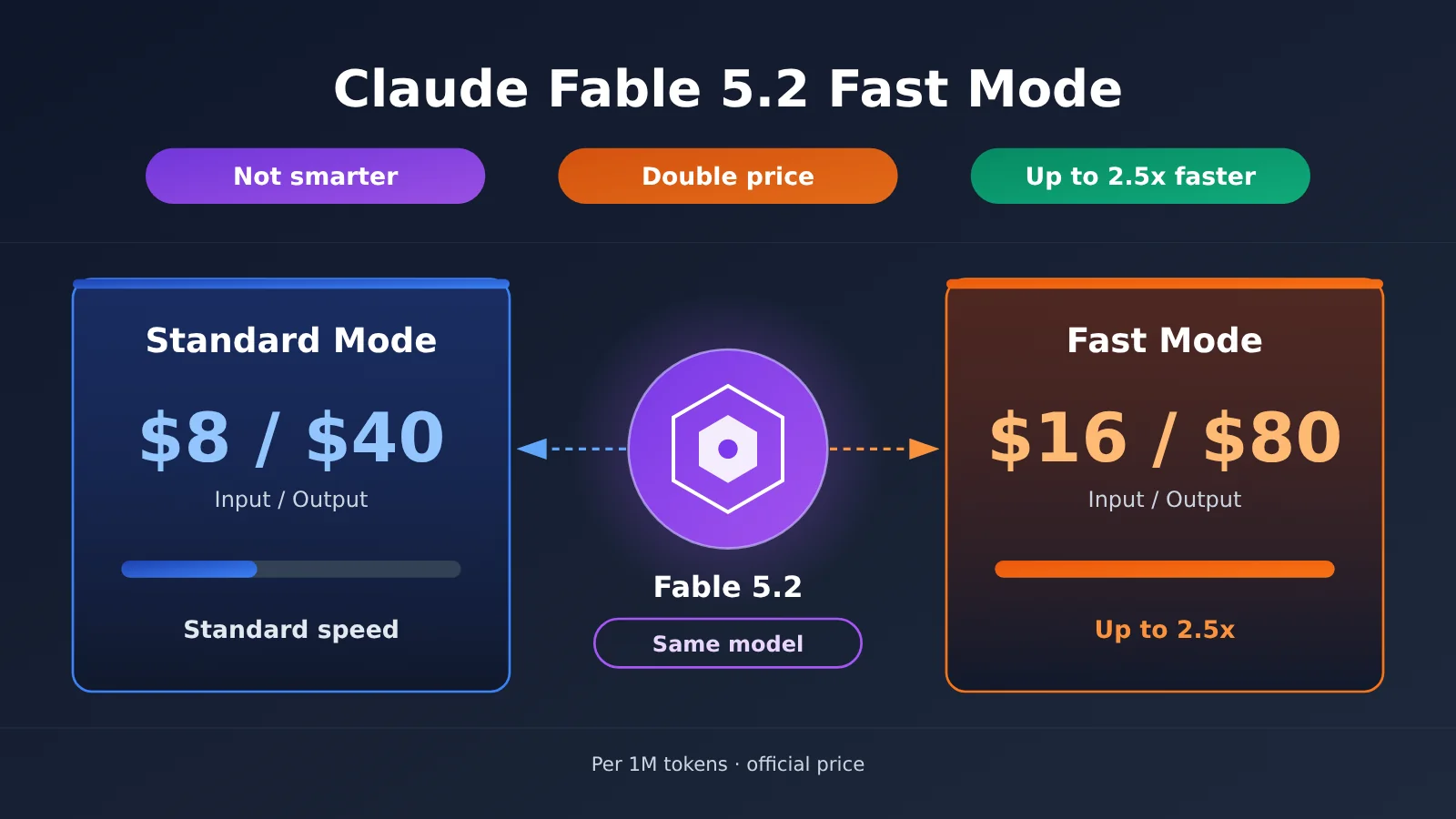
In its 2026-11-09 release post, Anthropic launched Claude Fable 5.2 along with an optional fast mode. The core of fast mode is token generation up to 2.5x faster, with pricing doubled to $16 per million input tokens and $80 per million output tokens. Many developers’ first reaction is “twice the price must mean a stronger model,” but the official post never says that.
The short version: Fable fast mode isn’t smarter. It’s the same model on a faster output lane. The data in this article comes from two kinds of sources. Pricing and speed are the official, self-reported figures from Anthropic’s release post. Platform pricing comes from the APIYI (apiyi.com) model price list as of 2026-11-11. I keep the two separate and don’t mix them.
What you’ll get: In 3 minutes, you’ll know what Fable 5.2 fast mode changes, what it doesn’t, and which scenarios justify paying double.
Fable Fast Mode: Key Facts at a Glance
Let’s start with everything we can confirm from the release post and the platform’s price list, all in one table. All prices are per 1M tokens, with data as of 2026-11-11.
| Item | Details | Source |
|---|---|---|
| Release date | 2026-11-09 | Anthropic release post |
| Publisher | Anthropic | Official |
| Standard mode official price | Input $8, output $40 | Self-reported by Anthropic |
| Fast mode official price | Input $16, output $80, i.e. 2x the standard price | Self-reported by Anthropic |
| Fast mode speed | Up to 2.5x faster token generation | Self-reported by Anthropic |
| Is it smarter? | Anthropic doesn’t claim fast mode is smarter | Official release post |
| Platform price list | claude-fable-5-2 input $8, output $40, cache read $0.2 |
APIYI apiyi.com model price table |
What Does Fable 5.2 Fast Mode Actually Change?
Going by the release post, fast mode changes only two things: output speed and price. On speed, token generation can reach up to 2.5x that of standard mode. On price, both input and output rates are exactly doubled. The words “up to” matter here: they describe a ceiling, and the actual speedup will vary with the request and the output length.
The release post says nothing about fast mode improving reasoning ability, accuracy, or context length. In other words, you should expect the same answer quality from fast mode as from standard mode, since it’s the same Fable 5.2. Paying twice as much buys you shorter wait times, not a higher tier of intelligence.
Fable 5.2 Standard Mode Is Already Faster and Cheaper
One easily overlooked point: Fable 5.2’s standard mode is already an improvement over the previous generation. Anthropic reports that Fable 5.1 was priced at $10 for input and $50 for output, while the 5.2 standard price drops to $8 for input and $40 for output. Anthropic also reports that 5.2 generates tokens up to 30% faster than 5.1.
So if you’re upgrading a project from Fable 5.1, you get both a price cut and a speedup without turning on fast mode at all. Whether it’s worth paying double on top of that for up to 2.5x faster output depends on whether your workload is really bottlenecked by waiting time.
Fable Fast Mode Pricing: Official Prices vs. Platform Prices
The table below puts several sets of prices side by side, but check the source column: these numbers don’t all come from the same basis. Official prices are the list prices from Anthropic’s announcement posts. Platform prices are the numbers on APIYI’s model list. Third-party compilations are for reference only.
| Item | Input (per 1M tokens) | Output (per 1M tokens) | Cache read | Source and date |
|---|---|---|---|---|
| Fable 5.1 Standard | $10 | $50 | Not listed | Official, self-reported |
| Fable 5.2 Standard | $8 | $40 | Not listed | Official, self-reported, 2026-11-09 |
| Fable 5.2 Fast Mode | $16 | $80 | Not listed | Official, self-reported, 2026-11-09 |
| Fable 5.2 Batch | $4 | $20 | Not listed | Third-party compilation by Apidog, 2026-11-10 |
claude-fable-5-2 |
$8 | $40 | $0.2 | APIYI model list, 2026-11-11 |
claude-fable-5-2-thinking |
$8 | $40 | $0.2 | APIYI model list, 2026-11-11 |
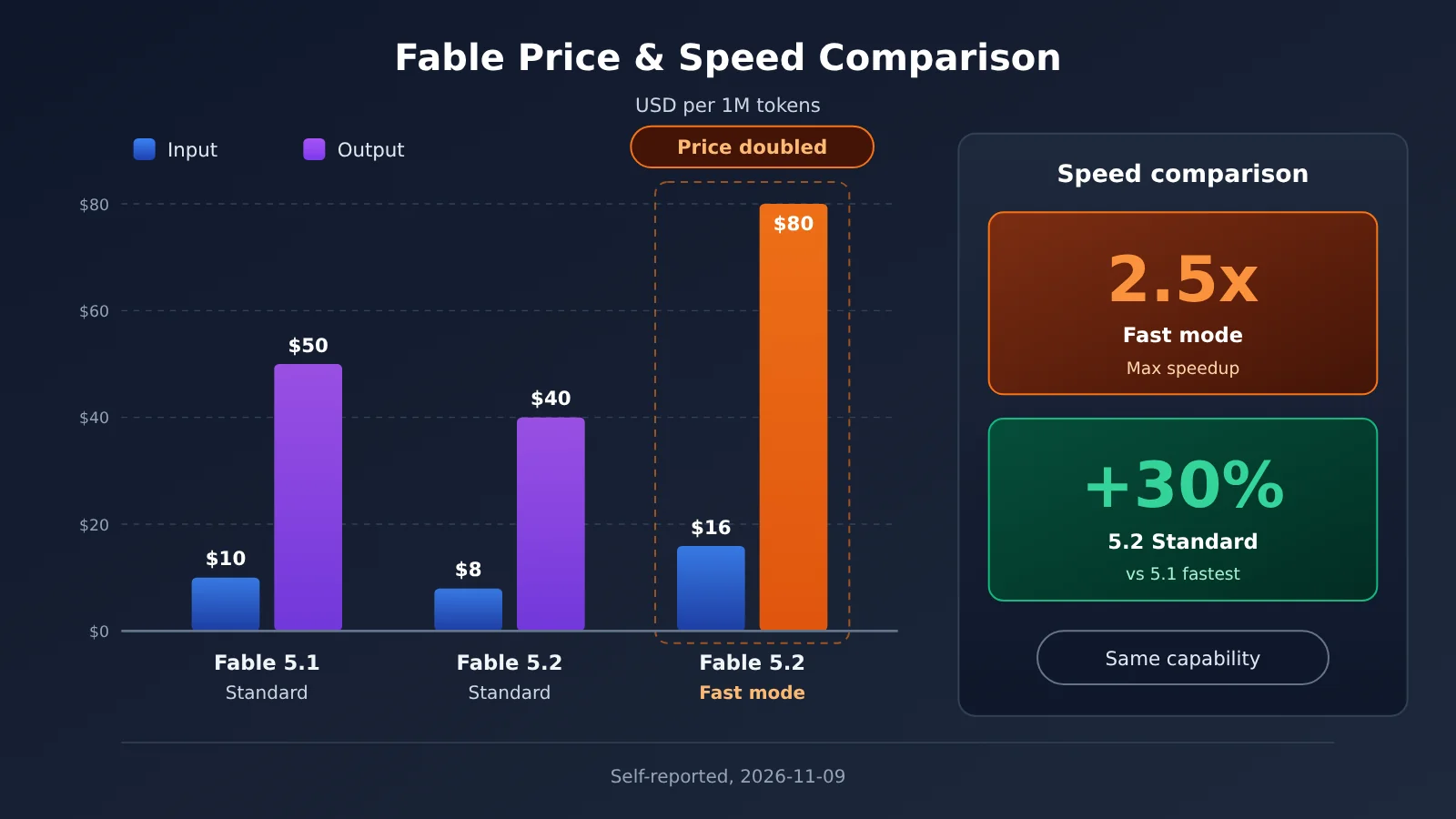
Chart note: Both the prices and the speeds in the chart are self-reported by Anthropic. To check the platform-side models and unit prices, see the APIYI (apiyi.com) model list, with data dated 2026-11-11.
Three Things to Watch For with Fable 5.2 Pricing
- The platform price list has no separate fast row: In the APIYI model list as of 2026-11-11, both
claude-fable-5-2andclaude-fable-5-2-thinkingare listed at $8 input, $40 output, and $0.2 cache read. There’s no dedicated fast mode model entry. Don’t assume the official fast mode price of $16 / $80 is what the platform actually charges. - The thinking version costs the same: On the platform’s price list,
claude-fable-5-2-thinkingis priced the same as the standard version, so whether to use thinking mostly comes down to whether your task needs a longer reasoning process. - Batch pricing is a third-party compilation: Apidog’s 2026-11-10 write-up puts Batch pricing at $4 input and $20 output, and mentions that Batch can’t be used together with fast mode. This figure isn’t on the APIYI price list, so it doesn’t mean the platform offers half-price batch processing.
Why Fable’s Fast Mode Isn’t Any Smarter
“You get what you pay for” is a natural instinct, especially with model tiers, since many vendors charge more for a bigger model or a stronger reasoning level. Fable 5.2’s fast mode isn’t one of those cases. The release post positions it as an optional speed setting, focuses on generation speed and price, and never claims any capability improvement.
So when you evaluate fast mode, look only at latency and throughput. If you run the same set of eval questions through standard mode and fast mode, you shouldn’t expect any systematic difference in accuracy, based on the official positioning. What does change is the time to first token, the time to finish the full output, and the unit price on your bill, which doubles.
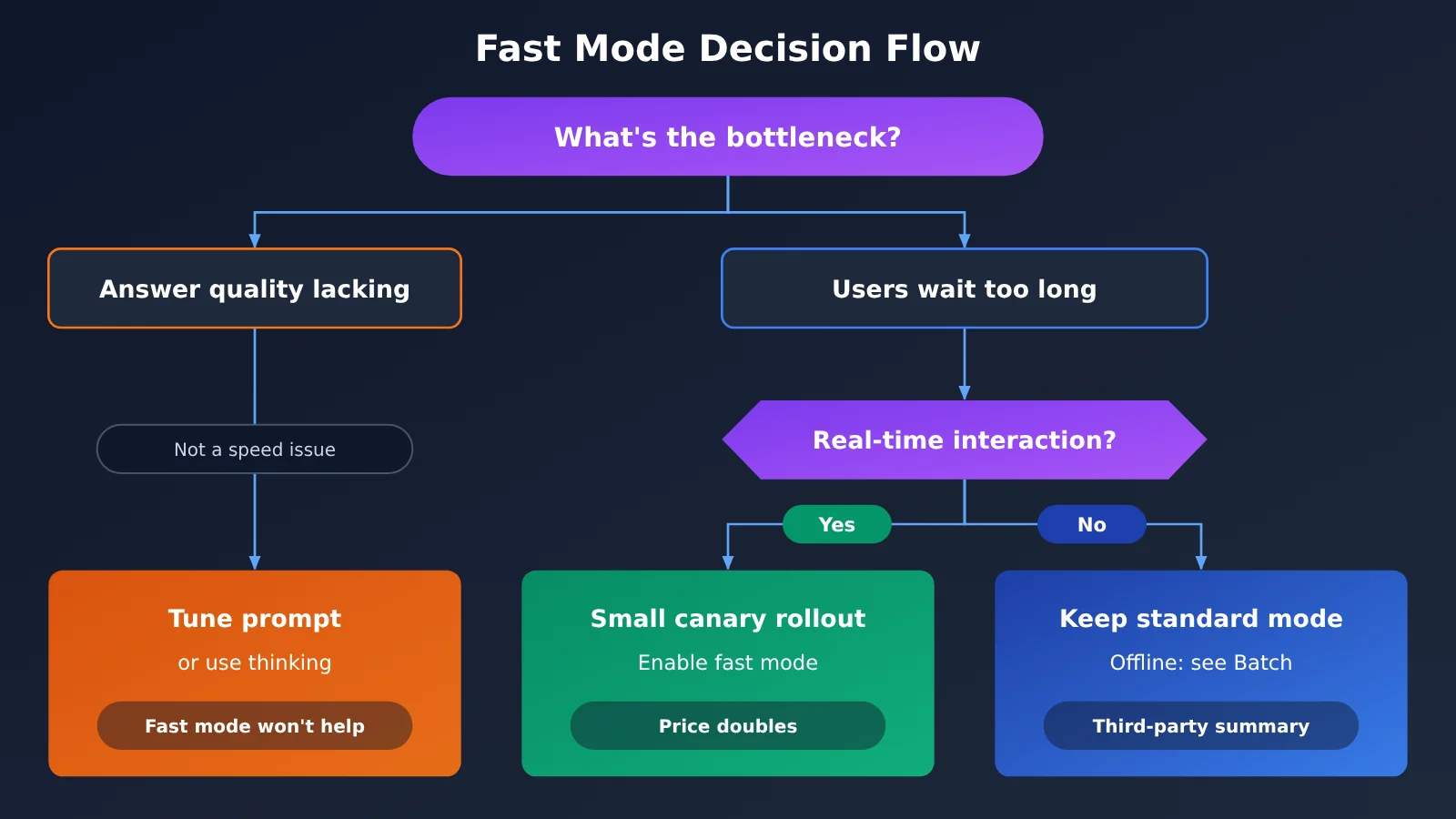
When Fable Fast Mode Makes Sense (and When It Doesn’t)
Given the three things we know (same model, faster, double the price), we can sort common scenarios into rough buckets. The table below is only a decision aid. Whether to turn it on still depends on your latency targets and budget.
| Scenario | Use fast mode? | Why |
|---|---|---|
| Real-time user-facing chat, customer support | Worth considering | Wait time directly affects the experience, so the speedup is noticeable |
| In-IDE code completion, long code generation | Worth considering | Long outputs and frequent interaction mean a clear speed payoff |
| Offline batch processing, report generation | Not recommended | Nobody’s waiting on the result, so double the price buys you nothing |
| Answer quality falls short | Not recommended | Fast mode doesn’t improve capability; tune your prompt or switch to a thinking model |
| Cost-sensitive, high-volume calls | Not recommended | The unit price doubles, so cost pressure scales linearly with usage |
Impact Analysis of Fable Fast Mode
Impact on Developers
- Clearer model selection logic: Fable 5.2 splits “capability” and “speed” into two independent dimensions. For capability, choose between
claude-fable-5-2andclaude-fable-5-2-thinking. Only consider fast mode when you have a speed problem. - Latency budget can be bought separately: In the past, cutting latency usually meant switching to a smaller model and accepting weaker capability. Fast mode gives you an option that doesn’t reduce capability and only costs more.
- Bills need itemized monitoring: If you mix standard and fast mode in the same project, we recommend tracking usage by mode. Otherwise it’s hard to tell whether the doubled spend is actually buying a better experience.
Impact on Cost Budgets
Fast mode pricing is straightforward: for the same number of tokens, you pay twice the standard-mode price. The longer the output, the more noticeable the gap, since the output price is already five times the input price. For a project that mainly generates long-form text, switching everything to fast mode means your overall model spend nearly doubles.
A safer approach is to enable it only at the entry points that are truly latency-sensitive, such as a user’s first question or real-time editor completions, and keep background summarization and batch-style tasks on standard mode. Fable 5.2’s standard mode is already self-reported by the vendor as up to 30% faster than the fastest 5.1, so many scenarios don’t need fast mode stacked on top.
Impact on Model Selection
In many teams’ evaluation workflows, “speed” and “intelligence” are often merged into a single score. Fable 5.2 fast mode is a reminder to score them separately: the same model can have two response speeds, while capability evaluation results should be shared. When evaluating, you only need to run the quality benchmarks once on standard mode, then measure latency separately for fast mode. There’s no need to rerun the full capability test suite.
Checking Fable 5.2 Models and Pricing on APIYI
If you plan to call Fable 5.2 through the OpenAI-compatible interface, use the checklist below to confirm the key parameters. As requested, this section has no code blocks, so every parameter is listed inline.
- Endpoint base_url:
https://api.apiyi.com/v1 - Standard model ID:
claude-fable-5-2 - Thinking model ID:
claude-fable-5-2-thinking - Platform pricing (2026-11-11): both models are $8 input, $40 output, and $0.2 cache read, per 1M tokens
- Fast mode: the platform’s model list has no separate fast model row, so check the documentation center to confirm whether it’s supported before you use it
🎯 Technical tip: Before deciding whether to enable fast mode for Fable 5.2, run the standard
claude-fable-5-2through the unified API at apiyi.com (APIYI) first. Record the current latency and output quality as a baseline, then decide whether speed is really your bottleneck. New users get free test credits, which are handy for small-scale comparisons like this.
Common Fable 5.2 Invocation Issues
When something goes wrong during model invocation, it usually comes down to the model name, how pricing is quoted, or the mode combination. The table below lists a few common symptoms and where to look first.
| Symptom | Likely cause | What to check |
|---|---|---|
| “Model does not exist” error | Typo in the model ID, or a nonexistent fast suffix | Check the spelling of claude-fable-5-2 against the model list on apiyi.com |
| Can’t find a fast mode model | The platform pricing has no separate fast row | Go by the model list and the documentation center, and don’t make up model names yourself |
| Billed unit price doesn’t match the official fast mode price | The official $16 / $80 was mistaken for the platform’s charge | Check platform pricing against the 2026-11-11 model list, and look at official pricing separately |
| Batch and fast mode enabled together has no effect | Third-party write-ups say the two can’t be used together | Handle offline and real-time jobs separately, and don’t stack the two modes |
| Quality falls short even with fast mode on | Fast mode doesn’t improve capability | Rework your prompt, or switch to claude-fable-5-2-thinking |
Frequently Asked Questions (FAQ)
Q1: What is Fable fast mode?
It’s an optional mode for Claude Fable 5.2, announced by Anthropic in its release post on 2026-11-09. Anthropic self-reports that token generation can be up to 2.5x faster than standard mode. It’s priced at $16 for input and $80 for output, which is twice the standard price. Anthropic doesn’t claim it makes the model any smarter.
Q2: Is there a difference in answer quality between Fable fast mode and standard mode?
According to the official documentation, they’re the same model. Fast mode only changes output speed and price. If you’re running into answer quality problems, turning on fast mode won’t help. You’re better off adjusting your prompt or switching to `claude-fable-5-2-thinking`.
Q3: What changed in Fable 5.2 compared with 5.1?
Anthropic self-reports that Fable 5.2’s standard price is $8 for input and $40 for output, down from 5.1’s $10 / $50. Generation speed is up to 30% faster than 5.1. In other words, even without fast mode, upgrading to 5.2 already gets you both a price cut and a speed boost.
Q4: If I call Fable 5.2 through APIYI, am I billed at the fast mode price?
No, that’s not the right way to read it. According to the model price table on APIYI (apiyi.com) dated 2026-11-11, both `claude-fable-5-2` and `claude-fable-5-2-thinking` are listed at $8 for input, $40 for output, and $0.2 for cache reads. The table has no separate fast model row. The $16 / $80 fast mode price is Anthropic’s official list price, so keep it separate from the platform’s pricing.
Q5: How can I quickly call Fable 5.2 for a side-by-side test?
Sign up for an account on APIYI and get your API key. Set the base_url to `https://api.apiyi.com/v1` and the model to `claude-fable-5-2`. Record your latency and quality baseline in standard mode first, then decide whether you need fast mode based on your application’s latency targets.
Q6: What are the limitations of Fable fast mode?
– **Cost:** The unit price is twice that of standard mode, and the longer the output, the bigger the difference.
– **Speed claims:** Anthropic says “up to 2.5x faster,” so actual speedup will vary from request to request.
– **Mode combinations:** A third-party write-up from Apidog on 2026-11-10 says Batch can’t be used together with fast mode. Treat that claim as unconfirmed and check the official documentation.
Fable Fast Mode: Key Takeaways
- Same model: Fable fast mode only speeds things up. It doesn’t make the model smarter, and the official docs don’t claim it does.
- Double the price: Official fast mode pricing is $16 input / $80 output, twice the standard rate.
- Up to 2.5x faster: Token generation speed tops out at 2.5x standard mode, per the official (self-reported) figures.
- Standard version upgraded: Version 5.2 is priced at $8 / $40 at the standard tier, and officially claims to be up to 30% faster than 5.1 (self-reported).
- Check platform pricing separately: In APIYI’s 2026-11-11 price list, both Fable 5.2 variants are $8 / $40, with a cache read price of $0.2.
- Batch is for reference only: The $4 / $20 figure comes from third-party compilations, not the platform price list, and it can’t be stacked with fast mode.
Summary
Here are the key points about Fable fast mode in three sentences:
- Same capability: Fast mode is the same Fable 5.2, so you can expect the same answer quality as standard mode.
- Double the price: The official price goes from $8 input / $40 output to $16 input / $80 output.
- Up to 2.5x faster: It’s a good fit for real-time interaction and long outputs where a user is waiting. For offline tasks, there’s no reason to turn it on.
To decide whether fast mode is worth it, start by asking: “Is my bottleneck speed or quality?” If it’s quality, change your prompt or switch to a thinking version. If it’s speed, consider rolling it out gradually, and only at the key entry points.
We’d suggest first running a baseline in standard mode with claude-fable-5-2 through the unified interface at APIYI (apiyi.com). Use the 2026-11-11 platform price list to estimate costs, and then decide whether the speedup is worth it.
📚 References
- Anthropic announcement: Claude Fable and Mythos 5.2 release notes, 2026-11-09
- Link:
anthropic.com/claude-fable-and-mythos-5-2 -
Description: Official self-reported source for standard pricing, fast mode pricing, and speed
-
APIYI model master list: Platform model IDs and pricing, 2026-11-11
- Link:
docs.apiyi.com/models -
Description: Input, output, and cache read prices for
claude-fable-5-2andclaude-fable-5-2-thinking -
Apidog third-party roundup: Fable 5.2 Batch pricing and usage limits, 2026-11-10
- Link:
apidog.com - Description: Batch pricing comes from a third-party roundup and is for reference only. Defer to the official docs
Author: APIYI Technical Team
Technical discussion: Feel free to reach out to us on the APIYI homepage. For more models and pricing details, visit the docs.apiyi.com documentation center