Author’s note: This article starts with seven key numbers from Anthropic’s IPO prospectus to answer the question developers care about most: will Claude get more expensive, and what risks should you watch out for next?
Bottom line first: Anthropic’s prospectus shows that Claude’s per-task cost keeps falling, so a broad price hike looks unlikely. But the filing also spells out three things: compute unit prices are higher in the near term, usage limits and rate limiting may be adjusted, and older models may be retired faster. So for teams using the Claude API, the real risk is one day suddenly being unable to make a call at all, or being forced to migrate — not a pricier rate card.
On October 26, 2026, Anthropic, PBC filed an S-1 registration statement with the U.S. SEC to list on the Nasdaq Global Select Market under the ticker symbol ANT. The official press release states that the number of shares to be offered and the price range have not yet been determined. This is not a rumor — every number cited below is sourced: directly from the filing, calculated by media outlets, or estimated by analysts.
The value here: this isn’t about how to buy the stock. It’s about what the numbers in the filing mean for developers in China who are using Claude now, or planning to.
A Quick Look at 7 Key Numbers from Anthropic’s Prospectus
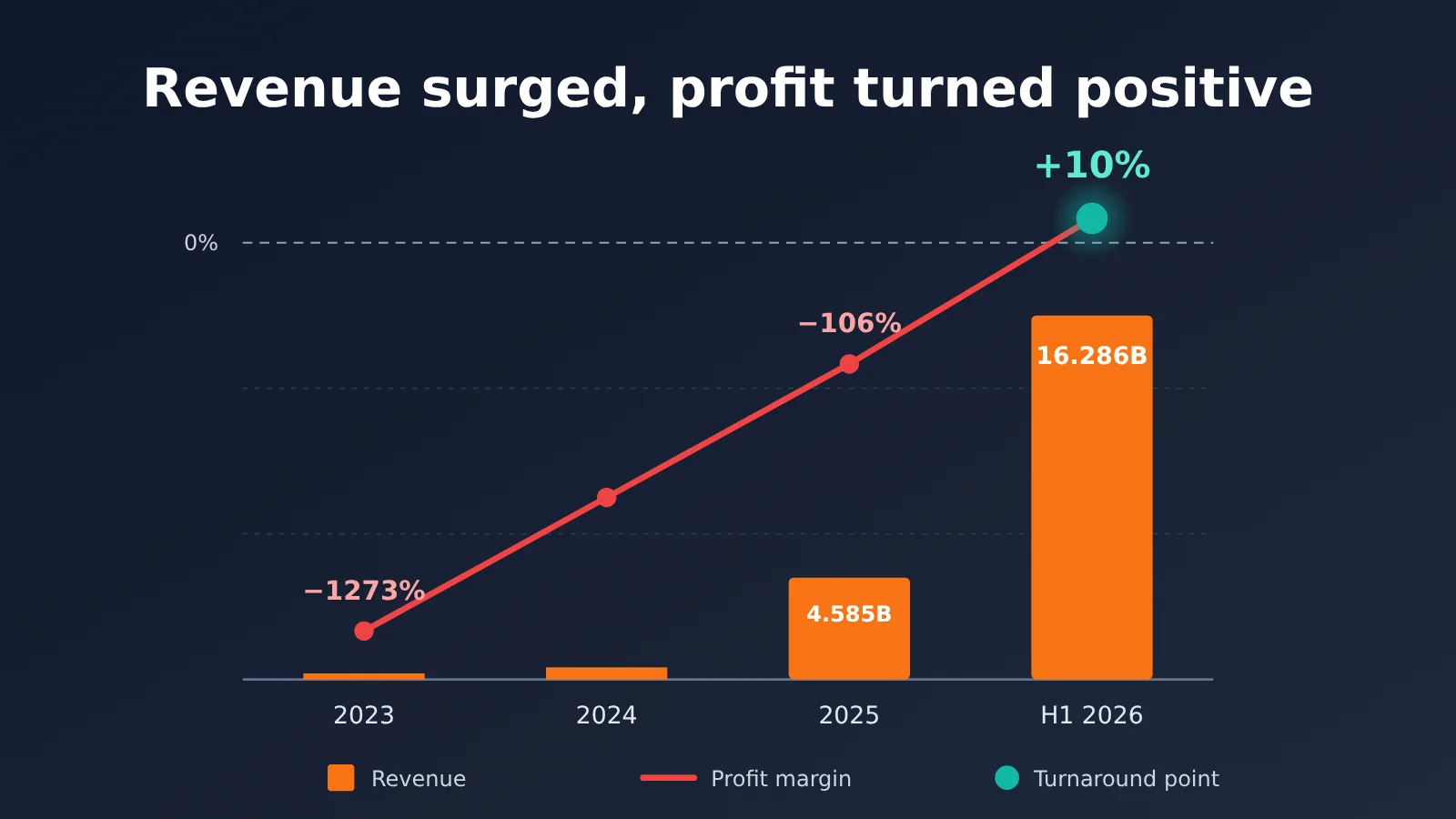
One-line takeaway: revenue is climbing, profit just turned positive, and per-task costs are falling. Put those three together and “across-the-board price hikes” don’t have much of a case.
The table below covers the 7 numbers that matter most to Claude users, all pulled straight from the prospectus:
| # | Key Number | What It Means | Source |
|---|---|---|---|
| 1 | H1 2026 revenue of $16.286 billion | Same period last year was just $1.163 billion | Prospectus |
| 2 | Net revenue retention around 900% | Existing customers spent roughly 9x what they spent last year (excluding individual subscriptions) | Prospectus |
| 3 | Adjusted operating margin +10% in H1 2026 | It was −106% in 2025 | Prospectus |
| 4 | Opus 5.5 per-task cost down about 40% | Versus Opus 5, driven by “price cuts plus efficiency gains” | Prospectus |
| 5 | New models drive over 80% of revenue | Versions released in the past six months account for more than 80% of Q3 revenue | Prospectus |
| 6 | Cloud provider channels account for 48% of revenue | Sold through AWS, Google Cloud, Azure, and other marketplaces | Prospectus |
| 7 | About 5%–7% of revenue comes from violating customers | Found to have breached usage policies or commercial terms; access has been restricted or terminated | Prospectus |
These 7 numbers fall into three groups. 1–3 show the business is getting healthier, so there’s little financial pressure to raise prices. 4–5 show Anthropic is mainly driving usage through new models and lower per-task costs. 6–7 tie directly to access channels and account security, which we’ll dig into in Section 4.
Claude’s revenue is growing fast — thanks to usage and new models
The one-line takeaway: Claude’s revenue growth comes mainly from people using it more, not from charging more.
| Period | Revenue (USD) | Source |
|---|---|---|
| 2023 | $41 million | Prospectus |
| 2024 | $386 million | Prospectus |
| 2025 | $4.585 billion | Prospectus |
| H1 2025 | $1.163 billion | Prospectus |
| H1 2026 | $16.286 billion | Prospectus |
| Q3 2026 | ~$16.9 billion | Derived from “86x the $197 million in Q4 2024” |
The prospectus states that Q2 2026 revenue grew 1368% year over year, roughly 13.7x. The exact Q3 figure is still blank in the filing — all it gives is the multiple, “86x Q4 2024.” Some analysts estimate that puts Q3 at around $16.9 billion, up about 46% quarter over quarter, suggesting growth is starting to slow.
The usage logic behind Claude’s revenue
The prospectus explains that revenue is billed primarily by usage, and most of it isn’t locked into long-term contracts — customers can cut usage anytime if budgets tighten. As of June 30, 2026, remaining performance obligations (RPO) stood at $10.8 billion, with roughly 75% expected to be recognized over the next 12 months. Some analysts note that against a Q2 annualized revenue run rate of about $46 billion, RPO covers less than 20% — meaning next year’s revenue basically depends on how much customers use it next year.
That’s good news for developers. A company that makes money mainly from usage has every reason to fear customers bailing because it’s too expensive, so it’s more inclined to trade price cuts and efficiency gains for more API calls. The prospectus offers an example: after Opus 4.5 launched in November 2025 with stronger capabilities at a lower price, quarterly QoQ revenue growth jumped from 48% to 132%.
The customer base is also becoming more diversified. Over the past 12 months, more than 11,900 customers spent over $100K, more than 1,900 spent over $1M, and about 250 spent over $10M. In Q3, roughly 79% of revenue came from outside the top five customers, compared with about 64% in Q1. Another data point worth noting for teams that write code: the top 5% of Enterprise users who adopted Claude Code spent about 20x what non-Claude-Code users did. Coding agents are already the main source of Claude usage.
Anthropic’s profits turn positive for the first time — but mind the accounting basis
Bottom line: the adjusted figures are already profitable, while GAAP is still just short. Compute costs remain the biggest expense, and they’re the root cause of the near-term cash strain.
| Period | Adjusted operating margin (Non-GAAP) | GAAP operating margin |
|---|---|---|
| 2023 | −1273% | −1344% |
| 2024 | −722% | −772% |
| 2025 | −106% | −176% |
| H1 2026 | +10% | −4% |
The data above comes directly from the S-1 filing. Q2 2026 was the first profitable quarter: GAAP operating margin of 8% for the quarter, adjusted operating margin of 19%, and adjusted operating profit of $2.2 billion. By Fortune’s calculations, adjusted operating profit for the first half was about $1.6 billion, with a GAAP operating loss of $693 million — versus a $2.1 billion loss in the same period last year. The $80.7 billion net loss for the first half reported by TechCrunch comes mainly from non-cash accounting adjustments related to convertible notes, and doesn’t mean the business itself is bleeding money at scale.
Gross margin also depends on which basis you use. CNBC calculated an implied gross margin of about 85% based on $2.38 billion in cost of revenue for the first half, up from roughly 12% a year earlier. Some analysts think that number is inflated, for two reasons: cloud provider commissions and inference costs for free users aren’t counted in cost of revenue, while compute for training and research gets booked under R&D expenses.
Anthropic’s compute costs and “hundreds of billions” in commitments
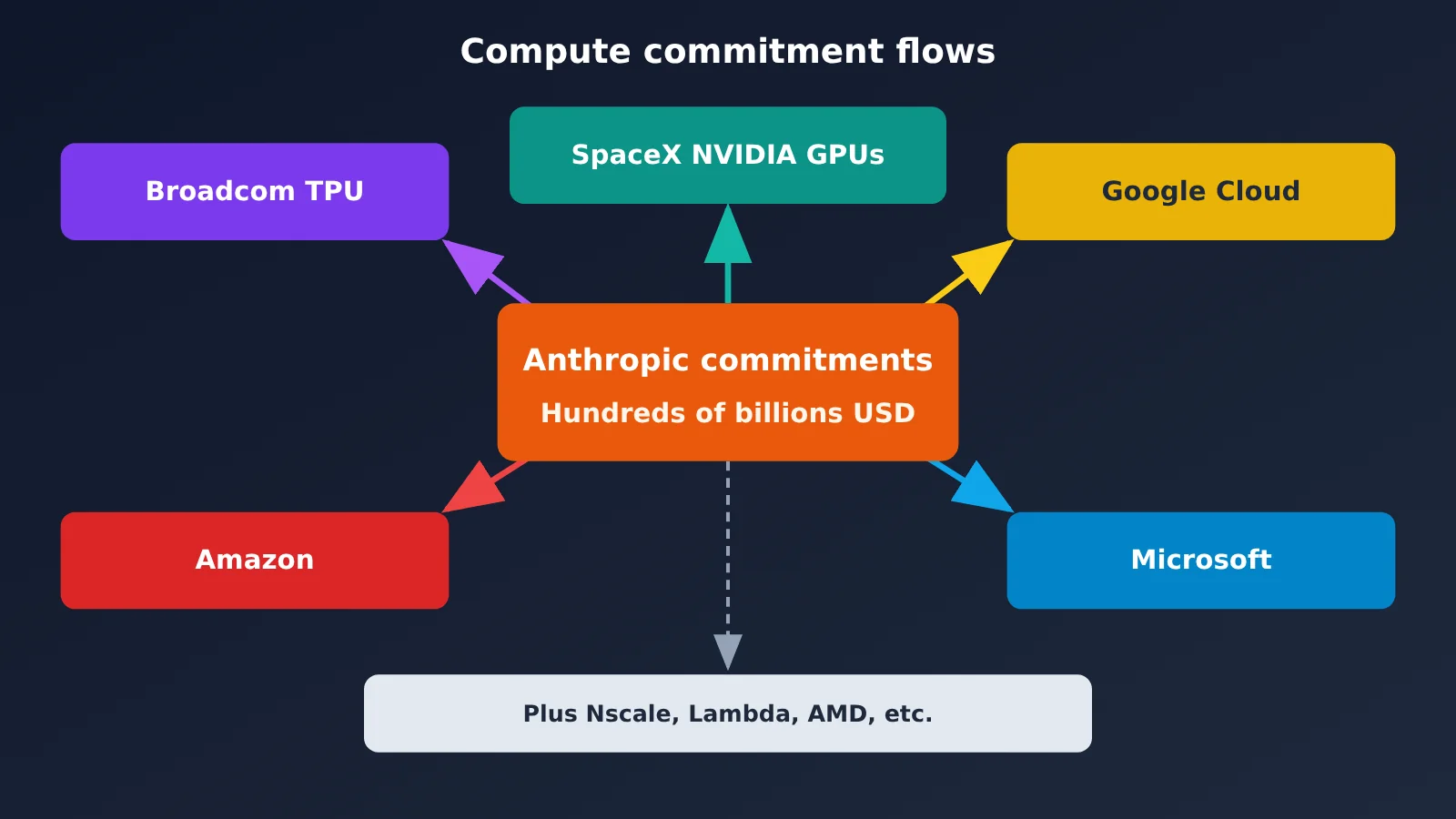
The S-1 lists H1 2026 expenses: $8.945 billion for compute and infrastructure, $3.152 billion for personnel, $3.168 billion for sales, marketing, and partnerships, and $1.714 billion for other operating and administrative costs — compute is the single largest expense. Most of that compute is locked in through multi-year contracts signed 12–18 months in advance, and many carry substantial “take-or-pay” clauses: you pay whether you use it or not. The total commitments line in the S-1 is still blank, but by Fortune’s and other outlets’ estimates it runs into the hundreds of billions of dollars.
The major contracts Motley Fool lists include Broadcom’s TPU, Nvidia GPUs under SpaceX, Google Cloud, Amazon, and Microsoft — each in the tens of billions to over a hundred billion dollars. CNBC reports that Anthropic also signed long-term contracts with SpaceXAI, Nscale, and Lambda to secure Nvidia chips, and may purchase more than $20 billion in AMD chips.
The other side of this section is that there’s plenty of money in the bank. As of June 30, 2026, cash and equivalents stood at $112.4 billion, short-term investments at $19.3 billion, and cumulative funding raised at $141.1 billion. Efficiency is improving too: by September 2026, more than 90% of contributions to the company’s codebase were written by Claude, and revenue per employee rose from $1.4 million to over $6.6 million over the past 12 months. No cash shortage, rising efficiency, and long-term compute already locked in all suggest there isn’t much pressure to “plug the hole with price hikes.”
5 Ways the Prospectus Affects Claude Users
Bottom line: prices will most likely stay stable or edge lower. What you need to prepare for is rate limits, deprecations, enforcement, and rapid model turnover.
Impact 1: Will Claude raise prices? Per-task costs are falling
The prospectus explicitly states that Opus 5.5, released in September 2026, lowers customers’ per-task costs by about 40% compared with Opus 5. Fable 5.1, released the same month, cuts costs for typical workloads by about 25% compared with Fable 5, and saves up to 45% on complex coding and highly agentic tasks. The savings come from “price cuts + efficiency gains,” and how much each contributes depends on the task type.
You can also see the change in unit prices. The table below shows Claude pricing on APIYI:
| Model | Input | Output | Cache read |
|---|---|---|---|
claude-opus-5 |
5 | 25 | 0.50 |
claude-opus-5-5 |
4 | 20 | 0.20 |
claude-sonnet-5-5 |
2 | 10 | 0.10 |
Units: USD per million tokens. Data as of 2026-10-29.
Switching from Opus 5 to Opus 5.5 lowers both input and output unit prices by 20%, and cache reads drop even more. Add in the efficiency gains the company mentions, and the same task will cost even less to complete. The thinking variant of claude-opus-5-5 is the same price, and it’s supported on both the chat and messages endpoints. Your actual charge is the price in the table multiplied by your group multiplier: 1x for the default group and 0.95x for the ClaudeCode group.
💰 Cost tip: If you’re still using Opus 5, route some traffic to Opus 5.5 first and compare total spend on similar tasks. On APIYI (apiyi.com), billing is pay-as-you-go with no fixed monthly fee, so small-scale comparisons cost very little.
Impact Two: Rate Limits and Usage Caps May Tighten
The prospectus notes that when demand outpaces long-term capacity, the company will buy short-term compute at higher unit prices—and it expects short-term compute usage to rise in the near term. It also states that the company has already adjusted usage limits, rate limits, and model capabilities, and may keep adjusting them going forward. When Opus starts throwing 429s or queuing up during peak hours, that’s a situation you need a response plan for ahead of time.
🎯 Technical recommendation: On APIYI apiyi.com, a single token lets you call
claude-sonnet-5-5. Set it up as a fallback for Opus so that when the primary model gets rate-limited or errors out, you can automatically degrade to it and keep your service running without interruption.
Impact Three: Model Retirement and Temporary Suspension
This is the risk people overlook most often. The prospectus mentions that accelerated or forced retirement of older models could make migration painful for customers who’ve already integrated them. There was also a real case back in June 2026: the U.S. Department of Commerce imposed global export restrictions on Fable 5 and Mythos 5, and Anthropic suspended both models for all customers—only lifting the restrictions after updating its security measures. The fix is the same as the previous point: don’t hardcode model names in your code, and always keep a verified fallback model on hand.
Impact 4: Account Bans and Distillation Enforcement Will Get Stricter
The prospectus explicitly discloses that about 5%–7% of revenue in the first three quarters came from customers later found to have violated usage policies or commercial terms. Once those customers were restricted or had their access terminated, that revenue will not recur. The risk factors also note that some parties have been trying to copy and distill model capabilities, and the company may restrict features or use cases as a result. Some analysts believe this revenue is mainly tied to distillation, and that as enforcement tightens, ordinary users could get caught in the crossfire too.
Developers in China need to face two realities. First, if you’re in mainland China, Claude’s official website isn’t accessible. Second, even if you find a way around that, the risk of getting banned is high—you could lose both your account balance and your chat history. Whether a channel is legitimate matters more than price.
The prospectus shows that cloud provider channels already account for 48% of Anthropic’s revenue, and that Anthropic recognizes this revenue on a gross basis as the principal. That makes it an officially recognized mainstream sales path. APIYI apiyi.com’s Claude service only offers official API relay: the default channel uses official AWS Bedrock access, and the backup uses a direct connection with an official Anthropic API key. That’s the same legitimate route as the cloud provider channel mentioned in the prospectus.
Impact 5: Model Iteration Will Only Get Faster
Model versions released in the past six months accounted for more than 80% of Q3 revenue — a clear sign that Anthropic’s business model runs on shipping new versions and moving customers onto them. For developers, that means the thinner your integration layer, the better. On APIYI, you set base_url to https://api.apiyi.com/v1 and get an OpenAI-compatible interface; switching Claude models — or even jumping to GPT or Gemini — only means changing the model name in your request. Everything else in your code stays exactly as it is.
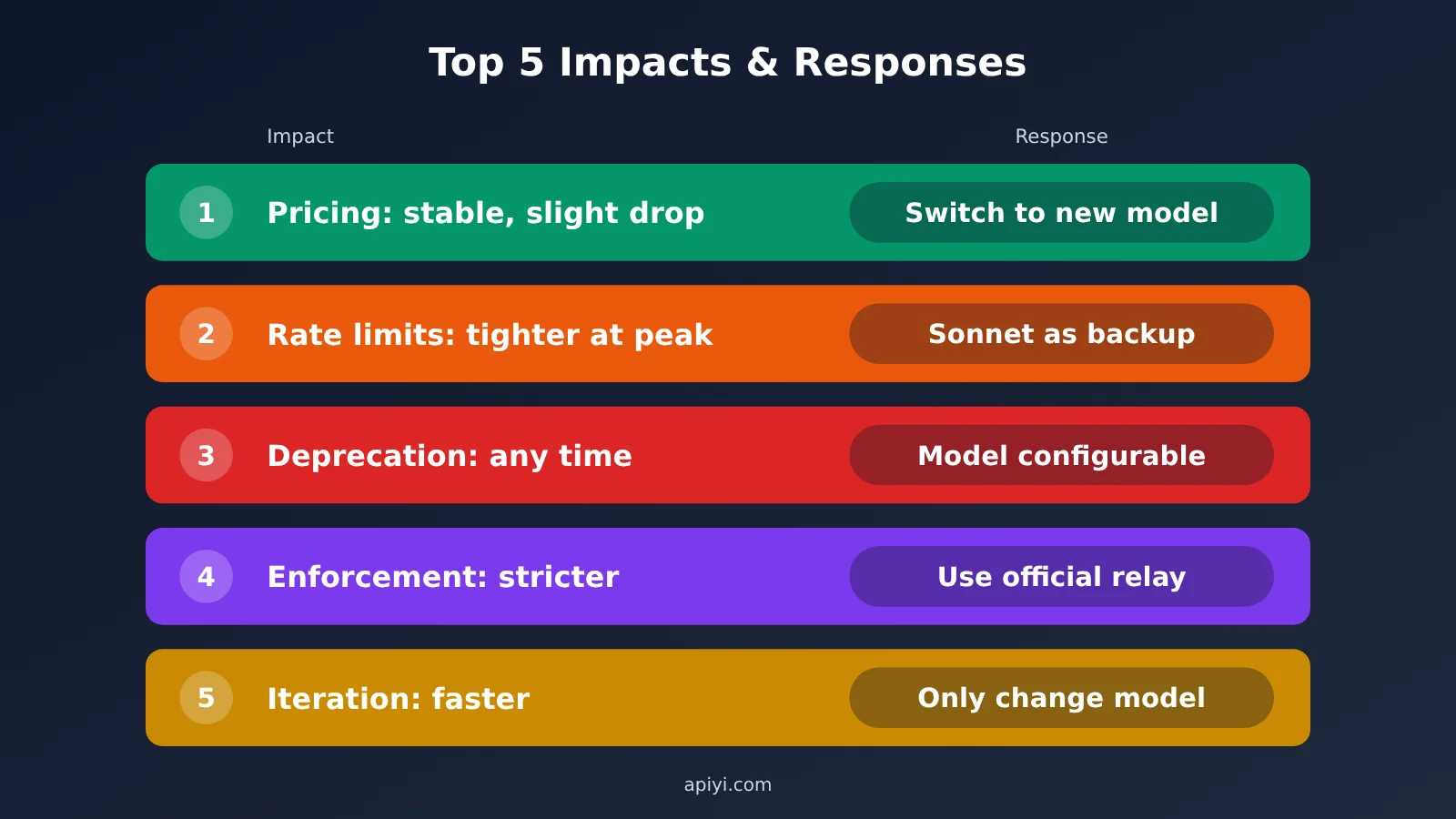
| Impact | Prospectus evidence | Developer response |
|---|---|---|
| Will prices go up? | Opus 5.5 cuts per-task cost by roughly 40% | Migrate to the new model promptly |
| Tighter rate limits | Compute is more expensive in the short term; quotas may be adjusted | Keep Sonnet 5.5 ready as a fallback |
| Model deprecation | Older models may be retired sooner or shut off outright | Make model names a config item |
| Account bans and enforcement | 5%–7% of revenue from non-compliant customers was cut off | Go through officially authorized channels |
| Faster iteration | New models drive 80%+ of revenue | Change only model in the integration layer |
The Impact of Anthropic’s IPO on the AI Market
Bottom line: going public means the market will price the major Large Language Model companies every single day — but that has little to do with your API bill.
Everything below reflects market expectations or analyst estimates and does not constitute any investment advice. Media broadly expect ANT to list in mid-to-late November at a valuation of roughly $1.5 trillion to $2 trillion, and Motley Fool reports a target raise of about $100 billion. Some analysts figure that on annualized Q3 revenue of roughly $68 billion, that implies a price-to-sales ratio of about 22–30x; given that nearly half of revenue is recognized on a gross basis, the multiple would be even higher on a net basis. Fast-track inclusion in the Nasdaq 100, passive fund buying, staggered lockup expirations, and capital rotating away from other AI stocks are all market estimates — we won’t dig into them here.
One thing worth noting for developers: after the IPO, Anthropic will face public-market scrutiny of its profit margins every quarter. Analysts paraphrase the founder’s letter as saying the company’s principle is to “under-promise, over-deliver.” That could make Anthropic more decisive about cost-control moves like rate limits and model deprecation, so it’s worth having the contingency plan from the previous section ready ahead of time.
Claude Price Increase FAQ, Key Takeaways, and Summary
Frequently Asked Questions (FAQ)
Q1: Does the prospectus contain any signal that Claude is going to get more expensive?
No direct signal. The prospectus emphasizes falling per-task costs — Opus 5.5 is roughly 40% cheaper than Opus 5 — and historically, price cuts have led to faster revenue growth. What might get tighter is rate limits, not unit price.
Q2: Does an 85% gross margin mean Claude is cheap to build?
That 85% figure is CNBC’s calculation based on cost of revenue. Some analysts think it’s on the high side, because training compute is booked under R&D expenses and cloud provider commissions aren’t deducted either. Compute is still Anthropic’s single largest expense.
Q3: Are the Q3 revenue and RPO coverage figures official numbers?
No. The prospectus only states that “Q3 revenue was 86 times Q4 2024 revenue” and that RPO stands at $10.8 billion. The roughly $16.9 billion Q3 revenue figure and the sub-20% coverage rate are both analyst estimates.
Q4: How do I keep my business running when a model is temporarily suspended?
Make the model version a configuration item, and prepare a fallback model — for example, Opus 5.5 as primary and Sonnet 5.5 as the downgrade path. When you connect through APIYI (apiyi.com), both share the same token and the same codebase.
Q5: How can teams in China call the Claude API through proper channels?
We recommend choosing a platform that goes through officially authorized channels to avoid account and balance risks. You can register at APIYI (apiyi.com) to get a token, set `base_url` to `https://api.apiyi.com/v1`, and it routes to the official AWS Bedrock integration by default — pay-as-you-go, with no fixed monthly fee.
Q6: What are the limitations of reading the prospectus this way?
The S-1 still has blank fields, such as Q3 revenue and total compute commitments. The prospectus may be revised again before the final pricing. The forward-looking judgments in this article are reasonable inferences, not established facts.
Claude Prospectus Key Takeaways
- Per-task costs are falling: Opus 5.5 is about 40% cheaper than Opus 5, and broad price hikes are unlikely.
- Growth comes from usage: Net revenue retention is around 900%, with revenue mainly driven by customers using more.
- Profits just turned positive: Adjusted H1 came in at +10%, while GAAP is still −4%.
- Short-term risk is rate limiting: Short-term compute unit prices are higher, and quotas may tighten.
- Plan ahead for deprecations: Fable 5 was once globally disabled, so you can’t afford to skip backup models.
- Stick to legitimate channels: Cloud vendor channels account for 48% of revenue, and enforcement will keep intensifying.
- Keep the integration layer thin: With APIYI, one token covers multiple models — switching models only means changing
model.
Summary
To sum up this prospectus in one sentence: Anthropic is trading cheaper per-task costs for more usage, and Claude’s prices will most likely stay stable or drift slightly downward. But compute shortages, quota adjustments, model deprecations, and stronger enforcement are all written into the risk factors — so what developers should do isn’t stockpile credits, but focus on three things: migrate to new models promptly, prepare fallback models, and choose legitimate channels.
If you want to compare the real-world costs of Opus 5, Opus 5.5, and Sonnet 5.5 on your own workloads at low cost, we recommend using APIYI at apiyi.com to switch and verify with the same token.
References
- Anthropic Official Press Release: S-1 filing announcement
- Link:
anthropic.com/news/s1-sec - Description: Confirms the IPO application, stock ticker, and offering timeline
- SEC S-1 Original Filing: Full prospectus text
- Link:
sec.gov/Archives/edgar/data/2130357/000162828026067168/anthropicpbc-sx1.htm - Description: The original source for the revenue, profit margins, and risk factors cited in this article
- CNBC, Fortune, TechCrunch, and Motley Fool reports: 2026-10-26 to 10-27
- Link:
cnbc.com,fortune.com,techcrunch.com,nasdaq.com - Description: Media calculations for gross margin, profit figures, compute contracts, and more
Author: APIYI Technical Team
Technical Inquiries: Feel free to reach out to us through the APIYI homepage. Models likeclaude-opus-5-5mentioned in this article are all available now — for models and pricing, please refer to the platform’s model list: docs.apiyi.com/models