
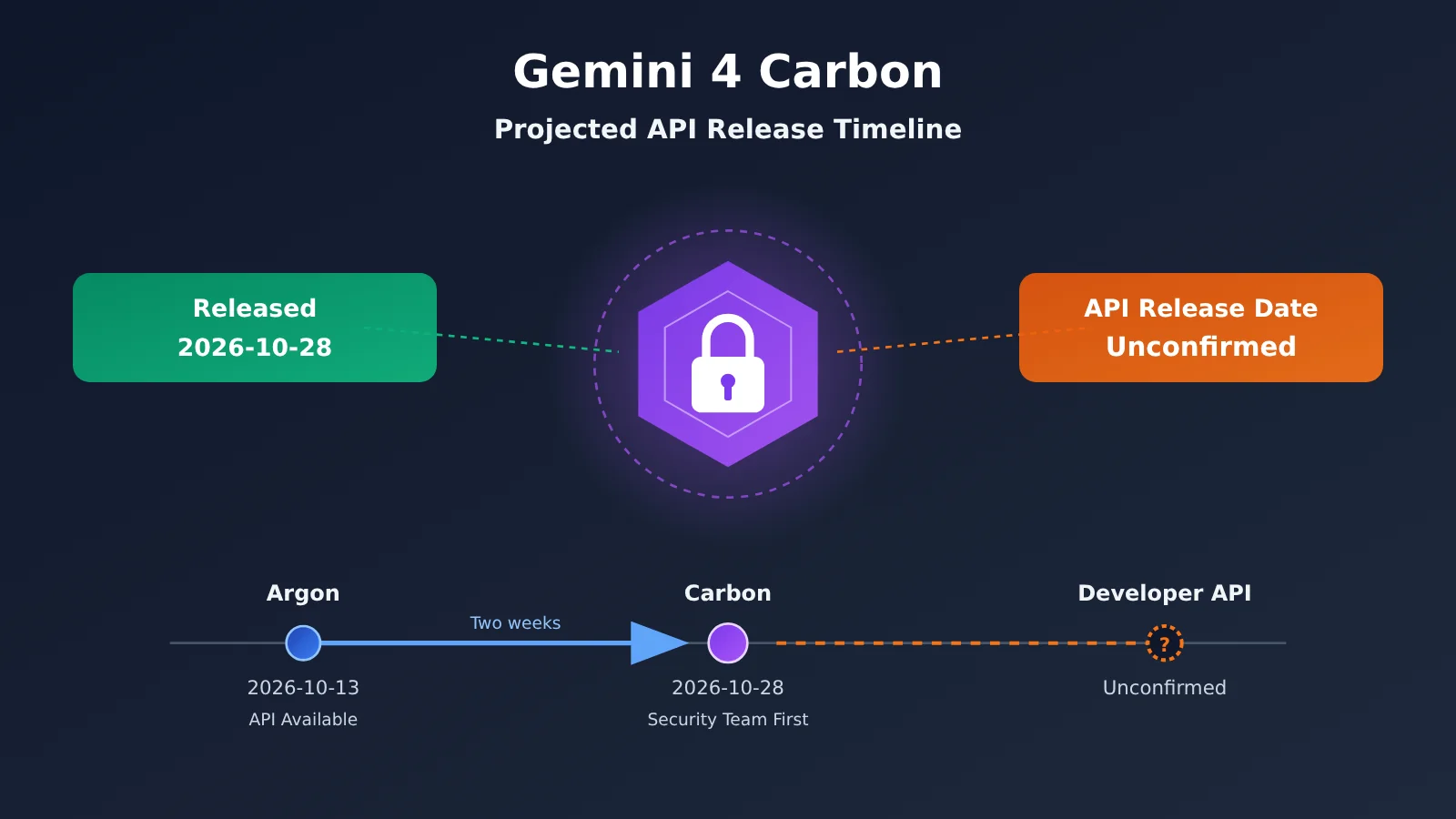
Author’s note: Gemini 4 Carbon was released on 2026-10-28, but there’s no public API yet. This article uses four known dates and Fairwind’s phased rollout gates to estimate when developers might get access, along with alternatives you can use now.
Google released Gemini 4 Carbon on 2026-10-28, positioning it as “its most capable model, with SOTA cybersecurity capabilities and support for long-running tasks.” The release came exactly two weeks after Gemini 4 Argon’s API became available to developers on 2026-10-13. Carbon ranks first on the Artificial Analysis Intelligence Index.
This isn’t another benchmark roundup. After Carbon’s release, the question developers care about most isn’t how powerful it is—it’s when they’ll be able to call it. Google hasn’t provided a developer API timeline, and the Artificial Analysis page explicitly labels Carbon “No publicly available API.”
What you’ll get: This article answers one question: how long might developers have to wait for Gemini 4 Carbon? We use four known dates and Fairwind’s phased rollout gates to make an assessment without inventing a release date. We also cover alternatives you can use now, so you can decide whether to wait or switch.
Gemini 4 Carbon Release: Key Facts at a Glance
Let’s start by separating what’s confirmed from what isn’t. Whenever Google hasn’t announced a date, we’ll mark it as “unconfirmed.”
| Item | Details | Status |
|---|---|---|
| Release date | 2026-10-28 | Confirmed |
| Released by | Google DeepMind | Confirmed |
| Official positioning | Most capable model, SOTA cybersecurity capabilities, long-running tasks | Official claim |
| Context window | 1M tokens | Official claim |
| Public API model ID | None | Confirmed unavailable |
| Initial availability | Select security teams in the Fairwind program | Confirmed |
| Developer availability | No official timeline | Unconfirmed |
| Introductory pricing end date | Not officially announced | Unconfirmed |
The official release page is at deepmind.google/models/gemini-4-carbon and includes a PDF comparing results across 17 benchmarks. Google CEO Sundar Pichai and Logan Kilpatrick shared the same message on X: give it to cyber defenders first, then expand access as soon as possible. Neither provided a timeline. Elon Musk replied “Impressive” to Sundar’s post, but that interaction contained no information about availability.
Gemini 4 Carbon Benchmark Results: Three Perspectives
Benchmark results need to be viewed in context—you can’t treat official claims as the whole story. Here’s a breakdown of official results, independent results, and what’s still unknown.
| Area | Official results | Independent results from Artificial Analysis | Unknown / Unconfirmed |
|---|---|---|---|
| Overall ranking | First on the AA Intelligence Index v5.0 with 59 points, followed by Opus 5.5 (Max) at 58, Opus 5.5 (Xhigh) at 57, and GPT-6 Astra at 57 | Ranked first in only 4 of 9 component benchmarks | Results from retesting after the public API launches |
| Coding | Scored 61.2% on FrontierSWE 2, behind Astra at 65.5% and Opus at 62.3% | Second on the Coding Agent Index: Carbon at 59, Claude Code + Opus 5.5 Max at 62; scored 51% on FrontierCode v1.1 | Agent stability in real-world codebases |
| Terminal tasks | Scored 65.2% on Terminal-Bench 4.0 | Recorded 64% on the same benchmark, differing from the official result | Source of the discrepancy |
| Cybersecurity | SEC-bench Pro: 88.2%, ExploitGym: 54.8%, CWE-bench: 71.0% | No separate results provided | Performance outside defensive scenarios |
| Long context | Scored 96.2% on GraphWalks 256k–1M, versus 66.8% for Opus | No separate results provided | Latency and cost when using the full 1M context window |
| Other | Gained 89 Elo on WebDev Arena to reach 1768 (fourth globally); final balance of $16,484 on Vending-Bench 2 | Ranked first on HLE-Diamond, Terminal-Bench-Science, AA-Omniscience, and AutomationBench-AA | — |
In the official 17-benchmark comparison, Carbon wins 15 and loses two: FrontierSWE 2 and the OSWorld-2.1 offline subset, where Opus scores 87.2% versus Carbon’s 81.5%. The third-party results are more conservative. Claude Opus 5.5 still leads in coding agents, in particular—a point that directly affects the model recommendations later in this article.
How Much Longer Will Developers Wait for Gemini 4 Carbon? Four Timeline Anchors
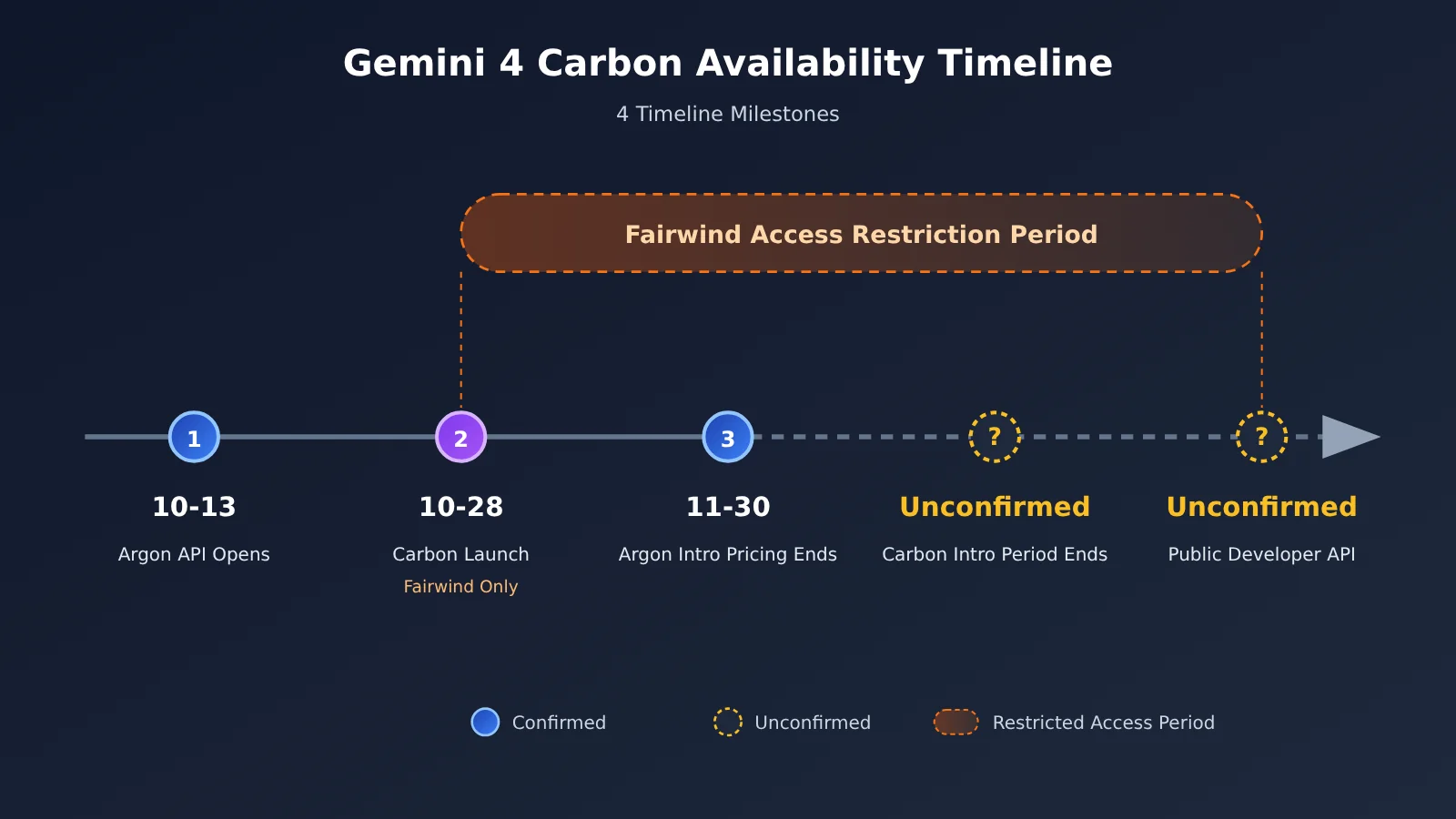
Since there’s no official date, we can only work backward from the milestones we know. The table below lists four key dates and signals to watch.
| Anchor | Date | What it means | What it tells us about Carbon access |
|---|---|---|---|
| ① Argon API access opens | 2026-10-13 | A model from the same generation has reached developers | Google has already opened a model from this generation to developers |
| ② Carbon launches | 2026-10-28 | Access at launch is limited to Fairwind security teams | Launch doesn’t mean open access; there’s a gated period in between |
| ③ Argon introductory pricing ends | 2026-11-30 | Explicitly stated in a footnote on the official blog | Argon’s pricing schedule is already set |
| ④ Carbon introductory period ends | Not announced | The official footnote only says pricing returns to $4 / $20 afterward | Unconfirmed, and the signal most worth watching |
Fairwind’s Access Controls Determine Gemini 4 Carbon’s Rollout
Carbon isn’t being rolled out gradually by increasing quotas—it’s being released through an approval process. That’s the most important factor in estimating its availability. The Fairwind program currently has more than 650 partners, and Carbon was initially made available to only some of their security teams. Access requirements are strict:
- Use restrictions: Only dual-use defensive tasks are permitted, not general business use.
- Identity requirements: User-level authentication, phishing-resistant MFA, and access controls are required.
- Scope of use: Access is limited to internal security, incident response, and penetration testing teams; resale isn’t allowed.
- Compliance checks: Background checks are required.
This means expanding Carbon access isn’t as simple as changing a quota setting. Each new group of users requires a fresh assessment of the risk that its cybersecurity capabilities could be misused. The fact that Google emphasizes its “SOTA cybersecurity capabilities” also points to why access is restricted.
Our Take on When Gemini 4 Carbon Will Open Up
Taken together, these anchors suggest that ordinary developers are unlikely to get a public Carbon API in the short term, and the timing remains unconfirmed. There are three reasons: the initial Fairwind rollout covers only some security teams, and expansion requires batch-by-batch review; Google’s leadership has said only that it will expand access “as soon as possible,” with no commitment to a date; and third-party pages also explicitly note that there’s no public API.
That said, several signals would suggest broader access is approaching:
- A public Carbon model ID appears in Google’s official documentation.
- Google announces the end date for Carbon’s introductory period (anchor ④). A clear pricing schedule usually suggests that a channel for paying developers is being planned.
- Artificial Analysis removes the “No publicly available API” label from its page.
- Plans to expand access beyond Fairwind are officially announced.
Until those signals appear, it’s risky to build business plans around Carbon.
Gemini 4 Carbon Pricing: Google Official vs. APIYI
Pricing is split into two parts: Google’s official pricing and APIYI’s platform pricing. All prices are in US dollars per million tokens.
Google Official Pricing (Gemini 4 Carbon / Argon)
| Model | Pricing stage | Input | Output | Cache read | Period |
|---|---|---|---|---|---|
| Gemini 4 Carbon | Launch introductory pricing | 2 | 10 | 0.10 (95% discount on input pricing) | End date not announced, to be confirmed |
| Gemini 4 Carbon | After introductory period | 4 | 20 | To be confirmed (approximately 0.20 if the 95% discount still applies) | To be confirmed |
| Gemini 4 Argon | Launch introductory pricing | 2 | 10 | 0.10 | Ends 2026-11-30 |
| Gemini 4 Argon | After introductory period | To be confirmed | To be confirmed | To be confirmed | From December 2026 |
Note that Carbon’s introductory price currently comes without a public access channel. Most developers can’t access the API, so the price only matters to teams within Fairwind for now. The price will double after the introductory period. If that period has already ended by the time access opens, the first developers may see prices of $4 / $20 right away. This also remains to be confirmed.
APIYI Platform Pricing (Checked 2026-10-29)
On 2026-10-29, we checked the model listing details and pricing API at APIYI apiyi.com. Of the 279 models available, gemini-4-carbon was not listed. The table below shows available models from the same generation or performance tier that can serve as alternatives.
| Model | Input | Output | Cache read | Supported endpoints | Groups | Positioning |
|---|---|---|---|---|---|---|
gemini-4-carbon |
— | — | — | — | — | Not listed; awaiting official access |
gemini-4-argon |
2 | 10 | 0.1 | chat, gemini | Default, SVIP | Flagship model from the same generation; closest to Carbon |
gemini-3.8-flash |
0.75 | 3.75 | 0.075 | chat, gemini | Gemini_Reverse, Default, SVIP | Low-cost option for high-volume use |
claude-opus-5-5 |
4 | 20 | 0.2 | chat, messages | ClaudeCode, Claude_Reverse, Claude_Enterprise, Default, SVIP | Strongest for coding agents |
The table reflects the data on the day we checked; refer to the platform’s model list for current models and prices. Once Carbon’s public API opens, we’ll make the model available as soon as possible. Until then, we recommend using Argon to get your application running. Switching later will only require changing the model name.
🚀 Quick start: While you wait for Gemini 4 Carbon, you can request free testing credits through APIYI apiyi.com and use
gemini-4-argonto test your prompts and workflows. Once Carbon is available, you can change the model name in the same code to compare results.
Gemini 4 Carbon Impact Analysis
Impact on Developers
- Planning: Carbon isn’t suitable for any project with a firm delivery date right now. Its availability date remains unconfirmed and depends on compliance approval, not technical progress.
- Technical considerations: Argon, from the same generation, is already available at the same price as Carbon’s introductory rate. Integrating with Argon first is the lowest-cost path for migration.
- Costs: The end date for Carbon’s introductory pricing is unknown. If its price has already returned to $4 / $20 by the time it becomes available, its costs will be in the same range as
claude-opus-5-5, so you’ll need to reassess its value for money.
Impact on the Industry
- “Limit access to powerful models first” may become the norm: Carbon sends a clear signal that frontier models with significant cybersecurity capabilities may launch with allowlist-only access before gradually opening up.
- First on a leaderboard doesn’t mean first in availability: Carbon ranks first with an official score of 59, but a third-party coding agent ranking still puts Opus 5.5 ahead. Developers need to consider both capability and accessibility when choosing a model.
Gemini 4 Carbon Alternatives You Can Use Now
If your project needs to launch now, you don’t have to wait for Carbon. Here’s what to choose based on your needs:
| Your needs | Recommended model | Why | When to consider switching to Carbon |
|---|---|---|---|
| Closest same-generation capabilities to Carbon | gemini-4-argon |
Same-generation model, same introductory pricing as Carbon, with the same context window and invocation method | Run an A/B comparison when Carbon opens up |
| Low-cost, high-volume batch processing | gemini-3.8-flash |
Input 0.75, output 3.75, cache reads 0.075 | You probably won’t need to switch |
| Strongest coding and code agent performance | claude-opus-5-5 |
Outperforms Carbon on FrontierSWE 2 and the OSWorld-2.1 offline subset, and also leads the third-party Coding Agent Index | Reconsider if Carbon pulls ahead in third-party retesting |
| Graph reasoning with an ultra-long context | Start with gemini-4-argon |
Carbon has a clear advantage on GraphWalks, but it isn’t currently accessible | This is the scenario most worth waiting for Carbon |
| Internal enterprise security defense | Check whether you can apply for Fairwind | Carbon’s only current access channel | Apply if you meet the eligibility requirements |
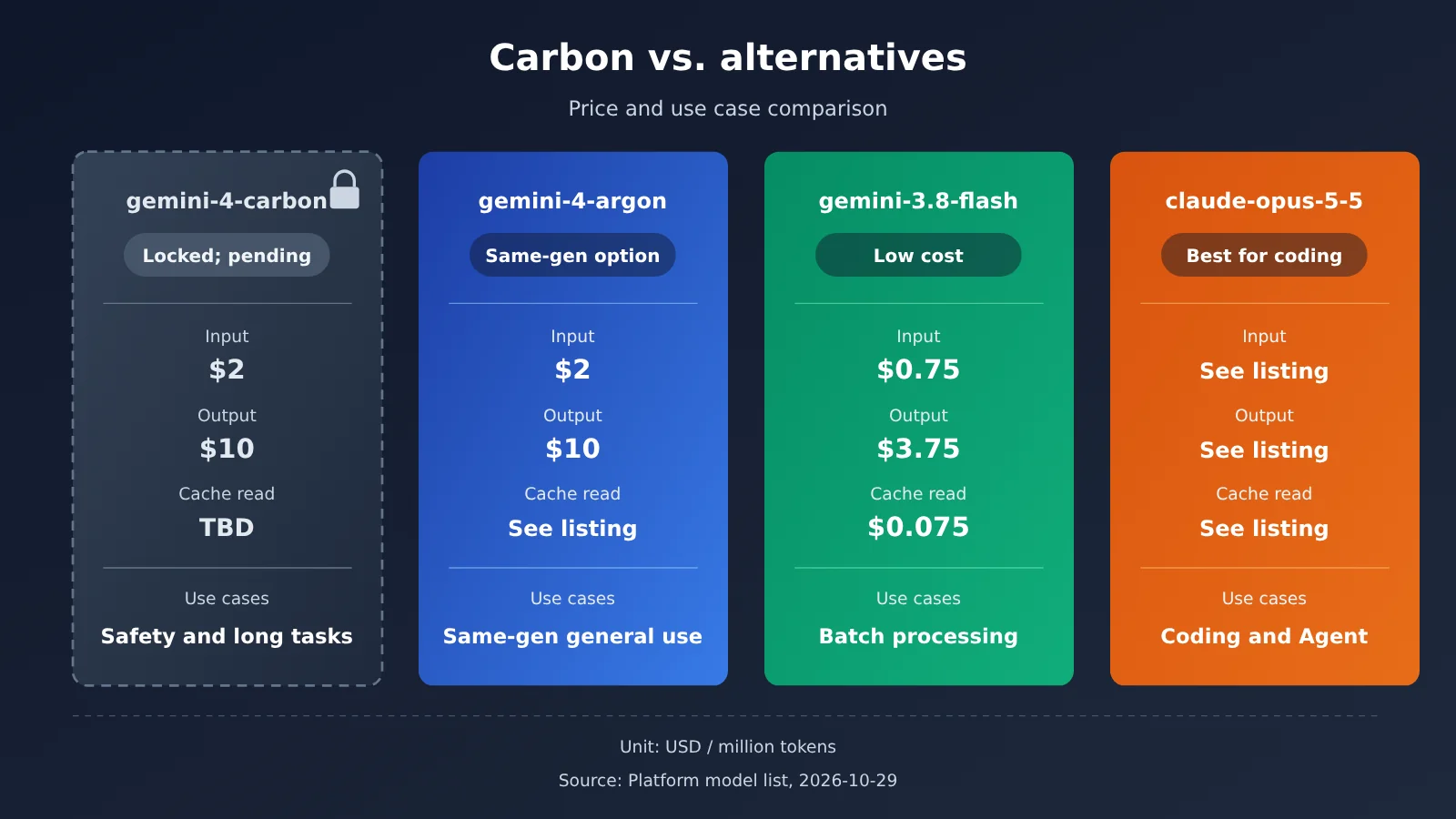
The pricing data above comes from a review of the APIYI apiyi.com model list on 2026-10-29. All models use an OpenAI-compatible interface, with base_url set to https://api.apiyi.com/v1. To switch models, just change the model parameter—for example, from gemini-4-argon to claude-opus-5-5. Claude models can also use the messages endpoint.
When You Shouldn’t Wait for Gemini 4 Carbon
In the following cases, we recommend choosing an existing model rather than waiting for Carbon:
- You primarily work on coding and coding agents: Both Google’s comparison table and third-party results suggest Carbon doesn’t lead in this area.
claude-opus-5-5is a safer choice. - Your project has a firm launch date: Carbon’s availability date hasn’t been confirmed, so you can’t plan around it.
- You have high usage volumes and are sensitive to costs:
gemini-3.8-flashis significantly cheaper, and Carbon’s pricing after the introductory period is still unknown. - You only need routine chat, summarization, or classification: Argon is already sufficient. Carbon’s main advantages are in cybersecurity and long-running tasks.
On the other hand, if your core use case involves complex reasoning with a 1M-token context window or long-running autonomous tasks, Carbon is worth keeping an eye on. Even then, we recommend building your integration with Argon first.
Gemini 4 Carbon FAQ
Q1: What is Gemini 4 Carbon?
Gemini 4 Carbon is a model in Google’s Gemini 4 family, released on 2026-10-28. Google positions it as its most capable model, emphasizing state-of-the-art cybersecurity capabilities and long-running tasks. It has a 1M-token context window. Currently, it’s available only to select security teams in the Fairwind program.
Q2: What’s the difference between Gemini 4 Carbon and Gemini 4 Argon?
Both belong to the same model generation and share the same introductory pricing: $2 per million input tokens and $10 per million output tokens. The difference is that Argon’s developer API has been available since 2026-10-13, while Carbon doesn’t yet have a public model ID. Carbon also scores higher on Google’s official benchmarks, particularly in cybersecurity and long-context tasks.
Q3: When will Gemini 4 Carbon be available to developers?
Google hasn’t provided a timeline, so we’ve marked it as “unconfirmed.” Both Sundar Pichai and Logan Kilpatrick have said access will go to cyber defenders first, with broader availability coming as soon as possible. Watch the official documentation for a Carbon model ID and an announced end date for the introductory pricing period.
Q4: Can I access Gemini 4 Carbon through APIYI now?
Not yet. As of 2026-10-29, `gemini-4-carbon` isn’t among the models available on APIYI at apiyi.com because Google hasn’t opened a public API for it. Check the platform’s model list for current models and pricing. We’ll add Carbon as soon as possible after Google makes it publicly available. In the meantime, you can use `gemini-4-argon`.
Q5: How can I quickly start using a model from the same generation while waiting for Carbon?
It’s straightforward:
1. Visit APIYI at apiyi.com, sign up for an account, and get an API key and free testing credits.
2. In any OpenAI-compatible SDK, set `base_url` to `https://api.apiyi.com/v1`.
3. Set `model` to `gemini-4-argon` and start making calls. If you’re using Gemini’s native format, you can also use the `gemini` endpoint.
Q6: What are Gemini 4 Carbon’s known limitations?
According to Google’s own comparison table, Carbon trails competing models on FrontierSWE 2 and the OSWorld-2.1 offline subset. Third-party evaluator Artificial Analysis reports more conservative results: Carbon ranks first in only four of nine sub-evaluations, places second on the Coding Agent Index, and scores 64% on Terminal-Bench 4.0, below Google’s reported 65.2%. Its availability is also strictly limited to those admitted to Fairwind.
Gemini 4 Carbon: Key Takeaways
- Released, but not yet callable: Carbon was released on October 28, but there’s currently no public API model ID.
- Public availability is unconfirmed: The official announcement only says access will expand “as soon as possible,” with no timeline.
- Access controls are the key variable: Fairwind requires review and approval, so the pace of expansion depends on compliance.
- Benchmark results need context: The official announcement claims first place with a score of 59, while a third party ranks Opus ahead for coding agents.
- Pricing could change: Introductory pricing is $2 / $10. No end date has been announced, after which pricing returns to $4 / $20.
- Available to use now: You can call Argon, 3.8-flash, and Opus 5.5 directly through APIYI at apiyi.com.
Summary
The key takeaways for Gemini 4 Carbon:
- Powerful, but currently unavailable through the API: The question isn’t whether it’s capable—it’s that you can’t call it yet. Official access is limited to security teams.
- The wait is hard to predict: Of the four dates and milestones, the most important—the end of Carbon’s introductory period—remains unconfirmed. Fairwind’s batch-by-batch review process also suggests access won’t expand too quickly.
- The best strategy is to get started now: Use
gemini-4-argonfrom the same generation to complete your integration. Chooseclaude-opus-5-5for coding tasks andgemini-3.8-flashfor low-cost batch processing. Once Carbon becomes available, you can compare and switch.
If your application doesn’t depend on cybersecurity or reasoning over very long contexts, there’s no need to delay your launch for Carbon. We recommend using the existing models through APIYI at apiyi.com to test your results first. With a single API key, you can switch between Gemini, Claude, and other models. Once Carbon is available, you’ll only need to change the model name to use it.
📚 References
- Google DeepMind – Official Gemini 4 Carbon Announcement: Model positioning and comparison table covering 17 benchmarks
- Link:
deepmind.google/models/gemini-4-carbon -
Notes: Source of Google’s self-reported data, including a comparison table PDF and pricing footnotes
-
Artificial Analysis – Gemini 4 Carbon Page: Independent third-party evaluation
- Link:
artificialanalysis.ai -
Notes: Includes the Intelligence Index v5.0, Coding Agent Index, and the note “No publicly available API”
-
APIYI Model List: Available models and pricing
- Link:
docs.apiyi.com/models - Notes: Check this page for Argon, 3.8-flash, and Opus 5.5 pricing, endpoints, and groups. Refer to it as the authoritative model list.
Author: APIYI Technical Team
Technical discussions: Contact us through the APIYI homepage. You’ll find more model integration resources in the documentation center.