Gemini 4 Argon has made fresh progress: after its official announcement on September 30 and its initial rollout to network defenders in the Fairwind program, Gemini 4 Argon is now available through Vertex AI. Google Cloud’s broader rollout is officially underway. For most developers, the practical question now is: how much does Gemini 4 Argon cost, and what will it add to your monthly bill?
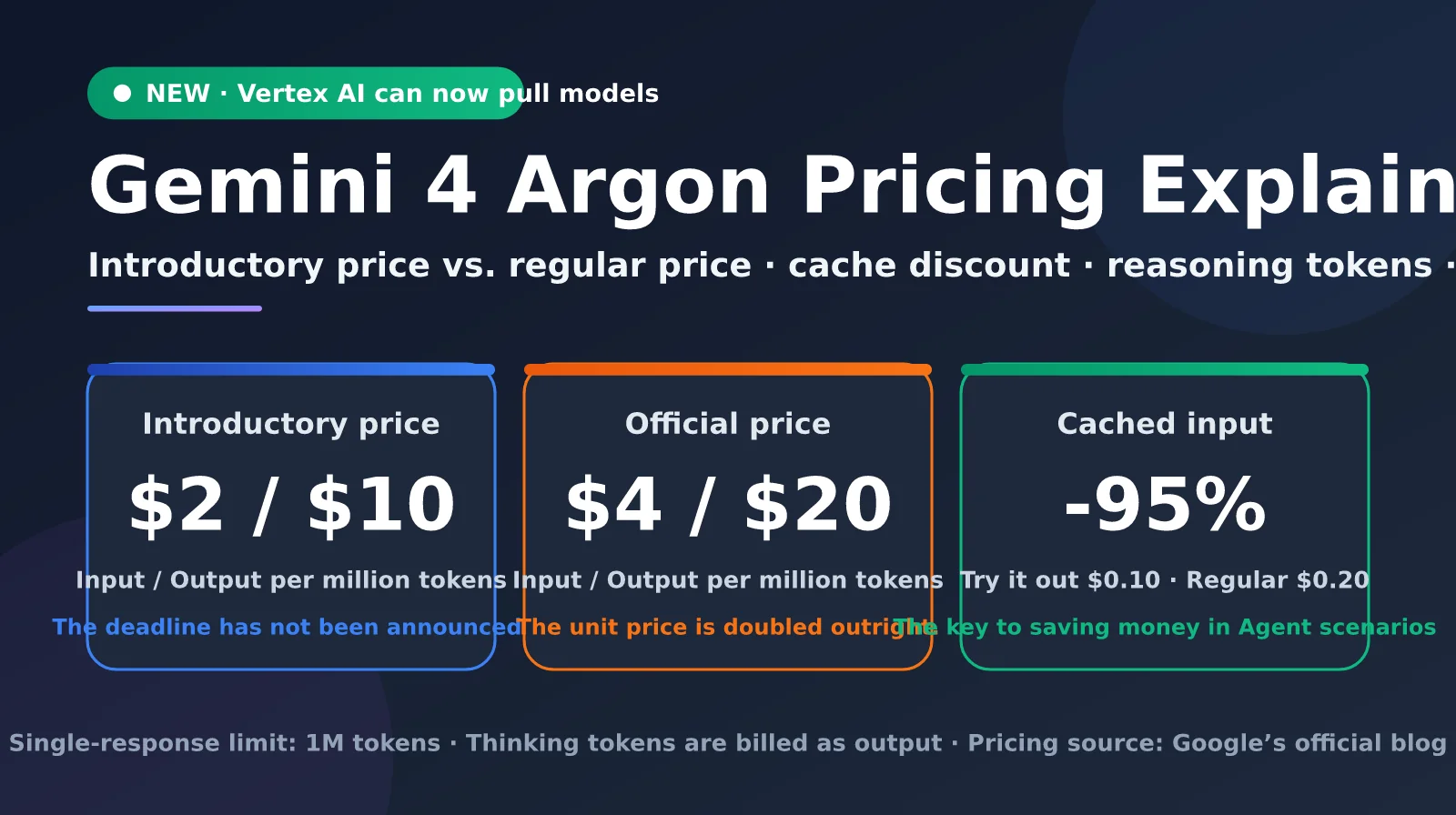
At first glance, Argon’s pricing is simple: introductory rates of $2 per million input tokens and $10 per million output tokens, rising to $4/$20 at standard rates, with a 95% discount on cached input. But there are a few other factors behind those numbers: how reasoning tokens are billed, whether the 1M-token output limit could make individual requests prohibitively expensive, and how much more token usage Argon requires compared with competitors. Drawing on Google’s official blog post and public data from English-language media and third-party evaluators, this article breaks down Gemini 4 Argon’s pricing and estimates costs across five typical use cases.
What you’ll learn: By the end, you’ll be able to calculate Gemini 4 Argon’s real per-task cost for your business, understand how your bill could change after the introductory period, and see how caching and output limits can help control costs.
Gemini 4 Argon Pricing at a Glance
Let’s start with a summary of the pricing Google has officially announced. One important caveat: Google has only published introductory and standard rates. It hasn’t said how long the introductory period will last or provided details on Batch, Flex, long-context pricing tiers, or cache storage fees.
| Billing item | Introductory rate (per million tokens) | Standard rate (per million tokens) | Notes |
|---|---|---|---|
| Input | $2.00 | $4.00 | Duration of introductory period not announced |
| Output | $10.00 | $20.00 | Google hasn’t specified how reasoning tokens are billed |
| Cached input | $0.10 | $0.20 | 95% discount on input pricing; standard rate estimated using the same discount |
| Maximum output per request | 1M tokens | 1M tokens | Previous Gemini models were capped at 64K |
| Batch / Flex | Not announced | Not announced | Existing Gemini models typically offer Batch discounts |
| Long-context pricing tiers | Not announced | Not announced | Google hasn’t announced the input context window either |
Three Key Details About Gemini 4 Argon Pricing
The first is reasoning tokens. Google hasn’t specified how Argon’s thinking tokens are billed, but the current practice across the Gemini lineup is to charge for thinking tokens at the output rate. The safest assumption for budgeting is that Argon will follow the same rule, meaning all reasoning tokens are billed at $10 (introductory) or $20 (standard) per million tokens.
The second is the cache discount. A 95% discount brings the cost of cached input during the introductory period down to just $0.10 per million tokens. Agent workflows often resend the same system prompt, tool definitions, and codebase context in every conversation turn. Cache hit rates can often exceed 70%, so this discount may affect your total bill more than the $2 headline rate.
The third is uncertainty around the introductory period. Once it ends, all rates double—and Google hasn’t announced when that will happen. If you’re estimating ROI based on introductory pricing, it’s best to run the numbers at standard rates too, so you’re prepared if your bill suddenly doubles.
🎯 Budgeting tip: Gemini 4 Argon’s pricing has several unknowns, so start with a small amount of traffic to get a clear picture of your actual token usage before switching at scale. With APIYI at apiyi.com, you can call Gemini, GPT, Claude, and other model families through a unified interface, making it easy to compare real costs on the same set of tasks.
Latest Developments: Gemini 4 Argon on Vertex AI
Argon’s rollout schedule has been one of developers’ biggest questions. According to Google’s blog post, Argon is first being made available to trusted network defenders in the Fairwind program and to Google employees, followed by paid API customers and Google AI Ultra subscribers. Broader access for developers, businesses, and consumers will come later. The table below tracks the timeline from announcement to availability on Vertex AI.
| Date | Event | Source |
|---|---|---|
| September 3 | The Fairwind program launches with Gemini 3.8 Flash Cyber as its first model | Google official blog |
| September 30 | Gemini 4 Argon is announced and made available to Fairwind members | Google official blog |
| September 30 | DataCamp check: Argon isn’t listed on Vertex AI, Gemini CLI, or other platforms | DataCamp |
| October 7–8 | Community members spot the gemini-4-argon-cyber-permissive entry on Vertex AI |
Community and tech media |
| Mid-October | Gemini 4 Argon becomes available to pull from Vertex AI | Latest update |
The model ID first spotted by the community, gemini-4-argon-cyber-permissive, is particularly telling. “Cyber-permissive” suggests this version is intended for network defenders, with relaxed cybersecurity guardrails—consistent with Google’s blog post, which says trusted defenders won’t face cybersecurity guardrails. The version for ordinary paid customers will likely use a different ID and retain the full set of safety protections. When integrating, check the model ID shown in your own Google Cloud Model Garden rather than copying a name circulating online.
Gemini 4 Argon Pricing and Platform Changes on Vertex AI
Community reports say Vertex AI lists Argon’s global pricing at $4 per million input tokens and $20 per million output tokens—the official price tier mentioned in Google’s blog post. This is worth keeping in mind: if your business is billed at the official rate when accessing Argon through Vertex AI, any estimates based on the $2/$10 introductory pricing will need to be doubled. Google hasn’t clarified which channels qualify for the introductory price, so check the actual rates on your console’s billing page before integrating.
Another easy-to-miss change involves the platform itself. At Cloud Next in April 2026, Google consolidated Vertex AI services into the Gemini Enterprise Agent Platform, and the legacy Vertex AI documentation is now marked as no longer being updated. Existing endpoints will continue to work, but documentation and new features for models like Argon will appear first on the Agent Platform. In addition, Gemini 2.5 Pro, 2.5 Flash, and 2.5 Flash-Lite are scheduled to retire on October 16. Teams still using these models can take this opportunity to complete their migrations together.
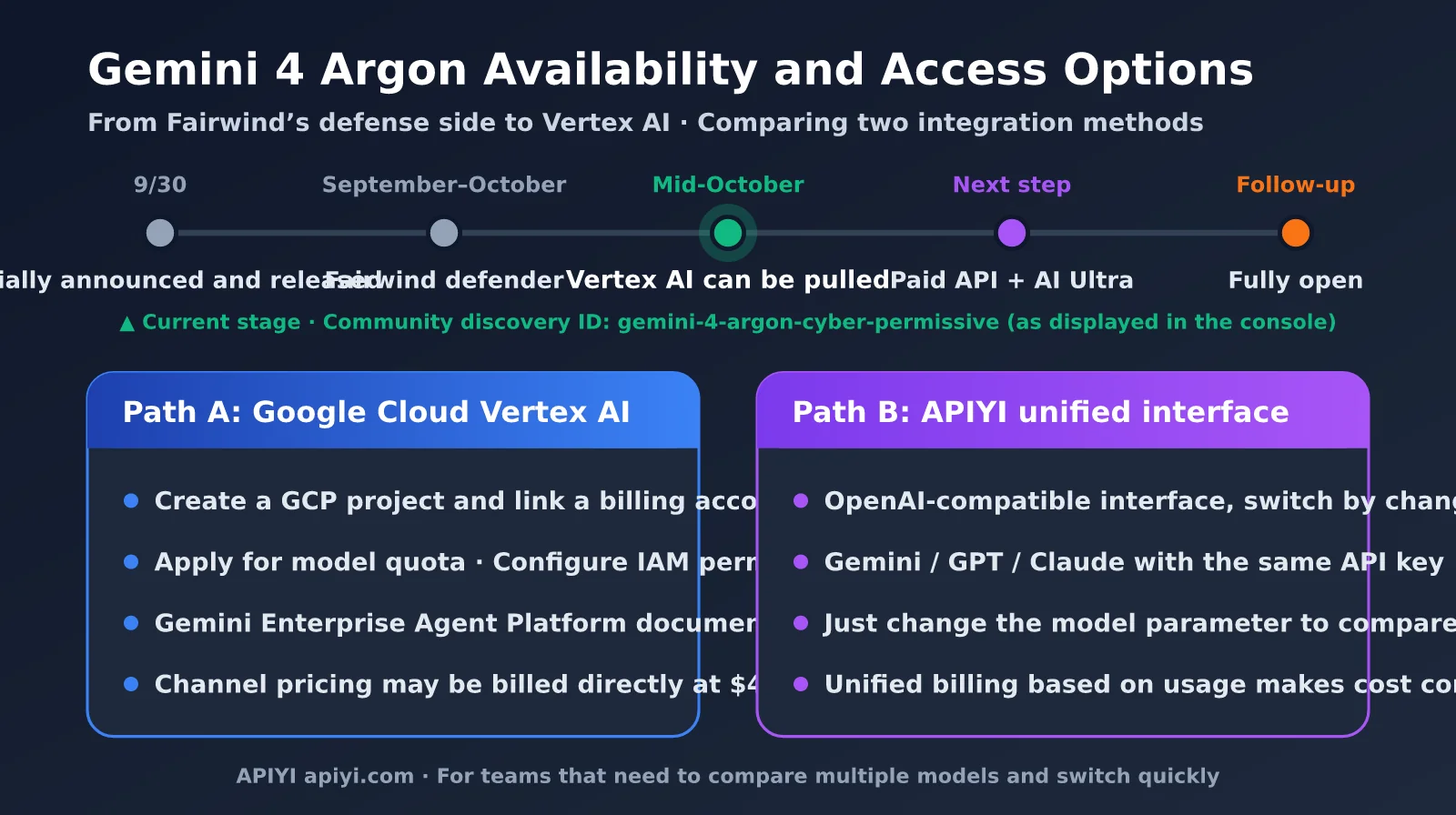
🚀 Integration tip: Accessing Vertex AI directly requires a GCP project, a billing account, quota approval, and IAM configuration—a high bar for small and midsize teams. We recommend using APIYI (apiyi.com)’s OpenAI-compatible interface to access the Gemini model family through a single integration. Just change the
modelparameter to switch between Argon and other models.
Gemini 4 Argon Pricing Compared: Its Gemini Sibling and Competitors
It’s hard to tell whether Argon is expensive by looking at its per-token price alone. To get a clearer picture, compare it with its Gemini sibling, Gemini 3.8 Flash, and competing flagship models. The table below shows each model’s list price. Competitor prices were compiled by third parties; check each provider’s official page for the latest pricing.
| Model | Input / million tokens | Output / million tokens | Max output per request | Positioning |
|---|---|---|---|---|
| Gemini 3.8 Flash | $0.75 | $3.75 | — | Everyday workhorse, great value |
| Gemini 4 Argon (introductory pricing) | $2.00 | $10.00 | 1M | Flagship for long-chain reasoning |
| Gemini 4 Argon (regular pricing) | $4.00 | $20.00 | 1M | Flagship for long-chain reasoning |
| Claude Opus 5.5 | $4.00 | $20.00 | 128K | Competitor flagship |
| GPT-6 Astra | $10.00 | $50.00 | 128K | Competitor flagship |
At introductory pricing, Argon costs about 2.7 times as much as Gemini 3.8 Flash. Its regular price matches Claude Opus 5.5 and is just 40% of GPT-6 Astra’s price. But per-token pricing is only half the story. The other half is how many tokens it takes to complete the same task—and that’s where Argon’s pricing calls for the most scrutiny.
Gemini 4 Argon Cost per Task: Token Usage Is What Matters
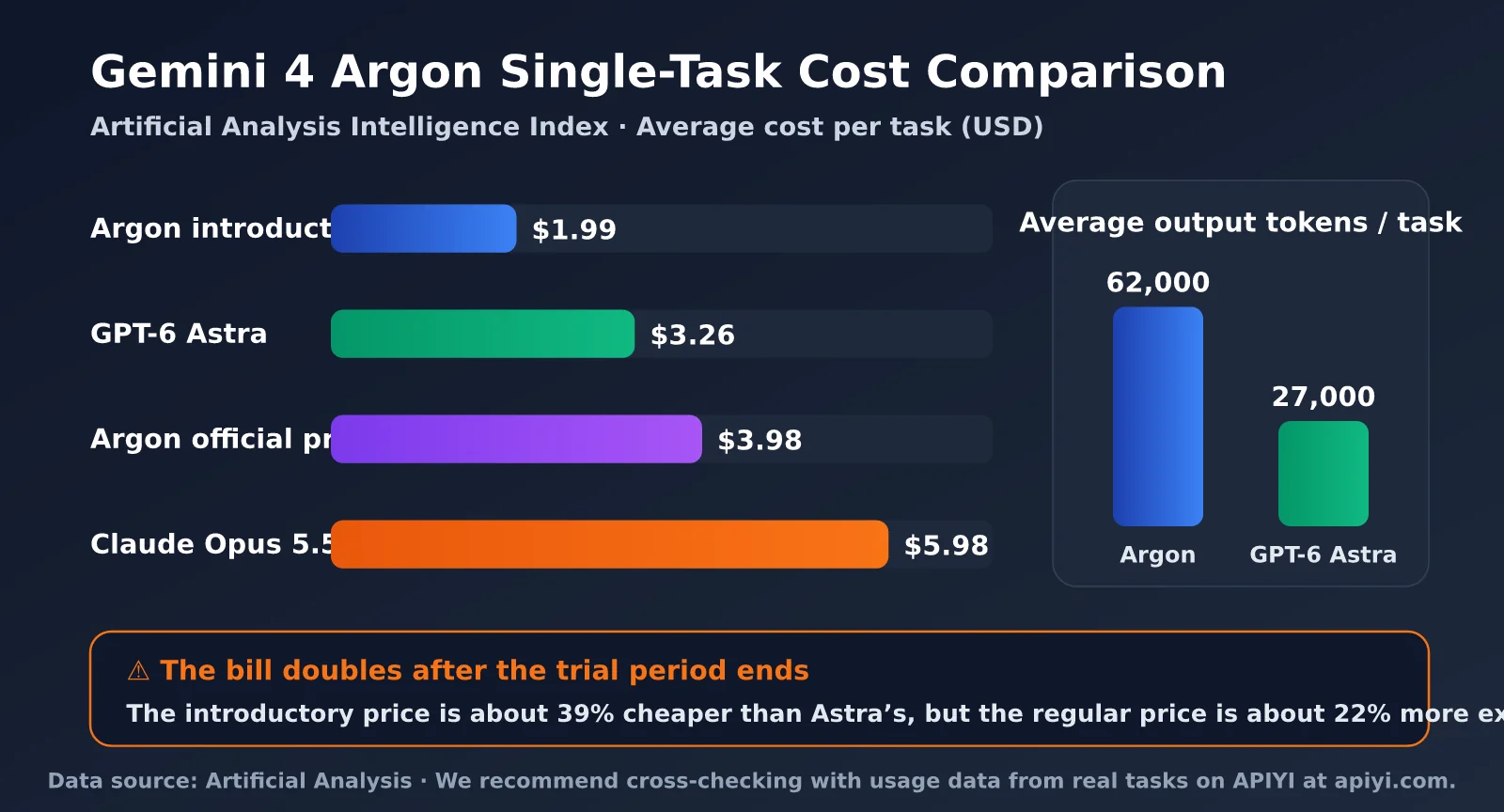
Cost per task, as reported by third-party evaluators, gives a clearer picture than per-token pricing. According to Artificial Analysis, Argon generates an average of around 62,000 output tokens per task on its Intelligence Index test. GPT-6 Astra achieves the same score with just 27,000 tokens, meaning Argon uses more than twice as many.
| Evaluation metric | Gemini 4 Argon | Comparison model | Takeaway |
|---|---|---|---|
| AA cost per task (introductory pricing) | $1.99 | GPT-6 Astra $3.26 | About 39% cheaper than Astra during the introductory period |
| AA cost per task (regular pricing) | $3.98 | GPT-6 Astra $3.26 | About 22% more expensive than Astra at regular pricing |
| AA cost per task | $1.99 | Claude Opus 5.5 $5.98 | About one-third the cost of Opus 5.5 |
| Vals cost per test | $15.68 | Opus 5.5 $32.14 / Sonnet 5.5 $21.34 | Lowest cost for this workload |
| Average output tokens per task | About 62,000 | GPT-6 Astra about 27,000 | Argon’s reasoning process is significantly longer |
This table highlights the key point about Gemini 4 Argon’s pricing: Argon offers great value during its introductory period, but once that ends, it could cost more than GPT-6 Astra—which has a higher per-token price—for some workloads. That’s because Argon uses more output tokens. However, Vals’ results show that Argon is the least expensive option for another type of workload. The takeaway depends heavily on the task, so you’ll need to run your own tests to estimate costs.
💡 Model selection tip: A lower per-token price doesn’t necessarily mean a lower bill. Try running the same set of real tasks through Argon and other flagship models on the APIYI apiyi.com platform, and record the
usagefields for each request. Base your routing strategy on actual token usage, not list prices.
Gemini 4 Argon Cost Estimates: 5 Typical Scenarios
Using Google’s published prices, the table below estimates the cost of a single request across five typical scenarios at both introductory and regular pricing. Thinking tokens are counted as output.
| Scenario | Input tokens | Output tokens | Cost at introductory pricing | Cost at regular pricing |
|---|---|---|---|---|
| Everyday Q&A | 20,000 | 5,000 | $0.09 | $0.18 |
| Long document analysis | 200,000 | 50,000 | $0.90 | $1.80 |
| Agentic coding (80% cache hits) | 600,000 | 62,000 | $0.91 | $1.82 |
| Large-scale code migration | 300,000 | 400,000 | $4.60 | $9.20 |
| Full 1M output | Negligible | 1,000,000 | $10.00 | $20.00 |
Take the agentic coding scenario as an example: of the 600,000 input tokens, 480,000 are cache hits, billed at $0.10 for a total of just $0.048. The remaining 120,000 tokens cost $0.24 at $2 per million. The 62,000 output tokens cost $0.62 at $10 per million, bringing the total to about $0.91. With a high cache hit rate, output tokens account for nearly 70% of the total cost. Keeping output short matters more than reducing input.
Large-scale code migrations and requests that use the full 1M output allowance deserve particular attention. The 1M output limit is one of Argon’s main selling points, but a single full-length response costs $20 at regular pricing. If an overly short client timeout causes a request to fail and retry automatically, the cost can double. For teams running hundreds of long tasks a day, these hidden costs can quickly send monthly bills out of control.
Gemini 4 Argon: A Checklist of Hidden Costs
Based on these estimates, watch out for the following hidden costs when integrating Argon:
- Reasoning token inflation: Argon generates more than twice as many output tokens as GPT-6 Astra on average. Its reasoning process is billed at the output rate, which can significantly increase the cost per task.
- Very long outputs and retries: With a 1M output limit, misconfigured client or load balancer timeouts can cause long requests to fail and retry, multiplying costs.
- Cache misses: Poorly structured prompts can lead to a low cache hit rate, wasting the 95% discount.
- The end of introductory pricing: All per-token prices double, with no clear end date announced.
- Price differences across platforms: Vertex AI may list regular pricing directly, creating a 2x gap compared with estimates based on introductory pricing.
Cost-Saving Practices for Using Gemini 4 Argon
The three most effective ways to control the hidden costs mentioned above are to set a clear output limit for every request, place stable content at the beginning of the prompt to improve cache hit rates, and route requests to different models based on task difficulty. The examples below use an OpenAI-compatible API, with the model ID configured through an environment variable.
import os
from openai import OpenAI

client = OpenAI(
    api_key=os.getenv("APIYI_API_KEY"),
    base_url="https://api.apiyi.com/v1"  # APIYI OpenAI-compatible API
)

# Use the model ID shown in your platform or Vertex AI console
ARGON = os.getenv("ARGON_MODEL", "gemini-4-argon")

resp = client.chat.completions.create(
    model=ARGON,
    max_tokens=16000,  # Set an explicit output limit instead of allowing the default to reach 1M
    messages=[{"role": "user", "content": "Analyze the concurrency issues in this code"}],
)
u = resp.usage
print(f"Input {u.prompt_tokens} / Output {u.completion_tokens} tokens")
View Full Code: Difficulty-Based Routing and Cost Tracking
import os
from openai import OpenAI

client = OpenAI(
    api_key=os.getenv("APIYI_API_KEY"),
    base_url="https://api.apiyi.com/v1"
)

# Configure models and prices so you can switch them by changing environment variables after the trial period
ROUTES = {
    "easy": {
        "model": os.getenv("FLASH_MODEL", "gemini-3.8-flash"),
        "price_in": 0.75, "price_out": 3.75, "max_tokens": 8000,
    },
    "hard": {
        "model": os.getenv("ARGON_MODEL", "gemini-4-argon"),
        "price_in": float(os.getenv("ARGON_PRICE_IN", "2")),
        "price_out": float(os.getenv("ARGON_PRICE_OUT", "10")),
        "max_tokens": 64000,
    },
}

# Put the stable prefix first to improve cache hit rates
SYSTEM_PREFIX = open("system_prompt.md", encoding="utf-8").read()


def classify(task: str) -> str:
    """Simple example: route long tasks, migrations, and audits to Argon; everything else goes to Flash"""
    keywords = ("迁移", "重构", "审计", "漏洞", "多文件")
    return "hard" if len(task) > 4000 or any(k in task for k in keywords) else "easy"


def run(task: str) -> str:
    route = ROUTES[classify(task)]
    resp = client.chat.completions.create(
        model=route["model"],
        max_tokens=route["max_tokens"],
        messages=[
            {"role": "system", "content": SYSTEM_PREFIX},
            {"role": "user", "content": task},
        ],
        timeout=600,  # Allow more time for long outputs to avoid doubled costs from failed retries
    )
    u = resp.usage
    cost = (u.prompt_tokens * route["price_in"]
            + u.completion_tokens * route["price_out"]) / 1_000_000
    print(f"[{route['model']}] in={u.prompt_tokens} out={u.completion_tokens} "
          f"estimated cost ${cost:.4f} (cache discounts not included)")
    return resp.choices[0].message.content


if __name__ == "__main__":
    print(run("Migrate the C modules in the legacy/ directory to Rust while preserving the interfaces"))
This code demonstrates three cost-saving principles. First, set max_tokens explicitly instead of relying on the model’s extremely high default output limit. Second, put the system prompt at the beginning as a stable prefix so repeated requests are more likely to hit the cache. Third, route requests based on difficulty: send simple tasks to Gemini 3.8 Flash, which costs about one-third as much as Argon, and reserve Argon for complex, multi-step tasks.
Tip: You can get test credits from APIYI at apiyi.com and run the routing script on real traffic for a week. Then use your usage logs to adjust the routing thresholds and output limits.
Frequently Asked Questions
Q1: Is Gemini 4 Argon currently priced at $2/$10 or $4/$20?
Google’s published trial pricing is $2/$10, and the standard price is $4/$20. However, Google hasn’t said how long the trial period will last or whether the trial pricing applies consistently across all channels. Some community reports say Vertex AI lists the standard price of $4/$20. Check the per-unit prices on the bill from your actual provider, and budget for both price tiers.
Q2: Can I use `gemini-4-argon-cyber-permissive` directly on Vertex AI?
Based on its name, this ID appears to be a version for cyber defenders with more permissive cybersecurity guardrails. It’s tied to access under the Fairwind program, and ordinary projects typically don’t have permission to call it. Regular paying customers should use the model ID shown in Model Garden in their own console. If you’d rather not deal with GCP project, quota, and permission setup, you can also access Gemini models through an aggregator such as APIYI at apiyi.com.
Q3: Are Argon’s thinking tokens billed separately?
Google hasn’t clarified this yet. However, thinking tokens in existing Gemini models are billed at the output rate, so it’s reasonable to budget using the same rule. Argon tends to generate more output tokens on average, making thinking tokens a major source of cost. You can control this by limiting `max_tokens` and adjusting the reasoning level.
Q4: When is Gemini 4 Argon worth the cost?
Argon’s strengths are most valuable for long, multi-step tasks such as large-scale code migrations, specialized analysis of long documents, legal and financial agents, and security audits. For everyday questions, simple code completion, and lightweight tasks with high concurrency, lower-cost models such as Gemini 3.8 Flash are usually a better deal. The safest approach is to run A/B tests on real tasks through the APIYI platform at apiyi.com, then decide how to split traffic between models.
Summary
Gemini 4 Argon’s pricing can be summed up as “competitive list prices, but plenty of variables.” Its introductory price of $2/$10 is highly competitive among flagship models, and the 95% cache discount is especially appealing for agent workloads. But high reasoning token usage, a price doubling after the introductory period, and the possibility that Vertex AI may charge the full list price from the start can all make actual bills differ significantly from what the listed prices suggest.
Now that Gemini 4 Argon is available on Vertex AI, the priority shouldn’t be to switch everything over right away. First, use real traffic to measure token consumption, then control costs with output limits, cached prefixes, and difficulty-based routing. We recommend positioning Argon as a flagship model for “hard problems” and pairing it with Flash-tier models.
We recommend using the APIYI apiyi.com platform to access the Gemini model family through a unified interface. This lets you compare Argon’s cost and performance with other models through the same API, so you can make model strategy decisions based on data rather than list prices.
References:
- Google’s official Gemini 4 Argon announcement: blog.google/innovation-and-ai/models-and-research/gemini-models/gemini-4-argon
- Google Fairwind Program overview: deepmind.google/fairwind-program
- DataCamp’s overview of Gemini 4 Argon benchmarks and pricing: datacamp.com/blog/gemini-4-argon
- Artificial Analysis model cost and intelligence indices: artificialanalysis.ai
- Vals AI model evaluation and cost data: vals.ai
Author: APIYI Team | Tracking Large Language Model pricing and access updates. Visit APIYI apiyi.com for more AI model access news.