Author’s note: Third-party benchmarks support Gemini 4 Carbon’s claim to the top spot globally, but it’s currently available only to a small number of cybersecurity teams. This article breaks down what each score measures and explains which model developers in China can use right now.
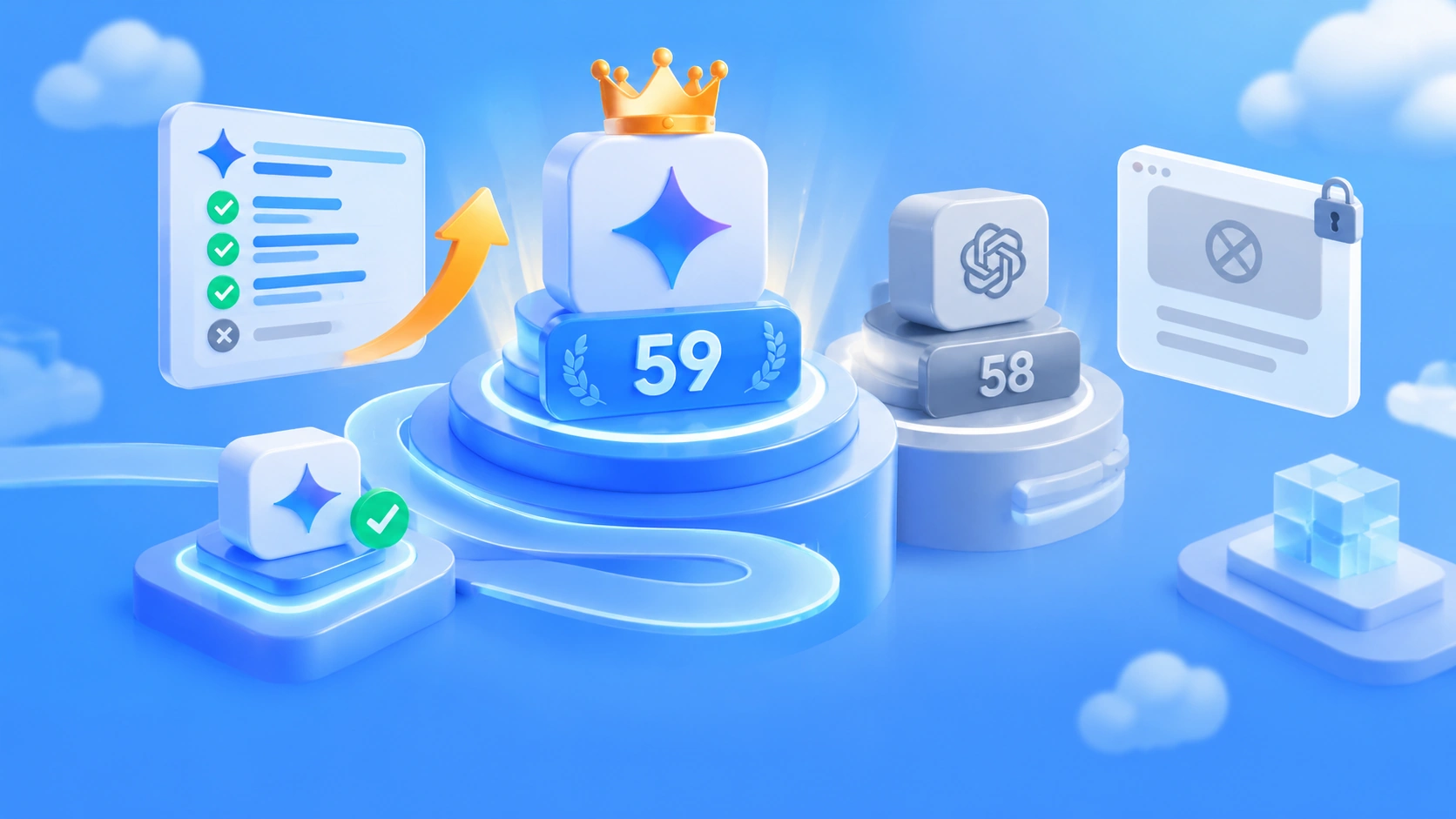
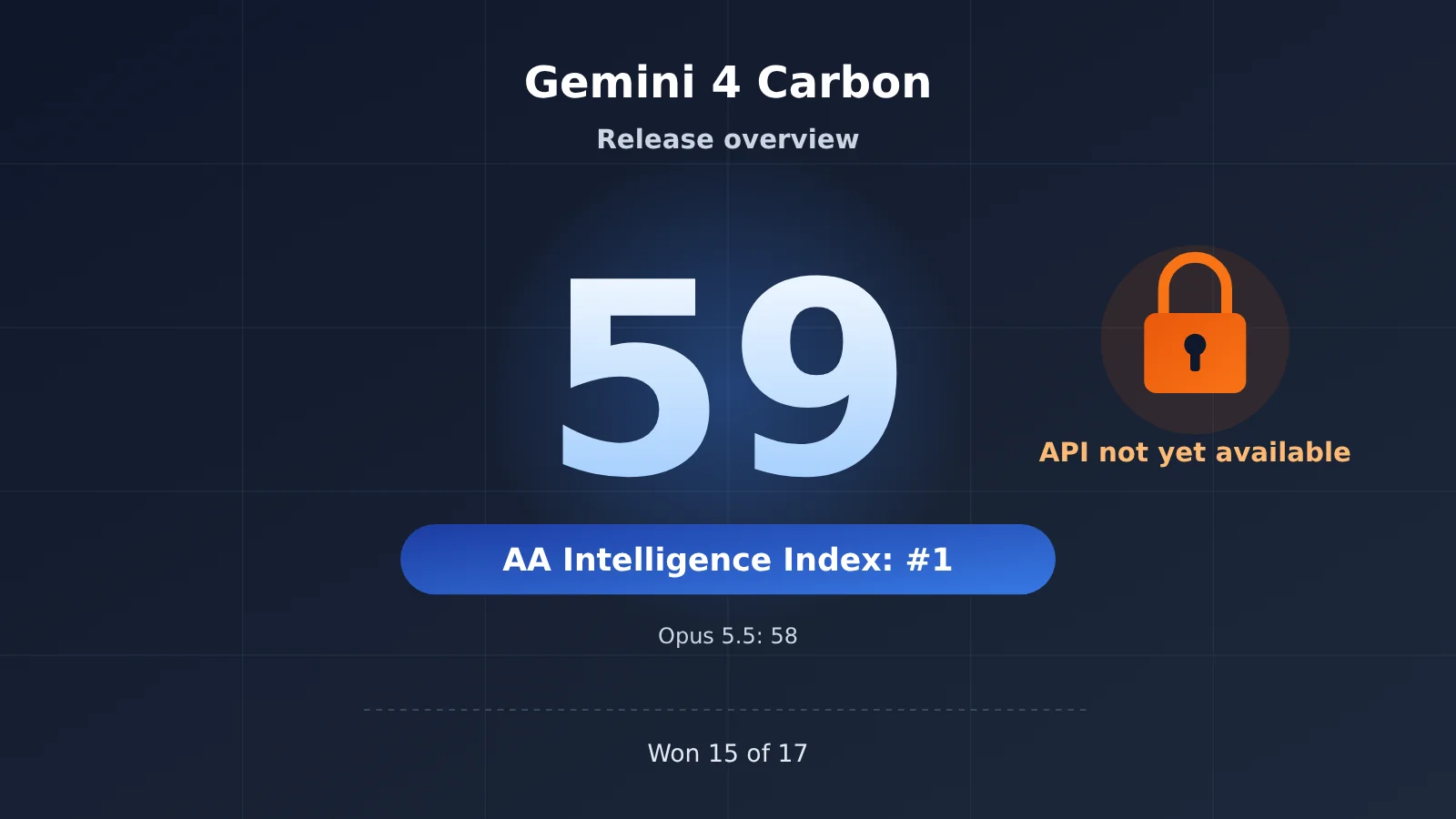
Here’s the bottom line: Gemini 4 Carbon really is ranked first globally, and you really can’t access it right now. In Artificial Analysis’s independent evaluation, Carbon leads the Intelligence Index with a score of 59—one point ahead of Claude Opus 5.5 at 58. But when Google announced it on 2026-10-28, it provided neither an API model ID nor a timeline for availability.
This isn’t another recap of the launch event. Every score in this article identifies its source: scores published by Google are labeled “Google-reported,” while third-party scores are labeled “Artificial Analysis independent evaluation.” Beyond the numbers, we’re more interested in a practical question: What does this release mean for the code you’re writing and the APIs you’re integrating today?
What you’ll get: By the end of this article, you’ll know where Carbon genuinely leads, what’s been exaggerated, why you can’t access it yet, and which model to use today if you want to work with the Gemini 4 series.
Gemini 4 Carbon at a Glance: Three Numbers
If you only have time for three numbers, here’s the quick version. They cover Carbon’s overall capabilities, security capabilities, and alignment, respectively. Only the first comes from a third party.
| Number | What it represents | Source |
|---|---|---|
| 59 | Artificial Analysis Intelligence Index v5.0 score, ranking first globally. Claude Opus 5.5 (Max) is second with 58 | Independent evaluation by Artificial Analysis |
| 88.2% | SEC-bench Pro vulnerability detection rate, measuring the ability to find vulnerabilities in real software | Reported by Google, with guardrails disabled |
| 0.0% | Attack success rate on Gray Swan’s indirect prompt injection benchmark, compared with 0.7% for Argon | Reported by Google |
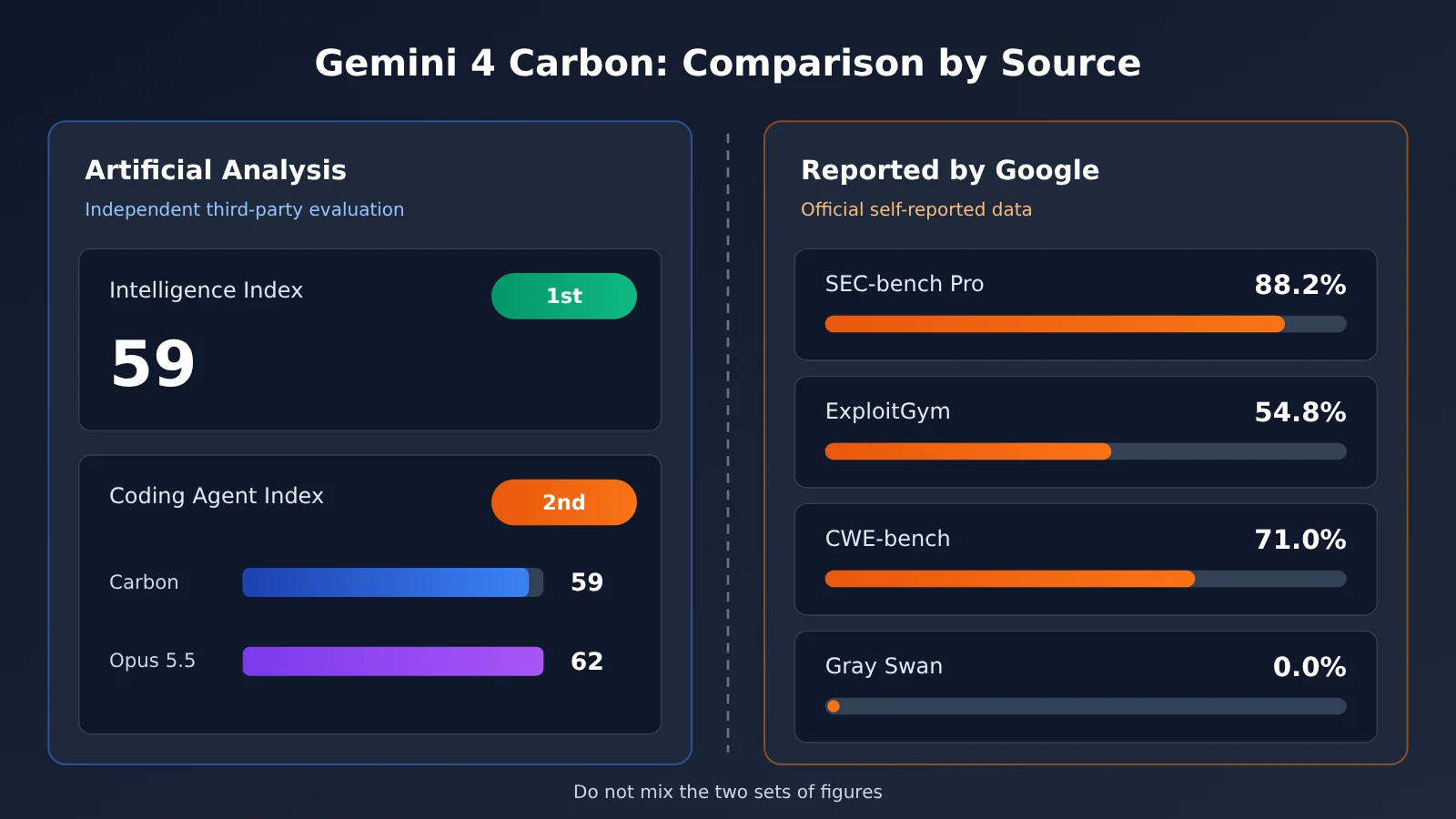
The first number carries the most weight because it comes from a third party. The other two are from Google’s own testing, and AA notes that third parties can’t currently reproduce them. Keep that in mind when reading those figures: they’re results reported by Google, and no one outside Google has verified them yet.
Gemini 4 Carbon at a Glance
Carbon is the second Gemini 4 model Google has released in two weeks. Argon became available to developers on October 13, 2026, and Carbon followed on October 28. Google calls Carbon its “most capable model,” with a focus on cybersecurity and long-running tasks.
| Item | Details |
|---|---|
| Release date | October 28, 2026 (two weeks after Gemini 4 Argon became available) |
| Released by | Google / Google DeepMind |
| Official positioning | Google’s most capable model, focused on state-of-the-art cybersecurity and long-running tasks |
| Overall ranking | No. 1 on the AA Intelligence Index v5.0 (59 points) |
| Launch pricing | $2 input, $10 output per million tokens; $0.10 for cached input, the same as Argon |
| Post-introductory pricing | $4 / $20 per million tokens; Google hasn’t announced when the introductory period ends |
| API model ID | Not provided by Google; AA lists it as “No publicly available API” |
| Availability | Initially available only to cybersecurity defenders in the Fairwind program |
The pricing deserves a closer look. AA calls the launch price a “50% launch discount,” meaning the price will double after the introductory period. Argon has a published end date for its introductory period, but Carbon doesn’t. So estimating long-term costs using the launch price could be overly optimistic.
How Gemini 4 Carbon Improves on Argon
Compared with Argon, released two weeks earlier, Carbon’s three biggest gains in Google’s published figures are:
- The AA Index score rose from 50 to 59.
- The GraphWalks long-context score rose from 84.2% to 96.2%.
- The SWE-sweep coding agent benchmark score rose from 4.3% to 9.6%.
Google also says Carbon succeeds at generating secure code more than twice as often as Argon.
Google says its internal teams observed Carbon running for days at a time, locating and fixing hidden bugs in large codebases and low-level systems. This is an internal Google observation, not a result reproduced by a third party. The Chrome team says the quality of Carbon’s generated patches was more than 10 times better than those from “a large frontier model from another lab.” That’s also a customer and internal claim, and Google didn’t identify the model used for comparison.
Beyond official claims, there’s also some output from early users. On October 22, X user @thtbee_ shared the results of using Carbon to recreate two reference images: the entire scene was generated with three.js, and the user said it took 1 hour and 40 minutes. The video shows two versions with different color schemes and camera angles, Aurum and Viola. Visual recreations like this—judging whether they look right and run properly—are among the few ways to see Carbon’s output quality directly. But this is still a user’s account, not a reproducible evaluation.

Image: The recreation shared by X user @thtbee_, generated with three.js and reportedly completed in 1 hour and 40 minutes (source: @thtbee_, October 22, 2026).
Gemini 4 Carbon’s Official 17-Benchmark Comparison: 15 Wins, 2 Losses
The table below shows all 17 benchmarks from the Google DeepMind methodology page. Carbon ranks first on 15, losing the other 2 to competing models.
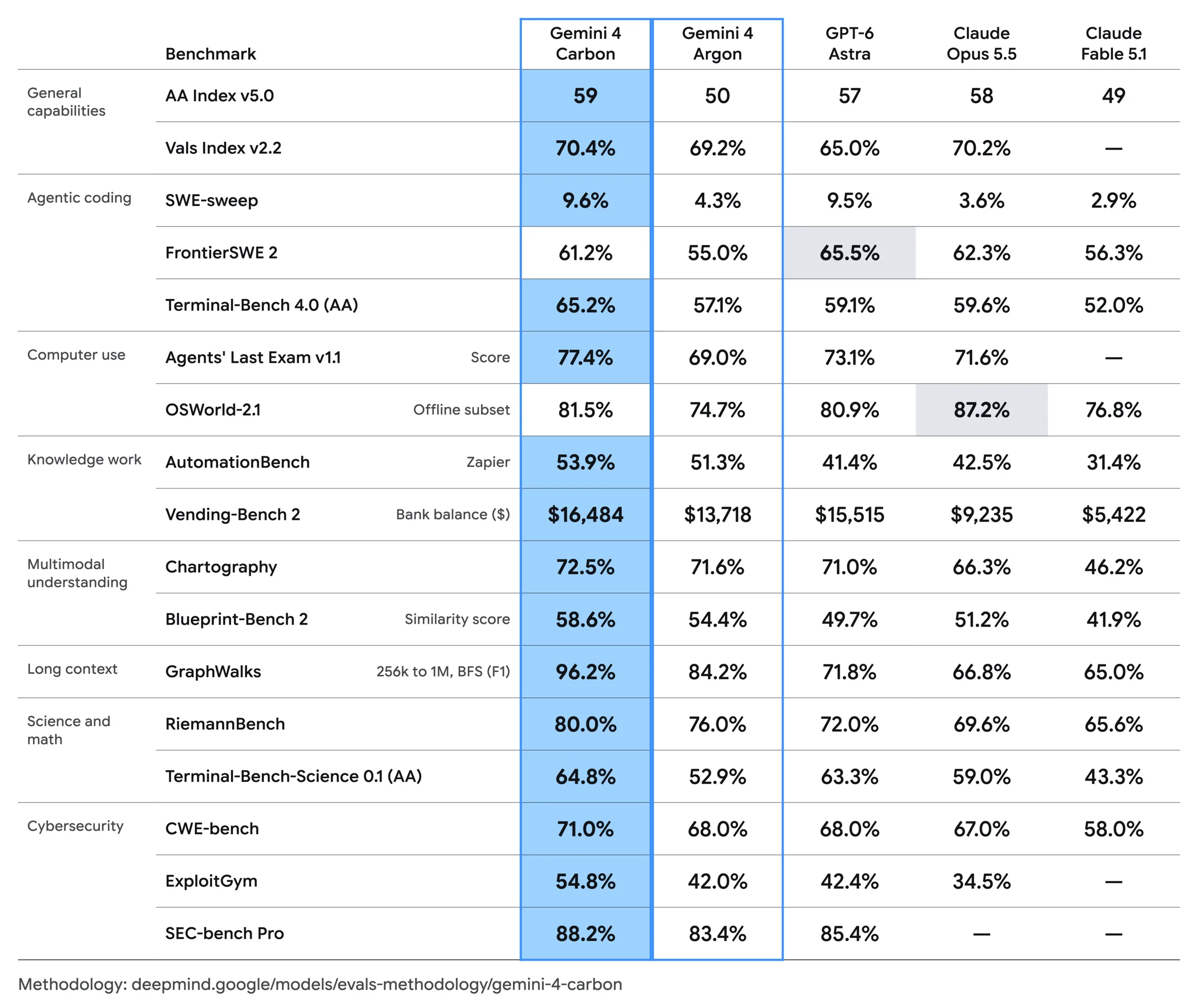
Figure: Google DeepMind’s official 17-benchmark comparison, with Carbon’s 15 leads marked in blue. Competing models outscore it on FrontierSWE 2 and OSWorld 2.1 (source: @GoogleDeepMind, 2026-10-28).
| Category | Benchmark | Gemini 4 Carbon | Gemini 4 Argon | GPT-6 Astra | Claude Opus 5.5 | Claude Fable 5.1 |
|---|---|---|---|---|---|---|
| General capabilities | AA Index v5.0 | 59 | 50 | 57 | 58 | 49 |
| General capabilities | Vals Index v2.2 | 70.4% | 69.2% | 65.0% | 70.2% | — |
| Coding agents | SWE-sweep | 9.6% | 4.3% | 9.5% | 3.6% | 2.9% |
| Coding agents | FrontierSWE 2 | 61.2% | 55.0% | 65.5% | 62.3% | 56.3% |
| Coding agents | Terminal-Bench 4.0 (AA) | 65.2% | 57.1% | 59.1% | 59.6% | 52.0% |
| Computer use | Agents’ Last Exam v1.1 | 77.4% | 69.0% | 73.1% | 71.6% | — |
| Computer use | OSWorld-2.1 (offline subset) | 81.5% | 74.7% | 80.9% | 87.2% | 76.8% |
| Knowledge work | AutomationBench (Zapier) | 53.9% | 51.3% | 41.4% | 42.5% | 31.4% |
| Knowledge work | Vending-Bench 2 (ending balance) | $16,484 | $13,718 | $15,515 | $9,235 | $5,422 |
| Multimodal understanding | Chartography | 72.5% | 71.6% | 71.0% | 66.3% | 46.2% |
| Multimodal understanding | Blueprint-Bench 2 | 58.6% | 54.4% | 49.7% | 51.2% | 41.9% |
| Long context | GraphWalks (256k–1M, BFS F1) | 96.2% | 84.2% | 71.8% | 66.8% | 65.0% |
| Science and math | RiemannBench | 80.0% | 76.0% | 72.0% | 69.6% | 65.6% |
| Science and math | Terminal-Bench-Science 0.1 (AA) | 64.8% | 52.9% | 63.3% | 59.0% | 43.3% |
| Cybersecurity | CWE-bench | 71.0% | 68.0% | 68.0% | 67.0% | 58.0% |
| Cybersecurity | ExploitGym | 54.8% | 42.0% | 42.4% | 34.5% | — |
| Cybersecurity | SEC-bench Pro | 88.2% | 83.4% | 85.4% | — | — |
The Two Benchmarks Gemini 4 Carbon Lost
Both benchmarks Carbon lost involve practical coding or computer use:
- FrontierSWE 2: Carbon scored 61.2%, trailing GPT-6 Astra at 65.5% and Claude Opus 5.5 at 62.3%. Carbon ranked third on this benchmark.
- OSWorld-2.1: Carbon scored 81.5%, losing to Claude Opus 5.5 at 87.2%—a gap of nearly 6 percentage points.
If you mainly use models for coding agents or computer-use agents, these two benchmarks are more useful than the overall AA score. Some of Carbon’s leads are also very narrow: it’s just 0.1 percentage points ahead of GPT-6 Astra on SWE-sweep and 0.2 points ahead of Opus 5.5 on Vals Index. Those are essentially ties.
What to Know Before Reading the Gemini 4 Carbon Comparison Table
Google’s methodology page spells out several caveats that directly affect how to read the table:
- Carbon and Argon scores are pass@1, using the highest thinking setting in the Gemini API. Neither majority voting nor parallel test-time compute is allowed.
- Unless otherwise noted, scores for non-Gemini models come from numbers published by their respective developers. That means the table wasn’t produced by a single evaluator running all the models in the same environment.
- OSWorld 2.1 uses an offline subset of 82 tasks. GraphWalks uses a subset of 200 questions with context lengths from 256k to 1M.
- SEC-bench Pro averages three independent attempts per question. ExploitGym uses a default timeout of six hours per question, with mitigations disabled.
- AA Index and Terminal-Bench 4.0 come from Artificial Analysis; FrontierSWE comes from Proximal’s public leaderboard; Vending-Bench 2 and Blueprint-Bench 2 come from Andon Labs; and CWE-bench is evaluated consistently by Collinear AI.
What “No. 1” Means for Gemini 4 Carbon
The claim that Carbon is “No. 1 in the world” holds up, but only for the overall Intelligence Index. Other rankings published by Artificial Analysis show that Carbon doesn’t lead in every category.
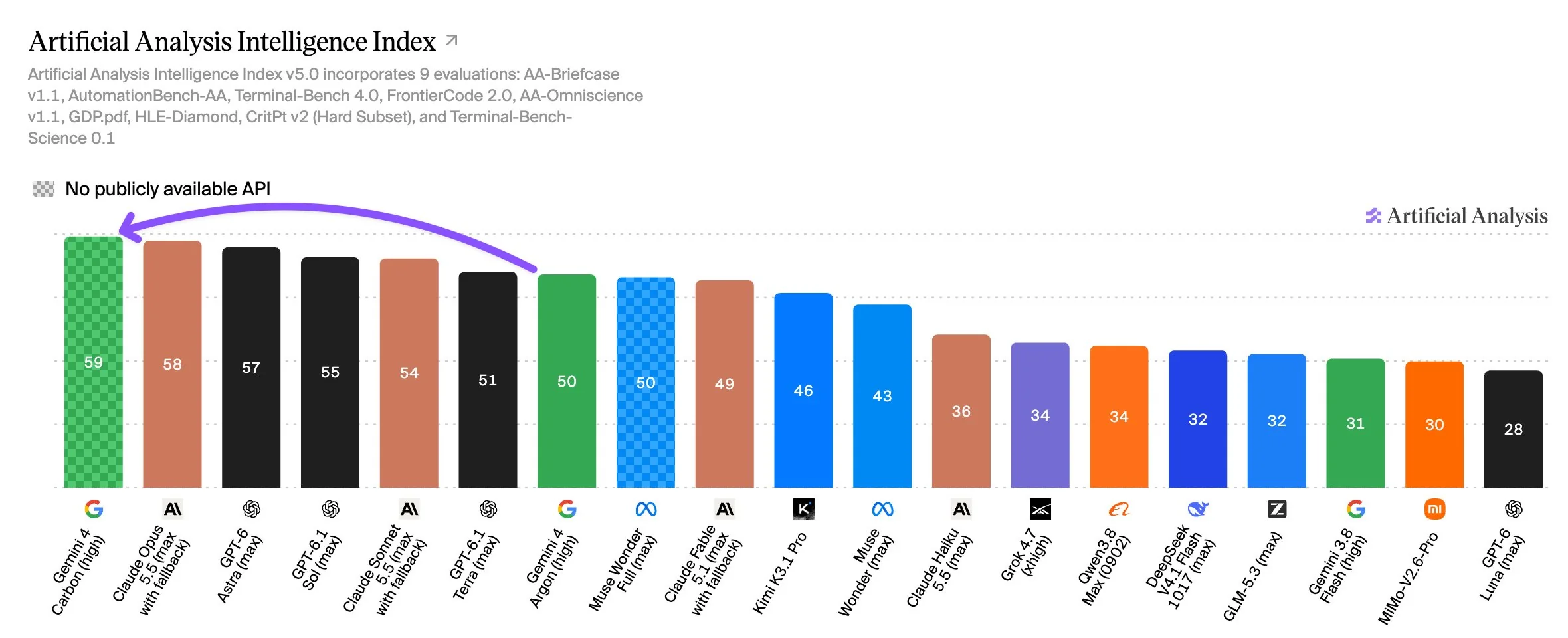
Figure: Artificial Analysis Intelligence Index v5.0. Carbon ranks first with 59 points, followed by Claude Opus 5.5 (Max) with 58. The chart also notes that Carbon has “No publicly available API” (source: @ArtificialAnlys, 2026-10-28).
| Metric | Gemini 4 Carbon | Comparison | Result | Source |
|---|---|---|---|---|
| Intelligence Index v5.0 | 59 | Claude Opus 5.5 (Max): 58 | First | Independent Artificial Analysis evaluation |
| Coding Agent Index | 59 (Antigravity CLI, high) | Claude Code + Opus 5.5 (max): 62 | Second, 3 points behind | Independent Artificial Analysis evaluation |
| Terminal-Bench 4.0 | 64% | Opus 5.5 (max): 56% | Ahead | Independent Artificial Analysis evaluation |
| FrontierCode v1.1 | 51% | Opus 5.5: 56% | Behind | Independent Artificial Analysis evaluation |
| SEC-bench Pro / ExploitGym / CWE-bench | 88.2% / 54.8% / 71.0% | — | Google claims it leads | Published by Google |
Carbon ranks only second on the Coding Agent Index. In AA’s Coding Agent Index, Carbon scores 59 points, while Claude Code with Opus 5.5 scores 62. Of the nine components in the Intelligence Index, Carbon ranks first in only four: HLE-Diamond, Terminal-Bench-Science, AA-Omniscience, and AutomationBench-AA. It doesn’t rank first in either coding or knowledge work.
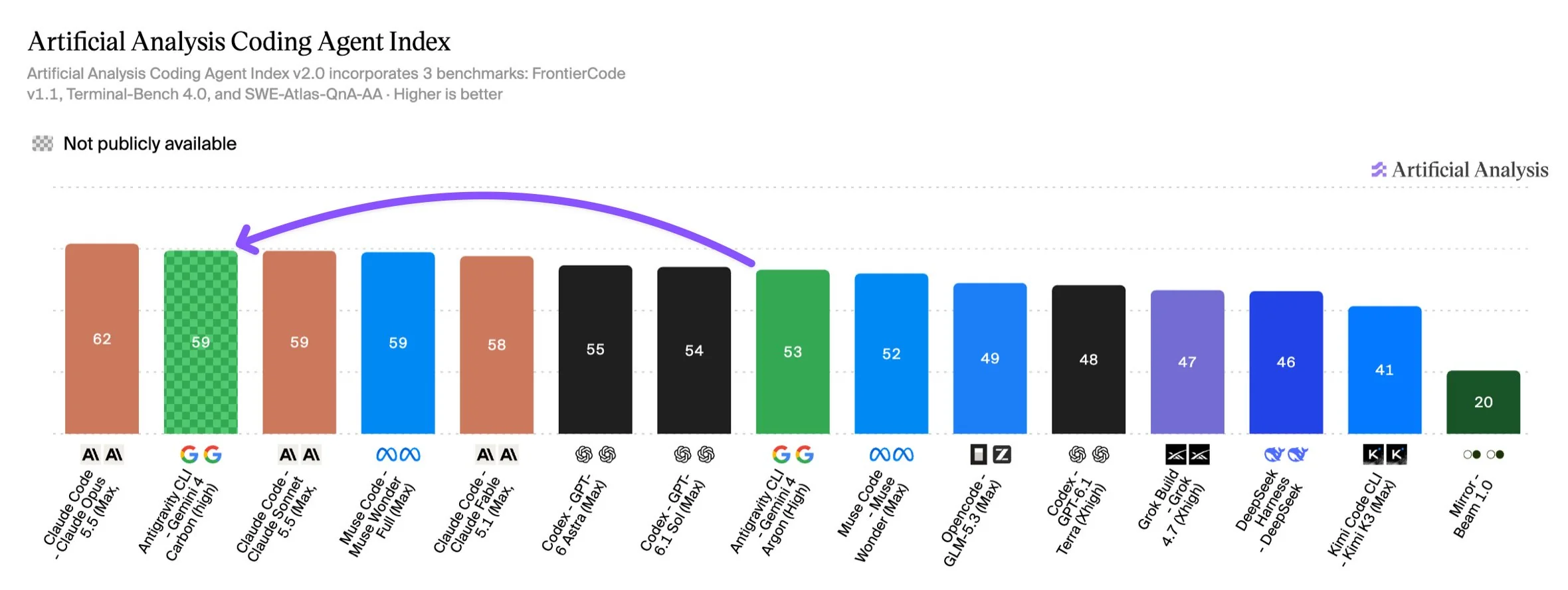
Figure: Artificial Analysis Coding Agent Index. Claude Code with Opus 5.5 (Max) ranks first with 62 points, while Antigravity CLI with Gemini 4 Carbon ranks second with 59 (source: @ArtificialAnlys, 2026-10-28).
There’s another difference in reporting worth noting. The official table lists Carbon’s Terminal-Bench 4.0 score as 65.2%, while AA’s tweet reports 64%—a difference of about one percentage point. When citing the score, specify the source and don’t mix the two figures.
💡 Selection advice: Carbon isn’t available to use yet, so leaderboard scores can only serve as a reference. Before choosing a coding agent, try it on your own codebase. With APIYI at apiyi.com, you can use the same API key to switch between Claude, GPT, Gemini, and other models, making side-by-side comparisons easier.
Why You Can’t Access Gemini 4 Carbon Yet
The clearest takeaway from this release is that Carbon isn’t available to most developers yet. Here’s why, based on official and third-party information:
- There’s no API model ID: The official announcement didn’t provide a model ID for Carbon, and its AA leaderboard page says “No publicly available API.”
- There’s no release timeline: Google’s official account said “as soon as possible,” but didn’t give a specific date.
- Initial access is limited to security teams in the Fairwind program: Fairwind currently has more than 650 partners. Priority goes to national cybersecurity agencies, critical infrastructure operators in sectors like healthcare, telecommunications, energy, and finance, and major technology platforms.
- Background checks are required: Organizations must apply through their Google Cloud customer team, and Google will verify their security history and operational track record. Participants must also have user-level authentication and phishing-resistant MFA. Access can only be granted to internal security, incident response, and penetration testing teams, and organizations must log employee access and usage.
- Access can’t be resold: Google explicitly prohibits partners from sharing, redistributing, or selling access to frontier models. So if someone claims they can “resell Carbon access,” it’s almost certainly not credible.
Sundar Pichai said on X that “Some trusted cyber defenders will get access starting this week.” Access will then expand through Fairwind. He ended with “so hang tight!”—in other words, everyone else will have to wait. Logan Kilpatrick said much the same: “Carbon is rolling out first to cyber defenders and we are working to make it more widely available soon!”
Both used the word “soon,” but neither gave a date. When Argon launched, Google AI Pro and Ultra subscribers and paying API developers could use it that same day. At Carbon’s launch, neither the general public nor most developers could access it. Quite a few people online have expressed frustration with this “announce now, open access much later” approach.
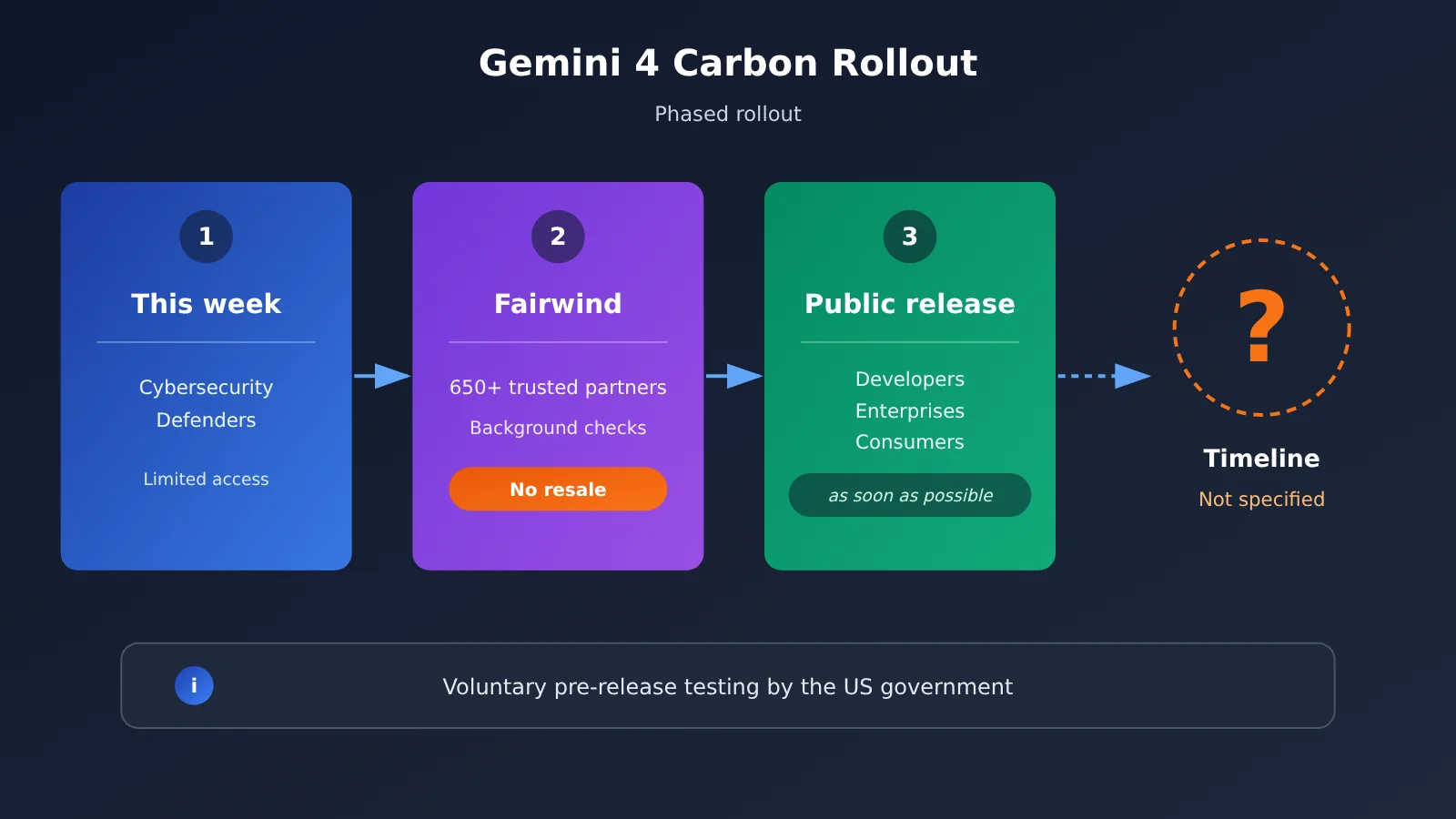
Google is also participating in the US government’s voluntary pre-release testing process for frontier models. Carbon has strong offensive and defensive cybersecurity capabilities, and its official security benchmark results were measured with guardrails disabled, so a phased rollout makes sense. For developers, though, that also means there’s no way to estimate when they’ll be able to use it based on Google’s announcements.
Which Gemini 4 model can you use now?
If you want to integrate a Gemini 4 model into your project today, Gemini 4 Argon is available now. APIYI has already added it to the platform:
- Model ID:
gemini-4-argon - Supported endpoints:
chat(OpenAI-compatible) andgemini(native format) - OpenAI-compatible base_url:
https://api.apiyi.com/v1 - Available groups:
default,svip - Pricing: $2 for input, $10 for output, and $0.10 for cache reads, all per million tokens, billed by usage
- Model documentation:
https://docs.apiyi.com/models/gemini-4-argon - Pricing endpoint:
https://api.apiyi.com/api/pricing
There’s one date to keep in mind: Argon’s official introductory pricing ends on 2026-11-30. After that, it doubles to $4 for input and $20 for output per million tokens. If your application uses a lot of tokens each month, budget using the post-November pricing rather than the introductory rates. For the latest model availability and pricing, check the model list on APIYI at apiyi.com.
| Model | Current status | Introductory pricing (input/output) | Post-introductory pricing | Available platforms |
|---|---|---|---|---|
gemini-4-argon |
Available now | $2 / $10 | $4 / $20 (after 2026-11-30) | APIYI apiyi.com, Google’s official API |
| Gemini 4 Carbon | Fairwind security team only | $2 / $10 | $4 / $20 (official end date not announced) | No public API yet |
As for Carbon: on October 29, APIYI’s pricing endpoint listed 279 models, including gemini-4-argon but not Carbon. Carbon was also absent from the model registry generated on October 27 because it wasn’t released until October 28. We’ll add this model as soon as possible. Once Google makes the API public, Carbon will appear in the platform’s model list. At that point, you’ll only need to change the model parameter from gemini-4-argon to the new model ID—there’s no need to change your integration code.
🚀 Quick start: Use
gemini-4-argonnow to get your Gemini 4 integration up and running. Once Carbon is available, you’ll only need to change the model parameter. Sign up at APIYI apiyi.com and use the free testing credits for new users to see how Argon performs in your application.
Gemini 4 Carbon Impact Analysis
Impact on Developers in China
- No direct impact in the short term: Whether Carbon becomes available has little bearing on your technology choices this quarter. For production, focus on the models you can access today.
- You can start integrating the Gemini 4 series now: Carbon and Argon have the same launch pricing. Build your prompts and evaluation sets with Argon first, and you’ll be ready to compare them as soon as Carbon becomes available.
- No need to change your Coding Agent choice yet: Opus 5.5 still leads the AA Coding Agent Index and ranks first on OSWorld. If you’re already using a Claude model, there’s no need to change your approach for a model you can’t access yet.
- Long-context use cases are worth watching: Carbon’s 96.2% GraphWalks score, as reported by Google, is significantly higher than other models. Once Carbon is available, it’s worth testing for tasks like document retrieval and codebase understanding.
- Plan costs around the doubled price: Argon and Carbon’s introductory prices are both limited-time offers, so long-term budgets should use $4/$20.
Impact on the Industry
- Frontier model releases are accelerating: Just two weeks separated Argon and Carbon. Carbon, Opus 5.5, and GPT-6 Astra are only 1 to 2 points apart in the race for AA’s top spot, and the gap between leading models is narrowing.
- Cybersecurity capabilities are starting to limit access: When a model becomes capable enough at finding and exploiting vulnerabilities, vendors may give defenders access first, followed by the public. This “security teams first, developers later” approach could become more common.
- Treat official self-reported results with caution: Carbon’s results on three security benchmarks, along with claims that it can “run continuously for days” and is “10 times better,” haven’t been independently reproduced. Until third parties verify them, these figures should be treated as reference points only.
Frequently Asked Questions
Q1: Is Gemini 4 Carbon really the “world’s best” model?
There’s evidence for its top ranking in overall intelligence: Carbon scored 59 on Artificial Analysis’s independent Intelligence Index v5.0, one point ahead of Claude Opus 5.5. But on AA’s coding agent index, Carbon trails Opus 5.5 by 59 to 62. Carbon also lost on two benchmarks in Google’s official 17-benchmark comparison: FrontierSWE 2 and OSWorld-2.1.
Q2: What’s the difference between Gemini 4 Carbon and Argon?
According to Google’s published data, Carbon scores 59 on the AA index, while Argon scores 50. Its GraphWalks score rises from 84.2% to 96.2%, and its success rate for generating secure code is more than twice as high. Both launched at the same price. The biggest difference is availability: Argon is already open for use, while Carbon is currently available only to security teams.
Q3: When will Gemini 4 Carbon be available to developers?
Google hasn’t said. The company says “as soon as possible,” while Sundar Pichai and Logan Kilpatrick have both said “soon.” None has given a specific date. Google also hasn’t announced when Carbon’s introductory pricing will end.
Q4: What’s the quickest way to get started with the Gemini 4 series now?
Call `gemini-4-argon` directly. Register at APIYI apiyi.com to get an API key, set the OpenAI-compatible interface’s base_url to `https://api.apiyi.com/v1`, and set the model parameter to `gemini-4-argon`. Check the platform’s model list for available models and pricing. Once Carbon is listed, you can switch to it by changing the model parameter.
Q5: When will APIYI offer Gemini 4 Carbon?
We’ll make the model available as soon as possible. First, Google needs to release a public API and provide a model ID. Neither is available yet. Once listed, Carbon will appear in the model list at APIYI apiyi.com. Check that list for available models and pricing.
Q6: What are Gemini 4 Carbon’s known limitations?
There are three main limitations. First, there’s no public API yet, and resale of Fairwind access is prohibited. Second, the three security benchmark results and claims such as “running continuously for days” come from Google’s own tests or internal observations and can’t currently be independently reproduced. Third, the introductory price is temporary and will double to $4/$20 afterward, but no end date has been announced.
Gemini 4 Carbon Key Takeaways
- Its overall lead has third-party backing: In AA’s independent evaluation, Carbon scored 59, ahead of Opus 5.5’s 58.
- It’s not the top coding agent: On AA’s coding agent index, Carbon scored 59, behind Opus 5.5’s 62.
- It won 15 out of 17 tests: The two it lost were FrontierSWE 2 and OSWorld-2.1.
- Safety results come from Google’s own tests: The 88.2%, 54.8%, and 71.0% scores were all measured without guardrails enabled.
- It’s not available to call yet: There’s no model ID or release timeline, and initial access is limited to more than 650 partners in the Fairwind program.
- Argon is available now: APIYI has added
gemini-4-argon, with pricing doubling after 2026-11-30.
Summary
The key points about Gemini 4 Carbon come down to three things:
- It leads on capability, but the metric matters: It ranks first on AA’s overall index, while Claude Opus 5.5 still leads in coding agents and OSWorld.
- Google’s results still need verification: Most of the cybersecurity, long-running task, and alignment results were published by Google itself.
- You can’t use it anytime soon: There’s no API or timeline, and developers can’t currently apply for access.
For developers in China, a practical approach is to start using Argon to connect to the Gemini 4 series and prepare your own evaluation suite, so you can compare models as soon as Carbon becomes available. We recommend accessing gemini-4-argon through APIYI at apiyi.com. You can also use the same API key to call Claude and GPT for side-by-side testing. We’ll make Carbon available as soon as possible; check the platform’s model list for the model ID and pricing.
📚 References
- Google Official Blog: Introducing Gemini 4 Carbon: Announcement, pricing, and rollout schedule
- Link:
blog.google/innovation-and-ai/models-and-research/gemini-models/introducing-gemini-4-carbon -
Details: Source for the official positioning, results across three safety measures, and introductory pricing footnotes
-
Google DeepMind: Gemini 4 Carbon Evaluation Methodology: 17-metric comparison table and evaluation criteria
- Link:
deepmind.google/models/evals-methodology/gemini-4-carbon -
Details: Explains the pass@1 settings and sources for non-Gemini model scores
-
Google DeepMind: Fairwind Program: Rules for the initial access program
- Link:
deepmind.google/fairwind-program -
Details: Covers the 650-plus partners, background checks, and restrictions such as the ban on resale
-
Artificial Analysis Rankings: Independent third-party evaluations
- Link:
artificialanalysis.ai -
Details: Intelligence Index v5.0 and Coding Agent Index rankings
-
APIYI Gemini 4 Argon Documentation: A currently available Gemini 4 model
- Link:
docs.apiyi.com/models/gemini-4-argon -
Details: Model ID, endpoints, and pricing
-
Original material on X: Sources for the images in this article
- Official comparison table:
x.com/GoogleDeepMind/status/2115489356437651654(2026-10-28) - Two leaderboard screenshots:
x.com/ArtificialAnlys/status/2115494553780367384(2026-10-28) - three.js recreation demo:
x.com/thtbee_/status/2113301369826464147(2026-10-22)
Author: APIYI Technical Team
Get in touch: Contact us through the APIYI homepage at apiyi.com. For more resources, visit the documentation center at docs.apiyi.com.