ByteDance's Seedance 2.0 video generation model has become a sensation since its February release, hailed as the "DeepSeek moment" in video generation. Volcano Engine has already published the Seedance 2.0 API pricing page, though the API interface hasn't officially launched yet. This article provides a detailed breakdown of Seedance 2.0 API's three-tier pricing structure, core capabilities, and how developers can prepare ahead of the API's official release.
Core Value: Master the complete pricing structure of Seedance 2.0 API, compare costs with Sora 2 / Kling 3.0, and discover alternative integration options before the API goes live.
Seedance 2.0 API Pricing Structure Breakdown
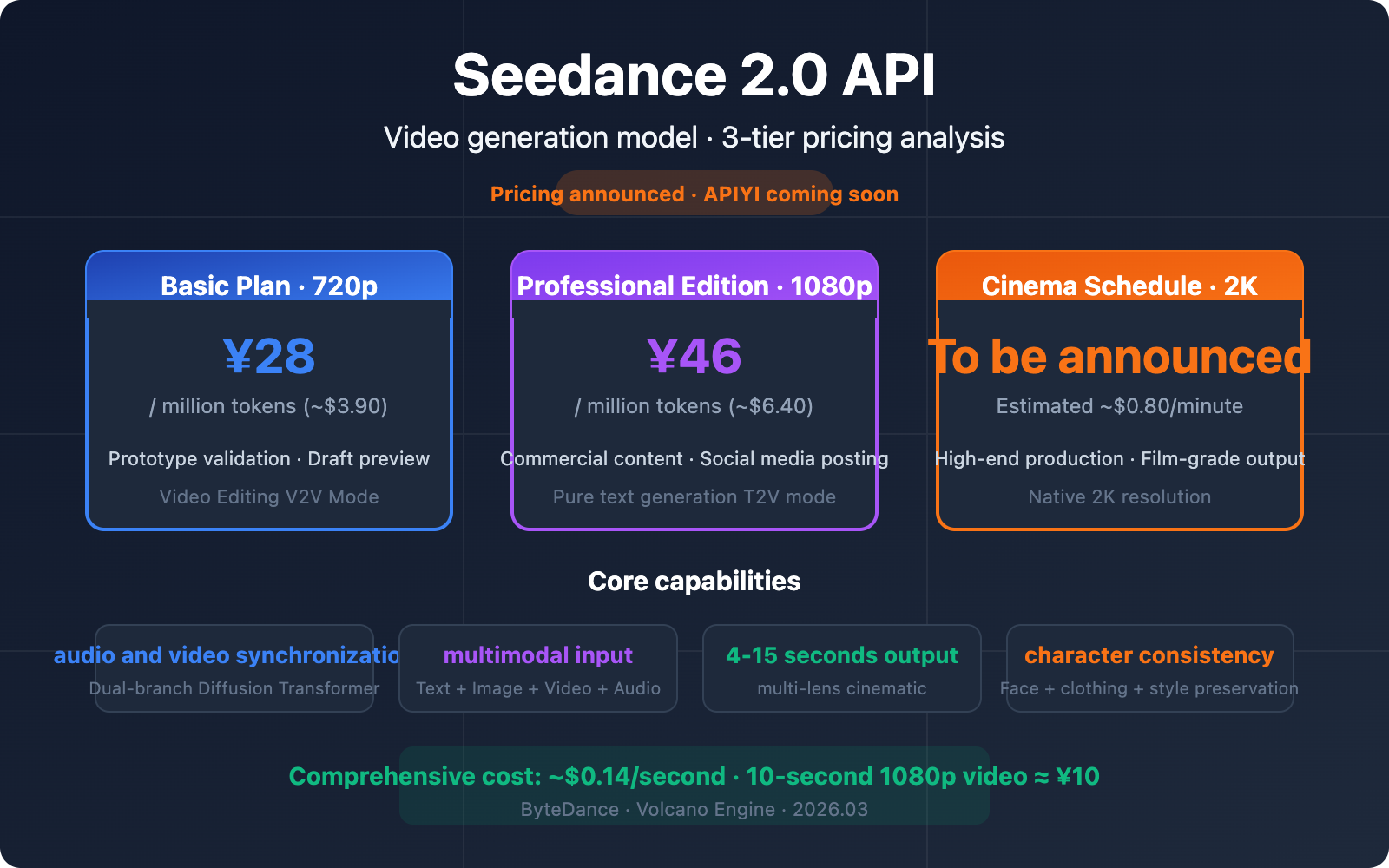
Volcano Engine has published the API billing plan for Seedance 2.0 on its pricing page. The Seedance 2.0 API uses a pay-as-you-go model, with different tiers based on resolution and input type.
Seedance 2.0 Official API Pricing
| Pricing Tier | Resolution | Price (CNY) | USD Equivalent | Use Case |
|---|---|---|---|---|
| Basic | 720p | ¥28 / million tokens | ~$3.90/M tokens | Prototype validation, draft preview |
| Professional | 1080p | ¥46 / million tokens | ~$6.40/M tokens | Commercial content, social media publishing |
| Cinema | 2K | TBD | Estimated ~$0.80/minute | High-end production, cinema-grade output |
📊 Pricing Notes: The basic and professional tier prices above come from Volcano Engine's published pricing page. Based on a combined cost of approximately $0.14 per second, generating a 10-second 1080p video costs about $1.40 (roughly ¥10). Cinema tier pricing hasn't been officially announced yet; the above is an industry estimate.
It's important to note that Seedance 2.0 API distinguishes between two input modes with different pricing:
| Input Mode | Token Price | Description |
|---|---|---|
| Text-to-Video (T2V) | ¥46 / million tokens | Generate video directly from text descriptions |
| Video-to-Video (V2V) | ¥28 / million tokens | Edit or apply style transfer based on reference video |
This means if you already have reference material (like a dance motion reference video), using video-to-video mode costs about 40% less than pure text-to-video generation. This is a cost optimization strategy worth paying attention to.
Seedance 2.0 API Current Status and Launch Timeline
This is the question developers care about most: Seedance 2.0 API hasn't officially launched yet.
Seedance 2.0 API Timeline
| Date | Event | Status |
|---|---|---|
| 2026.02.10 | Seedance 2.0 model officially released | ✅ Completed |
| 2026.02.12 | Jimeng App opens for testing | ✅ Completed |
| 2026.02.24 | Volcano Engine API originally scheduled launch | ❌ Delayed |
| 2026.03.06 | Pricing page live, API not yet available | 🔄 Current status |
| TBD | API official launch | ⏳ Pending |
Why Seedance 2.0 API Launch Was Delayed
The Seedance 2.0 API delay is driven by several key factors:
Copyright controversy pressure: After Seedance 2.0's release, some users generated highly realistic celebrity videos, triggering strong reactions from Hollywood. ByteDance has suspended sensitive features like "photo-to-voice" and strengthened content safety review mechanisms.
Enhanced compliance requirements: Before opening the API, ByteDance needs to complete these safety measures:
- Stress testing of real-time content filtering systems
- Full deployment of mandatory watermark marking mechanisms
- Face similarity detection and celebrity portrait protection
- Regional regulatory compliance reviews
Technical stability: As a complex system handling multimodal inputs (text + images + video + audio), API-level concurrency stability and response time optimization are still underway.
🎯 Developer tip: Before Seedance 2.0 API officially launches, you can use Seedance 1.5 Pro or other video generation models (like Kling 3.0) through the APIYI platform at apiyi.com for development and testing. You'll be able to switch seamlessly once the API goes live.
Seedance 2.0 Core Capabilities Breakdown
Seedance 2.0 is called the "DeepSeek moment in video generation" because of its breakthrough capabilities across multiple dimensions.
Seedance 2.0 Technical Specifications Overview
| Technical Metric | Seedance 2.0 Specs | Industry Significance |
|---|---|---|
| Architecture | Dual-branch diffusion Transformer | Synchronized audio-video generation |
| Input modalities | Text + images + video + audio | Most comprehensive in the industry |
| Output duration | 4-15 seconds per generation | Supports multi-shot transitions |
| Maximum resolution | Native 2K | Broadcast-quality output |
| Aspect ratios | 16:9 / 9:16 / 4:3 / 3:4 / 21:9 / 1:1 | Full scenario coverage |
| Audio generation | Native synchronized | No post-production voiceover needed |
| Character consistency | Face + clothing + style preservation | Production-ready quality |
Seedance 2.0's 4 Core Capabilities
1. Native synchronized audio-video generation
Unlike other video generation models that create silent videos first and add audio in post-production, Seedance 2.0 uses a dual-branch diffusion Transformer architecture that processes visual and audio signals simultaneously during generation. This means:
- When instruments are played, finger movements sync perfectly with the notes
- Dance movements align precisely with background music beats
- Environmental sounds (footsteps, water, wind) match the scene naturally
2. Multimodal reference input (@ reference system)
Seedance 2.0's innovative @ reference system lets users specify multiple reference materials simultaneously:
@person photo+@dance video+@background music→ generates that person dancing the specified choreography in sync@product image+text description→ generates e-commerce product showcase video@reference video→ precisely replicates camera movement and action choreography
3. Multi-shot cinematic-quality output
In a single 15-second generation, Seedance 2.0 can automatically plan multiple shots with natural transitions and editing rhythm, producing short films that approach professional editing standards.
4. High-fidelity character consistency
Major advances in cross-frame character preservation keep facial features, clothing details, and visual style stable throughout the entire video, meeting commercial content production consistency requirements.
Seedance 2.0 API Pricing vs. Competitors
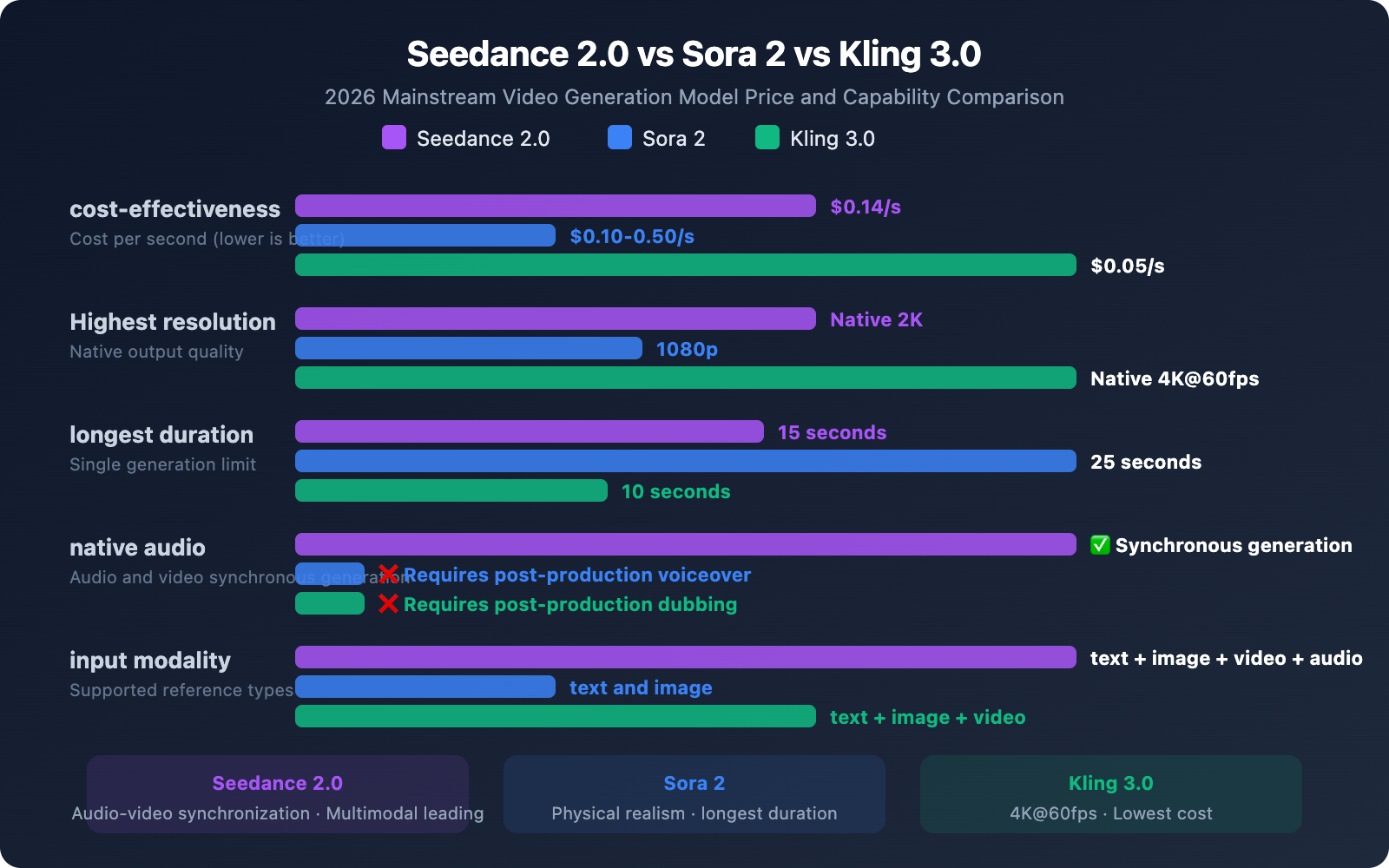
When evaluating Seedance 2.0 API pricing, it's crucial to compare it side-by-side with mainstream competitors:
| Comparison Dimension | Seedance 2.0 | Sora 2 | Kling 3.0 |
|---|---|---|---|
| Cost per second | ~$0.14 | $0.10-0.50 | ~$0.05 |
| 10-second video cost | ~$1.40 | $1.00-5.00 | ~$0.50 |
| Maximum resolution | Native 2K | 1080p | Native 4K |
| Maximum duration | 15 seconds | 25 seconds | 10 seconds |
| Frame rate | 30fps | 30fps | 60fps |
| Native audio | ✅ Synchronized generation | ❌ Requires post-production | ❌ Requires post-production |
| Multimodal input | Text + Image + Video + Audio | Text + Image | Text + Image + Video |
| API status | Pricing announced, not yet live | Live | Live |
| Available platforms | Volcano Engine (coming soon) | OpenAI API | APIYI and other platforms |
Seedance 2.0 API Pricing Competitiveness Analysis
From a pricing perspective, Seedance 2.0 occupies a middle position:
- Cheaper than Sora 2: In standard mode, costs roughly one-third of Sora 2's Pro mode
- More expensive than Kling 3.0: About 2-3 times the cost of Kling 3.0
- Unique value: Native audio synchronization is a differentiation capability that other models don't offer
For scenarios requiring synchronized audio-video output (music videos, dance content, voice-over ads), Seedance 2.0's total cost is actually lower because it eliminates post-production dubbing and audio-visual synchronization work.
💡 Selection recommendation: Which video generation model you choose depends on your core needs. If you need audio-video synchronization, Seedance 2.0 is the top choice; if you need ultimate image quality, go with Kling 3.0; if you need physical realism, choose Sora 2. We recommend testing different models through the APIYI platform at apiyi.com to compare and find the solution that best fits your use case.
Seedance 2.0 API Integration Preparation and Alternative Solutions
While the Seedance 2.0 API hasn't officially launched yet, developers can get technically prepared ahead of time.
Expected Interface Specifications for Seedance 2.0 API
Based on Volcano Engine's API design patterns, the Seedance 2.0 API is expected to use the following invocation method:
import openai

client = openai.OpenAI(
    api_key="YOUR_API_KEY",
    base_url="https://vip.apiyi.com/v1"  # APIYI unified interface
)

# Text-to-video (T2V) invocation example
response = client.chat.completions.create(
    model="seedance-2.0",
    messages=[{
        "role": "user",
        "content": "A young woman dancing ballet under cherry blossom trees, cinematic quality, accompanied by soft piano music"
    }],
    extra_body={
        "video_params": {
            "resolution": "1080p",
            "duration": 10,
            "aspect_ratio": "16:9",
            "audio": True
        }
    }
)
View image-to-video (I2V) invocation example
import openai
import base64

client = openai.OpenAI(
    api_key="YOUR_API_KEY",
    base_url="https://vip.apiyi.com/v1"  # APIYI unified interface
)

# Read reference image
with open("character.jpg", "rb") as f:
    image_data = base64.b64encode(f.read()).decode()

# Image-to-video invocation
response = client.chat.completions.create(
    model="seedance-2.0",
    messages=[{
        "role": "user",
        "content": [
            {"type": "image_url", "image_url": {"url": f"data:image/jpeg;base64,{image_data}"}},
            {"type": "text", "text": "Have this character running on the beach at sunset with backlighting, slow motion"}
        ]
    }],
    extra_body={
        "video_params": {
            "resolution": "1080p",
            "duration": 8,
            "aspect_ratio": "16:9"
        }
    }
)
🚀 Quick Start: Before the Seedance 2.0 API officially launches, we recommend using the APIYI platform at apiyi.com to integrate already-available video generation models like Kling 3.0 and Sora 2 for development and testing. The platform provides a unified API interface, so you can switch to Seedance 2.0 with a single line change once it launches—no need to refactor your code architecture.
Alternative Solutions Before Seedance 2.0 API Launch
| Alternative | Core Advantages | Use Cases | Availability |
|---|---|---|---|
| Seedance 1.5 Pro | Interface compatible with 2.0 | Basic video generation | Available on APIYI and other platforms |
| Kling 3.0 | 4K@60fps, lowest cost | High-quality social media content | Available on APIYI and other platforms |
| Sora 2 | Strongest physical realism | Documentaries, B-roll | OpenAI API |
| Jimeng App | Native Seedance 2.0 experience | Effect validation, small-batch production | Already open |
Frequently Asked Questions
Q1: When will the Seedance 2.0 API officially launch?
Volcano Engine originally planned to launch the Seedance 2.0 API on February 24, 2026, but it's been delayed due to copyright disputes and content safety compliance issues. No new launch date has been announced yet. The pricing page has already gone live, indicating that technical preparations are essentially complete. The API is expected to open soon after completing content safety reviews. We recommend keeping an eye on Volcano Engine's official announcements, or checking the APIYI platform at apiyi.com for first-hand launch notifications and integration support.
Q2: How much does it cost to generate a 1-minute video with Seedance 2.0?
Based on the currently published pricing (approximately $0.14 per second), generating a 1-minute 1080p video would cost around $8.40 (roughly ¥60). However, Seedance 2.0 can generate a maximum of 15 seconds per request, so a 1-minute video requires four separate generations that are then stitched together. If you use video editing mode (V2V, ¥28 per million tokens) with reference materials, costs can be reduced by about 40%. Actual costs depend on video complexity and resolution choices. We recommend getting free testing credits through APIYI at apiyi.com to test it yourself.
Q3: Can I experience Seedance 2.0 now?
Yes, you can. While the API isn't yet available, you can experience Seedance 2.0 through these methods:
- Jimeng App: ByteDance's official application with full access to all Seedance 2.0 features
- Jimeng Web Version: Visit jimeng.jianying.com for online experience
- API Alternative: Use Seedance 1.5 Pro or Kling 3.0 through APIYI at apiyi.com for development
Summary
Key takeaways on Seedance 2.0 API pricing:
- Three clear pricing tiers: Basic tier (720p, ¥28/M token), Professional tier (1080p, ¥46/M token), Cinema tier (2K, pricing TBA), with combined costs around $0.14/second
- API not yet live: Volcano Engine's pricing page is published but API launch is delayed due to copyright disputes and content safety compliance concerns
- Mid-range value positioning: About 2/3 the cost of Sora 2, but 2-3x more expensive than Kling 3.0, though its native audio-video sync capability is unmatched
- Developers can prepare ahead: Uses a unified API interface approach, enabling seamless switching once live without code restructuring
Seedance 2.0's native audio-video synchronized generation capability stands out uniquely among current video generation models. For scenarios requiring audio-visual sync—like music videos, dance content, and voiced advertisements—its overall cost-effectiveness actually outperforms seemingly cheaper competitors.
We recommend testing your video generation workflows through the APIYI platform at apiyi.com in advance. The platform supports unified interface calls across multiple mainstream video models, and Seedance 2.0 can be seamlessly integrated once it launches.
📚 References
-
TechNode Report: Seedance 2.0 Video Model Pricing Analysis
- Link:
technode.com/2026/03/05/bytedances-seedance-2-0-video-model-costs-about-0-14-per-second/ - Description: Authoritative reporting on Seedance 2.0 API pricing and cost analysis
- Link:
-
Seedance Official Page: ByteDance Seed Model Official Website
- Link:
seed.bytedance.com/en/seedance2_0 - Description: Official technical specifications and feature overview for Seedance 2.0
- Link:
-
Volcano Engine: Seedance API Pricing and Documentation
- Link:
volcengine.com - Description: Official API pricing page and technical documentation, essential reading for integration
- Link:
Author: APIYI Technical Team
Technical Discussion: We welcome your feedback on Seedance 2.0 usage in the comments. For more video generation API integration resources, visit the APIYI documentation center at docs.apiyi.com