Deep Dive into Google Veo 3.1's Latest Update: 4K Resolution Output, Native 9:16 Vertical Video, Enhanced Ingredients to Video – Complete Analysis vs Sora 2 on AI Video Generation's New Landscape
On January 13, 2026, Google DeepMind dropped a major Veo 3.1 update, officially supporting 4K resolution output and native vertical video generation. This update elevates AI video generation to professional production standards, directly challenging OpenAI Sora 2's market position.
Core Value: Get up to speed in 3 minutes on Veo 3.1 4K update's key features, API access methods, and real-world application value to help you decide whether to upgrade.
Veo 3.1 4K Update Key Points
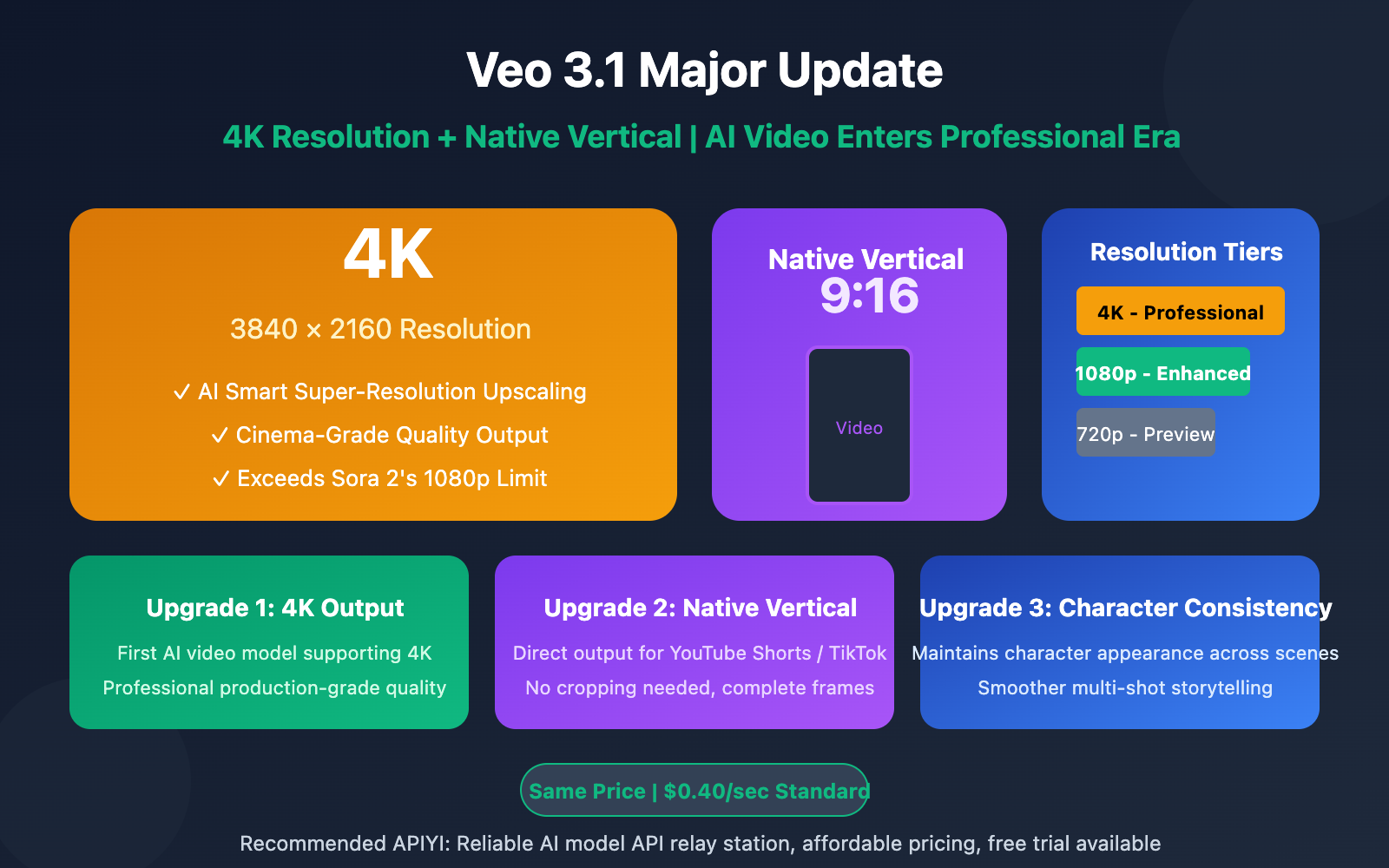
| Update Item | Details | Impact |
|---|---|---|
| 4K Resolution | Supports 4K (3840×2160) output | Meets professional production and large-screen playback needs |
| 1080p Enhanced | Sharper, more detailed 1080p quality | Top choice for everyday creation, richer details |
| Native Vertical | Native 9:16 vertical video support | No cropping needed, direct output for short-video platforms |
| Character Consistency | Maintains character appearance across scenes | Smoother multi-shot storytelling |
| Same Pricing | Standard $0.40/sec, Fast $0.15/sec | More features, same price |
Industry Significance of Veo 3.1's 4K Update
The biggest highlight of this update is 4K resolution output, making Veo 3.1 the only mainstream AI video generation model currently supporting 4K output. In comparison, OpenAI Sora 2's maximum resolution remains at 1080p.
For professional creators, 4K means:
- Cinema-grade quality: Suitable for commercials, promotional videos, and other commercial productions
- Large-screen playback: Can be displayed without quality loss on TVs, projectors, and other large screens
- Post-production flexibility: 4K footage can be cropped while maintaining 1080p+ clarity
- Future compatibility: Meets streaming platforms' increasingly higher quality requirements
Veo 3.1 4K: Three Major Upgrades Explained
Upgrade One: 4K Resolution + Enhanced 1080p
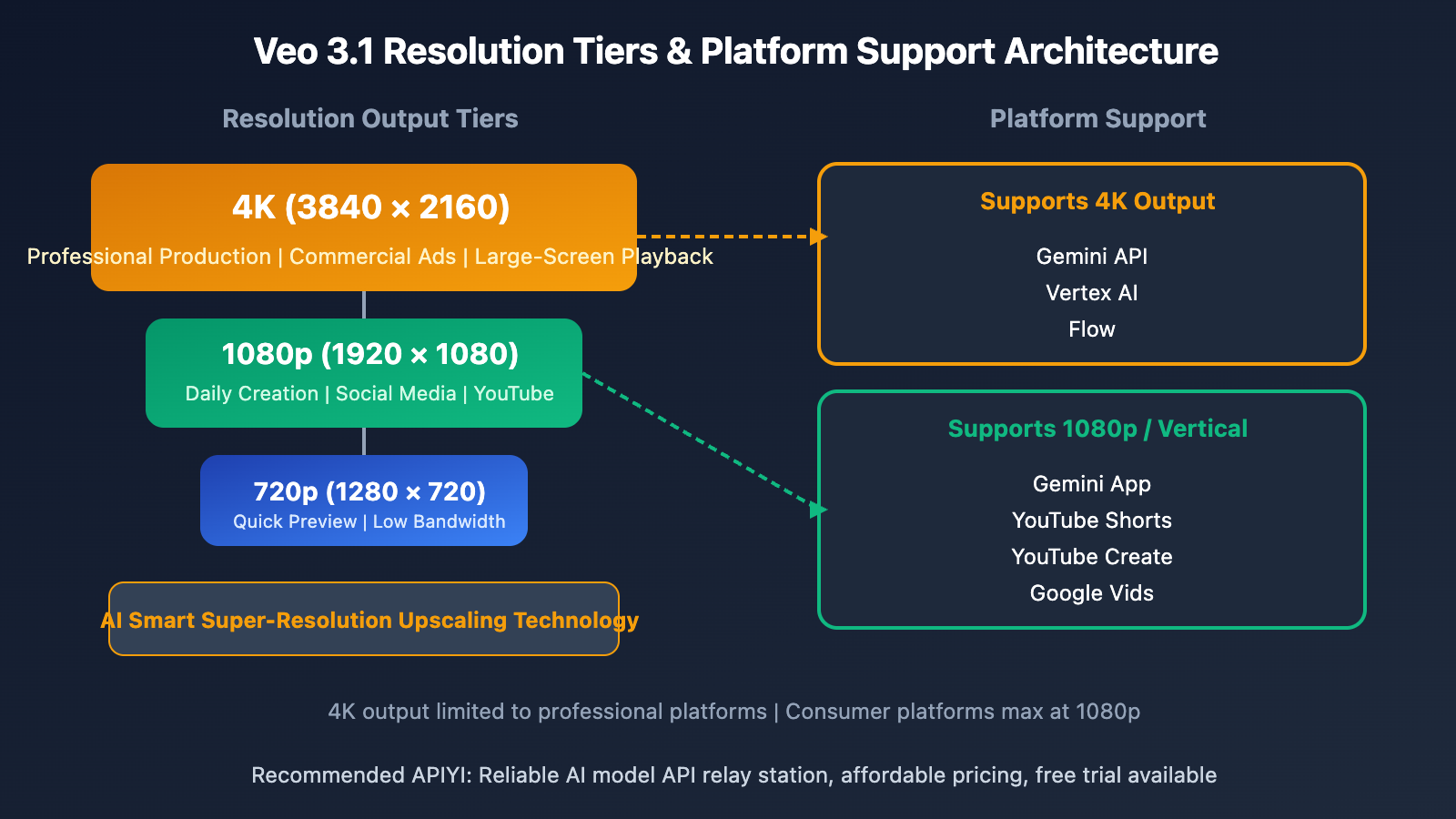
| Resolution | Pixels | Use Cases | Available Platforms |
|---|---|---|---|
| 4K | 3840 × 2160 | Professional production, large screen playback, commercial ads | Flow, Gemini API, Vertex AI |
| 1080p | 1920 × 1080 | Daily creation, social media, YouTube | All platforms |
| 720p | 1280 × 720 | Quick previews, low-bandwidth scenarios | All platforms |
Veo 3.1 uses advanced AI upscaling technology – it's not just simple pixel interpolation, but deep learning-based detail reconstruction. This means 4K output delivers:
- Sharper texture details
- More natural edge transitions
- More realistic lighting effects
Upgrade Two: Native 9:16 Vertical Video
This is a feature short-form video creators have been waiting for. Previously, creating vertical videos required:
- Generating 16:9 horizontal video
- Manually cropping to 9:16
- Losing significant frame content
Now, Veo 3.1 natively supports 9:16 vertical output, allowing creators to compose directly for platforms like:
- YouTube Shorts
- TikTok / Douyin
- Instagram Reels
- Xiaohongshu (RED) videos
Upgrade Three: Enhanced Ingredients to Video
The "Ingredients to Video" feature has also received major upgrades:
| Feature | Before | After |
|---|---|---|
| Reference Images | Up to 4 | Up to 4 (better results) |
| Character Consistency | Basic | Consistent across scenes |
| Expressions & Actions | Somewhat stiff | More natural and fluid |
| Short Prompts | Average results | High-quality content even with brief prompts |
Real-world Testing: When calling the Veo 3.1 API through API Yi (apiyi.com), even with short prompt descriptions, the generated character expressions and movements are noticeably more natural than before. Character appearance consistency across multiple shots in narrative scenarios has improved significantly.
Veo 3.1 4K API Integration Guide
Platform Support
| Platform | 4K Support | Vertical Support | Ingredients | Notes |
|---|---|---|---|---|
| Gemini API | ✅ | ✅ | ✅ | Developer's choice |
| Vertex AI | ✅ | ✅ | ✅ | Enterprise deployment |
| Flow | ✅ | ✅ | ✅ | Visual creation |
| Gemini App | ❌ | ✅ | ✅ | Personal users |
| YouTube Shorts | ❌ | ✅ | ✅ | Content creators |
Veo 3.1 4K API Call Example
import google.generativeai as genai
from google.genai import types

# Configure API (get more stable service through API Yi relay)
client = genai.Client(api_key="YOUR_API_KEY")

# Veo 3.1 4K video generation
response = client.models.generate_videos(
    model="veo-3.1",
    prompt="A young woman walking through Shibuya, Tokyo at night, neon lights flashing, cinematic quality",
    config=types.GenerateVideosConfig(
        aspect_ratio="16:9",      # or "9:16" for vertical
        duration_seconds=8,
        output_resolution="4k"    # New: 4K output
    )
)
View Complete Ingredients to Video 4K Example
import google.generativeai as genai
from google.genai import types

client = genai.Client(api_key="YOUR_API_KEY")

# Upload reference image
reference_image = client.files.upload("character_reference.jpg")

# Generate 4K vertical video using reference image
response = client.models.generate_videos(
    model="veo-3.1",
    prompt="Character drinking coffee in a café, sunlight streaming through the window",
    image=reference_image,  # Reference image
    config=types.GenerateVideosConfig(
        aspect_ratio="9:16",       # Native vertical
        duration_seconds=6,
        output_resolution="4k",    # 4K output
        enhance_prompt=True        # Enhanced prompt understanding
    )
)

# Get video result
video_url = response.generated_videos[0].video_uri
print(f"4K video generated: {video_url}")
Recommendation: Access the Veo 3.1 API through API Yi (apiyi.com) – the platform provides a unified interface with free testing credits, supporting 4K output and vertical video generation.
Veo 3.1 4K vs Sora 2 Comparison
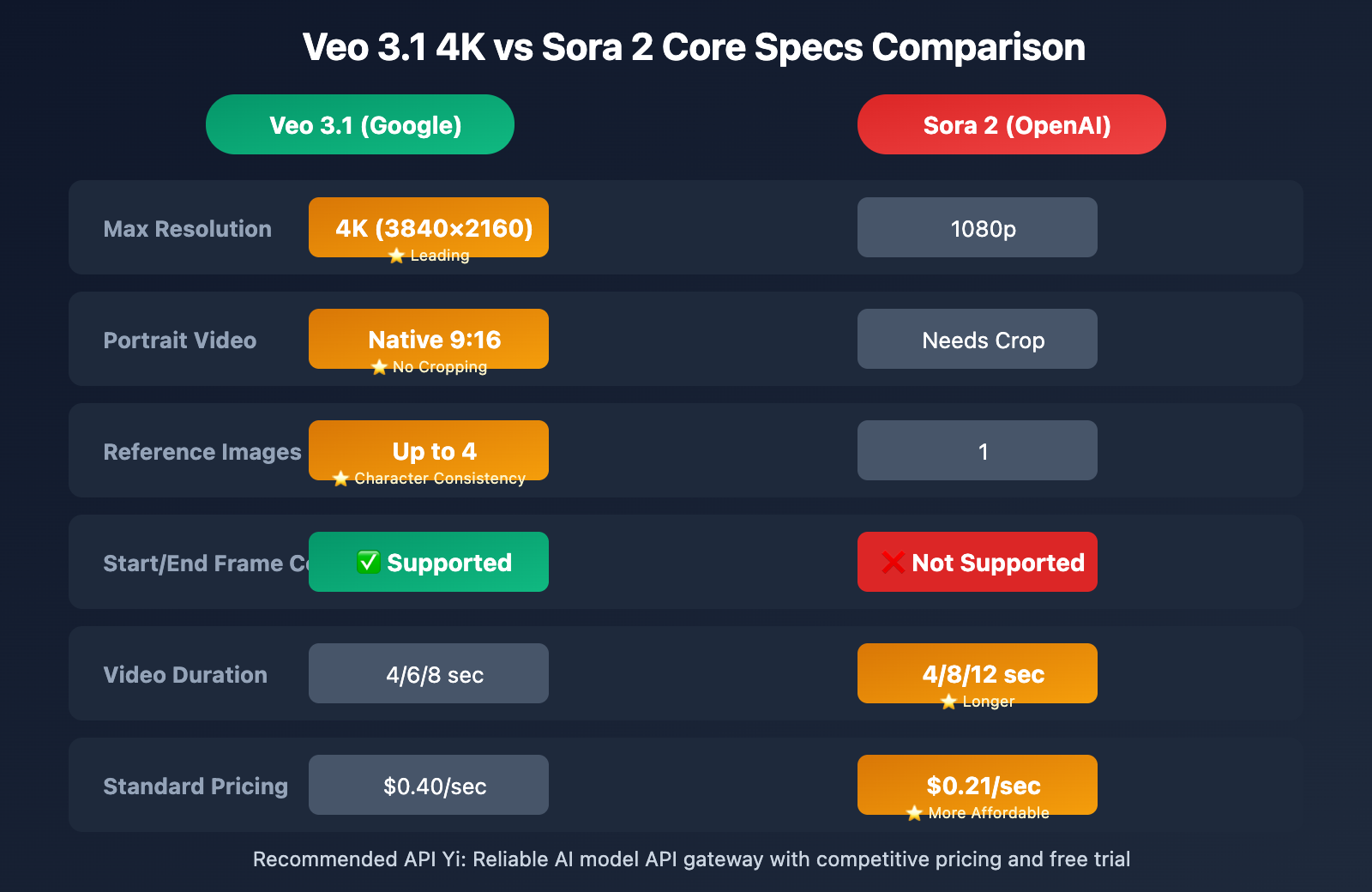
| Comparison | Veo 3.1 (Latest) | Sora 2 |
|---|---|---|
| Max Resolution | 4K (3840×2160) ⭐ | 1080p (1920×1080) |
| Portrait Support | Native 9:16 ⭐ | Requires cropping |
| Reference Images | Up to 4 | 1 |
| Start/End Frame Control | ✅ Supported | ❌ Not supported |
| Video Duration | 4/6/8 seconds | 4/8/12 seconds ⭐ |
| Audio Generation | ✅ Native support | ✅ Native support |
| Standard Pricing | $0.40/sec | $0.21/sec |
| API Availability | Gemini API / Vertex AI | OpenAI API |
How to Choose?
Choose Veo 3.1 4K if you need:
- Professional-grade 4K output quality
- Primarily creating portrait/vertical short-form content
- Multiple reference images for character consistency
- Precise start and end frame control
Choose Sora 2 if you need:
- Generate 12-second videos
- Working with a limited budget, prioritizing cost-effectiveness
- Already integrated with OpenAI ecosystem
Veo 3.1 4K Pricing Strategy
| Version | Price | Features | Recommended Use Cases |
|---|---|---|---|
| Veo 3.1 Standard | $0.40/sec | Highest quality, 4K support | Commercial production, professional content |
| Veo 3.1 Fast | $0.15/sec | Quick generation, 720p-1080p | Rapid iteration, preview testing |
Cost Calculation Examples:
- 8-second 4K video (Standard): $0.40 × 8 = $3.20
- 8-second 1080p video (Fast): $0.15 × 8 = $1.20
Cost-Saving Tip: It's recommended to first validate your creative direction using the Fast version, then generate the final 4K output with the Standard version once you're satisfied. You can get better pricing through API Yi at apiyi.com.
常见问题
Q1: 4K 输出是直接生成还是放大?
Veo 3.1 的 4K 输出采用 AI 智能放大技术,模型首先生成高质量的基础视频,然后通过先进的超分辨率算法放大到 4K。这种方式可以在保持生成效率的同时,输出清晰锐利的 4K 画面。实测效果优于传统的双三次插值放大。
Q2: 4K 功能在哪些平台可用?
目前 4K 输出仅在专业平台可用:Flow、Gemini API 和 Vertex AI。Gemini App、YouTube Shorts 等消费级平台暂不支持 4K 输出。如果需要 4K 视频,建议通过 APIYI apiyi.com 接入 Gemini API 进行调用。
Q3: 原生竖屏视频和裁剪有什么区别?
原生竖屏是从构图阶段就按 9:16 比例生成,主体居中、画面完整;而裁剪是从 16:9 视频中截取中间部分,可能丢失重要画面元素。原生竖屏的视觉效果和内容完整性明显更好。
总结
Veo 3.1 4K 更新的核心价值:
- 4K 分辨率: AI 视频生成首次进入 4K 时代,满足专业制作需求
- 原生竖屏: 短视频创作者的福音,无需裁剪直出平台
- 角色一致性: 多镜头叙事更流畅,Ingredients to Video 效果显著提升
- 价格不变: 功能升级但定价不变,性价比提升
这次更新使 Veo 3.1 在分辨率和竖屏支持上全面领先 Sora 2,对于追求专业画质的创作者来说是一个重要选择。
推荐通过 APIYI apiyi.com 接入 Veo 3.1 API,平台提供稳定的 4K 视频生成服务和免费测试额度,帮助你快速体验最新功能。
📚 References
⚠️ Link Format Note: All external links use the
Resource Name: domain.comformat – easy to copy but not clickable, helping us avoid SEO weight loss.
-
Google Official Blog – Veo 3.1 Update Announcement: Detailed explanation of the Ingredients to Video feature
- Link:
blog.google/innovation-and-ai/technology/ai/veo-3-1-ingredients-to-video/ - Note: Official information about the Veo 3.1 4K update
- Link:
-
Google Developers Blog – Gemini API Update: Veo 3.1 API integration guide
- Link:
developers.googleblog.com/introducing-veo-3-1-and-new-creative-capabilities-in-the-gemini-api/ - Note: Technical documentation for developer API access
- Link:
-
TechCrunch Coverage: Analysis of Veo 3.1's vertical video capabilities
- Link:
techcrunch.com/2026/01/13/googles-update-for-veo-3-1-lets-users-create-vertical-videos-through-reference-images/ - Note: Industry media's in-depth analysis of this update
- Link:
-
Vertex AI Documentation: Enterprise-grade video generation API
- Link:
cloud.google.com/vertex-ai/generative-ai/docs/video - Note: Veo 3.1 integration guide for the Vertex AI platform
- Link:
Author: Tech Team
Tech Discussion: Feel free to share your thoughts in the comments. For more resources, visit the APIyi apiyi.com tech community