Author’s note: Here’s a clear look at where the Qwen 4 series actually stands today — qwen4-max can already be called on a pay-as-you-go basis, what trial entry points are available, why the open-weight 27B still has no date, plus an integration checklist and acceptance criteria.
Alibaba released Qwen4-Max on November 16, 2026 — the only Qwen 4 model officially released so far. The next day, APIYI apiyi.com listed qwen4-max, with pricing aligned to the official price, and all three invocation endpoints now open. Meanwhile, the open-weight small-size versions a lot of people are waiting for — including the repeatedly mentioned 27B — still have no official date at all.
This is not a roadmap prediction. This article simply separates the three states — released, available for trial, and not yet released — and keeps them clearly distinct, labeling each piece of information as official self-reported, third-party tracked, or community rumor.
The key takeaway: In 3 minutes, get clear on what Qwen 4 can do right now, how to connect to it, how to validate it, and which signals to watch when judging whether 27B has shipped.
Qwen 4 Series: Core Facts at a Glance
Let’s put the most important facts into one table first. The release information and specifications below come from Alibaba’s official release announcement and the QwenCloud model page — all officially self-reported.
| Item | Details | Source type |
|---|---|---|
| Release date | 2026-11-16 10:01 (UTC+8) | Official release announcement |
| Released model | Qwen4-Max, model ID qwen4-max |
Official release announcement |
| Preview ID | qwen4-max-preview, runs through 24:00 on November 25 (UTC+8) |
Official release announcement |
| Architecture scale | 2.4T backbone, 71B activated per token | Official, self-reported |
| Modality | Text, image, and video input; text output (native vision) | QwenCloud model page |
| Context | 1M | QwenCloud model page |
| Open weights | The release announcement only says “coming soon to developers worldwide”; no size, no date | Official release announcement |
There’s one easily missed detail here: the official materials never said the open-weight model would be 27B. The community keeps focusing on 27B because the previous generation already included Qwen3.8-27B, so people assume that size will carry over. But that’s an expectation, not an official promise.
The Three States of the Qwen 4 Series
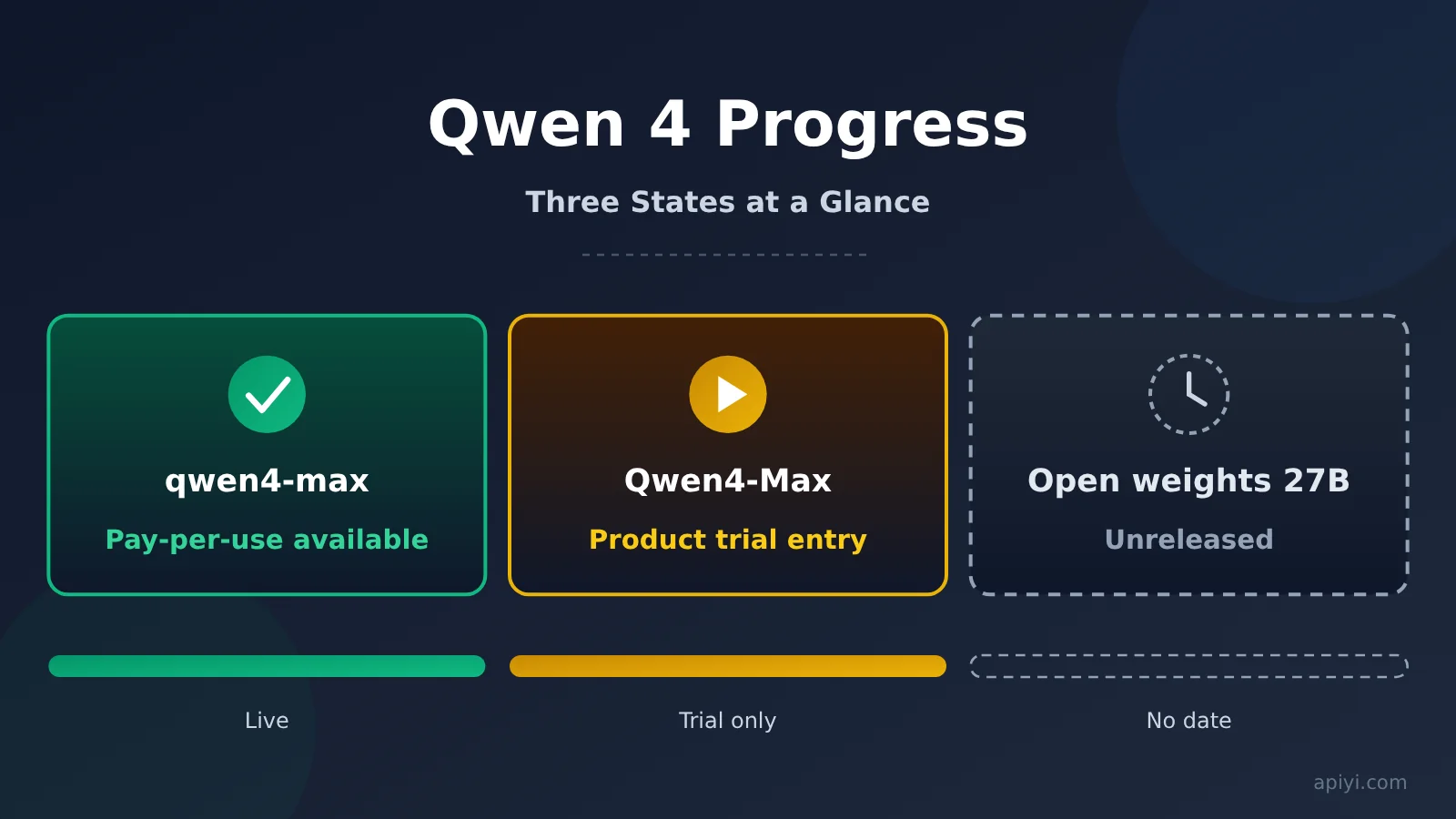
Grouping what’s currently available in Qwen 4 into three categories by status is more useful than listing model names. Each category comes with very different usage patterns and risks.
| Status | Specific object | What you can do | What to watch out for |
|---|---|---|---|
| Released, pay-as-you-go | qwen4-max |
Invoke it through the API with token-based billing and integrate it into your product | This is the only dependable entry point for building a product |
| Released, product trial entry only | Qwen4-Max in Qwen Studio, QwenWork, and Qoder | Try it out in chat or the workbench | It isn’t the same as programmatic invocation; billing follows each product’s page |
| Unreleased | Small open-weight Qwen4 (including the community’s hoped-for 27B) | Can’t download or deploy it yet | No size, no date — don’t put it on your roadmap |
There’s also a transitional state worth calling out separately: qwen4-max-preview only runs through 24:00 on November 25 (UTC+8). If you integrated it during the preview period, you should switch the model ID to the official qwen4-max now. Otherwise, your requests will fail after the cutoff.
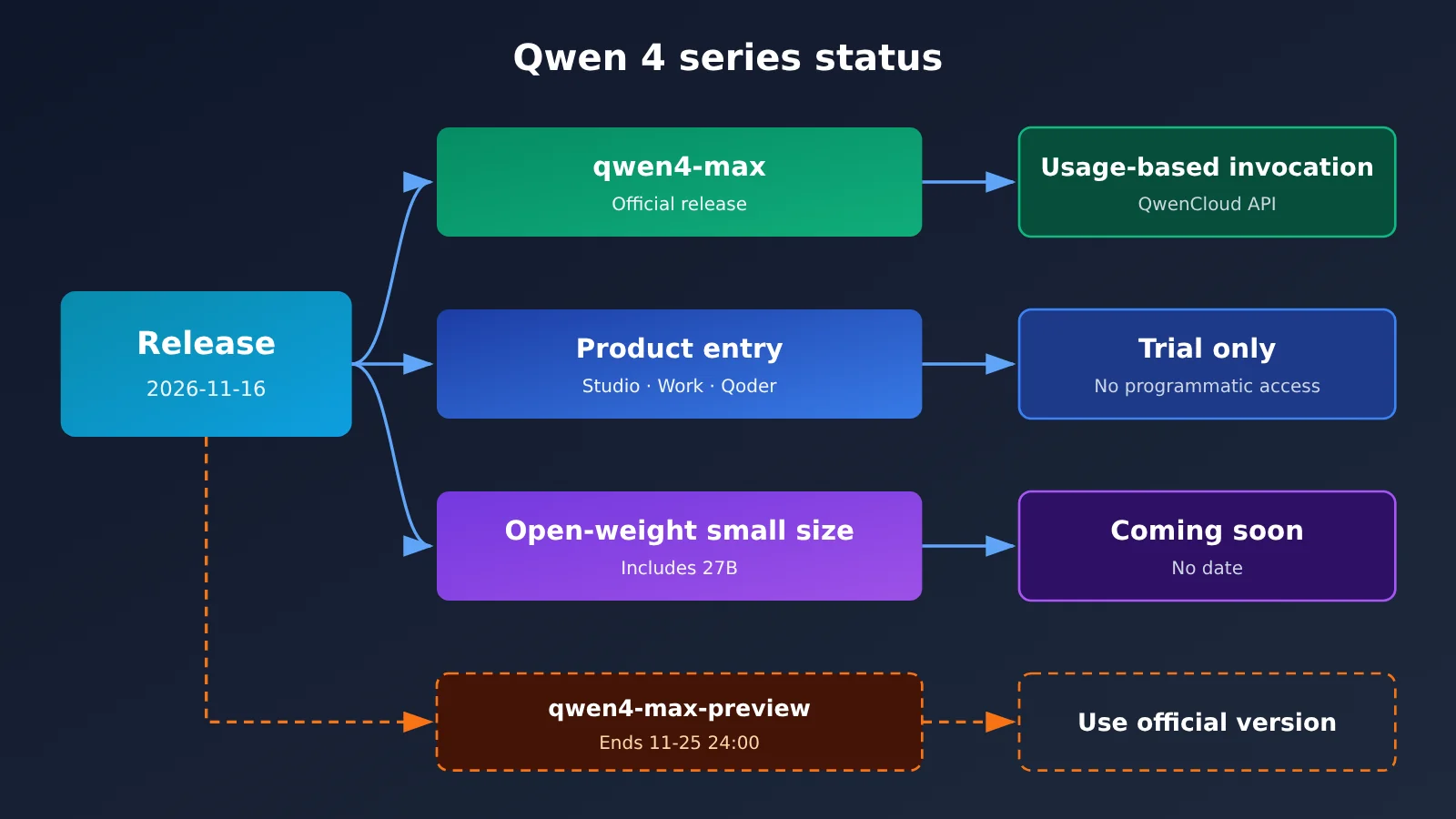
The diagram puts the three states and the preview ID cutoff on one timeline, making it easier to align internally. If you want to start calling from the first branch right away, you can access qwen4-max through APIYI (apiyi.com) using the same API key.
Qwen4-Max Specs and Official Self-Reported Results
The QwenCloud model page provides fairly detailed context and output limits, so teams working on long documents or long-running tasks need to plan around the thinking mode. All the numbers below come from the official model page.
| Spec | Non-thinking mode | Thinking mode |
|---|---|---|
| Context window | 1M | 1M |
| Max input | 991K | 983K |
| Max output | 131K | 262K |
| Max thinking budget | Not applicable | 262K |
Default reasoning_effort |
high | high |
As for benchmark results, the official self-reported score for Qwen4-Max on Work360 is 52.69, compared with 47.74 for the previous generation, Qwen3.8-Max. Average task cost also dropped from $4.43 to $1.67. These are all official self-reported figures. So far, I haven’t seen any reproduction results from an independent third-party leaderboard, and other benchmark scores circulating online come from unknown sources, so this article doesn’t cite them.
Note that the default reasoning_effort is high. That means if you don’t change any settings, the model will work at a relatively high reasoning intensity, which tends to increase output tokens and latency. For simple Q&A, classification, and extraction tasks, it’s worth actively lowering it.
Qwen4-Max Pay-As-You-Go Integration Checklist
This section is for readers who are getting a product ready to launch. APIYI listed qwen4-max on November 17, with pricing matching the overseas official site and pay-as-you-go billing. You can configure directly from the checklist below:
- Model ID:
qwen4-max(don’t useqwen4-max-previewanymore) - base_url:
https://api.apiyi.com/v1 - Authentication: use an API key generated in the APIYI console in the request header
- Chat Completions endpoint:
/v1/chat/completions, suitable for projects already using the OpenAI SDK - Responses endpoint:
/v1/responses, suitable for projects using Responses-style workflows - Messages endpoint:
/v1/messages, suitable for clients written in the Claude message format - Available groups:
Default,SVIP,CodexResponses,ClaudeCode - Reasoning effort: defaults to
high; if you need to lower it, passreasoning_effortin the request body. For acceptable values, refer to the QwenCloud model page and platform docs—don’t just copy the value conventions from other models - Input limit error:
Range of input length should be [1, 991808]. Seeing this means the request exceeded the input limit of about 991K, so you’ll need to truncate or split it
The point of the four groups is to support different clients. For example, when using a Codex-style tool over the Responses protocol, choose CodexResponses; when integrating in Claude Code, choose ClaudeCode; for a regular backend service, Default is enough.
🚀 Quick start: If your project already uses the OpenAI SDK, just change
base_urltohttps://api.apiyi.com/v1and the model ID toqwen4-max, and you can get connected through APIYI apiyi.com. New users can use free trial credits to get the flow working first.
Acceptance criteria after integrating Qwen4-Max
Integrating doesn’t mean it’s usable. Before going live, I recommend completing at least the following checks; each one has a clear pass criterion:
- Model confirmation: The
modelfield in the response isqwen4-max, not preview or some other fallback model. - Three endpoints connected: Send one request to each endpoint you’ll actually use; all should return 200 with normal text output.
- Reasoning effort takes effect: Ask the same question with the default value and with a lowered
reasoning_effort; the latter should produce a noticeably lower output token count. - Long context boundary: Build an input close to 991K and verify it returns normally; when it exceeds the limit, you should get the input range error above, not a timeout or empty response.
- Image/video input: If your product relies on native vision, send a separate request with an image and confirm parsing works.
- Cache hit: Repeatedly send requests with the same long prefix, and confirm in the billing details that cache read charges appear.
For reference, the acceptance record before the platform launch shows: 325 calls completed, and after launch, 15 online acceptance checks were done in the default group; among 951,498 tokens of actual input, markers placed in the middle and at the end were both recalled. This is the platform’s launch acceptance record and cannot replace testing on your own business data.
Qwen 4 vs Qwen 3.8 Price Comparison
Many teams considering whether to migrate from Qwen3.8 start with the pricing math. The table below comes from the APIYI model list (data updated 2026-11-23 10:23 UTC+8), with prices in USD per 1M tokens.
| Model | Input | Output | Cache read | Positioning | Available platforms |
|---|---|---|---|---|---|
qwen4-max |
$1.50 | $4.50 | $0.075 | Qwen 4 flagship | APIYI apiyi.com, QwenCloud |
qwen3.8-max |
$1.65 | $4.95 | $0.20625 | Previous-generation flagship | APIYI, QwenCloud |
qwen3.8-27b |
$0.44 | $1.76 | $0.088 | Currently available 27B | APIYI, QwenCloud |
qwen3.8-flash |
$0.114 | $0.3876 | $0.01425 | Low-cost fast model | APIYI, QwenCloud |
Two conclusions jump out from the table. First, qwen4-max has slightly lower input and output prices than qwen3.8-max, and its cache-read price is less than half, so migrations show the biggest payoff in workloads with long repeated prefixes. Second, if you were using qwen3.8-27b or qwen3.8-flash to control costs, qwen4-max can’t directly replace them — the per-unit price gap is still several times.
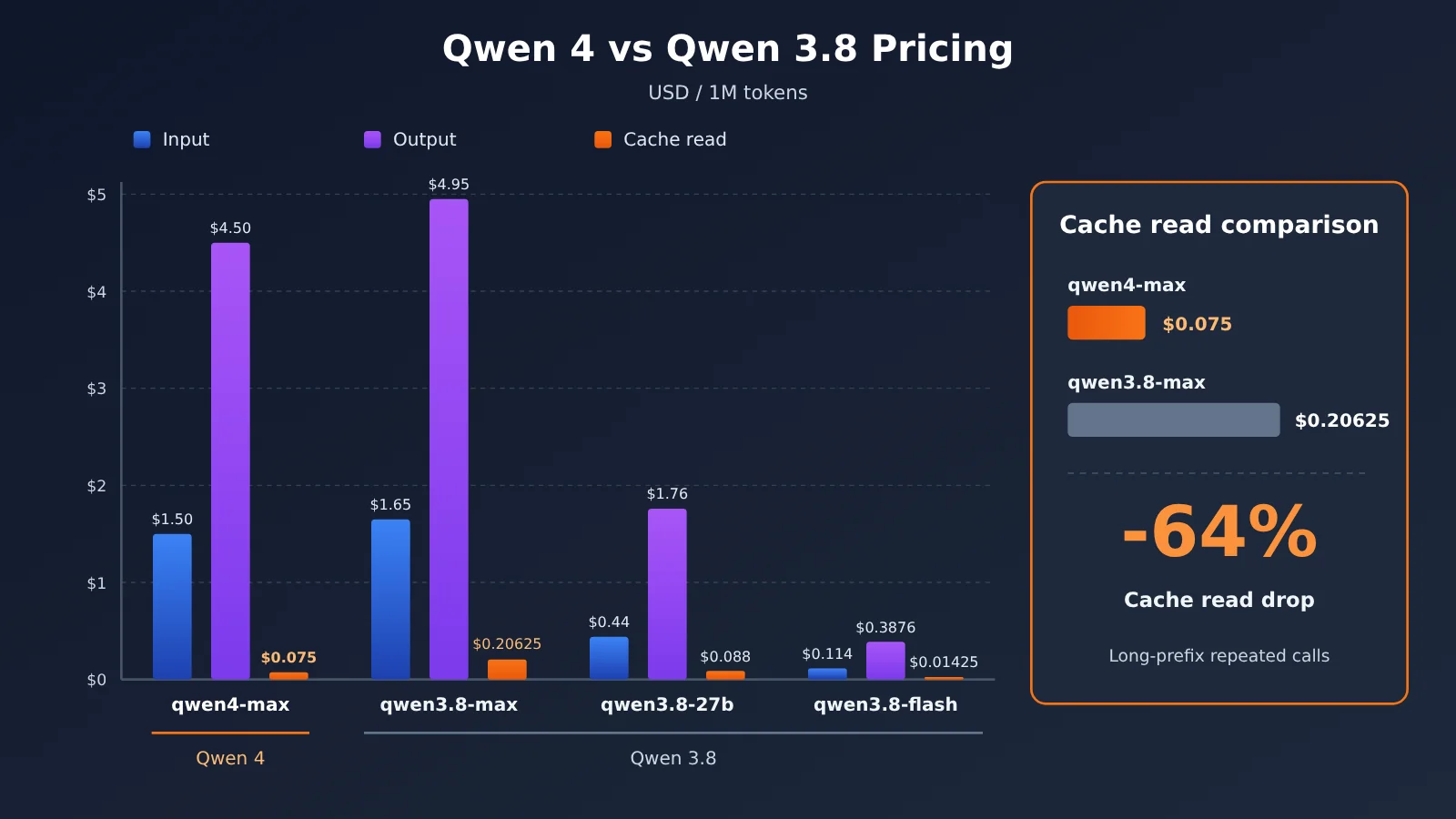
💰 Cost tip: Pricing data should be checked against the model list and may change. Before migrating, run the same batch of real requests through both
qwen4-maxandqwen3.8-maxon APIYI apiyi.com, and compare based on actual token consumption rather than unit price.
Why There’s No Date for Qwen4 27B Open Weights
This is the part readers ask about most, and the part where we can least afford to draw conclusions. To judge whether open weights have actually been released, you should look at only the three signals below. If any one of them hasn’t changed, don’t put 27B on your project schedule.
| Signal to watch | Current status (third-party tracking, verified 2026-11-21) | What should change after release |
|---|---|---|
| Official wording | The press release only says “coming soon to developers worldwide” — no size, no date | A formal announcement with size and license appears |
| Hugging Face Qwen account | No Qwen4 repo; the latest upload is Qwen-Image-2.1-Turbo on October 9 | A model repo named Qwen4 with weight files appears |
| QwenCloud text model list | The newest 27B is still qwen3.8-27b, no Qwen4 27B |
A small Qwen4 model ID appears in the list |
The claim circulating online that “open weights would drop on November 19” traces back to a post on r/LocalLLM. It’s a community observation, and Alibaba never confirmed it. November 19 has come and gone with nothing released, so that claim can be considered a miss.
So the reason there’s no date right now is simple: nothing official, no repo, no change to the model list. Even “will there be a 27B size at all” counts as unknown. Any specific date prediction has no basis until these three signals change.
What to Do While You Wait for Qwen4 27B
If you need local deployment or a private setup, the 27B you can download right now is Qwen3.8-27B, Apache-2.0 licensed, with the repo created on 2026-08-05. Use it to get your inference service and evaluation pipeline in place first; when the small Qwen4 model ships, you just swap the weights and rerun the evaluation.
If you just want 27B-level cost without necessarily deploying it yourself, you can also call qwen3.8-27b on a pay-as-you-go basis, using it as a canary comparison or a fallback model.
Qwen 4 Series FAQ
Q1: Which Qwen 4 models are available right now?
The only officially released model is Qwen4-Max, with the model ID `qwen4-max`. You can call it through the API on a pay-as-you-go basis, or try it out in Qwen Studio, QwenWork, and Qoder. The open-weight small-size versions haven’t been released yet.
Q2: Can Qwen4-Max be called directly on a pay-as-you-go basis?
Yes. In addition to the official QwenCloud API, APIYI apiyi.com also listed `qwen4-max` on November 17, at the same price as the official site. The Chat Completions, Responses, and Messages endpoints are all available, so you can compare it against the Qwen3.8 series with a single key.
Q3: How much longer can I use qwen4-max-preview?
The official notice says the preview ID will run until November 25 at 24:00 (UTC+8). Before it expires, replace every model ID in your code and configuration with `qwen4-max`, and re-run the acceptance checks described above.
Q4: When will Qwen4 27B be open-sourced?
There’s no date yet, and the official team hasn’t even confirmed the 27B size. The only places to watch are three: official announcements, the Qwen account on Hugging Face, and the QwenCloud model list. A release only counts once all three show a change.
Q5: Is it worth migrating from Qwen3.8-Max to Qwen4-Max?
On price, Qwen4-Max’s unit price is slightly lower and cached reads are significantly cheaper. On the officially self-reported Work360 benchmark, the score rises from 47.74 to 52.69. But those results are self-reported by the vendor, so I’d recommend running both models against your own business samples on APIYI apiyi.com before switching.
Q6: What known limitations does Qwen4-Max have?
– Output is text only; it can’t generate images or video.
– The default reasoning effort is high; if you don’t lower it, you’ll burn more tokens and see higher latency.
– The input ceiling is about 991K (983K in thinking mode); exceeding it triggers an input-range error.
– No third-party independent leaderboard has reproduced the official results yet.
Qwen 4 Series: Key Takeaways
- Only one model released so far: Qwen4-Max shipped on November 16, model ID
qwen4-max. - Core specs: 2.4T backbone, 71B activated per token, native vision, 1M context window.
- Pay-as-you-go access: already live on APIYI apiyi.com with three endpoints open, priced the same as the official site.
- Preview ID expires:
qwen4-max-previewshuts down at 24:00 on November 25 — migrate as soon as you can. - The 27B has no date: the official team has shared neither a size nor a timeline, and the November 19 rumor didn’t pan out.
- Interim plan: for local deployment, start with the Apache-2.0 Qwen3.8-27B to get your pipeline in place.
Summary
The current state of the Qwen 4 series comes down to three points:
- What’s usable:
qwen4-maxis already callable on a pay-per-use basis, with specs and pricing made public — ready to plug straight into a product. - What you can try: Qwen Studio, QwenWork, and Qoder give you trial entry points to test quality, but that isn’t the same as API access.
- What’s still missing: open-weight small-size Qwen4 models, including the 27B the community has been hoping for — no size, no date.
Product teams can go live with qwen4-max today using the onboarding checklist, and should finish migrating off the preview ID this week. Teams waiting on open weights only need to watch three signals: official announcements, Hugging Face, and the QwenCloud model list. No need to chase community rumors.
We recommend using the free trial quota on APIYI apiyi.com to work through the acceptance checklist first, then decide on your migration timeline.
📚 References
-
Alibaba Qwen4-Max official announcement: release date, model ID, trial entry point, and statements about open weights
- Link: refer to the official QwenCloud announcement page
- Note: the only official source that can confirm open-weight status
-
QwenCloud model page and text model list: Qwen4-Max specs, pricing, and existing 27B models
- Link: QwenCloud console – model list
- Note: the third signal for determining whether smaller Qwen4 sizes have launched
-
Hugging Face Qwen account: list of open-weight repositories
- Link:
huggingface.co/Qwen - Note: a Qwen4 repository appearing is what actually indicates the weights have been released
- Link:
-
r/LocalLLM community discussion: source of the “open weights on November 19” rumor
- Link:
reddit.com/r/LocalLLM - Note: community observation only; Alibaba has not confirmed it, and the date has passed with no release
- Link:
Author: APIYI Technical Team
Technical inquiries: Feel free to contact us through the APIYI website homepage. For more integration resources, visit the docs.apiyi.com documentation center.