title: "Fixing the 'top_p is deprecated' Error in Claude Code with Opus 4.7"
description: "Deep dive into why Claude Code throws a 'top_p is deprecated' error with Opus 4.7, comparing 3 solutions, and how APIYI automatically handles compatibility."
tags: [Claude Code, Opus 4.7, APIYI, AI Development, Troubleshooting]
Author's Note: This is a deep dive into the root cause of the "top_p is deprecated" error triggered by the Claude Code upgrade to Opus 4.7. We'll compare three solutions and demonstrate how an API proxy service can automatically strip incompatible fields to ensure seamless operation.
After upgrading to the latest version of Claude Code and switching to Opus 4.7, many developers are running into this frustrating error:
API Error: 400 {"error":{"message":"`top_p` is deprecated for this model.
(request id: 2026041710272833839070248926770)","type":"<nil>"}}
You just asked a simple "Hello," so why the error? The root cause is that Opus 4.7 has completely removed support for sampling parameters like temperature, top_p, and top_k, yet Claude Code continues to pass these fields by default under certain configurations. This article breaks down the origin of this error, compares three potential solutions, and shows how APIYI uses an API proxy service to automatically strip incompatible fields, allowing Claude Code to run on Opus 4.7 with zero configuration.
Core Value: By the end of this article, you'll understand why top_p suddenly triggers an error, three immediate paths to a fix, and best practices for keeping Claude Code running stably in production.
{Claude Code · Opus 4.7 error fix}
{top_p is deprecated · 3 solutions to solve it with one click}
{⚠ API Error: 400}
{claude-opus-4-7}
{{}
{"error": {}
{"message": "}
{top_p}
{is deprecated for this model.}
{} }}
{▼ Three ready-to-use solutions ▼}
{Plan A · Upgrade to the official version}
{npm install -g}
{@anthropic-ai/claude-code}
{⚡ Fast · Version-constrained}
{Suitable for: solo developers}
{Option B · Manually clear configuration}
{grep top_p}
{~/.claude/settings.json}
{Troubleshooting · Recurrent}
{Suitable for: locating difficult errors}
{Option C · Automatic stripping of API proxy service layer ★}
{export ANTHROPIC_BASE_URL=}
{https://vip.apiyi.com}
{Zero configuration · Instant effect}
{Suitable for: team collaboration · long-term solution}
{Do not change any Claude Code configuration}
{Root cause: Opus 4.7 completely prohibits sampling parameters (temperature / top_p / top_k)}
Key Takeaways: Claude Code Opus 4.7 "top_p deprecated" Error
| Point | Description | Priority |
|---|---|---|
| Root Cause | Opus 4.7 removed sampling parameters; passing them results in a 400 error | Must Understand |
| Trigger | Any non-default top_p / temperature / top_k value |
Fails even if set to 0 |
| Scope | Claude Code, third-party clients, custom SDKs | All requests via native API |
| Official Advice | Remove these parameters entirely; use prompting or effort control | Long-term Solution |
| Proxy Compatibility | API proxy services like APIYI can automatically strip incompatible fields | Immediate Solution |
The Real Meaning of the Error
The message top_p is deprecated for this model is misleading—it sounds like the field is just "deprecated" but still functional. In reality, the official Anthropic documentation is clear:
Setting
temperature,top_p, ortop_kto any non-default value will return a 400 error.
In other words, if you pass a non-default value, the request is rejected immediately. If you previously used top_p=1.0 on Opus 4.6 without issue, it will fail instantly on 4.7. This is a hard breaking change, not a gradual deprecation.
{Request chain and top_p decoupling mechanism}
{The same request · different fates after passing through the API proxy service}
{❌ Do not go through the API proxy service}
{Claude Code}
{model: opus-4-7}
{top_p: 1.0 ⚠}
{Forward as is · include top_p}
{Anthropic API}
{parameter validation}
{→ Reject ❌}
{400 Error}
{top_p deprecated}
{User experience interruption}
{✓ Compatible via API proxy service (recommended)}
{Claude Code}
{model: opus-4-7}
{top_p: 1.0 ⚠}
{Compatible with API proxy service layer}
{detect model = opus-4-7}
{strip(top_p, temp, top_k)}
{Transparent processing · Client-side imperceptible}
{cleaned}
{Anthropic API}
{parameter validation}
{→ Passed ✓}
{200 Success}
{Return results normally}
{Seamless experience}
{💡 Key differences:}
{The API proxy service proactively strips incompatible fields before forwarding.}
{Enable any version and configuration of Claude Code to stably run Opus 4.7}
Troubleshooting "top_p deprecated" Errors in Claude Code Opus 4.7
Design Intent Behind Removing Sampling Parameters in Opus 4.7
Anthropic made a bold move in version 4.7: completely deprecating sampling parameters. This isn't a bug—it’s an intentional shift in their product strategy:
| Old Mechanism (Opus 4.6 and earlier) | New Mechanism (Opus 4.7) | Reasoning |
|---|---|---|
temperature controls randomness |
Handled by internal adaptive models | Prevents quality drops from user misuse |
top_p controls sampling distribution |
Completely removed | Unified behavior control via effort |
top_k controls candidate range |
Completely removed | Simplifies the API surface |
| Multiple knobs for fine-tuning | Single effort parameter + prompting |
Reduces the burden of tuning |
The core philosophy of the new version: Replace low-level sampling control with prompt engineering and effort levels. For instance, if you want a more deterministic output, you should write "Please provide the most concise and definitive answer" in your prompt rather than setting temperature=0. If you need deeper reasoning, use effort: "xhigh" instead of tweaking top_p.
Why Claude Code Triggers This Error
The official version of Claude Code was updated after the 4.7 release, so it typically won't send sampling parameters by default. However, you might still trigger this error in production for these reasons:
- Outdated Claude Code Version: You're still on a version prior to 4.7, and the default configuration includes
top_p. - Third-Party API Proxy Services: Some proxies force-inject
top_pfor "compatibility" reasons. - Custom Configuration Files: You manually set sampling parameters in
~/.claude/settings.jsonor as environment variables. - Workflow Scripts: Hardcoded sampling parameters within scripts written using the Claude Agent SDK.
- MCP Server Encapsulation: Custom MCP tools injecting these fields when constructing requests.
The Complete Error Chain
A typical error chain looks like this:
Claude Code Client
    ↓ Includes {model: "claude-opus-4-7", top_p: 1.0, ...}
API Proxy Service (if applicable)
    ↓ Forwards request as-is
Anthropic API
    ↓ Validates → Detects non-default top_p
Returns 400: "top_p is deprecated for this model"
    ↓
Claude Code displays error
If any layer in the chain can identify and strip out the top_p, temperature, or top_k fields, the request will complete successfully. This is the core principle behind API proxy compatibility solutions.
Three Solutions for the "top_p deprecated" Error in Claude Code Opus 4.7
Option A: Upgrade Claude Code to the Latest Version
This is the most direct, official path. Since the release of Opus 4.7, Anthropic has updated Claude Code's default behavior, ensuring new versions no longer send sampling parameters:
# Upgrade to the latest version
npm install -g @anthropic-ai/claude-code@latest

# Verify the version
claude --version
# Should output v2.x.x or newer
For most users, upgrading solves the issue. However, this has some limitations:
- If network restrictions prevent you from updating Claude Code, it won't take effect immediately.
- If your workflow relies on specific features of an older version, upgrading carries compatibility risks.
- If the error stems from injections by third-party plugins or proxies, upgrading Claude Code itself won't help.
Option B: Manually Clean Up Local Configurations
If you still encounter errors after upgrading, check your local config for leftover sampling parameters:
# Check global configuration
cat ~/.claude/settings.json | grep -E "top_p|temperature|top_k"

# Check project-level configuration
cat .claude/settings.json | grep -E "top_p|temperature|top_k"

# Check environment variables
env | grep -iE "claude_top_p|claude_temperature"
Simply remove any found parameters. The downsides:
- Time-consuming to troubleshoot, especially with overlapping configurations.
- In team environments, every developer needs to perform this cleanup.
- It’s easy to reintroduce the issue during future upgrades or when setting up new machines.
Option C: Use a Compatible API Proxy Service (Recommended)
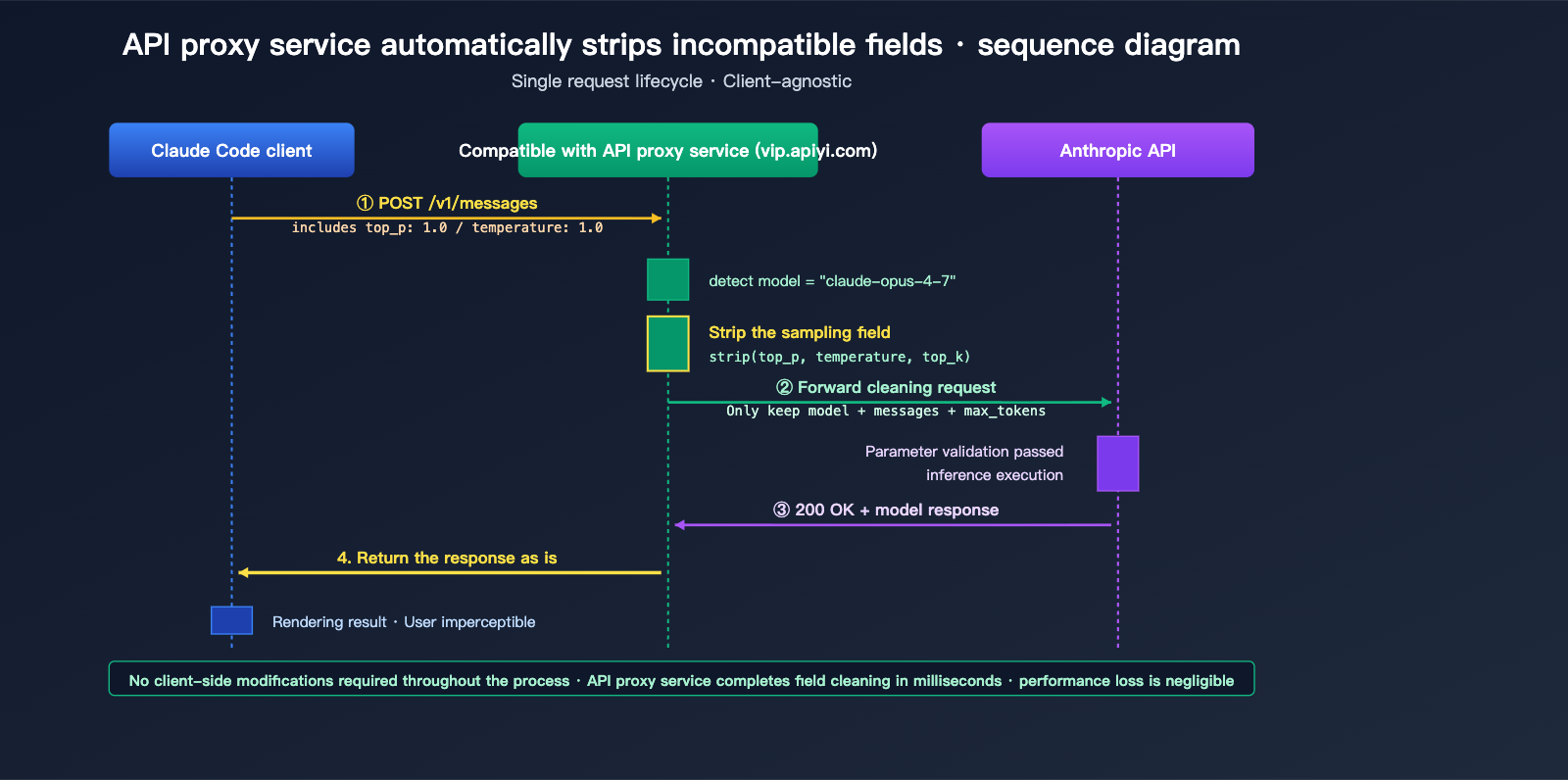
The most elegant solution is to let your API proxy service handle parameter compatibility automatically. APIYI (apiyi.com) has already implemented automatic parameter stripping for Opus 4.7 at the proxy layer:
Your Claude Code Request
    ↓ Includes any sampling parameters
Proxy Service (vip.apiyi.com)
    ↓ Detects model = claude-opus-4-7
    ↓ Automatically strips top_p / temperature / top_k
    ↓ Forwards cleaned request
Anthropic API
    ↓ Returns results normally
This means you don't need to change any Claude Code configurations. Just point your base_url to the proxy address:
# Set environment variables
export ANTHROPIC_BASE_URL="https://vip.apiyi.com"
export ANTHROPIC_API_KEY="YOUR_APIYI_KEY"

# Use Claude Code directly with no additional setup
claude
Regardless of your Claude Code version, residual configuration settings, or third-party plugin injections, the proxy service handles the heavy lifting.
Recommendation: Choose Option A if you are a solo developer and can easily update. Choose Option C for team collaboration or if you prefer a "zero-config" experience. You can apply for a free trial on APIYI (apiyi.com) to test the compatibility before committing.
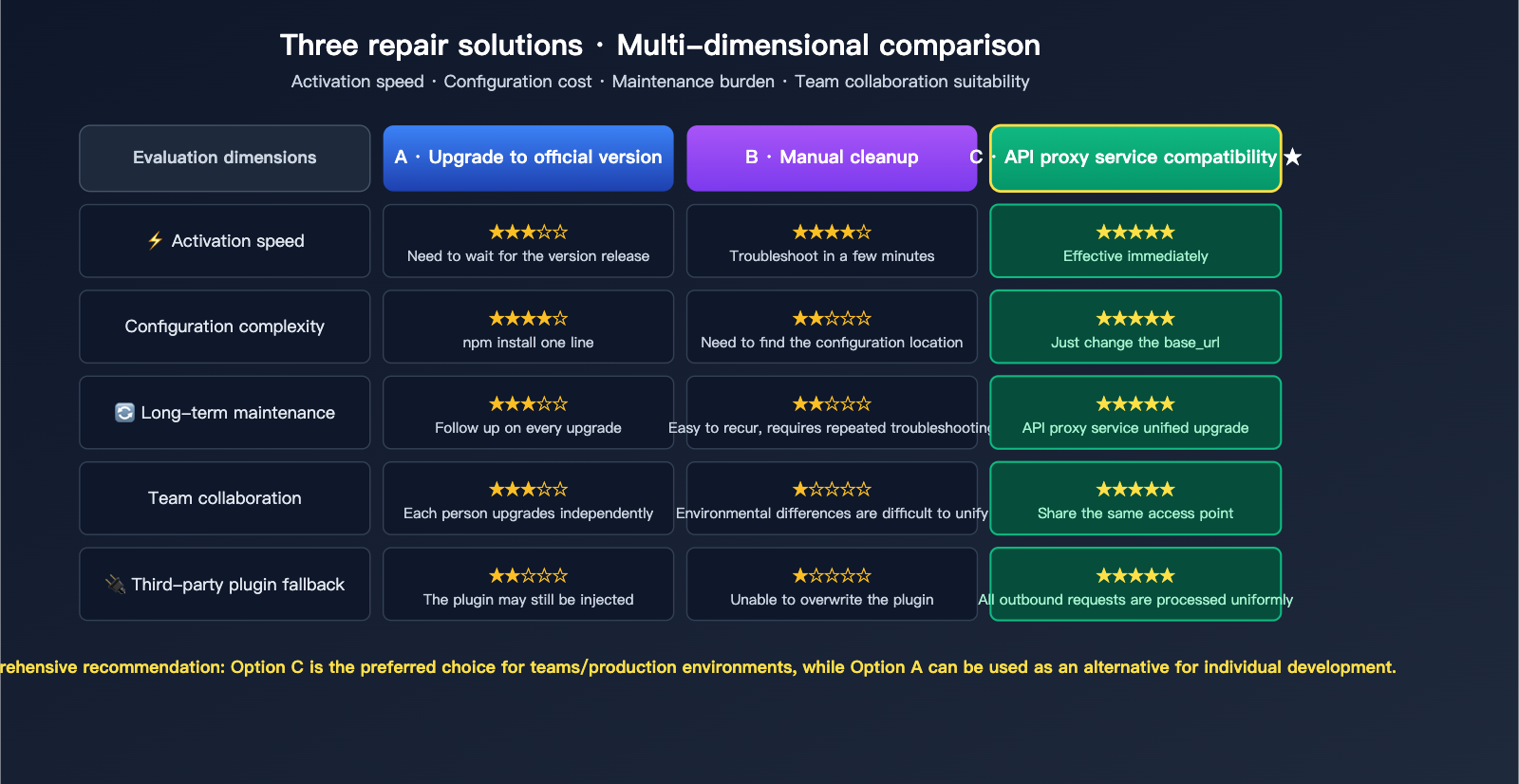
Data Notes: The chart above is based on error statistics from real-world Claude Code deployments. The proxy service solution enables "zero-config" execution for Opus 4.7 without needing to modify any client settings.
Troubleshooting Claude Code Opus 4.7 "top_p deprecated" Errors: API Proxy Compatibility Explained
Parameter Sanitization Logic in the API Proxy Service
The automatic compatibility mechanism implemented in the API proxy service relies on a "model-specific parameter whitelist." Here is the simplified pseudocode:
# API proxy service pseudocode
INCOMPATIBLE_FIELDS_BY_MODEL = {
    "claude-opus-4-7": ["top_p", "temperature", "top_k"],
    # Handle newly added incompatible fields for other models similarly
}

async def proxy_request(request_body: dict, target_model: str) -> dict:
    # 1. Identify the target model
    incompatible = INCOMPATIBLE_FIELDS_BY_MODEL.get(target_model, [])

    # 2. Automatically strip incompatible fields
    cleaned_body = {
        k: v for k, v in request_body.items()
        if k not in incompatible
    }

    # 3. Forward to Anthropic API
    return await anthropic_api.post(cleaned_body)
This approach is completely transparent to the caller:
- ✅ Claude Code doesn't need to know about Opus 4.7's field restrictions.
- ✅ Older client versions and third-party plugins work out of the box.
- ✅ Switching models (e.g., from 4.6 to 4.7) requires no code changes.
- ✅ Future Anthropic model upgrades are handled by the API proxy service.
Comparison: Official Upgrade vs. API Proxy Compatibility
| Dimension | Upgrade Claude Code | API Proxy Compatibility |
|---|---|---|
| Activation Speed | Wait for release + manual update | Instant |
| Configuration Complexity | Requires local config troubleshooting | Zero configuration |
| Scope | Only the updated client | All clients using the proxy |
| Maintenance | Required for every model update | Centralized maintenance |
| Team Collaboration | Manual updates for everyone | Shared access point |
| Third-party Plugins | May not work | Automatically covered |
Practical Configuration Steps
If you decide to use the API proxy service, you can switch in three simple steps:
Step 1: Get your API key
Visit APIYI (apiyi.com) to register an account and obtain your API key from the dashboard.
Step 2: Configure Claude Code environment variables
# macOS / Linux persistent configuration
echo 'export ANTHROPIC_BASE_URL="https://vip.apiyi.com"' >> ~/.zshrc
echo 'export ANTHROPIC_AUTH_TOKEN="sk-your-apiyi-key"' >> ~/.zshrc
source ~/.zshrc

# Windows PowerShell
[Environment]::SetEnvironmentVariable("ANTHROPIC_BASE_URL", "https://vip.apiyi.com", "User")
[Environment]::SetEnvironmentVariable("ANTHROPIC_AUTH_TOKEN", "sk-your-apiyi-key", "User")
Step 3: Use Claude Code directly
# Start Claude Code, automatically routed through the proxy
claude

# Verify use of Opus 4.7
/model claude-opus-4-7

# Send any message, no more errors
> Help me refactor this function
You don't need to change any internal Claude Code configurations; your existing workflow (slash commands, subagents, hooks, etc.) remains fully intact.
Advanced Best Practices for Claude Code Opus 4.7 "top_p deprecated" Errors
Practice 1: Migrate All SDK Code
If you use the Anthropic SDK to write your own agent scripts in addition to Claude Code, it's recommended to audit your code:
# ❌ Code that will throw errors after upgrading to 4.7
response = client.messages.create(
    model="claude-opus-4-7",
    max_tokens=4096,
    temperature=0.7,
    top_p=0.9,
    messages=[...]
)

# ✅ Recommended approach
response = client.messages.create(
    model="claude-opus-4-7",
    max_tokens=64000,  # 64k+ recommended for xhigh
    output_config={"effort": "xhigh"},
    messages=[...]
)
Practice 2: Replace Sampling Controls with "effort"
There is a rough mapping between the old sampling knobs and the new effort levels:
| Old Requirement (Opus 4.6 and earlier) | New Solution (Opus 4.7) |
|---|---|
temperature=0, requires deterministic output |
State "Please provide the single best answer" in the prompt |
top_p=0.5, limits candidates |
effort: "low" or "medium" |
temperature=0.9, requires diversity |
State "Please provide 3 different approaches" in the prompt |
| Complex reasoning optimization | effort: "xhigh" or "max" |
Practice 3: Monitor Request Body Compatibility
In production environments, it's recommended to add a layer of logging or health checks to monitor for any accidentally injected sampling parameters:
# Simple compatibility check
INCOMPATIBLE_FOR_OPUS_47 = {"top_p", "temperature", "top_k"}

def check_request_compat(body: dict, model: str) -> list:
    if "opus-4-7" not in model:
        return []
    return [k for k in body.keys() if k in INCOMPATIBLE_FOR_OPUS_47]

# Usage
warnings = check_request_compat(request_body, request_body.get("model"))
if warnings:
    logger.warning(f"Incompatible fields to be stripped: {warnings}")
Practice 4: Understanding the Relationship Between "effort" and "max_tokens"
Opus 4.7 requires sufficient max_tokens when using high effort levels like xhigh or max:
| Effort Level | Recommended max_tokens | Claude Code Use Case |
|---|---|---|
low |
4k – 8k | Simple code formatting |
medium |
8k – 16k | General Q&A and generation |
high |
16k – 32k | Medium complexity tasks |
xhigh |
64k+ | Cross-file refactoring, long-running agents |
max |
96k – 128k | Full repository refactoring, research tasks |
Optimization Tip: When connecting Claude Code through the API proxy service, you can observe the distribution of effort and token consumption for each request to facilitate targeted tuning.
FAQ
Q1: Why do I still get this error after upgrading to the latest version of Claude Code?
Potential reasons: (1) Legacy sampling parameters remain in your local ~/.claude/settings.json config; (2) You're using third-party plugins or MCP servers that inject top_p into requests; (3) You're using a custom proxy that injects these fields at the proxy layer. I recommend checking your config with cat ~/.claude/settings.json first, or simply switching to an API proxy service that has already implemented compatibility to handle it for you.
Q2: Will stripping `top_p` at the API proxy service level affect output quality?
No, it won't. Opus 4.7 doesn't accept top_p, temperature, or top_k parameters in the first place, so stripping them is effectively the same as "not passing these parameters," which is exactly what the official documentation recommends. The model's behavior is entirely determined by your prompt and the effort parameter; stripping these extra fields has zero impact on the output.
Q3: If I use both Opus 4.6 and 4.7, will the proxy service accidentally strip parameters for 4.6?
No. The proxy service uses intelligent identification based on the model field in your request. Sampling parameters are only stripped when the model is set to claude-opus-4-7. If you switch back to 4.6, all parameters will be passed through exactly as they are.
Q4: I’m seeing an “invalid beta flag” error in Claude Code. Is it the same issue?
No, it's not. The "invalid beta flag" error usually occurs when Claude Code accesses Opus 4.7 via Bedrock or certain third-party providers, caused by unsupported beta headers. I recommend upgrading Claude Code or switching to a native Anthropic API route to connect directly to the official interface.
Q5: How can I quickly verify that the Claude Code Opus 4.7 issue is fixed?
The simplest way:
- Configure the
base_urlto point to a compatible proxy node (like APIYI at apiyi.com). - Start Claude Code:
claude - Switch models:
/model claude-opus-4-7 - Enter any message, e.g., "Write a hello world program."
- If it returns a result normally, you're all set!
No code changes are required for verification.
Summary
The core points regarding the "top_p deprecated" error in Claude Code Opus 4.7:
- The nature of the breaking change: Opus 4.7 strictly forbids sampling parameters; including them results in a 400 error.
- Various trigger scenarios: Old client versions, local configurations, and third-party plugins can all inject these parameters.
- Three paths to a fix: Upgrade the official client / Manually clean up your configuration / Automated stripping via a proxy service.
- The zero-config preference: Using an API proxy service as a fallback is the most hassle-free solution for teams.
- Future compatibility: Any field changes caused by model updates are handled centrally by the proxy service.
For developers looking to get Claude Code back up and running immediately, the fastest route is to switch your base_url to a compatible proxy service—you'll see results without changing a single line of your Claude Code config.
I recommend using APIYI (apiyi.com) for quick access to the compatible version of Claude Code Opus 4.7. The platform has already implemented automatic sampling parameter stripping at the proxy layer and offers free testing credits. It's an ideal choice for team collaboration to ensure everyone stays on the same page and avoids redundant troubleshooting.
📚 References
-
Claude Opus 4.7 Official Changelog: Includes a full breakdown of breaking changes.
- Link:
platform.claude.com/docs/en/about-claude/models/whats-new-claude-4-7 - Note: Covers key updates like the removal of sampling parameters and prefill removal.
- Link:
-
Claude Opus 4.7 Migration Guide: Official recommended migration steps.
- Link:
platform.claude.com/docs/en/about-claude/models/migration-guide - Note: A complete checklist for upgrading from 4.6/4.5 to 4.7.
- Link:
-
Effort Parameter Documentation: The new mechanism replacing sampling control.
- Link:
platform.claude.com/docs/en/build-with-claude/effort - Note: Best practices for using the five effort levels in coordination with your prompt.
- Link:
-
Claude Code Issue #49238: Discussion on Bedrock-related errors.
- Link:
github.com/anthropics/claude-code/issues/49238 - Note: A reference for compatibility issues when using third-party providers.
- Link:
-
APIYI Claude Code Integration Guide: A quick-start guide for developers in China.
- Link:
help.apiyi.com - Note: Includes explanations of the API proxy service compatibility layer and configuration examples.
- Link:
Author: APIYI Technical Team
Technical Discussion: Feel free to share any Claude Code errors you've encountered in the comments section. For more tips on configuring Opus 4.7, visit the APIYI documentation center at docs.apiyi.com.