

The “make the model draw a pelican riding a bicycle” test in AI circles has a pretty clear origin. It comes from a blog post Simon Willison wrote back in October 2024, and one prompt he kept using throughout it: “Generate an SVG of a pelican riding a bicycle.”
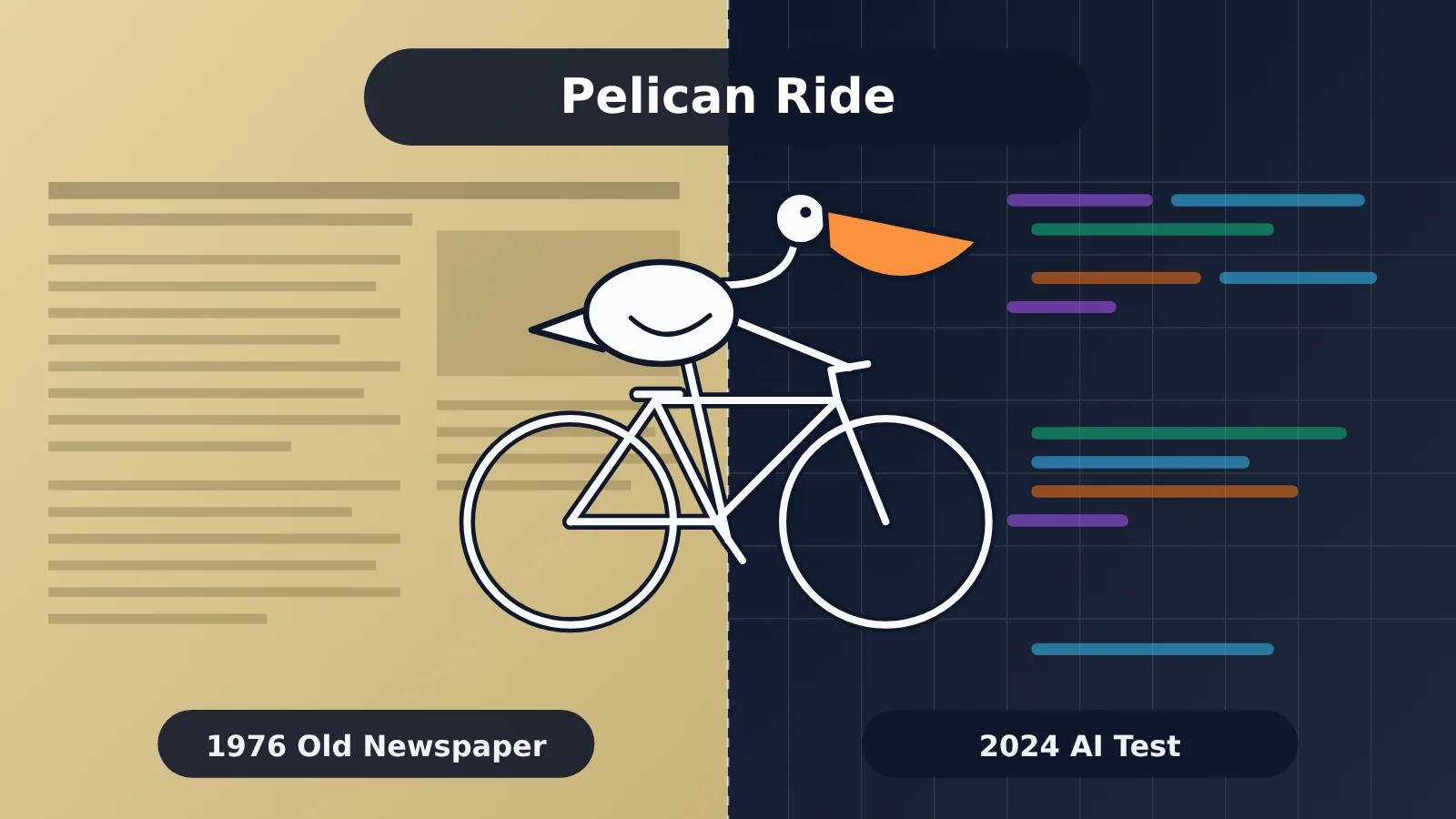
The image of a pelican on a bicycle showed up much earlier. That’s exactly what I want to get into here: the image has its own history, and the test has its own history — both threads are interesting, but we shouldn’t force them into one.
Along the way, we’ll dig up an old newspaper from 1976, briefly mention a 1988 film, and then come back to 2024 to talk about why Simon picked pelicans and SVG in particular, and what makes a test you can “get at a glance” so much fun.
| To Know | In short |
|---|---|
| Simon Willison | A blogger who’s long written about AI and developer tools; the pelican bicycle test went mainstream from his post |
| SVG | A format that describes graphics with code — the model has to “write” the image, not “generate pixels” |
Where the pelican-on-a-bicycle came from: a small 1976 ad
On October 8, 1976, the Island Reporter in Florida published an issue. In the lower-left corner of page A3 — page 3 of the PDF — there’s a car rental ad for a shop called The Pedaling Pelican, and the illustration is a pelican pedaling a bike.
The image sits in the corner of the page, presumably aimed at tourists: biking around the island? Rent from us. A picture like this very likely shows up in more than one place, so I won’t claim it’s the world’s earliest pelican on a bicycle. What matters is what it reminds us of: “pelican + bicycle” isn’t some absurd combination that popped out of nowhere in the AI era. Someone thought it was cute long ago — and thought it would sell.
A seaside rental shop using a pelican as its mascot isn’t strange at all. Pelicans are common coastal birds — big beak, short legs, a waddling walk. Put one on a bike and the comedy writes itself.
The pelican-on-a-bicycle image even made it to the big screen in 1988
Further along, Who Framed Roger Rabbit (1988) has a segment too: a hand-drawn pelican riding a live-action bicycle. An animated character sharing the frame with a practical prop — that was exactly the film’s signature trick.
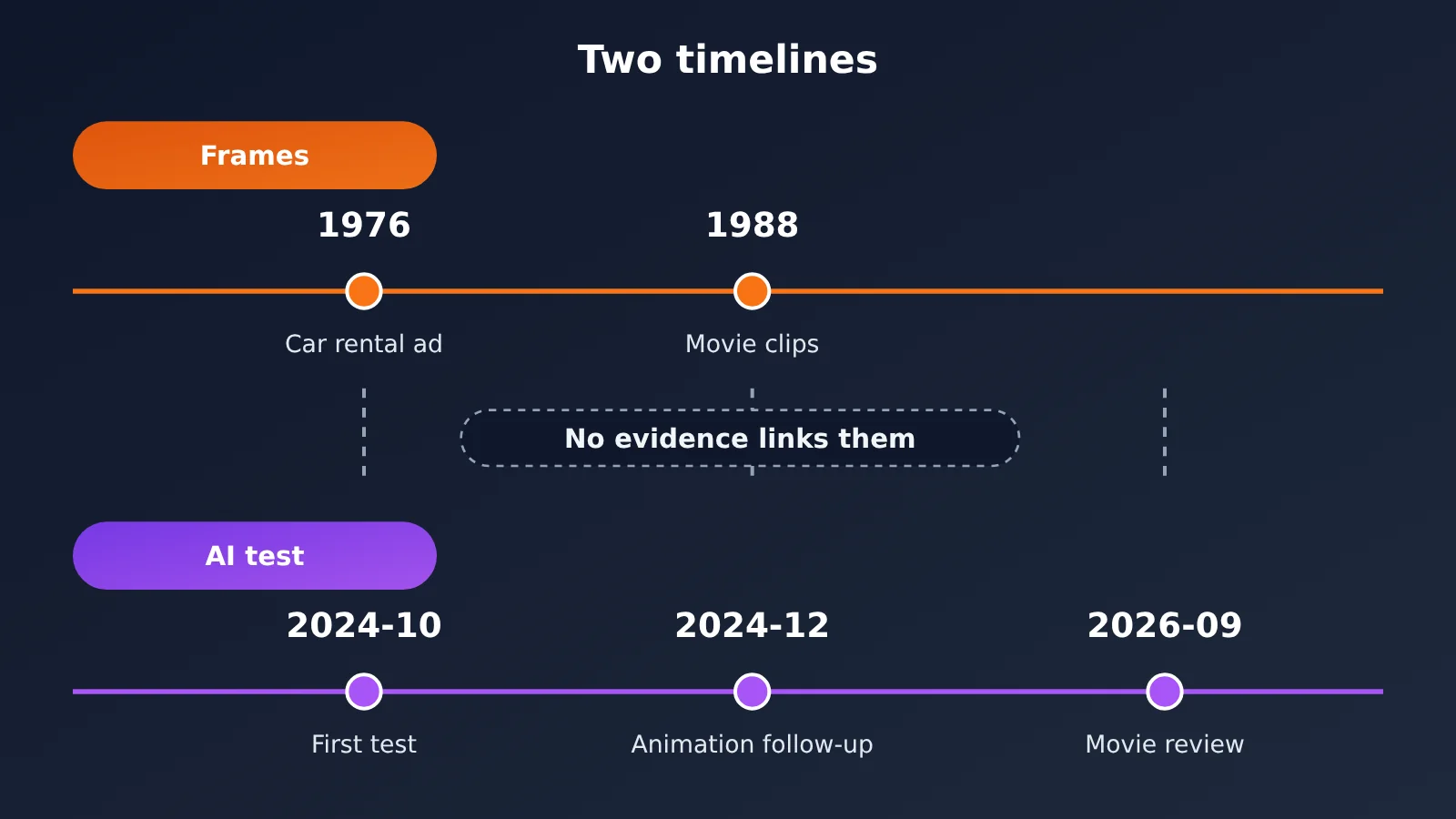
What’s interesting is that Simon didn’t write about this segment until September 18, 2026. He only wrote a dedicated piece after someone brought it up to him on social media. In other words, there’s no evidence that this film was the inspiration for the prompt he posed in 2024.
I kind of like that time gap. Once a meme takes off, people go back and hunt for its “ancestors,” and what they find does exist — but existing doesn’t mean it’s the source. The 1976 ad and the 1988 film are both points on the visual history of the pelican-on-a-bicycle, and neither has a direct causal link to the AI-test thread.
The Pelican Riding a Bike AI Test: Why Pelicans and SVG
Let’s go back to October 25, 2024. Simon ran that prompt through 16 models and posted the results.
His reasoning was refreshingly simple: he likes pelicans, and he figured a “pelican riding a bicycle as an SVG” ought to be rare. Note how carefully he phrased it—”rare” isn’t the same as “definitely not in the training data.” He never claimed to have invented a task the model had absolutely never seen. He just picked a combination that most likely hadn’t been fed to it over and over.
The SVG part is the more important choice. When you ask a model to generate an image, how good it looks depends largely on the image model. But when you ask a language model to write SVG, it has to use coordinates, circles, and paths to assemble the pelican and the bicycle line by line—like asking someone who can’t see the canvas to paint from a description.
One more thing worth being clear about: that article just laid out the samples for everyone to look at. There was no unified scoring rubric. It was never meant to be a serious benchmark—more like a public “come and take a look.”
What Makes the Pelican on a Bike Test Fun: Can the Bike Actually Be Ridden?
I think the best thing about this test is that ordinary people can be the judge.
Look at a pelican-on-a-bike image a model produces, and you don’t need to understand SVG or read any kind of benchmark score. Just ask a few plain questions: Can this bike be ridden? Are both wheels on the ground? Are the pelican’s feet on the pedals? Are the wings—or hands—holding the handlebars? Is it sitting on the bike, or hovering next to it?
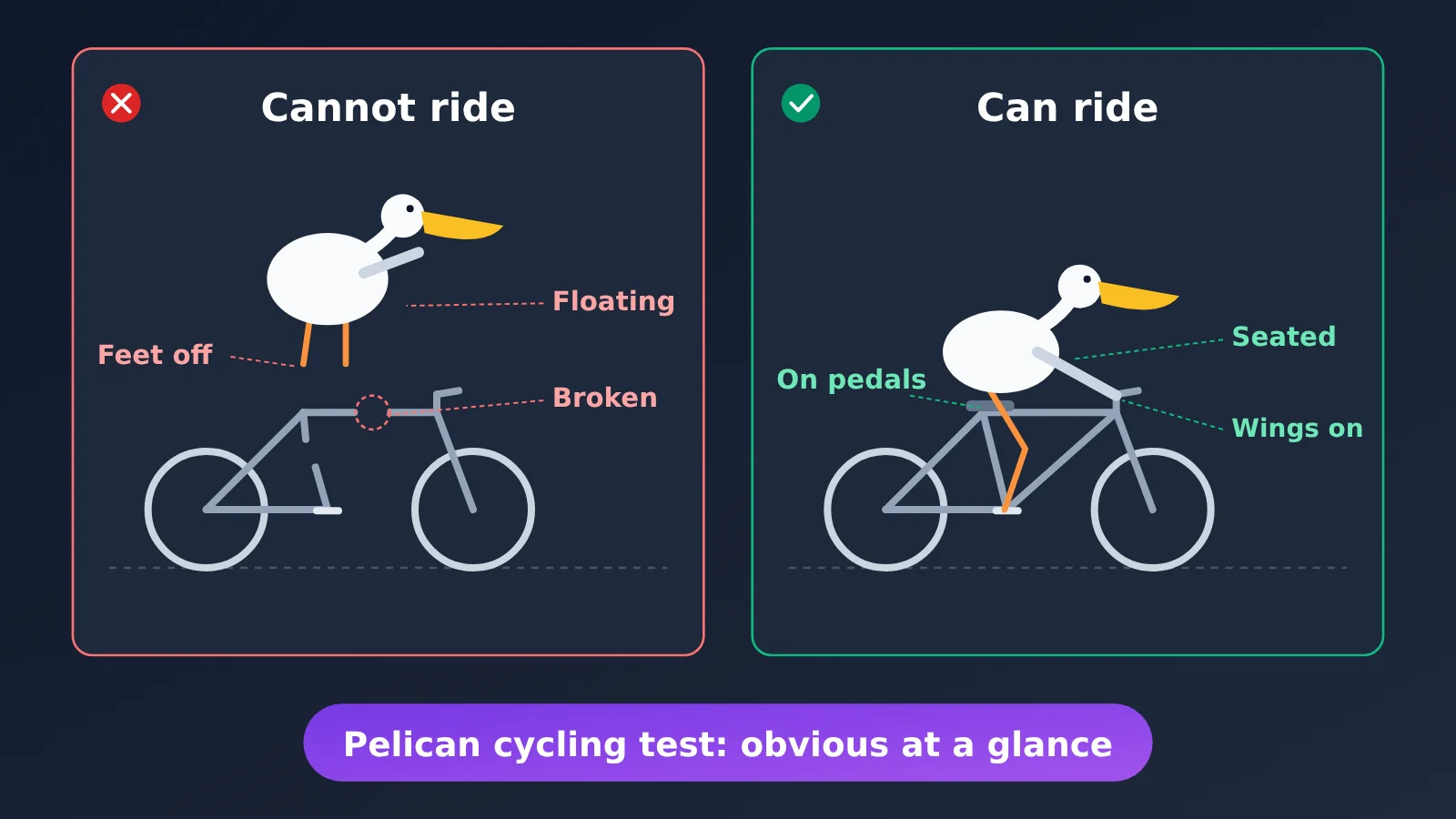
The answers to those questions jump out at you, and those answers happen to expose how well the model understands spatial relationships. A bicycle is a fairly particular structure: the frame has to connect, the chain links the pedals to the rear wheel, and the rider has to sit in the middle. A pelican’s body is nothing like a human’s. Put the two together, and any place where the model just wings it (pun intended) gives itself away.
That’s how you end up with plenty of laugh-out-loud results: the frame turns into a few disconnected lines, the pelican floats above the bike, or the wheels get drawn as two donuts. Once you’re done laughing, you get it—this model still has some work to do when it comes to “assembling a world.”
This is far more intuitive than a string of percentages. A score tells you who’s higher and who’s lower; the pelican tells you exactly what’s wrong.
The Pelican on a Bicycle Got Followed Up Into an Animation, and the Meme Survived
If it were just one static image, this whole thing probably would’ve caused a stir for a while and then faded away. In December 2024, while trying out gemini-exp-1206, Simon pushed one step further and asked the pelican to move.
Animation raises both the difficulty and the comedic stakes. Structures that could get by in a static image can’t hide once things start moving: do the pedals turn, do the legs follow along, are the wheels actually rolling. The prompt still has that same flavor, but there’s more to play with.
What keeps a meme spreading usually isn’t how perfect it is at the start—it’s that it leaves enough room for people to keep following up, again and again. The pelican on a bicycle is exactly this kind of prompt: low barrier to entry, lots of variations, and every time a new generation of models comes out, you can trot it out and take it for another spin.
The Origin of the Pelican on a Bicycle Comes Down to a Bird
Looking back, it’s pretty simple. Someone likes pelicans, wanted a combination a model probably wouldn’t have memorized, picked a format that has to be “built” with code, and then posted the result out in the open.
A 1976 rental car shop used a pelican to attract tourists; a 1988 movie used a pelican to show off technology. In 2024, this pelican was used to test models, and what it needs to do hasn’t really changed: make people laugh at a glance, and after they’ve laughed, still let them say what’s weird about it.
A piece of SVG code no one else can read ends up becoming an image everyone can point at and say “this bike can’t be ridden.” I think that’s basically the charm of this prompt.
Sources:
- Simon Willison – Pelicans on a bicycle: simonwillison.net/2024/Oct/25/pelicans-on-a-bicycle/
- Island Reporter, 1976-10-08, page 3: digifind-it.com/sanibel/DATA/newspapers/IslandReporter/1976/1976-10-08.pdf
- D23 – Who Framed Roger Rabbit: d23.com/a-to-z/who-framed-roger-rabbit-film/
- Simon Willison – The creative spirit of Who Framed Roger Rabbit: simonwillison.net/2026/Sep/18/the-creative-spirit-of-who-framed-roger-rabbit/
- Simon Willison – gemini-exp-1206: simonwillison.net/2024/Dec/6/gemini-exp-1206/