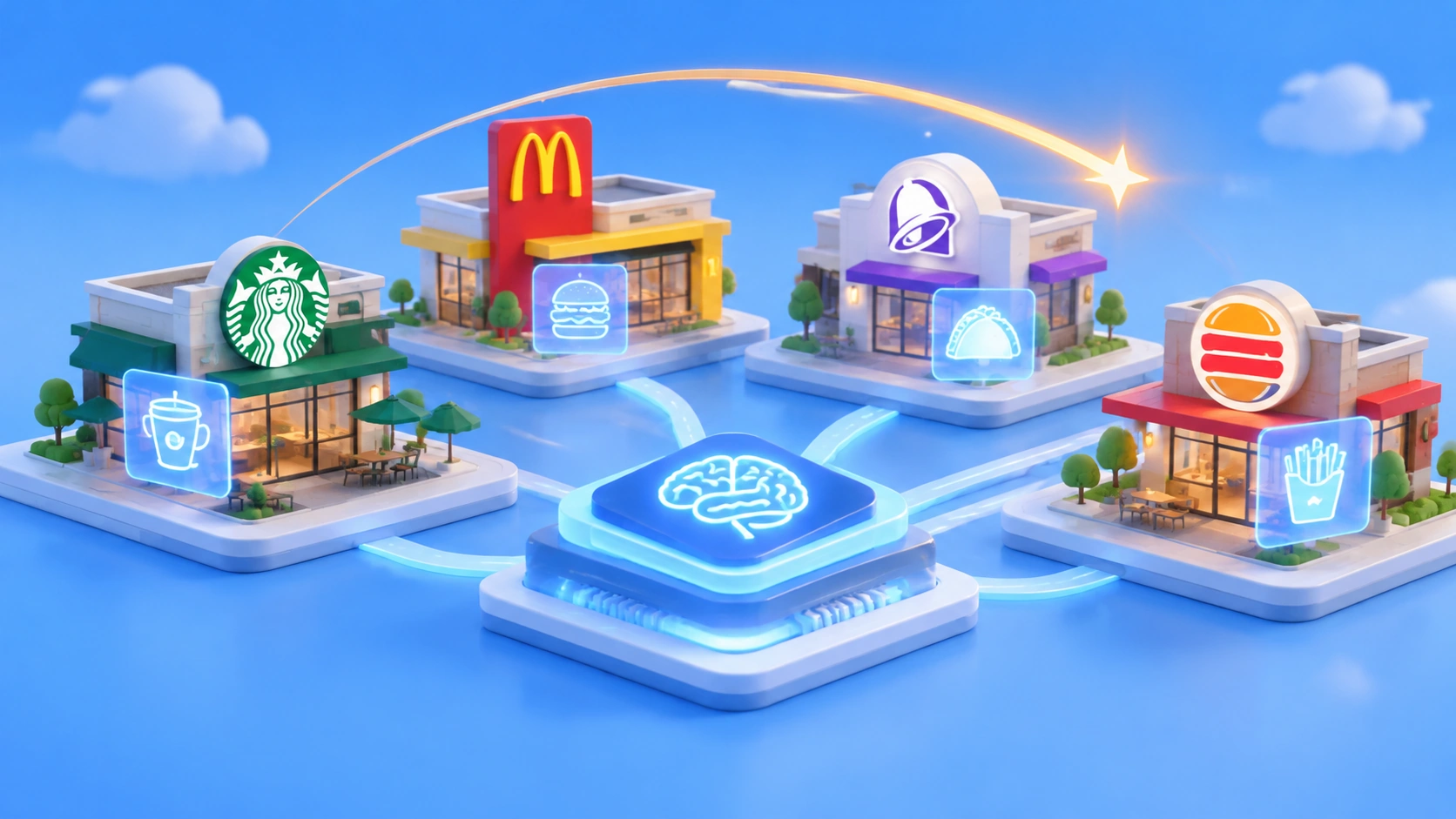
Author’s note: This article compares the restaurant AI strategies of Starbucks, McDonald’s, Taco Bell, and Burger King, examining deployment progress, public evidence, investment, and technology integration to assess whether each project is a concept demo or is already creating business value.
On October 29, 2026, Starbucks disclosed on an earnings call that it was exploring ways to recognize drive-through customers who voluntarily opt in and show them personalized digital menus. The plan brings an old question back into focus: Does the restaurant industry need AI to replace staff, or to improve the entire service experience?
This isn’t a ranking of restaurant AI projects. The four companies aren’t competing to build the same ordering bot, and public information doesn’t provide cost, accuracy, or ROI tests conducted under consistent conditions. Instead, this article compares them by the problems they address, their deployment stages, and the strength of the evidence.
What you’ll learn: By the end, you’ll understand four major approaches to restaurant AI and have a set of metrics for judging whether a project is still a concept demo or is already creating verifiable business value.
Restaurant AI: The Key Facts at a Glance
| Item | Details |
|---|---|
| News origin | Starbucks’ Q4 fiscal 2026 earnings call on October 29, 2026 |
| Confirmed plan | Test back-end AI to help baristas enter orders starting in fiscal 2027 |
| Early exploration | Identifying participating customers, personalizing digital menus, and streamlining payments; no launch date yet |
| Not yet disclosed | Identification technology, pilot locations, model provider, investment, or quantified results |
| Industry benchmark | Intouch Insight’s 2026 drive-thru study, covering 13 brands and 2,145 main-study visits, plus 120 dedicated AI ordering visits |
Starbucks CEO Brian Niccol says about half of its customers use the drive-thru. That explains why the company is focused on the channel, but it doesn’t mean drive-thrus account for half of revenue. There’s also no evidence that Starbucks has decided to use facial or license plate recognition. Media concerns about privacy and differential pricing are discussions of potential risks, not confirmed facts.
How Do the Four Restaurant AI Approaches Differ?
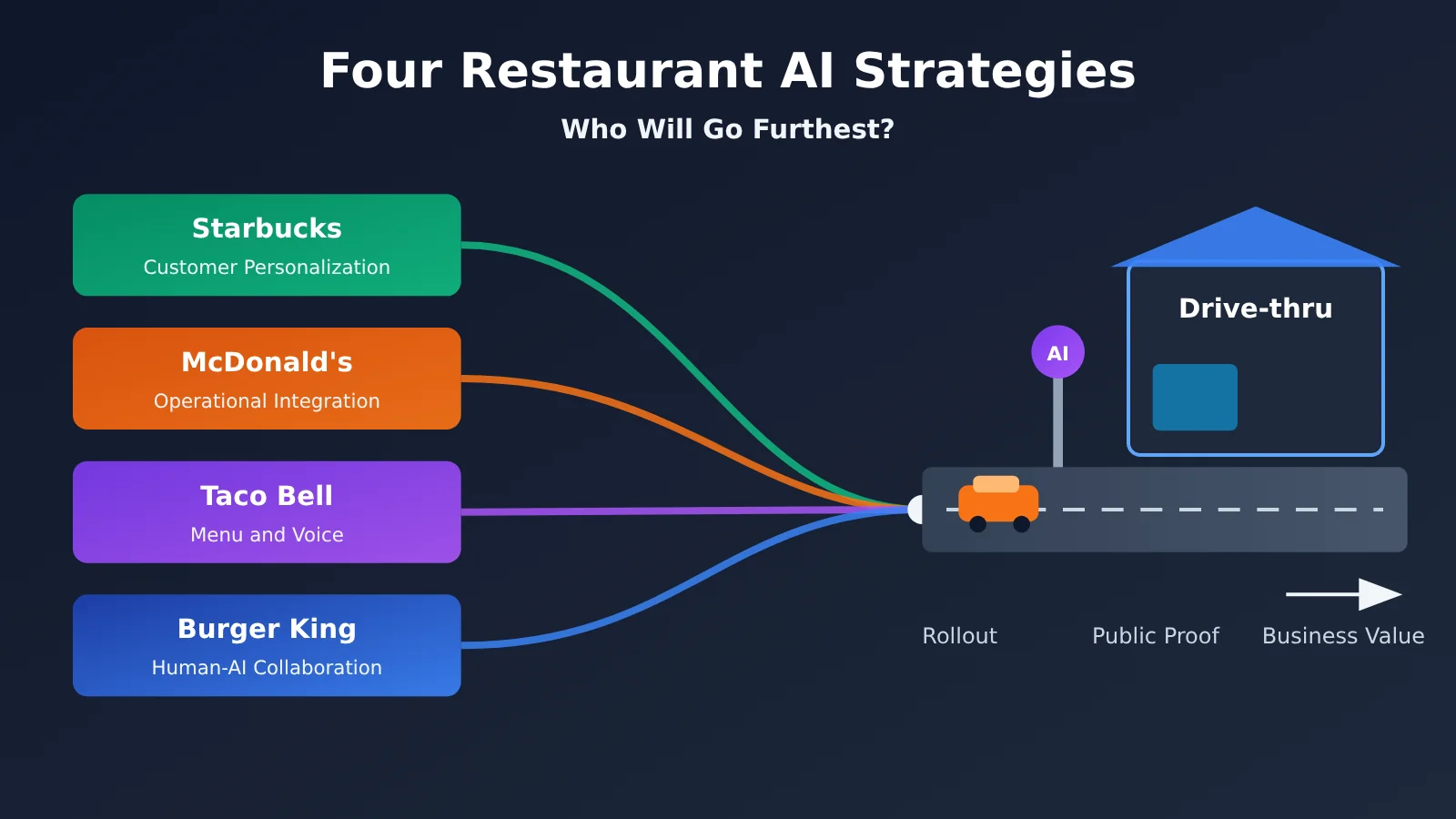
The real difference between these four companies is which parts of the process AI should take over and which should remain in human hands. Calling them all “AI ordering” glosses over differences in product design, data requirements, and risks.
| Brand | Main functions | Deployment status | Public evidence | Main limitations |
|---|---|---|---|---|
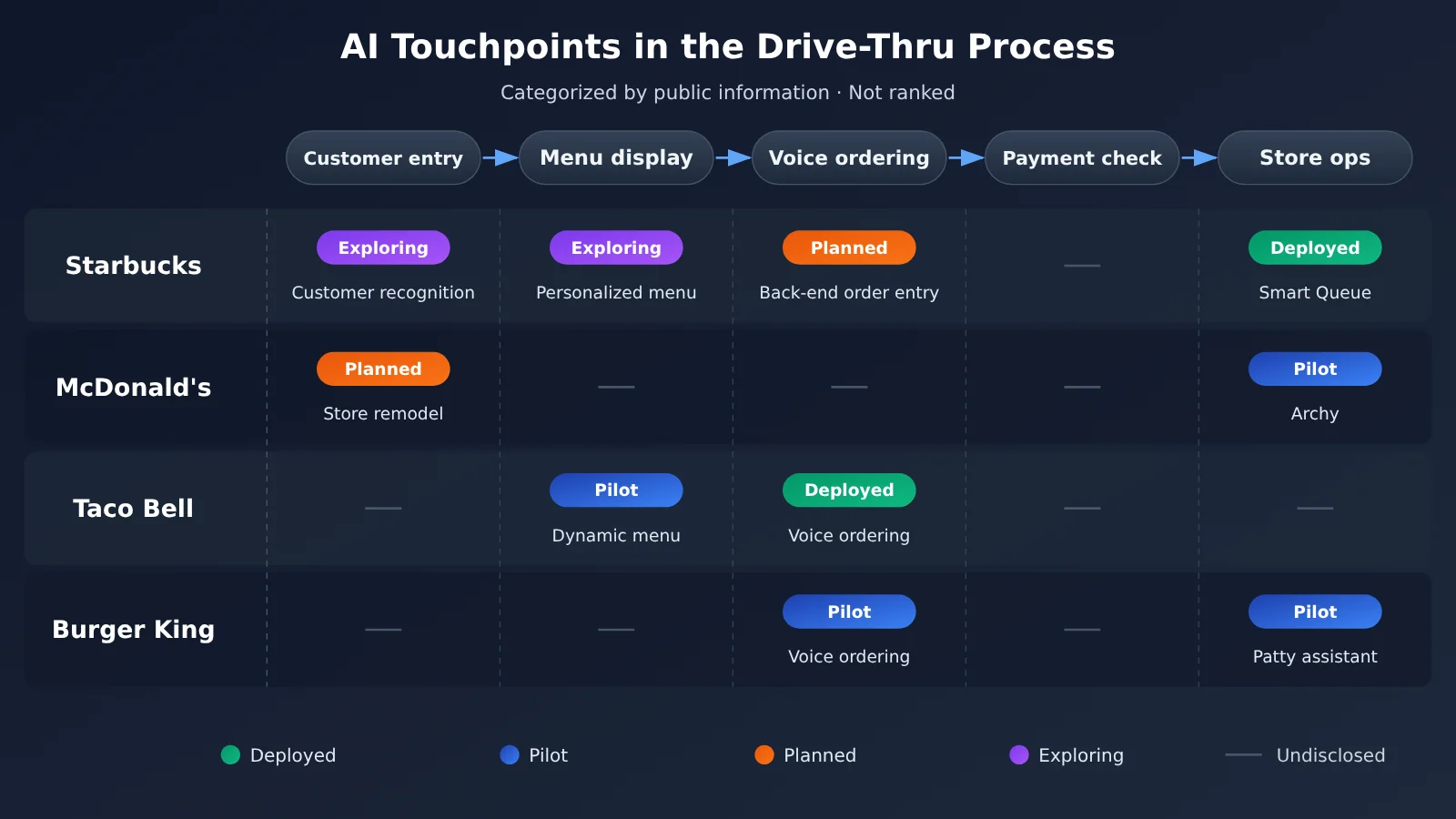
| Starbucks | Smart Queue, Green Dot Assist, back-end order entry, personalized menus | The first two are in use or have launched; order entry is planned for testing; menus are still being explored | CEO statements and descriptions of existing systems | No quantified test results for new projects; identification method not disclosed |
| McDonald’s | ArchIQ operations platform, Archy voice ordering, inventory and equipment management | Pilots at some US locations; no timeline for full deployment | The company says Archy achieved over 90% accuracy in testing | Many key benefits are forecasts and haven’t yet been fully realized |
| Taco Bell | AI-powered dynamic menus, Omilia voice ordering | Menus are being tested; voice ordering has been deployed at more than 890 locations | The company confirmed menu tests don’t change prices; location count disclosed by its partner | No average accuracy across all locations or per-location cost figures |
| Burger King | Customer voice ordering, Patty employee assistant | Voice ordering piloted at roughly 50–70 locations; Patty piloted at roughly 500 locations as of February | Executives acknowledge that some customers refuse to interact with a robot or even leave | Consumer acceptance and employee monitoring concerns remain unresolved |
Starbucks Restaurant AI: Give Baristas the Information First
Niccol described a specific Fast Pass scenario: A customer enters the drive-thru lane and opens the app, prompting the system to show the employee their recent orders. The barista then asks whether they’d like their usual drink before completing payment and handing over the order. AI’s role here is to give employees context about the customer’s purchasing history, not to speak on their behalf.
Starbucks has an advantage in its data and transaction infrastructure. It has 36 million Rewards members in the U.S. who were active over a 90-day period; in fiscal 2025, members accounted for nearly 60% of revenue at company-operated U.S. stores. But those are existing business figures, not evidence of the AI menu’s impact. The company also hasn’t said which data fields the new project will use.
McDonald’s ArchIQ: Bringing Ordering Into the Operations System
ArchIQ is an integrated operations platform, with Archy providing its voice capabilities. The platform also covers inventory visibility, equipment monitoring, and order checks before delivery, with the aim of connecting front-end ordering to back-of-house execution.
McDonald’s partnered with IBM to test AI ordering in 2021, then ended the partnership in 2024 amid challenges including accuracy. Archy’s accuracy rate of over 90% comes from test results disclosed by the company, not an independent third-party assessment. Employee feedback in the investor day video was also presented by the company and shouldn’t be treated as a sample survey.
Taco Bell’s Restaurant AI: Menus and Voice Ordering Are Two Separate Projects
Taco Bell’s AI-powered dynamic menu addresses “what to show.” The system can adjust the layout, content, and presentation of recommendations for each vehicle. One goal is to get faster feedback on how menu displays perform. The company has made clear that the test won’t change menu prices, so it shouldn’t be described as dynamic pricing or assumed to involve license plate recognition.
Omilia’s voice-ordering system addresses “who takes the order.” Its partner says it has reached more than 890 locations across 38 states. That figure can’t be added to the roughly 500 Nvidia-related test locations reported by the media, since the projects are at different stages and the locations may overlap. A 2025 prank involving a large water order also serves as a reminder that the scale of deployment doesn’t mean the experience is consistently reliable.
Burger King’s Restaurant AI: Keep Patty Separate From Customer Voice Ordering
Burger King’s customer-facing voice-ordering system serves drive-thru customers and is being piloted at around 50–70 locations. Chakri Somisetti, the brand’s vice president of technology, acknowledged that some customers don’t want to talk to a robot and even drive away. As a result, the company plans to make it easier for customers to choose a human instead.
Patty, meanwhile, is a headset assistant for employees. It uses OpenAI models and Burger King’s own technical architecture to provide guidance on food preparation, inventory, and operations. The roughly 500 locations were the size of Patty’s pilot in February 2026 and shouldn’t be counted as voice-ordering locations. Its ability to analyze polite language has also raised concerns. The company says it’s used to observe store-wide trends, not to score individuals.
What Does Real-World Data Tell Us About AI in Restaurants?
Intouch Insight’s study is a useful industry reference, but its dedicated AI test covered only Burger King, Taco Bell, and Wendy’s. The combined results can’t be attributed to any one brand, and they have nothing to do with Starbucks’ new system.
| Metric | 2026 Result | How to Interpret It |
|---|---|---|
| AI order accuracy | 90.8% (82.5% in 2025) | The dedicated test sample improved, but it doesn’t represent the industry average |
| Accuracy at the same brands without AI | 86.7% | Limited to the specific scenarios in the same study |
| Total visit time | 5 minutes 14 seconds with AI; 5 minutes 15 seconds without | The difference is tiny and doesn’t prove AI is necessarily faster |
| Visits requiring part of the order to be repeated | 29.1% (34.2% in 2025) | An improvement, but voice interactions still aren’t consistently reliable |
| Overall satisfaction with AI | 94.2% | A result from the test sample |
| Visits involving AI in the main study | 36 / 2145 | Less than 2%; voice AI hasn’t become an industry standard |
These numbers challenge two extreme claims. AI can handle real orders: Of 120 visits in the dedicated test, 92 involved AI, and AI completed 77 of those orders from start to finish. But it didn’t show an overwhelming speed advantage. When customers have to repeat themselves, the hit to their experience may not show up in the total visit time.
Starbucks’ 96% order accuracy and 99% satisfaction rate in the main study also reflect only its existing service performance. The brands, order types, and samples differ from those behind the 90.8% AI accuracy figure, so you can’t subtract one from the other and declare that humans outperform AI. Satisfaction was 98.6% when employees were friendly and 26.8% when they weren’t. That’s an observed association, not proof of causation, but it’s a reminder not to focus solely on automating order-taking.
A Technomic survey offers another signal: 46% of respondents found ordering from a person inside a restaurant appealing, while 23% found AI ordering at the drive-thru appealing and 46% found it unappealing. Because the report didn’t provide complete sample information, these percentages shouldn’t be treated as precise measures of consumer attitudes across the United States.
How Can You Assess AI Investment and Maturity in the Restaurant Industry?
When assessing maturity, it’s important to distinguish between store coverage, evidence of results, and financial commitments. The table below groups projects based on publicly available information. It’s a framework for comparison, not an official rating of the four companies.
| Maturity | Representative projects | Publicly available evidence | What’s still missing |
|---|---|---|---|
| Concept exploration | Starbucks customer identification and personalized menus | CEO statements, Fast Pass scenario | Identification approach, pilot data, launch date |
| Planned testing | Starbucks back-office order entry | Testing begins in fiscal 2027 | Accuracy, efficiency, and workforce impact |
| Small-scale testing | Burger King voice technology, Taco Bell dynamic menus, McDonald’s Archy | Store pilots or company-reported results | Independent verification, ROI, reliability at scale |
| Actual deployment | Starbucks Smart Queue, Taco Bell voice technology | Operational system in use or deployed at more than 890 locations | Consistent data on business results and costs |
| Plans to scale | McDonald’s Restaurant > NEXT | Investment and return projections published | Actual returns and results of full deployment |
On costs, McDonald’s is one of the few companies to have published a financial framework. The incremental Restaurant > NEXT investment for its traditional U.S. drive-thru restaurants is estimated at around $800,000 per location. Once all components are deployed, a typical restaurant is expected to generate approximately $100,000 in additional gross cash flow per year. That investment covers restaurant upgrades, equipment, and operational technology—it’s not the purchase price of Archy.
McDonald’s also expects deployment at scale to free up at least 50 labor hours per restaurant per week, with automated inventory management saving around 5 hours per week and reducing food waste by approximately 15%. These figures are company forecasts or targets and haven’t yet been fully realized. The costs of related projects at Starbucks, Taco Bell, and Burger King haven’t been disclosed in enough detail to determine which approach is the least expensive.
Why Does Restaurant AI Need Systems to Work Together?
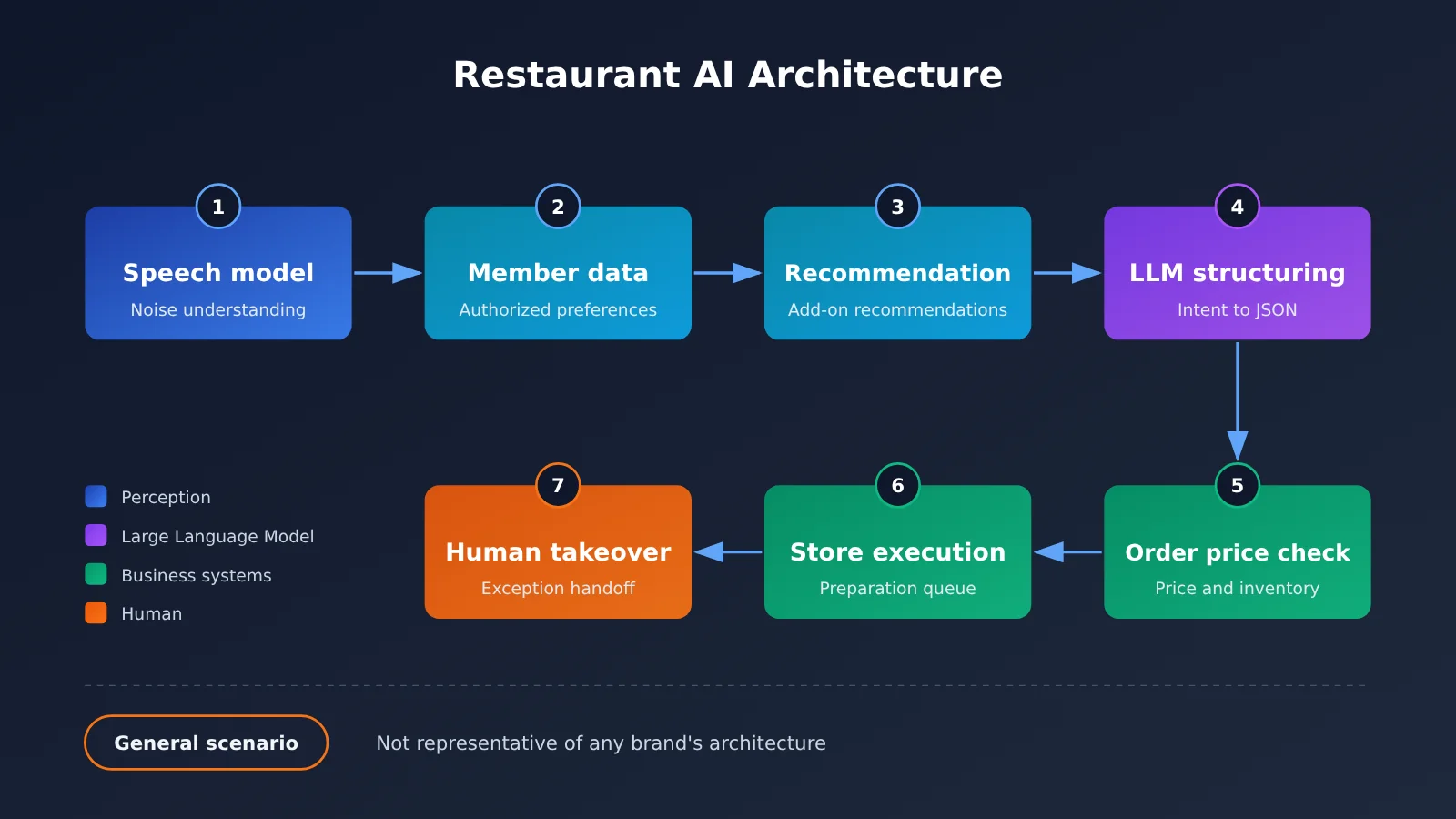
A single model can’t handle everything involved in AI-powered drive-thrus. Different systems are responsible for understanding speech in noisy environments, managing member consent, tracking inventory changes, validating prices, and managing preparation queues. A failure at any step can prevent an accurately recognized order from being fulfilled correctly. The table below illustrates a general architecture, not an implementation disclosed by any of the four companies.
| Technical module | Main task | Typical failure | Key metrics |
|---|---|---|---|
| Speech model | Handle accents, noise, and modification requests | Customers have to repeat themselves | Repetition rate, human handoff rate |
| Recommendation algorithm | Determine product order and add-on recommendations | Recommends sold-out or irrelevant items | Incremental conversion, change in average order value |
| Membership data | Provide preferences and order history within the scope of consent | Misidentifies customers or exposes purchase history | Consent rate, misidentification rate, opt-out rate |
| Order system | Confirm prices, discounts, inventory, and payment | Menu and bill don’t match | Order error rate, payment success rate |
| Human interaction | Handle exceptions while preserving the service experience | Handoff fails and the customer leaves | Handoff time, satisfaction, abandonment rate |
Developers can start by validating one small part of the process: converting a speech transcript into a structured order. The example below demonstrates a general workflow: the model only interprets intent, while pricing and inventory remain the responsibility of business systems.
import openai

client = openai.OpenAI(
    api_key="YOUR_API_KEY",
    base_url="https://api.apiyi.com/v1"  # APIYI OpenAI-compatible endpoint
)

response = client.chat.completions.create(
    model="gpt-4o-mini",
    messages=[{"role": "user", "content": "把订单转为 JSON:大杯拿铁,换燕麦奶,再加一个可颂"}]
)
print(response.choices[0].message.content)
View the full implementation
import json
import openai

client = openai.OpenAI(
    api_key="YOUR_API_KEY",
    base_url="https://api.apiyi.com/v1"
)

MENU = {"拿铁", "美式", "可颂"}  # Sample data; query currently available items in production

def parse_order(transcript: str, model: str = "gpt-4o-mini") -> dict:
    system_prompt = (
        "你是点单解析器,只输出 JSON。格式为 "
        '{"items":[{"name":"","size":"","changes":[],"qty":1}],"need_human":false}。'
        f"可售菜单:{sorted(MENU)}。不得输出价格;无法确定时 need_human 设为 true。"
    )
    response = client.chat.completions.create(
        model=model,
        messages=[
            {"role": "system", "content": system_prompt},
            {"role": "user", "content": transcript},
        ],
        response_format={"type": "json_object"},
        temperature=0,
    )
    order = json.loads(response.choices[0].message.content)

    # Model output isn't the final order; validate it against business rules first
    if any(item.get("name") not in MENU for item in order.get("items", [])):
        order["need_human"] = True
    return order

print(parse_order("大杯拿铁换燕麦奶,再来一个可颂"))
Technical tip: Use the same set of transcripts and menu data to compare models on structured-output success rate, latency, and cost. APIYI at apiyi.com provides a unified interface for switching between OpenAI, Claude, Gemini, and other models, helping reduce integration work during early evaluations.
The example doesn’t cover real-time audio, order submission, or payment. Voice input also needs to be designed separately based on the capabilities of the chosen model and API. In a real-world environment, you’d also want to track the human handoff rate, error types, and model cost per order. These metrics are more useful than a one-off demo for assessing whether the project is viable.
Restaurant AI: Impact and Industry Outlook
Impact on Restaurant Businesses
Each of the four approaches works under different conditions, so the choice should start with the business bottleneck. A company that leads in voice understanding isn’t necessarily ahead in personalization or overall operations.
- Starbucks-style approach: Best suited to businesses with a strong membership base and repeat customers, where employee interactions are themselves part of the brand’s value.
- McDonald’s-style approach: Best suited to highly standardized businesses with large store networks and the ability to upgrade equipment and processes at the same time.
- Taco Bell-style approach: Best suited to businesses with complex menu combinations that want to test display optimization and order-taking automation separately.
- Burger King-style approach: Best suited to businesses where customer acceptance is still uncertain and that need to preserve access to a human while focusing first on employee efficiency.
Impact on Developers and Product Managers
The next phase of retail AI should focus less on demos and more on reproducible business results. At a minimum, project evaluations should validate these metrics:
- Incremental impact: Whether average order value, repeat purchases, and processing capacity show a net improvement compared with control stores.
- End-to-end order quality: Not just speech recognition, but also final order fulfillment accuracy and repeat rates.
- Exception recovery: Human handoff rate, takeover time, handling of recognition errors, and customer abandonment rate.
- Privacy and transparency: How customers opt in and out, and whether they can confirm the final order and price.
- Unit economics: Per-store investment, inference cost per order, maintenance costs, and payback period.
If a project has only demo videos, projected returns, or vendor case studies—but no controlled experiments or exception data—it’s still closer to a proof of concept. A project that creates real business value should show what improved, across which sample, and who steps in when things go wrong.
Frequently Asked Questions
Q1: Has Starbucks launched AI facial recognition for ordering?
There’s no evidence to support that claim. Starbucks has only said it’s exploring ways to recognize customers who opt in. It hasn’t disclosed the technology, pilot locations, or launch date, and neither facial nor license plate recognition has been confirmed.
Q2: Which of the four companies is furthest ahead in restaurant AI?
It depends on what you’re measuring. Taco Bell has a relatively large number of publicly disclosed voice AI locations, while McDonald’s has integrated AI more broadly into its operations. Starbucks is already using back-end systems such as Smart Queue, and Burger King has provided important lessons about customer acceptance. Without a standardized test, it’s not appropriate to give an overall ranking.
Q3: Which company’s AI ordering system achieved 90.8% accuracy?
That figure comes from a sample in Intouch Insight’s dedicated test of Burger King, Taco Bell, and Wendy’s. It doesn’t refer to Starbucks or McDonald’s Archy. McDonald’s claim of over 90% comes from test results disclosed by the company itself, so the two figures aren’t directly comparable.
Q4: How can I use a model API to test an ordering or recommendation workflow?
Start by preparing de-identified transcripts, menus, and human-labeled results. Then compare structured output accuracy, latency, and cost. You can register at APIYI apiyi.com and get test credits, replace the model name in this article’s example with the model you want to test, and gradually add business validation checks.
Q5: What are the main limitations of restaurant AI projects?
The main limitations include recognition errors caused by noise and complex orders, customer resistance to interacting with robots, privacy concerns around identification, and unclear implementation costs. Systems should provide a way to reach a human and leave final price validation to the business system.
Q6: Do small and medium-sized teams need to build a complete system from the start?
Usually not. You can start with offline evaluations of lower-risk tasks, such as knowledge-base Q&A, order structuring, or recommendation ranking, and connect them to real workflows once you’ve validated the metrics. Pay-as-you-go model invocation through APIYI apiyi.com is a good way to test an approach before investing in hardware and system upgrades.
Key Takeaways: Four Approaches to AI in Restaurants
- They aren’t all competing on the same track: The four companies focus on personalization, operational integration, menus and voice, and human-AI collaboration, respectively.
- Starbucks is still in the early stages: There’s no launch date for personalized menus, and back-office order entry is scheduled for testing in fiscal 2027.
- McDonald’s benefits remain unproven: The 50 labor hours and $100,000 in cash flow are projections that haven’t yet been fully realized.
- Projects need to be assessed separately: Taco Bell’s menu and voice projects are distinct, as are Burger King’s Patty and customer ordering.
- Voice AI still has limitations: Accuracy improved on a targeted sample, but 29.1% of customers still had to repeat themselves.
- Validate technology choices first: Use APIYI apiyi.com to compare model performance, latency, and cost per invocation.
Conclusion
The experiences of Starbucks, McDonald’s, Taco Bell, and Burger King show that the key question for restaurant AI isn’t whether it can replace staff, but whether it can improve a measurable part of the service experience.
- Different approaches: Start by comparing the problems each project solves, rather than lumping them all together as ordering bots.
- Different stages: Clearly distinguish between concepts, plans, pilots, deployments, and projections at scale.
- Different evidence: Company disclosures, vendor case studies, and third-party tests each support different conclusions.
- Value depends on the whole system: Voice, recommendations, loyalty programs, orders, and human workflows need to work together to produce business results.
If you’re planning a similar project, start with one clear metric and use real data to test a minimum viable workflow end to end. Consider using APIYI apiyi.com to compare how different models perform on order parsing and recommendation explanation tasks before deciding whether to expand the pilot.
📚 References
- Starbucks Q4 FY2026 Earnings Call: Personalized drive-thru plans
- Link:
stockanalysis.com/stocks/sbux/transcripts/702818-q4-2026 -
Notes: Includes the CEO’s original remarks and FY2027 testing plans
-
Yahoo Finance Interview: Starbucks Fast Pass concept
- Link:
sg.finance.yahoo.com/news/starbucks-wants-to-trial-a-fast-pass-drive-through-with-ai-211128951.html -
Notes: Describes the proposed app, recent orders, and payment experience
-
McDonald’s NEXT Official FAQ: Investment and projected returns
- Link:
corporate.mcdonalds.com/corpmcd/our-stories/article/what-is-mcdonalds-next.html -
Notes: Useful for checking the full scope of investment and how returns are projected
-
McDonald’s 2026 Investor Day Transcript: Archy and operational data
- Link:
stockanalysis.com/stocks/mcd/transcripts/746101-investor-day-2026 -
Notes: Includes disclosures on accuracy, labor hours, and inventory management
-
Restaurant Dive: Taco Bell’s AI-powered dynamic menu
- Link:
restaurantdive.com/news/yum-brands-ai-menu-board-taco-bell-kfc-global-menu-innovation/818803 -
Notes: Confirms what’s being tested and the statement that prices won’t change
-
Restaurant Dive: Taco Bell and Omilia expand their partnership
- Link:
restaurantdive.com/news/taco-bell-omilia-drive-thru-ai-deployment/824564 -
Notes: Provides the number of locations using voice AI and background on the partnership
-
Restaurant Business: Burger King adjusts its voice AI strategy
- Link:
nrn.com/quick-service/burger-king-rethinks-its-drive-thru-ai-strategy -
Notes: Covers the pilot’s scale, customer resistance, and a Technomic survey
-
Associated Press: Burger King’s Patty employee assistant
- Link:
apnews.com/article/b7d5a4120dc669fe338a4da3eedb0016 -
Notes: Helps distinguish the employee assistant from customer-facing voice ordering
-
Intouch Insight: 2026 Drive-Thru Study
- Link:
intouchinsight.com/press-releases/2026-drive-thru-study - Notes: Provides sample size, speed, accuracy, and satisfaction data
Author: APIYI Technical Team
Technical discussions: Contact us through the APIYI homepage. For more resources, visit the documentation center at docs.apiyi.com.