
Author’s note: As of 2026-11-19, there’s no Gemini 4 Flash Lite in Google’s model catalog, and no official price either. This article traces where the rumor came from and explains how to budget using the Flash Lite models that are actually listed.
Lately, a lot of developers have heard that Gemini 4 is coming out with a cheaper small model, and they want to adjust next quarter’s invocation budget ahead of time. Before you touch that budget spreadsheet, you need to answer one question: is Gemini 4 Flash Lite currently on Google’s official model list.
This isn’t about dumping on a new model. We’ve gathered every clue we could verify as of 2026-11-19 — the official model catalog, changelogs, social media hints, and third-party interpretations. The conclusion is pretty straightforward: Gemini 4 Flash Lite is just a rumor right now. It has no model ID and no official price.
Key takeaway: By the end of this article, you’ll know how strong the evidence behind this rumor really is, and you’ll know which already-listed Flash Lite models to base your budget on first. Once the official list shows up, we’ll also walk through the process for switching over.
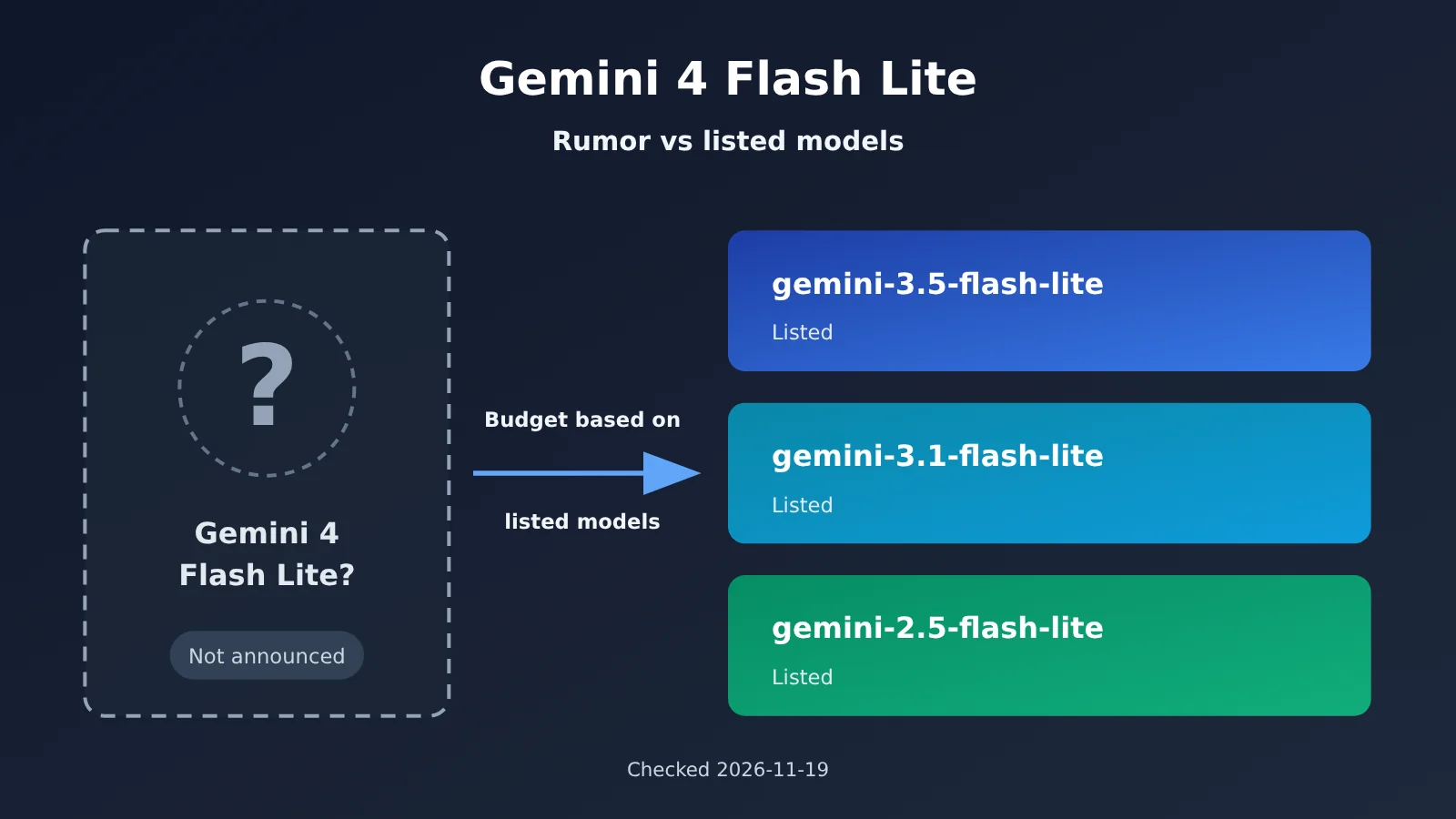
Gemini 4 Flash Lite Rumors: Key Facts at a Glance
Let’s start with the conclusion table. Each row below maps to a verifiable data point—no speculative pricing included.
| Item | Details |
|---|---|
| Verification date | 2026-11-19, third-party OrcaRouter checked the Google Gemini API model catalog |
| Gemini 4 in the official catalog | Only Hydrogen, Carbon, Neon, and Argon |
Is there a gemini-4-flash-lite? |
No. Neither the catalog nor the changelog lists this tier |
| Are Helium / Helix there? | Neither appears in the official catalog |
| Has Google confirmed the name or tier? | No |
| Official pricing | Not announced |
| Budgeting advice | Start by calculating based on the Flash Lite models that are already listed |
How the Gemini 4 Flash Lite rumor started
The direct starting point was 2026-11-19. That day, Google DeepMind’s Omar Sanseviero posted “Shipping will continue” on X, along with a video. The phrase itself didn’t mention any model name or tier—it only hinted that more releases were coming.
TestingCatalog interpreted this post as the imminent arrival of codename Helium and concluded that Helium maps to Flash Lite. It’s worth noting that this author had earlier treated Neon as Flash Lite too, and explicitly labeled that as pure speculation. The same author mapped two different codenames to the same tier in succession, which shows the codename-to-tier mapping was never stable to begin with.
As for Helix, the evidence is even weaker. Right now no strings extracted from a product package support it; it’s still only at the discussion stage. Separately, ofox gave a rumored price in an article the same day, but that price is exactly the same as the existing Gemini 3.5 Flash-Lite. That looks more like taking an old model’s price and applying it to a new name than independent evidence, so this article doesn’t use that rumored price.
| Clue | Source | Strength of evidence | Usable for budgeting? |
|---|---|---|---|
| “Shipping will continue” plus video | Omar Sanseviero’s X post | Weak; doesn’t name a model or tier | No |
| Helium equals Flash Lite | TestingCatalog’s interpretation | Weak; the author made a similar guess about Neon earlier | No |
| Helix | Community discussion | Very weak; no product package strings | No |
| Rumored price | ofox | Weak; overlaps with the 3.5 Flash-Lite price | No |
| Official model catalog | Google Gemini API | Strong | Yes, but this tier isn’t in the catalog |
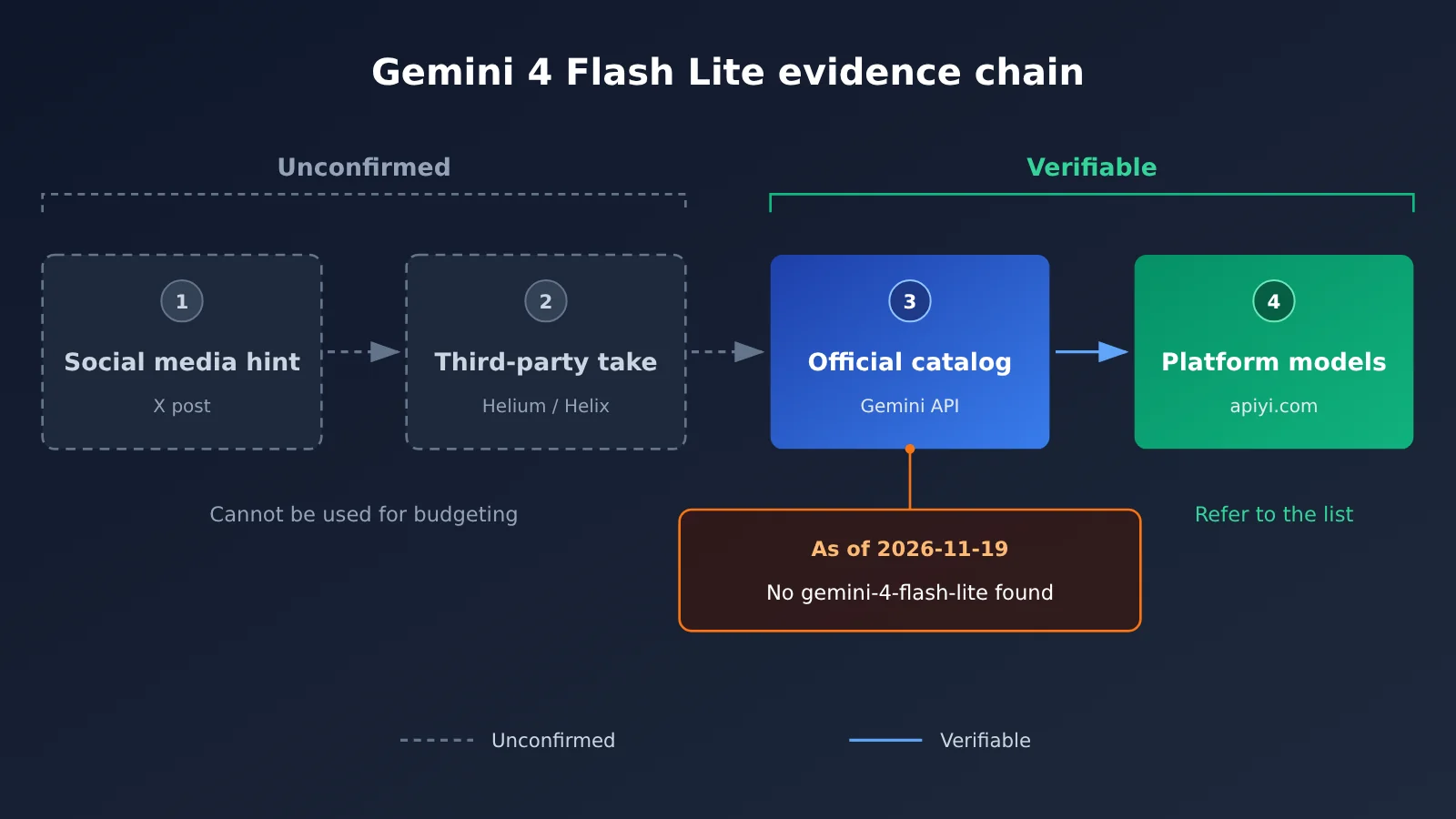
What Should You Base a Gemini 4 Flash Lite Budget On?
Since there’s no official price, you can’t build a budget on a number you made up. The safer approach is to calculate based on Flash Lite models that are already listed and directly callable, while leaving room to switch later.
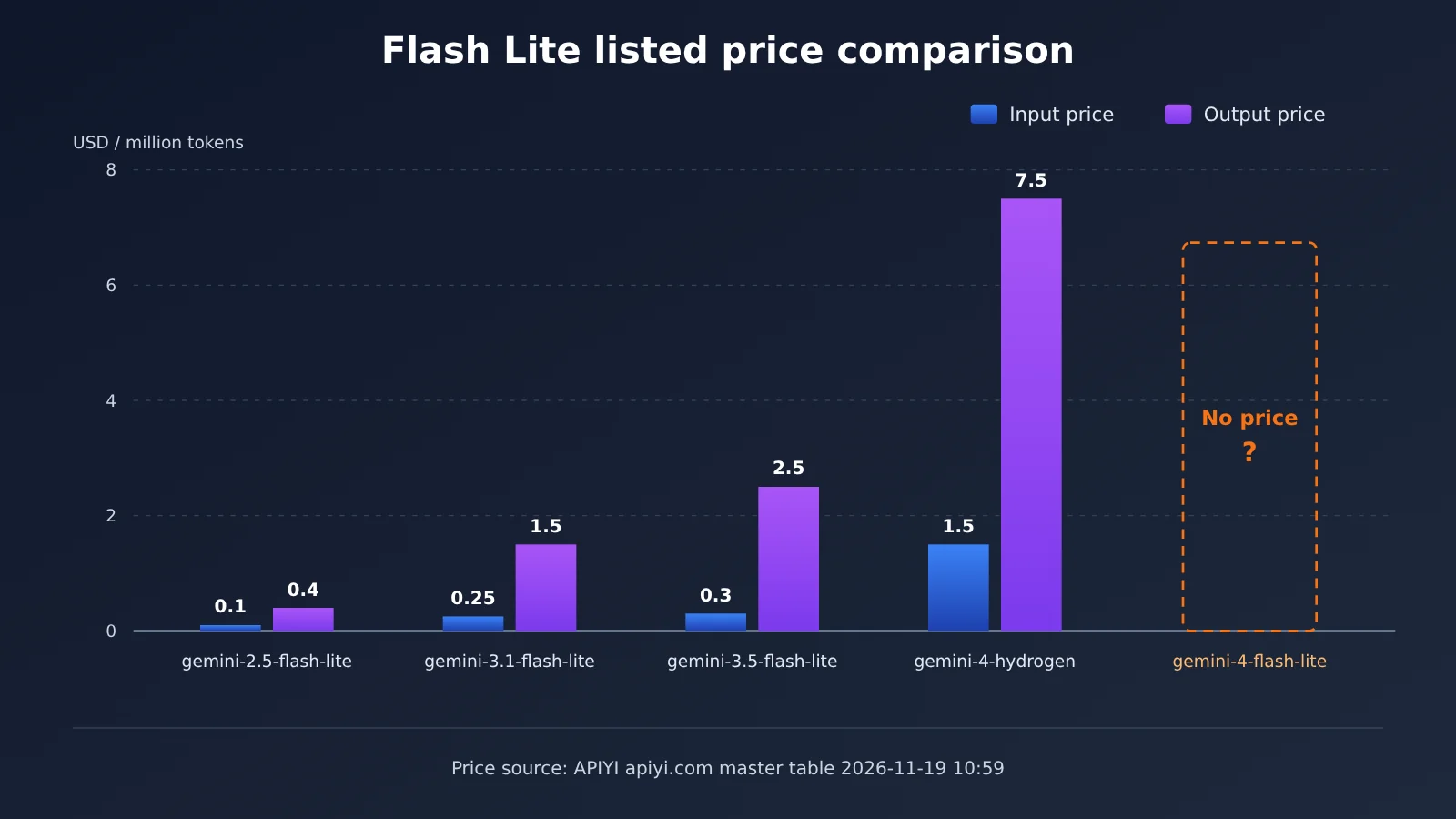
The table below shows the Flash Lite series already listed in the APIYI apiyi.com price master table. The master table was last updated on 2026-11-19 10:59 (UTC+8), and prices are in USD per million tokens.
| Model ID | Input | Output | Cache Read | Status |
|---|---|---|---|---|
gemini-3.5-flash-lite |
0.3 |
2.4999 |
0.03 |
Listed |
gemini-3.1-flash-lite (including preview) |
0.25 |
1.5 |
0.025 |
Listed |
gemini-2.5-flash-lite |
0.1 |
0.4 |
0.01 |
Listed |
gemini-4-flash-lite |
Not published | Not published | Not published | Not yet listed |
gemini-4-flash-lite currently can’t be found in either the APIYI master table or the pricing endpoint, so it’s marked as not yet listed in the table. We’ll get this model listed as soon as possible; the model name and price will be subject to the platform’s model list. Until it shows up, we recommend using one of the three tiers above as your budget baseline.
Can Any of the Listed Gemini 4 Models Pass as Flash Lite?
Some readers might wonder: since there are already four Gemini 4 models, could you pick the cheapest one as a stand-in for Flash Lite? Be careful here — Google hasn’t confirmed that any codename maps to the Flash Lite tier, and the earlier claim that Neon equals Flash Lite is just speculation. The table below lists the actual prices of the listed Gemini 4 models, for reference only — it doesn’t represent Flash Lite pricing.
| Model ID | Input | Output | Cache Read | Notes |
|---|---|---|---|---|
gemini-4-hydrogen |
1.5 |
7.5 |
0.075 |
Listed |
gemini-4-carbon |
2 |
10 |
0.1 |
Corresponds to Google’s introductory price through 2026-11-30; starting December 1, Google’s standard price is 4 input, 20 output |
gemini-4-neon |
3 |
15 |
0.15 |
From the pricing endpoint, consistent with Google’s listed price |
gemini-4-argon |
2 |
10 |
0.1 |
Listed |
As you can see, even Hydrogen — the cheapest of the Gemini 4 models — has an input price 5 times that of gemini-3.5-flash-lite. If your use case involves lightweight tasks like classification, extraction, or batch summarization, pinning your budget directly to existing Gemini 4 models will make costs noticeably higher. Carbon also has a timing consideration: after December 1, Google’s standard price will double, so you need to factor that in when budgeting for Carbon long-term.
Gemini 4 Flash Lite Quick Start: Get the Pipeline Working with an Available Model First
Before Gemini 4 Flash Lite actually ships, the most practical move is to get your pipeline working with a model that’s already available. That way, when the new model goes live, you only need to change a single model ID. All the steps below are built on the OpenAI-compatible interface.
- Look up the model: Open APIYI’s model directory at
docs.apiyi.com/models.mdand confirm the exact ID spelling of your target model, for examplegemini-3.5-flash-lite. Don’t writegemini-4-flash-litefrom memory — it doesn’t exist yet, and the call will throw an error. - Configure the endpoint: In the OpenAI SDK, set
base_urltohttps://api.apiyi.com/v1, put the key generated by the platform inapi_key, and setmodelto the ID you confirmed in the previous step. The message format is the same as any standard Chat Completions request. - Check the pricing: Query APIYI’s pricing endpoint at
https://api.apiyi.com/api/pricing, currently versioned asshell-api-modelmak-v1. Read themodel_ratio,completion_ratio, andcache_ratiofor your model, then convert them into USD prices. - Abstract the model name: Put the model ID in a config file or environment variable, for example
LITE_MODEL=gemini-3.5-flash-lite. Then switching models later won’t require any code changes.
The conversion rule for the pricing endpoint is simple: when model_ratio is 1, the input price is $2 per million tokens. The output price equals the input price times completion_ratio, and the cached-read price equals the input price times cache_ratio. Take gemini-4-neon as an example: model_ratio is 1.5, completion_ratio is 5, and cache_ratio is 0.05, which works out to input 3, output 15, and cached read 0.15 — matching the table above.
🚀 Quick start: Register at APIYI apiyi.com and claim the free trial quota for new users, run a real request against
gemini-3.5-flash-liteorgemini-2.5-flash-lite, then plug your actual token usage into the budget table. That’s far more reliable than any rumored price.
A Budget Sample Using Flash Lite’s Current Pricing
Let’s walk through the math with a hypothetical monthly usage: 100 million input tokens and 20 million output tokens per month, ignoring caching for now. This is just a demonstration of the calculation method — you’ll want to substitute your own real usage.
| Model ID | Input cost | Output cost | Monthly total (USD) |
|---|---|---|---|
gemini-2.5-flash-lite |
100 × 0.1 = 10 |
20 × 0.4 = 8 |
about 18 |
gemini-3.1-flash-lite |
100 × 0.25 = 25 |
20 × 1.5 = 30 |
about 55 |
gemini-3.5-flash-lite |
100 × 0.3 = 30 |
20 × 2.4999 ≈ 50 |
about 80 |
gemini-4-hydrogen (reference) |
100 × 1.5 = 150 |
20 × 7.5 = 150 |
about 300 |
This table makes one thing clear: the higher your output share, the bigger the gap between models. If your workload has a lot of repeated system prompts, the cached-read price is only a tenth of the input price, so turning on caching will bring your real cost down even further. As a budgeting baseline, pick the lowest tier that still meets your quality needs, then leave 20% to 30% of headroom to absorb the swings that come with switching models later.
Impact of the Gemini 4 Flash Lite Rumors
Impact on Developers
- Don’t hardcode the model ID ahead of time:
gemini-4-flash-liteisn’t in any official or platform list yet, so hardcoding it will only get you errors. - Benchmark against models that are actually available: use the three Flash Lite tiers—3.5, 3.1, and 2.5—as your performance baseline, then run another comparison round once the new model launches.
- Minimize switching costs: make model names configurable and pull pricing from the API. Do both, and when a new model goes live you’ll basically only need to change one line of config.
Impact on Budget Planning
- Don’t budget against rumored pricing: ofox’s rumored price overlaps with 3.5 Flash-Lite and has no independent source—using it to build a budget is baseless.
- Flag Carbon’s pricing timeline separately: starting December 1, Google’s standard pricing becomes
4for input and20for output, so quarterly budgets need to be calculated in segments. - A new tier isn’t necessarily cheaper: until the official announcement, there’s no way to tell whether Gemini 4 Flash Lite will be cheaper or more expensive than the existing Flash Lite.
💡 Recommendation: If you’re just waiting for the new model, put the three listed Flash Lite tiers in the same codebase and run an A/B comparison. With APIYI apiyi.com, a single key lets you call these Gemini models—when you switch, you only need to change the
modelfield.
Frequently Asked Questions (FAQ)
Q1: Is Gemini 4 Flash Lite a released model?
No. As of 2026-11-19, the Gemini 4 lineup in the Google Gemini API model catalog only includes four variants — Hydrogen, Carbon, Neon, and Argon — and there’s no Flash Lite tier in the changelog either. For now, it’s just a rumor.
Q2: Is Helium the same thing as Gemini 4 Flash Lite?
That’s just TestingCatalog’s interpretation — Google hasn’t confirmed the name or the tier. The same author previously speculated that Neon was Flash Lite as well, and labeled it pure speculation. So the Helium-to-Flash-Lite connection shouldn’t be treated as fact.
Q3: When will APIYI list Gemini 4 Flash Lite?
At the moment, `gemini-4-flash-lite` doesn’t appear in APIYI’s master table or pricing endpoint, so it’s not listed yet. We’ll get this model up as soon as we can — the model ID and pricing are subject to the platform’s model list, so keep an eye on the master model table updates at apiyi.com.
Q4: Which Flash Lite tier should I use for budgeting right now?
Pick based on how hard the task is:
– **Batch classification, tag extraction**: start with `gemini-2.5-flash-lite` — input `0.1`, output `0.4`, the lowest cost.
– **General summarization, customer support Q&A**: `gemini-3.1-flash-lite` gives you a solid balance of price and quality.
– **Lightweight tasks that need higher quality**: use `gemini-3.5-flash-lite` as your baseline.
Q5: How do I quickly call an already-listed Flash Lite model via the API?
1. Register an account at APIYI apiyi.com to get your API key and free trial credits for new users;
2. In the OpenAI SDK, set `base_url` to `https://api.apiyi.com/v1`;
3. Set `model` to a listed ID such as `gemini-3.5-flash-lite`, then send the request.
Q6: Can I trust the Gemini 4 Flash Lite prices floating around online?
We wouldn’t rely on them. The rumored price matches the existing Gemini 3.5 Flash-Lite exactly, which looks a lot like old prices slapped onto a new name — not independent evidence. Until Google makes it official, any specific number is just a guess.
Gemini 4 Flash Lite Key Takeaways
- Current status: Gemini 4 Flash Lite is only a rumor — there’s no model ID and no official price.
- Official lineup: As of 2026-11-19, Gemini 4 has just four models: Hydrogen, Carbon, Neon, and Argon.
- Rumor evidence: Neither Helium nor Helix has been confirmed by Google, and Helix doesn’t even have product bundle strings backing it.
- Budget baseline: Work from the three Flash Lite tiers already on the market — 3.5, 3.1, and 2.5 — rather than rumored prices.
- Carbon heads-up: Starting December 1, Google’s standard price becomes input
4and output20. - How to get started: Use a single key on APIYI apiyi.com to call multiple Gemini tiers, and turn the model name into a config option.
Summary
The core information about Gemini 4 Flash Lite comes down to three points:
- It’s not on the official list yet: Neither the Google catalog nor the changelog includes this tier, and neither the name nor the tier itself has been confirmed.
- The rumored price isn’t usable: The only price in circulation overlaps with 3.5 Flash-Lite and has no independent source.
- Budget based on models that are actually listed: The three Flash Lite tiers already on the market have clear prices and can be called directly — enough to support planning today.
A sensible pace is this: get your workload running and your usage measured on the Flash Lite models that are listed now; once gemini-4-flash-lite shows up in the official lineup and on platform model lists, run one round of quality and price comparison, then decide whether to switch. We recommend checking the model list and pricing endpoints through APIYI apiyi.com, and verifying results with real requests.
📚 References
-
Google Gemini API Model Catalog: the primary source for verifying official Gemini 4 model names
- Link:
ai.google.dev/gemini-api/docs/models - Note: check the model IDs and tiers currently listed officially
- Link:
-
Google Gemini API Changelog: confirms whether a new model has officially launched
- Link:
ai.google.dev/gemini-api/docs/changelog - Note: new model releases are recorded here
- Link:
-
APIYI Model Catalog: listed models and pricing
- Link:
docs.apiyi.com/models.md - Note: the Flash Lite pricing in this article comes from the 2026-11-19 10:59 version
- Link:
Author: APIYI Technical Team
Technical Discussion: Feel free to reach out via the APIYI website homepage; for more models and integration guides, visit the docs.apiyi.com documentation center