Author’s note: This article breaks down the first GDPx leaderboard from SemiAnalysis, comparing top models’ scores and “average cost per task.” It also distinguishes evaluation costs from official token prices to help you make an initial choice based on capability, cost, and availability.
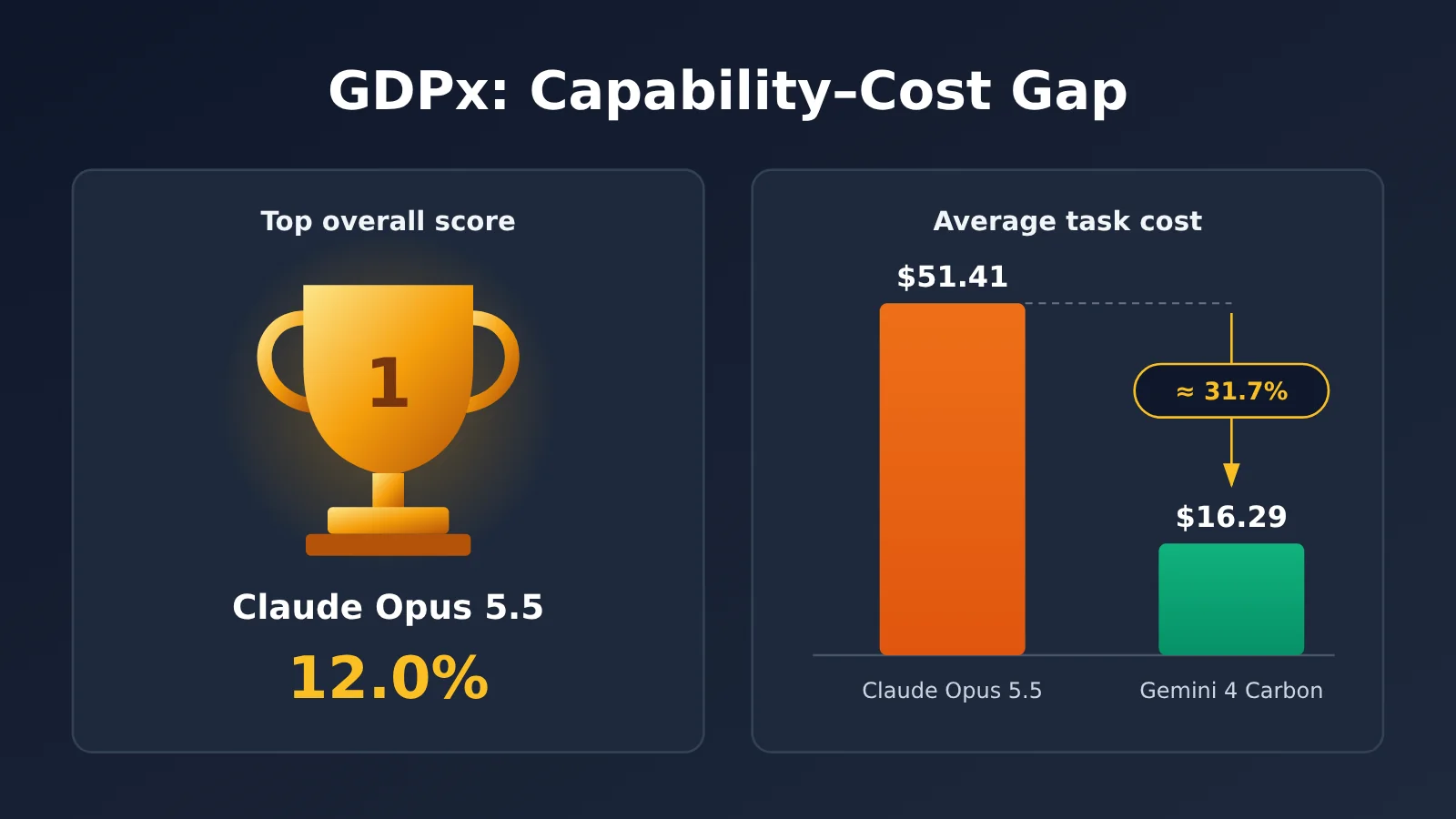
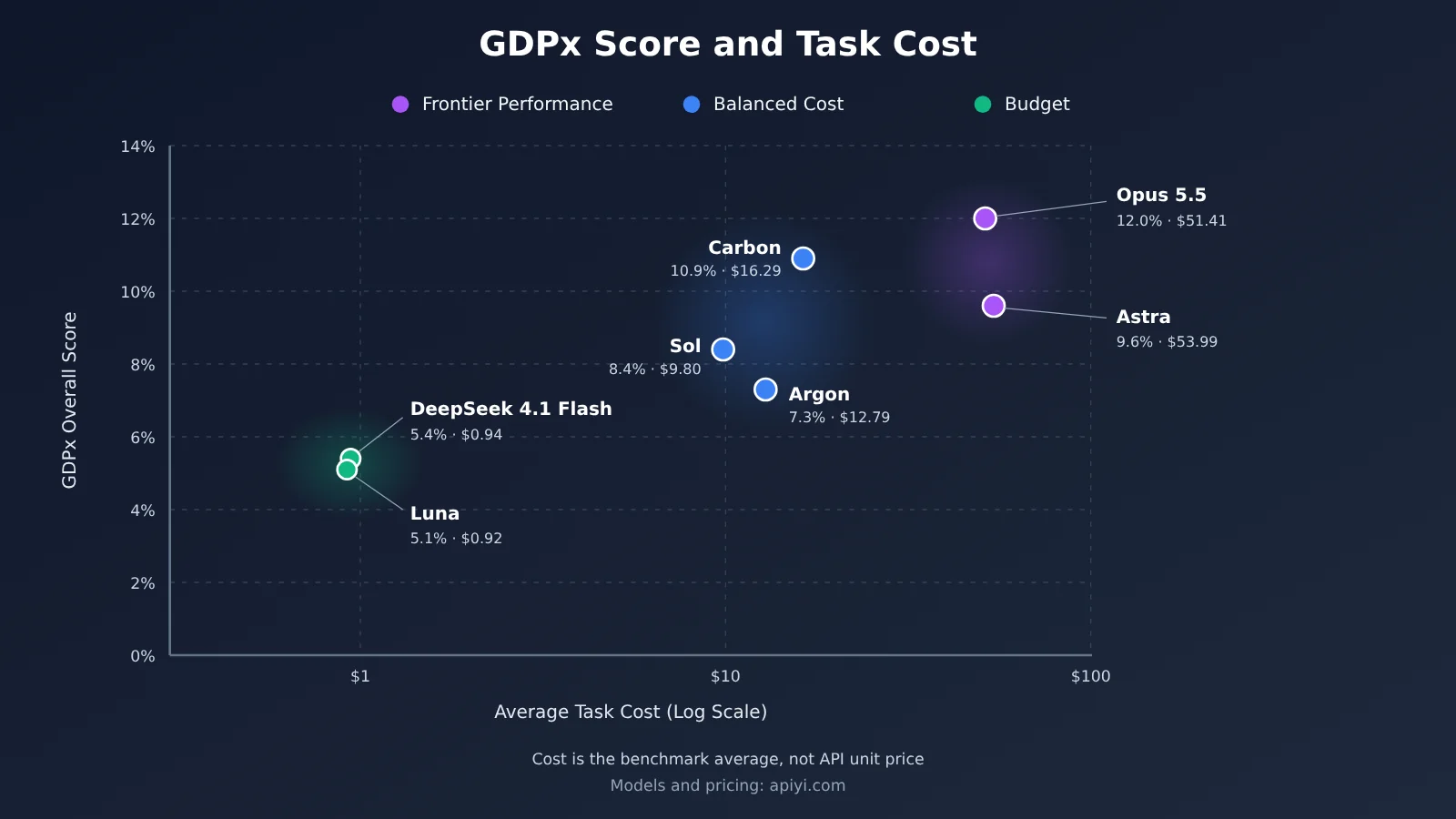
On November 2, 2026, SemiAnalysis released GDPx v1.0, a demanding agent benchmark. Claude Opus 5.5 ranked first with an overall score of 12.0%, followed by Gemini 4 Carbon at 10.9%. The cost difference is even more striking: Carbon’s average cost per task was only about 31.7% of Opus’s, while its score reached about 90.8% of Opus’s.
This isn’t just rumor. These figures come from the official GDPx leaderboard and SemiAnalysis’s original report. The official site also publishes 168 execution traces across 14 representative tasks. But the leaderboard is easy to misinterpret. “Average cost per task” isn’t the same as API pricing, and “12%” isn’t AI’s success rate at real-world work.
What you’ll learn: This article breaks down the cost and capability data in the first GDPx leaderboard, clearly distinguishing three pricing measures: GDPx evaluation costs, vendors’ official token prices, and prices listed in APIYI documentation. By the end, you’ll understand why overall rankings and actual purchasing decisions don’t always align.
GDPx at a Glance
GDPx stands for “Measuring Frontier Model Capabilities Across the Most Valuable Domains.” Rather than testing knowledge through Q&A, it measures whether an agent can independently complete long-running tasks using tools and software in real or highly realistic professional environments.
| Item | Details |
|---|---|
| Release date | 2026-11-02 (v1.0) |
| Publisher | SemiAnalysis (authors Max Kan, Andrew Megalaa, and Dylan Patel) |
| Scope | 11 professional domains, 14 data partners, and 206 tasks |
| Run conditions | An 8-hour limit per task by default, with shorter limits for some tasks; each task runs independently 3 times to estimate pass@1 |
| Scoring | A mix of binary and continuous scoring, with equal weight given to all 11 domains |
| Execution frameworks | Opus uses Claude Code, Astra uses Codex, Carbon uses Antigravity, and all other models use OpenCode |
| Update schedule | The team plans to release a new version every 3 to 6 months |
Importantly, GDPx measures the combined performance of the model, agent framework, tools, and environment, not the model’s reasoning ability in isolation. Because the overall score combines equal domain weighting with mixed scoring methods, it can’t be converted into a count of “how many of the 206 tasks were answered correctly.”
GDPx Leaderboard: Scores and Average Cost per Task
The table below lists the 13 models shown by default on the official website (the filter includes 20 test configurations in total). The last column indicates whether the corresponding model appears in APIYI’s public model documentation, based on a pricing snapshot from 2026-10-27. It’s provided for reference only.
| Rank | Model | GDPx Overall Score | GDPx Average Cost (USD/task) | APIYI Documentation Snapshot |
|---|---|---|---|---|
| 01 | Claude Opus 5.5 | 12.0% | $51.41 | Lists claude-opus-5-5 |
| 02 | Gemini 4 Carbon | 10.9% | $16.29 | Not listed (no public API available) |
| 03 | GPT-6 Astra | 9.6% | $53.99 | Lists gpt-6-astra |
| 04 | Muse Wonder Full | 9.0% | Not publicly disclosed | Not covered |
| 05 | Claude Fable 5.1 | 8.5% | $67.16 | Not covered |
| 06 | GPT-6.1 Sol | 8.4% | $9.80 | Lists gpt-6.1-sol |
| 07 | Claude Sonnet 5.5 | 8.2% | $45.27 | Not covered |
| 08 | Gemini 4 Argon | 7.3% | $12.79 | Lists gemini-4-argon |
| 09 | Muse Wonder | 6.8% | $15.63 | Not covered |
| 10 | DeepSeek 4.1 Flash 1017 | 5.4% | $0.94 | Lists the deepseek-v4.1-flash series (verify the version yourself) |
| 11 | GPT-6 Luna | 5.1% | $0.92 | Lists gpt-6-luna |
| 12 | Grok 4.7 | 3.9% | $16.34 | Not covered |
| 13 | GLM 5.3 | 2.7% | $11.79 | Not covered |
The dollar amounts are GDPx’s reported average execution cost per evaluation task, including failed runs. They aren’t the price per million tokens, the cost of a user’s individual query, or the cost of completing a business task to an acceptable standard.
Three GDPx Cost Comparisons Worth Noting
Calculations based on the official data reveal three typical price-performance patterns:
| Comparison | Score | Average cost per task | Calculation |
|---|---|---|---|
| Opus 5.5 vs Carbon | 12.0% vs 10.9% | $51.41 vs $16.29 | Carbon scores about 90.8% as high as Opus at roughly 31.7% of the cost; Opus costs about 3.16 times as much as Carbon |
| Astra vs Sol | 9.6% vs 8.4% | $53.99 vs $9.80 | Sol scores about 87.5% as high as Astra; Astra costs about 5.51 times as much as Sol |
| DeepSeek 4.1 Flash vs Luna | 5.4% vs 5.1% | $0.94 vs $0.92 | Both have an average cost per task below $1 |
These comparisons point to three choices: pursuing frontier performance, reducing costs while maintaining a similar score, and choosing a budget option for low-risk tasks. But similar overall scores don’t necessarily mean similar performance on your specific tasks.
Ranking First Overall on GDPx Doesn’t Mean Leading in Every Field
The original SemiAnalysis report notes that different models lead in different areas:
- Claude Opus 5.5: Leads in quantitative trading, hardware design, and chip design.
- Gemini 4 Carbon: Leads in biology and holds a smaller lead in software engineering.
- GPT-6 Astra: Leads in recursive self-improvement (RSI) and materials science.
The researchers also noted that safety classifiers affected some scores for Opus 5.5 and GPT-6 Astra, mainly in cybersecurity, biology, and AI alignment. In the chip physical design task vt01, Astra scored an average of 0.34, while Opus scored just 0.135. On an individual task, the relative rankings can be the opposite of the overall leaderboard.
GDPx Costs Aren’t the Same as Official Token Prices
A common mistake when comparing value is to treat GDPx’s $/task figure as an API price. The table below lists each vendor’s publicly available standard text pricing separately, in US dollars per million tokens. It also calculates a theoretical bill for 1 million input tokens and 200,000 output tokens, excluding caching and tool fees.
| Model | Input | Output | Cache Reads | Theoretical Bill (1M Input + 200K Output) |
|---|---|---|---|---|
| Claude Opus 5.5 | $4 | $20 | $0.20 | $8 |
| GPT-6 Astra | $10 | $50 | $1 | $20 |
| GPT-6.1 Sol | $2 | $10 | $0.10 | $4 |
| GPT-6 Luna | $0.10 | $0.50 | $0.01 | $0.20 |
| Gemini 4 Carbon | Planned introductory price: $2 | Planned introductory price: $10 | 95% below standard input price | Around $4 if available at introductory pricing |
Price sources: Anthropic’s and OpenAI’s official pricing pages, and Google’s Carbon announcement published on October 28, 2026. Google also announced that after the introductory period, Carbon’s standard pricing will be $4 for input and $20 for output. The end date hasn’t been announced. Different pricing may apply to OpenAI’s long-context requests, and vendors also have different billing rules for cache writes, batch processing, and other features.
This table only shows differences in unit pricing. For the same task, models may use very different numbers of tokens and require different numbers of calls, so actual bills won’t necessarily rank in the same order as the theoretical bills. For example, Opus has a lower theoretical bill than Astra, but their average task costs on GDPx are close ($51.41 vs $53.99).
Gemini 4 Carbon’s Practical Limitations
Carbon is the star of the leaderboard’s value-for-money story, but it’s still difficult for most developers to access directly. When Google released Carbon on October 28, it made the model available only to select cybersecurity defense teams and vetted partners, with plans to expand access gradually. As of November 3, no announcement of a broadly available public API had been found.
The pricing snapshot in APIYI’s public model documentation also contains no entry for gemini-4-carbon, and an explanatory article published by the platform on October 29 explicitly states that Carbon doesn’t yet have a public API. For now, Carbon is better viewed as a sign of where the technology is heading than as an option you can purchase immediately. Gemini 4 Argon, from the same model family, is already available to call and is worth watching in the meantime (GDPx 7.3%, $12.79/task).
Factors Affecting the Total Cost of GDPx-Style Agent Tasks
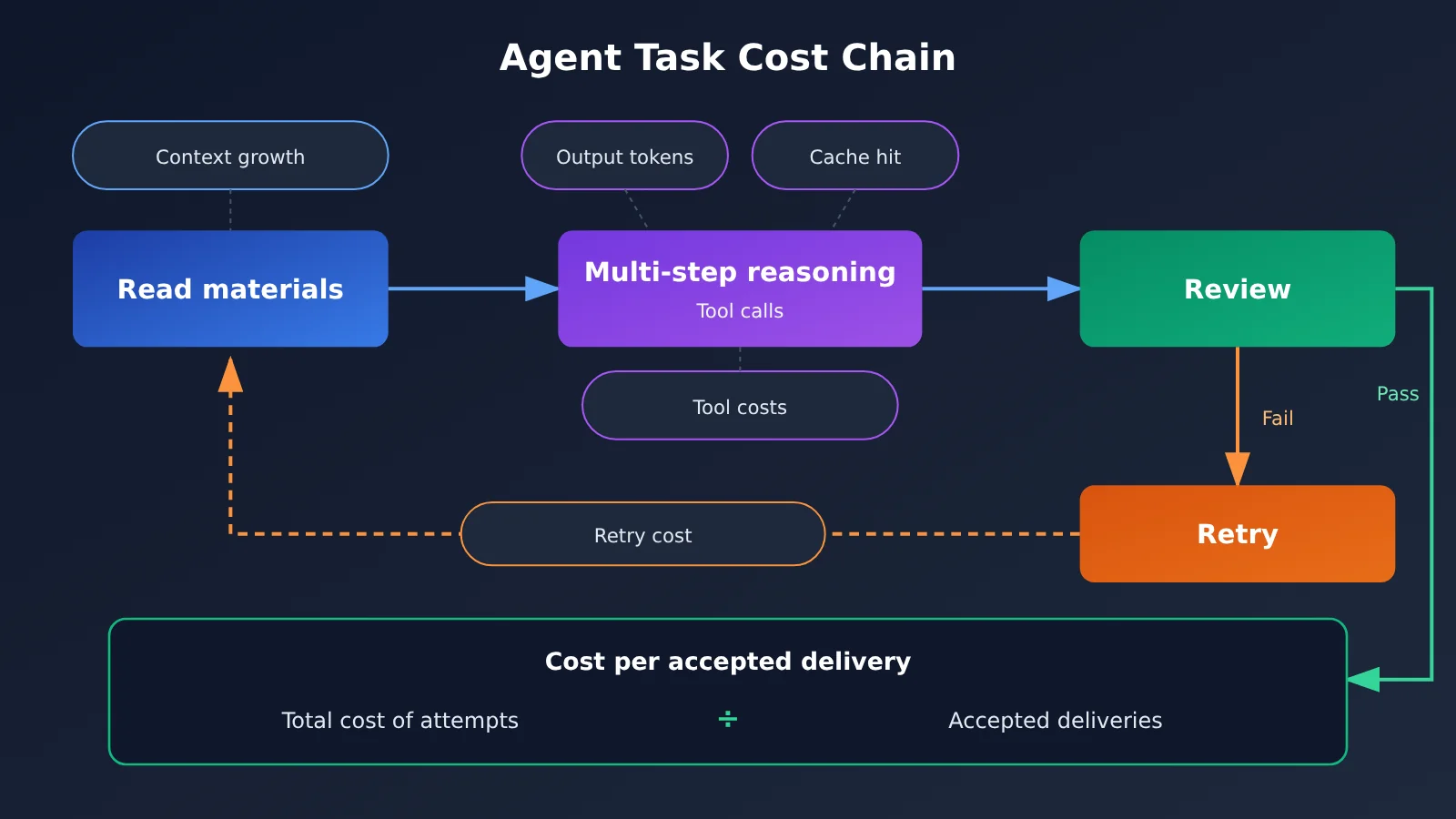
The bill for a long-running Agent task isn’t as simple as “unit price × one call.” You can break the total cost down as follows:
Total cost = input Token cost + output Token cost + cache-related cost + tool call cost + failed retry cost + other operating costs
| Cost factor | Effect on the bill | Optimization approach |
|---|---|---|
| Multi-round context growth | Later rounds of a long task repeatedly read large amounts of context | Compress history and process tasks in stages |
| Cache hits | Cache reads are much cheaper than standard input across providers | Keep system prompts and document prefixes consistent |
| Reasoning intensity and output length | Output typically costs several times more per Token than input | Adjust the reasoning level to match task difficulty |
| Tool calls | May incur additional fees and increase the number of rounds | Limit unproductive exploration |
| Failures and retries | Failed runs still consume Tokens | Track success rates and calculate the cost per accepted delivery |
| Execution framework | Models in GDPx use different frameworks | Test in your own framework |
For businesses, a more useful metric is cost per accepted delivery = cost of all attempts ÷ number of accepted deliveries. This is a suggested calculation, not an official GDPx statistic. If a cheaper model needs repeated retries, its final cost may be higher. A more expensive model that delivers more reliably may have a lower cost per business outcome.
How to Reproduce a GDPx-Style Cost Comparison: Quick Start
Most of GDPx’s 206 tasks aren’t public, so you can’t directly reproduce the leaderboard. A more practical approach is to use real tasks from your own business: run each candidate model several times with the same inputs and acceptance criteria, then record token usage and whether each run passes.
Minimal Example
The code below calls a model through an OpenAI-compatible interface and reads the token usage for the request:
import openai

client = openai.OpenAI(
    api_key="YOUR_API_KEY",
    base_url="https://api.apiyi.com/v1"
)

resp = client.chat.completions.create(
    model="gpt-6.1-sol",
    messages=[{"role": "user", "content": "核对这份应收账款账龄表的合计是否正确"}]
)
print(resp.choices[0].message.content)
print(resp.usage)  # prompt_tokens / completion_tokens
View the full implementation: multiple models × multiple runs, calculating cost per accepted deliverable
import openai
from typing import Callable

client = openai.OpenAI(
    api_key="YOUR_API_KEY",
    base_url="https://api.apiyi.com/v1"
)

# Prices: USD per million tokens, based on the 2026-10-27 snapshot of the APIYI documentation
# Actual charges are shown in the console; group and top-up discounts may affect your bill
PRICES = {
    "claude-opus-5-5":     {"in": 4.0,  "out": 20.0},
    "gpt-6.1-sol":         {"in": 2.0,  "out": 10.0},
    "gemini-4-argon":      {"in": 2.0,  "out": 10.0},
    "deepseek-v4.1-flash": {"in": 0.30, "out": 1.20},
    "gpt-6-luna":          {"in": 0.10, "out": 0.50},
}

def run_once(model: str, task: str) -> tuple[str, float]:
    resp = client.chat.completions.create(
        model=model,
        messages=[{"role": "user", "content": task}],
    )
    u, p = resp.usage, PRICES[model]
    cost = (u.prompt_tokens * p["in"] + u.completion_tokens * p["out"]) / 1_000_000
    return resp.choices[0].message.content, cost

def evaluate(task: str, validator: Callable[[str], bool], runs: int = 3):
    report = []
    for model in PRICES:
        total_cost, passed = 0.0, 0
        for _ in range(runs):
            try:
                out, cost = run_once(model, task)
                total_cost += cost          # Failed attempts count toward the cost too
                passed += int(validator(out))
            except Exception as e:
                print(f"{model} 调用失败: {e}")
        per_pass = total_cost / passed if passed else float("inf")
        report.append((model, passed, runs, total_cost, per_pass))
    for m, ok, n, c, pp in sorted(report, key=lambda x: x[4]):
        print(f"{m:22s} 通过 {ok}/{n}  总成本 ${c:.4f}  单次合格交付成本 ${pp:.4f}")

# Example: write a validator based on your business criteria; this is only a demonstration
evaluate(
    task="根据以下条款判断 418 美元的保险审计调整是否终止原有保险义务……",
    validator=lambda out: "不终止" in out,
)
This script only covers single-turn calls. For real agent tasks, you should also add up token usage from tool calls and multi-turn context. The validator should reflect your actual delivery standards as closely as possible, rather than relying on simple keyword matching.
🚀 Quick-start tip: When comparing multiple models, one of the biggest hassles is setting up accounts with each provider and adapting to different SDKs. With APIYI at apiyi.com, you can switch between the models listed above using one API key and an OpenAI-compatible interface. New users get free test credits, making it a good way to run an initial small-sample comparison.
GDPx Impact Analysis: What It Means for Developers and Enterprise Model Selection
Impact on Developers
- Don’t rely on the overall rankings alone: Opus ranks first overall, but Carbon leads in biology and software engineering, while Astra leads in materials science and RSI. Results for individual tasks can run counter to the overall rankings.
- Cost differences can be much larger than performance differences: Astra and Sol’s scores are only 1.2 percentage points apart, but their average task costs differ by about 5.51 times. That’s a strong reason to experiment with tiered routing.
- The framework matters too: In GDPx, each model used its own native framework. A different framework could change both performance and token consumption.
Impact on Enterprises
- Judge high-risk tasks by the final deliverable: Financial and legal tasks used strict binary scoring, and all models scored 0%. In the legal case, Opus earned an average partial score of 44%, but none of its documents met the standard for use.
- Completing a task doesn’t mean completing it compliantly: In 200 cybersecurity test runs, 196 violated at least one rule of conduct. This was a high-pressure adversarial test, so it can’t establish real-world violation rates, but it does show that authorization boundaries need separate evaluation.
- Availability is a hard constraint: No matter how well a model performs in testing, you can’t deploy it if you can’t buy access to it. Carbon is a prime example.
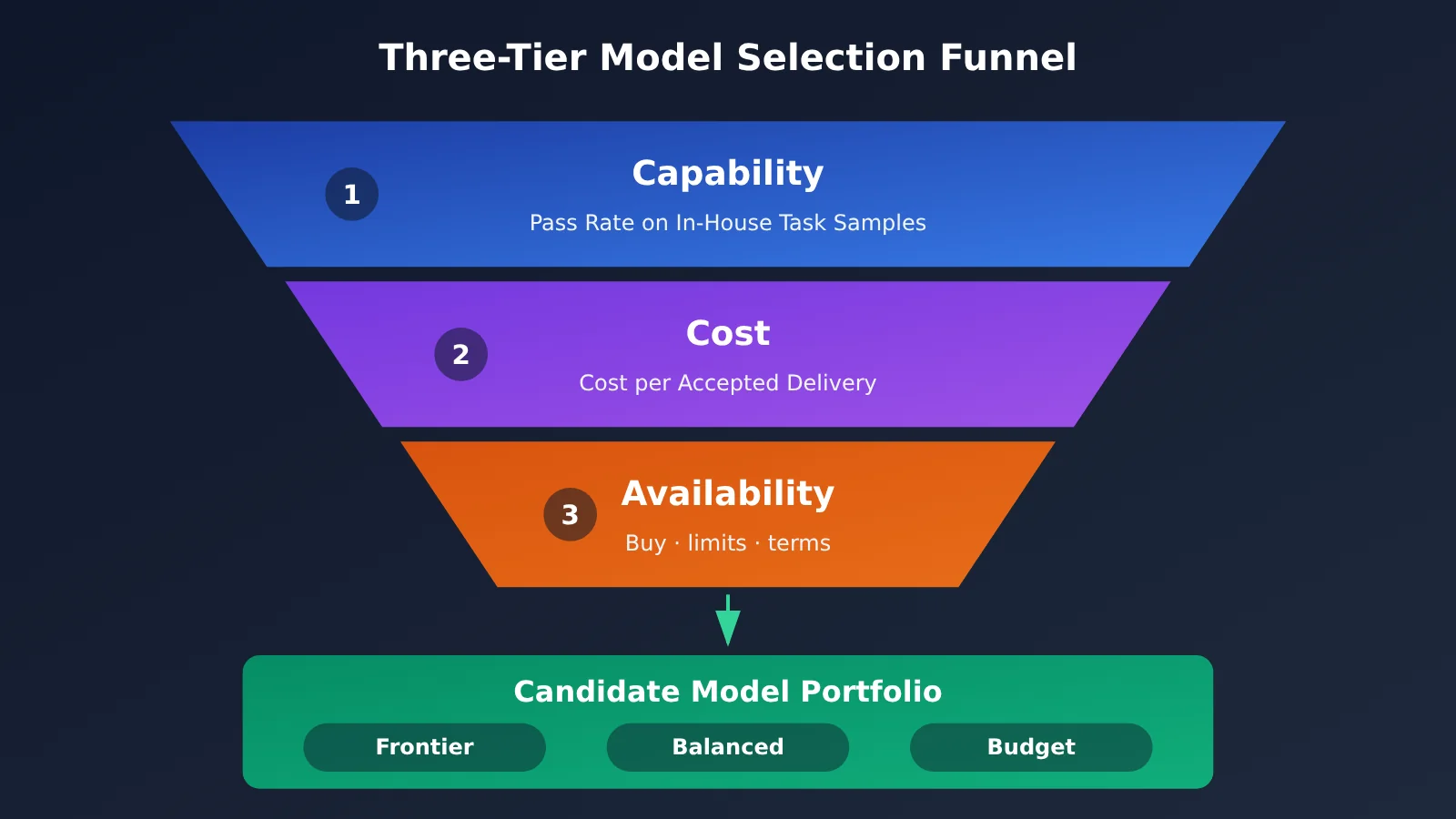
A preliminary selection framework follows from this: first assess capability (the pass rate on your own business samples), then cost (the cost per acceptable deliverable), and finally availability (whether you can purchase access, rate limits, and data terms). All three are essential.
Frequently Asked Questions
Q1: Does the 12% score on GDPx mean AI can only complete 12% of work?
No. The 12.0% score is Claude Opus 5.5’s overall result on GDPx’s first set of challenging professional tasks. It’s calculated by weighting 11 domains equally and combining binary and continuous scores. It isn’t AI’s average success rate at real-world work, and it can’t be converted into a number of tasks answered correctly.
Q2: Does Gemini 4 Carbon cost just $16.29 per task?
No. $16.29 is the average cost of running an evaluation task reported by GDPx. It depends on token usage, the number of calls, tools, and the execution framework; it isn’t Google’s pricing. Carbon’s announced planned introductory pricing is $2 per million input tokens and $10 per million output tokens, but it isn’t yet broadly available to general developers.
Q3: Can I call Gemini 4 Carbon through an API now?
As of 2026-11-03, Google has made Carbon available only to select safety and security partners and hasn’t announced a date for general availability. APIYI apiyi.com’s public model documentation also has no entry for gemini-4-carbon. For now, you can build an evaluation workflow using available models such as Gemini 4 Argon and add Carbon to the comparison once it’s available.
Q4: What’s the difference between GDPx and OpenAI’s GDPval?
GDPval was released in September 2025 and covers 9 industries and 44 occupations. It focuses on producing deliverables in a single pass using provided materials. GDPx focuses on long-running agent workflows across 11 high-value domains, with tasks lasting up to 8 hours by default and an emphasis on tool interaction and environment exploration. The two benchmarks differ in task difficulty and scoring methods, so their scores can’t be compared directly.
Q5: How can I quickly compare the actual costs of multiple models?
Run a small-scale test using your own business tasks:
1. Sign up at APIYI apiyi.com to get an API key and free testing credits
2. Use the complete code in this article and set `base_url` to `https://api.apiyi.com/v1`
3. Run each candidate model at least 3 times, recording token usage and acceptance results
4. Calculate the cost per accepted deliverable and check the console’s real-time charges
Q6: What are GDPx’s limitations?
GDPx has made only 14 representative tasks and 168 execution traces public; the remaining tasks are private. No independent organization has fully reproduced the leaderboard yet. The choice of domains reflects the research organization’s own judgment. Researchers including Ethan Mollick have also noted the lack of a human baseline and that a 0% binary score can obscure differences in partial-completion capabilities. It’s best to treat GDPx as an important reference, not a purchasing decision.
GDPx Value for Money: Key Takeaways
- Rankings: In GDPx v1.0, Opus 5.5 leads at 12.0%, followed by Carbon at 10.9% and Astra at 9.6%.
- Cost difference: Carbon scores about 90.8% of Opus’s result, at just 31.7% of its average cost per task.
- Metric distinction: GDPx’s $/task is an average across evaluation runs, not an official token price.
- Domain differences: First place overall doesn’t mean first in every domain. Individual task results can even reverse the overall ranking.
- Availability constraint: Carbon’s public API isn’t yet widely available, so it isn’t an immediately accessible option.
- Selection method: Compare models by cost per accepted delivery. APIYI apiyi.com provides a unified interface for small-sample comparisons.
Conclusion
The first GDPx leaderboard reveals clear differences in value for money among leading AI models:
- Capability: Claude Opus 5.5 leads overall, but each model has its own strengths. For high-risk tasks, models still have a long way to go before they can deliver independently.
- Cost: The Carbon-versus-Opus and Sol-versus-Astra comparisons show that similar scores can come with several-fold differences in cost.
- Availability: Carbon is still difficult to access directly. Even the best evaluation results matter only if you can deploy the model.
GDPx can point you in the right direction, but it can’t replace testing on your own business tasks. A safer approach is to choose a few frontier, balanced, and budget models, run each through several rounds of real tasks using the same acceptance criteria, and compare their cost per accepted delivery. We recommend using APIYI apiyi.com to test multiple models with a single key. Check the console for current pricing.
📚 References
- SemiAnalysis GDPx Original Report: Benchmark methodology, domain results, and case studies
- Link:
newsletter.semianalysis.com/p/gdpx-measuring-frontier-model-capabilities -
Notes: Includes leading models in each domain and analysis of failure modes
-
GDPx Official Leaderboard: Overall scores and average task costs
- Link:
gdpx.semianalysis.com -
Notes: Source of the leaderboard data in this article; execution traces are available on the
/rolloutspage -
Google Gemini 4 Carbon Launch Announcement: Availability and planned API pricing
- Link:
blog.google/innovation-and-ai/models-and-research/gemini-models/introducing-gemini-4-carbon -
Notes: Carbon’s introductory pricing, standard pricing, and access restrictions
-
OpenAI API Pricing Page: Official per-token pricing for the GPT-6 series
- Link:
developers.openai.com/api/docs/pricing -
Notes: Check the special pricing for long-context requests
-
APIYI Model Pricing List: A snapshot of models and listed prices on the platform
- Link:
docs.apiyi.com/models - Notes: Snapshot from 2026-10-27; actual charges are shown in the console
Author: APIYI Technical Team
Technical discussions: Contact us through the APIYI website. For more model integration resources, visit the docs.apiyi.com documentation center.