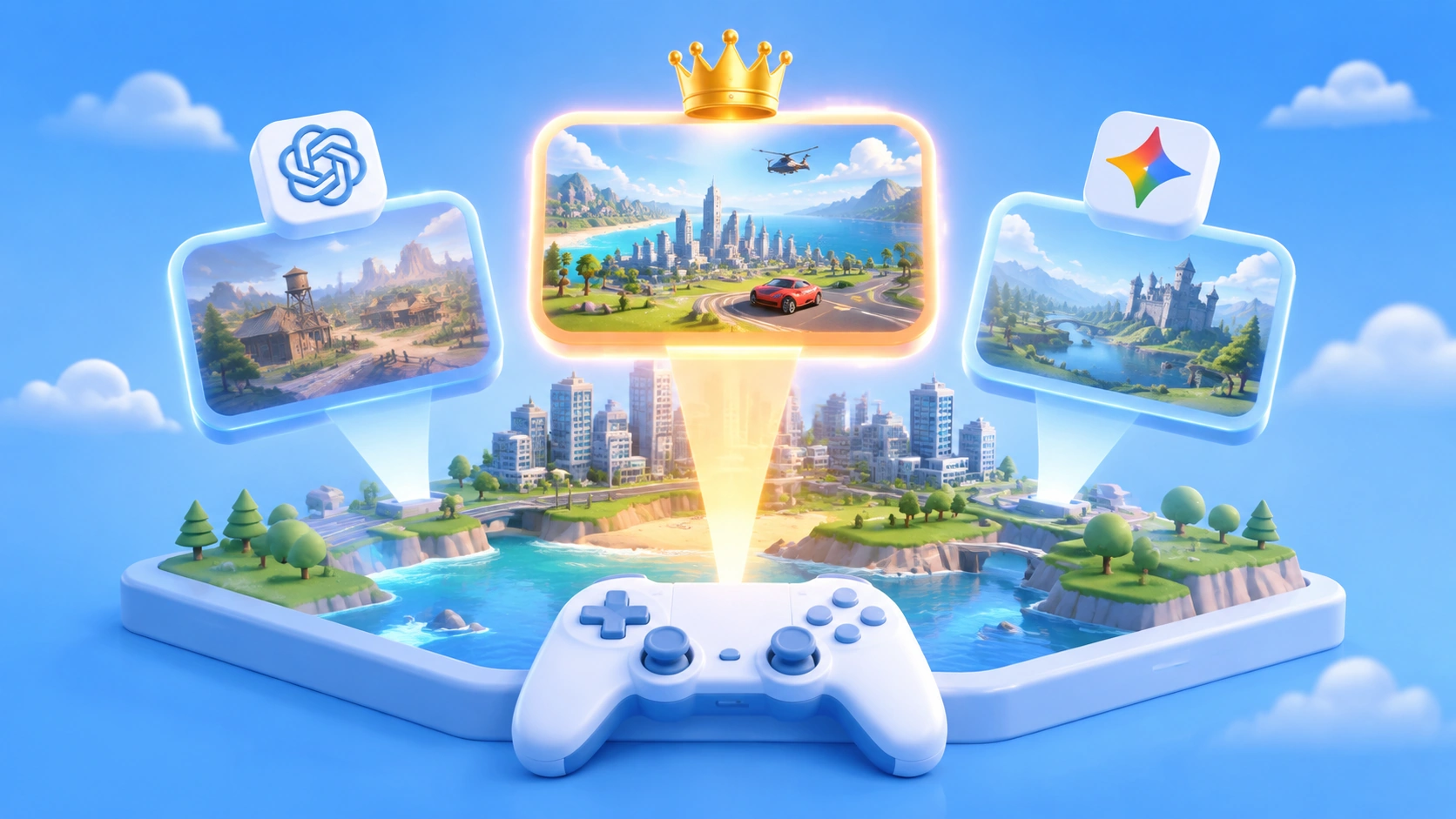
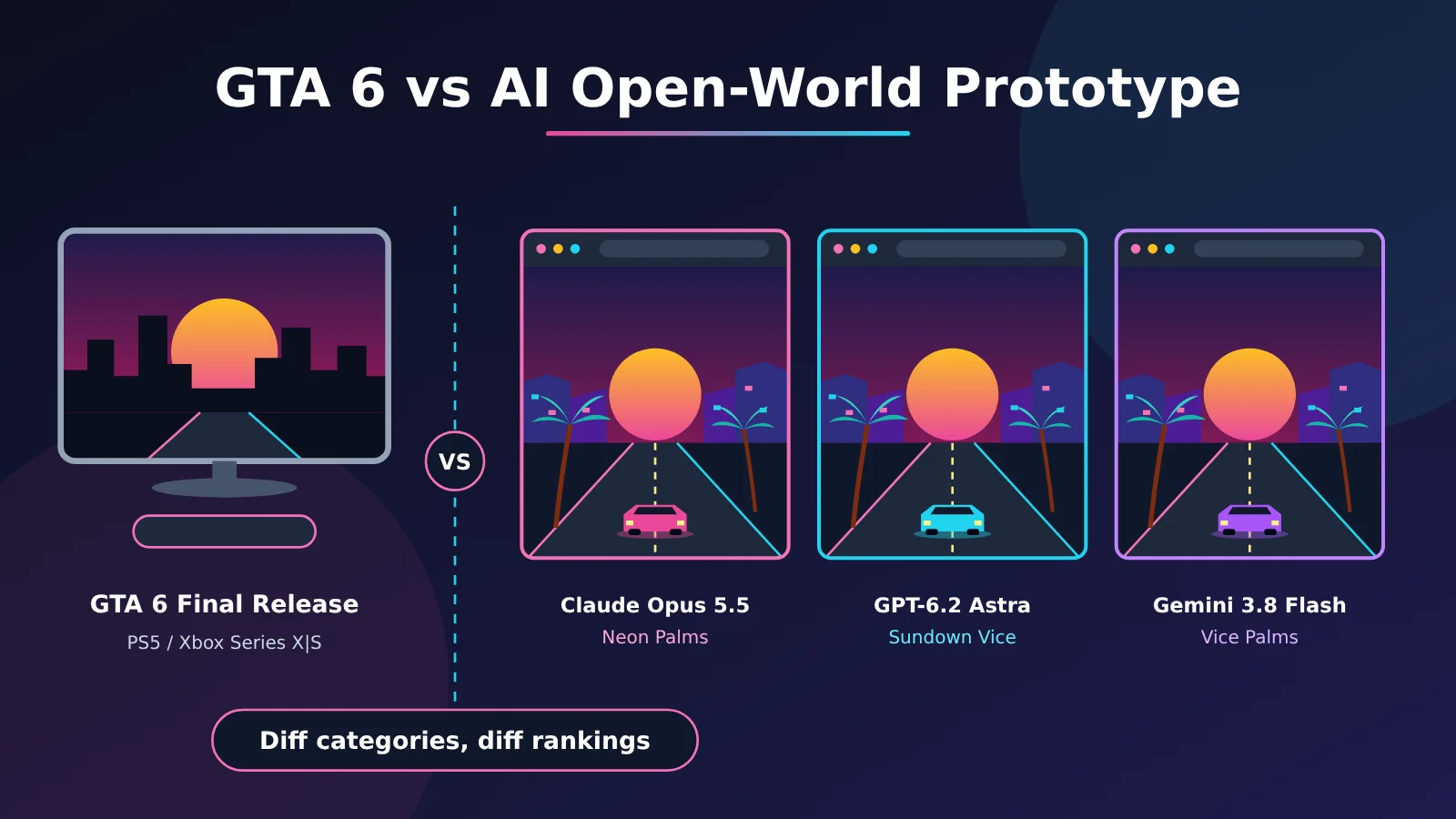
Short answer: none of the three models can build GTA 6, and none of them belongs on the same leaderboard as GTA 6. Rockstar launched GTA 6 on November 19 for PS5 and Xbox Series X|S, while what AI produced are just 3D city prototypes running in a browser. Looking only at the batch of samples Dubovsky Labs made public, each of the three models leans in a different direction. Claude Opus 5.5’s Neon Palms is the biggest in scope and ships with the most built-in automated checks, but it took 11 rounds and 69 agent runs — roughly $1,512 at list prices. GPT-6.2 Astra’s Sundown Vice strikes a better balance between cost and completeness. Gemini 3.8 Flash’s Vice Palms turned out a first version fastest and cheapest, though the author calls it “playable but empty, and buggy.” The samples were built on very different working budgets, so there’s no single overall champion — you can only compare them dimension by dimension.
What you’ll get from this article:
- What the shared task behind these public samples was, and where the rules diverge;
- The known data on playability, iteration count, human effort, and cost for the Claude, GPT, and Gemini samples — plus which numbers can’t be compared head-to-head;
- A repeatable acceptance test you can run yourself along the same route: launch, get in a car, cross a bridge, deliver, restart, regression;
- A Python example that feeds the same initial task to all three models so you get comparable prototypes.
Index: “To Know” starts with the terminology — benchmark, agent run, list-price estimate. “Impact at a Glance” covers what this means for prototype developers, indie game teams, and ordinary players. “Objective Facts” lists GTA 6’s release details and the public data for each of the three samples. “Analysis and Judgment” breaks the differences down across four dimensions and explains why there’s no overall ranking. “How to Reproduce It Yourself” gives you the acceptance checklist and the code. Then FAQ and references.
GTA 6 and AI Open-World Games: To Know Concept Explainer
| Concept | Quick explanation |
|---|---|
| Coding model benchmark | Have multiple models complete the same type of task, then record the results according to pre-specified rules. The samples in this article come from a public collection by Dubovsky Labs |
| Browser-based 3D city | 3D scenes that run in a browser using technologies such as HTML, JavaScript, and WebGL, with no client installation required |
| First pass (One Prompt) | The version a model delivers when it receives only the initial task and no follow-up refinement |
| Follow-up refinement | After the first pass, a person sends revision feedback and has the model continue iterating. This benchmark allows follow-up refinement, but requires it to be documented |
| Agent Run | The model autonomously performs a multi-step task in agent mode, such as reading code, editing files, and running checks |
| In-house automated checks | Automated tests written by the project itself to verify that functionality hasn’t regressed. The count is self-reported by the project and is not third-party testing |
| List-price estimate | Cost calculated from the model’s official published unit price and usage; not necessarily equal to the actual amount paid |
| Regression testing | Rerun existing checks after every change to confirm that old functionality hasn’t been broken |
Impact at a Glance: Who Benefits from the GTA 6 and AI Open-World Game Samples
- Interactive prototype developers: These samples show that, with an initial prompt plus documented follow-up refinement, coding models can produce a browser city with walking, vehicles, pedestrians, missions, and sound. But scale and completeness are highly dependent on the number of rounds and the budget.
- Indie game teams: For scenarios like gameplay validation and pitch demos, model-generated prototypes can serve as a starting point. They’re still a long way from a shippable product; art, content volume, and stability all need human work.
- Regular players: These samples are not the same type of product as GTA 6 and should not be read as “AI can already replace AAA games.”
- People choosing models: The budgets for public samples aren’t standardized, so you can’t just look at whose city is bigger; you need to rerun your own tests using a consistent methodology.
The Facts: GTA 6’s Launch and the Public Samples from Claude, GPT, and Gemini
GTA 6 Release Info
According to an announcement on Take-Two Interactive’s investor relations page, Rockstar Games has confirmed that GTA 6 (Grand Theft Auto VI) launches on November 19 for PS5 and Xbox Series X|S. The AI samples discussed below are all browser prototypes—the only thing they share with that commercial product is the theme of a “Miami-style open world.”
The Shared Task and Rules Behind the Dubovsky Labs Benchmark
Dubovsky Labs published 20 samples, and the author judged 17 of them playable. Every sample started from the same task: build an original, Miami-flavored 3D city that runs in a browser, with on-foot movement, vehicles, pedestrians, missions, and sound. The benchmark allows documented follow-up polish, but each sample came with a different work budget, and the project pages and public data files list these details item by item.
“Playable” is the author’s own call, not an independent score. This article cites it only as the author’s assessment.
Public Data for Three Representative Samples
| Item | Claude Opus 5.5 · Neon Palms | GPT-6.2 Astra · Sundown Vice | Gemini 3.8 Flash · Vice Palms |
|---|---|---|---|
| Iteration log | 11 rounds, 69 agent runs | 16 follow-up messages after the first round | Two control fixes |
| First-round duration | Not disclosed | 25 min 16 sec | About 13 minutes |
| City scale | Self-reported 3445 buildings, 151 km of roads | 11 blocks in the final version | Not disclosed (author calls it sparse) |
| Mission count | Self-reported 28 story missions | 24 missions in the final version | Not disclosed |
| Automated checks | 175 in-house checks | Not disclosed | Not disclosed |
| Cost record | ~$1512 estimated at list price | $18.61 for the initial version / $182.87 for the full run (estimated) | $1.79 recorded |
| Version notes | Playable build differs from the recorded build | First-round build and final build published separately | Author calls it playable but sparse and buggy |
Table note: data comes from the individual Dubovsky Labs project pages; scale and check counts are self-reported by the projects. “Not disclosed” means it wasn’t found in the public materials—it doesn’t mean zero or unsupported.
One thing worth flagging about Claude’s Neon Palms: the project page states that the playable build and the recorded build aren’t the same, so what you see in the video may not match what you’d actually get when you play it in the browser. GPT’s Sundown Vice published both the first-round build and the final build, so you can see for yourself what the follow-up polish changed. Gemini’s Vice Palms saw the least work—just two control fixes.
Analysis: Comparing Claude, GPT, and Gemini Open-World Prototypes by Dimension
The following is this article’s interpretation based on the facts above, and doesn’t represent the conclusions of any unified test. We haven’t run unified playtests on this site, nor have we built our own benchmarks.
Playability: We Can Only Cite the Author’s Judgment, Not Rank Them
Of the 20 samples, 17 were judged playable by the author, and all three representative samples are among them. But “playable” is a binary judgment—it doesn’t show any difference in degree. The author explicitly described Gemini’s sample as somewhat empty and flawed, while Claude’s and GPT’s samples clearly have more content, which is indirectly supported by the task count and scale data.
The catch is that the samples with more content also involved more investment, so you can’t conclude from this that “some model has stronger playability.” A more reasonable way to put it: given their respective investment, all three met the playability threshold the author set.
Iteration: Three Different Metrics, Only Comparable Side by Side
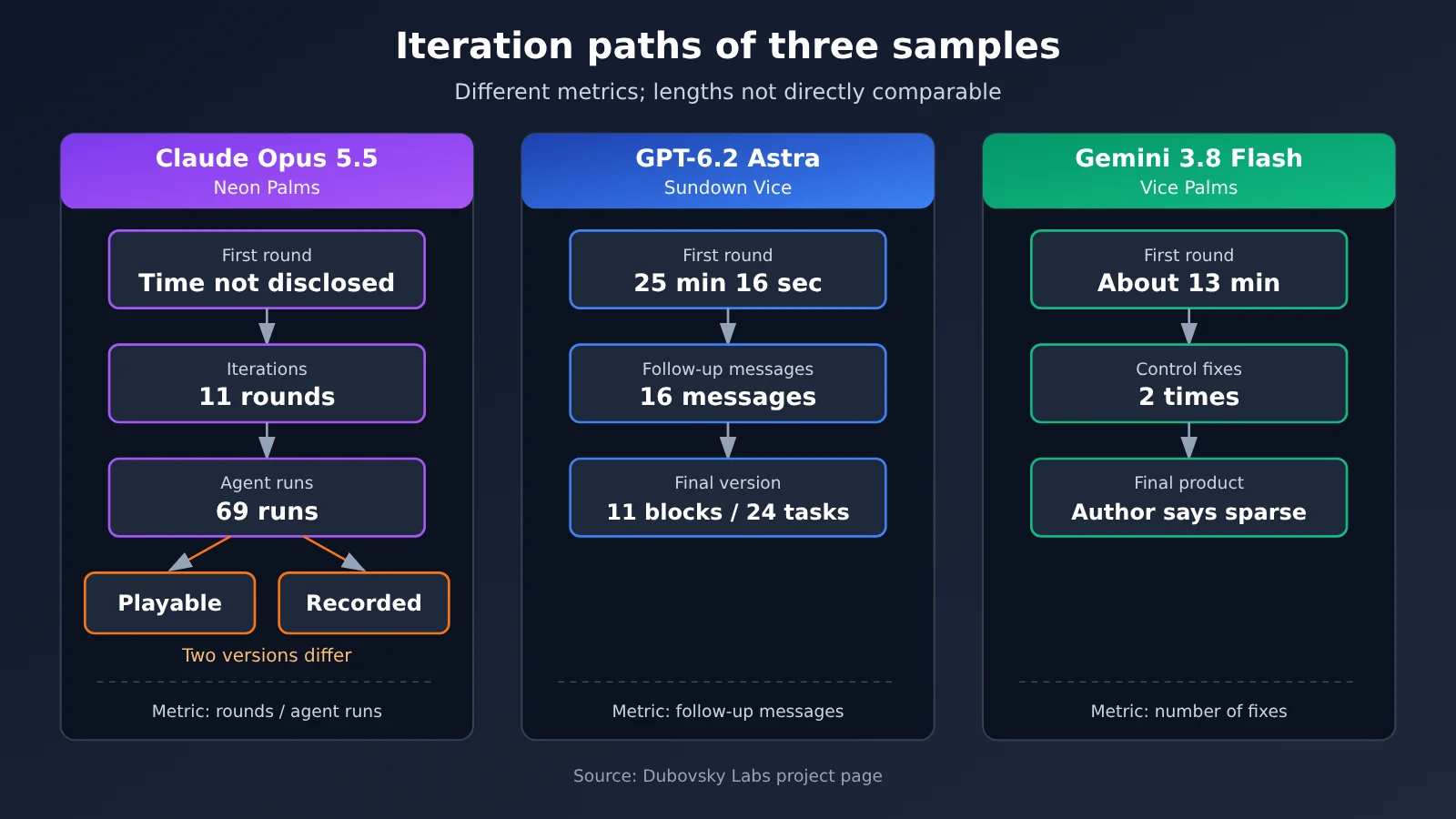
The three samples track iteration in different units: “rounds and agent runs,” “number of follow-up messages,” and “number of fixes.” The metrics aren’t the same. What we can pin down is first-round speed: Gemini took about 13 minutes, GPT took 25 minutes 16 seconds, and Claude didn’t disclose it. If what you care about most is seeing a working first version as quickly as possible, Gemini stands out among these samples.
Claude’s sample included 175 automated checks of its own, which are worth studying for prototype developers. Over long iteration cycles, automated checks can significantly reduce the “fix one thing, break three” problem. That capability has nothing to do with the model itself, and you can borrow it into any model’s workflow.
Human Effort: How Many Instructions Did Someone Actually Send?
The benchmark allows for follow-up refinement, so how much a person gets involved is a key variable shaping the result. The GPT sample logged 16 follow-up messages, Gemini had just two fixes, and Claude had 11 rounds. Of the 69 agent runs, how many were manually triggered isn’t broken out in the public materials.
If we loosely define human effort as “how many times someone has to step in,” Gemini is the least trouble — but its output is also the thinnest. Both GPT and Claude traded sustained human feedback for more complete content.
Cost: Roughly Three Orders of Magnitude Apart, and Different Scopes
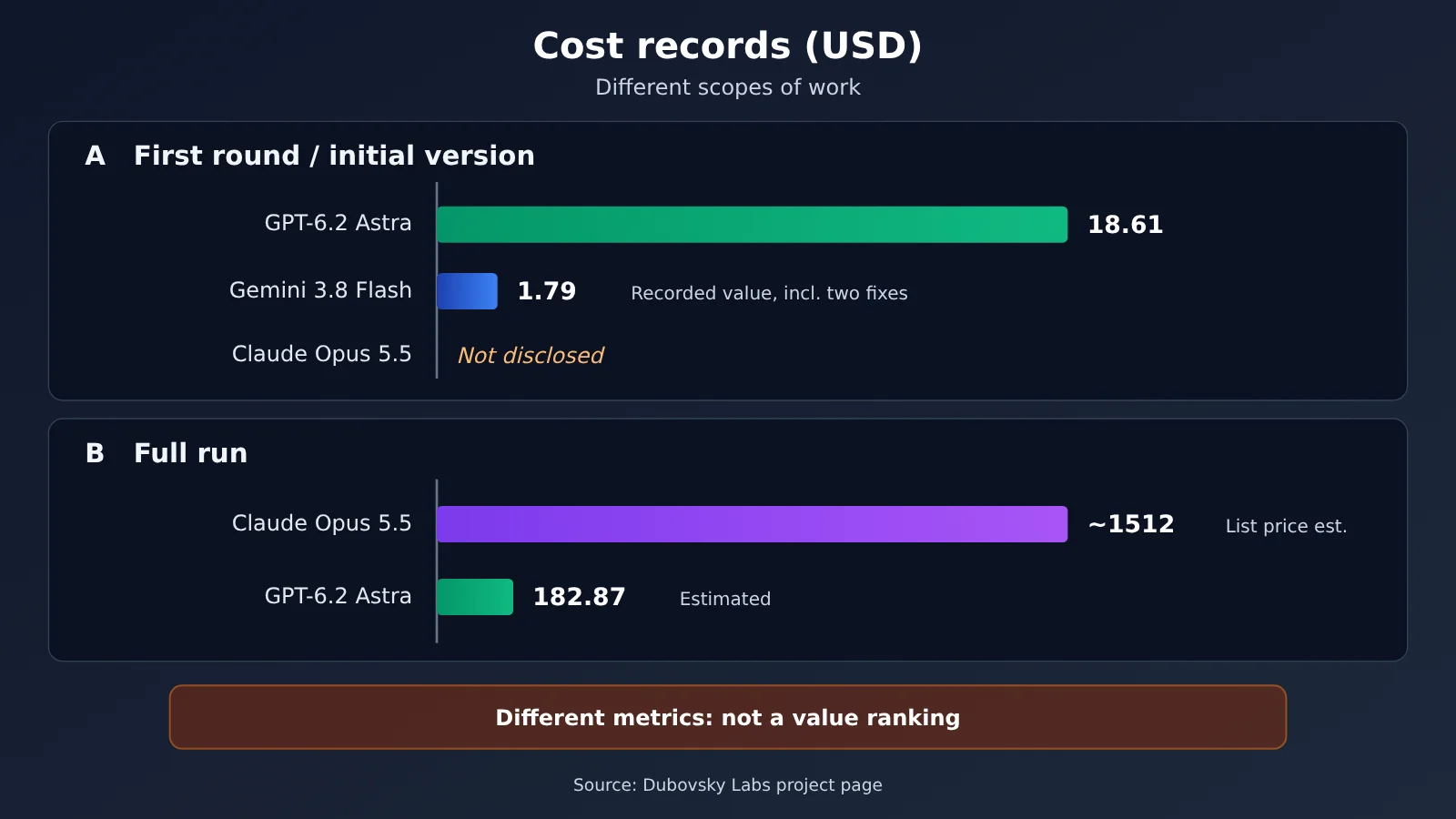
Cost figures are the easiest thing to misread. Claude’s roughly $1,512 is a list-price estimate for the full run, GPT’s $182.87 is also a full-run estimate, and Gemini’s $1.79 covers only the first round plus two fixes. Those three numbers map to different scopes of work, so you can’t convert them straight into “who gives you more bang for the buck.”
💰 Cost tip: If you want to re-test all three models under your own budget on a consistent basis, you can call Claude, GPT, and Gemini through APIYI apiyi.com using the same API key on pay-as-you-go billing — handy for keeping one ledger for per-round spending.
Why GTA 6 doesn’t belong on the same leaderboard as browser samples
GTA 6 is a commercial console game built by a large team over years of development, while these samples are prototypes running in a browser. The platform, content scale, and engineering effort involved aren’t on the same level at all. Putting them on one leaderboard won’t show you how much AI has actually progressed, and it’ll mislead readers’ judgment about both kinds of products. The more useful question is: on the same budget, which model can turn a gameplay idea into a testable prototype faster?
💡 Model-picking tips: If you’re after speed to a first version and low cost, start with Gemini 3.8 Flash; if you need more complete tasks and content, consider the “first round plus multiple feedback rounds” approach of GPT-6.2 Astra; if you have plenty of budget and need large-scale scenes with automated checks, take a look at how Claude Opus 5.5 does it. I’d suggest running one same-prompt test round on APIYI apiyi.com with a small budget first, then deciding on your main model.
How to reproduce the AI open-world game prototype comparison yourself with APIs
The public samples don’t use a consistent budget. The best way to get comparable conclusions is to run the test yourself with the same hardware and the same budget.
Same-Route Acceptance Method
| Step | What to check | What to record |
|---|---|---|
| Startup | Does the page load, does the console throw errors, is the frame rate stable | Load time, number of errors |
| Boarding | After walking up to the vehicle, can you get in, do the controls behave | Success or not, number of freezes |
| Bridge crossing | Drive a fixed route through bridges and other complex geometry | Clipping through or falling off |
| Delivery | Complete one task, confirm the trigger and settlement | Whether the task can be finished |
| Restart | Refresh or restart, then check whether state is correct | Leftover state |
| Regression | Re-run every step above after each round of polish | Count of new vs. fixed issues |
All three models use the same initial task, the same test machine, the same round limit, and the same cost cap. Each step records only “pass / fail” plus a short note — no subjective scoring.
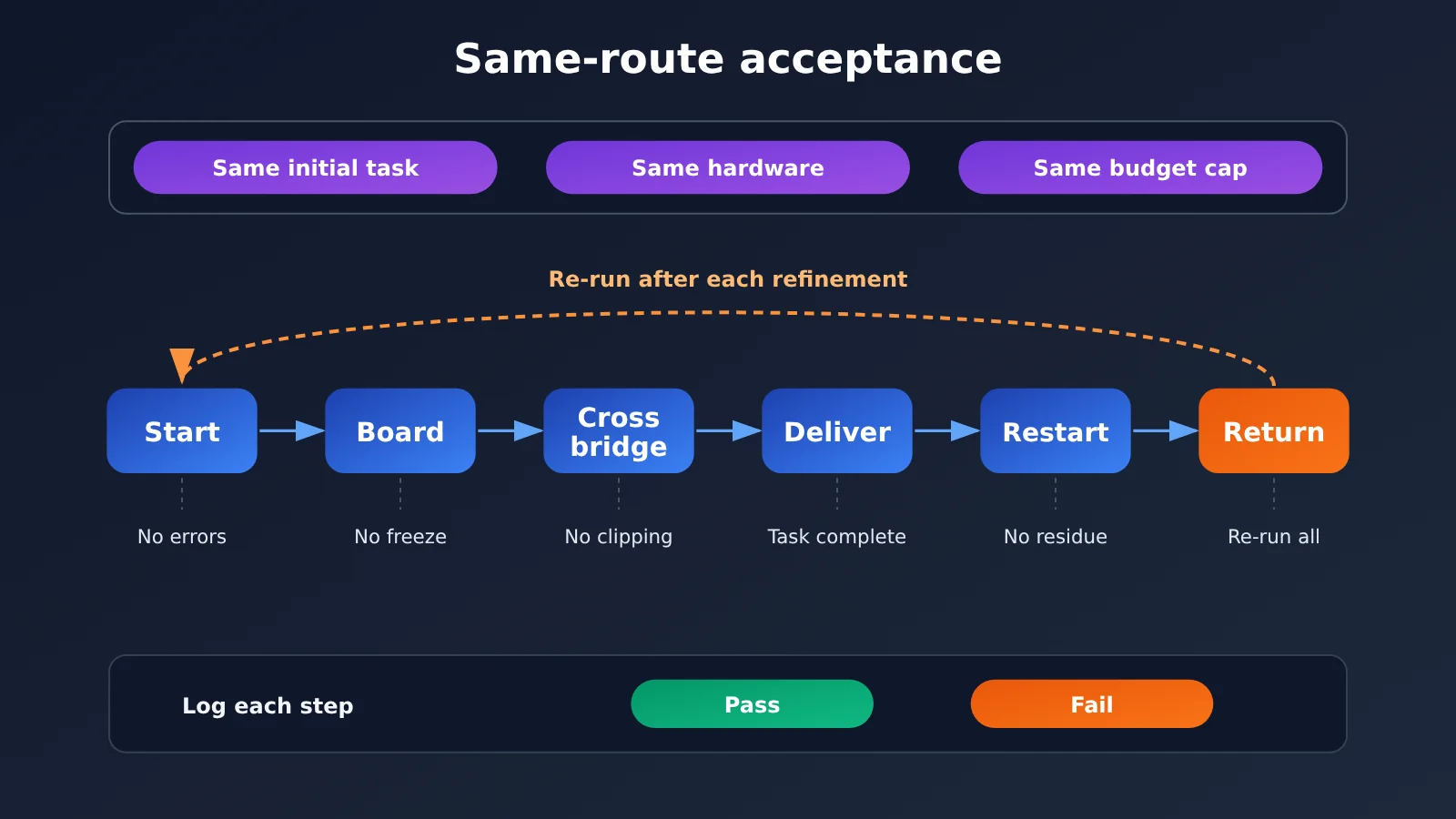
Minimal example: send the same task to three models
import openai, time

client = openai.OpenAI(api_key="YOUR_API_KEY", base_url="https://api.apiyi.com/v1")
TASK = "Build an original Miami-style browser 3D city in a single HTML file, including walking, vehicles, pedestrians, missions, and sound."
# Model names are examples only; use the actual IDs from the platform's model list
for model in ["claude-opus-5-5", "gpt-6.2-astra", "gemini-3.8-flash"]:
    t0 = time.time()
    r = client.chat.completions.create(model=model, messages=[{"role": "user", "content": TASK}])
    open(f"{model}.html", "w", encoding="utf-8").write(r.choices[0].message.content)
    print(model, round(time.time() - t0, 1), "s", r.usage.total_tokens, "tokens")
View the full code with round and budget logging
import json
import re
import time
import openai

client = openai.OpenAI(
    api_key="YOUR_API_KEY",
    base_url="https://api.apiyi.com/v1"
)

TASK = (
    "Build an original Miami-style browser 3D city in a single HTML file (inline JS is fine, use the three.js CDN). "
    "It must include: walking, getting in and out of vehicles and driving, pedestrians, at least one completable mission, and ambient sound. "
    "Output only the complete HTML code."
)

# Model names are examples only; use the actual IDs from the platform's model list
MODELS = ["claude-opus-5-5", "gpt-6.2-astra", "gemini-3.8-flash"]
MAX_ROUNDS = 3        # Shared round limit
MAX_TOKENS_TOTAL = 400_000  # Shared total token budget cap

def extract_html(text: str) -> str:
    m = re.search(r"```html\s*(.*?)```", text, re.S)
    return m.group(1) if m else text

def run(model: str, feedbacks: list[str]) -> dict:
    messages = [{"role": "user", "content": TASK}]
    log = {"model": model, "rounds": []}
    used = 0
    for i in range(MAX_ROUNDS):
        t0 = time.time()
        r = client.chat.completions.create(model=model, messages=messages)
        html = extract_html(r.choices[0].message.content)
        used += r.usage.total_tokens
        fname = f"{model}_round{i + 1}.html"
        with open(fname, "w", encoding="utf-8") as f:
            f.write(html)
        log["rounds"].append({
            "round": i + 1,
            "seconds": round(time.time() - t0, 1),
            "tokens": r.usage.total_tokens,
            "file": fname,
        })
        if used >= MAX_TOKENS_TOTAL or i >= len(feedbacks):
            break
        # Human feedback written from acceptance results on the same route, shared identically across all three models
        messages += [
            {"role": "assistant", "content": html},
            {"role": "user", "content": feedbacks[i]},
        ]
    log["total_tokens"] = used
    return log

if __name__ == "__main__":
    shared_feedback = [
        "Acceptance found: the player can't drive after getting in the car. Fix the controls and keep everything else unchanged.",
        "Acceptance found: the vehicle falls off when crossing a bridge, and state persists after restarting once the mission is delivered. Fix both.",
    ]
    results = [run(m, shared_feedback) for m in MODELS]
    with open("benchmark_log.json", "w", encoding="utf-8") as f:
        json.dump(results, f, ensure_ascii=False, indent=2)
    print(json.dumps(results, ensure_ascii=False, indent=2))
This code only handles generation and bookkeeping — the real judgment still comes from a human playtesting each item against the acceptance checklist. The feedback stays identical across all three models, which is how you hold “human effort” constant as a variable.
🚀 Quick start: Sign up at APIYI apiyi.com to get free trial credits. One key lets you switch between all three models above — perfect for running through the workflow on a small budget first.
GTA 6 and AI Open-World Games FAQ
Q1: Can AI make a game like GTA 6 today?
No. The public samples are all 3D city prototypes running in a browser. They’re not in the same category as a commercial console game like GTA 6, which launches on November 19, and they shouldn’t be put on the same leaderboard for comparison.
Q2: Among the Claude, GPT, and Gemini samples, which one is best?
There’s no single overall champion. Claude’s sample is the largest in scale, but it also took the most investment; GPT’s sample is more balanced; Gemini’s sample was the fastest and cheapest first version, but its content is on the thin side. Because the work budgets differ, you can only compare them dimension by dimension.
Q3: Can the author’s claim of “17 playable” be used as a benchmark score?
No. That’s the author’s own judgment — a review comment, not an independent quantitative test. Cite the source when you reference it.
Q4: Why is the cost difference so large?
Mainly because the scope of work differs. The roughly $1,512 figure is a list-price estimate for all 11 rounds of the Claude sample, while $1.79 covers only Gemini’s first round plus two fixes. The two aren’t comparable.
Q5: How can I run a like-for-like comparison myself at low cost?
Fix the initial task, hardware, rounds, and budget, then record each item using the acceptance table in this article. Through APIYI apiyi.com, you can call all three models with the same OpenAI-compatible code, and new users get free testing credits.
Q6: Which model should I start with for an interactive prototype?
If you want to validate gameplay quickly, start with a fast, low-cost model to produce the first version; when you need more complete content, switch to a stronger model and iterate over multiple rounds. I’d suggest running one round each with the same task on APIYI apiyi.com, then deciding based on the actual acceptance results.
Q7: What are the limitations of these samples?
The budgets and iteration criteria aren’t standardized, the scale figures are self-reported by the project, and Claude’s playable version differs from the recorded version. Some metrics weren’t disclosed, so missing values shouldn’t be treated as zero.
If you want to take an open-world gameplay idea from concept to a verifiable prototype, what matters more is stable output under a fixed budget — not whose city is bigger.
References
- Take-Two Interactive: Rockstar Announces Grand Theft Auto VI Is Now Available
- Link:
take2games.com/ir/news/rockstar-games-announces-grand-theft-auto-vi-now-available - Details: release date and launch platforms
- Link:
- Dubovsky Labs: GTA Benchmark Overview and Data
- Link:
dubovskylabs.com/gta-benchmark/index.html,dubovskylabs.com/data/gta-benchmark.json - Details: 20 samples, shared tasks, and rules
- Link:
- Dubovsky Labs: Claude Opus 5.5 · Neon Palms
- Link:
dubovskylabs.com/neon-palms-claude-opus-5-5/
- Link:
- Dubovsky Labs: GPT-6.2 Astra · Sundown Vice (first round / final version)
- Link:
dubovskylabs.com/benchmarks/gta/play/gpt-6-2-astra-one-prompt/index.html,dubovskylabs.com/benchmarks/gta/play/gpt-6-2-astra/index.html
- Link:
- Dubovsky Labs: Gemini 3.8 Flash · Vice Palms
- Link:
dubovskylabs.com/benchmarks/gta/play/gemini-3-8-flash/index.html
- Link:
Author: APIYI Technical Team
Technical discussion: Feel free to reach us through the APIYI website at apiyi.com. For more integration resources, check out the docs center at docs.apiyi.com.