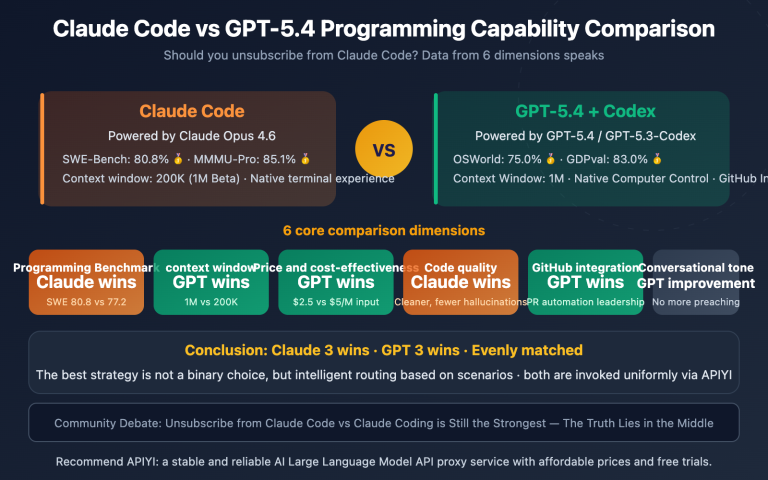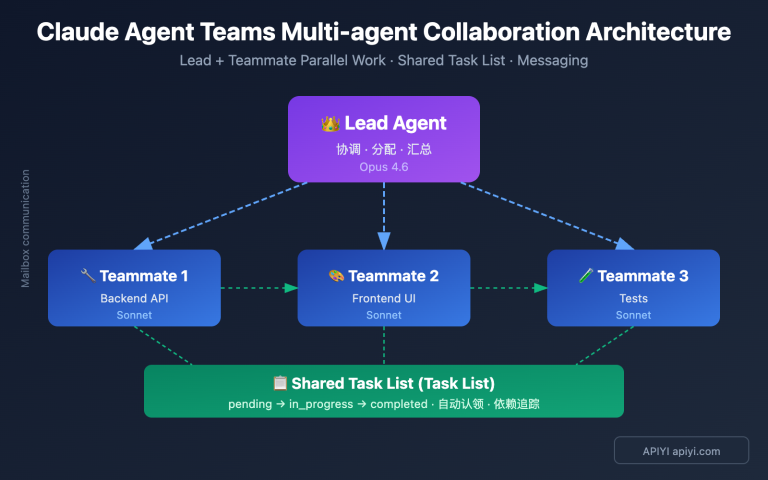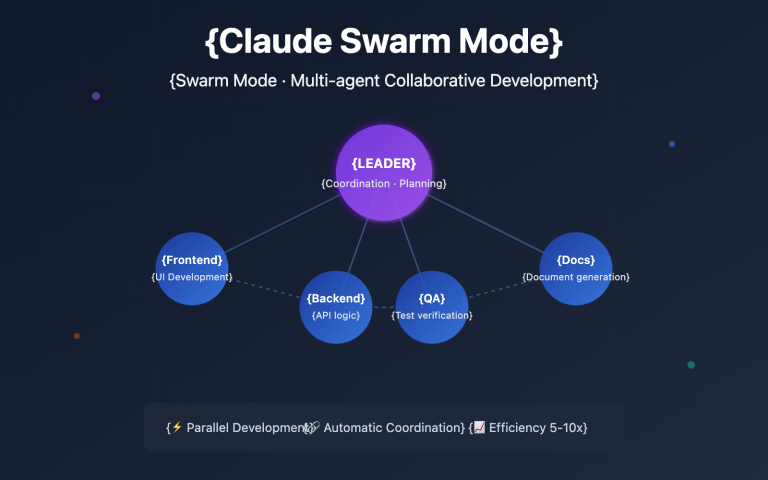
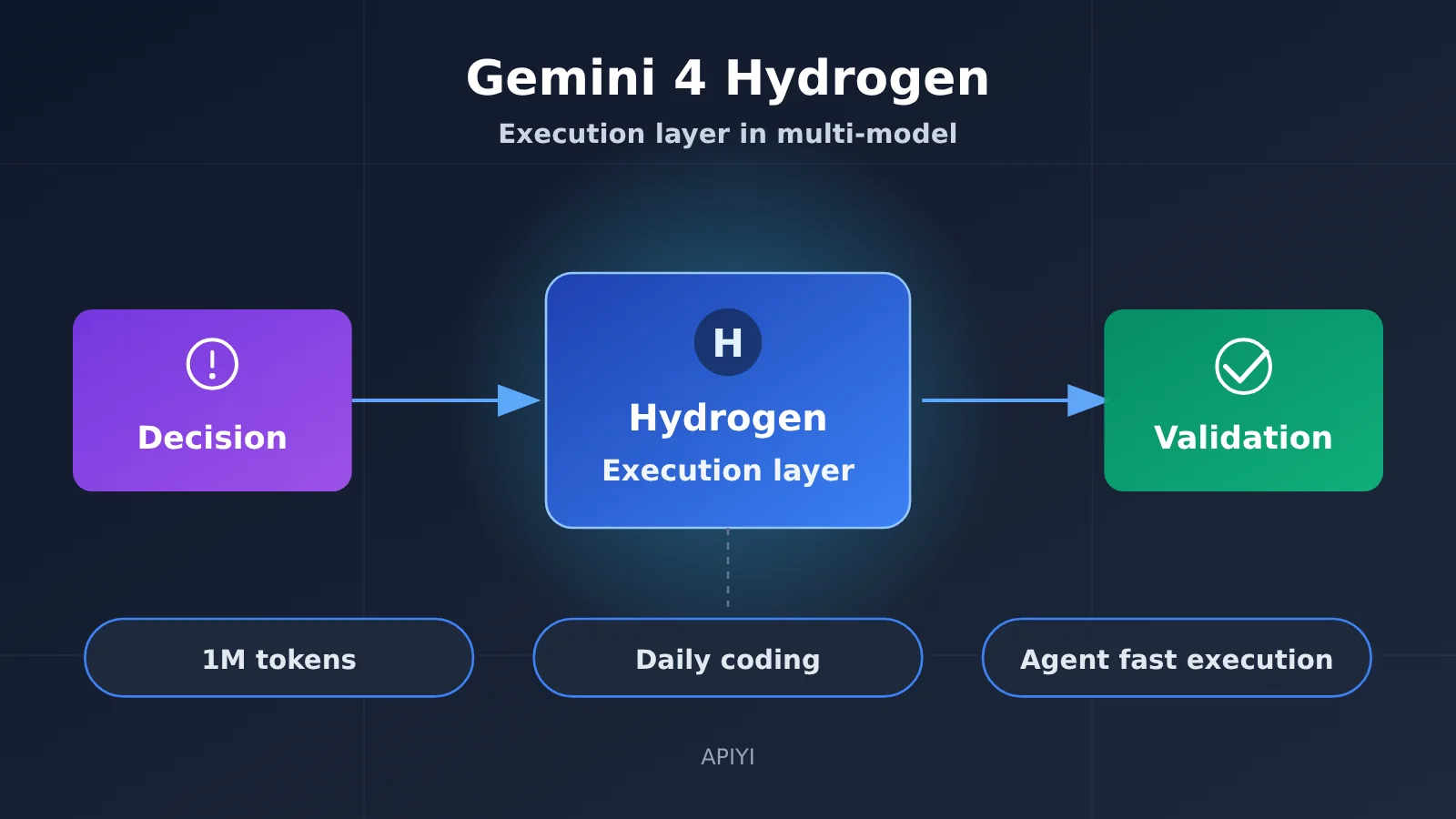
Gemini 4 Hydrogen has a clear core positioning: it’s the model Google built for everyday programming and fast Agent execution. In multi-model workflows, it’s better suited to the “execution layer” than to owning all judgment and review. Official pricing is flat for contexts up to 1M tokens: $1.50 per million input tokens and $7.50 per million output tokens. Google’s own testing says it gets close to Carbon’s success rate on a specific benchmark mix while using less quota and running faster. But those numbers come from vendor tests, so you shouldn’t treat them as a savings percentage every user will get.
What will you learn from this article?
- Gemini 4 Hydrogen’s release date, positioning, pricing, and available access points.
- What Google’s published Terminal-Bench 4.0 results actually show—and what they don’t.
- Why Hydrogen fits the execution step in a “judgment—execution—validation” flow, and what information should be included at handoff.
- Constraints different user groups should consider before adopting Hydrogen.
Index: Below, a concept table and an impact snapshot help you get oriented quickly. The “Objective Facts” section covers release information, pricing and access points, Antigravity Orchestrator’s model-switching capability, and vendor test data in that order. The “Analysis and Judgment” section discusses what it means for Hydrogen to be an execution layer, how to design handoffs, how to estimate costs, and which conclusions to treat with caution.
Gemini 4 Hydrogen: Key Concepts to Know
| Concept | Brief Explanation |
|---|---|
| Gemini 4 Hydrogen | The Gemini 4 series model Google released in November 2026, positioned for everyday coding and fast Agent execution |
| Carbon | Another model in the same series; Google used it in testing as the baseline for comparing Hydrogen’s success rate |
| Agent | An AI system that plans its own steps, calls tools, and carries out tasks based on a goal |
| Execution layer | The stage in a multi-model pipeline responsible for carrying out concrete operations according to a set plan, as opposed to the “judgment” and “verification” stages |
| Context window | The total number of tokens a model can process in a single request; Hydrogen’s unified pricing covers up to 1 million tokens |
| token | The basic unit models use to measure text; billing is calculated per million tokens |
| Antigravity Orchestrator | Google’s orchestration tool that lets you switch between Carbon, Hydrogen, and other models within the same session; requires the corresponding subscription |
| Terminal-Bench 4.0 | A benchmark that evaluates how well models complete tasks in a terminal environment; Google uses it to report Hydrogen’s performance |
| Quota | The invocation allowance a platform allocates to users; Google describes Hydrogen’s resource consumption as using “less quota” |
| Google AI Studio | Google’s platform for developers to try out models and build prototypes |
Gemini 4 Hydrogen: Impact at a Glance
- Developers: You now have another option built for fast execution, with transparent pricing and unified context-based billing — a good fit for bulk code edits, running commands, and handling Agent subtasks. That said, you’ll want to benchmark the actual savings against your own workloads.
- Teams using Antigravity: You can switch between Carbon and Hydrogen within the same session depending on the task stage, separating heavy reasoning from fast execution — provided you have the right subscription.
- Everyday users: You can reach this model through the Gemini app entry point. The day-to-day difference mostly shows up in response speed; keep reasonable expectations about where the model’s capabilities end.
- Enterprise technical leads: Flat pricing up to 1 million tokens makes budgeting simpler, but a large context window doesn’t mean the model accurately understands every piece of material — critical workflows still need a validation step.
Gemini 4 Hydrogen: The Facts
Release date and positioning
Google published Gemini 4 Hydrogen on its official blog on November 12, 2026, and updated the post on November 13. The date of this fact-check is November 17, 2026. Google positions it as a model for everyday coding and fast Agent execution. Reading that phrasing, Hydrogen is about high-frequency, fast, cost-controlled execution work — not about being the flagship of the family that handles the heaviest reasoning.
| Item | Official information |
|---|---|
| Release date | 2026-11-12 |
| Update date | 2026-11-13 |
| Positioning | Everyday coding, fast Agent execution |
| Context pricing range | Flat price within a 1M-token context |
| Available entry points | AI Studio, Gemini API, enterprise services, Gemini app |
| Orchestration support | Antigravity Orchestrator can switch between Carbon, Hydrogen, and other models in the same session |
Pricing and entry points
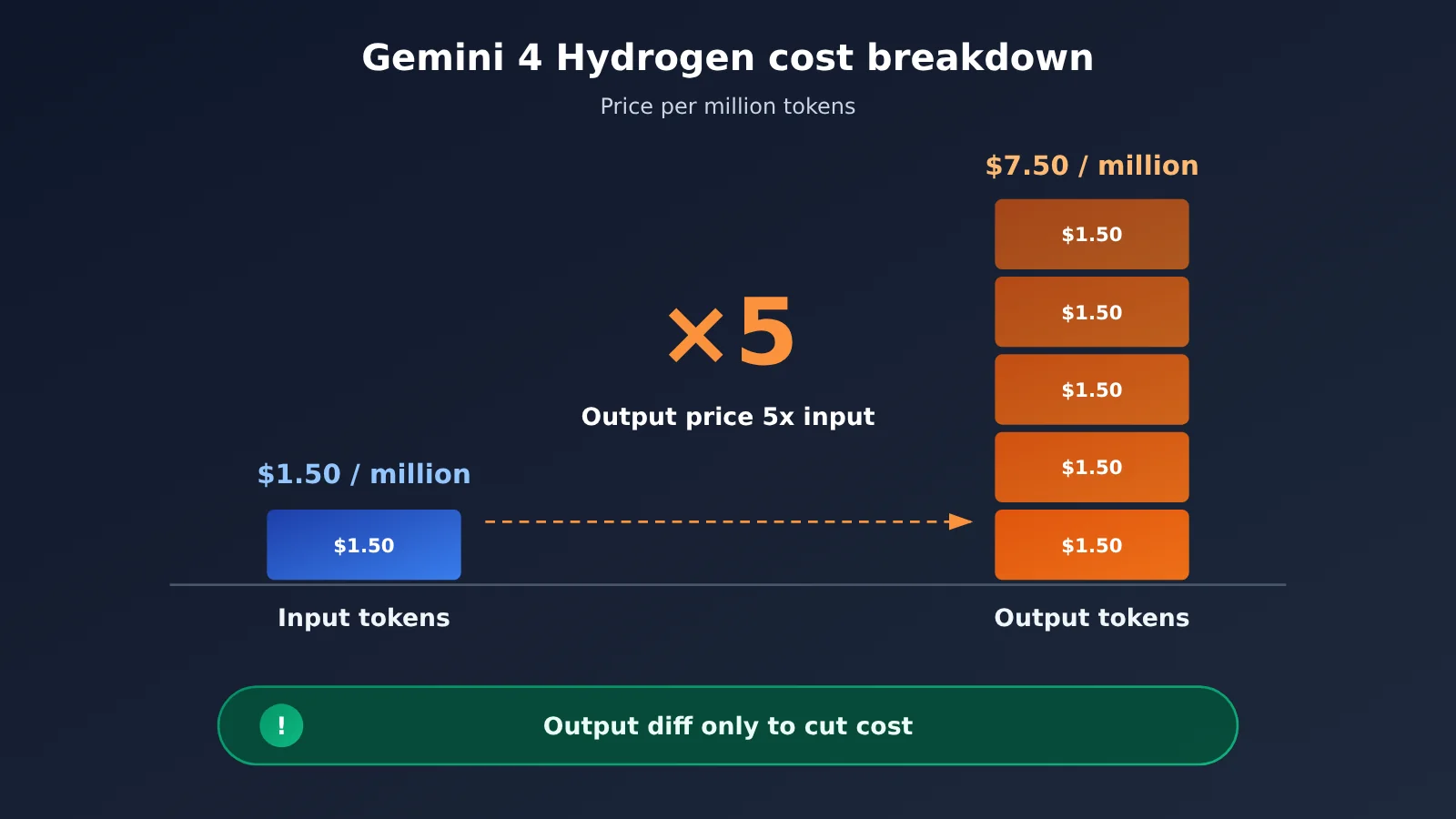
According to the release notes, Gemini 4 Hydrogen uses a flat price within a 1M-token context — it doesn’t move into a different billing tier as the context grows longer. The specific prices are in the table below. Note that these are Google’s official prices; third-party platforms may quote differently, so their own published rates are what apply.
| Billing item | Official price (per million tokens) | Scope |
|---|---|---|
| Input | $1.50 | Within a 1M-token context |
| Output | $7.50 | Within a 1M-token context |
The entry points listed in the release notes — AI Studio, the Gemini API, enterprise services, and the Gemini app — cover pretty much all four scenarios: prototyping, programmatic calls, enterprise deployment, and end users.
Gemini 4 Hydrogen and model switching in Antigravity Orchestrator
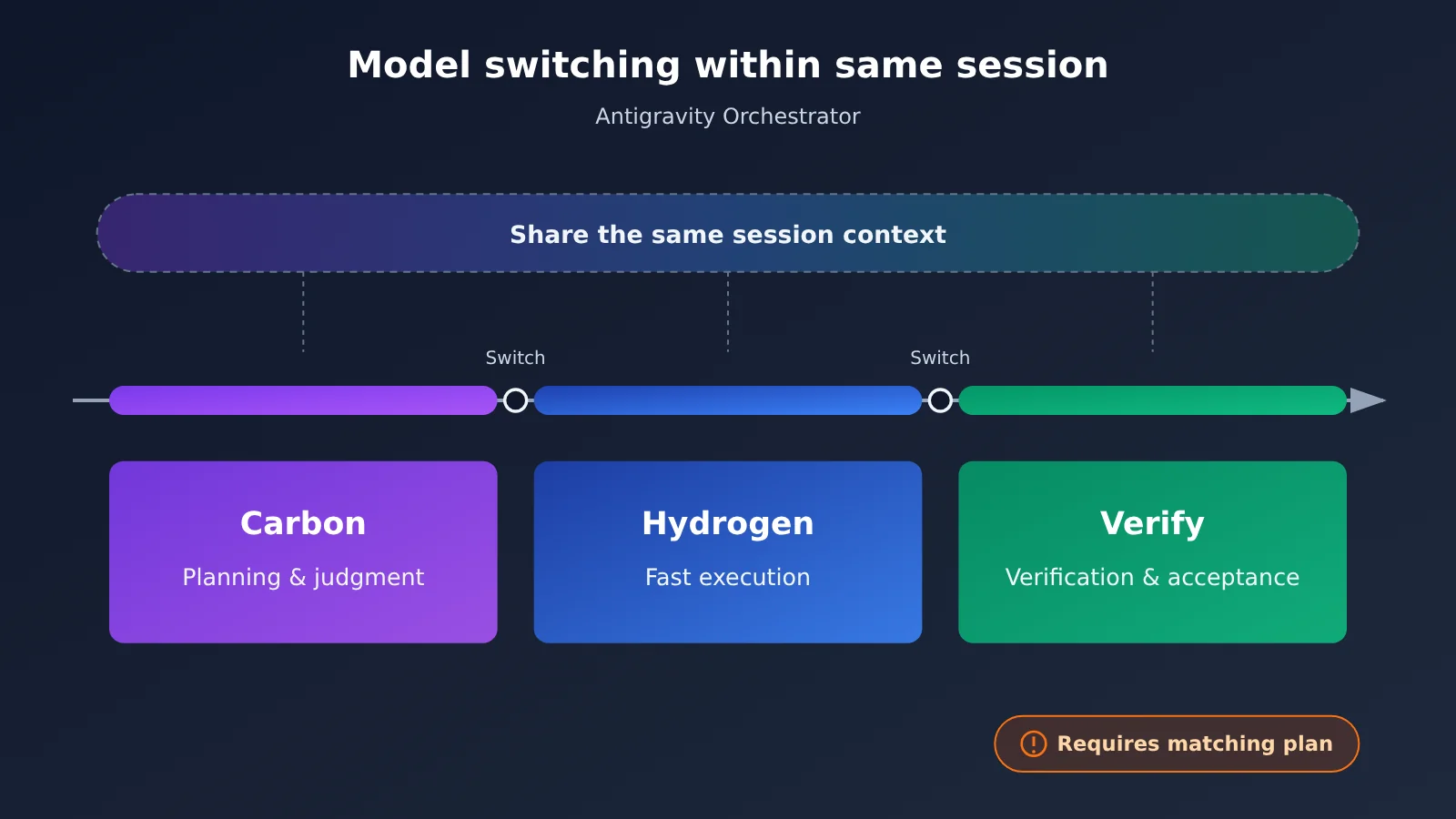
Official information shows that Antigravity Orchestrator can switch between Carbon, Hydrogen, and other models within the same session. That means, inside one task context, you can have different models handle different stages without opening a new session and hauling all the background information over again. That said, using Antigravity requires the corresponding subscription — this capability isn’t available to every user by default.
Terminal-Bench 4.0 results for Gemini 4 Hydrogen
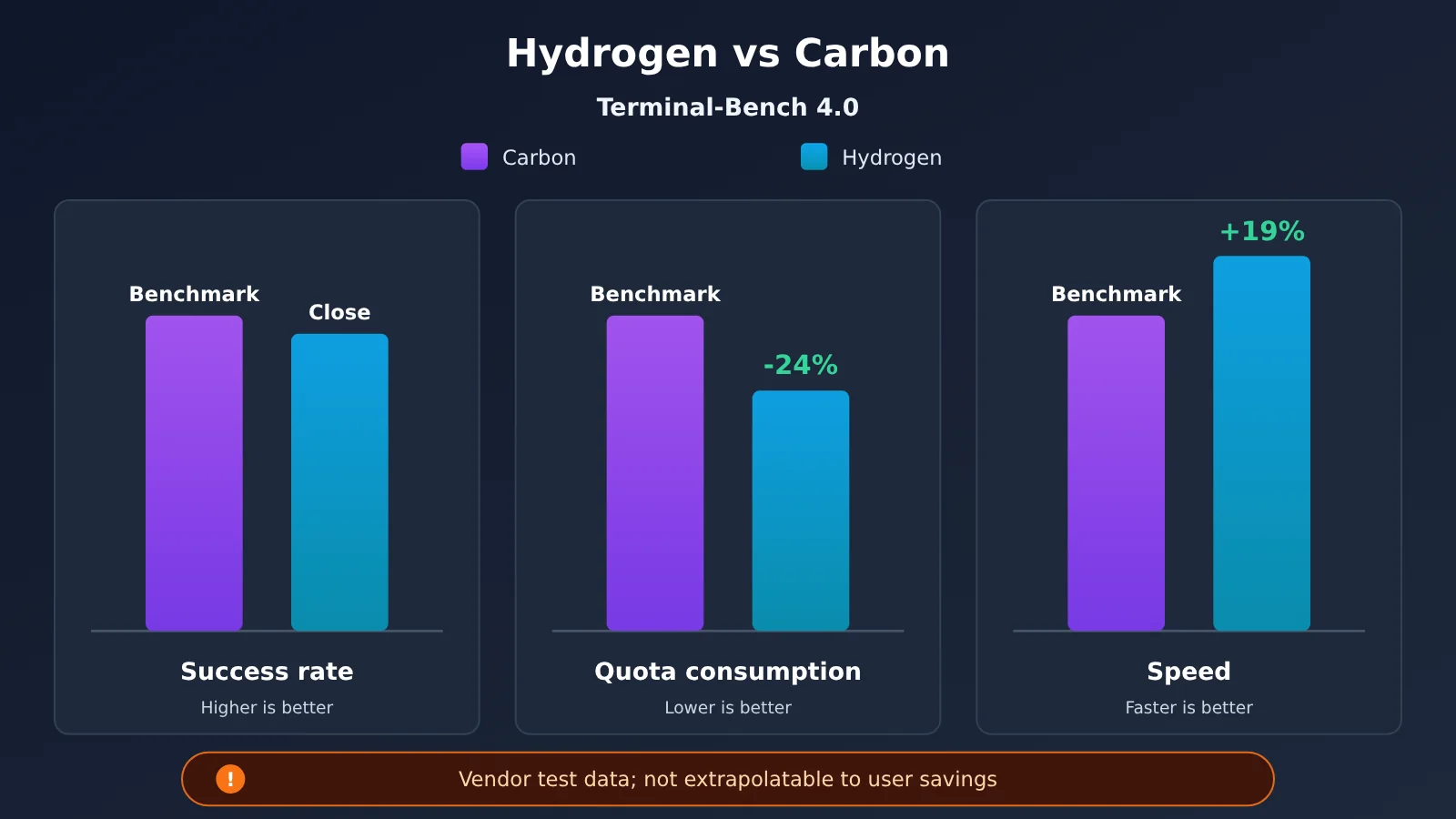
Google reports that, on a specific test combination in Terminal-Bench 4.0, Hydrogen’s success rate comes close to Carbon while using 24% less quota on average and running 19% faster.
There are three caveats worth noting about these numbers. First, they come from the vendor’s own testing, not an independent third-party evaluation. Second, they apply to a specific test combination, not to all task types. Third, “close to Carbon” means the success rate isn’t fully on par. So the 24% and 19% figures only describe Hydrogen’s relative performance under this particular test setup — they can’t be extrapolated into a savings percentage for your own projects.
Gemini 4 Hydrogen Analysis and Assessment
Why Gemini 4 Hydrogen Fits as the Execution Layer
Based on its official positioning and test data, Hydrogen’s strengths are concentrated in “speed” and “efficiency”: while its success rate is close to Carbon, it consumes less quota and shortens execution time. These traits make it best suited for the most frequent, most mechanical steps in a multi-model workflow—things like modifying multiple files according to a plan, running test commands, organizing logs, and completing an Agent’s sub-steps.
Conversely, steps that require weighing architecture trade-offs, judging whether requirements are reasonable, or handling ambiguous problems are still better left to a stronger model or a human. The fact that the success rate is “close to” rather than “equal to” Carbon makes exactly this point: a small number of deviations in the execution layer can be caught by the verification stage, but if errors happen in the judgment layer, every subsequent execution step will proceed in the wrong direction.
How to split a Gemini 4 Hydrogen multi-model workflow
One approach worth considering is to divide the task into three stages: judgment, execution, and verification. The table below is an analytical suggestion — it reflects a workflow design idea, not benefits Google has claimed to have delivered.
| Stage | Main responsibility | Possible owner | Output |
|---|---|---|---|
| Judgment | Understand the requirement, decide on the approach, break down subtasks | A stronger model such as Carbon, or a human | Task goals, constraints, acceptance criteria |
| Execution | Modify code, run commands, and complete subtasks per the plan | Gemini 4 Hydrogen | Code changes, execution logs, intermediate results |
| Verification | Check whether the results meet the acceptance requirements and spot deviations | Test scripts, another model, or a human | A pass/fail conclusion and a rework list |
The value of this split is that each stage only takes on work that matches its own capabilities. The Antigravity Orchestrator’s ability to switch models within the same session provides the tooling foundation for completing this division of labor within a single context. Teams without that subscription can still implement a similar workflow in their own orchestration code through the Gemini API.
What a Gemini 4 Hydrogen handoff should include
How well the execution-layer model performs depends heavily on whether the task description it receives is clear. The content the judgment layer hands to Hydrogen should ideally include at least three kinds of information: the goal, verified facts, and acceptance requirements. Without a goal, execution tends to drift; without verified facts, the model may act on incorrect assumptions; without acceptance requirements, the verification stage has no basis for deciding whether the work is done.
An example structure for a handoff description looks like this:
[Goal]
Change the pagination API of the user module from offset pagination to cursor pagination.

[Verified facts]
- Files involved: api/user.py, services/user_service.py, tests/test_user.py
- The user table in the database already has a created_at index
- The frontend will not change for now; keep the old parameter compatibility for 30 days

[Acceptance requirements]
- All existing tests pass
- Add at least 3 new test cases for cursor pagination
- Requests using the old offset parameter return unchanged results
The “verified facts” section is especially important. A 1-million-token context window lets you drop in a large amount of material at once, but a large context doesn’t guarantee the model accurately understood everything in it. Distilling the key facts up front is more reliable than simply stuffing the entire codebase into the execution model.
Gemini 4 Hydrogen Cost Estimation Method
Flat pricing has one big upside: the math is easy. Using the official prices, suppose an Agent subtask consumes 200k input tokens and 20k output tokens. The input cost works out to about 0.2 × 1.50 = $0.30, and the output cost to about 0.02 × 7.50 = $0.15, for a total of roughly $0.45. This is just a hypothetical scenario to show how the calculation works — actual consumption depends on the task itself.
One thing to keep in mind: the output unit price is 5x the input price. In execution-layer tasks, if you let the model keep emitting whole files instead of only the parts that changed, costs climb fast. So spelling out the output format in your handoff instructions — for example, “output only the diff” — is another effective way to keep costs down.
A Few Claims About Gemini 4 Hydrogen Worth Treating Cautiously
| Common Assumption | More Accurate Statement |
|---|---|
| Hydrogen cuts costs by 24% | 24% is the vendor’s average quota reduction on a specific test combination; your actual savings need to be measured yourself |
| Hydrogen is as strong as Carbon | In specific tests the success rate is “close to” Carbon, which doesn’t mean parity across all tasks |
| A 1M context window means you can safely stuff in every document | A large context doesn’t guarantee accurate understanding of all materials; key facts should be distilled before handoff |
| Anyone can switch models within the same session | Antigravity Orchestrator requires the corresponding subscription |
| Official pricing is the price on every platform | Official pricing doesn’t reflect third-party platform quotes; go by what’s actually published |
Directions worth watching going forward include: whether independent third-party evaluations of Hydrogen will appear; how large the gap is between it and Carbon on task types beyond Terminal-Bench; and whether Antigravity’s model-switching capability will extend to more subscription tiers. All of these affect Hydrogen’s real cost-effectiveness as an execution layer, and for now they remain open questions.
For teams building Agent or AI coding workflows, a pragmatic approach is this: pick a dozen or so representative tasks from your own project, run them through both Hydrogen and Carbon, record the success rate, elapsed time, and token consumption, and then decide who carries the execution layer. Vendor data is a fine starting point, but it shouldn’t be the final word.
References
- Google Official Blog — Introducing Gemini 4 Hydrogen: Release notes for Gemini 4 Hydrogen
- Link:
blog.google/innovation-and-ai/models-and-research/gemini-models/introducing-gemini-4-hydrogen/ - Details: Covers positioning, pricing, available entry points, Antigravity Orchestrator, and Terminal-Bench 4.0 test information; published 2026-11-12, updated 2026-11-13
- Link:
Putting the right model in the right place gets you closer to the essence of engineering than chasing an “all-in-one model.” As it says in The Analects (Book XV, Duke Ling of Wei): “To do a good job, one must first sharpen one’s tools.”
Author: APIYI Technical Team