Author’s note: There’s no head-to-head comparison of GLM-5.4 and Gemini 4 Carbon on the same tasks. This article splits things up by task: vulnerability discovery and remediation, plus any work that needs a public, reproducible benchmark, stays on Carbon; visual coding, 3D, and CAD are worth a try on GLM-5.4. We’ll also spell out exactly how the bill changes once Carbon’s limited-time pricing expires.
Many teams have two kinds of work piling up at the same time. One is security auditing and the hardest reasoning problems. The other is visual coding, game prototypes, 3D shaders, and CAD modeling. Over the past month or so, plenty of people have been putting their budget behind Gemini 4 Carbon. On 2026-11-23, Z.ai released GLM-5.4, pitched as general-purpose coding — which raises the question: can some of that Carbon budget be moved over to GLM-5.4?
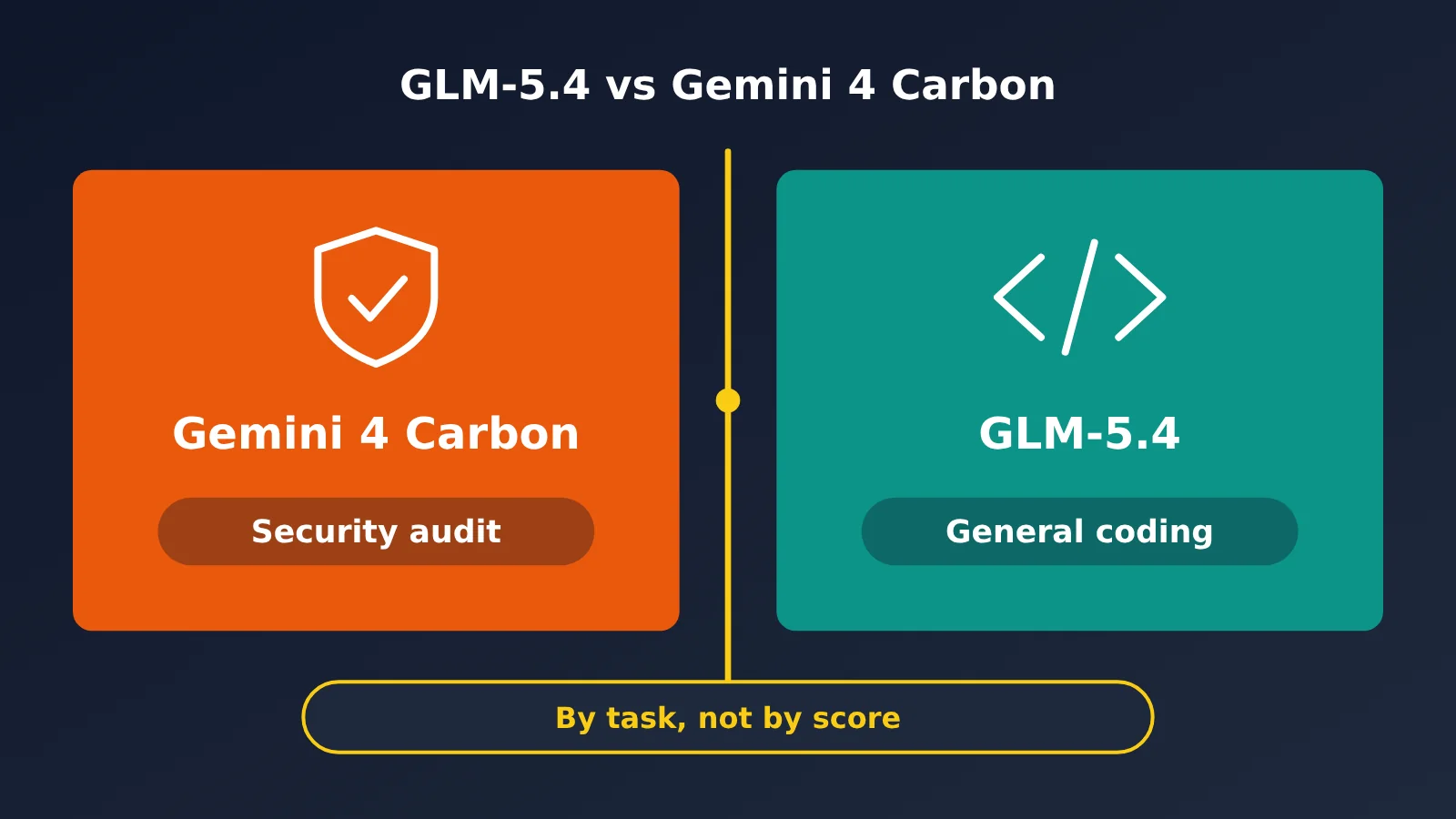
This isn’t a fence-sitting “each has its strengths” analysis, and it won’t invent same-task scores out of thin air. The two products are positioned very differently, so this article divides the work by task rather than ranking them by score. Every claim is labeled by source: which ones are the vendor’s own numbers, which are third-party single-instance results, and which can’t be verified right now.
The core takeaway: by the end of this article, you’ll know which tasks should stay on Gemini 4 Carbon and which ones you can throw at GLM-5.4. You’ll also know how your bill changes after November 30.
GLM-5.4 vs Gemini 4 Carbon: Key Takeaways
Here’s a quick-read table that pulls together the most important factors for this selection.
| Factor | Gemini 4 Carbon | GLM-5.4 | Why it matters for selection |
|---|---|---|---|
| Official focus | Safety triad, general intelligence, and web development | Video, games, 3D shaders, CAD, and other broad coding tasks, with a stronger visual coding focus | Route by task type first |
| Public benchmarks | Has an AA index (officially cited as 59) and multiple safety benchmarks | No AA score; official SWE-bench or other overall scores haven’t been published | When you need to report benchmarks externally, Carbon is easier to substantiate |
| Context / max output | 1,048,576 / 65,536 | 1M / 128K | Both handle long context; GLM-5.4 can output more in a single pass |
| Access | API is already available | Coding Plan, ZCode, and Z.ai Chat; API not yet available | Different ways to integrate into production pipelines |
| Pricing | Limited-time $2 / $10; from 12-01, $4 / $20 | No token pricing, subscription only | Different cost models, so you can’t compare unit prices directly |
Why there’s no same-task head-to-head between GLM-5.4 and Gemini 4 Carbon
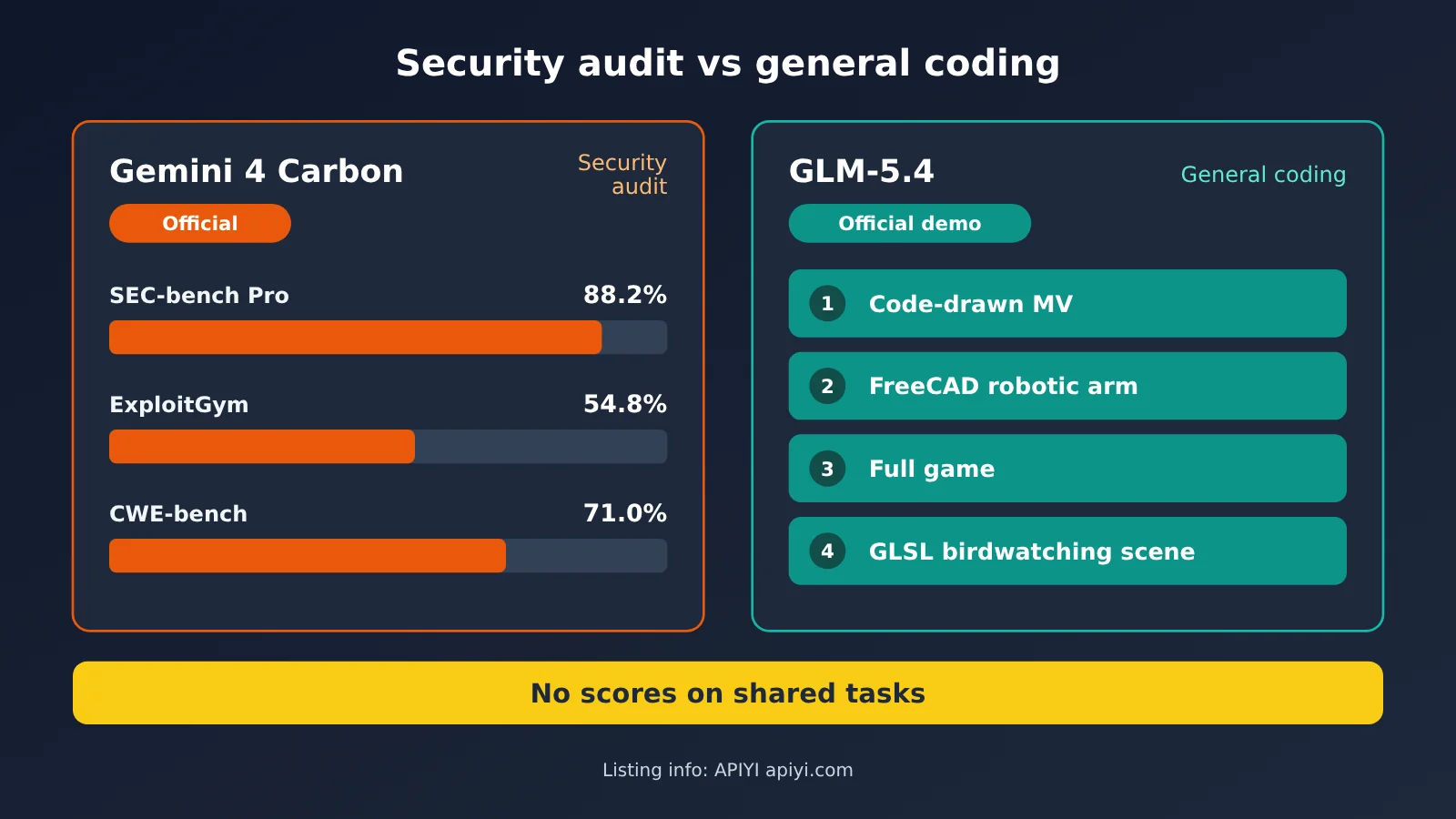
Let’s be clear up front: Carbon didn’t take part in KingBench 4, and GLM-5.4 doesn’t have an Artificial Analysis score, so this article doesn’t do a same-task head-to-head. It only compares positioning and availability. You’ll see two sets of numbers online: GLM-5.4 has a KingBench 4 score, while Carbon has an AA index and safety benchmarks. These numbers come from different test sets and different scoring criteria, so putting them in the same table and ranking them against each other doesn’t mean anything.
Z.ai’s official self-reported win-rate test only compared GLM-5.3, Kimi K3.1 Pro, and DeepSeek-V4.1-Flash-1017. It did not include Claude Opus 5.5, Gemini 4 Carbon, or Gemini 4 Neon. So for this selection, “who’s stronger” isn’t something the available material can answer. What it can answer is which kinds of tasks better match each side’s positioning.
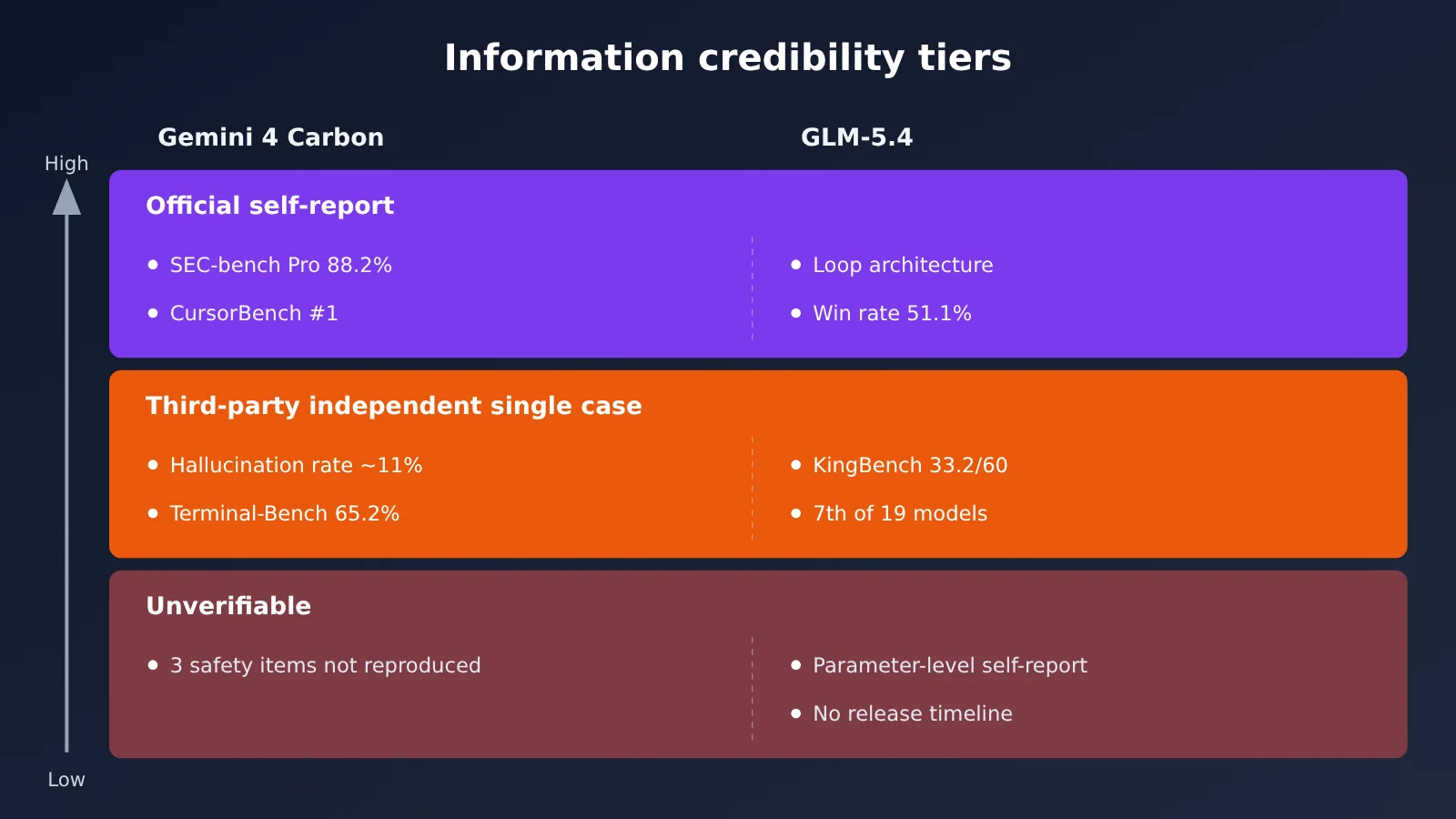
GLM-5.4 vs Gemini 4 Carbon: Fact Tiers
The table below sorts the information used in this article into three tiers by credibility. When you see numbers in the text, you can check here first to gauge how much weight they carry.
| Tier | Gemini 4 Carbon | GLM-5.4 |
|---|---|---|
| Official self-reported | AA Index v5 score: 59 (No. 1 at launch); SEC-bench Pro 88.2%; ExploitGym 54.8%; CWE-bench 71.0%; WebDev Arena 1768 points, No. 4; CursorBench 4.0 No. 1 | Loop Transformer architecture, with intelligence at the 2T–3T parameter level; 30B control experiment: AIME25 rose from 19.17 to 30.42; 51.1% win rate against GLM-5.3; internal 200-scenario evaluation ranked near the top among domestic models in the evaluation (no specific score) |
| Third-party independent | Artificial Analysis: AA-Omniscience hallucination rate about 11%, with noticeably more verbose outputs; Terminal-Bench 4.0 independent leaderboard 65.152% | AICodeKing’s KingBench 4 (independent single case, private test set): 33.2 / 60, 7th among 19 models |
| Unverifiable | The three security items have not been independently reproduced by APIYI | “2T–3T parameter level” is the vendor’s own claim; no timeline for API access or open-source release |
GLM-5.4 vs. Gemini 4 Carbon: The Core Differences
| Comparison dimension | Gemini 4 Carbon | GLM-5.4 | Selection tip |
|---|---|---|---|
| Architecture approach | Deep thinking on by default, three adjustable levels | First Loop Transformer, reuses the GLM-5 base with 28 layers looped for two rounds | GLM-5.4 trades loops for depth |
| Input modalities | Text, image, video, audio | Video, image, text, files | Choose Carbon when you need audio input |
| Knowledge cutoff | 2026-03 | Not stated in official materials | Verify separately for time-sensitive tasks |
| Thinking cost | Longer outputs; the full AA index is roughly 200 million output tokens | Officially acknowledged that it tends to fall into marathon thinking | Control the thinking level on both sides |
| Available platforms | APIYI apiyi.com (gemini-4-carbon), official API |
GLM Coding Plan, ZCode, Z.ai Chat, and several coding tools | Different API access paths |
Gemini 4 Carbon Benchmark Analysis: The Security Triple Is the Core
Gemini 4 Carbon has the most complete public materials on the security front. According to Google’s official release data, it hits 88.2% on SEC-bench Pro, 54.8% on ExploitGym, and 71.0% on CWE-bench. These three map to vulnerability discovery, exploit validation, and defect classification, respectively. APIYI hasn’t independently reproduced these numbers, but they’re public and citable, which makes them suitable for writing into audit reports or procurement documentation.
Carbon’s trade-offs deserve equal clarity. Third-party Artificial Analysis measured its hallucination rate on AA-Omniscience at around 11%, versus about 4% for Argon in the same table. Its output is also noticeably more verbose: a full run of the index consumes roughly 200 million output tokens, compared with a median of 64 million. In a security audit, that means every vulnerability finding in the report needs human review—it can’t be treated as a final verdict.
GLM-5.4 Benchmark Analysis: General Coding Is the Core
GLM-5.4’s official direction is to extend Coding beyond traditional software engineering into video, games, 3D shaders, and CAD modeling, while adding vision capabilities to strengthen “writing code from images.” The official blog showcases four demos: rendering frames in real time with code and calling a third-party music model to produce an MV, engineering-grade CAD modeling of a 6-axis robotic arm with FreeCAD, generating a complete game with physics and combat systems from scratch, and building an interactive 3D birdwatching scene using pure mathematical geometry plus custom GLSL shaders.
On the technical side, GLM-5.4 marks 28 of the 78 layers in the GLM-5 base as shared weights and runs them through two loops—parameter count stays the same, but the network is effectively deeper. At the 750B scale, there are three additional engineering changes: per-token gated write-back, cross-round KV cache sharing, and reusing the sparse attention indices in the second round. Officially, on benchmarks such as GPQA-Diamond, average output length drops by 10%–14%.
GLM-5.4’s Independent Single-Run Data and Time Cost
The only third-party data so far comes from AICodeKing’s KingBench 4. This benchmark tested 19 models on six one-sentence app tasks, with a max score of 60, all using max thinking effort. GLM-5.4 scored 33.2 and placed 7th; by the evaluator’s account, it was the highest-scoring open-weight model in this test. This is an independent single run on a private test set—neither a vendor’s final leaderboard nor an APIYI test result.
The time cost deserves its own callout. In the same test, GLM-5.4 used 1,128 reasoning steps and 431 minutes; Gemini 4 Neon (note: not Carbon) used 244 steps and 109 minutes. In a 180-second short-task probe, the Low and Medium tiers finished on time, while the High and Max tiers timed out. On long tasks, Max scored 33.2 and High 28.8, clearly above Low’s 25.2 and Medium’s 24.1. In other words, GLM-5.4’s high score was bought with time.
How to Compare GLM-5.4 and Gemini 4 Carbon Pricing
The two use completely different billing models. Carbon bills by token; GLM-5.4 is currently subscription-only, so you can’t compare unit prices directly—you have to judge based on which billing model is more cost-effective for your workload. The prices below come from APIYI apiyi.com’s model price master table (2026-11-23 10:23 UTC+8), in USD / 1M tokens.
| Model | Input | Output | Cache read | Notes |
|---|---|---|---|---|
gemini-4-carbon (through 2026-11-30) |
$2 | $10 | $0.1 | Limited-time price |
gemini-4-carbon (from 2026-12-01) |
$4 | $20 | — | Returns to official list price |
glm-5.3 |
$1.4 | $4.396 | $0.259 | ClaudeCode group 0.95× |
glm-5.3-flash |
$0.15 | $0.5 | $0.03 | Lightweight tasks |
| GLM-5.4 | No token price | No token price | — | Coding Plan only, from $12.6/month (see Z.ai subscription page) |
The easiest budgeting mistake is treating Carbon’s limited-time price as the long-term price. Starting December 1, both input and output unit prices double. On top of that, Carbon’s outputs tend to run long, so for output-heavy tasks like audit reports, your monthly bill could come close to doubling. I’d suggest recalculating your December budget at $4 / $20 now.
There’s no token price to calculate on the GLM-5.4 side. The GLM Coding Plan is available to all users, and for users on weekly limits, the GLM-5.4 quota is 1.5× the GLM-5.3 quota. Subscription billing is a good fit for interactive coding, but not for production scenarios that require per-call metering and integration with your own pipeline. GLM-5.4 isn’t listed on APIYI yet; we’ll get it listed as soon as we can. Model names and prices are subject to the platform’s model list. Until it’s listed, you can use the available glm-5.3 or glm-5.3-flash to get your invocation pipeline set up.
💰 Cost tip: If part of your current Carbon usage is visual tasks like UI replication or visualization pages, split that part out first and run a comparison round with
glm-5.3to see whether the quality is good enough. On APIYI apiyi.com, switching models only requires changing themodelfield, which makes canary comparisons easy.
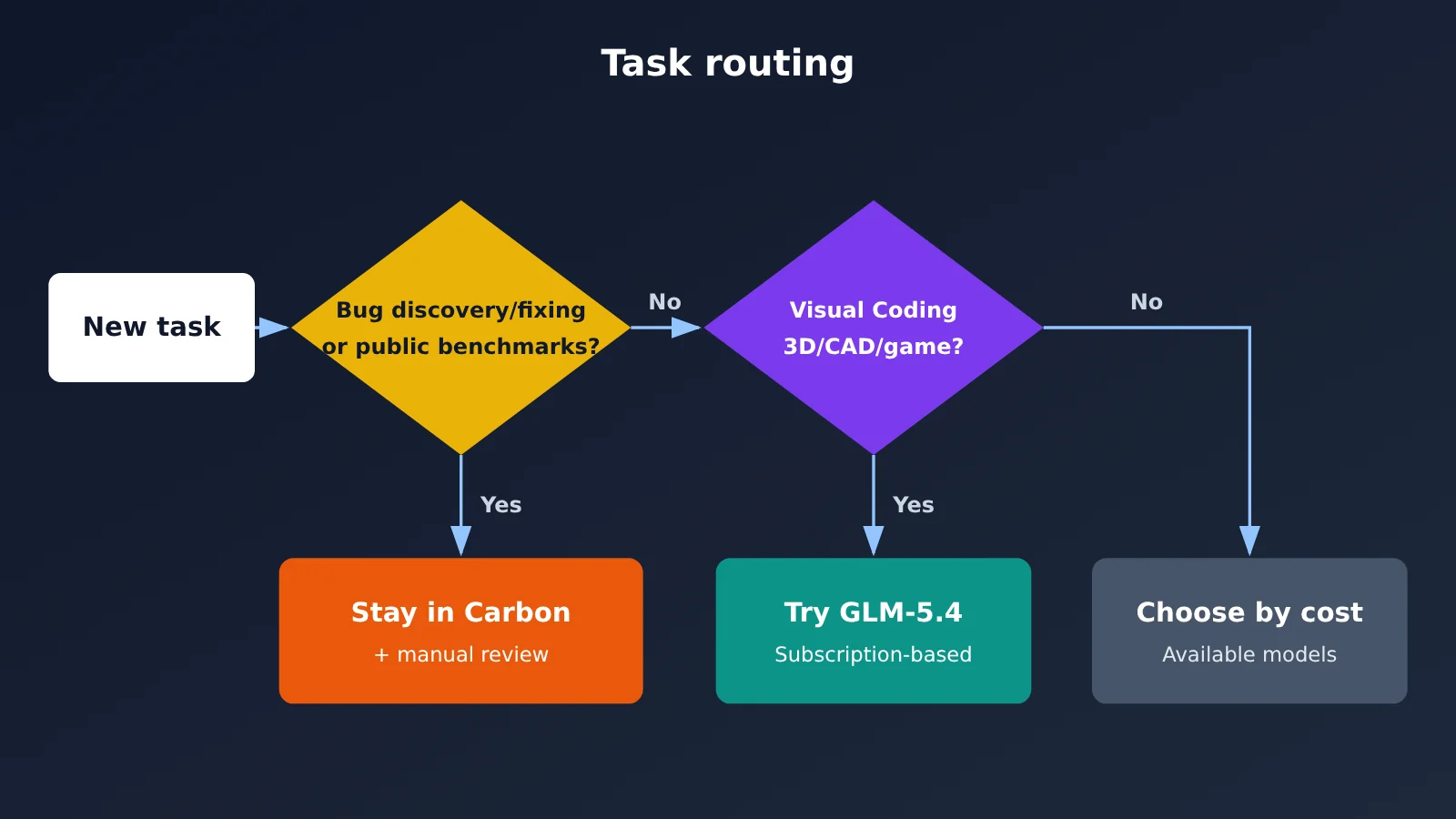
Scenario Recommendations: Which Tasks Stay on Gemini 4 Carbon, and Which You Can Try on GLM-5.4
Tasks That Should Stay on Gemini 4 Carbon
- Vulnerability discovery and fixing: All three official benchmarks — SEC-bench Pro, ExploitGym, and CWE-bench — map directly onto this kind of work, and GLM-5.4 has no public materials in this area.
- Deliverables that need a public, reproducible baseline: When you’re writing explanations for clients or compliance teams and need to cite a third-party index anyone can check, Carbon has results from the AA index and the independent Terminal-Bench 4.0 leaderboard that you can point to.
- Multimodal tasks with audio input: Carbon supports audio input, while audio isn’t among GLM-5.4’s officially supported input modalities.
- Production pipelines that must go through the API and pay per use: GLM-5.4’s API won’t open up until security evaluation is complete, and there’s no timeline yet.
Tasks Worth Trying on GLM-5.4
- Visual coding and visual replication: The Chinese-language official docs list visual coding, visual replication, and long-horizon tasks as strengths (that’s the vendor’s own claim, with no specific scores).
- 3D shaders, CAD modeling, game prototypes: These are exactly the areas the official demos cover, so they’re good candidates to try in ZCode or a supported coding tool.
- Complex long tasks where long runtimes are acceptable: A single KingBench 4 sample showed higher scores at the higher settings, but the runtime was very long — good for overnight batches or asynchronous runs.
- Teams that want to test the waters at subscription pricing: The Coding Plan starts at $12.6/month, a low barrier that makes small-scale validation easy.
One thing to keep in mind: GLM-5.4 trials are currently happening within the Z.ai ecosystem and third-party coding tools — third-party reports list tools like Trae, WorkBuddy, Qoder, CatPaw, and OpenCode. It’ll only be suitable for wiring into automated pipelines once it arrives in API channels.
How to Call Gemini 4 Carbon and the GLM Series: Quick Start
APIYI offers an OpenAI-compatible interface, so a single API key lets you call models from multiple providers. Here are the minimum steps for calling Carbon, plus how to leave a switching slot open for the GLM series.
- Create an API key in the APIYI console and save it as an environment variable, for example
APIYI_API_KEY. - When initializing the OpenAI SDK, set
base_urltohttps://api.apiyi.com/v1andapi_keyto the key from the previous step. - Call
chat.completions.createwithmodelset togemini-4-carbon, and put your audit target and code snippets inmessages. - To compare against the GLM series, just change
modeltoglm-5.3orglm-5.3-flash— everything else stays the same.
See the full recommended parameter settings
– `model`: use `gemini-4-carbon` for security audits; for visual comparisons, start with `glm-5.3`.
– `max_tokens`: Carbon’s maximum output is 65,536, but its responses tend to run long, so for audit-report tasks you’ll want to set a cap up front to keep the bill from spiraling.
– `stream`: for long tasks, set this to `true` so you can watch progress and cut things off partway.
– `response_format`: for vulnerability lists, ask for structured output so a human can review each item one by one afterward.
– System prompt: ask the model to provide the file path, line number, and reproduction steps for every vulnerability, which offsets the risk from its roughly 11% hallucination rate.
– Don’t hard-code model names in your code — put them in a config file. When GLM-5.4 ships, you only need to change the config.
🚀 Quick start: We recommend first running both the
gemini-4-carbonandglm-5.3paths on APIYI apiyi.com using the free credits for new users, then deciding how to allocate your December budget.
GLM-5.4 vs Gemini 4 Carbon: Decision Guidance
Let’s wrap up by turning the judgment criteria into concrete actions in a single table.
| Your situation | Suggested action | Rationale |
|---|---|---|
| Mostly doing vulnerability discovery, remediation, and audit reports | Stay on Carbon, and redo the budget in December at $4 / $20 | The three security benchmarks have the most complete official data |
| Need to cite public benchmarks externally | Stay on Carbon | GLM-5.4 has no AA score |
| Visual coding, 3D, and CAD make up a high share | Sign up for the Coding Plan and trial GLM-5.4 | Its official positioning and demos cover this directly |
| Need API access for production | First use the already-available glm-5.3 as a control, then wait for GLM-5.4 to open its API |
There’s still no timeline for the GLM-5.4 API |
| Sensitive to response latency | Only use GLM-5.4’s Low / Medium tiers | In isolated single runs, the High / Max tiers time out within 180 seconds |
💡 Recommendation: These two models aren’t meant to replace each other — the smarter approach is to route by task. Security tasks stay with Carbon, while visual and general coding tasks get a small-scale validation on GLM-5.4. Managing the available models through APIYI apiyi.com’s unified interface makes future switching and gradual rollouts a lot easier.
FAQ
Q1: What kind of model is GLM-5.4?
GLM-5.4 is Z.ai’s (Zhipu) flagship model, released on 2026-11-23, and its first model built on the Loop Transformer. On the GLM-5 base, it loops some layers through a second pass, aiming at “generalized coding”: beyond traditional programming, it also covers video, games, 3D shaders, and CAD modeling, with stronger visual coding on top.
Q2: Can you compare GLM-5.4 and Gemini 4 Carbon scores directly?
No. Carbon didn’t take part in KingBench 4, and GLM-5.4 has no Artificial Analysis score, so the two have zero same-task results. The only things you can compare are positioning, context, modality, and how you get access. Claims online that line up 33.2 and 59 side by side are mixing two different measurement setups.
Q3: When does Gemini 4 Carbon’s limited-time pricing end?
The promotional price of $2 / $10 (cached read $0.10) runs through 2026-11-30; from 2026-12-01 it reverts to the official $4 / $20. Carbon launched on 2026-10-28, opened to all paid developers on 2026-11-10, and APIYI put `gemini-4-carbon` online on 2026-11-11.
Q4: Are Carbon’s three security numbers trustworthy?
SEC-bench Pro 88.2%, ExploitGym 54.8%, and CWE-bench 71.0% all come from Google’s official release materials — self-reported, with no independent reproduction. They’re fine as a selection reference in audit scenarios, but you’ll also want to weigh the roughly 11% hallucination rate third parties have measured; every conclusion should get a human review.
Q5: How do I call these models through an API right now?
Carbon is ready to use: register with APIYI to get a key, set `base_url` to `https://api.apiyi.com/v1`, and put `gemini-4-carbon` in `model`. GLM-5.4 isn’t listed yet — we’ll get it up as soon as we can; model IDs and pricing are subject to the platform’s model list. Until then, you can build out the pipeline with `glm-5.3`, which is already live, and new users can claim free trial credits to run a quick check first.
Q6: What known limitations does GLM-5.4 have?
– It admits itself that it tends to fall into overly long marathon thinking; accuracy may go up, but it takes a lot of time.
– In a single KingBench 4 case, it took 431 minutes to finish the test; in a 180-second short-task probe, the High / Max tiers timed out.
– There’s no timeline for either API access or open-sourcing the weights.
– The official throughput figures are up to 200 tokens/s off-peak and 70-80 tokens/s during peak hours.
Q7: How is GLM-5.4’s Coding Plan priced?
GLM-5.4 has no public per-token price right now — you can only use it through the GLM Coding Plan, starting at $12.6/month, subject to Z.ai’s official subscription page. For weekly-quota users, the GLM-5.4 allowance is 1.5× that of GLM-5.3.
GLM-5.4 vs Gemini 4 Carbon: Key Takeaways
- No head-to-head on the same benchmark: Carbon didn’t take part in KingBench 4, and GLM-5.4 has no AA score.
- Carbon’s strength is safety: All three safety metrics plus the AA 59 score are vendor-reported, which makes it a good fit for audit-style tasks.
- Factor in Carbon’s costs: Roughly 11% hallucination rate, verbose output, and the per-unit price doubles starting in December.
- GLM-5.4 leads with general coding: Visual coding, 3D shaders, CAD, and game prototypes are the official focus areas.
- GLM-5.4 trades time for depth: Higher tiers score better, but they take noticeably longer.
- Different ways to get access: GLM-5.4 is subscription-only for now, with no public API yet; Carbon can be called pay-as-you-go directly on APIYI.
Summary
When choosing between GLM-5.4 and Gemini 4 Carbon:
- Split the work by task, not by leaderboard rank: There’s no same-task data for the two models, so any “which one is stronger” conclusion has nothing to stand on.
- Keep security audits on Carbon: Vulnerability discovery, remediation, and any deliverable that needs a public benchmark should stay with Carbon — with human review built in.
- Try GLM-5.4 for general coding: Visual coding, 3D, and CAD work can be validated at small scale through the Coding Plan, as long as you’re willing to accept the longer run times.
The most urgent item right now is recalculating Carbon’s budget at $4 / $20 before November 30, and carving out the visual tasks so you can run a side-by-side comparison. Our suggestion: keep both the Carbon and GLM chains live on APIYI (apiyi.com), so that once GLM-5.4 goes live you can switch over with a one-line config change.
📚 References
-
Z.ai Official Technical Blog: GLM-5.4 architecture and official demos
- Link:
z.ai/blog/glm-5.4 - Description: Loop Transformer design, the 30B control experiment, and officially acknowledged limitations
- Link:
-
Z.ai Official Documentation: GLM-5.4 specifications and parameters
- Link:
docs.z.ai/guides/llm/glm-5.4 - Description: Input modalities, 1M context window, 128K max output, and other specs
- Link:
-
Zhipu Chinese Documentation: GLM-5.4 model introduction
- Link:
docs.bigmodel.cn/cn/guide/models/glm-5.4 - Description: Qualitative conclusions from an internal 200-scenario evaluation
- Link:
-
Artificial Analysis: Third-party intelligence index and hallucination rate
- Link:
artificialanalysis.ai - Description: AA Index v5.0.1 and AA-Omniscience data
- Link:
Author: APIYI Technical Team
Technical discussion: Feel free to reach us through the APIYI website homepage — the model list and pricing are available in the docs.apiyi.com documentation center.